


Does a Wyoming Asset Protection Trust Actually Protect a Virginia Family?
By Adam L. Engel, Esq. | Estate Planning and Probate | Shin Law Office, PLC | Serving Northern Virginia
BOTTOM LINE UP FRONT
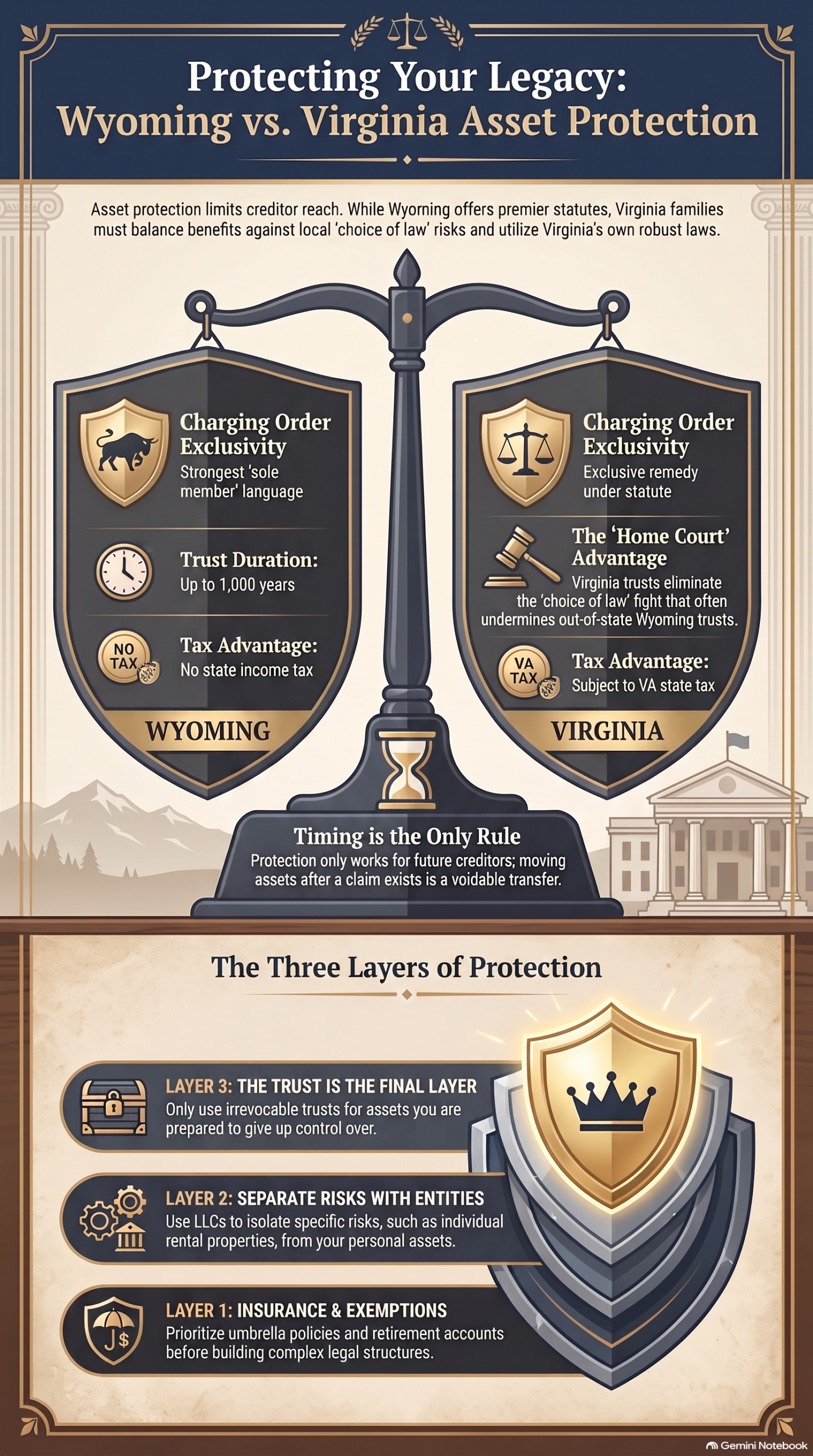
Wyoming has the strongest LLC charging order statute in the country and a trust law built to run for a thousand years without a state income tax. Those advantages are real. What Wyoming cannot do is decide which court hears a claim against you, and for a Virginia family that is usually the question that decides everything.
Two facts change most conversations. Virginia has had its own self settled asset protection trust since 2012, with a five year window, which removes the choice of law fight entirely. And Virginia's LLC charging order is already an exclusive remedy under its own statute. Before you reach for another state, it is worth knowing what your own gives you.
One rule governs all of it. This works forward only. Once a claim, demand, or judgment exists, moving assets is a voidable transfer question, and Wyoming itself makes you swear in writing at every funding that no litigation threatens your solvency.
Talk it through. Call 571-445-6565 or Schedule a Consultation.
What This Guide Covers
- The Question Behind the Question
- What Asset Protection Actually Means
- The One Rule That Governs Everything
- The Layers, In Order
- What Wyoming Truly Offers
- What Wyoming Cannot Do
- Virginia Has Its Own Statute, and Most People Do Not Know It
- The Charging Order, Explained Without Jargon
- Five Situations I Hear About Most
- Inside a Wyoming Qualified Spendthrift Trust
- Funding Is the Whole Game
- Control, and the Price of Keeping It
- Real Estate Follows the Land
- Bankruptcy, the Hardest Test
- What It Costs, and When I Tell People Not to Bother
The Question Behind the Question
People rarely call me and say they want an irrevocable trust. What they say is some version of the same sentence: I have worked for thirty years and I cannot lose it now.
Behind that is usually one specific fear. A surgeon who just read her policy limits and did the arithmetic. A contractor whose name is on four personal guarantees. A couple who bought their first rental in 2009 and now own six and lie awake thinking about the stairs on the one in Sterling. A founder eight months from a closing who has never in his life had a number that large in one place.
Somewhere in that reading they find Wyoming. The pages are confident and the claims are large, and by the time we speak they have often already decided. So let me tell you where I actually land, before you read another five thousand words.
Wyoming is real. The statutes are among the best drafted in the country and I use them. Wyoming is also not a vault, and it cannot do the one thing people most want it to do, which is decide which court hears a claim against you. And for a great many Virginia families, the law that helps most is sitting in the Code of Virginia, unread.
This guide is long because the details are where the money is. Use the table of contents to jump. If you want the shorter version of how we approach this work, it is on our Wyoming asset protection page, along with a five question diagnostic that will tell you within a minute whether a structure is even the right conversation.
What Asset Protection Actually Means
Asset protection is not hiding money. It is not a secret account and it is not a loophole. Stripped of the marketing, it is the deliberate arrangement of what you own so that a future creditor has fewer things to reach and a harder time reaching them.
That word future is doing an enormous amount of work, and I will come back to it in the next chapter.
It helps to see the whole field at once. Every plan I build is made of the same four materials, and they are not interchangeable:
- Insurance. The first and cheapest layer. It pays the claim and, just as valuable, it pays for the defense.
- Exemptions. What state and federal law already puts out of reach regardless of what you do. Retirement accounts are the big one, and most people underestimate how much is already protected.
- Entities. LLCs and similar structures that separate one risk from another and limit what a personal creditor can take.
- Trusts. The last layer, and the one that requires you to give something up in exchange for what it gives you.
Almost every bad plan I review skipped straight to the fourth. Somebody sold a trust to a person whose real problem was a policy limit that had not been raised since 2014.
The One Rule That Governs Everything
If you take a single thing from this guide, take this. Asset protection works in one direction only, and that direction is forward.
Move assets before anything is wrong and you are planning. Move the same assets after a claim exists and you are making a transfer a court can undo, and possibly doing something worse than that. Virginia's Uniform Voidable Transactions Act, at Chapter 4 of Title 55.1, reaches transfers made with intent to hinder, delay, or defraud a creditor. It also reaches transfers made without adequate consideration when they leave you unable to pay what you owe, which does not require any bad intent at all.
Here is what makes this concrete rather than theoretical. Wyoming's own statute builds the rule into the paperwork. Every transfer into a qualified spendthrift trust has to be accompanied by a sworn affidavit under Wyoming Statute 4-10-523, and that affidavit says, among other things, that the transfer will not render you insolvent, that it is not intended to defraud a creditor, and that you have no pending litigation that threatens your solvency.
Read that again. The state that wrote the country's friendliest trust statute made you swear, in writing, at each funding, that you are not doing the thing everyone assumes these trusts are for.
The conversation I have most often
Someone calls the week after a demand letter arrives and asks how fast we can set up a trust. The answer is that we should not, and that anyone who says yes is selling you a second problem on top of the one you already have. Defend the claim. Check what is already exempt, which is usually more than people expect. Tender it to your carrier. Then plan for afterward.
The Layers, In Order
I put the four materials in a sequence, and I do not skip steps, because each one is cheaper and more reliable than the one above it.
Layer one: raise the limits
Before any structure, we look at coverage. Professional liability, general liability, an umbrella policy, and whether the limits still make sense for the balance sheet you have now rather than the one you had when the policy was written. An umbrella policy is the least glamorous thing in this guide and the highest return per dollar in it.
Layer two: count what is already safe
Qualified retirement plans, certain life insurance and annuity values, and various statutory exemptions are already beyond the reach of most creditors without any planning at all. I have had clients discover that two thirds of their net worth was never exposed in the first place, which changes the whole conversation about what a structure needs to do.
Layer three: separate the risks
Entities keep one problem from becoming every problem. The rental where someone falls should not put the other five at risk. The operating business should not be owned in the same name that signs the personal guarantees. This is where Wyoming often earns its place, and I will get to why.
Layer four: the trust
Only after the first three does a self settled trust make sense, and only for assets you can truly part with. This layer asks the most of you and returns the most, and it is the one people want to start with.
What Wyoming Truly Offers
Now the part you came for. Wyoming's advantages are real, and I want to state them precisely enough that you could check them yourself.
The charging order statute
Wyoming Statute 17-29-503(g) says the charging order is the exclusive remedy by which a judgment creditor may satisfy a judgment from a member's transferable interest or from the assets of the company, and it says this applies including where the judgment debtor is the sole member. It then says other remedies, including foreclosure on the interest, are not available and may not be ordered by the court.
That sole member language matters. Several states leave a gap there, and courts elsewhere have used it. Wyoming closed it in the text.
The qualified spendthrift trust
Wyoming Statutes 4-10-510 through 4-10-523 authorize a self settled spendthrift trust, enacted in 2007. You can create an irrevocable trust, remain a discretionary beneficiary, and shield the assets from most future creditors, which the common law flatly did not allow.
A thousand years
Under Wyoming Statute 34-1-139, a trust created after July 1, 2003 that holds property other than real property can run for up to one thousand years. If your goal is multigenerational rather than defensive, that duration is a real structural advantage.
No state income tax
Wyoming imposes no state income tax. For a trust designed to accumulate income over decades rather than distribute it, this is frequently the strongest argument for Wyoming, and it has nothing to do with creditors at all.
What Wyoming Cannot Do
Here is the part the sales pages skip, and it is the part that decides most cases.
It does not choose your courtroom
A trust document can say Wyoming law governs. That does not bind the court where somebody sues you. If you live in Loudoun County, work in Fairfax, and own property in Virginia, the fight happens here, and a Virginia judge decides whether to apply Wyoming law to a Virginia resident with Virginia assets.
Courts have declined. The case planners cite most is a bankruptcy decision involving a Washington resident whose Alaska trust was unwound under Washington law, because the settlor, the beneficiaries, and nearly all the assets were in Washington and the only meaningful connection to Alaska was the trust's administrative address. The reasoning transfers directly to a Wyoming trust created by a Virginia family.
It does not survive federal bankruptcy intact
Under 11 U.S.C. section 548(e), a bankruptcy trustee can avoid a transfer to a self settled trust made within ten years before the filing where the debtor made it with actual intent to hinder, delay, or defraud. Ten years is longer than any state waiting period, Wyoming's included. Chapter 14 goes into this properly.
It does not protect you from yourself
No structure shields you from liability for your own conduct. If you commit the malpractice, cause the accident, or sign the guarantee, you are personally liable. Entities and trusts change what a creditor can collect from, not whether you owe.
Why I still use Wyoming
None of this makes Wyoming useless. It makes Wyoming one layer rather than the plan. A Wyoming holding company for business interests, a Wyoming trust built for a hundred year horizon with no state tax drag, both are sound. The failure mode is treating a jurisdiction as a substitute for structure, funding, and time.
Virginia Has Its Own Statute, and Most People Do Not Know It
This chapter surprises more clients than any other in the guide.
Since July 2012, Virginia has had its own domestic asset protection trust. Sections 64.2-745.1 and 64.2-745.2 of the Code of Virginia authorize what the statute calls a qualified self settled spendthrift trust. A Virginia settlor can transfer assets, retain a qualified interest, and put those assets beyond most creditors, in Virginia, under Virginia law, in front of a Virginia court.
The statute is more conservative than Wyoming's, and I consider that a feature rather than a defect. The main terms:
- A creditor whose claim existed on the date of a transfer has five years from that transfer to bring an action, under subsection D.
- Each later transfer starts its own five year clock, and a distribution is treated as coming from the most recent transfer.
- The trust must be irrevocable and must have a qualified independent trustee, who cannot be the settlor or certain close relatives.
- A transfer is not treated as made with intent to defraud merely because you kept a qualified interest or made it without consideration, but it can still be set aside on other grounds, such as leaving you insolvent.
- Moving an existing trust's administration into Virginia so that it qualifies for the first time is treated as a fresh transfer on that date, which restarts the clock.
Think about what that means for a Virginia family. The single largest vulnerability of an out of state trust is the argument that a Virginia court should apply Virginia law. If the trust is already a Virginia trust, that argument disappears. The choice of law fight you were worried about does not happen.
One thing to check before relying on this
Section 64.2-745.1 was amended in 2026. Anything you read about the Virginia statute that predates July 2026, including a good deal of what is online, may describe the prior version. We work from the current text, and we would rather show you the section than summarize it.
The Charging Order, Explained Without Jargon
Half the Wyoming pitch rests on a phrase most people have never had explained, so let me do that.
Suppose a creditor gets a judgment against you personally, and you own a membership interest in an LLC. The creditor wants the LLC's assets. A charging order stops that. It is a court order telling the company that if it ever makes a distribution to you, that money goes to the creditor instead. The creditor gets your distributions. It does not get your interest, your vote, or the company's property.
The question that separates the states is whether the charging order is the only thing a creditor can get. Where it is merely one available remedy, a judge may allow foreclosure on the interest, or appoint a receiver, and the protection unravels.
Wyoming
Section 17-29-503(g) makes it exclusive, says so expressly for a sole member, and bars foreclosure and court ordered accounts and inquiries outright.
Virginia
And here is the part almost nobody mentions. Virginia Code section 13.1-1041.1(D) also makes the entry of a charging order the exclusive remedy by which a judgment creditor may satisfy a judgment out of the debtor's transferable interest. Subsection E adds that no creditor has any right to obtain possession of, or exercise remedies against, the property of the LLC.
So Virginia is not the weak sibling here. The Wyoming text is more explicit about the single member situation, and that difference can matter. But if someone tells you a Virginia LLC gives no charging order protection, they have not read the statute.
There is a side by side comparison of the two states on our Wyoming asset protection page covering trustee requirements, funding formalities, duration, and tax.
Five Situations I Hear About Most
Let me make this concrete. These five are composites built from the kinds of calls I take, not actual clients, and no two situations are the same. Read them for the shape rather than the facts.
The surgeon who did the arithmetic
She is forty four, in a practice with four partners, and she just looked at her coverage limits next to her net worth for the first time. Nothing has happened. No claim, no complaint, no bad outcome she is worried about. She simply noticed that the gap between what a bad day could cost and what her policy would pay is larger than she assumed.
What the law does here. This is the ideal fact pattern, and I mean that plainly. Nothing pending, a real and identifiable exposure, and time. Both the Virginia and Wyoming statutes reward exactly this posture, because the sworn affidavit Wyoming requires and the five year window Virginia sets are both easy to satisfy when there is nothing on the horizon.
Where I would start
Coverage first. We look at whether the policy limits and an umbrella can close most of the gap for a fraction of what a trust costs to build and run. Then we look at what portion of her assets she can truly part with, because whatever goes into the trust is no longer hers to direct.
The couple with six rentals
They bought the first one in 2009 and kept going. All six sit in Loudoun and Prince William. Four are in one LLC, two are in their own names because the refinance was easier that way, and the operating agreement was a template from 2011 that nobody has opened since.
What the law does here. Their real exposure is not creditor law, it is concentration. One incident at one property reaches everything in that LLC and, for the two held personally, everything they own. A charging order is the wrong thing to be thinking about. Separation is the right thing. And because real property is governed where it sits, a Wyoming entity in the chain does not move a Loudoun rental out of a Loudoun court.
Where I would start
Separate the properties so one stairwell is not everyone's problem. Read the deeds and the loan documents before restructuring, because due on sale clauses and guarantees complicate transfers. Then make the operating agreements match how these properties actually run.
The founder eight months from closing
He has signed a letter of intent. If the deal holds, he will go from a balance sheet that is mostly an illiquid company to one that is mostly cash, and he has never had a number like that. He also knows that transaction disputes have a way of surfacing after a closing rather than before.
What the law does here. The window is now and it is narrow. Before a closing, planning is planning. After the wire hits and after any dispute emerges, the same steps look very different to a court. This is also the situation where Wyoming's no state income tax argument is strongest, because a trust designed to hold and accumulate proceeds for decades feels that difference every year.
Where I would start
Sequence it against the deal calendar, and coordinate with his tax counsel before anything moves, because the estate and income tax consequences of funding a trust before versus after a sale are not small and they are not the same.
The man who bought a package online
He formed a Wyoming LLC through a filing service and set up a trust from a template. He has a binder. He also still holds the brokerage account in his own name, never retitled the rental, and has never signed a transfer affidavit for anything. He wants to know if he is protected.
What the law does here. He owns documents, not a structure. A trust that was signed but never funded protects nothing at all, and under Wyoming's statute a transfer made without its affidavit can lose protection for that transfer even where the rest of the trust is fine. A later affidavit does not repair an earlier transfer.
Where I would start
An audit. What was signed, what was actually retitled, whether the trustee satisfies the governing statute, and whether the entity has ever been treated as separate from him. Then we fix what can be fixed and tell him plainly where it will not hold.
The letter that already arrived
A demand came from a lawyer two weeks ago. He has not answered it. He found a page promising that a Wyoming trust could put his savings out of reach and he wants to move quickly.
What the law does here. This is the one situation where the answer is no. Moving assets now is a voidable transfer question under Chapter 4 of Title 55.1 before it is a planning question, and if bankruptcy ever enters the picture the trustee's reach at a self settled trust runs ten years. Wyoming's affidavit would require him to swear no litigation threatens his solvency, which would not be true.
Where I would start
Defend the claim. Inventory what is already exempt, which in most cases is more than people expect. Tender to any carrier that might cover it. Then plan for the world after this resolves, because there will be one.
Inside a Wyoming Qualified Spendthrift Trust
If we do decide Wyoming is right, here is what you are actually signing up for.
Under Wyoming Statute 4-10-510(a), the trust instrument has to state that it is a qualified spendthrift trust under that section, expressly adopt Wyoming law to govern validity, construction, and administration, and provide that your interest in income or principal is held subject to a spendthrift provision. The trust must be irrevocable.
Beyond the document:
- A qualified trustee. At least one trustee must be a Wyoming resident other than you, or a trust company authorized to act in Wyoming. Some part of the administration has to happen there. This is not a formality you can paper over with a mail drop.
- Trustee discretion. The trustee must have discretion over distributions. You cannot demand a payout. That is the mechanism, not a technicality.
- An affidavit for every transfer. Wyoming Statute 4-10-523 requires a sworn qualified transfer affidavit each funding round, covering ownership, solvency, absence of fraudulent intent, absence of threatening litigation, and support obligations.
- Liability insurance. The same section requires the settlor to have and maintain personal liability insurance of at least one million dollars, or coverage equal to the fair market value of total qualified transfers, whichever is less. This requirement is unusual among asset protection states and it is ongoing, not one time.
Wyoming does allow directed structures, where you serve as investment adviser with authority over how trust assets are invested while a separate trustee or distribution director handles distributions. That preserves investment input without making you the trustee, and it is often how we thread the control question.
Funding Is the Whole Game
I want to be blunt about the most common failure I see, because it is not exotic and it is not a drafting problem.
People sign a trust and never fund it.
The account stays in their name. The deed never gets recorded. The membership interest is listed on a schedule at the back of the binder but was never actually assigned. Five years later a creditor appears and the trust protects nothing, because it never owned anything.
Funding a Wyoming trust is not one event. It is a series of them, each with its own paperwork:
- Retitle the asset, in the records that actually control ownership. A schedule attached to a trust is not a deed and it is not a transfer agreement.
- Sign the affidavit for that transfer, at that time. It cannot be backdated and a later one does not cure an earlier gap.
- Update the records that follow the asset. Beneficiary designations, insurance, lender notices, registered agent filings.
- Keep the trust administered. Separate accounts, real trustee decisions, actual records. A trust you run out of your personal checking account is a trust a court will look through.
The test I apply
If a creditor's lawyer took a deposition tomorrow and asked who owns this and when did it change hands, could you answer with documents rather than intentions? If the answer is no, the structure is decorative.
Control, and the Price of Keeping It
Every conversation reaches this point, and it is the one that ends about a third of them.
These trusts work because you gave something up. The trust is irrevocable. The trustee has discretion. You are one beneficiary among others, and you cannot demand a distribution. If you retain the practical ability to do whatever you want with the assets, you have handed a court the argument that nothing really changed, and that is the argument that most often succeeds.
So the honest question is not how much protection do you want. Everyone wants all of it. The question is how much control you can actually live without.
There are legitimate ways to keep meaningful input. A directed trust that leaves you as investment adviser. A trust protector with power to remove and replace the trustee or adjust administrative terms. Careful beneficiary design so a spouse can receive distributions that benefit the household. These are real tools and we use them.
What none of them do is let you keep the checkbook. If somebody tells you otherwise, ask them to put it in writing.
Real Estate Follows the Land
This one costs people money, so I want it stated plainly. Real property is governed by the law of the state where it sits. A Virginia rental is a Virginia asset no matter what jurisdiction appears on the entity that holds it.
So what does a Wyoming entity do for a Virginia rental? Less than the marketing suggests, and more than nothing.
- A creditor pursuing you personally is still limited to a charging order against your interest, though Virginia's own statute already provides that under 13.1-1041.1.
- Separation between properties is real and valuable, and it works regardless of which state chartered the entity.
- A foreign entity doing business in Virginia has registration and registered agent obligations here, which is cost and paperwork rather than protection.
- The lawsuit about the property is heard where the property sits, before a judge applying Virginia law to the land.
Before you restructure any property, read the loan documents. Transfers into entities can trip a due on sale clause, and a personal guarantee follows you into the new structure. I have seen a well intentioned reorganization create a default where there was not one.
Bankruptcy, the Hardest Test
Every domestic structure has one scenario it struggles with, and this is it.
Section 548(e) of the Bankruptcy Code lets a trustee avoid a transfer made within ten years before a filing where the transfer went to a self settled trust or similar device, the debtor made it, the debtor is a beneficiary, and the debtor acted with actual intent to hinder, delay, or defraud a creditor.
Three things follow. The ten year federal window is longer than any state waiting period, so waiting out a state clock does not put you outside it. The trustee must prove actual intent, which is a real burden and not automatic, so a well timed transfer made for legitimate planning reasons is not doomed. And a bankruptcy court sitting in your home state is precisely the forum most likely to look past the choice of law clause in the document.
A bankruptcy court in Alaska made the point clearly in a decision involving an Alaska resident with an Alaska trust: complying with the state statute would not save the transfer if the trustee could establish the elements of section 548(e). The settlor lived in the right state, used the right statute, and the trust still failed.
What this actually argues for
Not despair. Sequence. A transfer made years before any trouble, for reasons you can document, funded when you were plainly solvent, is a very different exhibit than one made as things were falling apart. The ten year rule is an argument for starting early, not an argument against structures.
What It Costs, and When I Tell People Not to Bother
I will not quote you a number in an article, because the honest answer depends on what you own and how complicated the funding is. What I can do is tell you where the money goes and when I advise against the whole exercise.
Where the cost lives
There is design and drafting at the front. There is funding, which is often the larger line because retitling assets takes real work. Then there is the part people forget, which is ongoing: a corporate trustee charges annually, entities have annual filings and registered agents, and someone has to prepare returns for the trust. A structure that is cheap to create and expensive to ignore is the worst of both.
When I say no
- Something is already pending. Covered at length above, and the answer does not change.
- The exposure does not justify the expense. If a higher umbrella policy closes most of the gap, buy the policy.
- You cannot part with the assets. An irrevocable trust you effectively still control is the structure most likely to be disregarded, which means you paid for the cost and kept the risk.
- Nobody will maintain it. If there is no one to keep the records and file the papers in year three, the plan is already failing on the day it is signed.
- The real problem is somewhere else. Sometimes it is an entity that was never respected, or a guarantee that could be renegotiated, or a business partner arrangement with no buy sell agreement. Those are cheaper fixes with better returns.
I would rather tell you that at the first meeting than build something that does not fit. There is a short version of this analysis in the five question diagnostic on our practice page, which will get you to roughly the same answer in about a minute.
The Short Version
If you remember seven things from this guide, make them these.
- Timing decides everything. Before a problem it is planning. After, it is a transfer a court can undo.
- Insurance first, then exemptions, then entities, then trusts. Most people want to start at four.
- Wyoming's charging order statute is the best drafted in the country, and it names the sole member expressly.
- Wyoming cannot pick your courtroom, and a Virginia court decides whether Wyoming law applies to a Virginia family.
- Virginia has had its own self settled spendthrift trust since 2012, and its LLC charging order is already exclusive.
- A trust that was signed but never funded protects nothing. Funding and administration are where these plans live or die.
- Real protection costs control. If you keep the checkbook, you kept the risk too.
The condensed version, with a five question diagnostic, is on our Wyoming asset protection practice page.
Questions I Get Asked Most
Do I have to live in Wyoming to use a Wyoming trust or LLC?
No. Wyoming does not require the settlor or the members to be residents. A qualified spendthrift trust does require at least one qualified trustee who is a Wyoming resident or a trust company authorized there, and some administration has to happen in the state. The harder question is not whether you may use Wyoming law. It is whether the court hearing a claim against you will apply it.
Is a Wyoming LLC actually better than a Virginia LLC?
On the text, Wyoming has an edge worth naming. Section 17-29-503(g) makes the charging order the exclusive remedy, says so expressly where the judgment debtor is the sole member, and bars foreclosure. Virginia's section 13.1-1041.1(D) also makes it the exclusive remedy and bars creditors from reaching company property. For many Virginia owners the practical gap is narrower than the marketing suggests, and holding Virginia real estate in a Wyoming entity does not move that property out of Virginia.
Virginia has its own asset protection trust. Why would I use Wyoming?
Sometimes you would not. The usual reasons to look at Wyoming are state income tax on accumulating trust income, trust duration for multigenerational planning, and administrative cost. Creditor protection alone is rarely the deciding factor for a Virginia resident with Virginia assets, because the choice of law exposure runs the other way.
Can I set this up now that I have been sued?
No, and we will not help you try. Once a claim, demand, or judgment exists, moving assets raises a voidable transfer question under Chapter 4 of Title 55.1, and in bankruptcy a trustee has a ten year reach at self settled trusts under 11 U.S.C. section 548(e). Wyoming's statute requires a sworn affidavit with each transfer stating that no pending litigation threatens your solvency.
Will a Wyoming trust protect me in bankruptcy?
Not reliably. Section 548(e) lets a trustee avoid a transfer to a self settled trust made within ten years of the filing where the debtor acted with actual intent to hinder, delay, or defraud. That federal window is longer than any state period, and a bankruptcy court in your home state is the forum most likely to look past a choice of law clause.
How much control can I keep?
Less than most people want, and that is the mechanism rather than a drawback. The trust must be irrevocable and the trustee must hold discretion over distributions. Wyoming allows directed structures where you act as investment adviser while a separate trustee handles distributions, and a trust protector can hold power to remove and replace a trustee. What you cannot keep is the ability to take the money whenever you like.
What happens if I skip the transfer affidavit?
Under Wyoming Statute 4-10-523 each transfer needs its own sworn affidavit. A transfer made without one can lose protection for that transfer even where the rest of the trust is intact, and a later affidavit does not repair an earlier gap or restart the challenge period for it.
Does any of this protect against divorce, child support, or taxes?
Generally no. Asset protection statutes typically carve out support obligations and certain government claims, and the details vary by state. If a domestic relations issue is anywhere in the picture, say so at the first meeting, because it changes the analysis substantially.
Are you licensed in Wyoming?
Our attorneys are licensed in Virginia. We design the plan, draft what Virginia law governs, and coordinate with a qualified Wyoming trustee and Wyoming counsel where a Wyoming structure is the right answer. We will tell you which pieces we handle and which require Wyoming professionals.
I already have a trust from an online service. Is it worth reviewing?
Almost always. Most of what we review fails on funding and administration rather than drafting. Assets never retitled, affidavits missing, a trustee who does not satisfy the statute, or a trust whose only connection to its chosen state is an address. Some of that is repairable and some is not, and you should know which before you rely on it.
Build It Before You Need It
The best version of this conversation happens on an ordinary week when nothing is wrong. Bring me what you own, how it is titled, and what you have personally guaranteed, and I will tell you whether Wyoming belongs in your plan, whether Virginia already covers it, and what it takes to make either one hold.
Call 571-445-6565 or Schedule a Consultation. You can also read more about our Wyoming asset protection practice. We serve families and business owners across Northern Virginia from our Leesburg and Fairfax offices.
This article is general information about Virginia and Wyoming law, current as of publication. It is not legal advice about your situation and reading it does not create an attorney client relationship. Asset protection results depend on facts, timing, and the court that hears any claim, and no structure can promise an outcome. Both states have amended these statutes recently, so confirm anything you plan to rely on.
References
- Wyoming Statutes. Creation of qualified spendthrift trust, Wyo. Stat. § 4-10-510. https://codes.findlaw.com/wy/title-4-trusts/wy-st-sect-4-10-510/
- Wyoming Statutes. Qualified transfer affidavit, Wyo. Stat. § 4-10-523. https://law.justia.com/codes/wyoming/title-4/chapter-10/article-5/section-4-10-523/
- Wyoming Statutes. Charging order, Wyo. Stat. § 17-29-503. https://law.justia.com/codes/wyoming/title-17/chapter-29/article-5/section-17-29-503/
- Wyoming Statutes. Perpetuities; time limits for vesting, Wyo. Stat. § 34-1-139. https://law.justia.com/codes/wyoming/title-34/chapter-1/article-1/section-34-1-139/
- Code of Virginia. Self settled spendthrift trusts, Va. Code § 64.2-745.1. https://law.lis.virginia.gov/vacode/title64.2/chapter7/section64.2-745.1/
- Code of Virginia. Definitions; right to withdraw, Va. Code § 64.2-745.2. https://law.lis.virginia.gov/vacode/title64.2/chapter7/section64.2-745.2/
- Code of Virginia. Member's transferable interest subject to charging order, Va. Code § 13.1-1041.1. https://law.lis.virginia.gov/vacode/title13.1/chapter12/section13.1-1041.1/
- Code of Virginia. Voidable transactions, Va. Code § 55.1-400 et seq. https://law.lis.virginia.gov/vacode/55.1-400/
- United States Code. Fraudulent transfers and obligations, 11 U.S.C. § 548(e).
- United States Code. Bankruptcy estate provisions, 11 U.S.C. § 541.
