


When Business Partners Fall Out in Washington, D.C., Who Controls the Company, Who Gets Bought Out, and Who Pays the Price?
Buyouts, Fiduciary Duties, Deadlock, Misuse of Company Funds, and Judicial Dissolution
By Basil M. Al-Qaneh, Esq. | Shin Law Office, PLC | Updated September 20, 2026
BOTTOM LINE UP FRONT
The document you signed when you started the business decides most of what happens next. District law fills the gaps, and the gap-fillers are frequently not what owners expect.
The one that surprises people most: in a DC limited liability company, walking away does not get you paid. A member who dissociates loses all management and voting rights and keeps only a transferable interest held as a transferee. There is no statutory buyout. A general partner in the same situation must be bought out by statute, and a corporation facing a dissolution petition can elect to purchase the petitioner's shares at court-determined fair value. Three entity types, three completely different exits.
If you are frozen out, cut off from the books, watching money leave, or trying to end a partnership that no longer works, call 571-445-6565 or Schedule a Consultation. Bring the operating agreement, the bylaws, or the partnership agreement. Do not resign first.
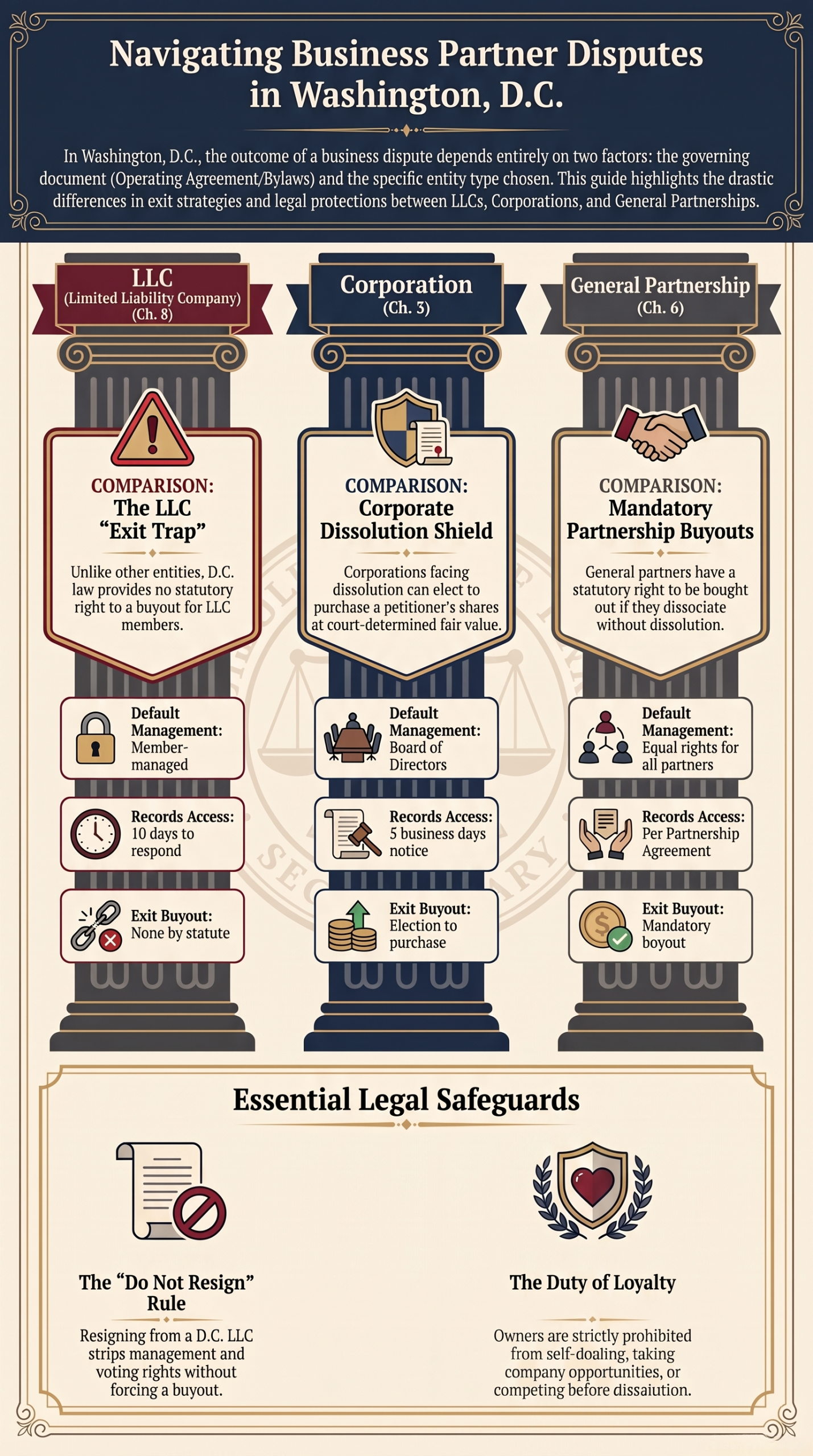
Table of Contents
- 1. The Call That Starts These Cases
- 2. Which Entity You Chose Decides Most of This
- 3. What the Operating or Shareholder Agreement Controls
- 4. Management and Voting Rights
- 5. Getting Access to the Financial Records
- 6. Unequal Distributions and Compensation
- 7. Fiduciary Duties: Loyalty, Care, and Good Faith
- 8. Diverting Customers and Taking Company Opportunities
- 9. Competing With the Business
- 10. Misuse of Company Funds
- 11. Deadlocked Ownership
- 12. Majority-Owner Oppression
- 13. Direct Claims Versus Derivative Claims
- 14. Emergency Injunctions
- 15. Withdrawal and Expulsion: The Exit Trap
- 16. Business Valuation and Negotiated Buyouts
- 17. Judicial Dissolution
- 18. Protecting Operations While the Dispute Runs
- 19. How We Handle District Ownership Disputes
- Summary
- Frequently Asked Questions
- References
1. The Call That Starts These Cases
Two people start a company. One brings the clients, the other runs operations. For six years nobody reads the operating agreement because nobody needs to. Then one of them buys a house, or gets divorced, or wants to sell, or simply decides the split stopped being fair three years ago.
The call usually comes after something concrete happened. The login stopped working. The quarterly distribution did not arrive. A vendor mentioned a new company with a familiar name. The bookkeeper was told not to share the reports anymore.
Almost every one of these conversations includes a version of the same sentence: we never really finished the paperwork, or we used a template, or we had an understanding.
That is the fight. Not the personal grievance, which is usually real, but what the governing document says and what District law supplies where the document is silent. This guide walks through both, for limited liability companies, corporations, and general partnerships, because the District treats the three very differently and owners routinely assume rules from one apply to another.
Before you do anything else
Do not resign, withdraw, or send a letter announcing you are out. In a DC LLC that single act can strip your management and voting rights while giving you no right to be paid. It is the most common self-inflicted wound in these cases, and it is usually done in the first week, in anger, without advice.
Copy what you can still access, today. Financial statements, bank records, the general ledger, your own email, the signed governing documents. Access tends to disappear shortly after the other side realizes there is a dispute.
2. Which Entity You Chose Decides Most of This
Before any analysis of who did what, establish what kind of company this is. In the District the governing statutes sit in Title 29 and they diverge sharply.
| LLC | Corporation | General partnership | |
|---|---|---|---|
| Core statute | D.C. Code Title 29, Chapter 8 | D.C. Code Title 29, Chapter 3 | D.C. Code Title 29, Chapter 6 |
| Governing document | Operating agreement | Bylaws and shareholder agreement | Partnership agreement |
| Default management | Member-managed, § 29-804.07(a) | Board of directors elected by shareholders | Equal rights in management, § 29-604.01 |
| Default ordinary decisions | Majority of members, § 29-804.07(b)(3) | Board majority | Majority of partners, § 29-604.01 |
| Records access | § 29-804.10, 10 days to respond | § 29-313.02, 5 business days notice | Partnership agreement and Chapter 6 |
| Exit buyout | None by statute, § 29-806.03 | Election to purchase in lieu of dissolution, § 29-312.24 | Mandatory buyout, § 29-607.01 |
| Judicial dissolution | § 29-807.01(a)(4) and (a)(5) | § 29-312.20 | § 29-608.01 |
Read the exit row again, because it drives strategy in almost every case.
- General partnership. When a partner is dissociated without the partnership dissolving, D.C. Code § 29-607.01 requires the partnership to cause the dissociated partner's interest to be purchased. The price is based on the greater of liquidation value or going concern value, interest runs from the date of dissociation, and the partner can go to court to have the price determined.
- Corporation. A shareholder who petitions for judicial dissolution can be bought out instead. Under § 29-312.24 the corporation, or failing that one or more shareholders, may elect within 90 days of the petition to purchase all shares owned by the petitioner. The election is generally irrevocable, and if the parties cannot agree on price the Superior Court determines fair value.
- LLC. Nothing comparable. Under § 29-806.03 a dissociated member's right to participate in management and conduct of the company terminates, and the interest becomes a transferable interest held as a transferee. No statute requires the company to buy it.
That asymmetry means an LLC member who is unhappy has fewer automatic exits and has to create one, through the operating agreement, through negotiation, or through the pressure a dissolution or oppression claim generates. It also means the operating agreement is the most important document in the room, which is the subject of the next chapter.
3. What the Operating or Shareholder Agreement Controls
The District, like most states, lets owners write their own rules. The statutes are largely default provisions that apply when the agreement says nothing. So the first question in every one of these cases is what the agreement actually says, and the second is whether the parties ever followed it.
The provisions that decide most disputes
- Management structure. Member-managed or manager-managed, who the managers are, and how they are removed.
- Voting thresholds. What takes a majority, what takes a supermajority, and what takes unanimity. Pay attention to whether voting is per capita or by percentage interest.
- Distributions. Whether distributions are mandatory or discretionary, whether tax distributions are guaranteed, and who decides.
- Compensation. Whether owners are paid salaries, who sets them, and whether an owner can set their own.
- Transfer restrictions. Rights of first refusal, tag-along and drag-along provisions, and what happens on death, divorce, disability, or bankruptcy of an owner.
- Buy-sell terms. Triggering events, the valuation method, and payment terms. This is the single most valuable clause in the document and the one most often left out.
- Deadlock resolution. A tiebreaker, a mediator, a buy-sell trigger, or nothing at all.
- Non-compete and confidentiality obligations that apply to owners, which are analyzed differently from employee covenants.
- Dispute resolution. Arbitration or court, venue, and whether the prevailing party recovers fees.
Two things people get wrong about their own agreement
Downloaded templates usually omit the buy-sell provision entirely. That is the clause that would have resolved the dispute in thirty days. Without it, the parties have to negotiate a valuation method and a payment structure while they are already angry, which is the worst possible time.
Years of ignoring the agreement can matter. If the document requires annual meetings, written consents, and formal approval of distributions, and the owners did none of that for six years, the party now insisting on strict compliance has a course of dealing problem. That cuts both ways and it is worth mapping the actual history before taking a position.
One limit worth knowing. An operating agreement can modify a great deal, but it cannot do everything. The District places restrictions on the extent to which an agreement may eliminate core duties or unreasonably restrict certain rights, including access to information. Do not assume a sweeping waiver in a form document will be enforced as written. Our business formation and structuring practice drafts these properly, and it is the cheapest legal work a company will ever buy.
4. Management and Voting Rights
Freeze-outs usually start here. One owner stops being consulted, stops being invited, and eventually finds out about decisions after they are made.
The LLC default
Under D.C. Code § 29-804.07(a), a limited liability company is member-managed unless the operating agreement provides otherwise. In a member-managed company, each member has equal rights in the management and conduct of the company, and under § 29-804.07(b)(3) a difference arising among members as to a matter in the ordinary course of the activities and affairs may be decided by a majority of the members.
The unanimity rules sit in the next two paragraphs. Under § 29-804.07(b)(4) an act outside the ordinary course may be undertaken only with the consent of all members, and under § 29-804.07(b)(5) the operating agreement may be amended only with the consent of all members. In a manager-managed company, § 29-804.07(c)(4) reserves a similar set of decisions to the members, including disposition of substantially all the company's property outside the ordinary course, mergers and similar transactions, acts outside the ordinary course, and amendment of the operating agreement.
Two practical consequences. A fifty percent member cannot be outvoted on ordinary matters, which produces deadlock rather than domination. And a majority member cannot unilaterally amend the operating agreement or sell the business out from under a minority member, because those require unanimity unless the agreement changed the rule.
The partnership default
Under D.C. Code § 29-604.01, partners share profits equally and have equal rights in management. Ordinary course differences go to a majority of partners, while matters outside the ordinary course and amendments to the partnership agreement require the consent of all partners. Note also that a partner is not entitled to remuneration for services performed for the partnership, except for reasonable compensation for services rendered in winding up. Partners who have been drawing a salary for years without a written agreement authorizing it sometimes discover that rule at an inconvenient moment.
The corporate structure
Shareholders elect directors, directors manage the business and appoint officers. A minority shareholder with no board seat has limited direct control, which is why shareholder agreements with board representation, veto rights over major decisions, and mandatory distribution provisions matter so much in closely held corporations. Our corporate governance and compliance practice addresses these structures.
5. Getting Access to the Financial Records
You cannot prove a distribution was unfair, or that funds were diverted, without the financial records. Cutting off access is often the first hostile act, and it is also one of the most fixable.
LLC members: the statute gives you a specific procedure
Under D.C. Code § 29-804.10, in a member-managed company a member may inspect and copy any record maintained by the company regarding its activities and affairs, financial condition, and other circumstances, to the extent the information is material to the member's rights and duties.
In a manager-managed company the member must make a demand in a record received by the company, describing with reasonable particularity the information sought and the purpose for seeking it.
The company then has 10 days after receiving the demand to inform the member what information it will provide and when, or to state the reasons it is declining. A company that ignores a properly drafted demand has created a clean, provable violation, which is a useful thing to have early in a case.
Shareholders
Under D.C. Code § 29-313.02 a shareholder may inspect and copy corporate records on notice in a record delivered at least 5 business days before the inspection date. The statute separates records into two groups, and the difference matters. The basic records identified in subsection (a) require notice alone. The more sensitive group in subsection (b), which includes board and shareholder meeting minutes, accounting records, and the record of shareholders, carries three additional conditions under subsection (c): the demand must be made in good faith and for a proper purpose, it must describe with reasonable particularity the purpose and the records sought, and the records must be directly connected with that purpose.
Do not concede the three conditions for records that fall in the first group. Shareholders are routinely told they must justify a request that the statute does not require them to justify.
Proper purpose is the usual battleground. Investigating suspected mismanagement, valuing your shares, and determining whether distributions were handled correctly are ordinarily proper. Gathering material for a competing venture is not.
How to make the demand work
Send it in writing, state a proper purpose in plain terms, and describe the records with enough specificity that a refusal looks unreasonable. Broad demands for everything invite a partial production and an argument about scope.
Calendar the response deadline. A refusal or a silent expiration is not a dead end. It is evidence, and in the District it can support a court action to compel inspection, which often produces the documents faster than negotiating for months.
6. Unequal Distributions and Compensation
A frequent complaint: the other owner is taking more money out than I am, and calling it something different.
Owners get paid through several channels, and the labels matter because different rules apply to each.
| Channel | What it is | Where the rules come from |
|---|---|---|
| Distributions | Pro rata payments on ownership interest | The operating agreement or bylaws; often discretionary by default |
| Salary or wages | Payment for services as an employee | Employment terms; who sets them is a governance question |
| Guaranteed payments | Payments to a member without regard to income | The operating agreement and the tax structure |
| Expense reimbursement | Repayment of costs advanced for the company | The agreement and the company's expense policy |
| Loans to or from owners | Advances treated as debt rather than equity | Loan documentation, or its absence |
The classic pattern is an owner in control who keeps formal distributions at zero, so nothing is owed pro rata, while paying themselves a large salary, reimbursing personal expenses, and putting a family member on payroll. The minority owner receives a tax bill for their share of pass-through income and no cash with which to pay it. That combination, income allocated without cash distributed, is one of the strongest oppression fact patterns there is.
What to examine: whether distributions were ever formally declared, whether salaries were approved by anyone other than the recipient, whether compensation is proportionate to work actually performed, whether expense reimbursements have documentation, and whether owner loans have notes and repayment terms or simply move money.
7. Fiduciary Duties: Loyalty, Care, and Good Faith
Where the agreement runs out, fiduciary duty law frequently takes over. The District codifies these duties, and the statutory language is narrower than most owners assume.
LLC members and managers, D.C. Code § 29-804.09
Duty of loyalty under subsection (b), which includes three things: account to the company and hold as trustee for it any property, profit, or benefit derived from the company's activities, the use of company property, or the appropriation of a company opportunity; refrain from dealing with the company as or on behalf of a person having an interest adverse to the company; and refrain from competing with the company in the conduct of its activities and affairs before dissolution.
Duty of care under subsection (c): refrain from engaging in grossly negligent or reckless conduct, willful or intentional misconduct, or a knowing violation of law.
Good faith and fair dealing under subsection (d): discharge duties and exercise rights consistently with the contractual obligation of good faith and fair dealing.
The partnership analog at D.C. Code § 29-604.07 tracks the same three-part structure: an identical duty of loyalty, a duty of care measured by gross negligence, recklessness, intentional misconduct, or knowing violation of law, and a good faith and fair dealing obligation.
Two things to notice about the care standard
First, the duty of care is not ordinary negligence. It is gross negligence, recklessness, intentional misconduct, or a knowing violation of law. A co-owner who made a bad business decision, even an expensive one, has usually not breached the duty of care. Claims that amount to second-guessing judgment tend to fail.
Second, the duty of loyalty is where the real cases live, and it is much less forgiving. Self-dealing, taking company opportunities, and competing before dissolution are addressed by name in the statute. Those are the next three chapters.
We handle fiduciary claims through our shareholder and member disputes and partnership disputes practices.
8. Diverting Customers and Taking Company Opportunities
The fact pattern that generates the most valuable claims: one owner routes business away from the company and into something they control.
It shows up in recognizable forms. A new entity is formed with a similar name and the same phone number. A long-standing client's invoices start coming from somewhere else. A contract the company bid on is awarded to an affiliate. A referral source is told to send work to a different address.
Section 29-804.09(b)(1) addresses this directly by requiring a member to account to the company and hold as trustee any property, profit, or benefit derived from the appropriation of a company opportunity. Holding as trustee is the important phrase. It means the profit belongs to the company, not merely that damages may be available.
What makes these cases provable
- Corporate filings. The District's business filings are public. A new entity formed during the relevant period, with an overlapping registered agent or address, is a starting point.
- Customer revenue history. A client whose billing drops to zero on a specific date, with a matching gap in the company's receivables, tells a clear story.
- Email and calendar. Company systems belong to the company. Preserve them before anyone decides to clean up.
- Vendor and referral source testimony. Third parties who were redirected are often the most credible witnesses available, because they have no stake in the outcome.
- Overlapping employees. Staff paid by the company while working on the competing venture is both evidence of diversion and a separate damages claim.
Preserve the evidence before you raise the issue
The moment you accuse someone of diversion, the records supporting it become a target. Image or export what you have lawful access to first, then send the letter. If you are already past that point, a litigation hold letter and, where warranted, an emergency application to preserve records are the immediate moves.
9. Competing With the Business
Competition by an owner is analyzed differently from competition by a departing employee, and the difference favors the company.
Under D.C. Code § 29-804.09(b)(3), a member's duty of loyalty includes refraining from competing with the company in the conduct of the company's activities and affairs before the dissolution of the company. Section 29-604.07 imposes the same obligation on partners. This duty arises from status as an owner. It does not require a signed non-compete, and it does not depend on the reasonableness analysis courts apply to restrictive covenants.
Two consequences follow. An owner who competes while still an owner has a problem even with no non-compete in the file. And the statutory duty runs until dissolution, so resigning from a management role while retaining an ownership interest does not necessarily end it.
Contractual non-competes still matter, particularly for the period after an owner exits, when the statutory duty no longer applies. Those are analyzed under the standards for non-competes and restrictive covenants, and the District regulates employee non-competes more strictly than owner covenants given in connection with the sale of a business interest. If your dispute involves a covenant signed by an owner, get the classification right before assuming either that it is enforceable or that it is void.
10. Misuse of Company Funds
Separate from diversion of opportunities, there is the simpler problem of money leaving the company for things that are not company business.
What turns up on examination: personal expenses run through the company card, a vehicle or a lease in the company's name used personally, family members on payroll without corresponding work, distributions characterized as loans that are never repaid, credit card balances and lines of credit drawn for personal purposes, and cash transactions that never reach the deposit record.
How this gets proven
Through the records, in a specific order. Bank statements and cancelled checks first, because they are hard to dispute. Then the general ledger and the coding of each transaction, which shows how the spending was characterized. Then credit card statements with the underlying receipts. Then payroll records against actual work performed. Then the tax returns, which sometimes tell a different story from the books.
A forensic accountant is usually worth the cost once the amounts are meaningful. The accountant's work also serves the valuation analysis later, because normalizing owner compensation and removing personal expenses is a standard step in valuing a closely held business.
Where the conduct is serious enough, it supports more than a damages claim. Misapplication or waste of assets is an express statutory ground for judicial dissolution of a DC corporation under D.C. Code § 29-312.20(a)(2)(D), and comparable conduct supports the fraudulent or oppressive conduct ground for an LLC under § 29-807.01(a)(5).
11. Deadlocked Ownership
Deadlock is structural rather than moral. Nobody necessarily did anything wrong. The company simply cannot make decisions, and every month of paralysis costs something.
It arises most often in a fifty-fifty LLC where the operating agreement has no tiebreaker, in a corporation where the board splits evenly, and in a two-partner partnership where ordinary course matters need a majority that does not exist.
Work through the agreement first
Many agreements contain deadlock provisions that owners have forgotten: a casting vote given to one party or to an outside director, mandatory mediation, an appointed tiebreaker, or a shotgun buy-sell in which one owner names a price and the other elects to buy or sell at that price. If a mechanism exists, it usually resolves matters faster and far more cheaply than litigation. Read the document before concluding there is no way out.
If there is no mechanism
For corporations, D.C. Code § 29-312.20(a)(2) makes deadlock an express ground for judicial dissolution on a shareholder's application, in two forms. Directors deadlocked in the management of corporate affairs where the shareholders cannot break the deadlock and irreparable injury is threatened or being suffered, or the business can no longer be conducted to the shareholders' advantage. And shareholders deadlocked in voting power who have failed, for a period including at least two consecutive annual meeting dates, to elect successors to directors whose terms have expired.
For LLCs, deadlock is not named in the statute. The route is § 29-807.01(a)(4)(B), which allows a member to apply for dissolution on the ground that it is not reasonably practicable to carry on the company's activities and affairs in conformity with the certificate of organization and the operating agreement. A genuine, persistent inability to make decisions is the standard way that showing is made.
For partnerships, § 29-608.01(5) provides parallel grounds, including that the economic purpose of the partnership is likely to be unreasonably frustrated and that it is not otherwise reasonably practicable to carry on the partnership activities in conformity with the partnership agreement.
Deadlock usually settles
Filing a dissolution petition rarely ends in an actual dissolution. It changes the negotiation by putting a real deadline and a real risk in front of both owners. For a corporation the effect is explicit, because the petition triggers the 90 day election window under § 29-312.24 in which the company or the other shareholders can buy the petitioner out. That is frequently the point of filing.
12. Majority-Owner Oppression
Oppression is the legal category for conduct by those in control that defeats the reasonable expectations of a minority owner. It is broader than outright theft and it is the theory that carries most minority owner cases.
The District names it in both statutes. For corporations, § 29-312.20(a)(2)(B) permits dissolution where those in control have acted, are acting, or will act in a manner that is illegal, oppressive, or fraudulent. For LLCs, § 29-807.01(a)(5) permits a member to seek dissolution where the managers or those members in control have acted, are acting, or will act in a manner that is illegal or fraudulent, or have acted or are acting in a manner that is oppressive and was, is, or will be directly harmful to the applicant.
The conduct that typically qualifies
- Terminating a minority owner's employment where employment was understood to be part of the return on the investment
- Eliminating distributions while the controlling owner continues to take compensation
- Denying access to books and records
- Excluding the minority owner from management they were promised or had always exercised
- Diluting the minority interest through issuances the minority cannot participate in
- Forcing a sale at an inadequate price, or refusing any reasonable exit
- Removing the minority owner from the payroll, the lease, the insurance, or the premises
Courts assessing oppression generally look at the reasonable expectations the owners had when they went into business together, which is why the early history of the company matters. What was said at formation, how the parties actually behaved for years, and what the minority owner gave up to participate are all part of the record. In a closely held company, an owner's expectation of continued employment and a share of the cash flow is frequently central to the bargain, and defeating it is frequently the heart of the claim.
One caution for majority owners. Oppression does not require bad motive or a plan. A controlling owner who runs the company the way they have always run it, without appreciating that the minority owner's position has become worthless, can still be found to have acted oppressively. Documented, business-justified decisions and even-handed treatment of distributions are the defense.
13. Direct Claims Versus Derivative Claims
This distinction decides who owns the claim and who collects on it, and getting it wrong is a common way these cases get dismissed.
| Direct claim | Derivative claim | |
|---|---|---|
| Who is injured | The owner personally | The company |
| Who brings it | The owner in their own name | The owner on the company's behalf |
| Who recovers | The owner | The company, which benefits owners pro rata |
| DC authority (LLC) | D.C. Code § 29-808.01 | D.C. Code § 29-808.02 |
| Preconditions | Injury not solely derivative of company injury | Demand on members or managers, or futility |
Under D.C. Code § 29-808.01, a member may maintain a direct action against another member, a manager, or the company, but the member must plead and prove an actual or threatened injury that is not solely the result of an injury suffered or threatened to be suffered by the limited liability company. That sentence disposes of a lot of complaints.
Examples help. A manager who embezzles from the company injures the company, and every member is harmed only through their interest in it. That is derivative. A controlling member who refuses to honor your contractual right to a distribution, denies your statutory records access, or wrongfully terminates your employment has injured you individually. That is direct. Many real disputes contain both, and they are pleaded together.
The derivative procedure, and the committee that can end it
Under D.C. Code § 29-808.02, a member may bring a derivative action only after demanding that the other members in a member-managed company, or the managers in a manager-managed company, cause the company to bring the action, and they have not done so within a reasonable time. The alternative is to plead that such a demand would be futile.
Then there is a feature of the DC statute that catches plaintiffs off guard. Under § 29-808.05, a company named in a derivative proceeding may appoint a special litigation committee to investigate the claims and determine whether pursuing them is in the company's best interests. On motion by the committee made in the name of the company, the Superior Court is directed to stay discovery for the time reasonably necessary to permit the investigation, except for good cause shown. The committee may determine that the proceeding should continue under the plaintiff's control, continue under the committee's control, be settled on approved terms, or be dismissed.
If the court finds the committee members were disinterested and independent and that the committee conducted its investigation in good faith, independently, and with reasonable care, the court is directed to enforce the committee's determination. A derivative claim can therefore be stopped by a properly constituted committee before the plaintiff ever reaches the merits. Plan for it, and examine the independence of every person appointed to it.
14. Emergency Injunctions
Some situations cannot wait for a trial date. Money is being moved, a sale is closing, records are disappearing, or a co-owner is locking the doors.
The tool is a temporary restraining order and preliminary injunction under the Superior Court's civil rules. The familiar four-factor framework asks whether the movant is likely to succeed on the merits, whether the movant will suffer irreparable harm without relief, how the balance of harms falls between the parties, and where the public interest lies.
What irreparable harm means here
Money damages available later are ordinarily not irreparable harm, which is the obstacle in most commercial injunction applications. What clears it in ownership disputes is harm that cannot be undone by a later judgment: loss of the business itself, destruction of goodwill or client relationships, dissipation of assets past the point of recovery, a transaction that cannot be unwound, or the destruction of records needed to prove the case.
Relief actually granted in these matters tends to be specific rather than sweeping: preserving documents and electronic records, requiring dual signatures or notice on transactions above a threshold, restoring records access, prohibiting transfer or encumbrance of major assets, barring solicitation of the company's clients pending trial, or in serious cases appointing a receiver or custodian to run the company during the case.
Speed is part of the standard
An applicant who waited four months after learning of the conduct has undercut the claim that the harm is urgent. If the situation warrants emergency relief, move quickly, because delay is the first argument the other side will make.
Also expect a bond. Courts commonly require security to protect the enjoined party if the injunction later proves to have been wrongly granted, and the amount can be substantial in a case that restricts how a business operates.
15. Withdrawal and Expulsion: The Exit Trap
This chapter contains the single most consequential trap in District ownership disputes, and it is worth reading even if nothing else here applies to you.
Withdrawing from an LLC
Under D.C. Code § 29-806.01, a person may dissociate as a member at any time, rightfully or wrongfully, by withdrawing as a member by express will. The power exists. The question is what it gets you.
Under § 29-806.03, on dissociation the person's right to participate in the management and conduct of the company's activities and affairs terminates, and the person's membership interest becomes a transferable interest held as a transferee. Nothing in the statute requires the company to purchase it.
Put those together and the result is stark. A member who quits in frustration can end up with no vote, no management role, a substantially reduced claim to information, and an interest nobody has to buy, while the remaining members continue running a business the withdrawing member still partly owns. They may also owe damages: § 29-806.01 provides that a person who wrongfully dissociates is liable to the company and, subject to § 29-808.01, to the other members for damages caused by the dissociation.
Do not resign to force a deal
It is a common instinct. The relationship has become intolerable, and withdrawing feels like taking control of the situation and forcing a negotiation.
In a DC LLC it does close to the opposite. It removes the rights that gave you bargaining power and creates no obligation to pay you. If there is an exit to negotiate, negotiate it while you still hold your membership rights, or create pressure through the claims in this guide. Withdraw when a deal is signed, not before.
Expulsion
The other direction is also regulated. Under D.C. Code § 29-806.02 a person may be dissociated by expulsion, including unanimous consent of the other members in defined circumstances such as where it is unlawful to carry on the company's activities with that person, or where the person has transferred all of their transferable interest other than for security purposes.
There is also judicial expulsion under § 29-806.02(5), on three grounds: the person has engaged or is engaging in wrongful conduct that has adversely and materially affected the company's activities and affairs; the person has willfully or persistently committed a material breach of the operating agreement or of the person's duties and obligations under § 29-804.09; or the person has engaged in conduct relating to the company's activities and affairs that makes it not reasonably practicable to carry on the activities and affairs with that person.
Read the applicant requirement carefully
Judicial expulsion under § 29-806.02(5) is available on application by the company. An individual member cannot petition the court to expel a co-member under this provision. That distinction gets missed, and it changes the strategy.
A member who wants a co-owner out has two other routes. Obtain the unanimous consent of the other members where the defined circumstances in § 29-806.02(4) apply. Or pursue dissolution under § 29-807.01(a)(5), which does permit a member to apply, and use the pressure that creates to negotiate a buyout. Whether the company itself can be made to apply is its own governance question, and in a two-member deadlock it usually cannot.
Expulsion is a real remedy where one owner's conduct has made the business unworkable, and it can be a better outcome than dissolution because the company survives. It is also a demanding standard, and an attempted expulsion that does not meet it creates liability of its own.
Partnerships work differently
Return to the contrast from Chapter 2. When a partner is dissociated without the partnership dissolving, D.C. Code § 29-607.01 requires the partnership to cause the interest to be purchased. The buyout price is based on the greater of liquidation value or the value of the business as a going concern without the dissociated partner, interest accrues from the date of dissociation, and the partner may bring an action to have the price determined, within 120 days after a payment offer is made or within one year after written demand if no offer is made. The court may also award attorney fees against a party the court finds acted arbitrarily, vexatiously, or not in good faith.
If your entity is a general partnership, you have an exit the LLC member does not. Know which one you are before you act.
16. Business Valuation and Negotiated Buyouts
Most of these disputes end with one owner buying the other out. The litigation is largely an argument about price and about who has the stronger position while the price is negotiated.
Start with the agreement's own method
If there is a buy-sell provision, read it before commissioning anything. It may fix a formula, require a specific appraisal process, set payment terms over a period of years, or specify discounts. A formula-driven price the parties agreed to in calmer times generally controls, even if one side now thinks it is wrong.
The valuation approaches
- Income approach. Capitalizing normalized earnings or discounting projected cash flows. Usually the primary method for a profitable operating business.
- Market approach. Comparing to sales of similar businesses or public company multiples. Useful where comparable transaction data exists.
- Asset approach. Net asset value. Typically the floor, and the primary method for holding companies and businesses with little goodwill.
The adjustments that move the number most
Normalizing owner compensation to market rates, removing personal expenses run through the company, adjusting for non-recurring items, and accounting for related-party transactions. In a dispute where one owner has been taking excess compensation, normalization frequently increases the value of the company and therefore the value of the interest being bought, which is why the misuse analysis in Chapter 10 and the valuation analysis are usually done by the same professional.
The two discounts worth fighting about
Lack of control. A minority interest that cannot direct the company is worth less per unit than a controlling one.
Lack of marketability. An interest in a closely held company with no ready buyer is worth less than a liquid one. These discounts are often applied together and can reduce a minority interest substantially.
Whether they apply at all depends on the standard of value being used. Fair value in a statutory buyout or dissolution proceeding is a different concept from fair market value, and in many contexts fair value is determined without minority discounts. Settle the standard of value before arguing about the discounts, because that choice can matter more than the discounts themselves.
For corporations, remember the statutory path. Under § 29-312.24 a dissolution petition opens a 90 day window for the corporation or other shareholders to elect to purchase the petitioner's shares, or such later time as the court in its discretion may allow. The election is irrevocable unless the court determines it is equitable to set it aside or modify it, and if the parties cannot agree the Superior Court determines fair value as of the day before the petition was filed, or another date the court deems appropriate. Filing the petition is therefore a way to force a valuation with a deadline attached. Do not treat the 90 days as an absolute cutoff in either direction, since the statute lets the court extend it.
Where the resolution is a sale of the whole business rather than a buyout of one owner, our mergers and acquisitions practice handles the transaction side.
17. Judicial Dissolution
Judicial dissolution is the remedy of last resort and the threat that resolves many cases without ever being granted.
LLCs
D.C. Code § 29-807.01(a) lists the events causing dissolution. Two matter in a dispute. Under (a)(4), on application by a member, the Superior Court may order dissolution where the conduct of all or substantially all of the company's activities and affairs is unlawful, or where it is not reasonably practicable to carry on the company's activities and affairs in conformity with the certificate of organization and the operating agreement. Under (a)(5), on application by a member, the court may order dissolution on the ground that the managers or those members in control have acted, are acting, or will act in a manner that is illegal or fraudulent, or have acted or are acting in a manner that is oppressive and was, is, or will be directly harmful to the applicant.
Corporations
D.C. Code § 29-312.20 sets the grounds. On a shareholder's application the court may dissolve where the directors are deadlocked and the shareholders cannot break it and irreparable injury is threatened or the business can no longer be conducted to the shareholders' advantage, where those in control have acted, are acting, or will act in a manner that is illegal, oppressive, or fraudulent, where the shareholders are deadlocked in voting power and have failed for a period including at least two consecutive annual meeting dates to elect successor directors, or where corporate assets are being misapplied or wasted.
Partnerships
D.C. Code § 29-608.01(5) provides for judicial dissolution on application by a partner where the court determines that the economic purpose of the partnership is likely to be unreasonably frustrated, that another partner has engaged in conduct relating to the partnership activities and affairs which makes it not reasonably practicable to carry on the business in partnership with that partner, or that it is not otherwise reasonably practicable to carry on the partnership activities and affairs in conformity with the partnership agreement.
Why dissolution is usually the wrong outcome and still the right filing
Dissolving a profitable operating business destroys the going concern value both owners have been arguing about. A winding up sells assets, terminates employees, and ends customer relationships. Both sides almost always do better with a buyout at a negotiated or court-determined price.
The filing still does work. It establishes a forum, a schedule, and a consequence, and for a corporation it opens the § 29-312.24 election window. Most of these petitions produce a transaction rather than a dissolution, which is generally the intent. Our business dissolution practice handles both the petition and the negotiated alternative.
18. Protecting Operations While the Dispute Runs
While the owners fight, the company still has customers, employees, a lease, and a bank. Cases are frequently won or lost on how well the business is protected during the dispute.
Immediate steps
- Secure the records. Issue a litigation hold. Preserve email, accounting files, contracts, and text messages. Do not delete anything, including material that is unhelpful to you.
- Address banking authority. Find out who has signature authority and what the bank requires to change it. Consider whether dual authorization above a threshold can be agreed to voluntarily, which is far cheaper than an injunction.
- Protect key relationships. Customers and vendors should not learn about the dispute from one owner's version of it. A neutral, brief communication, agreed between counsel where possible, prevents a great deal of damage.
- Keep the compliance obligations current. Biennial reports, licenses, registered agent, payroll taxes, insurance. Owners locked in a dispute let these lapse, and the resulting penalties come out of value both of them own.
- Handle employees carefully. Staff can tell something is wrong. Turnover during a dispute reduces the value of the business being fought over.
Interim arrangements that avoid motions
Many of these disputes can be stabilized by a short written standstill covering the period of the case: no distributions to either owner without agreement, no compensation changes, no transactions outside the ordinary course above a stated dollar figure, continued access to financial reporting for both owners, and agreed treatment of client communications. A standstill that takes a week to negotiate costs a fraction of what contested emergency motions cost, and courts respond well to parties who tried.
Where the case is heard
Ownership disputes go to the Civil Actions Branch of DC Superior Court, where all parties are required to participate in mediation. A dissolution or records inspection action is equitable and belongs there regardless of the dollar amount involved, so the Small Claims limit is not relevant to these matters. If the governing document contains an arbitration clause, it will usually control, and arbitration agreements are enforceable in the District except on grounds that would permit revocation of any contract.
Claims for breach of the governing document are analyzed under contract law, including the limitations periods discussed in our guide to breach of contract in Washington, DC. Check the signature block: a document executed under seal carries a considerably longer limitations period than an ordinary one, which matters when the conduct at issue began years ago.
If a ruling goes the wrong way, these cases are appealable to the District of Columbia Court of Appeals. Our civil appeals practice includes business and contract appeals, commercial litigation appeals, summary judgment and dismissal appeals, arbitration and settlement enforcement appeals, and post-judgment enforcement and contempt appeals.
19. How We Handle District Ownership Disputes
Shin Law Office represents majority and minority owners, LLCs, corporations, and partnerships in ownership disputes in the District, Northern Virginia, and Maryland. Basil M. Al-Qaneh is admitted in the District of Columbia, Maryland, Massachusetts, and Virginia, which matters for companies and owners who operate across the region.
What we handle:
- Shareholder and member disputes, including oppression, freeze-outs, and fiduciary duty claims
- Partnership disputes, including dissociation, buyout valuation, and dissolution
- Business dissolution, both judicial petitions and negotiated wind-downs
- Corporate governance and compliance, including records demands and board disputes
- Breach of contract claims arising from operating, shareholder, and partnership agreements
- Non-compete and restrictive covenant matters involving owners
- Business formation and structuring, including the buy-sell and deadlock provisions that prevent these disputes
- Mergers and acquisitions where the resolution is a sale, and bankruptcy where the company cannot be saved
- Business tort claims and civil appeals when a ruling needs review
We work across all four quadrants and all eight wards. See our Washington, DC service areas for the full practice and our business litigation and transactions overview for related work.
Summary
Ownership disputes turn on three things: what the governing document says, what District law supplies where it is silent, and which entity type you chose years ago.
- The exits are not the same. A dissociated general partner must be bought out under § 29-607.01. A corporation facing a dissolution petition can elect within 90 days to purchase the petitioner's shares at court-determined fair value under § 29-312.24. A dissociated LLC member gets neither, and becomes a bare transferee under § 29-806.03.
- Do not resign. Withdrawing from a DC LLC surrenders management and voting rights, creates no right to payment, and can expose you to damages for wrongful dissociation under § 29-806.01.
- Records access is a statutory right with a clock. An LLC has 10 days to respond to a proper demand under § 29-804.10. A shareholder gives 5 business days notice under § 29-313.02 and must show good faith and a proper purpose.
- The duty of care is forgiving, the duty of loyalty is not. Section 29-804.09 sets care at gross negligence, recklessness, intentional misconduct, or knowing violation of law, while the duty of loyalty expressly covers self-dealing, taking company opportunities, and competing before dissolution.
- Know whether your claim is direct or derivative. Under § 29-808.01 a direct claim requires injury that is not solely the result of injury to the company, and a derivative claim under § 29-808.02 requires a demand or futility, and can be stopped by a special litigation committee under § 29-808.05.
- Oppression and deadlock are statutory grounds for dissolution. Sections 29-807.01 and 29-312.20 name illegal, fraudulent, and oppressive conduct, deadlock, and waste of assets.
- Most of these end in a buyout. Settle the standard of value before arguing about discounts, because fair value and fair market value are different concepts and the choice frequently matters more than the discounts.
If the relationship has broken down, the useful first step is to gather the governing document and the financial records while you still have access to both.
Frequently Asked Questions
Can I force my business partner to buy me out in Washington, DC?
It depends on the entity. If you are a partner in a general partnership and you dissociate without the partnership dissolving, D.C. Code § 29-607.01 requires the partnership to cause your interest to be purchased, at the greater of liquidation value or going concern value, with interest from the date of dissociation. If you are a shareholder, filing a judicial dissolution petition opens a 90 day window under § 29-312.24 in which the corporation or other shareholders may elect to purchase your shares, with the Superior Court determining fair value if the parties cannot agree. If you are an LLC member, there is no statutory buyout. Your bargaining position comes from the operating agreement or from claims such as oppression and judicial dissolution.
What happens if I quit my LLC in DC?
Under D.C. Code § 29-806.01 you may dissociate at any time by express will, but § 29-806.03 provides that your right to participate in the management and conduct of the company's activities terminates and your interest becomes a transferable interest held as a transferee. You keep an economic interest with no vote and no management role, and no statute requires the company to buy it. If the dissociation is wrongful, § 29-806.01 also makes you liable to the company and, subject to § 29-808.01, to the other members for damages caused by the dissociation. This is why withdrawing as a negotiating tactic usually backfires.
Do I have a right to see the company's financial records?
Yes, with a procedure. For an LLC, D.C. Code § 29-804.10 gives a member in a member-managed company the right to inspect and copy records material to the member's rights and duties, and requires a member of a manager-managed company to make a demand in a record describing with reasonable particularity the information sought and the purpose. The company then has 10 days to state what it will provide and when, or why it is declining. For a corporation, § 29-313.02 allows inspection of specified records on at least 5 business days notice, where the demand is made in good faith and for a proper purpose, describes the purpose and records with reasonable particularity, and the records are directly connected to that purpose.
What counts as oppression by a majority owner?
Conduct by those in control that defeats the reasonable expectations the minority owner had when entering the business. Common examples are terminating a minority owner's employment where employment was part of the expected return, eliminating distributions while the controlling owner keeps taking compensation, denying access to records, excluding the owner from management they had always exercised, and dilution the minority cannot participate in. D.C. Code § 29-807.01(a)(5) permits an LLC member to seek dissolution where those in control have acted oppressively in a way directly harmful to the applicant, and § 29-312.20(a)(2)(B) provides a parallel ground for corporations.
What is the difference between a direct claim and a derivative claim?
A direct claim belongs to you personally and any recovery goes to you. A derivative claim belongs to the company, you bring it on the company's behalf, and any recovery goes to the company. Under D.C. Code § 29-808.01 a member bringing a direct action must plead and prove an actual or threatened injury that is not solely the result of an injury suffered by the limited liability company. Embezzlement from the company is typically derivative. Denial of your records rights, refusal to pay a distribution you are contractually owed, or wrongful termination of your employment are typically direct. Many disputes contain both and are pleaded together.
Do I have to make a demand before filing a derivative suit in DC?
Generally yes. D.C. Code § 29-808.02 requires a member to first demand that the other members in a member-managed company, or the managers in a manager-managed company, cause the company to bring the action, and that they fail to do so within a reasonable time. The alternative is to plead that a demand would be futile. Be aware that under § 29-808.05 the company may appoint a special litigation committee, which can obtain a stay of discovery and may determine that the proceeding should be dismissed. If the court finds the committee was disinterested, independent, and acted in good faith with reasonable care, the court is directed to enforce that determination.
My business partner started a competing company. Do I need a non-compete to stop them?
Not while they are still an owner. D.C. Code § 29-804.09(b)(3) makes refraining from competing with the company before dissolution part of a member's duty of loyalty, and § 29-604.07 imposes the same obligation on partners. That duty arises from ownership status and does not require a signed agreement or the reasonableness analysis applied to restrictive covenants. A contractual non-compete still matters for the period after the owner exits, when the statutory duty no longer applies.
Can a court dissolve my company if my partner and I are deadlocked?
It can. For corporations, D.C. Code § 29-312.20(a)(2) names deadlock expressly, both director deadlock that the shareholders cannot break where irreparable injury is threatened or the business can no longer be conducted to the shareholders' advantage, and shareholder deadlock in voting power that has persisted through at least two consecutive annual meeting dates without electing successor directors. For LLCs, deadlock is not named, and the route is § 29-807.01(a)(4)(B), which allows dissolution where it is not reasonably practicable to carry on the company's activities in conformity with the certificate of organization and the operating agreement. Read your agreement first, because many contain a tiebreaker or shotgun buy-sell that resolves this far more cheaply.
Is the duty of care in a DC LLC the same as ordinary negligence?
No, and this is a common misunderstanding. Under D.C. Code § 29-804.09(c), the duty of care requires a member to refrain from engaging in grossly negligent or reckless conduct, willful or intentional misconduct, or a knowing violation of law. A co-owner who simply made a poor business decision has usually not breached it. The duty of loyalty under subsection (b) is far less forgiving and is where most successful claims are built, because it expressly covers self-dealing, appropriating company opportunities, and competing with the company.
Can I get an emergency order to stop my partner from draining the company?
Potentially. A temporary restraining order and preliminary injunction are available in DC Superior Court, and the court considers likelihood of success on the merits, irreparable harm, the balance of harms, and the public interest. The obstacle is that harm compensable by money damages is ordinarily not irreparable. What clears that bar is harm that a later judgment cannot undo: dissipation of assets past recovery, destruction of goodwill or client relationships, loss of the business itself, a transaction that cannot be unwound, or destruction of records. Move quickly, because delay undermines the urgency argument, and expect the court to require a bond.
How is my ownership interest valued in a buyout dispute?
Through an income approach capitalizing normalized earnings or discounting cash flows, a market approach using comparable transactions, an asset approach, or some combination. The adjustments usually matter more than the method: normalizing owner compensation to market rates, removing personal expenses run through the company, and correcting related-party transactions. Settle the standard of value first. Fair value in a statutory buyout or dissolution proceeding is a different concept from fair market value, and in many contexts fair value is determined without discounts for lack of control and lack of marketability, which can change the result substantially.
Can I expel a member who is damaging the business?
Sometimes. D.C. Code § 29-806.02 allows expulsion by unanimous consent of the other members in defined circumstances, and § 29-806.02(5) provides for judicial expulsion on three grounds: the person has engaged or is engaging in wrongful conduct that has adversely and materially affected the company's activities and affairs, the person has willfully or persistently committed a material breach of the operating agreement or of the duties under § 29-804.09, or the person has engaged in conduct making it not reasonably practicable to carry on the activities and affairs with that person. Note who may ask: judicial expulsion under that paragraph is available on application by the company, not by an individual member. A member who wants a co-owner out generally has to obtain the unanimous consent of the other members where § 29-806.02(4) applies, or pursue dissolution under § 29-807.01(a)(5), which a member may apply for. It is a demanding standard either way, and an attempted expulsion that does not meet it creates liability of its own.
Bring Us the Agreement Before You Make a Move
Frozen out, cut off from the books, watching money leave, or trying to end a partnership that stopped working. Send us the operating agreement, the bylaws, or the partnership agreement. We will tell you what it actually gives you and what the District supplies where it is silent.
Schedule a Consultation with Basil M. Al-Qaneh, Esq.
Call 571-445-6565 | Majority and minority owners, LLCs, corporations, and partnerships in DC, Northern Virginia, and Maryland
References
Code of the District of Columbia. Inspection of records by shareholders, D.C. Code § 29-313.02. https://code.dccouncil.gov/us/dc/council/code/sections/29-313.02
Code of the District of Columbia. Grounds for judicial dissolution, D.C. Code § 29-312.20. https://code.dccouncil.gov/us/dc/council/code/sections/29-312.20
Code of the District of Columbia. Election to purchase in lieu of dissolution, D.C. Code § 29-312.24. https://code.dccouncil.gov/us/dc/council/code/sections/29-312.24
Code of the District of Columbia. Partner's rights and duties, D.C. Code § 29-604.01. https://code.dccouncil.gov/us/dc/council/code/sections/29-604.01
Code of the District of Columbia. General standards of partner's conduct, D.C. Code § 29-604.07. https://code.dccouncil.gov/us/dc/council/code/sections/29-604.07
Code of the District of Columbia. Purchase of dissociated partner's interest, D.C. Code § 29-607.01. https://code.dccouncil.gov/us/dc/council/code/sections/29-607.01
Code of the District of Columbia. Events causing dissolution and winding up of partnership business, D.C. Code § 29-608.01. https://code.dccouncil.gov/us/dc/council/code/sections/29-608.01
Code of the District of Columbia. Management of limited liability company, D.C. Code § 29-804.07. https://code.dccouncil.gov/us/dc/council/code/sections/29-804.07
Code of the District of Columbia. Standards of conduct for members and managers, D.C. Code § 29-804.09. https://code.dccouncil.gov/us/dc/council/code/sections/29-804.09
Code of the District of Columbia. Right of members, managers, and dissociated members to information, D.C. Code § 29-804.10. https://code.dccouncil.gov/us/dc/council/code/sections/29-804.10
Code of the District of Columbia. Member's power to dissociate; wrongful dissociation, D.C. Code § 29-806.01. https://code.dccouncil.gov/us/dc/council/code/sections/29-806.01
Code of the District of Columbia. Events causing dissociation, D.C. Code § 29-806.02. https://code.dccouncil.gov/us/dc/council/code/sections/29-806.02
Code of the District of Columbia. Effect of person's dissociation as member, D.C. Code § 29-806.03. https://code.dccouncil.gov/us/dc/council/code/sections/29-806.03
Code of the District of Columbia. Events causing dissolution, D.C. Code § 29-807.01. https://code.dccouncil.gov/us/dc/council/code/sections/29-807.01
Code of the District of Columbia. Direct action by member, D.C. Code § 29-808.01. https://code.dccouncil.gov/us/dc/council/code/sections/29-808.01
Code of the District of Columbia. Derivative action, D.C. Code § 29-808.02. https://code.dccouncil.gov/us/dc/council/code/sections/29-808.02
Code of the District of Columbia. Special litigation committee, D.C. Code § 29-808.05. https://code.dccouncil.gov/us/dc/council/code/sections/29-808.05
Code of the District of Columbia. Limitation of time for bringing actions, D.C. Code § 12-301. https://code.dccouncil.gov/us/dc/council/code/sections/12-301
Code of the District of Columbia. Validity of agreement to arbitrate, D.C. Code § 16-4406. https://code.dccouncil.gov/us/dc/council/code/sections/16-4406
