


Is a Competitor, Former Employee, or Business Partner Targeting Your Company?
Fraud, Business Defamation, Tortious Interference, Unfair Competition, and Emergency Injunctions
By Basil M. Al-Qaneh, Esq. | Shin Law Office, PLC | Updated September 21, 2026
BOTTOM LINE UP FRONT
When someone is deliberately hurting your business, the first thing I do is separate the conduct into claims, because each one carries a different burden, a different clock, and a different defense.
Two District rules decide more of these cases than anything else. Fraud must be pleaded with particularity and proven by clear and convincing evidence, a higher bar than the rest of a civil case. And defamation carries a one-year limitation period under D.C. Code § 12-301(4), which is the shortest clock in this guide and the one I see run out most often.
There is also a trap for the plaintiff. Under the District's Anti-SLAPP Act, a defendant can file a special motion to dismiss within 45 days, discovery stops, and the burden shifts to you to show your claim is likely to succeed on the merits. Suing over a bad review can cost you your case and your fees.
If revenue is moving right now, call today rather than next month. 571-445-6565 or Schedule a Consultation. Preserve every document and message before you confront anyone.
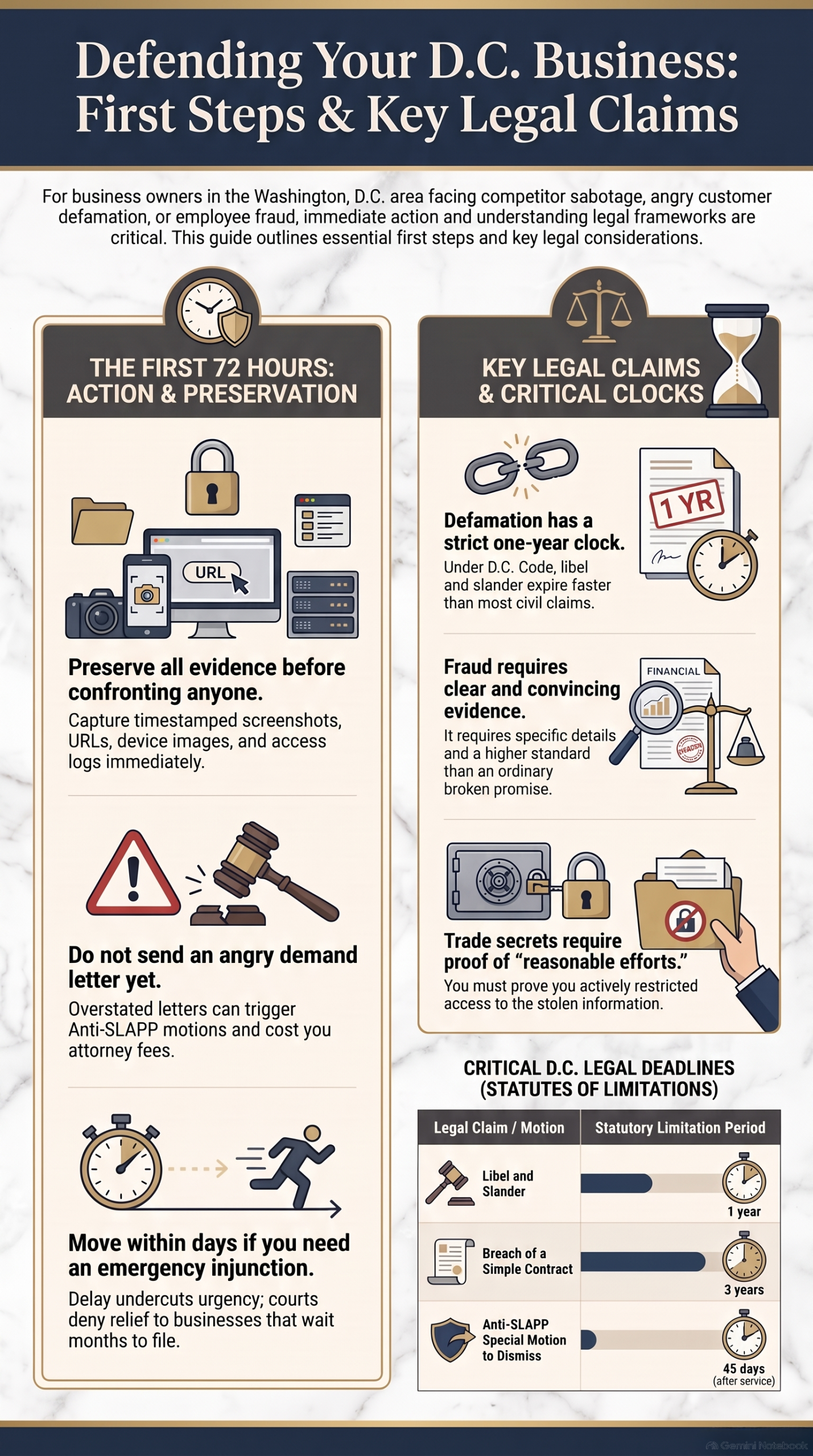
Table of Contents
- 1. The Call I Get When Someone Is Going After a Business
- 2. Sorting the Conduct Before Naming the Claim
- 3. Fraud: Six Elements and a Higher Burden
- 4. Fraud or Just a Broken Promise?
- 5. Concealment and the Duty to Speak
- 6. Business Defamation: The Four Elements
- 7. Defamation Per Se and Proving the Loss
- 8. The One-Year Clock, and Why It Ends Cases
- 9. Anti-SLAPP: The Motion That Can End Your Case in 45 Days
- 10. The Angry Customer Versus the Competitor
- 11. Tortious Interference With a Contract
- 12. Interference With Prospective Business Advantage
- 13. The Competition Defense
- 14. Trade Secret Misappropriation
- 15. The Departing Employee Who Took the Customer List
- 16. Civil Conspiracy Is Not a Claim by Itself
- 17. Emergency Injunctions: What a Court Actually Needs
- 18. Evidence, Deadlines, and What Recovery Looks Like
- 19. How I Handle These Cases
- Summary
- Frequently Asked Questions
- References
1. The Call I Get When Someone Is Going After a Business
The calls have a pattern. Something is wrong with the revenue and the owner has just worked out why.
A long-standing client cancelled and mentioned something a competitor had told them. A former employee is now selling to the same accounts using a list they built here. A one-star review appeared describing conduct that never happened. A buyer walked away from a deal after receiving an anonymous email. A partner who has been quietly setting up a parallel company took three customers with them.
The owner is angry, and the anger is usually justified. My job in that first conversation is narrower than the anger: figure out which of these facts supports an actual claim, which claim, and how fast something has to happen.
That is not a formality. In the District these claims carry genuinely different requirements. Fraud demands clear and convincing evidence. Defamation expires in a year and can trigger a fee-shifting motion against you. Tortious interference requires proof that the defendant knew about the relationship they wrecked. Trade secret claims require you to have treated the information as secret before anyone took it.
This guide walks through each one the way I work through it, and it is honest about where these cases are weak, because a client who files the wrong claim loudly is worse off than one who files the right claim quietly.
Before you confront anyone
Preserve everything, now. Emails, texts, the CRM history, call logs, the review itself with a timestamped screenshot and the URL, the client's cancellation message, server and access logs, and any device the departing employee used. Evidence disappears quickly once the other side knows you are looking.
Do not send the angry letter yet. A demand letter tells the other side to clean up, and where the target is a critic rather than a competitor it can hand them an Anti-SLAPP motion. Get the claim analysis first. It takes days, not weeks.
2. Sorting the Conduct Before Naming the Claim
I start by writing down what the person actually did, in plain language, and then matching conduct to claims. The same episode often supports several, and some of the most common grievances support none.
| What happened | The claim I look at first | The hard part |
|---|---|---|
| They lied to get my money or my signature | Fraud | Clear and convincing evidence, pleaded with particularity |
| They said something false about my business | Defamation or trade libel | One-year limitation period, and Anti-SLAPP exposure |
| They talked my customer into breaking a signed contract | Tortious interference with contract | Proving they knew the contract existed |
| They cost me a deal that was not signed yet | Interference with prospective business advantage | Proving the expectancy was real, not hoped for |
| They took my customer list, pricing, or process | Trade secret misappropriation | Proving you took reasonable steps to keep it secret |
| A former employee competes against me | Restrictive covenant, or trade secrets | Competition alone is lawful without a covenant or a secret |
| Several of them coordinated it | Civil conspiracy, attached to an underlying tort | Conspiracy is not a claim on its own in the District |
| They are doing it right now and it is getting worse | Preliminary injunction | Showing harm that money cannot repair later |
Notice the sixth row. Owners frequently arrive convinced that a former employee competing with them is automatically wrongful. Absent an enforceable restrictive covenant, a trade secret, or a breach of some duty the person owed while still employed, ordinary competition is lawful and the District expects it. That is a hard conversation to have early and a much more expensive one to have after a complaint has been filed.
These matters run through our business torts, fraud, and interference practice, within the broader civil litigation group.
3. Fraud: Six Elements and a Higher Burden
Fraud is the claim clients most want to bring and the one I am most careful about, because the District sets the bar higher than for an ordinary civil claim.
In Hercules & Co. v. Shama Restaurant Corp., 613 A.2d 916 (D.C. 1992), the Court of Appeals set out the elements: a false representation, made in reference to a material fact, with knowledge of its falsity, with the intent to deceive, and an action taken in reliance upon the representation. In a commercial contract setting the reliance must also have been reasonable.
The two sentences that decide fraud cases
The same opinion states that common law fraud is never presumed, that a plaintiff alleging it must do so with particularity, and must prove it by clear and convincing evidence.
Read that as two separate hurdles. Particularity is a pleading requirement: the complaint has to say who said what, when, to whom, and why it was false, not simply that the defendant was dishonest. Clear and convincing evidence is a proof requirement, higher than the preponderance standard that governs most civil claims. A fraud count drafted in generalities gets dismissed before anyone reaches the merits.
What I need from a client to plead fraud properly
- The specific statement. The exact words if possible, or the substance, in writing where it exists.
- Who made it and when. A named person and a date, not a company generally.
- Why it was false when made. This is the element that separates fraud from a promise that later went wrong, and it is covered in the next chapter.
- What the client did because of it. Signed, paid, delivered, hired, declined another opportunity. Reliance has to be an action.
- Why relying was reasonable. If the truth sat in a document the client received and never read, expect that argument.
- The loss, quantified. Not the disappointment. The dollars.
Where the fraud involves property, the analysis overlaps with our real estate fraud and seller nondisclosure practice, and where it involves a co-owner, with the fiduciary claims in my guide to business partner disputes in Washington, DC.
4. Fraud or Just a Broken Promise?
This is the distinction I spend the most time on, and getting it right changes what a case is worth.
A breach of contract claim says the defendant promised something and did not deliver. A fraud claim says the defendant lied. The difference is what the defendant knew at the time they made the representation.
| Breach of contract | Fraud | |
|---|---|---|
| What the defendant did | Failed to perform a promise | Made a knowingly false statement of material fact |
| State of mind | Generally irrelevant | Knowledge of falsity and intent to deceive |
| Burden of proof | Preponderance of the evidence | Clear and convincing evidence |
| Pleading | Ordinary notice pleading | Particularity required |
| Damages | Generally contract damages, benefit of the bargain | Tort damages, with punitive damages available on egregious conduct |
| Limitation period | 3 years under D.C. Code § 12-301(7), or 12 years under seal per (6) | Generally 3 years under the residual provision, § 12-301(8) |
Why clients push for fraud: punitive damages, and sometimes a longer reach. Why I resist when the facts do not support it: a fraud count that fails can take the credibility of the rest of the case with it, and it invites a motion that costs money to answer.
The question I ask to tell them apart
Did the defendant intend to perform when they made the promise? A contractor who genuinely meant to finish the job and then ran out of money breached a contract. A contractor who took the deposit with no intention of ever starting committed fraud. The evidence that separates them is usually circumstantial: what else they were doing at the time, what they told other people, whether the same pattern repeated with other customers, and where the money actually went.
For the contract side of the analysis, including the District's limitation periods and the effect of a document executed under seal, see my guide to breach of contract in Washington, DC and our breach of contract practice.
5. Concealment and the Duty to Speak
Not every fraud involves a statement. Sometimes the wrong is what the other side did not say.
Concealment claims are harder, because silence is only actionable where there was a duty to speak. That duty typically arises from a fiduciary or confidential relationship between the parties, from a half-truth where a partial disclosure creates a misleading impression, from active steps taken to hide a condition, or from a contractual or statutory disclosure obligation.
So a seller who says nothing about a defect in an arm's length commercial deal is in a different position from a managing member who says nothing to a co-owner, or from a seller who painted over the water damage the week before the inspection.
What I look for in a concealment case: evidence the defendant actually knew the fact, evidence the client could not have discovered it through the diligence they were entitled to rely on, and the source of the duty to disclose. That third item is where most of these claims are won or lost.
6. Business Defamation: The Four Elements
When someone spreads falsehoods about a business, defamation is the claim, and the District's elements are specific.
In Oparaugo v. Watts, 884 A.2d 63 (D.C. 2005), the Court of Appeals set out the four elements, quoting Crowley v. North American Telecommunications Association, 691 A.2d 1169 (D.C. 1997): that the defendant made a false and defamatory statement concerning the plaintiff; that the defendant published the statement without privilege to a third party; that the defendant's fault in publishing the statement amounted to at least negligence; and either that the statement was actionable as a matter of law irrespective of special harm, or that its publication caused the plaintiff special harm.
Where business defamation claims actually fail
- The statement was opinion. Calling your work overpriced or your service terrible is ordinarily opinion. Stating that you failed an inspection you passed is a fact.
- The statement was substantially true. Truth is a defense, and a statement that is unflattering but accurate is not defamation.
- No publication to a third party. Under Oparaugo, publication to the plaintiff alone does not support the claim. A furious email sent only to you is not defamation.
- The statement was privileged. Statements made in judicial proceedings, and certain statements between parties with a shared interest, carry privileges that can defeat the claim.
- It was not about the plaintiff. Criticism of an industry, or of a category of business, generally will not support a claim by one member of it.
Get the exact words, and get them preserved
Before anything else I want a timestamped screenshot with the full URL, the reviewer or poster name as displayed, the platform, and the date. Posts get edited and deleted, and a paraphrase from memory is not a case. If the statement was oral, I want the names of everyone who heard it while the memory is fresh.
Reputation work of this kind sits alongside our corporate brand defense practice, and appellate work in the area runs through defamation and business tort appeals.
7. Defamation Per Se and Proving the Loss
The fourth Oparaugo element has two branches, and which branch you are on decides whether you have to prove specific lost dollars.
Some statements are treated as actionable as a matter of law irrespective of special harm. Statements attacking a person in their trade, business, or profession have traditionally fallen in that category, along with allegations of serious criminal conduct. Where a statement qualifies, the plaintiff does not have to itemize particular losses to state a claim.
Everything else requires special harm, which means identifiable loss. For a business that usually means named customers who left, contracts that were cancelled, deals that died, and the revenue attached to each.
What I build to prove business loss
- The customers who left, by name, with dates, and where possible a statement from them about why
- Revenue history before and after the statement was published, by account rather than in total, so the decline is traceable
- The lost contracts and proposals, including the ones that had been progressing normally until the statement appeared
- Platform analytics where the statement was online, showing traffic and conversion against the publication date
- Remediation cost, including reputation management and advertising bought to offset it
Causation is the fight. The defense will say the decline came from pricing, the economy, a lost key employee, or ordinary churn. Revenue analysis by account is what answers that, which is why I want the accounting rather than the impression.
8. The One-Year Clock, and Why It Ends Cases
This is the shortest deadline in this guide and the one I see missed most.
One Year for Libel and Slander
Under D.C. Code § 12-301(4), an action for libel or slander must be brought within one year. Compare that with three years for a simple contract under § 12-301(7), twelve years for an instrument under seal under § 12-301(6), and three years under the residual provision at § 12-301(8) for claims with no specific period.
So a business that spends eight months trying to get a review taken down through the platform, then three months deciding whether to sue, then a month looking for a lawyer, has a problem. By the time most owners are angry enough to call, a meaningful part of the year is gone.
Two practical consequences. First, if defamation is part of your situation, the defamation piece sets the pace for everything else even when the other claims have longer clocks. Second, republication matters: a fresh publication can start a fresh period, which is a question worth analyzing rather than assuming in either direction.
I would rather look at a situation in month two and tell a client there is nothing worth filing than look at it in month fourteen and tell them the claim is gone.
9. Anti-SLAPP: The Motion That Can End Your Case in 45 Days
Here is the part most articles about suing over false statements leave out, and it can turn your case into a bill.
The District has an Anti-SLAPP statute. Under D.C. Code § 16-5502, a party may file a special motion to dismiss any claim arising from an act in furtherance of the right of advocacy on issues of public interest, within 45 days after service of the claim. When that motion is filed, the ordinary posture of litigation inverts.
What the motion does
Discovery stops. The statute generally stays discovery while the motion is pending, though a court may permit targeted discovery that appears likely to help defeat the motion, and may condition it on the plaintiff paying the defendant's cost of responding.
The burden shifts to you. The movant must first make a prima facie showing that the claim arises from an act in furtherance of the right of advocacy on issues of public interest. Once they do, the motion is granted unless the responding party demonstrates that the claim is likely to succeed on the merits. That is a substantive showing, made early, without the discovery you would normally use to build it.
Fees follow. Under D.C. Code § 16-5504(a), the court may award a moving party who prevails, in whole or in part, the costs of litigation including reasonable attorney fees. The award is discretionary rather than automatic, but the exposure is real. The statute is not one-sided: under § 16-5504(b) fees can run to the responding party where the court finds the motion is frivolous or is solely intended to cause unnecessary delay.
So before I file a defamation claim in the District, I ask whether the statement plausibly concerns an issue of public interest, and I assume the other side's counsel will ask the same question. If the answer is yes, the case has to be strong enough to survive that motion on the papers, because you will not get to discovery first.
10. The Angry Customer Versus the Competitor
The statutory definitions are where this gets useful, because they draw a line that matches commercial reality.
Under D.C. Code § 16-5501, an issue of public interest includes an issue related to health or safety; environmental, economic, or community well-being; the District government; a public figure; or a good, product, or service in the market place. That last phrase covers a great deal of what gets written about businesses online.
But the same section limits the term. It provides that an issue of public interest shall not be construed to include private interests, such as statements directed primarily toward protecting the speaker's commercial interests rather than toward commenting on or sharing information about a matter of public significance.
| The situation | How I read the Anti-SLAPP risk |
|---|---|
| A customer posts a negative review of your service | High risk. Commentary on a service in the marketplace sits inside the definition |
| A journalist or neighborhood group criticizes your project | High risk. Community well-being and petitioning activity are squarely covered |
| A competitor tells your client you are under investigation when you are not | Lower risk. A statement made primarily to protect the speaker's own commercial interests is outside the definition as written |
| A former employee emails your customers disparaging your product to move them to a new employer | Lower risk, and the same facts may support interference and trade secret claims |
| An anonymous poster fabricates a health or safety failure | Mixed. The subject matter is covered, so the claim has to be strong enough to show likely success on the merits |
The practical instruction I give clients: a bad review from a real customer is usually a business problem to be answered publicly and professionally, not a lawsuit. A competitor's false statement made to take your customer is a different matter, and it is often better framed as interference than as defamation anyway, which is the next chapter.
11. Tortious Interference With a Contract
When someone deliberately breaks up a relationship you already had under contract, this is the claim.
In Casco Marina Development, L.L.C. v. District of Columbia Redevelopment Land Agency, 834 A.2d 77 (D.C. 2003), the Court of Appeals identified the elements: the existence of a contract; knowledge of the contract; intentional procurement of a breach; and damages resulting from the breach. The opinion also notes that a strict breach is not always required, because a failure of performance can suffice.
The element that decides most of these cases
Knowledge. The defendant has to have known about the contract they interfered with. A competitor who solicits your customer while having no idea the customer is under a term agreement has not committed this tort, however much damage it caused.
So I look for the evidence of knowledge first: the defendant's own emails, testimony from the customer about what the defendant said and asked, whether the defendant is a former employee who negotiated that very contract, whether the contract or its terms were publicly known, and whether the defendant ever received a notice from you about the relationship.
The letter that creates the element
This is one place where a well-timed letter does real work. If you learn a third party is circling a customer who is under contract, putting that third party on written notice of the contract's existence converts their future conduct from arguably innocent competition into intentional procurement with knowledge. Send it carefully, because an overstated letter has its own risks, but the knowledge element is frequently built rather than found.
We handle these through the business torts, fraud, and interference practice, and the underlying contract analysis through breach of contract.
12. Interference With Prospective Business Advantage
Not every valuable relationship is under contract. The renewal that was routine every year, the proposal that was days from signature, the referral pipeline that had run steadily for a decade. When someone destroys one of those, the claim is interference with prospective business advantage.
The Casco Marina opinion notes that the elements for interference with prospective advantage mirror those for interference with contract, with the difference that the plaintiff need only demonstrate a prospective advantageous business transaction rather than an actual contract.
That sounds easier and is usually harder, because the expectancy itself becomes the battleground.
What makes an expectancy provable rather than hopeful
- A history. Eleven consecutive annual renewals is an expectancy. A prospect who once took a meeting is not.
- Documents showing the transaction was moving. A signed letter of intent, an approved proposal, a purchase order in process, an email confirming terms, a scheduled closing.
- Testimony from the counterparty that they intended to proceed and why they stopped. This is the single most valuable evidence, and it depends on that person being willing to say it.
- A specific, identifiable relationship. Courts are unreceptive to claims framed around the market generally or unidentified future customers.
- Improper means or improper purpose. Competition alone is not enough. I want the conduct that made it wrongful, such as a lie, a threat, a bribe, a breach of confidence, or use of information the defendant had no right to.
Because the same conduct often supports several theories, I usually plead interference alongside the claim that captures the wrongful means, whether that is defamation, trade secret misappropriation, or breach of a covenant.
13. The Competition Defense
I raise this early with every client, because it is the defense that arrives in every one of these cases and because it is often correct.
Competition is lawful. A business is generally entitled to pursue customers, including your customers, to offer better pricing, to hire people who used to work for you, and to say true things about the comparison. Interference law does not protect a company from losing business to someone better or cheaper. It protects against wrongful means.
| Generally lawful | Potentially actionable |
|---|---|
| Offering a lower price to your customer | Telling that customer you are insolvent when you are not |
| Hiring your employee who has no enforceable covenant | Hiring them to use your confidential pricing model |
| Truthful comparative advertising | Fabricating a safety failure or a lost license |
| Approaching a customer whose contract is expiring | Inducing a breach of a contract the defendant knew was in force |
| Building a competing product independently | Building it from documents taken on the way out the door |
| Publicly criticizing your service | Paying people to post false reviews |
Where the conduct sits in the left column, my advice is usually commercial rather than legal: compete, fix the pricing, tighten the contracts, and put proper covenants and confidentiality terms in place going forward. That prevention work runs through our non-compete and restrictive covenant practice on the business side and non-competes and restrictive covenants on the employment side.
14. Trade Secret Misappropriation
When the harm came from information rather than words, the District's Uniform Trade Secrets Act is usually the strongest claim available, and it carries remedies the other torts do not.
Under D.C. Code § 36-401, a trade secret is information, including a formula, pattern, compilation, program, device, method, technique, or process, that derives actual or potential independent economic value from not being generally known to and not being readily ascertainable by proper means by another who can obtain economic value from its disclosure or use, and that is the subject of reasonable efforts to maintain its secrecy.
The element clients lose on: reasonable efforts
The statute protects information you treated as secret. If the customer list lived on an open shared drive, if pricing circulated by email to anyone who asked, if departing employees were never reminded of confidentiality obligations and never had their access revoked, the defense writes itself.
What reasonable efforts look like in practice: written confidentiality agreements, access limited to people who need it, password protection and access logging, documents marked confidential, exit interviews with a return-of-property step, and prompt deactivation of accounts. None of this is expensive. All of it is far cheaper than losing a case over it.
The remedies
This is why I look at the trade secrets claim first when the facts support it. Under D.C. Code § 36-403, the complainant may recover damages for both the actual loss caused by the misappropriation and the unjust enrichment, or alternatively a reasonable royalty for the unauthorized disclosure or use. For willful and malicious misappropriation, the court may award exemplary damages up to twice the amount awarded under that section. And under D.C. Code § 36-404, the court may award reasonable attorney fees where a claim of misappropriation is made in bad faith, where a motion to terminate an injunction is made or resisted in bad faith, or where willful and malicious misappropriation exists.
Note the fee provision cuts both ways. A trade secret claim brought in bad faith can produce a fee award against the party who brought it, which is another reason I want the reasonable-efforts evidence before filing rather than after.
Federal law offers a parallel route with its own advantages, and choosing between or combining the two is a real strategic decision. Our trade secret protection and IP litigation practices handle both.
15. The Departing Employee Who Took the Customer List
This is the most common version of the whole problem, so it deserves its own chapter.
An employee leaves, and within weeks your customers are hearing from them. The owner's instinct is that this must be illegal. Sometimes it is. Often the answer depends on three questions I ask in order.
- Was there an enforceable restrictive covenant? If yes, the analysis starts with the agreement and its enforceability, which in the District depends on the type of covenant and the circumstances in which it was given.
- Did they take something? Documents, files, a downloaded contact database, source code, pricing models. This is the trade secret question from the previous chapter, and it is usually answered by forensic examination of devices and access logs rather than by argument.
- What did they do while still employed? An employee who solicited your customers, diverted business, or set up the competing venture on your time and with your resources breached duties they owed during employment, regardless of what they were free to do afterward.
Memory is the line clients find hardest. An employee is generally entitled to remember the industry and their own skills. Exporting the customer database to a personal drive is a different act, and the forensic record usually shows which one happened.
What I do in the first 72 hours of a departure case
Preserve and image the devices and accounts before anyone touches them. Pull access and download logs for the final weeks of employment. Collect the signed agreements. Identify which customers have been contacted and get the dates. Then decide whether the facts support emergency relief, which is Chapter 17.
Speed matters here more than in any other scenario in this guide, because the information is being used right now and because delay undercuts an injunction request.
Where the dispute is with a co-owner rather than an employee, the fiduciary framework in my guide to business partner disputes in Washington, DC applies, including the statutory duty of loyalty that bars competing with the company before dissolution.
16. Civil Conspiracy Is Not a Claim by Itself
Clients often want to name everyone who was involved and call it a conspiracy. In the District that requires care.
In Executive Sandwich Shoppe, Inc. v. Carr Realty Corp., 749 A.2d 724 (D.C. 2000), the Court of Appeals stated plainly that there is no recognized independent tort action for civil conspiracy in the District of Columbia, and that civil conspiracy depends on performance of some underlying tortious act. Conspiracy operates as a means of establishing vicarious liability for that underlying tort.
The elements the court identified are an agreement between two or more persons; to participate in an unlawful act, or in a lawful act in an unlawful manner; an injury caused by an unlawful overt act performed by one of the parties to the agreement; pursuant to, and in furtherance of, the common scheme.
What that means practically is that conspiracy is a way to reach additional defendants for a tort you have already established, not a substitute for establishing one. If the fraud count fails, the conspiracy-to-commit-fraud count fails with it. So I build the underlying tort first and add conspiracy where the evidence of an agreement is genuinely there, which usually means communications among the defendants rather than inference from the fact that they both benefited.
17. Emergency Injunctions: What a Court Actually Needs
When the harm is happening now, damages later are not the point. The point is stopping it, and this is the chapter I turn to first when a client tells me the conduct is still going on.
A temporary restraining order and preliminary injunction are available in the Superior Court under its civil rules. The familiar framework asks whether the movant is likely to succeed on the merits, whether the movant will suffer irreparable harm without relief, how the balance of harms falls between the parties, and where the public interest lies.
Irreparable harm is the obstacle, and here is how it is met
Money damages available later are ordinarily not irreparable harm. That defeats most commercial injunction requests. What clears it in these cases is harm a later judgment cannot undo:
- Trade secrets being disclosed or used. Once information is out, it cannot be made secret again. This is the strongest irreparable harm story in this guide.
- Customer relationships being taken. Loss of goodwill and of relationships built over years is difficult to value and difficult to restore.
- Ongoing publication of a false statement where the damage compounds daily.
- Destruction or dissipation of evidence, which supports preservation relief even where the substantive claim needs more development.
- A transaction about to close that cannot be unwound afterward.
Two things that sink injunction motions
Delay. A movant who waited four months after learning of the conduct has undercut their own claim of urgency, and the other side will say so in the first paragraph of their opposition. If the situation warrants emergency relief, move within days.
Overreach. A request to shut a competitor down entirely invites denial. Narrow, specific relief gets granted: preserve and return specified files, stop soliciting a defined list of customers pending trial, take down an identified statement, stop using a specific process. Expect to post a bond as security, and expect the amount to be substantial where the order restricts how a business operates.
We handle these applications through our injunctions and emergency relief practice, and where the dispute is really about what the parties' rights are, a declaratory judgment action sometimes serves better than an injunction.
18. Evidence, Deadlines, and What Recovery Looks Like
Here is the consolidated view I keep in front of me on these matters, because the clocks and the money differ sharply across the claims.
| Claim | Limitation period | Source |
|---|---|---|
| Libel and slander | 1 year | D.C. Code § 12-301(4) |
| Breach of a simple contract | 3 years | D.C. Code § 12-301(7) |
| Breach of an instrument under seal | 12 years | D.C. Code § 12-301(6) |
| Fraud, interference, and other claims with no specific period | 3 years under the residual provision | D.C. Code § 12-301(8) |
| Anti-SLAPP special motion to dismiss | Filed within 45 days after service of the claim | D.C. Code § 16-5502 |
What recovery looks like
- Compensatory damages. Lost profits, lost contracts, the cost of remediation. Proven by accounting records rather than estimates.
- Unjust enrichment or a reasonable royalty on a trade secret claim, under D.C. Code § 36-403, which can be easier to prove than your own lost profits when the defendant's gain is documented.
- Exemplary damages up to twice the award for willful and malicious trade secret misappropriation, under § 36-403.
- Punitive damages on tort claims involving egregious conduct, which require a showing well beyond ordinary wrongdoing and are not available on a straightforward contract claim.
- Attorney fees where a statute or a contract provides them. Under D.C. Code § 36-404 fees are available in trade secret cases in defined circumstances, and under § 16-5504 they can run against a plaintiff who loses an Anti-SLAPP motion.
- Injunctive relief, which in many of these cases is worth more than the damages.
On forum: larger claims go to the Civil Actions Branch of the Superior Court, where all parties are required to participate in mediation, and a meaningful share of these disputes resolve there. Where federal trade secret or trademark claims are involved, or where the parties are in different states, federal court may be available and sometimes preferable. If a contract between the parties contains an arbitration clause, that will usually control.
19. How I Handle These Cases
My sequence in these matters is consistent, because the order protects the client's options.
- Preserve first. Litigation hold, device imaging where a departure is involved, screenshots with URLs and timestamps, and collection of the agreements.
- Assess the claims honestly, including the Anti-SLAPP exposure and the reasonable-efforts evidence, before anything is sent or filed.
- Decide whether this needs emergency relief in days rather than weeks, because delay forecloses it.
- Build the loss by account, with records, because causation is where these cases are contested.
- Then choose the pressure. Sometimes a narrow, accurate letter resolves it. Sometimes a filing and a preliminary injunction motion is the only thing that stops the conduct.
I represent businesses on both sides of these disputes in the District, Northern Virginia, and Maryland, including defending companies and former employees accused of them, which informs how I assess a claim before filing it. I am admitted in the District of Columbia, Maryland, Massachusetts, and Virginia.
Related work we handle: business torts, fraud, and interference, injunctions and emergency relief, trade secret protection, IP litigation and disputes, corporate brand defense, trademark enforcement and infringement, tort claims, consumer protection claims, shareholder and member disputes, and appeals through defamation and business tort appeals. For prevention, see our trademark and intellectual property and business litigation and transactions practices.
Other District guides: breach of contract, business partner disputes, construction disputes, and commercial lease disputes. For the areas we serve, our Washington, DC service areas.
Summary
What I want a business owner to take from this:
- Preserve evidence before you confront anyone. Screenshots with URLs and timestamps, device images, access logs, and the customer's own words about why they left.
- Fraud carries a higher bar. Under Hercules & Co. v. Shama Restaurant Corp., 613 A.2d 916 (D.C. 1992), it must be pleaded with particularity and proven by clear and convincing evidence, and it turns on what the defendant knew when they spoke.
- Defamation expires in one year under D.C. Code § 12-301(4), against three years for most other claims. That clock sets the pace for the whole matter.
- Anti-SLAPP can end your case in 45 days. Under § 16-5502 discovery stays and you must show your claim is likely to succeed on the merits, and under § 16-5504 fees can be awarded against you.
- The definition draws a useful line. Section 16-5501 covers commentary on a good, product, or service in the marketplace, but excludes statements directed primarily toward protecting the speaker's own commercial interests. A customer's review and a competitor's smear are not the same risk.
- Interference turns on knowledge. Under Casco Marina, 834 A.2d 77 (D.C. 2003), you must prove the defendant knew of the contract, and a written notice can build that element going forward.
- Competition itself is lawful. Without a covenant, a trade secret, or a breach of duty during employment, a former employee may compete with you.
- Trade secrets carry the best remedies and the hardest element. Section 36-403 allows actual loss plus unjust enrichment or a reasonable royalty, with exemplary damages up to twice that for willful and malicious conduct, but § 36-401 requires reasonable efforts to keep the information secret.
- Conspiracy is not a standalone claim in the District under Executive Sandwich Shoppe, 749 A.2d 724 (D.C. 2000). It needs an underlying tort.
- Move within days if you need an injunction. Delay defeats urgency, and narrow requests get granted where sweeping ones do not.
If revenue is moving right now, the useful call is today. If it stopped moving eleven months ago and defamation is involved, the useful call is still today.
Frequently Asked Questions
What can I do if a competitor is spreading lies about my business in Washington, DC?
Start by preserving the exact statement with a timestamped screenshot, the full URL, the poster name as displayed, and the date, because posts get edited and deleted. Then I assess it against the four defamation elements from Oparaugo v. Watts, 884 A.2d 63 (D.C. 2005): a false and defamatory statement concerning you, published without privilege to a third party, with fault amounting to at least negligence, and either actionability irrespective of special harm or publication causing special harm. Where the speaker is a competitor rather than a customer, the same facts often support a stronger tortious interference claim, and carry less Anti-SLAPP exposure. Note the one-year limitation period under D.C. Code § 12-301(4).
How long do I have to sue for defamation in DC?
One year. D.C. Code § 12-301(4) sets a one-year period for libel and slander, which is the shortest deadline among the claims in this area. Compare three years for a simple contract under § 12-301(7), twelve years for an instrument under seal under § 12-301(6), and three years under the residual provision at § 12-301(8) for claims with no specific period. Businesses routinely lose the claim by spending months trying to get a post removed through the platform first, so if defamation is part of your situation it sets the pace for everything else.
What is the DC Anti-SLAPP Act and can it be used against my lawsuit?
Yes, and it is the risk most often overlooked. Under D.C. Code § 16-5502 a party may file a special motion to dismiss any claim arising from an act in furtherance of the right of advocacy on issues of public interest, within 45 days after service of the claim. Discovery is generally stayed while it is pending, and the motion is granted unless you demonstrate that your claim is likely to succeed on the merits, which is a substantive showing made without the discovery you would normally use to build it. Under § 16-5504 the court may award a prevailing movant the costs of litigation including reasonable attorney fees. So a defamation claim in the District has to be strong enough to survive on the papers.
Does the Anti-SLAPP Act protect a competitor who lies about my company?
Often not, and the statutory text is where the line sits. D.C. Code § 16-5501 defines an issue of public interest to include a good, product, or service in the market place, which covers a lot of online commentary about businesses. But the same section provides that the term shall not be construed to include private interests, such as statements directed primarily toward protecting the speaker's commercial interests rather than commenting on a matter of public significance. A competitor's false statement made to take your customer is aimed at the speaker's own commercial interest, which puts it outside the definition as written. A genuine customer review is a different and much riskier target.
What are the elements of fraud in Washington, DC?
Under Hercules & Co. v. Shama Restaurant Corp., 613 A.2d 916 (D.C. 1992): a false representation, made in reference to a material fact, with knowledge of its falsity, with the intent to deceive, and an action taken in reliance upon the representation, with the reliance required to be reasonable in a commercial contract setting. The same opinion states that fraud is never presumed, must be pleaded with particularity, and must be proven by clear and convincing evidence. That is a higher standard than the preponderance of the evidence that governs most civil claims, and a fraud count drafted in generalities gets dismissed before anyone reaches the merits.
Is this fraud or just a breach of contract?
The dividing question is what the defendant knew when they made the promise. If they intended to perform and then failed, that is breach of contract, proven by a preponderance of the evidence, with contract damages. If they never intended to perform, or made a knowingly false statement of material fact to induce you, that is fraud, with a clear and convincing burden, a particularity pleading requirement, and punitive damages available on egregious conduct. Clients push for fraud because of the punitive exposure, and I resist it when the facts do not support it, because a failed fraud count can damage the credibility of the rest of the case.
What do I have to prove for tortious interference in DC?
For interference with an existing contract, Casco Marina Development, L.L.C. v. District of Columbia Redevelopment Land Agency, 834 A.2d 77 (D.C. 2003), sets out four elements: the existence of a contract, knowledge of the contract, intentional procurement of a breach, and damages resulting from it. The opinion also notes a strict breach is not always required because a failure of performance can suffice. Knowledge is the element that decides most of these cases. A competitor who solicited your customer without knowing about the term agreement has not committed this tort.
Can I sue if someone cost me a deal that was never signed?
Potentially, as interference with prospective business advantage. Casco Marina notes the elements mirror interference with contract, except that you need only show a prospective advantageous business transaction rather than an actual contract. In practice this is harder, because the expectancy is the battleground. What makes it provable is a history such as consecutive annual renewals, documents showing the transaction was moving such as an approved proposal or a letter of intent, testimony from the counterparty that they intended to proceed and why they stopped, a specific identifiable relationship rather than the market generally, and evidence of improper means.
My former employee is calling my customers. Is that illegal?
It depends on three things. Whether there is an enforceable restrictive covenant. Whether they took something, such as a downloaded contact database, pricing model, or files, which is a trade secret question usually answered by forensic examination of devices and access logs. And what they did while still employed, since soliciting your customers or setting up the competing venture on your time breached duties owed during employment regardless of what they could do afterward. Absent a covenant, a trade secret, or a breach of duty during employment, a former employee is generally free to compete and to use their own skills and industry knowledge.
What qualifies as a trade secret under DC law?
Under D.C. Code § 36-401, information including a formula, pattern, compilation, program, device, method, technique, or process that derives actual or potential independent economic value from not being generally known to and not readily ascertainable by proper means by another who can obtain economic value from its disclosure or use, and that is the subject of reasonable efforts to maintain its secrecy. Reasonable efforts is the element clients lose on. If the customer list sat on an open shared drive and departing employees kept their access, the defense writes itself. Written confidentiality agreements, need-to-know access limits, password protection and logging, confidential markings, and prompt account deactivation are what the element looks like in practice.
What can I recover in a DC trade secret case?
Under D.C. Code § 36-403 you may recover damages for both the actual loss caused by the misappropriation and the unjust enrichment, or alternatively a reasonable royalty for the unauthorized disclosure or use. For willful and malicious misappropriation the court may award exemplary damages up to twice that amount. Under § 36-404 the court may award reasonable attorney fees where willful and malicious misappropriation exists, and also where a claim of misappropriation is made in bad faith or a motion to terminate an injunction is made or resisted in bad faith, so the fee provision runs in both directions. Injunctive relief is frequently worth more than the damages.
Can I get an emergency court order to stop the conduct?
Sometimes, and speed is the deciding factor. A temporary restraining order and preliminary injunction are available in Superior Court, with the court weighing likelihood of success on the merits, irreparable harm, the balance of harms, and the public interest. The obstacle is that harm compensable by money later is ordinarily not irreparable. What clears it is trade secrets being disclosed or used, since information cannot be made secret again; customer relationships and goodwill being taken; ongoing publication of a false statement; destruction of evidence; or a transaction about to close that cannot be unwound. Two things sink these motions: waiting months before moving, and asking for sweeping relief instead of narrow, specific orders. Expect to post a bond.
Preserve the Evidence, Then Call Me
If someone is taking your customers, your information, or your reputation, the first hours matter more than the first month. Screenshot what you can, do not confront anyone yet, and tell me what happened and when. I will tell you which claims are real, what your deadlines are, and whether this needs an emergency filing.
Schedule a Consultation with Basil M. Al-Qaneh, Esq.
Call 571-445-6565 | Businesses in DC, Northern Virginia, and Maryland
References
Code of the District of Columbia. Limitation of time for bringing actions, D.C. Code § 12-301. https://code.dccouncil.gov/us/dc/council/code/sections/12-301
Code of the District of Columbia. Definitions (Anti-SLAPP), D.C. Code § 16-5501. https://code.dccouncil.gov/us/dc/council/code/sections/16-5501
Code of the District of Columbia. Special motion to dismiss, D.C. Code § 16-5502. https://code.dccouncil.gov/us/dc/council/code/sections/16-5502
Code of the District of Columbia. Special motion to quash, D.C. Code § 16-5503. https://code.dccouncil.gov/us/dc/council/code/sections/16-5503
Code of the District of Columbia. Costs of litigation and attorney fees, D.C. Code § 16-5504. https://code.dccouncil.gov/us/dc/council/code/sections/16-5504
Code of the District of Columbia. Definitions (Uniform Trade Secrets Act), D.C. Code § 36-401. https://code.dccouncil.gov/us/dc/council/code/sections/36-401
Code of the District of Columbia. Injunctive relief, D.C. Code § 36-402. https://code.dccouncil.gov/us/dc/council/code/sections/36-402
Code of the District of Columbia. Damages, D.C. Code § 36-403. https://code.dccouncil.gov/us/dc/council/code/sections/36-403
Code of the District of Columbia. Attorney's fees, D.C. Code § 36-404. https://code.dccouncil.gov/us/dc/council/code/sections/36-404
Casco Marina Development, L.L.C. v. District of Columbia Redevelopment Land Agency, 834 A.2d 77 (D.C. 2003). https://caselaw.findlaw.com/court/dc-court-of-appeals/1199147.html
Crowley v. North American Telecommunications Association, 691 A.2d 1169 (D.C. 1997).
Executive Sandwich Shoppe, Inc. v. Carr Realty Corp., 749 A.2d 724 (D.C. 2000). https://caselaw.findlaw.com/dc-court-of-appeals/1167137.html
Hercules & Co. v. Shama Restaurant Corp., 613 A.2d 916 (D.C. 1992). https://law.justia.com/cases/district-of-columbia/court-of-appeals/1992/90-cv-593-5.html
Oparaugo v. Watts, 884 A.2d 63 (D.C. 2005). https://www.dccourts.gov/sites/default/files/pdf-opinions/01-CV-437.PDF
Superior Court of the District of Columbia. Rules of Civil Procedure, Rule 65 (Injunctions and Restraining Orders). https://www.dccourts.gov/

ATTORNEY
Practice Areas
Meet Our Team
Shin Law Office, PLC
