


What Changed in the Virginia Human Rights Act on July 1, 2026?
By Anthony I. Shin, Esq. | Employment Litigation and Transactions | Shin Law Office, PLC | Serving Northern Virginia
BOTTOM LINE UP FRONT
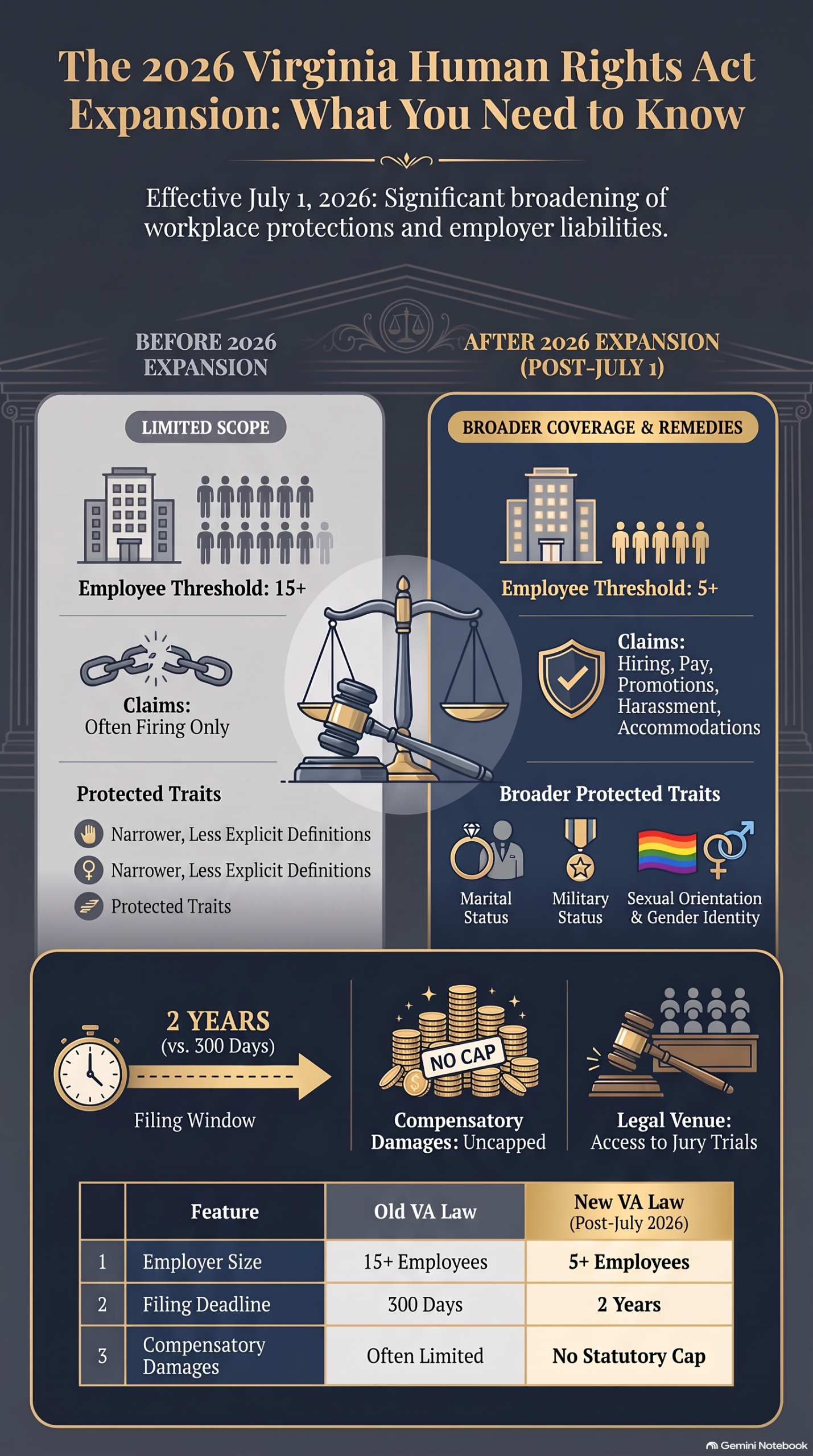
On July 1, 2026, the Virginia Human Rights Act became one of the most useful employment laws in the Commonwealth. It now covers any employer with five or more employees, down from fifteen, for every protected class and every kind of employment decision rather than firings alone. The window to file with Virginia's Office of Civil Rights went from 300 days to two years. Compensatory damages under the Act have no statutory cap, and a jury can decide the case.
If you were pushed out, passed over, harassed, or refused an accommodation, doors that were closed to you a year ago are open now. If you run a business with five or more people, the duties that used to belong to large employers belong to you, and a decision you make this year can still be questioned in 2028.
Talk it through with me. Call 571-445-6565 or Schedule a Consultation.
What This Guide Covers
- The Day the Rules Quietly Changed
- What the Act Is, in Plain Terms
- Exactly What Changed on July 1, 2026
- Are You Covered? How Virginia Counts Employees
- The Traits an Employer Cannot Use
- Five Situations I Hear About Most
- Motivating Factor: The Standard That Decides Close Cases
- Harassment and the Hostile Work Environment
- Retaliation, and Why It Is Often the Cleanest Claim
- Accommodation: Disability, Pregnancy, and Religion
- Where to File: Richmond, the EEOC, or Your County
- Every Deadline That Matters
- From Charge to Courtroom
- What You Can Actually Recover
- Virginia Claim or Federal Claim
- If You Are the Employer, Here Is Your First Week
- The Evidence That Decides These Cases
- What This Law Does Not Do
The Day the Rules Quietly Changed
On July 1, 2026, a law most Virginians had never heard of got a great deal bigger. Two bills signed that spring rewrote who the Virginia Human Rights Act protects and how long people have to act on it. Nothing about the change made the evening news. It simply took effect, and thousands of workplaces across the Commonwealth woke up covered by a law that had not applied to them the day before.
I want to be direct about why that matters. For years I had a conversation I disliked having. Someone would call me from a small office in Leesburg or a family run shop in Fairfax, describe something that was plainly unfair, and I would have to explain that Virginia law reached their employer only if they had been fired outright. Passed over for a promotion, harassed for months, paid less than the person doing the same job, none of that was actionable under state law at a company that size. Federal law did not help either, because most of it stops at fifteen employees.
That conversation is over. If your employer has five or more people on the payroll, the Virginia Human Rights Act now covers the full range of employment decisions, and you have two years to file rather than 300 days. If you are the one signing the paychecks, the same sentence reads very differently, and I will spend a fair amount of this guide on what it means from your side of the desk.
This is a long article because the law rewards people who understand the details. Use the table of contents above to jump to what applies to you. For the short version of how our firm handles these cases, see our Virginia Human Rights Act practice page, which also has a two question guide that points you to the right starting place. If you would rather just talk it through, my number is at the bottom of every section.
What the Act Is, in Plain Terms
The Virginia Human Rights Act lives in Chapter 39 of Title 2.2 of the Code of Virginia, at sections 2.2-3900 through 2.2-3909. It is the Commonwealth's own antidiscrimination law, separate from federal statutes like Title VII, the Americans with Disabilities Act, and the Age Discrimination in Employment Act.
It does three things. It declares a public policy against discrimination and instructs courts to read the chapter liberally to accomplish that policy. It lists the traits an employer, a labor organization, an employment agency, or an apprenticeship committee cannot use against you. And it creates a path to enforce those protections, first through a state agency and then, if that does not resolve matters, in court.
For most of its life the Act was more statement than remedy. The 2020 Virginia Values Act changed that by adding real damages and a private right to sue. The 2026 amendments changed who can use it. Together, those two moments turned a symbolic statute into one of the more useful employment laws in the region.
The Act reaches beyond the workplace as well. It covers places of public accommodation, which since July 1, 2026 expressly include educational institutions, and it covers real estate transactions. This guide focuses on employment, because that is where nearly every call I take begins.
Exactly What Changed on July 1, 2026
Two bills did the work. Senate Bill 637 became Chapter 950 of the 2026 Acts of Assembly. House Bill 925 became Chapter 1119. Both were signed in April 2026 and took effect July 1.
The employer threshold dropped from fifteen to five
Before the change, section 2.2-3905 defined a covered employer as one with fifteen or more employees, with a set of narrow exceptions that let smaller employers be sued only for a discriminatory discharge, and age based discharge claims only against employers with more than five but fewer than twenty people. Those carve outs are gone. The definition now reads simply: five or more employees for each working day in each of twenty or more calendar weeks in the current or preceding calendar year, plus any employer of one or more domestic workers.
The practical effect is larger than the numbers suggest. It is not only that smaller employers are covered. It is that at those employers, every kind of claim now works. Hiring, pay, scheduling, promotion, discipline, training, harassment, accommodation, and retaliation, not just termination.
The filing window went from 300 days to two years
Section 2.2-3907 now gives you two years from the day the discriminatory practice occurred to file a complaint with Virginia's Office of Civil Rights. It used to be 300 days, which matched the federal deadline. The two no longer match, and that gap is one of the most important practical facts in this entire guide.
Local commissions now start the clock to court
House Bill 925 also amended section 2.2-3908 so that the 180 day path into court runs from a filing with a local human rights commission organized under section 15.2-965, not only from a filing with the state office. In Northern Virginia that matters, because four localities run their own offices.
One change that did not happen
The General Assembly passed bills in 2026 to add menopause and perimenopause as named protected categories. The Governor vetoed them in May 2026, stating that existing protections for age and sex already cover that kind of discrimination. So those conditions are not named in the Act, and a claim would be built on the sex and age protections that are.
Are You Covered? How Virginia Counts Employees
This is the first question I ask on almost every call, and people get it wrong in both directions.
The test is not how many people work there today. It is whether the employer had five or more employees for each working day in each of twenty or more calendar weeks in the current calendar year or the one before it. Twenty weeks is not the same as twenty consecutive weeks, and the look back into last year catches employers who have since shrunk.
A few points that come up constantly:
- Part time staff on the payroll count toward the number. The Act borrows the counting language federal courts have long applied under Title VII, which looks at the employment relationship rather than hours worked.
- A household that employs even one domestic worker is a covered employer under the Act's own definition. That reaches nannies, home health aides, housekeepers, cooks, and caretakers, with narrow exceptions for family members, friends, and neighbors providing child care in the child's home, and for licensed child day programs.
- One wrinkle worth knowing: the disability accommodation section, 2.2-3905.1, still defines an employer as one with more than five employees. So the general nondiscrimination duty starts at five, while that specific accommodation duty starts at six.
- Religious corporations, associations, educational institutions, and societies keep an exemption for employing people of their own faith to do work connected to their activities.
If you are close to the line, do not guess. The payroll records answer the question, and they answer it the same way for both sides.
The Traits an Employer Cannot Use
Section 2.2-3905 lists what an employer cannot hold against you. Some of these go further than federal law, which is a large part of why the Virginia claim is often the stronger one.
- Race, which the Act expressly defines to include traits historically associated with race such as hair texture, hair type, and protective hairstyles including braids, locks, and twists
- Color
- Religion, expressly including outward expression, religious dress and grooming practices, and the carrying or display of religious items or symbols
- Sex, which the Act defines to include pregnancy, childbirth, and related medical conditions including lactation
- Sexual orientation, actual or perceived
- Gender identity, meaning gender related identity, appearance, or characteristics, with or without regard to the sex a person was designated at birth
- Marital status
- Pregnancy, childbirth, or related medical conditions, including lactation
- Age, meaning forty or older
- Military status, covering members of the uniformed forces and reserve components, veterans, and certain dependents
- Disability, with a separate duty to accommodate
- Ethnic or national origin, with ethnic origin added by the General Assembly in 2024
Retaliation is not on that list because it is its own violation, and I give it a chapter of its own below.
Notice what Virginia includes that federal employment statutes do not: marital status, military status, and sexual orientation and gender identity written directly into the statutory text rather than read into it. If your situation involves one of those, the state claim may be the only claim you have.
Our practice page walks through each of the twelve traits with the statutory definitions side by side, which is useful if you are trying to work out whether yours is on the list.
Five Situations I Hear About Most
Let me get concrete. These five are composites drawn from the kinds of calls I take. They are illustrations, not actual clients, and no two situations are identical. Read them for the pattern rather than the facts. If you want to skip ahead and see the kinds of matters we take on, that is on the practice page.
The nine person office
You work at a dental practice with nine employees. You tell the office manager you are pregnant. Over the next two months your hours get cut, a newer hire is moved into the front desk role you were told was yours, and when you ask why, you are told the schedule is just how it worked out. You are not fired. You are being made smaller.
Where the Act comes in. Before July 2026, an employer that size could be reached under state law only for an outright discriminatory firing, and federal law did not apply at all below fifteen employees. Now the Act covers reduced hours, reassignment, and the promotion you did not get, all of it, at any employer with five or more people.
What I would do first
Write down the dates. When you disclosed the pregnancy, when the schedule changed, who replaced you and when. Save the old schedules before they are overwritten. That timeline is the case.
The complaint that made things worse
You reported a coworker's conduct to your supervisor. Nothing happened to the coworker. What happened instead was to you: your best accounts moved to someone else, you stopped being invited to the Monday meeting, and your next review, after four good ones, described you as difficult.
Where the Act comes in. Section 2.2-3905(B)(7) makes it unlawful to punish anyone for opposing discrimination, filing a charge, testifying, or helping with an investigation. In most cases you do not have to win the underlying complaint to win the retaliation claim. What matters is what you reported, when you reported it, and what changed afterward.
What I would do first
Keep the report itself, in writing if you have it. Keep the four good reviews. The contrast between the record before your complaint and the record after is usually more persuasive than anything either side says at trial.
The accommodation nobody discussed
You have a back injury and a doctor's note asking for a lifting restriction and a stool at your station. Your employer does not say no. Your employer says nothing, then puts you on unpaid leave until you are one hundred percent, which your doctor never said you would be.
Where the Act comes in. For disability under section 2.2-3905.1, and for pregnancy, childbirth, and lactation under section 2.2-3909, the Act requires a timely, good faith interactive process, and it separately makes it unlawful to require an employee to take leave when another reasonable accommodation could be provided. Silence is not a defense here. Failing to engage is itself a violation.
What I would do first
Put the request in writing if it was verbal, and keep a copy. Ask, in writing, what alternatives the employer considered. That single question often produces the most useful document in the file.
The letter that said you were too late
You were let go fourteen months ago. At the time you called somewhere, were told the deadline was 300 days, and that you had missed it. You put it away and moved on. Something reminded you of it recently and you started reading.
Where the Act comes in. As of July 1, 2026, the window to file with Virginia's Office of Civil Rights is two years from the discriminatory act, not 300 days. The federal EEOC deadline is still 300 days, so a claim in that range is likely a Virginia claim only. That is not a small consolation, because the Virginia claim carries no cap on compensatory damages.
What I would do first
Bring me the dates before you conclude anything. Whether the two year window reaches conduct from before July 1, 2026 is a question Virginia courts have not settled, and I would rather tell you plainly where you stand than guess.
The envelope on the owner's desk
You run a twelve person contracting business in Fairfax. A charge arrives from the Office of Civil Rights naming a former employee you let go last spring for what you are certain were performance reasons. Your first instinct is to call the supervisor involved and get the story straight.
Where the Act comes in. A charge is an investigation, not a verdict, and you have real defenses. But the Act also protects the person who filed from anything that looks like payback, and the position statement you file becomes the story you live with through conciliation, mediation, and any trial that follows.
What I would do first
Preserve everything today, including texts and scheduling apps. Take no action toward the person who filed. Then let counsel run the internal investigation rather than a manager who is also a witness.
Motivating Factor: The Standard That Decides Close Cases
Most people assume they must prove that discrimination was the only reason for what happened. That is not what the Act says.
Section 2.2-3905(B)(6) makes it an unlawful discriminatory practice for an employer to use a protected trait as a motivating factor for any employment practice, even though other factors also motivate the practice. Read that last clause twice, because it is doing a lot of work.
It means an employer does not escape liability by producing a real complaint about your performance. Real complaints and unlawful motives can live in the same decision. The question is whether the protected trait was part of why, not whether it was all of why.
This also explains why these cases turn on comparison rather than confession. Nobody writes down the bad reason. What people do write down is how they treated everyone else. Who else was late and kept their job. Who else had a bad quarter and got coaching instead of a termination. Who was promoted with less experience than you. Line those up and the pattern speaks.
Harassment and the Hostile Work Environment
The Act does not use the word harassment in its employment section, and people sometimes take that to mean it is not covered. In practice it is, for two reasons.
First, section 2.2-3905 protects the compensation, terms, conditions, and privileges of employment. That is the same language federal courts have long read to cover a work environment made hostile because of a protected trait. Second, section 2.2-3902 provides that conduct violating any Virginia or federal statute or regulation governing discrimination on those grounds is an unlawful discriminatory practice under the Act.
Two shapes recur. One is a single incident severe enough to change the conditions of the job. The other is a pattern that is unremarkable on any given day and unbearable across six months. The second is harder to describe and often easier to prove, because patterns leave records.
How the employer responded is part of the claim
In my experience the response often matters as much as the conduct. An employer that took a complaint seriously, investigated it with care, and acted on what it found is in a much better position than one that let it sit. If you are an employee, that is why reporting in writing matters. If you are an employer, that is your defense, and it has to be built before the lawyers arrive.
Retaliation, and Why It Is Often the Cleanest Claim
Retaliation is its own violation under section 2.2-3905(B)(7). It protects anyone who opposed a practice made unlawful by the chapter, or who made a charge, testified, assisted, or participated in an investigation, proceeding, or hearing.
Three features make it valuable. In most cases you do not have to prove the underlying discrimination to prove the retaliation, because the protected act is the complaint itself. The timeline is usually short and documented, so causation is easier to show. And the conduct tends to be recent, which means the two year clock runs from the retaliatory act rather than from the original complaint.
The employer side of this deserves equal attention. I have watched defensible terminations become indefensible ones because someone reacted to a complaint. Once a charge is filed, treat every decision touching that person as something a jury will read later, because it may be.
Accommodation: Disability, Pregnancy, and Religion
Disability, section 2.2-3905.1
A covered employer must make reasonable accommodation to the known physical and mental impairments of an otherwise qualified person with a disability, unless it can show undue hardship. The Act lists what goes into that hardship analysis, including the nature of the operation, the size of the facility, the cost of the accommodation, whether other employees could use the same accommodation, and safety considerations.
The section also makes four things independently unlawful: taking adverse action against someone who requests or uses an accommodation, denying employment or promotion because accommodation would be required, requiring leave when another reasonable accommodation could be provided, and failing to engage in a timely, good faith interactive process.
Pregnancy, childbirth, and lactation, section 2.2-3909
This section runs on its own track and it is the one most people miss. It lists examples of reasonable accommodation directly in the statute: more frequent or longer bathroom breaks, breaks to express breast milk, a private location other than a bathroom for that purpose, equipment or seating changes, temporary transfer to a less strenuous or hazardous position, help with manual labor, job restructuring, a modified schedule, light duty, and leave to recover from childbirth.
It also creates a rebuttable presumption against the employer: if the employer provides or would be required to provide a similar accommodation to other classes of employees, that fact presumes no undue hardship. And an employee can bring this claim directly in court within two years, without filing an agency charge first.
Religion
Religion is defined to include outward expression, dress and grooming practices, and the carrying or display of religious items or symbols. A grooming or appearance policy applied to push those out of the workplace is where these claims usually start.
The notices most employers have never posted
Both accommodation sections require covered employers to post information about these rights in a conspicuous location, include it in any employee handbook, give it to new employees when they start, and deliver it to any employee within ten days of learning that the employee has a disability or is pregnant. In small workplaces this is the single most commonly missed obligation I see.
Where to File: Richmond, the EEOC, or Your County
You have more than one door, and which one you walk through changes the timeline.
Virginia's Office of Civil Rights
Housed in the Office of the Attorney General, it accepts sworn complaints of discrimination in employment, public accommodations, educational institutions, and real estate. This is where the two year state deadline applies.
The federal EEOC
For claims under Title VII, the ADA, or the ADEA. The charge has to be filed within 300 days of the act in Virginia. Courts here accept an EEOC notice of right to sue as the equivalent of a state notice under section 2.2-3907, which is a genuine convenience.
Your county or city office
Four Northern Virginia localities run their own human rights offices, and since July 1, 2026 a filing with one of them starts the 180 day clock to court:
- Fairfax County Office of Human Rights and Equity Programs, which dual files with the EEOC so one filing can preserve both state and federal claims
- Arlington County Office of Human Rights and its Human Rights Commission
- City of Alexandria Office of Human Rights, enforcing a local code dating to 1975 and operating under contract with the EEOC
- Prince William County Human Rights Office and Commission, created in 1993
Loudoun County does not have one. If you work in Leesburg, Ashburn, Sterling, or Purcellville, your filing goes to the state office or the EEOC. Our Leesburg office handles both routes, and the absence of a local commission is one more reason not to let the calendar drift.
There is a locality by locality breakdown on our Virginia Human Rights Act page if you are trying to work out which office covers where you work.
Every Deadline That Matters
More strong cases die on deadlines than on facts. Here is the full set, in the order they arrive.
- Two years from the discriminatory act to file a complaint with Virginia's Office of Civil Rights, under section 2.2-3907(A) as amended in 2026.
- 300 days from the act to file a charge with the EEOC if you also want federal claims. This did not change.
- 180 days after filing with the Office of Civil Rights or a local commission, at which point you can request a notice of the right to sue, or proceed if none has issued.
- 90 days from receiving a notice of the right to sue, from either the Office or the EEOC, to file your case in court. Section 2.2-3908 says the action may only be filed, if at all, within that window.
- Two years from the denial for a pregnancy accommodation claim under section 2.2-3909(E), which can go straight to court without a charge.
- 21 days for an employer to respond after being served with a Circuit Court complaint, plus whatever response date an agency charge carries.
The gap that catches people
The state and federal clocks used to be the same length. They are not anymore. A charge filed on day 400 preserves your Virginia claim and forfeits your federal one. That is sometimes the right trade and sometimes an accident. It should always be a decision.
From Charge to Courtroom
Section 2.2-3907 lays out the process, and it is more structured than most people expect.
You file a written complaint under oath. The Office serves a charge on the employer and notifies both sides of the complainant's rights and the dates for exercising them, including a warning that the charge will be dismissed with prejudice if a written complaint is not timely filed in the appropriate general district or circuit court.
Both sides may agree to mediate. Nothing said in mediation is disclosed by the Office or admissible later unless both sides agree in writing, which is worth knowing before you decide how candid to be.
The Office investigates and produces a confidential report stating whether there is reasonable cause to believe the discrimination occurred. If the answer is no, the charge is dismissed and you receive notice of your right to sue. If the answer is yes, the Office attempts conciliation, and if that becomes unworkable it closes the case and issues the same notice.
There is also a rarely used but real provision for temporary relief. At any point after a notice of charge issues, the Office or the complainant may petition a court for an order preventing conduct that would render a later judgment meaningless, provided the Office certifies exceptional circumstances and irreparable injury.
Which court
You can file in general district court or circuit court. General district court is faster and less formal, but its civil jurisdiction caps at $50,000 under section 16.1-77 and it cannot issue injunctions or seat a jury. Circuit court gives you the jury, the injunction, and the full damages. Most serious claims belong there.
The Attorney General has separate authority under section 2.2-3906 to bring pattern or practice actions, with civil penalties up to $50,000 for a first violation and $100,000 for later ones, and may intervene in a private case certified as one of general public importance.
What You Can Actually Recover
Section 2.2-3908 gives the court or jury real tools. If unlawful discrimination is found, the plaintiff as prevailing party may be awarded compensatory and punitive damages, and the court may award reasonable attorney fees and costs and grant injunctive relief, a temporary restraining order, an order barring the practice, or other affirmative relief as appropriate.
Two features stand out. First, the Act itself puts no cap on compensatory damages, which covers lost pay and the human cost of what happened. Second, a jury decides in circuit court.
Punitive damages are available but harder. They require proof of conduct beyond ordinary discrimination, and Virginia's general cap at section 8.01-38.1 limits the total awarded for punitive damages to $350,000. How that cap applies when there are multiple plaintiffs is an area where courts have not spoken with one voice, so I do not promise anyone a particular number.
I also want to be honest about what I cannot tell you. I do not know what your case is worth, and anyone who tells you at a first meeting is guessing. What I can tell you is what the statute allows, what the record supports, and where the risk sits.
Virginia Claim or Federal Claim
The same facts can support a state claim, a federal claim, or both. Choosing well is a large part of the strategy, and the answer is not always the same.
- Employer size. Virginia reaches five or more employees, and any household with a domestic worker. Title VII and the ADA start at fifteen. The ADEA starts at twenty.
- Deadline. Two years for the state charge, 300 days for the federal one.
- Protected traits. Virginia adds marital status and military status, and writes sexual orientation and gender identity into the statute.
- Damages. The Act caps nothing on the compensatory side. Federal law caps compensatory and punitive damages together on a sliding scale tied to employer size, from $50,000 up to $300,000 under 42 U.S.C. section 1981a(b)(3).
- Proof. Under the Act, a protected trait need only be a motivating factor, and that applies to age claims too. Federal age claims are held to a stricter standard.
- Forum. A state claim filed in state court can sometimes be kept there. Add a federal claim and the defense may remove the whole case to federal court.
None of that makes the state claim automatically better. Federal law has its own advantages, including a developed body of case law that makes outcomes more predictable. The point is that this is a choice with consequences, and it should be made deliberately at the start rather than discovered at the end.
We keep a side by side comparison of the Virginia and federal claims on the practice page, covering employer size, deadlines, damages, and proof standards in one table.
If You Are the Employer, Here Is Your First Week
I represent businesses too, and this section is written for them without hedging.
If you would rather see this from the defense side in one place, our Virginia Human Rights Act page has a section written for employers, including the notices most small businesses have never posted.
If a charge has arrived
- Preserve everything today. Personnel files, emails, texts, scheduling apps, security footage, and any system with an automatic deletion policy. Suspend that policy in writing.
- Take no action toward the person who filed. Not a schedule change, not a performance conversation, not a transfer. If something truly must happen, run it past counsel first.
- Do not let the accused supervisor investigate, respond, or gather statements. They are a witness.
- Answer on time, with a position statement that matches the documents. Inconsistency between the statement and the file is the single most damaging thing I see.
- Check whether the charge is dual filed. If it is, both the state and federal claims are live and the timelines differ.
If no charge has arrived yet
- Count your employees against the twenty week test, for this year and last. If you are at five or more, you are covered.
- Post and distribute the accommodation notices required by sections 2.2-3905.1 and 2.2-3909, and put them in the handbook.
- Write down the reason for every discipline and termination before the meeting, not after. With a two year look back, the contemporaneous note is the defense.
- Train whoever receives complaints. A complaint that gets investigated with care is an asset. One that gets buried is evidence.
- Apply the rules the same way to everyone. Most cases I defend are lost in the comparison, not in the incident.
Why documentation carries more weight now
When the filing window was 300 days, a decision made in spring was largely settled by the following winter. With a two year window, a termination this year can still be questioned in 2028, long after the manager who made it has moved on and the emails have rolled off. The note you write today is the witness you will have then.
The Evidence That Decides These Cases
Discrimination cases are rarely won with a smoking gun. They are won with a record. Here is what I ask for, in rough order of usefulness.
- A timeline. Dates matter more than adjectives. When you disclosed, when you complained, when the treatment changed, when you were let go.
- Comparators. Who else did the same thing and what happened to them. This is what turns a story into a claim.
- The paper trail before the problem. Old reviews, commendations, raises. Contrast is persuasive.
- Your own written complaint. Reported in writing, it exists. Reported verbally, it becomes a dispute about whether it happened.
- Contemporaneous notes. A note written the day of a conversation is worth far more than a memory reconstructed a year later.
- The policy documents. Handbooks, accommodation notices, complaint procedures. What the employer promised is measured against what it did.
A practical caution. Do not take documents you are not authorized to have, and do not record conversations without understanding the rules that apply. I would rather build a case from what you can lawfully keep than defend how you got something.
What This Law Does Not Do
I would rather set expectations plainly than have you find the edges the hard way.
- It does not make Virginia anything other than an at will state. Your employer can still let you go for a bad reason or no reason. It cannot let you go for an unlawful reason.
- It does not require preferential treatment. Section 2.2-3905(D) says nothing in the chapter requires preferential treatment on account of an imbalance in the workforce.
- It does not disturb bona fide seniority or merit systems, or professionally developed ability tests, so long as they are not used to discriminate.
- It does not override a bona fide occupational qualification where religion, sex, or age is reasonably necessary to the normal operation of the business, a narrow exception that is often misread as broad.
- It does not name menopause or perimenopause as protected categories, because that legislation was vetoed in May 2026.
- It does not guarantee any outcome. Whether a case succeeds turns on the record, the forum, and facts specific to your situation.
Anything after May 2026 in this area deserves a fresh check before you rely on it. This is an active area of legislation and the Assembly has returned to it in each of the last several sessions.
The Short Version
If you remember six things from this guide, make them these.
- Five employees is the threshold now, for every claim, not fifteen.
- You have two years to file with Virginia's Office of Civil Rights, and 300 days for a federal EEOC charge. Those clocks no longer match.
- A protected trait only has to be a motivating factor. Other reasons can exist and the decision can still be unlawful.
- Retaliation is its own claim, and in most cases it stands whether or not the underlying complaint is proven.
- Compensatory damages under the Act are uncapped, punitive damages are limited to $350,000 by Virginia's general cap, and a jury decides in circuit court.
- For employers, the contemporaneous note and a careful investigation are the whole defense, and both have to exist before anyone files anything.
If you want any of this in a shorter form, start with our Virginia Human Rights Act practice page and come back here when you need the detail.
Questions I Get Asked Most
Does the Virginia Human Rights Act apply to my employer?
If the business had five or more employees for each working day in twenty or more calendar weeks this year or last, yes, for every protected class and every kind of employment decision. A household employing even one domestic worker is covered. The disability accommodation section, 2.2-3905.1, still reads more than five, so that specific duty starts at six.
How long do I have to file?
Two years from the discriminatory act to file with Virginia's Office of Civil Rights. If you also want federal claims, the EEOC charge must be filed within 300 days. Once a notice of the right to sue arrives from either agency, you have 90 days to file in court.
Do I have to go to an agency before I can sue?
For most claims, yes. You file with the Office of Civil Rights, the EEOC, or a local human rights commission, then sue within 90 days of the notice of right to sue. If 180 days pass without a notice, you can request one or proceed. A pregnancy accommodation claim under section 2.2-3909 can go directly to court within two years.
My employer has nine people. A year ago I was told nothing could be done. Is that still true?
No. Under the old law an employer that size could be reached only for a discriminatory firing. Since July 1, 2026 it is covered for hiring, pay, promotion, discipline, harassment, accommodation, and retaliation. Whether the new two year window reaches conduct from before that date is unsettled, so bring the dates and we will look at them together.
What can I recover?
Compensatory and punitive damages, attorney fees and costs, reinstatement, and injunctive relief. The Act itself caps nothing on the compensatory side. Punitive damages are subject to Virginia's general cap of $350,000 at section 8.01-38.1.
Is harassment covered even though the Act does not use the word?
In practice, yes. The Act protects the compensation, terms, conditions, and privileges of employment, the same language federal courts read to cover a hostile work environment, and section 2.2-3902 treats conduct violating a federal discrimination statute as an unlawful practice under the Act.
Can my supervisor be sued personally?
The Act defines an employer to include any agent of such a person. How far that reaches an individual supervisor is still being worked out by the courts, so it is evaluated on the facts rather than promised either way.
Is menopause protected?
Not by name. Bills to add menopause and perimenopause passed the General Assembly in 2026 and were vetoed in May 2026, with the Governor stating that existing age and sex protections already reach that discrimination. A claim would be built on those protections.
I am an employer and a charge just arrived. What comes first?
Preserve every record, take no action toward the person who filed, and keep the accused supervisor out of the investigation. Then respond on time with a position statement that matches the documents, because everything that follows is built on it.
Where would my case be heard?
General district court or circuit court. General district court is faster but caps at $50,000, cannot issue injunctions, and has no jury. Circuit court gives you the jury and the full range of relief, which is where most serious claims belong.
Find Out Where You Stand
The law reaches further than it did a year ago and the clock runs longer, which cuts both ways. Whether you are bringing a claim or answering one, the record that decides it is being built right now. Bring me the dates and the documents and I will tell you plainly what you are working with.
Call 571-445-6565 or Schedule a Consultation. We serve employees and employers across Northern Virginia from our Leesburg and Fairfax offices. You can also read more about our Virginia Human Rights Act practice.
This article is general information about Virginia law, current as of publication. It is not legal advice about your situation and reading it does not create an attorney client relationship. Employment law in Virginia changed substantially in 2026 and continues to move, so confirm anything you plan to rely on.
References
- Code of Virginia. (2026). Virginia Human Rights Act, Va. Code §§ 2.2-3900 through 2.2-3909. https://law.lis.virginia.gov/vacodefull/title2.2/chapter39/
- Virginia General Assembly. (2026). Chapter 950, 2026 Acts of Assembly (Senate Bill 637). https://lis.virginia.gov/bill-details/20261/SB637
- Virginia General Assembly. (2026). Chapter 1119, 2026 Acts of Assembly (House Bill 925). https://lis.virginia.gov/bill-details/20261/HB925
- Code of Virginia. (2026). Procedures for a charge of unlawful discrimination, Va. Code § 2.2-3907. https://law.lis.virginia.gov/vacode/title2.2/chapter39/section2.2-3907/
- Code of Virginia. (2026). Civil actions by private parties, Va. Code § 2.2-3908. https://law.lis.virginia.gov/vacode/title2.2/chapter39/section2.2-3908/
- Code of Virginia. (2025). Limitation on recovery of punitive damages, Va. Code § 8.01-38.1. https://law.lis.virginia.gov/vacode/title8.01/chapter3/section8.01-38.1/
- Code of Virginia. (2025). Civil jurisdiction of general district courts, Va. Code § 16.1-77. https://law.lis.virginia.gov/vacode/title16.1/chapter6/section16.1-77/
- Office of the Attorney General of Virginia. (2026). Civil rights. https://www.oag.state.va.us/citizen-resources/civil-rights
- Office of the Governor of Virginia. (2026, May 19). Governor Spanberger issues vetoes. https://www.governor.virginia.gov/newsroom/news-releases/2026/may-releases/name-1118109-en.html
- Fairfax County, Virginia. (2026). How to file a complaint, Office of Human Rights and Equity Programs. https://www.fairfaxcounty.gov/humanrights/how-file-complaint
- Arlington County, Virginia. (2026). Human Rights Commission. https://www.arlingtonva.us/Government/Commissions-and-Advisory-Groups/Human-Rights-Commission
- City of Alexandria, Virginia. (2026). Office of Human Rights. https://www.alexandriava.gov/HumanRights
- Prince William County, Virginia. (2026). Human rights. https://www.pwcva.gov/department/human-rights
- United States Code. Damages in cases of intentional discrimination in employment, 42 U.S.C. § 1981a(b)(3).
- United States Code. Definitions, 42 U.S.C. § 2000e(b); 42 U.S.C. § 12111(5)(A); 29 U.S.C. § 630(b).
