


If You Could No Longer Lead Your Washington, D.C. Business Tomorrow, Who Would Take Control?
Buy-Sell Agreements, Ownership Transfers, Management Succession, Estate Planning, and Probate
By Basil M. Al-Qaneh, Esq. | Shin Law Office, PLC | Updated September 20, 2026
BOTTOM LINE UP FRONT
Under D.C. Code § 29-806.02(6)(A), the death of an individual LLC member dissociates that person from the company. What passes to the family is the economic interest. Management rights do not travel with it. Under § 29-805.02, a transferee may receive distributions but is not entitled to participate in management or, subject to narrow exceptions, to access company records, and under § 29-804.01(c) nobody becomes a member without the consent of all members or a provision in the operating agreement that says otherwise.
So the common fear is backwards. Your heirs do not wake up as your partners. They wake up holding an illiquid interest with no vote, no information rights, and no buyer, while your co-owners keep running a company the family partly owns. A buy-sell agreement, funded and coordinated with the will or trust, is what converts that interest into money.
If you own part of a District business and have not read your operating agreement against your estate plan, call 571-445-6565 or Schedule a Consultation. Bring both documents. The gap between them is usually the whole problem.
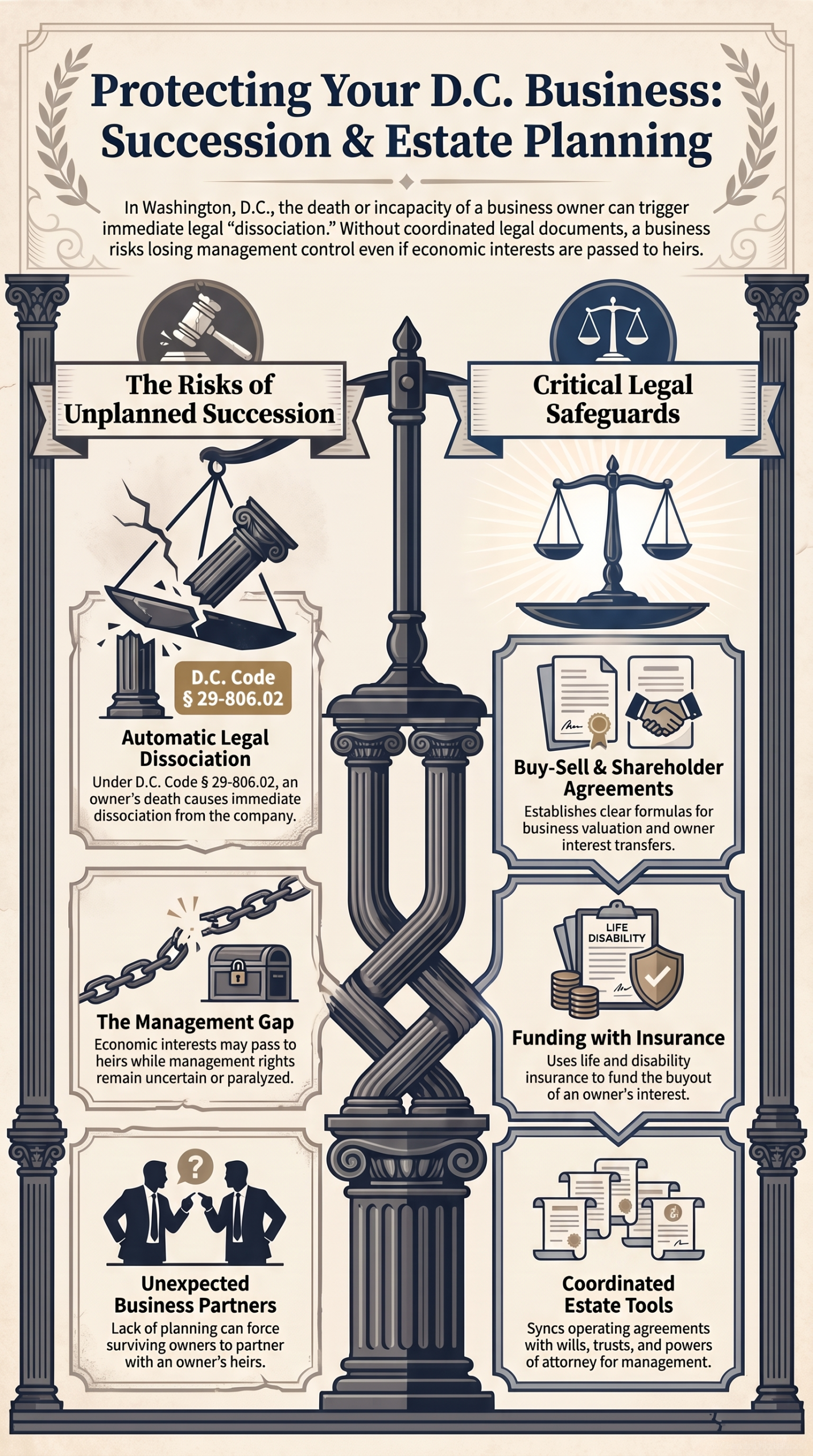
Table of Contents
- 1. The Question Owners Put Off Until Someone Else Has to Answer It
- 2. What District Law Actually Does When an Owner Dies
- 3. Your Heirs Do Not Become Your Partners, and That Is the Problem
- 4. Who Can Operate the Business During Incapacity
- 5. Powers of Attorney and Management Authority
- 6. The Manager-Managed Distinction Nobody Notices
- 7. The Single-Member LLC and the 90-Day Clock
- 8. Corporations and Partnerships: Different Defaults
- 9. Buy-Sell Agreements: The Document That Solves Most of This
- 10. Triggering Events and Deal Structure
- 11. Business Valuation Formulas
- 12. Life and Disability Insurance Funding
- 13. Transfers to Spouses, Children, Trusts, or Co-Owners
- 14. Coordinating the Operating Agreement With Wills and Trusts
- 15. Probate in the District and the Four-Month Clock
- 16. Estate Tax and the Liquidity Trap
- 17. Management Succession: The Part No Document Can Do
- 18. A Sequence That Actually Works
- 19. How We Handle District Succession Planning
- Summary
- Frequently Asked Questions
- References
1. The Question Owners Put Off Until Someone Else Has to Answer It
A widow called about a consulting firm her husband had built with two partners over eighteen years. He had died six weeks earlier. She had the death certificate, the will, and a copy of an operating agreement signed in 2009 that nobody had looked at since.
Her question was simple. When do I get paid?
The agreement had no buy-sell provision. It had a boilerplate paragraph saying a deceased member's interest passes to the member's successors. What that actually meant, under District law, was that she now held an economic interest in a company she could not vote, could not obtain records from, and could not force anyone to buy. The surviving partners were not hostile. They were sympathetic, and they also had no obligation and no cash.
That conversation happens because succession planning sits in the category of work that is never urgent until it is impossible. The owner is busy. The business is fine. The conversation is uncomfortable. And the documents that would have made it simple take a few weeks and cost a fraction of what the dispute costs.
This guide covers what District law does by default when an owner dies or becomes incapacitated, and what documents change that outcome. It is written for owners who still have time to fix it, and for families who are already past that point.
2. What District Law Actually Does When an Owner Dies
Start with the statutory chain, because every planning decision later in this guide is a response to it.
| Step | What the statute does | Authority |
|---|---|---|
| 1. Death dissociates the member | The death of an individual is an event causing that person to be dissociated as a member | D.C. Code § 29-806.02(6)(A) |
| 2. Management rights end | On dissociation the right to participate in management and conduct of the company terminates, and the interest is owned solely as a transferee | D.C. Code § 29-806.03 |
| 3. The transferee gets distributions only | A transferee may receive distributions, but subject to § 29-805.04 is not entitled to participate in management or, except in a winding up, to have access to records and information | D.C. Code § 29-805.02 |
| 4. The estate gets limited extra rights | The personal representative may exercise transferee rights and, for purposes of settling the estate, a current member's information rights | D.C. Code § 29-805.04 |
| 5. Nobody becomes a member automatically | After formation a person becomes a member as provided in the operating agreement, by a qualifying transaction, or with the consent of all the members | D.C. Code § 29-804.01(c) |
Read those five steps together and the default outcome is clear. The family inherits money rights without control rights. The business continues under the surviving owners. Nothing in the statute requires anyone to pay the family anything beyond distributions the company chooses to declare, and a company controlled by the surviving owners decides whether to declare any.
One meaningful exception sits in step 4, and it is worth knowing about. Under § 29-805.04, if a member dies, the personal representative or other legal representative may exercise the rights of a transferee and, for the purposes of settling the estate, the rights of a current member under § 29-804.10, which is the information and records section. So the estate is not blind. It can demand the financial records it needs to value the interest, even though the heirs themselves would have no such right once the estate closes and the interest is distributed to them.
This is the default, not the destiny
Every outcome described above is what happens when the operating agreement is silent. The operating agreement can require the company to purchase the interest, can admit a named successor as a full member, can grant information rights to a successor, and can fix the price and the payment terms in advance. That is what the rest of this guide is about.
3. Your Heirs Do Not Become Your Partners, and That Is the Problem
Owners often arrive worried about the wrong risk. The fear is that a co-owner's spouse or adult children will show up at the next meeting and start voting. Under District law that is not what happens, and the actual outcome is worse for everyone.
Why the heirs are stuck
The heir holds a transferable interest. Under § 29-805.02 that interest carries the right to receive distributions and essentially nothing else. No vote. No management participation. No records access. And under § 29-804.01(c) the heir cannot become a member without the consent of all the members or a provision in the operating agreement providing otherwise.
Now put yourself in the family's position. The largest asset on the estate inventory is an interest in a closely held company. They cannot sell it, because no outside buyer wants a minority interest with no control and no information. They cannot force a buyout, because no statute requires one. They cannot even confirm whether the reported profits are accurate once the estate closes. And they may owe estate tax on the value of an asset that produces no cash, which is the subject of Chapter 16.
Why the surviving owners are stuck too
This is the part owners underestimate. The surviving owners now have a passive co-owner who is entitled to a share of every distribution, forever, and who contributes nothing to the business. Every dollar distributed sends a percentage out of the building. Retaining earnings instead invites a claim that the company is being run to squeeze out the transferee. Bringing in a new working partner means diluting or negotiating with someone who has no incentive to cooperate.
Many of these situations end up in the dispute posture described in our guide to business partner disputes in Washington, DC, which is a considerably more expensive way to reach an outcome that a buy-sell agreement would have produced automatically.
The honest framing for a planning conversation
A buy-sell agreement is not primarily about protecting the business from the family. It is about making sure the family gets money instead of an interest, and the business gets certainty instead of a stranger on the cap table. Both sides of the table want the same document.
4. Who Can Operate the Business During Incapacity
Death at least produces a clear legal event. Incapacity is messier, and it is far more common. A stroke, a serious accident, a progressive diagnosis, or a period of hospitalization can remove an owner from the business for months without any document changing hands.
The immediate questions are operational. Who signs checks. Who signs the lease renewal due next month. Who approves payroll. Who talks to the bank. Who has authority to hire the replacement for the person who just quit.
The three sources of authority
- The governing document. A well-drafted operating agreement names a successor manager, defines incapacity with a workable standard such as certification by two physicians, and specifies what happens to the incapacitated owner's voting rights during the period of incapacity.
- A durable power of attorney. The owner's own agent, acting under the authority described in the next chapter. This is the fastest route and the one most often missing or too narrow.
- A court-appointed guardian or conservator. The fallback, and the slowest and most public of the three. It requires a petition, notice, a hearing, and continuing court supervision, and during the weeks that takes, the business has no clear decision maker.
The order matters. Planning documents operate immediately and privately. Court proceedings operate eventually and on the public record. If the first two sources are in place, the third is usually unnecessary, which is the entire argument for doing this work in advance. Our guardianship and conservatorship planning practice covers the planning side, and guardianship and conservatorship proceedings covers the court process when planning was not done.
Define incapacity in the document
Do not leave the trigger undefined. Agreements that say an owner may be removed from management "upon incapacity" without saying who determines it, by what standard, and with what process, generate exactly the dispute they were meant to prevent, at the worst possible moment.
A workable clause names the decision maker, sets an objective standard, requires written certification, provides for restoration of authority if the owner recovers, and states what happens to distributions and compensation in the interim.
5. Powers of Attorney and Management Authority
The District replaced its power of attorney statute. The older durable power of attorney provisions at D.C. Code §§ 21-2081 and 21-2082 have been repealed, and the District now operates under the Uniform Power of Attorney Amendment Act of 2022, codified in Title 21, Chapter 26. If your power of attorney predates that change, it is worth having reviewed.
Powers of attorney are durable by default
Under D.C. Code § 21-2601.04, a power of attorney created under the chapter is durable unless it expressly provides that it is terminated by the incapacity of the principal. That is the opposite of the old common law rule, and it is favorable: the default now preserves the agent's authority precisely when it is needed.
Business authority is a defined subject
This is the provision business owners should know by name. D.C. Code § 21-2602.09 addresses operation of an entity or business, and language granting general authority with respect to that subject authorizes the agent to do a specific list of things, including:
- Operate, buy, sell, enlarge, reduce, or terminate an ownership interest
- Perform a duty or discharge a liability and exercise a right, power, privilege, or option the principal has or claims to have as the holder of an ownership interest
- Enforce the terms of an ownership agreement
- Initiate, participate in, submit to alternative dispute resolution, settle, or appeal a claim concerning an ownership interest
- With respect to a business the principal owns solely, continue, modify, renegotiate, extend, or terminate contracts, and determine the business location, scope, methods, insurance, and personnel
- Change the form of organization of the business
- Contribute additional capital, participate in a reorganization, merger, or conversion, and sell or liquidate the business or its assets
- Establish the value of the entity under a buyout agreement
- Prepare and file reports, pay assessments, and handle related tax matters
That second to last item deserves attention. An agent acting under a properly drafted power of attorney can participate in establishing the value of the business under a buyout agreement. If your succession plan depends on a valuation happening while you are incapacitated, that authority needs to exist.
Two drafting cautions
General authority has to be granted. The business powers in § 21-2602.09 apply where the power of attorney grants general authority with respect to that subject. A narrow document limited to banking and real estate does not reach the business.
Some acts require a specific grant. Under D.C. Code § 21-2602.01, certain acts require express authority in the document, including creating, amending, revoking, or terminating an inter vivos trust, making a gift, creating or changing rights of survivorship, and creating or changing a beneficiary designation. Several of those matter a great deal in a succession plan, so the power of attorney and the estate plan have to be drafted together.
Third parties are the practical obstacle. Banks, transfer agents, and title companies review these documents and sometimes resist. A power of attorney that tracks the District's statutory framework, and where appropriate uses the statutory form, is accepted more readily than a document drafted to another state's conventions.
6. The Manager-Managed Distinction Nobody Notices
Here is a distinction inside the dissociation statute that changes the analysis and almost never gets mentioned.
Under D.C. Code § 29-806.02(6), in the case of an individual, paragraph (A) provides that the person dies. That applies to every LLC. But the provisions in paragraph (B), which address the appointment of a guardian or general conservator and a judicial determination that the person has otherwise become incapable of performing the person's duties as a member, open with the words in a member-managed limited liability company.
What that means in practice
In a member-managed LLC: appointment of a guardian or general conservator for a member, or a judicial determination of incapacity to perform member duties, dissociates that member. The member loses management and voting rights and becomes a transferee, while still alive.
In a manager-managed LLC: that automatic dissociation does not apply on those grounds. An incapacitated member remains a member. Whether anyone can exercise that member's rights then depends on the operating agreement, a durable power of attorney, or a guardianship order.
Neither outcome is obviously better, and that is the point. In a member-managed company, a family watching an owner decline may find that a guardianship petition, filed for entirely unrelated reasons, strips that owner's interest of its management rights permanently. In a manager-managed company, an incapacitated member keeps rights that nobody has clear authority to exercise, which can freeze a vote that requires unanimity.
Check which structure your company uses before assuming either result. It is stated in the operating agreement, and under § 29-804.07(a) a District LLC is member-managed unless the operating agreement provides otherwise, so silence means member-managed.
7. The Single-Member LLC and the 90-Day Clock
Single-member LLCs are everywhere in the District: consultants, contractors, medical and professional practices, rental property holders, government-adjacent advisory firms. They carry a specific risk that multi-member companies do not.
When the sole member dies, the company has no members. Under D.C. Code § 29-807.01(a)(3), the passage of 90 consecutive days during which the company has no members causes dissolution, unless two things happen: consent to admit at least one specified person as a member is given by transferees owning the rights to receive a majority of distributions, and at least one person actually becomes a member in accordance with that consent.
Ninety days, while the family is grieving and probate has not opened
Opening a District probate estate, obtaining letters of administration, and getting a personal representative in place routinely takes longer than people expect. The 90 day clock does not wait for any of that.
If it runs out, the operating company dissolves by statute. Contracts with change of control or dissolution provisions may terminate. Licenses and registrations tied to the entity are affected. The value the family was counting on can evaporate while everyone is still handling the funeral.
The fix is cheap and takes one paragraph. A single-member operating agreement should name a successor member, or at minimum a designated person who becomes a member on the sole member's death, so that the admission happens by the agreement rather than by a consent process that requires a probate appointment first.
Two related points for single owners. First, an operating agreement is not optional just because there is only one member. It is the document that carries the succession provision. Second, name a successor manager as well, so someone can sign, pay, and operate immediately rather than waiting for authority that arrives months later. Our business formation and structuring practice handles both.
8. Corporations and Partnerships: Different Defaults
The LLC rules above do not carry over to other entity types. A quick orientation.
| LLC | Corporation | General partnership | |
|---|---|---|---|
| What death does | Dissociates the member, § 29-806.02(6)(A) | Shares pass to the estate as property; the corporation continues | Dissociates the partner |
| What the successor holds | A transferable interest, economic rights only, § 29-805.02 | The shares themselves, including voting rights, unless restricted | An interest the partnership must purchase, § 29-607.01 |
| Voting and control | None, unless admitted as a member under § 29-804.01(c) | The estate or heirs generally may vote the shares | No management participation after dissociation |
| Automatic buyout | None by statute | None by statute | Yes where dissociation does not cause dissolution, at the greater of liquidation or going concern value, § 29-607.01 |
| Primary planning document | Operating agreement with a buy-sell | Shareholder agreement with transfer restrictions and a buy-sell | Partnership agreement modifying or funding the statutory buyout |
The corporate column is the one people misread. Shares are personal property that pass under the will or trust like any other asset, and with them go voting rights. A closely held corporation with no shareholder agreement can genuinely end up with a founder's heirs voting shares at the next meeting. That is why transfer restrictions and a buy-sell belong in a shareholder agreement, and why corporate governance and compliance work matters more in a small corporation than its size suggests.
The partnership column is the favorable one. Under § 29-607.01, where a partner is dissociated without that dissociation causing a dissolution and winding up under § 29-608.01, the partnership must cause the interest to be purchased, at the greater of liquidation value or the value based on a sale of the entire business as a going concern without the dissociated partner, with interest from the date of dissociation. That statutory buyout is a real protection the LLC member does not have. It is also unfunded, which means the partnership owes money it may not have, so partnerships need insurance funding just as much as anyone else.
9. Buy-Sell Agreements: The Document That Solves Most of This
The buy-sell agreement is the instrument that resolves nearly everything described so far. It can live inside the operating agreement, inside a shareholder agreement, or as a standalone contract among the owners and the entity.
What a complete buy-sell does:
- Creates an obligation to buy and an obligation to sell on defined events, converting an illiquid interest into a receivable
- Fixes the price or the method so the valuation fight happens once, in advance, among people who do not yet know which side of it they will be on
- Sets payment terms so the business is not forced to liquidate to fund the purchase
- Restricts transfers so an interest cannot reach an outsider, a creditor, or a divorcing spouse without first being offered to the company or the other owners
- Names who may be admitted as a member or shareholder, solving the § 29-804.01(c) consent problem in advance
- Coordinates with insurance so the money exists when the obligation is triggered
The most useful feature of a buy-sell is when it is negotiated
At signing, no owner knows whether they will be the one who dies first, becomes disabled, gets divorced, or wants out. That uncertainty produces terms both sides can live with. The same conversation held after the event is a negotiation between a grieving family and a business under pressure, and it rarely produces anything either side considers fair.
A caution worth stating plainly. A buy-sell agreement that is not funded is a promise to pay money the company may not have. An agreement obligating a business to purchase a departed owner's interest for $1.8 million, with no funding mechanism, can put the business into a cash crisis that harms the surviving owners and still leaves the family unpaid. Funding is Chapter 12, and it is not optional.
10. Triggering Events and Deal Structure
Two design decisions shape every buy-sell: what sets it off, and who does the buying.
Triggering events
Death is the obvious one and the least complete. A thorough agreement also addresses disability with a defined standard and waiting period, retirement with a minimum age or years of service, voluntary withdrawal, termination of employment where ownership was tied to working in the business, divorce so that an interest awarded to a spouse must be offered back, personal bankruptcy or a creditor charging order, loss of a professional license where the business requires one, and a material breach of the governing agreement.
Each trigger should specify whether the purchase is mandatory or optional, who holds the option and in what order, and how long they have to exercise it.
Three structures
| Structure | Who buys | Main advantage | Main drawback |
|---|---|---|---|
| Cross-purchase | The remaining owners individually | Buyers receive a basis step-up in what they purchase | With several owners it requires many policies and gets unwieldy |
| Entity redemption | The company itself | Simple, one policy per owner, the company controls funding | No basis step-up for the remaining owners, and corporate-level considerations apply |
| Hybrid or wait-and-see | The company or the owners, decided at the time | Flexibility to choose the better treatment when the event occurs | More complex drafting and more coordination with the funding |
The choice has real tax consequences and should be made with the company's accountant in the room. This guide describes the structures rather than recommending one, because the right answer depends on entity type, the number of owners, existing basis, and how the owners expect to exit. We are not tax advisors, and a succession plan built without the accountant's input usually gets rebuilt later.
11. Business Valuation Formulas
Every buy-sell needs a price mechanism. The method chosen at signing determines what the family receives, so it deserves more attention than it usually gets.
| Method | How it works | Where it fails |
|---|---|---|
| Fixed price with periodic update | The owners agree on a value and restate it annually | Owners stop updating it. A price set in 2014 gets applied in 2026 |
| Formula | A multiple of earnings, revenue, book value, or a blended figure | A formula calibrated to one business cycle can produce absurd results in another |
| Single appraisal | One appraiser selected by an agreed process values the interest | Everything depends on who selects the appraiser and by what standard |
| Multiple appraisal | Each side appoints an appraiser; a third resolves or the results are averaged | Expensive and slow, which delays payment to the family |
| Shotgun or right of first refusal | One owner names a price and the other elects to buy or sell at it | Works between owners of similar means, badly where one cannot fund a purchase |
The clauses that decide the number
Standard of value. Fair market value and fair value are different concepts and produce different results. Say which one applies, in the document.
Discounts. State expressly whether discounts for lack of control and lack of marketability apply. Silence on this point is the single most litigated gap in buy-sell valuations, and the swing can be very large on a minority interest.
Insurance proceeds. State whether life insurance proceeds received by the company are included in the company's value for purposes of the purchase. If the agreement is silent, the family may argue the proceeds increased the value of the business that is being bought with those same proceeds. Decide it in advance and write it down.
Whatever method is chosen, put a review obligation in the document: the owners will revisit the value or the formula annually, and a stale figure past a stated age defaults to an appraisal. That single sentence prevents the most common failure in this area.
12. Life and Disability Insurance Funding
A funded buy-sell works. An unfunded one is a lawsuit with a signature page.
Life insurance
Term life is the usual instrument for a death trigger, because it is inexpensive relative to the coverage and the obligation it secures is a defined amount. Permanent policies are used where the planning horizon extends past the term period, where cash value serves a secondary purpose, or where insurability is a concern.
Practical points that cause problems when ignored:
- Match ownership of the policy to the buy-sell structure. In a redemption the company generally owns the policies. In a cross-purchase the owners generally own policies on each other. A mismatch between the agreement and the policies undermines both.
- Review coverage as the business grows. A policy sized to a company worth $2 million does not fund a buyout of a company worth $9 million. Review coverage whenever the agreed value is reviewed.
- Confirm the beneficiary designations. These are the documents most often left pointing at an ex-spouse, a deceased parent, or an entity that no longer exists. Under D.C. Code § 21-2602.01 an agent cannot change a beneficiary designation without a specific grant of authority, so this is not something anyone can quietly fix later on the owner's behalf.
- Address insurability. If one owner cannot obtain coverage, the agreement needs an alternative funding path for that owner, such as an installment obligation secured by the interest.
Disability insurance
This is the gap in most plans. Disability is more likely than death during working years, and a disability buyout obligation is rarely funded. Disability buyout policies exist and are distinct from personal disability income coverage, which replaces the owner's salary rather than funding a purchase of the owner's interest. A plan that covers death but not disability solves the less probable problem.
Align the definitions. If the buy-sell defines disability one way and the policy defines it another, the obligation can trigger while the funding does not, which is the worst of both positions.
Where insurance is not enough
Installment purchases with a promissory note, a sinking fund, or borrowing are the alternatives. Each has consequences for the surviving business, and each should be sized against realistic cash flow rather than optimistic projections. An installment obligation should be secured, should carry a stated interest rate, and should include acceleration terms so the family is not left as an unsecured creditor of a business they no longer influence.
13. Transfers to Spouses, Children, Trusts, or Co-Owners
Where the interest goes is a separate decision from whether it gets bought, and the two have to be consistent.
To a spouse
Common and simple, and it carries a risk worth naming. If the plan is for the spouse to sell the interest, make sure the buy-sell obliges someone to buy it. If the plan is for the spouse to hold it, understand that under § 29-805.02 the spouse holds economic rights without management rights unless admitted as a member. A spouse who is not involved in the business and is not admitted becomes exactly the stranded transferee described in Chapter 3.
To children
The hardest category, because families are rarely symmetrical. One child works in the business, two do not. Leaving the business equally to all three creates a controlling block of people with no operating role over the one who runs it. Leaving it entirely to the operator treats the others unequally unless the estate has other assets to balance against.
Common approaches include equalizing with life insurance payable to the non-operating children, transferring voting and non-voting interests separately so the operator has control while the others share economics, or selling the business to the operating child on terms that fund the rest of the estate. Each requires the operating agreement to permit the transfer structure contemplated.
To trusts
A trust can hold a business interest and frequently should. It avoids probate for that asset, provides for management by a trustee if beneficiaries are minors or unable to manage it, and can carry distribution terms that a simple bequest cannot. Our revocable living trusts practice handles the probate-avoidance side, irrevocable trusts the planning that removes value from the estate, special needs trusts where a beneficiary receives public benefits, and charitable and testamentary trusts where charitable goals are part of the plan.
The step everyone forgets
Creating a trust does not move the business interest into it. The interest has to be assigned, the transfer has to be permitted by the operating agreement, and the company's records have to reflect it. An unfunded trust is a well-drafted document that governs nothing, and the asset it was supposed to keep out of probate goes through probate anyway.
To co-owners
The cleanest outcome where the family does not want to be in business. This is the buy-sell working as designed: the interest goes to the surviving owners and the money goes to the family. It requires the obligation, the price mechanism, and the funding to all be in place, which is the combination this guide keeps returning to.
14. Coordinating the Operating Agreement With Wills and Trusts
This is where plans fail most often, and the failure is entirely avoidable. Two sets of documents, usually drafted by different people at different times, contradict each other.
The conflicts we find
- The will leaves the business to someone the operating agreement will not admit. The will controls where the economic interest goes. The operating agreement controls whether that person becomes a member. Under § 29-804.01(c) admission requires the operating agreement's provision or the consent of all the members, so a bequest cannot override a transfer restriction.
- The trust is named as owner but the transfer was never made. Covered above, and it is the most common single defect.
- The buy-sell price and the estate plan assume different values. An estate plan built around a $6 million business and a buy-sell that produces $3 million leaves the rest of the plan underfunded, including any equalizing gifts to other children.
- The operating agreement prohibits the transfer the estate plan requires. Transfer restrictions written to keep outsiders out will also keep a family trust out, unless the agreement carves out permitted transfers for estate planning purposes.
- The power of attorney cannot do what the plan needs. Under § 21-2602.01, creating or amending a trust, making gifts, and changing beneficiary designations each require a specific grant. A plan that depends on those steps happening during incapacity needs the authority written in.
The coordination review
Put these documents on one table and read them against each other: the operating agreement or bylaws and shareholder agreement, the buy-sell, the will, any trust and its funding records, the durable power of attorney, every insurance policy with its beneficiary designation, and the current capitalization records.
This review usually takes a few hours and finds something every time. It is the single highest value thing an owner with existing documents can do.
We handle both halves of that review, through our estate planning practice and our business litigation and transactions practice, which is the point of doing it in one place.
15. Probate in the District and the Four-Month Clock
Even with good documents, an owner's death puts the business in contact with the probate process. Knowing the timeline explains why speed matters.
The District's timeline
| Step | Timing | Authority or source |
|---|---|---|
| Small estate proceeding available | Property subject to administration valued at $80,000 or less, raised from $40,000 effective March 21, 2025 | D.C. Code § 20-351 |
| Notice of appointment published | Published, with written notice to known heirs and creditors within 20 days of appointment | D.C. Code § 20-704 |
| Creditor claims barred after | 6 months from the first publication of notice of appointment | D.C. Code § 20-903 |
| Inventory due | Within 3 months of the personal representative's appointment | D.C. Code § 20-711 |
| First account due in a supervised estate | No later than 1 year and 1 day from first publication, then every 9 months | DC Superior Court Probate Division |
| DC estate tax return (D-76) due | Within 10 months after death, with a 6-month extension available on Form D-77 | DC Office of Tax and Revenue |
The Four-Month Limit on Running the Business
Under D.C. Code § 20-741(19), a personal representative may continue unincorporated businesses or ventures in which the decedent was engaged at the time of death, in the same business form, for a period of not more than 4 months after the representative's appointment, where continuation is a reasonable means of preserving the value of the business including goodwill, and the representative must file a bimonthly statement of income and expenses and a balance sheet with the Register of Wills. There is one way to extend it: the same paragraph permits continuation throughout the period of administration if the business is incorporated after the decedent's death in accordance with § 20-741(20), which itself requires that none of the probable distributees who are competent adults object.
Set that against the rest of the timeline. The inventory is not even due for 90 days. Creditor claims stay open for 6 months. The estate tax return is due at 10 months. And the authority to simply keep the doors open on an unincorporated business runs out at 4 months unless someone goes back to court. A business that depends on the probate estate for its authority to operate is a business on a short clock.
The conclusion owners should draw is not that probate is unworkable. It is that the business should not be depending on probate at all. An entity with a named successor manager, a funded buy-sell, and interests held in a trust keeps operating on day one, while the estate handles what estates handle. Our transfer-on-death and probate avoidance practice addresses the asset side, probate process guidance the administration, and executor and personal representative representation the fiduciary who has to manage all of it.
Where the succession itself is contested, the matter moves into will contests, trust disputes, or fiduciary litigation, which is the expensive end of a problem that planning prevents.
16. Estate Tax and the Liquidity Trap
This is the chapter that surprises District business owners, because the federal headline number has moved so far that people assume estate tax is somebody else's problem.
Two thresholds, and they are very far apart
Federal. The IRS has stated that estates of decedents who die during 2026 have a basic exclusion amount of $15,000,000. The annual gift tax exclusion for 2026 is $19,000.
District of Columbia. The DC Office of Tax and Revenue's D-76 instructions provide that estates of decedents who died January 1, 2026 through December 31, 2026 have an exclusion amount of $4,988,400. DC estate tax rates for 2026 run on a graduated scale from 11.2 percent up to 16 percent on the largest estates.
The gap is roughly $10 million. A District business owner can be nowhere near a federal estate tax problem and squarely inside a DC one.
Now apply that to a business owner's balance sheet. A District row house worth $1.4 million, retirement accounts, life insurance the owner owns personally, and a business interest valued at $3 million puts an estate over the DC threshold without anything unusual happening. The tax is due within 10 months of death. The largest asset cannot be sold quickly and produces no cash on demand.
That is the liquidity trap, and it is the reason succession planning and estate tax planning are the same project. A family that has to sell the business quickly to pay a tax bill sells it badly.
What addresses it
- Insurance owned outside the estate. Life insurance the decedent owns is generally includable in the estate. Insurance owned by an irrevocable trust, properly structured, can provide liquidity without adding to the taxable estate.
- A funded buy-sell. Converting the interest to cash on a defined timetable solves the liquidity problem and the valuation problem at the same time.
- Lifetime transfers. Moving value out of the estate over time, using the annual exclusion and other planning techniques, with the caveat that gifts of business interests interact with the transfer restrictions in the operating agreement.
- Coordination with the accountant. These figures are indexed and the rules change. Confirm current numbers before relying on any of them, and revisit the plan periodically rather than treating it as finished.
A note on these figures
The DC exclusion is adjusted annually and the federal figure is indexed as well. The amounts stated here are for decedents dying in 2026 and come from the DC Office of Tax and Revenue's D-76 instructions and the IRS inflation adjustments for tax year 2026. Verify the current year's amounts with the District and the IRS before acting, and note that we are not tax advisors. Work with your accountant on the tax calculations.
17. Management Succession: The Part No Document Can Do
Everything to this point is about ownership. Ownership is the part lawyers can fix. Management is the part that decides whether the business survives, and no document does it for you.
A company where one person holds the client relationships, knows the pricing, approves every exception, and is the reason customers stay has a concentration problem that a buy-sell does not touch. If that person is gone on Monday, the interest being valued on Friday is worth considerably less than the valuation assumed.
What actually transfers capability
- Name a successor, in writing, in the operating agreement. Not a plan to decide later. A named person with defined authority effective on a defined event.
- Introduce that person to the relationships now. Clients, the bank, the landlord, the insurance broker, key vendors, and the accountant should know who the second call is.
- Document what lives in one person's head. Pricing logic, vendor terms, the reason certain customers get certain treatment, where the passwords and the contracts are.
- Distribute signature and system authority before it is needed. Bank signature cards, payroll access, insurance, the domain registrar, and the accounting system. Businesses have been paralyzed by a locked email account.
- Give the successor real decisions in advance. Capability transfers through practice, not through a memo.
Key person insurance is a different product
Buy-sell insurance funds the purchase of an interest. Key person insurance pays the company for the operating loss caused by losing the person, covering the cost of recruiting and the revenue disruption while a successor comes up to speed. Owners frequently buy the first and assume it does the second. It does not.
18. A Sequence That Actually Works
A practical order, because owners who try to do all of this at once tend to do none of it.
- One. Read the operating agreement, bylaws, or partnership agreement you actually have. Find out whether it is member-managed or manager-managed, whether it has a buy-sell, and what it says about transfers and about death.
- Two. If you are a single-member LLC, fix the successor member provision first. The 90 day dissolution rule in § 29-807.01(a)(3) is the most serious exposure in this guide and the cheapest to close.
- Three. Put a durable power of attorney in place that grants general authority over operation of an entity or business, and check whether the specific grants in § 21-2602.01 that your plan needs are included.
- Four. Negotiate the buy-sell: triggers, structure, price mechanism, payment terms, and transfer restrictions. Do it with the accountant involved.
- Five. Fund it. Life insurance sized to the current value, disability buyout coverage, and an installment fallback where insurance is not available.
- Six. Align the estate plan. Will, trust, trust funding for the business interest, and beneficiary designations on every policy and account.
- Seven. Name the successor manager and start transferring capability.
- Eight. Calendar an annual review of the agreed value, the insurance amount, and the beneficiary designations. This is the step that keeps the other seven from going stale.
Owners who complete steps one through three have addressed most of the catastrophic risk. Steps four through six determine whether the family gets paid. Step seven determines whether there is a business left to pay them.
19. How We Handle District Succession Planning
Shin Law Office handles both halves of this work, which is the reason the coordination problems in Chapter 14 get caught. Basil M. Al-Qaneh is admitted in the District of Columbia, Maryland, Massachusetts, and Virginia, which matters for owners whose business, residence, and real property sit in different jurisdictions across this region.
What we handle:
- Estate planning for business owners, including wills, revocable living trusts, and irrevocable trusts
- Buy-sell agreements, operating agreements, and shareholder agreements through our business formation and structuring practice
- Guardianship and conservatorship planning and long-term care and elder law where incapacity planning is the priority
- Transfer-on-death and probate avoidance for the assets that should never see probate
- Probate administration, including probate process guidance and executor and personal representative representation
- Will contests, trust disputes, and fiduciary litigation when a succession is challenged
- Shareholder and member disputes and partnership disputes when succession planning was not done in time
- Mergers and acquisitions where the succession plan is a sale of the business
We work across all four quadrants and all eight wards. See our Washington, DC service areas, our guide to business partner disputes in Washington, DC, and our guide to breach of contract in Washington, DC for related work, or the estate planning and probate overview for the full practice.
Summary
District law has a default answer for what happens to your business when you die. It is not the answer most owners would choose.
- Death dissociates an LLC member. Under § 29-806.02(6)(A) death is a dissociation event, under § 29-806.03 management rights terminate, and under § 29-805.02 the successor holds economic rights with no vote and no records access.
- Heirs do not become members automatically. Under § 29-804.01(c) admission requires the operating agreement's provision or the consent of all members. The estate does get the deceased member's information rights for purposes of settling the estate under § 29-805.04.
- Incapacity is treated differently by structure. The guardian, conservator, and judicial incapacity provisions in § 29-806.02(6)(B) apply in a member-managed LLC. Death under (6)(A) applies to all of them.
- A single-member LLC can dissolve in 90 days. Section 29-807.01(a)(3) dissolves a company that has no members for 90 consecutive days unless transferees holding majority distribution rights consent and someone becomes a member. Name a successor member in the operating agreement.
- Powers of attorney are durable by default under § 21-2601.04, and § 21-2602.09 gives an agent broad authority over operation of an entity or business, including establishing the value of the entity under a buyout agreement. Certain acts still require a specific grant under § 21-2602.01.
- Probate runs on a slower clock than the business. A personal representative may continue an unincorporated business for not more than 4 months after appointment under § 20-741(19), unless it is incorporated after death under § 20-741(20), while creditor claims stay open 6 months and the DC estate tax return is due at 10 months.
- The DC estate tax threshold is far below the federal one. For 2026 the DC exclusion is $4,988,400 with rates from 11.2 to 16 percent, against a federal basic exclusion of $15,000,000. The gap is where the liquidity problem lives.
- An unfunded buy-sell is not a plan. Insurance, sized to current value and reviewed annually, is what turns the obligation into money.
If you do one thing after reading this, read your operating agreement and your will in the same sitting. The gap between them is the plan you do not have.
Frequently Asked Questions
What happens to my LLC interest in Washington, DC when I die?
Under D.C. Code § 29-806.02(6)(A) your death is an event causing your dissociation as a member. Under § 29-806.03 your right to participate in management terminates and the interest is owned solely as a transferable interest. Under § 29-805.02 a transferee may receive distributions but is not entitled to participate in management and, subject to § 29-805.04 and a narrow winding-up exception, is not entitled to access company records and information. Your successors therefore inherit the economic interest, not your seat at the table, unless the operating agreement provides otherwise or the members consent to admit them under § 29-804.01(c).
Will my spouse or children automatically become partners in my business?
Not in a DC LLC. Under § 29-804.01(c), after formation a person becomes a member as provided in the operating agreement, as the result of a merger, conversion, or similar transaction effective under the relevant subchapter, or with the consent of all the members. An heir who is not admitted holds a transferable interest with economic rights only. In a corporation the answer can be different, because shares are personal property that pass with voting rights attached unless a shareholder agreement restricts transfer, which is one reason closely held corporations need transfer restrictions.
Can my business be forced to buy out my family after I die?
Only if a document says so. No District statute requires an LLC to purchase a deceased member's interest. A general partnership is different: under D.C. Code § 29-607.01, where a partner is dissociated without that causing a dissolution and winding up under § 29-608.01, the partnership must cause the interest to be purchased at the greater of liquidation value or going concern value without the dissociated partner. For an LLC or a corporation, the obligation has to come from a buy-sell agreement, which is why that document is the center of any succession plan.
What happens to my single-member LLC if I die?
This is the most time-sensitive risk in this area. Under D.C. Code § 29-807.01(a)(3), the passage of 90 consecutive days during which the company has no members causes dissolution, unless transferees owning the rights to receive a majority of distributions consent to admit at least one specified person as a member and that person actually becomes a member. Opening probate and getting a personal representative appointed can take longer than that. The fix is to name a successor member in the operating agreement so admission happens automatically.
Who runs my business if I become incapacitated?
It depends on which documents exist. The fastest route is a durable power of attorney granting your agent general authority over operation of an entity or business under D.C. Code § 21-2602.09, which covers operating the business, exercising your rights as an owner, enforcing an ownership agreement, and even establishing the value of the entity under a buyout agreement. Next is a successor manager named in the operating agreement. The fallback is a court-appointed guardian or conservator, which is slower and public. Under § 21-2601.04 a DC power of attorney is durable unless it expressly says it terminates on incapacity.
Does a guardianship remove me as an LLC member in DC?
It can, depending on the structure. D.C. Code § 29-806.02(6)(B) addresses appointment of a guardian or general conservator and a judicial determination that a person has otherwise become incapable of performing the person's duties as a member, and those provisions apply in a member-managed limited liability company. In a manager-managed company that automatic dissociation on those grounds does not apply. Since § 29-804.07(a) makes an LLC member-managed unless the operating agreement provides otherwise, silence in the agreement means member-managed.
How much is my business worth for a buyout?
Whatever the buy-sell agreement says, which is why the price mechanism deserves careful attention. The common methods are a fixed price updated periodically, a formula tied to earnings or revenue, a single appraisal, a multiple-appraisal process, or a shotgun provision. Three clauses decide the actual number: the standard of value, since fair market value and fair value are different concepts; whether discounts for lack of control and lack of marketability apply; and whether life insurance proceeds received by the company count toward its value. State all three expressly.
How should a buy-sell agreement be funded?
Most commonly with life insurance sized to the agreed value, structured to match the agreement. In an entity redemption the company generally owns the policies; in a cross-purchase the owners generally own policies on each other. Disability buyout coverage is the piece most often missing, and it is distinct from personal disability income insurance, which replaces salary rather than funding a purchase. Where insurance is unavailable, an installment note that is secured, carries interest, and includes acceleration terms is the alternative. An unfunded buy-sell obligates a business to pay money it may not have.
Is there a DC estate tax on my business interest?
There can be, and the District threshold is much lower than the federal one. The DC Office of Tax and Revenue's D-76 instructions state that estates of decedents who died January 1, 2026 through December 31, 2026 have an exclusion amount of $4,988,400, with graduated rates running from 11.2 percent to 16 percent. The IRS has stated that estates of decedents dying during 2026 have a federal basic exclusion amount of $15,000,000. A District owner can be far below the federal threshold and still owe DC estate tax on an illiquid business interest. The DC return is due within 10 months of death. These figures are adjusted annually, so confirm the current amounts and work with your accountant.
How long can my personal representative keep the business running during probate?
For an unincorporated business, not long. Under D.C. Code § 20-741(19) a personal representative may continue unincorporated businesses or ventures in which the decedent was engaged at the time of death, in the same business form, for a period of not more than 4 months after the representative's appointment, where continuation is a reasonable means of preserving the value of the business including goodwill, and the representative must file a bimonthly statement of income and expenses and a balance sheet with the Register of Wills. The same paragraph allows continuation throughout the period of administration if the business is incorporated after death under § 20-741(20), which requires that no competent adult probable distributee objects. Meanwhile creditor claims remain open for 6 months from first publication under § 20-903 and the inventory is due within 90 days of appointment. A business that depends on the probate estate for its operating authority is on a short clock.
Should my business interest go into a trust?
Often yes, but two steps are required and the second is the one people skip. First the trust has to be created. Second the interest has to actually be assigned to it, the transfer has to be permitted by the operating agreement, and the company's records have to reflect the new owner. An unfunded trust governs nothing, and the asset it was meant to keep out of probate goes through probate anyway. Check the transfer restrictions first, because restrictions written to keep outsiders out will also block a family trust unless the agreement carves out estate planning transfers.
My operating agreement and my will say different things. Which one controls?
They control different questions, which is why the conflict is so damaging. The will or trust controls where your economic interest goes. The operating agreement controls whether that person can become a member, and under § 29-804.01(c) admission requires the agreement's provision or the consent of all members. So a bequest cannot override a transfer restriction. The result is an heir who owns an economic interest they cannot vote in a company they cannot get records from. The fix is a coordination review of the operating agreement, buy-sell, will, trust and its funding, power of attorney, and every beneficiary designation, read against each other in one sitting.
Bring Both Documents to One Table
The operating agreement and the estate plan are usually drafted years apart by different people, and the gap between them is where succession plans fail. Send us both. We will tell you what happens under your current documents, and what it would take to change the answer.
Schedule a Consultation with Basil M. Al-Qaneh, Esq.
Call 571-445-6565 | Business owners and families in DC, Northern Virginia, and Maryland
References
Code of the District of Columbia. Small estates; definition and administration, D.C. Code § 20-351. https://code.dccouncil.gov/us/dc/council/code/sections/20-351
Code of the District of Columbia. Notice of appointment to interested persons, creditors and unknown heirs, D.C. Code § 20-704. https://code.dccouncil.gov/us/dc/council/code/sections/20-704
Code of the District of Columbia. Inventory of property of the estate, D.C. Code § 20-711. https://code.dccouncil.gov/us/dc/council/code/sections/20-711
Code of the District of Columbia. General powers of the personal representative, D.C. Code § 20-741. https://code.dccouncil.gov/us/dc/council/code/sections/20-741
Code of the District of Columbia. Limitation on presentation of claims against the estate, D.C. Code § 20-903. https://code.dccouncil.gov/us/dc/council/code/sections/20-903
Code of the District of Columbia. Power of attorney is durable, D.C. Code § 21-2601.04. https://code.dccouncil.gov/us/dc/council/code/sections/21-2601.04
Code of the District of Columbia. Authority that requires specific grant; grant of general authority, D.C. Code § 21-2602.01. https://code.dccouncil.gov/us/dc/council/code/sections/21-2602.01
Code of the District of Columbia. Operation of entity or business, D.C. Code § 21-2602.09. https://code.dccouncil.gov/us/dc/council/code/sections/21-2602.09
Code of the District of Columbia. Becoming member, D.C. Code § 29-804.01. https://code.dccouncil.gov/us/dc/council/code/sections/29-804.01
Code of the District of Columbia. Management of limited liability company, D.C. Code § 29-804.07. https://code.dccouncil.gov/us/dc/council/code/sections/29-804.07
Code of the District of Columbia. Right of members, managers, and dissociated members to information, D.C. Code § 29-804.10. https://code.dccouncil.gov/us/dc/council/code/sections/29-804.10
Code of the District of Columbia. Transfer of transferable interest, D.C. Code § 29-805.02. https://code.dccouncil.gov/us/dc/council/code/sections/29-805.02
Code of the District of Columbia. Power of personal representative of deceased member, D.C. Code § 29-805.04. https://code.dccouncil.gov/us/dc/council/code/sections/29-805.04
Code of the District of Columbia. Events causing dissociation, D.C. Code § 29-806.02. https://code.dccouncil.gov/us/dc/council/code/sections/29-806.02
Code of the District of Columbia. Effect of person's dissociation as member, D.C. Code § 29-806.03. https://code.dccouncil.gov/us/dc/council/code/sections/29-806.03
Code of the District of Columbia. Purchase of dissociated partner's interest, D.C. Code § 29-607.01. https://code.dccouncil.gov/us/dc/council/code/sections/29-607.01
Code of the District of Columbia. Events causing dissolution, D.C. Code § 29-807.01. https://code.dccouncil.gov/us/dc/council/code/sections/29-807.01
District of Columbia Office of Tax and Revenue. 2026 D-76 Estate Tax Instructions for Estates of Individuals. https://otr.cfo.dc.gov/
Internal Revenue Service. IRS releases tax inflation adjustments for tax year 2026. https://www.irs.gov/newsroom/irs-releases-tax-inflation-adjustments-for-tax-year-2026-including-amendments-from-the-one-big-beautiful-bill
Superior Court of the District of Columbia, Probate Division. After Death: A Guide to Probate in the District of Columbia. https://www.dccourts.gov/

ATTORNEY
Practice Areas
Meet Our Team
Shin Law Office, PLC
