


What Legal Problems Are Hiding in Your D.C. Commercial Property Deal?
Title Defects, Liens, Zoning, Existing Tenants, Environmental Risks, and Contract Due Diligence
By Basil M. Al-Qaneh, Esq. | Shin Law Office, PLC | Updated September 21, 2026
BOTTOM LINE UP FRONT
When you buy commercial property, you buy its history. I am not only checking whether the seller owns it. I am checking what runs with it: recorded liens, unrecorded liens that can still be perfected after you close, lease obligations you must honor, zoning that may not match the use you have planned, contamination you can become responsible for, and District compliance obligations that transfer with the building.
Three District-specific items catch buyers most often. A mechanics' lien notice of intent can be recorded up to 90 days after the work ends, which can mean after your closing. A mixed-use building with apartments over retail can trigger tenant purchase rights under TOPA. And Building Energy Performance Standards obligations attach to the building, not to the seller who ignored them.
Send me the purchase agreement before you sign it, not after. Call 571-445-6565 or Schedule a Consultation. Almost every protection you will have in this deal comes from the contract.
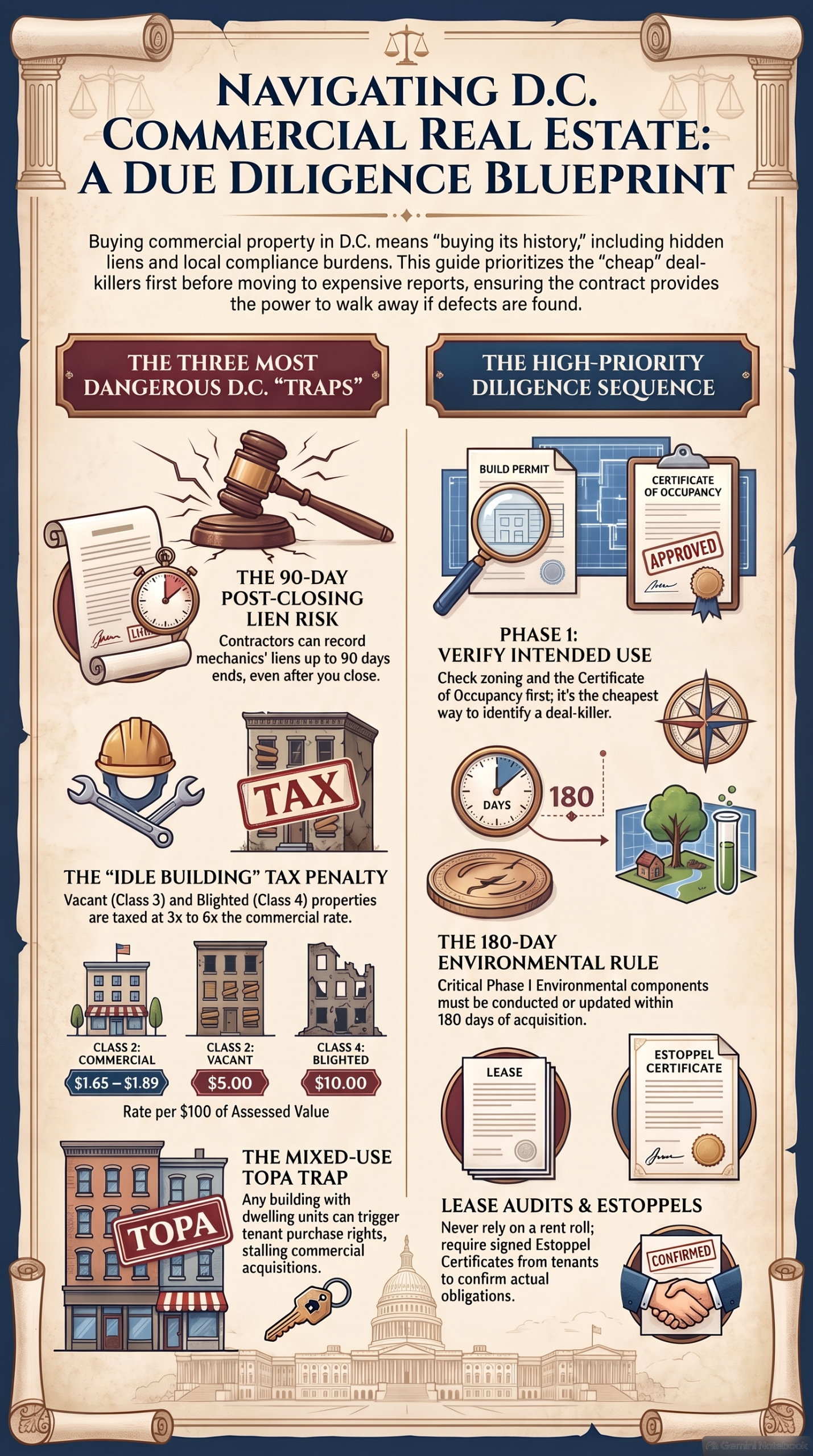
Table of Contents
- 1. The First Question I Ask a Buyer
- 2. The Contract Is Where Due Diligence Is Won or Lost
- 3. What I Want in the Study Period
- 4. Reading the Title Commitment
- 5. The Title Exceptions I Will Not Let a Client Accept
- 6. Liens That Are Recorded, and Liens That Arrive After You Close
- 7. Unpaid Taxes and the District's Tax Sale
- 8. The Vacant and Blighted Tax Classes
- 9. Survey, Encroachments, and Easements
- 10. Zoning: What the Property Is Allowed to Be
- 11. The Certificate of Occupancy and Nonconforming Use
- 12. Historic Districts and Landmark Designation
- 13. The Leases You Are Actually Buying
- 14. Estoppel Certificates and Subordination Agreements
- 15. TOPA: The Trap in Mixed-Use Buildings
- 16. Environmental: Phase I and the 180-Day Rule
- 17. Building Energy Performance Standards
- 18. Entity Deals and the Economic Interest Tax
- 19. My Closing Checklist, and How I Work With Buyers
- Summary
- Frequently Asked Questions
- References
1. The First Question I Ask a Buyer
When a business owner tells me they are buying a building, my first question is not about the price. It is this: what exactly do you intend to do in that space, starting what day?
The answer drives everything else. A buyer who plans to move their own operation in next quarter has a zoning and certificate of occupancy problem to solve. A buyer who plans to hold it and collect rent has a lease review problem. A buyer who plans to gut and rebuild has a permitting, historic review, and construction lien problem. A buyer who plans to sit on it while they raise capital has a vacant property tax problem they have almost certainly not priced.
I have watched buyers do careful financial modeling on a building and then discover, after closing, that the use they underwrote is not permitted, or that the anchor tenant has a below-market renewal option running eleven more years, or that the seller's contractor recorded a lien three weeks after settlement.
None of those were hidden. All of them were findable. They were missed because the due diligence period was too short, or the contract did not give the buyer the right to walk, or nobody read the leases.
This guide is what I actually look for, in the order I look for it. It is written for business owners and small investors buying in the District, not for institutional buyers with a team already doing this. If your purchase is in Virginia or Maryland, most of the framework carries over but several of the District-specific items in Chapters 8, 15, 17, and 18 do not.
2. The Contract Is Where Due Diligence Is Won or Lost
I want to be blunt about where your protection comes from. It is not from diligence itself. Diligence finds problems. The contract determines whether finding a problem does you any good.
If your agreement gives you thirty days of diligence and your only remedy on discovering a defect is to terminate and recover your deposit, then every problem you find has exactly one answer: walk or accept it. That is a weak position. If the agreement gives you the right to object, obligates the seller to cure defined categories of defect, and extends your period while cure is pending, then finding a problem becomes a negotiation rather than an ultimatum.
What I negotiate into a purchase agreement
- A study period long enough to actually finish. A Phase I environmental assessment, a survey, a zoning review, and a lease audit do not complete in three weeks. I would rather ask for sixty days and get forty-five than accept thirty and spend the whole period behind.
- A broad, sole-discretion termination right during the study period, with the deposit fully refundable. Everything else is a fallback.
- A title objection and cure mechanism with deadlines on both sides, and a clear list of which defects the seller must cure rather than may cure.
- Seller representations that survive closing, with a stated survival period and a dollar basket. A representation that dies at closing is worth very little.
- Document delivery obligations with a deadline and a consequence. Leases, amendments, service contracts, tax bills, environmental reports, permits, warranties, and the operating history. If the seller delivers late, my client's period extends.
- An access right for inspections, including invasive testing where warranted, with insurance and restoration terms the seller can live with.
- Estoppel certificates as a closing condition, covered in Chapter 14.
- Proration and adjustment terms for taxes, rent, security deposits, and any assessment already levied.
The clause I fight hardest over
The definition of what counts as a permitted exception to title. Sellers push for language making every matter of record a permitted exception, which converts your title review from a protection into a formality. I want the permitted exceptions identified specifically, after I have read them, not defined categorically before I have seen anything.
I handle this work through our purchase and sale agreements and commercial acquisitions and sales practices. If a deal later falls apart over one of these terms, that becomes a failed or breached property deal matter, sometimes with a specific performance claim, which is a far more expensive way to resolve a question that drafting could have answered.
3. What I Want in the Study Period
Here is the list I work from once a contract is signed. I sequence it so that the cheap items that can kill a deal come first, before the client has spent money on the expensive ones.
| Order | What I do | Why it comes when it does |
|---|---|---|
| 1 | Confirm the intended use against the zoning and the certificate of occupancy | Cheapest item that can end the deal outright |
| 2 | Order the title commitment and read every exception document | Drives the survey scope and the objection deadline |
| 3 | Pull the District tax record, including class and any vacancy designation | Cheap, fast, and a common surprise |
| 4 | Obtain and read every lease, amendment, side letter, and guaranty | Determines the income you are actually buying |
| 5 | Order an ALTA survey | Needed to clear survey exceptions and to see encroachments |
| 6 | Order a Phase I environmental site assessment | Timing matters, see Chapter 16 |
| 7 | Check the building's energy benchmarking and BEPS status | An inherited compliance obligation, see Chapter 17 |
| 8 | Search permits, open violations, and any pending zoning or historic actions | Open violations become yours |
| 9 | Send estoppel certificate requests to every tenant | Slow, so start early but after the leases are read |
| 10 | Confirm the transfer tax treatment and the closing structure | Affects net proceeds and sometimes the deal structure |
Two habits I hold to. I read the underlying documents rather than the summaries, because a rent roll is a spreadsheet somebody typed and a lease is the obligation. And I write down every unanswered question with a date, because the ones that quietly go unanswered are the ones that surface after closing.
4. Reading the Title Commitment
A title commitment is a promise to insure, subject to a list of things the insurer will not cover. The list is the part that matters, and it usually arrives as a set of recording references rather than as readable information.
So the first thing I do is order every document referenced in the exceptions and read it. A commitment that says the property is subject to an easement recorded at a given instrument number tells you nothing useful. The easement itself tells you where it runs, how wide it is, who holds it, whether it is exclusive, and whether it sits under the area where you intended to put a loading dock.
What I am looking for in the chain
- A complete chain of title with no gap, no unreleased interest, and no deed out of a party who did not appear to own it
- Proper authority on every conveyance by an entity, meaning the signer had power to sign and the entity was in good standing at the time
- Correct legal descriptions that match from deed to deed and match the survey
- Releases for every paid-off deed of trust, because an unreleased lien from 1998 is still an unreleased lien
- Estate transfers handled correctly, with the personal representative properly appointed and authorized to convey
- Judgments and tax liens against anyone in the chain, indexed by name, which is how they attach
Where the chain has a genuine defect, the question becomes whether it can be cured before closing, insured over, or neither. Curative work is ordinary and often fast. Our title examination and curative work practice handles it, and where a defect cannot be cured by agreement the remedy is a quiet title action.
Owner's policy, not just the lender's
Your lender will require a loan policy that protects the lender's lien. That policy does nothing for your equity. Buy an owner's policy, and ask about the endorsements that matter for commercial property: zoning, access, survey, contiguity, and a same-as-survey endorsement. The incremental premium on endorsements is small relative to what they cover.
5. The Title Exceptions I Will Not Let a Client Accept
Some exceptions are routine. Others should stop a closing until they are resolved. Here is how I sort them.
| Exception | My reaction |
|---|---|
| Standard printed exceptions for parties in possession, mechanics' liens, and survey matters | Removable. An ALTA survey and an owner's affidavit clear most of these. Do not simply accept them |
| Recorded utility easement in a location that does not affect the improvements or your plans | Ordinarily acceptable, after I have read it and confirmed the location on the survey |
| Easement whose location is undefined or described only by reference to a general area | Object. A blanket easement can appear anywhere on the parcel |
| Restrictive covenant limiting use, hours, signage, or building envelope | Read it against the intended use. This is a frequent conflict with the buyer's business plan |
| Unreleased deed of trust or judgment | Must be released or paid at closing. Not an acceptable exception |
| Reciprocal easement or shared parking agreement | Read it fully, including maintenance cost allocation and termination provisions |
| Gap in the chain, missing probate, or a conveyance by a dissolved entity | Cure or terminate. Insuring over a chain gap does not give you clean title, only a claim |
| Encroachment shown on the survey | Depends on which direction it runs and by how much. See Chapter 9 |
| Notice of a pending action or lis pendens | Stop. Find out what the litigation is about before anything else |
One point on insuring over. Title insurance transfers risk; it does not fix the property. If an easement runs where you intended to build, a policy exception removed by endorsement does not move the easement. I want defects cured where cure is possible and insured only where the risk is genuinely about someone else's claim rather than about your ability to use the building. Disputes that surface later become title and deed defect matters, and appellate work in this area runs through real estate and title appeals.
6. Liens That Are Recorded, and Liens That Arrive After You Close
This chapter contains the item I most often have to explain twice, because it runs against what buyers expect. A clean title search on the day of closing does not mean no construction lien is coming.
The Lien That Can Be Recorded After You Close
Under D.C. Code § 40-301.02, a contractor records a mechanics' lien by recording a notice of intent in the land records during the construction or within 90 days after the earlier of the completion or the termination of the project, and must send the owner a copy within 5 business days after recording. Subcontractor liens run on a parallel track under § 40-301.03.
So if the seller finished a build-out six weeks before settlement and did not pay the drywall subcontractor, that subcontractor still has time. The lien lands against the property after you own it. The debt is the seller's; the encumbrance is on your building.
What I do about it: ask directly what work has been performed in the last twelve months, get the contracts and the paid invoices, require final lien waivers from every contractor and major supplier, obtain a seller affidavit on the subject, and where recent work was substantial, hold part of the purchase price in escrow until the 90 day window has run.
The other liens I search
- Deeds of trust and any junior financing, including anything securing a line of credit that has been paid to zero but never released
- Judgment liens against the seller and against prior owners in the chain, searched by name, not by property
- District tax liens, covered in the next chapter
- Federal tax liens against the seller
- Water and sewer arrears, which in many jurisdictions travel with the property regardless of who incurred them
- Special assessments already levied but not yet billed
- Condominium or owners association assessments where the property is part of a regime, which is a condominium and association question as much as a title one
- UCC filings against fixtures and equipment you expect to acquire with the building
Construction lien fights are their own practice area, handled through mechanic's lien disputes, and the full set of District deadlines is in my guide to construction disputes in Washington, DC.
7. Unpaid Taxes and the District's Tax Sale
Unpaid real property tax in the District is not merely a debt to be prorated. It can become a proceeding against the property.
The District conducts tax sales of property for delinquent real property taxes under D.C. Code Title 47, Chapter 13A. The purchaser receives a certificate of sale rather than a lien certificate in the sense some neighboring states use, and under D.C. Code § 47-1370 that purchaser may file a complaint to foreclose the right of redemption at any time after a six month waiting period following the sale. For a buyer in diligence the practical consequences are these: any delinquency has to be identified and paid at closing, any certificate already issued has to be tracked down and redeemed, and any pending foreclosure of the right of redemption has to be resolved before you take title rather than after.
What I pull: the current tax account with the full payment history, the assessment history, the property's tax class, any vacancy or blight designation, any pending assessment appeal, and any record of a tax sale certificate. This is inexpensive and fast, which is why it sits third on my sequence rather than last.
Where a foreclosure of any kind is already in motion, the analysis changes substantially and the deal may need restructuring. Those matters run through our foreclosure disputes practice.
8. The Vacant and Blighted Tax Classes
This is a District-specific cost I raise early, because buyers routinely fail to model it and it is large enough to change whether a project works.
The District taxes real property by class, and the rates are set by the Council at D.C. Code § 47-812. The rates per $100 of assessed value, as published by the Office of Tax and Revenue and fixed in the statute, show how steep the penalty for an idle building is:
| Class | What it is | Rate per $100 of assessed value |
|---|---|---|
| Class 2 | Commercial and industrial, assessed at $5 million or less | $1.65 |
| Class 2 | Commercial, above $5 million and up to $10 million | $1.77 |
| Class 2 | Commercial, above $10 million | $1.89 |
| Class 3 | Vacant | $5.00 |
| Class 4 | Blighted | $10.00 |
Run the arithmetic before you plan a long vacancy
A building assessed at $4,000,000 in Class 2 carries roughly $66,000 of annual tax at $1.65 per $100. The same building designated vacant at $5.00 per $100 carries roughly $200,000. Designated blighted at $10.00, roughly $400,000.
That is the difference between a renovation that pencils and one that does not. If your plan involves holding a building empty through a long permitting and construction cycle, find out during diligence whether it is already designated, what the exemption and appeal process requires, and what the carrying cost looks like on the classification you will actually be in. Rates are set annually, so confirm the current figures with the Office of Tax and Revenue.
I treat an existing designation as a diligence finding in its own right. It tells me the District already considers the building unoccupied, which in my experience correlates with open violations, a lapsed certificate of occupancy, and deferred maintenance. So when I see a Class 3 or Class 4 designation on the tax record, I widen the permit and violation search rather than narrowing it.
9. Survey, Encroachments, and Easements
I order an ALTA survey on commercial acquisitions, and I read it against the title commitment rather than filing it.
What the survey answers that the title work cannot: where the boundaries actually run, where the improvements actually sit relative to those boundaries, where the recorded easements physically fall, whether anything encroaches in either direction, whether access to a public street is real rather than assumed, and whether the parking count the seller advertised exists.
Encroachments run two ways, and the direction matters
- Your building encroaches onto a neighbor. You have inherited exposure. The neighbor may have a claim for removal. This is resolved by an agreement, an easement, a boundary line adjustment, or occasionally by the passage of enough time.
- A neighbor encroaches onto your parcel. You have inherited a problem that is slowly getting worse. Long-standing use can mature into a prescriptive easement or adverse possession claim against the land you just bought.
- Either way, I want it addressed before closing, in writing, recorded. A handshake understanding between the current owners does not bind anyone after they sell.
These become boundary and encroachment disputes and easement and right-of-way disputes when they are not handled at acquisition. I also read every restrictive covenant against the client's intended use, because a covenant restricting use or signage is enforceable by whoever holds the benefit of it, and that person is usually not the seller you are negotiating with.
One more item I check on any parcel near a planned public project: whether any part of it sits in a corridor subject to a future taking, which is an eminent domain and condemnation question best asked before you own the land.
10. Zoning: What the Property Is Allowed to Be
Zoning is where I see the most expensive mismatches, because buyers reason from what the building looks like rather than from what the regulations permit.
The building was a restaurant, so a restaurant must be permitted. The upper floors have offices, so offices must be permitted. Neither inference is safe. A use can exist lawfully as a nonconforming use under prior regulations, or it can exist unlawfully because nobody has complained, and the difference does not show on a walkthrough.
What I verify, in writing, from the District
- The zone district the property sits in, and whether the intended use is permitted as a matter of right, permitted as a special exception requiring Board of Zoning Adjustment approval, or not permitted
- Whether the existing use is conforming, lawfully nonconforming, or unlawful
- The development standards that apply: floor area ratio, height, lot occupancy, rear yard, and court requirements, which matter enormously if you intend to expand
- Parking and loading requirements for the intended use, and whether the existing supply satisfies them
- Any variance, special exception, or planned unit development condition already granted, and the conditions attached to it, which bind you
- Any pending zoning case affecting the property or the square
- Whether the property sits in an overlay with additional requirements
A relief application is a timeline, not a formality
If the use you want requires a special exception or a variance, that is a public process with filings, notice, a hearing, and neighbor participation. It takes months, the outcome is not guaranteed, and conditions can be attached. A buyer whose business plan depends on obtaining relief should make the closing conditional on obtaining it, or should have priced the risk of not getting it. I would rather negotiate a zoning contingency than litigate a zoning and land use matter after the fact.
11. The Certificate of Occupancy and Nonconforming Use
Separate from zoning, and separately capable of stopping your opening day, is the certificate of occupancy. Zoning governs what use the law permits on the land. The certificate governs whether this building is approved for that use, at that occupant load, in its current configuration.
I ask for the existing certificate and read what it actually authorizes. A certificate issued for office use does not cover a restaurant. A certificate issued to a prior tenant for a specific use may not transfer to you. Where the configuration has been altered without permits, which I find regularly in older District buildings, obtaining a new certificate can require bringing work up to current code, and that cost belongs in the acquisition budget rather than in a surprise change order later.
Nonconforming use is more fragile than buyers expect
A lawfully nonconforming use generally may continue, but the protection is narrow. It typically does not permit expansion or intensification, it usually does not survive a change to a different nonconforming use, and it can be lost through discontinuance for a defined period. A buyer who plans to close the business for eight months of renovation may find the nonconforming status gone when they reopen. That specific sequence has cost clients a great deal, and it is avoidable by asking the question during diligence rather than after demolition.
I also pull the permit and violation history. Open violations, stop work orders, and unpermitted work become the new owner's problem, and an unresolved violation can block the permits you need.
12. Historic Districts and Landmark Designation
The District has an unusually large amount of protected building stock, and historic status changes what you can do to a property and how long it takes.
If the building is a designated landmark or sits within a historic district, exterior alterations, additions, and demolition generally require historic preservation review before permits issue. That is a process with its own standards, its own timeline, and its own outcome risk, layered on top of zoning and permitting.
What I check: whether the property is individually designated, whether it sits in a historic district, whether there is a pending nomination, which is easy to miss and can change the rules mid-project, and what prior preservation approvals or conditions exist on the building.
Design risk versus cost risk
Preservation review rarely stops a sensible renovation outright. What it does is constrain design choices, add months, and raise costs in ways that generic construction budgeting misses. Buyers planning a facade change, a rooftop addition, or new window openings should get a preservation read during diligence, not after the architect has finished drawings.
13. The Leases You Are Actually Buying
If the building has tenants, you are buying a set of contracts. The leases transfer, and you step into the landlord's obligations exactly as written. The rent roll is not the deal; the leases are.
I read every lease in full, plus every amendment, every side letter, and every guaranty. Here is what I am reading for.
| What I look for | Why it changes the value of the deal |
|---|---|
| Term, commencement, and expiration dates | A rent roll showing strong occupancy means little if three major leases expire within 18 months |
| Renewal and extension options, and at what rent | A below-market renewal option is a long-term reduction in the income you underwrote |
| Expansion, relocation, and right of first refusal or first offer | These constrain what you can do with the rest of the building, including selling part of it |
| Rent escalation mechanics | Fixed increases, index-based increases, and percentage rent behave very differently over a hold |
| Operating expense, CAM, and tax pass-through structure, plus any caps or gross-up language | Determines how much of your cost you can actually recover |
| Landlord obligations for repair, replacement, and capital items | An obligation to replace a roof or HVAC system in year two is a real liability |
| Unfunded tenant improvement allowances and free rent still owed | You inherit the obligation to pay or credit these |
| Exclusive use provisions and co-tenancy clauses | An exclusive can block the tenant you planned to sign next door; a co-tenancy failure can cut rent |
| Termination rights, kick-out clauses, and any go-dark right | Income that can be cancelled is worth less than income that cannot |
| Assignment, subletting, and change of control | Tells you who might actually be occupying the space next year |
| Security deposits and letters of credit, and whether they transfer | A deposit the seller spent is a deposit you still owe back |
| Guaranties, and whether they are assignable to you | A guaranty that does not run to a successor landlord protects nobody after closing |
Two things I check that are not in the lease. Whether the tenant is actually paying, which means asking for the ledger rather than the rent roll. And whether there is any pending dispute, arrearage, or informal accommodation the seller has granted verbally. A rent deferral agreed by email and never documented still shapes what you can collect.
For the substantive law governing these relationships in the District, including why commercial tenants do not get residential protections, see my guide to commercial lease disputes in Washington, DC. Ongoing matters run through lease disputes and landlord-tenant and unlawful detainer, and future leasing through commercial lease drafting and negotiation.
14. Estoppel Certificates and Subordination Agreements
Reading the lease tells me what the document says. An estoppel certificate tells me what the tenant says, and the gap between the two is where problems live.
An estoppel certificate is a signed statement from the tenant confirming the operative facts: that the lease is in effect and unmodified except as listed, the current rent and the date through which it is paid, the expiration date, the remaining options, the security deposit amount, whether the landlord is in default of anything, and whether any allowance or credit remains owed.
Once signed, the tenant is generally bound by those statements against a buyer who relied on them. That is the entire value. I make delivery of estoppel certificates from all major tenants a condition of closing rather than a courtesy, and I send the requests early, because tenants are slow and some will use the request as an opening to negotiate.
What an estoppel has told me that the file did not
That a side agreement existed reducing rent, which the seller had not disclosed. That the tenant believed it held an extension option the lease did not contain. That the landlord owed an unfunded improvement allowance. That the tenant considered the landlord in default over a building system.
Each of those was worth finding before closing. Each would have been the buyer's problem afterward.
Subordination, non-disturbance, and attornment
If you are financing the acquisition, your lender will want an SNDA from significant tenants. The tenant subordinates its lease to the lender's deed of trust, the lender agrees not to disturb the tenant's possession on a foreclosure, and the tenant agrees to recognize a successor as landlord. Whether an existing lease already requires the tenant to sign one, or leaves it to negotiation, is something to learn while you still have a diligence period rather than during your loan closing.
15. TOPA: The Trap in Mixed-Use Buildings
This is the District-specific issue most likely to catch a buyer who thinks of the purchase as purely commercial, and it belongs on the checklist for any building that contains a dwelling unit. It also changed recently, so anything you read about it written before 2026 needs checking.
Under D.C. Code § 42-3404.02(a), before an owner of a housing accommodation may sell it, or issue a notice to vacate for demolition or discontinuance of housing use, the owner must give the tenant an opportunity to purchase at a price and terms that represent a bona fide offer of sale. For a housing accommodation with five or more units, § 42-3404.02(a-1) adds appraisal and challenge machinery.
The RENTAL Act moved the definition, and narrowed it
The Rebalancing Expectations for Neighbors, Tenants, and Landlords Act, D.C. Law 26-80, took effect December 31, 2025. It repealed subsections (b) through (d) of § 42-3404.02 and relocated the definition of a sale into a new section, D.C. Code § 42-3404.02b, titled 'Sale' defined; excluded properties. If you are working from a memo, a form checklist, or an article that cites § 42-3404.02(b) for the definition, it is out of date.
Why a commercial buyer needs to care
Mixed-use buildings are everywhere in the District. Ground-floor retail with apartments above is one of the most common forms on a District commercial corridor. If the building you are buying contains rental dwelling units, the transaction can implicate tenant purchase rights even though you and the seller are treating it as a commercial deal.
An entity purchase does not sidestep it. Section 42-3404.02b(a)(3) includes within a sale the transfer of an ownership interest in a corporation, partnership, limited liability company, association, or trust entity that owns an accommodation as its sole or principal asset, where the transfer results in transferring the majority of the ownership interests. The statute defines principal asset by the value of the accommodation relative to the entity's other holdings, and a majority of the ownership interests as those associated with the majority of the value of the capital, profits, and losses of the entity.
That is a majority-of-value test tied to whether the building is the entity's sole or principal asset. It is more objective than what it replaced, and it is exactly the kind of test that has to be run against the actual capitalization table rather than assumed.
The exclusions now do real work
Section 42-3404.02b(b) sets out a list of excluded properties and transfers. Several matter to a commercial buyer, and one is significant enough to change deal feasibility:
- Recently completed construction. Under § 42-3404.02b(b)(20), an accommodation for which a permanent certificate of occupancy was completed within 15 years before the sale is excluded. On newer mixed-use construction, which describes a great deal of recent District development, this can take the transaction outside the statute entirely.
- Foreclosure sales and deeds in lieu, tax sales, and bankruptcy sales are excluded.
- Family transfers and transfers by inheritance are excluded.
- Transfers admitting only minority investors. The statute exempts a transfer whose sole purpose is to admit limited partners or investor members who individually or combined will hold a minority interest, which matters for capital raises at the ownership level.
There is also a vesting rule worth knowing. Under § 42-3404.02(f), a tenant's rights vest at the time of receipt of an offer of sale, and do not apply to a tenant who begins occupying the accommodation after the offer of sale was issued.
How I handle it
I raise this in the first conversation whenever a property has any residential component, because the answer affects the structure, the timeline, and sometimes whether the deal is feasible at all. The questions are concrete: are there dwelling units, how many, when was the permanent certificate of occupancy issued, is the building the owning entity's sole or principal asset, and would this transaction move a majority of the value of that entity.
One caution on relying too heavily on the new text. The RENTAL Act is recent and agency rulemaking on several provisions is still in progress, so the practical administration of some of this is not yet settled. Confirm the current statute and any regulations against your specific building rather than working from a summary, including this one.
16. Environmental: Phase I and the 180-Day Rule
Environmental liability is the area where a buyer can become responsible for someone else's contamination, and where the protection available depends on doing the right investigation at the right time.
Federal law provides a liability protection for a bona fide prospective purchaser under CERCLA, at 42 U.S.C. § 9607(r)(1), and the definition at 42 U.S.C. § 9601(40)(B) conditions it on the person having made all appropriate inquiries into the previous ownership and uses of the facility. You cannot do that investigation after you acquire the property. The standard itself is defined by regulation, and it has a shelf life that buyers and sellers both tend to overlook.
The 180-day rule, and why a seller's old report may not protect you
Under the federal all appropriate inquiries rule at 40 C.F.R. § 312.20, the inquiries must be conducted within one year prior to the date of acquisition. Within that, five components must be conducted or updated within 180 days of and prior to the date of acquisition:
- Interviews with past and present owners, operators, and occupants
- Searches for recorded environmental cleanup liens
- Reviews of federal, tribal, state, and local government records
- Visual inspections of the facility and of adjoining properties
- The environmental professional's declaration
So when a seller hands over a Phase I completed fourteen months ago and suggests you rely on it, the answer is no. At a minimum it needs updating, and the report should be prepared for or reliance-granted to your buying entity, because a report addressed to someone else may not support your defense.
What I want on the environmental side
- A Phase I environmental site assessment commissioned by the buyer, or with a reliance letter naming the buying entity, timed to satisfy the 180 day and one year windows
- A Phase II investigation where the Phase I identifies a recognized environmental condition, which requires an access and testing right in the purchase agreement
- Underground storage tank history, which is a recurring issue on older District commercial corridors, including former gas stations, dry cleaners, and auto repair sites
- A records check for environmental cleanup liens, which is one of the five 180 day components and is separate from an ordinary title search
- Asbestos and lead assessments where the building predates the relevant bans and renovation is planned, because these drive abatement cost rather than liability
- Consideration of the District's brownfield framework where contamination is known, since a voluntary cleanup path can convert an unquantified liability into a defined one
One practical note. Environmental findings are frequently the strongest renegotiation material a buyer gets, because the cost is estimable and the seller usually prefers a price adjustment to a terminated deal. That only works if your contract preserved the right to walk.
17. Building Energy Performance Standards
This is a compliance obligation that attaches to the building, and I include it on every District acquisition checklist because a seller who has ignored it does not take the problem with them.
Under D.C. Code § 8-1772.21, the District established a Building Energy Performance Standard program. The coverage thresholds step down over time:
| From | Covered buildings |
|---|---|
| January 1, 2021 | Privately owned buildings of 50,000 square feet or more, and District-owned buildings of 10,000 square feet or more |
| January 1, 2028 | Privately owned buildings of 25,000 square feet or more |
| January 1, 2034 | Privately owned buildings of 10,000 square feet or more |
Compliance runs in periods of five years from the date the standards are established, with the first cycle given six years. A building that does not meet the standard is required to make an alternative compliance payment set by the Department of Energy and Environment, and the statute also contemplates civil infraction penalties and an action by the Attorney General for damages, cost recovery, fees, and injunctive relief.
What this means in diligence
Ask for the benchmarking history and the building's current standing. Energy performance data for covered buildings is reported, so this is knowable rather than a matter of the seller's word.
Price the compliance pathway. A covered building below the standard faces either capital improvements to bring performance up or payments for falling short. Both belong in the acquisition model, not in a surprise the following year.
Watch the thresholds if your building is between 25,000 and 50,000 square feet. It may sit outside the program today and inside it from January 1, 2028. A ten-year hold crosses that line. Confirm current program requirements with the Department of Energy and Environment, since the standards and cycles are set administratively and change.
18. Entity Deals and the Economic Interest Tax
Many commercial acquisitions are structured as a purchase of the entity that owns the property rather than a purchase of the property. There are good reasons to do that, and there are District tax and diligence consequences that come with it.
The economic interest recordation tax
The District taxes transfers of an economic interest in real property, not only deeds. Under D.C. Code § 42-1102.02, this reaches the conveyance or assignment of a controlling interest in an entity that either derives more than 50 percent of its gross receipts from the ownership or disposition of real property in the District, or holds District real property with a value comprising 80 percent or more of the value of its entire tangible asset holdings. Transfers are aggregated over a 12 month period, so a deal split into tranches does not avoid it.
The rate matters. Under D.C. Code § 42-1103, a deed conveying title is taxed at 1.1 percent, and an additional 0.35 percent applies to every deed subject to that tax except residential property transferred for consideration under $400,000. So a commercial deed carries 1.45 percent. A transfer of an economic interest in real property is taxed at 2.9 percent of the consideration allocable to the real property.
A buyer who assumed an entity purchase would avoid transfer taxation can therefore find the entity structure carries double the recordation rate a deed would have. Note also that the temporary higher rate that once applied to larger commercial transfers expired on September 30, 2023, so a source quoting 2.5 percent for commercial deeds is stale. Confirm the current rates and their application to your specific structure with tax counsel or your accountant, because I am not a tax advisor and these provisions change.
What buying an entity adds to diligence
- You inherit the entity's liabilities, not only the property's. Litigation, employment claims, tax positions, contracts, and guarantees all come along.
- Entity records have to be reviewed: formation documents, the operating agreement or bylaws, every amendment, capitalization, consents authorizing the sale, and good standing.
- Authority has to be confirmed. Under the District's LLC act, admission of a new member and some fundamental acts require consent that the operating agreement may allocate differently than you assume. I cover the governance framework in my guide to business partner disputes in Washington, DC.
- Representations and indemnities carry more weight, because the universe of what you are assuming is larger. Survival periods, caps, baskets, and an escrow become central rather than boilerplate.
- TOPA still needs analysis, per Chapter 15. Section 42-3404.02b(a)(3) brings a transfer of the majority of the ownership interests in an entity that holds an accommodation as its sole or principal asset within the definition of a sale.
- Existing financing needs review for change of control and due on sale provisions, which is where loan document terms decide whether the structure works at all.
Where a like-kind exchange is part of the plan, the structure choice interacts with the exchange requirements, and our 1031 like-kind exchange practice coordinates that.
19. My Closing Checklist, and How I Work With Buyers
Here is the short version I give clients, in the order I want it done.
- Before signing: confirm the intended use is permitted, and negotiate the study period, the termination right, the document delivery obligation, the title objection and cure mechanism, and survival of the seller's representations.
- Week one: order the title commitment and every exception document, pull the tax record and class, and request the full document set including all leases.
- Weeks one to three: order the ALTA survey and the Phase I, get written zoning confirmation, read the certificate of occupancy, and pull permits and violations.
- Weeks two to four: read every lease and amendment, request estoppel certificates, and check the BEPS and benchmarking status.
- Ongoing: raise TOPA immediately if any dwelling unit exists, and settle the transfer tax and structure question with the accountant.
- Before closing: object to title in writing within the deadline, collect lien waivers and the seller affidavit, confirm deposits and prorations, and hold escrow where recent construction leaves a lien window open.
I represent buyers and sellers on District, Northern Virginia, and Maryland commercial property. I am admitted in the District of Columbia, Maryland, Massachusetts, and Virginia, which matters on deals where the property, the entity, and the lender sit in different jurisdictions.
Related work we handle: commercial acquisitions and sales, purchase and sale agreements, title examination and curative work, deed preparation and ownership transfers, zoning and land use litigation, real estate fraud and seller nondisclosure, broker and commission disputes, and the full real estate litigation and transactions practice. For the contract law underlying these deals, see my guide to breach of contract in Washington, DC, and for the areas we serve, our Washington, DC service areas.
Summary
What I want a buyer to take from this:
- Your protection is the contract. Diligence finds problems. The study period, the termination right, the cure mechanism, and surviving representations decide whether finding one helps you.
- Confirm the use first. Zoning and the certificate of occupancy are the cheapest items that can end a deal, so they go before the expensive reports.
- Read the exception documents, not the commitment summary. An easement is only knowable from the easement.
- A clean search at closing does not mean no construction lien is coming. Under D.C. Code § 40-301.02 a notice of intent can be recorded during construction or within 90 days after the earlier of completion or termination. Get lien waivers and hold escrow where recent work was substantial.
- Model the vacant and blighted tax classes. Under D.C. Code § 47-812 the rates per $100 of assessed value run $1.65 to $1.89 for Class 2 commercial, $5.00 for Class 3 vacant, and $10.00 for Class 4 blighted. A long empty renovation is expensive in a way spreadsheets usually miss.
- The leases are the income. Renewal options, expiring terms, unfunded allowances, exclusives, and untransferable guaranties all reduce what you are really buying. Estoppel certificates surface what the file does not.
- Any dwelling unit means a TOPA analysis under D.C. Code § 42-3404.02, and the definition of a sale now sits in § 42-3404.02b following the RENTAL Act, effective December 31, 2025. It reaches entity transfers of a majority of the value where the building is the entity's sole or principal asset, and it excludes accommodations whose permanent certificate of occupancy was completed within 15 years before the sale.
- Environmental protection has a clock. Under 40 C.F.R. § 312.20 five components of all appropriate inquiries must be conducted or updated within 180 days before acquisition, and the whole inquiry within one year. A seller's old Phase I addressed to someone else does not protect you.
- BEPS obligations come with the building. Under D.C. Code § 8-1772.21, coverage reaches 25,000 square feet from January 1, 2028 and 10,000 from January 1, 2034.
- An entity purchase is not a tax shortcut. Under § 42-1103 an economic interest transfer is taxed at 2.9 percent against 1.45 percent on a commercial deed, it is triggered by a controlling interest transfer aggregated over 12 months under § 42-1102.02, and you inherit the entity's liabilities as well as the property's.
Send me the purchase agreement before it is signed. That single step prevents more of the problems in this guide than everything that comes after it.
Frequently Asked Questions
What does commercial property due diligence in Washington, DC actually involve?
I work through a defined sequence: confirm the intended use against zoning and the certificate of occupancy, order and read the title commitment along with every exception document, pull the District tax record including the property's class and any vacancy designation, read every lease and amendment, order an ALTA survey, order a Phase I environmental site assessment, check the building's energy benchmarking and Building Energy Performance Standards status, search permits and open violations, request estoppel certificates from tenants, and settle the transfer tax and closing structure. Cheap items that can kill the deal come first, before the client spends money on the expensive reports.
Can a contractor put a lien on my building for work the seller ordered?
Yes, and this surprises buyers most often. Under D.C. Code § 40-301.02 a contractor perfects a mechanics' lien by recording a notice of intent in the land records during the construction or within 90 days after the earlier of the completion or the termination of the project. If the seller finished a build-out shortly before settlement and left a subcontractor unpaid, that lien can be recorded after you own the property. I ask what work was performed in the last twelve months, require final lien waivers and a seller affidavit, and where recent work was substantial I hold part of the price in escrow until the 90 day window closes.
How long should my due diligence period be?
Long enough to finish, which is usually more than sellers offer first. A Phase I environmental assessment, an ALTA survey, written zoning confirmation, and a full lease audit do not complete in three weeks, and estoppel certificates depend on tenants responding on their own schedule. I would rather ask for sixty days and settle at forty-five than accept thirty and spend the entire period behind. I also negotiate an extension that triggers if the seller delivers documents late.
What is the difference between zoning approval and a certificate of occupancy?
Zoning governs what use the law permits on that land. The certificate of occupancy governs whether this particular building is approved for that use, at that occupant load, in its current configuration. You can satisfy one and fail the other. A certificate issued for office use does not cover a restaurant, and where a building has been altered without permits, obtaining a new certificate can require bringing the work up to current code. That cost belongs in the acquisition budget.
Can I lose a nonconforming use if I renovate?
You can, and the sequence catches people. A lawfully nonconforming use generally may continue, but the protection is narrow: it usually does not permit expansion or intensification, generally does not survive a change to a different nonconforming use, and can be lost through discontinuance for a defined period. A buyer who closes the business for a long renovation may find the status gone on reopening. Ask the question during diligence rather than after demolition.
Do existing tenants stay after I buy the building?
Yes. The leases transfer and you step into the landlord's obligations as written. That is why I read every lease, amendment, side letter, and guaranty rather than relying on the rent roll. I am looking for expiring terms, below-market renewal options, unfunded tenant improvement allowances, free rent still owed, exclusive use and co-tenancy provisions, termination and go-dark rights, whether security deposits actually transfer, and whether guaranties run to a successor landlord. I also ask for the payment ledger, because a rent roll shows what is owed and a ledger shows what is paid.
What is an estoppel certificate and do I really need one?
It is a signed statement from the tenant confirming the operative facts: that the lease is in effect and unmodified except as listed, the rent and the date through which it is paid, the expiration date, remaining options, the deposit amount, whether the landlord is in default, and whether any allowance remains owed. Once signed, the tenant is generally bound by those statements against a buyer who relied on them. I make delivery from major tenants a closing condition. Estoppels have told me about undisclosed rent reductions, options the tenant believed it had, and unfunded allowances, all of which would otherwise have become the buyer's problem after closing.
Does TOPA apply if I am buying a commercial building?
It can, if the building contains rental dwelling units, and mixed-use buildings with apartments over ground-floor retail are common on District commercial corridors. Under D.C. Code § 42-3404.02(a), before an owner may sell a housing accommodation the owner must give the tenant an opportunity to purchase at a price and terms representing a bona fide offer of sale, with appraisal and challenge procedures under subsection (a-1) for buildings of five or more units. Note that the law changed recently: the RENTAL Act, D.C. Law 26-80, effective December 31, 2025, repealed subsections (b) through (d) and moved the definition of a sale to a new section, D.C. Code § 42-3404.02b. Under § 42-3404.02b(a)(3) a sale includes transferring the majority of the ownership interests in an entity that owns the accommodation as its sole or principal asset, measured by the majority of the value of capital, profits, and losses, so an entity structure does not automatically avoid it. The exclusions in § 42-3404.02b(b) now matter a great deal, including subsection (b)(20), which excludes an accommodation whose permanent certificate of occupancy was completed within 15 years before the sale. Agency rulemaking is still in progress, so check the current statute against your building.
Can I rely on the seller's environmental report?
Usually not as delivered. Qualifying for the federal bona fide prospective purchaser protection requires having conducted all appropriate inquiries before acquiring. Under 40 C.F.R. § 312.20 the inquiries must be conducted within one year prior to acquisition, and five components must be conducted or updated within 180 days of and prior to acquisition: interviews with past and present owners, operators and occupants; searches for recorded environmental cleanup liens; reviews of federal, tribal, state and local government records; visual inspections of the property and adjoining properties; and the environmental professional's declaration. A fourteen-month-old report needs updating, and it should be prepared for your buying entity or carry a reliance letter naming it.
What are the DC vacant and blighted property tax rates?
The Office of Tax and Revenue publishes rates per $100 of assessed value. Class 2 commercial runs $1.65 where assessed value is $5 million or less, $1.77 above $5 million up to $10 million, and $1.89 above $10 million. Class 3 vacant is $5.00 and Class 4 blighted is $10.00. On a building assessed at $4 million that is roughly $66,000 a year in Class 2 against roughly $200,000 vacant and roughly $400,000 blighted. If your plan involves holding a building empty through a long permitting and construction cycle, that carrying cost decides whether the project works. Rates are set annually, so confirm the current figures.
Do Building Energy Performance Standards transfer to me when I buy?
The obligation attaches to the building, so a seller who ignored it does not take the problem away. Under D.C. Code § 8-1772.21 the District established the program covering privately owned buildings of 50,000 square feet or more from January 1, 2021, stepping down to 25,000 square feet from January 1, 2028 and 10,000 square feet from January 1, 2034. Compliance runs in five-year periods, with six years for the first cycle. A building that falls short owes an alternative compliance payment set by the Department of Energy and Environment, and the statute also contemplates civil infraction penalties and an action by the Attorney General. If your building is between 25,000 and 50,000 square feet, a long hold crosses into coverage in 2028.
Is it cheaper to buy the entity that owns the property instead of the property?
Not automatically, and on District transfer taxation it can be more expensive. Under D.C. Code § 42-1102.02 a transfer of an economic interest occurs where the entity derives more than 50 percent of its gross receipts from District real property or holds District real property worth 80 percent or more of its tangible assets. Under § 42-1103 a deed conveying title is taxed at 1.1 percent with an additional 0.35 percent on most transfers, while an economic interest transfer is taxed at 2.9 percent of the consideration allocable to the real property. You also inherit the entity's liabilities rather than only the property's, which makes representations, indemnities, caps, and escrow central. Confirm the current rates and their application to your structure with your accountant or tax counsel.
Send Me the Agreement Before You Sign It
Almost every protection you will have in a commercial acquisition comes from the contract, and the contract is written before diligence starts. Send me the purchase agreement, the address, and what you intend to do with the building. I will tell you what to negotiate and what to look for.
Schedule a Consultation with Basil M. Al-Qaneh, Esq.
Call 571-445-6565 | Buyers and sellers of commercial property in DC, Northern Virginia, and Maryland
References
Code of the District of Columbia. Establishment of a Building Energy Performance Standard Program, D.C. Code § 8-1772.21. https://code.dccouncil.gov/us/dc/council/code/sections/8-1772.21
Code of the District of Columbia. Limitation of time for bringing actions, D.C. Code § 12-301. https://code.dccouncil.gov/us/dc/council/code/sections/12-301
Code of the District of Columbia. Mechanics lien created; extent, D.C. Code § 40-301.01. https://code.dccouncil.gov/us/dc/council/code/sections/40-301.01
Code of the District of Columbia. Notice of intent; contents; recordation; service on owner, D.C. Code § 40-301.02. https://code.dccouncil.gov/us/dc/council/code/sections/40-301.02
Code of the District of Columbia. Transfer of economic interest defined, D.C. Code § 42-1102.02. https://code.dccouncil.gov/us/dc/council/code/sections/42-1102.02
Code of the District of Columbia. Imposition of tax; rate of tax, D.C. Code § 42-1103. https://code.dccouncil.gov/us/dc/council/code/sections/42-1103
Code of the District of Columbia. Tenant opportunity to purchase, D.C. Code § 42-3404.02. https://code.dccouncil.gov/us/dc/council/code/sections/42-3404.02
Code of the District of Columbia. “Sale” defined; excluded properties, D.C. Code § 42-3404.02b. https://code.dccouncil.gov/us/dc/council/code/sections/42-3404.02b
Code of the District of Columbia. Exemptions from tenant opportunity to purchase, D.C. Code § 42-3404.12. https://code.dccouncil.gov/us/dc/council/code/sections/42-3404.12
Code of the District of Columbia. Classes of property; rates of tax, D.C. Code § 47-812. https://code.dccouncil.gov/us/dc/council/code/sections/47-812
Code of the District of Columbia. Complaints by purchasers to foreclose the right of redemption, D.C. Code § 47-1370. https://code.dccouncil.gov/us/dc/council/code/sections/47-1370
United States Environmental Protection Agency. Standards and practices for all appropriate inquiries, 40 C.F.R. § 312.20. https://www.law.cornell.edu/cfr/text/40/312.20
District of Columbia Office of Tax and Revenue. Real Property Tax Rates. https://otr.cfo.dc.gov/page/real-property-tax-rates
District of Columbia Office of Tax and Revenue. Vacant Real Property. https://otr.cfo.dc.gov/page/vacant-real-property-0
District of Columbia Department of Energy and Environment. Building Energy Performance Standards (BEPS). https://doee.dc.gov/
District of Columbia Municipal Regulations. Zoning Regulations of 2016, Title 11 DCMR. https://www.dcregs.dc.gov/

ATTORNEY
Practice Areas
Meet Our Team
Shin Law Office, PLC
