


Construction Disputes in Washington, D.C.: Change Orders, Delays, Defects, Liens, and Payment Claims
By Basil M. Al-Qaneh, Esq. | Shin Law Office, PLC | Updated September 20, 2026
BOTTOM LINE UP FRONT
Construction claims in the District are lost on the calendar more often than on the merits. A mechanics' lien is the strongest collection tool a construction business has here, and it runs on three separate deadlines, any one of which will destroy it. Record the notice of intent during construction or within 90 days after the earlier of completion or termination. Mail the owner a copy within five business days. File suit within 180 days of recording, and record a notice of pendency within 10 days of filing.
Change order, delay, and differing site condition claims run on even shorter contractual clocks, often measured in days after the event rather than years after the project. And an unlicensed contractor in the District can lose the right to be paid at all, on the contract and in quantum meruit.
If you are owed money, facing a lien, or holding a default notice, call 571-445-6565 or Schedule a Consultation. Bring the contract and the date you last furnished labor or materials.
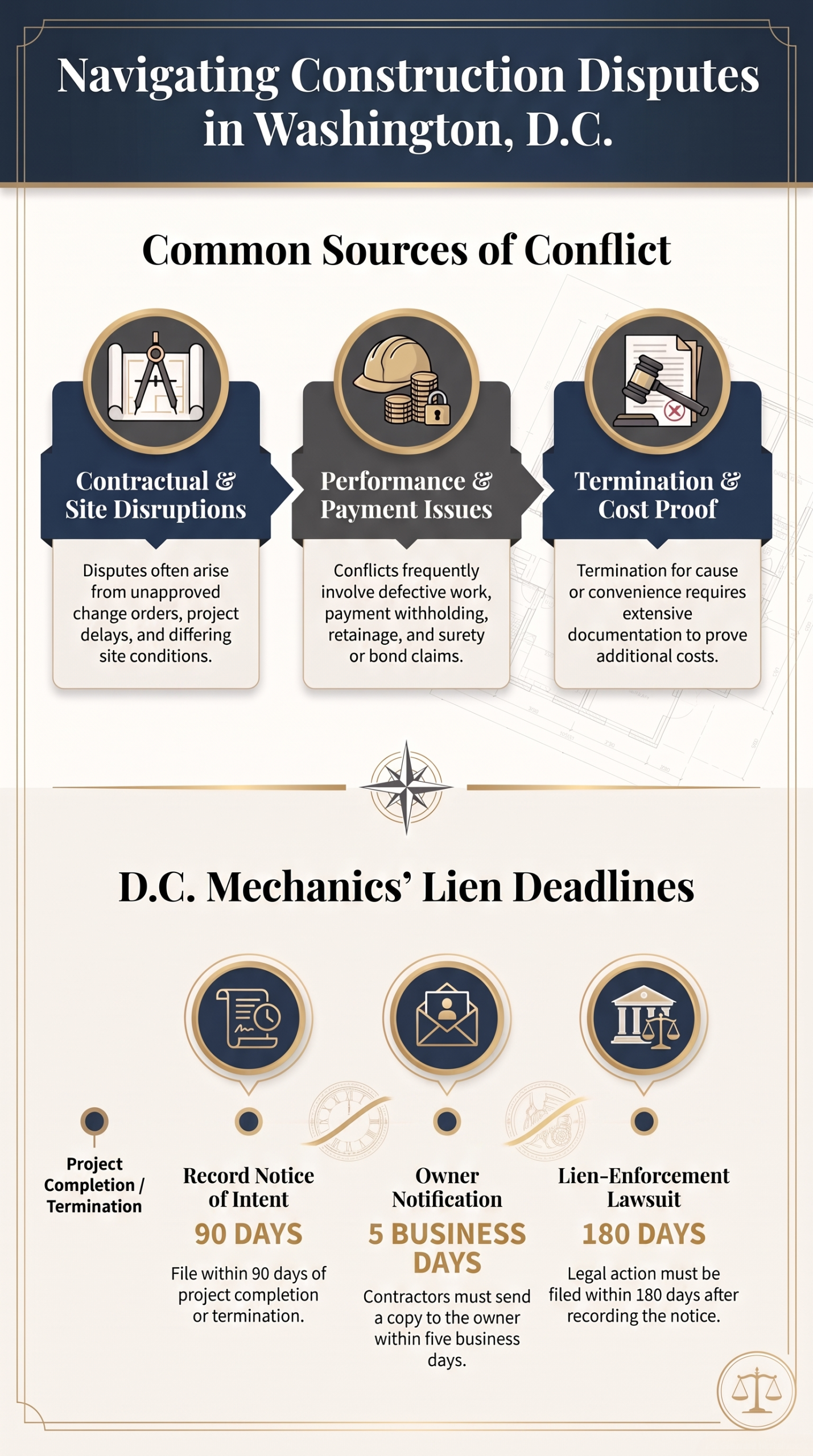
Table of Contents
- 1. Where Construction Money Actually Gets Lost in the District
- 2. Three Sets of Rules on the Same City Block
- 3. Unapproved and Disputed Change Orders
- 4. Constructive Changes: The Work Nobody Signed For
- 5. Project Delays and Disruption Claims
- 6. Proving Delay: Critical Path, Concurrency, and No-Damage Clauses
- 7. Defective or Incomplete Work
- 8. The Ten-Year Repose Clock on District Improvements
- 9. Differing Site Conditions
- 10. Payment Withholding and Retainage
- 11. The Quick Payment Act on District Projects
- 12. Contractor and Subcontractor Disputes
- 13. The Licensing Rule That Ends Payment Claims Before They Start
- 14. Surety and Payment Bond Claims
- 15. Termination for Cause or Convenience
- 16. Mechanics' Liens and the Three Deadlines That Kill Them
- 17. Documenting the Costs You Intend to Recover
- 18. Deadlines, Interest, and Where the Case Goes
- 19. How We Handle District Construction Matters
- Summary
- Frequently Asked Questions
- References
1. Where Construction Money Actually Gets Lost in the District
A drywall subcontractor called last spring about $186,000 on a finished project near NoMa. The work had been complete for months. He had been talking to the general contractor the whole time, patiently, the way you do when you want to keep the relationship and the next job.
The first question was not about the merits. It was about a date: when did your crew last furnish labor or materials on that site?
He had to check. That is usually the answer, and it is usually the problem. In the District, the most powerful collection tool a construction business has attaches to the property itself, and it expires on a schedule that runs from the work, not from the argument about the work. Every week spent being reasonable is a week off the clock.
This guide covers the disputes that actually arrive at our office: change orders nobody approved, schedules that slipped and the fight over whose fault it was, work that failed inspection or failed two winters later, conditions in the ground that nobody put in the bid documents, money withheld for reasons that keep changing, and the liens and bond claims that make any of it collectible.
It is written for the people signing the contracts. Owners and developers, general contractors, subcontractors and suppliers, and the design professionals who get pulled in when a defect claim starts looking for someone to blame. If your project is across the river, our construction litigation and transactions practice covers Virginia and Maryland work as well, and the deadlines there are different in ways that matter.
The one thing to do today
Find the last date your company furnished labor or materials to the project and write it down. Almost every deadline in this guide runs from that date or from substantial completion. If you do not know it, your project manager's daily reports or your last invoice will tell you.
2. Three Sets of Rules on the Same City Block
The District is a small jurisdiction with an unusual concentration of project types. A concrete subcontractor can pour a private mixed-use podium in Navy Yard on Monday, a District of Columbia Public Schools modernization on Wednesday, and a federal facility slab on Friday. Same crew, same trucks, three different rulebooks for getting paid and for making a claim.
This is the single most common source of avoidable loss we see. A project manager who has internalized the notice habits of one system applies them to another, and the claim is gone before anyone reads it.
| Private project in DC | District government project | Federal project in DC | |
|---|---|---|---|
| Payment timing | Whatever the contract says | Quick Payment Act, D.C. Code § 2-221.02 | Prompt Payment Act and FAR clauses |
| Mechanics' lien | Available, D.C. Code § 40-301.01 | Not available against public property | Not available against federal property |
| Bond protection | Only if the contract requires a bond | Required over $25,000, D.C. Code § 2-201.01 | Miller Act, 40 U.S.C. § 3131 |
| Differing site conditions | Only if the contract has a clause | Per the District's contract clauses | FAR 52.236-2 |
| Where disputes go | DC Superior Court or arbitration | Contracting officer, then the Contract Appeals Board | Contracting officer, then ASBCA or the Court of Federal Claims |
| Claim deadline | Contract notice provisions, then the statute of limitations | Contract notice provisions and the Procurement Practices Act | Contract Disputes Act, generally six years |
Two consequences are worth stating plainly. First, there is no mechanics' lien on public property, District or federal. If you are working on a government job and you are not paid, the bond is your security, and the bond has its own notice and suit deadlines that are shorter than most people expect. Second, a differing site condition is not automatically compensable on a private job. It is compensable because a clause says so. If the contract is silent, the risk usually sat with the contractor from the day of the bid.
Federal work carries its own architecture entirely, including certified claims, contracting officer final decisions, and appeal rights that do not resemble civil litigation. Our federal contracting and compliance practice handles that side, and bid protests and procurement disputes when the problem starts at award rather than during performance.
3. Unapproved and Disputed Change Orders
Start with the clause that causes the most litigation in this industry: the one saying no change to the work is valid unless it is in writing and signed before the work is performed.
Nearly every commercial construction contract has it. Nearly every project violates it. The owner's representative points at something in the field and says take care of it, the crew takes care of it, and four months later the pay application comes back short because there was no signed change order.
Why the clause exists and why courts take it seriously
The written change order requirement is not a technicality invented to cheat subcontractors. It exists because construction runs on budgets that have to be financed, and an owner who cannot control the commitments made in the field cannot control the project. Courts in most jurisdictions enforce these clauses, and you should assume a District judge or arbitrator will start from the position that the contract means what it says.
What still gets a contractor paid
That starting position is not the ending position. Several things move it.
- Waiver by course of dealing. If the parties processed the first eleven extras on a handshake and paid them, the argument that the twelfth is void for lack of a signature is considerably weaker. Pull the payment history on the project before anyone concedes this point.
- Authority of the person who directed the work. The question is not only whether a change was ordered but whether the person ordering it had actual or apparent authority to bind the owner. A construction manager who has been running the job for a year usually looks like authority to the field.
- Unjust enrichment and quantum meruit. Where a contract remedy fails, the work still has value and the owner still has it. These claims have real limits, especially against a licensing defense, but they are not nothing.
- Contemporaneous written confirmation. An email sent the same afternoon saying confirming your direction this morning to add the two additional floor drains, we are proceeding and will price this as a change is worth more than any testimony offered two years later.
Practical rule
If you are directed to perform work you believe is outside your scope, do three things before the end of that day. Put the direction in writing to the person who gave it. State that you consider it a change and will submit pricing. Track the cost separately from that moment forward.
A contractor who does those three things has a claim. A contractor who does the work and raises it at closeout has an argument.
We handle these matters through our change order dispute practice, and the prevention side through change order and project documentation review before a project starts.
4. Constructive Changes: The Work Nobody Signed For
A constructive change is work that functions as extra work without anyone calling it that. No one issued a change order because no one thought a change had occurred. The doctrine is most developed in federal contracting, where it is thoroughly established, and the same reasoning shows up in private disputes.
The recurring versions:
- Defective or contradictory plans and specifications. Under the rule from United States v. Spearin, an owner who supplies the design impliedly warrants that it is buildable. A contractor who follows the drawings is not usually responsible for the fact that the drawings did not work.
- Overinspection. Rejecting work that meets the specified standard, and requiring a higher standard than the contract calls for, is a change to the contract in substance.
- Late or contradictory responses to RFIs. A response that resolves an ambiguity in the owner's favor after the contractor bid the other reasonable reading is a change.
- Directed acceleration. Being told to recover a schedule that slipped for reasons outside your control, without a time extension, is constructive acceleration.
- Denial of a justified time extension. The same idea. If the delay was excusable and the extension was refused, the contractor is being made to buy back time it was owed.
The reason this doctrine matters more in practice than it looks on paper is that it converts a losing argument into a winning one. You never gave me a change order is weak. You directed me to build something different from what you specified, and here is the RFI trail proving it is strong.
It still depends on notice. Nearly every contract that recognizes changes also requires the contractor to claim them within a set window, commonly 14 or 21 days after the event. Read that provision on the first day of the project, not the last.
5. Project Delays and Disruption Claims
Delay claims are where the largest dollars sit and where the proof is hardest. Begin with vocabulary, because the categories decide the outcome.
| Type of delay | Who caused it | Time extension? | Money? |
|---|---|---|---|
| Excusable and compensable | Owner, or someone the owner is responsible for | Yes | Yes |
| Excusable and non-compensable | Neither party, such as unusual weather or a strike | Yes | No |
| Inexcusable | The contractor | No | No, and liquidated damages may run against the contractor |
| Concurrent | Both parties, in the same period | Usually yes | Usually no, though the analysis varies |
Owner-caused delay is the compensable category and includes late site access, late owner-furnished equipment, slow design responses, permitting the owner agreed to obtain, interference by other prime contractors, and failure to coordinate. In the District, add one that comes up constantly: public space permits, alley and sidewalk closure approvals, and utility coordination with WASA, Pepco, and Washington Gas. Whether those delays are compensable depends entirely on which party the contract made responsible for obtaining them.
Delay and disruption are not the same claim
This distinction is worth money. A delay claim says the project finished later than it should have, and seeks extended field and home office overhead for the additional duration. A disruption claim says the work itself became less efficient, and seeks the additional labor hours consumed, even where the project finished on time.
Disruption is common on District infill projects. Constrained urban sites, stacked trades, restricted delivery windows on downtown streets, and out of sequence work all reduce productivity without necessarily moving the completion date. Crews that should install 400 feet of conduit a shift install 240. That difference is a recoverable cost if you can prove it.
The accepted method of proving it is the measured mile: compare productivity during an undisrupted period on the same project with productivity during the disrupted period, and claim the difference. It requires labor hours tracked by activity and location. Companies that track hours only by job number cannot run the analysis, which is a documentation problem, not a legal one.
Our delay and acceleration claims practice handles both sides of these disputes.
6. Proving Delay: Critical Path, Concurrency, and No-Damage Clauses
Having a delay is not the same as proving one. Three things decide most delay cases.
The schedule
A delay claim is proven against a critical path method schedule. You need a baseline schedule that was accepted, contemporaneous updates showing actual progress as the job ran, and an analysis connecting specific delay events to movement of the critical path. Delay to work that was never on the critical path generally does not extend the project and does not support extended overhead.
Schedules created after the fact for litigation are treated with appropriate suspicion. A contractor who updated the schedule monthly as a matter of routine is in a completely different position from one reconstructing events from memory.
Concurrency
Owners defend delay claims by finding contractor-caused delay running in the same window. If both parties delayed the same period, the usual outcome is that the contractor gets time but not money, and the owner does not get liquidated damages. Expect this defense and address it in the analysis rather than waiting for it.
No-damage-for-delay clauses
Many contracts say the contractor's only remedy for delay is additional time, never money. These clauses are common in the District and they are frequently enforced. They are not always the end of the inquiry. Courts in a number of jurisdictions decline to apply them to delays caused by bad faith or active interference, delays not contemplated by the parties, or delays so extensive they amount to abandonment of the contract. Whether a particular District court will apply those exceptions to a particular clause is a question that turns on the language and the facts, and it should be analyzed before a claim is either filed or abandoned.
Liquidated damages run the other direction
If the contract sets liquidated damages for late completion, the owner does not have to prove actual loss. The number applies. Contractors defend by establishing that delays were excusable and that requested extensions were wrongly denied, which is why the time extension request file matters as much as the schedule.
Courts will strike a liquidated damages figure that functions as a penalty rather than a reasonable pre-estimate of loss, but that is an uphill argument on a negotiated commercial contract, not a reliable plan.
7. Defective or Incomplete Work
Defect claims split into two very different situations, and confusing them wastes money.
Incomplete work and punch list items
This is a performance and payment dispute. The work is not finished, the owner is holding money, and the question is what remains and what it costs to finish. It resolves through the contract's completion and payment provisions, and it usually resolves quickly once someone prices the remaining scope honestly.
Defective work
This is a different animal. The work appears complete, it was accepted, it was paid for, and then it fails. Water enters the envelope. The slab cracks. The facade delaminates. The mechanical system will not hold design conditions.
Defect claims in the District cluster around a few building types. Older row house conversions with structural modifications the original construction never contemplated. Condominium conversions where the association discovers common element defects after transition from declarant control. Historic rehabilitations where new work meets existing conditions of unknown quality. Envelope failures on mid-rise infill where multiple trades meet at details that were never fully drawn.
What the damages actually are
The general measure is the cost of repair. Where repair would require destroying substantially completed work to correct a defect of limited practical consequence, the doctrine of economic waste can limit recovery to the diminished value of the property instead. Owners should understand this before committing to a tear-out remedy, and contractors should raise it early where it applies.
Three related points that decide cases:
- A warranty period is not a statute of limitations. A one-year correction period in the contract obligates the contractor to return and fix defects found in that year. It does not extinguish breach of contract rights that survive longer. Owners regularly give up valid claims by assuming the warranty expiration ended everything.
- Latent defects are found when they are found. A defect concealed within the work is different from one visible at walkthrough, and the timing analysis reflects that.
- Preserve the evidence. Photograph and document the failed condition before repairing it. Give written notice and a reasonable opportunity to inspect. An owner who tears out and replaces the work before anyone else sees it has damaged the claim, sometimes fatally.
We handle these through our construction defects practice, and on construction defect and change order appeals when a trial result needs review.
8. The Ten-Year Repose Clock on District Improvements
The District places an outer boundary on claims arising from defective improvements to real property. Under D.C. Code § 12-310, an action to recover damages for personal injury, injury to real or personal property, or wrongful death arising from a deficiency in the design, planning, supervision, or construction of an improvement is barred unless the injury occurs within ten years after the improvement was substantially completed.
Substantial completion is defined by use: the improvement is substantially completed when it is first used, or first available for use after having been completed in accordance with the contract.
This is a statute of repose, not a statute of limitations, and the difference matters. A limitations period starts when a claim accrues. A repose period starts when the building was finished and runs regardless of whether anyone knew there was a problem. It can extinguish a claim before the claim ever existed.
The exceptions that swallow a lot of cases
Section 12-310 does not apply to actions based on an express or implied contract, to claims against the owner or the person in actual possession or control of the improvement at the time the defective condition caused the injury, to actions against manufacturers or suppliers of equipment or machinery installed in the structure, or to actions brought by the District itself.
The contract exception is the significant one for construction disputes. A defect claim framed as breach of the construction contract is analyzed under the contract limitations periods in D.C. Code § 12-301, generally three years for a simple contract and twelve years for an instrument under seal, rather than under the ten-year repose period. Whether a given claim sounds in contract or in tort is therefore not an academic question.
Check the signature block. Construction contracts, subcontracts, and guaranties in this region are sometimes executed under seal, and a document under seal carries a twelve-year clock rather than a three-year one. We have seen parties abandon live claims because nobody looked.
9. Differing Site Conditions
You bid the job on the geotechnical report and the existing conditions drawings. You start excavating and find something nobody mentioned: an abandoned foundation, uncharted utilities, a buried vault, fill where competent soil was indicated, groundwater fifteen feet higher than the borings showed, or contaminated material that has to be handled and hauled as regulated waste.
Downtown Washington produces these constantly. It is an old city built over older infrastructure, with vaults extending under public space, generations of utility work, and construction records that vary from excellent to nonexistent depending on the decade.
Type I and Type II
The standard framework, used in FAR 52.236-2 on federal work and mirrored in most commercial forms, recognizes two categories. A Type I condition is a subsurface or latent physical condition at the site that differs materially from what the contract documents indicated. A Type II condition is an unknown physical condition of an unusual nature that differs materially from conditions ordinarily encountered and generally recognized as inherent in work of that character.
Type I is the easier claim because it compares the site against a document. Type II requires proving what is ordinary, which usually takes an expert.
The notice requirement that decides these claims
Under FAR 52.236-2, the contractor must give written notice to the contracting officer promptly, and before the conditions are disturbed. The clause states that no request for an equitable adjustment shall be allowed unless the required written notice has been given, though it does permit the contracting officer to extend the time for giving that notice. Do not plan on the extension.
The widely used AIA A201 general conditions impose a similar rule on private projects. Section 3.7.4 of the 2017 version requires notice to the Owner and Architect before conditions are disturbed and in no event later than 14 days after first observance. Check which edition your contract uses. The 2007 version of the same provision allowed 21 days, and plenty of projects still run on that form.
Read that as a practical instruction: stop, photograph, notify in writing, and only then proceed. Excavating through a differing site condition and reporting it at the end of the month usually forfeits the claim, because the evidence is gone and the clause says so.
One more caution. Many contracts include a site investigation clause stating the contractor inspected the site and accepted conditions as found, and some include an exculpatory clause disclaiming the accuracy of geotechnical data furnished for information only. These provisions are negotiated in the contract, well before anyone hits anything, which is one reason construction contract drafting and review is cheaper than litigation.
10. Payment Withholding and Retainage
Money gets withheld on construction projects for good reasons and for bad ones, and telling them apart is most of the dispute.
Legitimate withholding
An owner or general contractor may generally withhold for defective work not remedied, third party claims filed or reasonable evidence indicating probable filing, failure to pay subcontractors or suppliers, reasonable evidence that the work cannot be completed for the unpaid balance, damage to another contractor, reasonable evidence the work will not be completed within the contract time such that the remaining balance would not cover the resulting liquidated damages, or repeated failure to carry out the work in accordance with the contract documents.
Those categories track the standard commercial forms. The common thread is that each requires a reason tied to performance, and the amount withheld is supposed to bear a relationship to the problem.
Withholding that will not hold up
Watch for the pattern where the stated reason changes. The first rejection cites a submittal issue. After that is cured, it becomes a quality concern. After that is addressed, it becomes a backcharge for something from eight months earlier. A shifting justification is itself evidence, and it is worth documenting the sequence in writing as it happens.
Also watch for withholding far in excess of the asserted problem. Holding $300,000 over a punch item priced at $12,000 is not a good faith dispute about $12,000. Several standard forms expressly limit withholding to amounts reasonably related to the deficiency.
Pay-if-paid and pay-when-paid
Every subcontractor should know which clause is in their subcontract, because they are not the same thing.
- A pay-when-paid clause is generally read as a timing provision. It sets when payment is due, but the general contractor still owes the money within a reasonable time whether or not the owner pays.
- A pay-if-paid clause attempts to make the owner's payment an actual condition precedent to the subcontractor's right to payment. Read literally, it shifts the risk of owner insolvency onto the subcontractor.
Courts generally require unmistakable language before treating a clause as a true condition precedent, because the consequence is severe. If your subcontract contains a contingent payment provision, have it read before you sign it rather than after the owner stops funding. This is the single clause most worth negotiating in a subcontract, and our subcontracts and supplier agreements practice addresses it directly.
Retainage
Retainage is the percentage held from each progress payment, commonly five or ten percent, released at or after substantial completion. It exists to give the owner a hold on the money until the work is finished, and it is frequently the entire amount in dispute at the end of a job, because by closeout the retainage is often the only money left unpaid.
On private District projects the contract controls the retainage percentage and the conditions for its release. Two things to negotiate before signing: a reduction in the retained percentage once the work is substantially complete or passes a milestone, and a clear definition of what triggers release, so that release does not depend on completion of scope belonging to other trades. Subcontractors routinely wait months for retainage because the release condition was tied to the whole project rather than to their own completed work.
11. The Quick Payment Act on District Projects
If your project is for the District government, the Quick Payment Act changes the payment analysis in your favor, and a number of contractors working District jobs do not realize it applies to them.
Under D.C. Code § 2-221.02, the District is generally required to pay a proper invoice within 30 calendar days, excluding legal holidays, after receipt. A prime contractor who receives payment from a District agency must pay the subcontractor within 7 days of receiving any amount paid by the District. For additional work performed under a change order, the statute directs payment to the prime within 30 days of a proper invoice and payment of the undisputed amount to the subcontractor within 10 days of the prime's receipt.
Late payment carries an interest penalty, and unpaid interest penalties are added to the principal amount of the debt at the end of each 30 day period, so the exposure compounds.
One qualification on the 7 day rule. The statute gives the prime contractor an alternative to paying: furnishing the subcontractor written notice of its intent to withhold, with the reasons stated. A prime that simply goes quiet has not satisfied the statute, and that silence is worth pointing out.
Where this actually helps
A subcontractor on a District project who can establish that the prime received payment has a statutory 7 day clock to point at, which is very different from arguing about what a reasonable time means under a pay-when-paid clause.
The practical step is to request confirmation of the payment status from the agency. On District work, unlike private work, there is a public record of what the District paid and when.
Note the boundary. The Quick Payment Act governs District government contracts. It does not set payment deadlines on private construction projects in the District, where the contract controls. Federal projects are governed by the federal Prompt Payment Act and the applicable FAR clauses instead.
12. Contractor and Subcontractor Disputes
Most construction disputes are not owner against contractor. They are contractor against subcontractor, subcontractor against supplier, or a chain of all of them pointing at each other over a single failure.
Flow-down and the gap between the documents
Subcontracts incorporate the prime contract by reference and bind the subcontractor to the general contractor for its portion of the work to the same extent the general contractor is bound to the owner. This means a subcontractor is frequently bound by provisions in a document it never received. Ask for the prime contract before signing. If the general contractor will not furnish it, that is information.
The more expensive gap is scope. The prime contract requires a complete and operable system. The subcontract lists specific work. Whatever falls between those two descriptions becomes a dispute, and it is resolved by whoever drafted the scope more carefully.
Pass-through claims
When an owner causes damage to a subcontractor, the subcontractor usually has no contract with the owner and therefore no direct claim. The standard solution is a pass-through claim, where the general contractor asserts the subcontractor's claim against the owner, supported by a liquidating agreement in which the general contractor acknowledges liability to the subcontractor limited to whatever is recovered from the owner.
These agreements should be drafted before the claim is submitted, not improvised afterward. On federal work the analysis is more constrained, and a pass-through arrangement needs to be structured with that in mind.
Backcharges
A general contractor who completes or corrects a subcontractor's work charges the cost back. Legitimate backcharges require written notice and an opportunity to cure, actual costs rather than estimates, and some proportionality. Backcharges that appear for the first time on the final pay application, with no prior notice and no supporting invoices, do not usually survive scrutiny.
We represent both sides of these disputes through our subcontractor and supplier disputes practice.
13. The Licensing Rule That Ends Payment Claims Before They Start
This chapter is short and it is the one most likely to change an outcome, particularly for contractors based in Virginia or Maryland who take District work occasionally.
The District regulates construction trades through the Department of Licensing and Consumer Protection, including a General Contractor and Construction Manager license. Operating without required licensing is an infraction with its own penalty. That is the regulatory consequence, and it is not the expensive one.
The expensive consequence
Under 16 DCMR § 800.1, a person may not require or accept payment for a home improvement contract to be performed in the District in advance of full completion of all work unless licensed and bonded as required.
The District of Columbia Court of Appeals has enforced that rule strictly for decades. In Cevern, Inc. v. Ferbish, 666 A.2d 17 (D.C. 1995), the court held that a contractor who accepted advance payments while unlicensed forfeited the right to recover for the work performed on either a contract or a quantum meruit theory, and obtaining a license later did not cure it. Earlier decisions including Truitt v. Miller, 407 A.2d 1073 (D.C. 1979), and Nixon v. Hansford, 584 A.2d 597 (D.C. 1991), point the same direction.
Read that again in business terms. The work can be finished, the quality can be fine, the owner can be living in the improvement, and the contractor can recover nothing. The homeowner may also recover payments already made.
There is a second consequence that surprises people, and it connects licensing directly to your security for payment. D.C. Code § 40-301.02 requires the notice of intent that creates a mechanics' lien to include a copy of the claimant's current business license and a certificate of good standing. A contractor who is not properly licensed and in good standing cannot perfect a lien in the District. The licensing problem and the collection problem are the same problem.
If you work across the District line with any regularity, treat licensing as project infrastructure. Our contractor licensing and compliance practice handles this, and it is considerably cheaper to fix before a dispute than during one.
14. Surety and Payment Bond Claims
On public work there is no lien, so the bond is the security. The rules are specific and the deadlines are short.
District government projects
Under D.C. Code § 2-201.01, a contract exceeding $25,000 for the construction, alteration, or repair of a public building or public work of the District generally requires a performance bond and a payment bond. The payment bond protects all persons supplying labor and material in the prosecution of the work. The statute sets the payment bond amount by contract size: one half the total amount payable for contracts up to $1,000,000, forty percent for contracts between $1,000,000 and $5,000,000, and $2,500,000 for contracts exceeding $5,000,000.
Note that $25,000 threshold carefully. The federal Miller Act threshold is $100,000. Contractors who work both sides sometimes assume the federal number applies in the District and conclude no bond exists on a project where one does.
Two deadlines on a District payment bond claim
90 day notice. Under D.C. Code § 2-201.02, a claimant who has a direct contractual relationship with a subcontractor but not with the prime contractor must give written notice to the prime contractor within 90 days from the date on which that claimant last performed labor or supplied material, stating the amount claimed and the party for whom the work was done. Note that this statute specifies registered mail, where the mechanics' lien statute specifies certified mail. They are not interchangeable, and the distinction is worth honoring.
One year suit deadline. No suit on the bond may be commenced after the expiration of one year after the day on which the last of the labor was performed or material was supplied. Suit is brought in the Superior Court of the District of Columbia.
Federal projects follow a closely parallel structure under the Miller Act, 40 U.S.C. §§ 3131 through 3133, with a comparable 90 day notice requirement for second tier claimants and a one year period to bring suit. The structures are similar enough that people assume they are identical and different enough that the assumption is risky. Confirm which statute governs before relying on either.
Performance bond claims
A performance bond responds when the contractor fails to perform. Declaring a default under a bond is not simply a matter of sending a letter to the surety. The common commercial bond forms condition the surety's obligation on the owner taking specific steps first, which frequently include notifying the contractor and the surety of consideration of a default declaration and giving an opportunity to discuss performance before formally terminating.
Owners lose performance bond claims on these procedural conditions with some regularity. The surety's first response to a claim is usually to examine whether the owner satisfied every condition in the bond form, and a terminated contract that skipped a step gives the surety a defense that has nothing to do with whether the contractor actually failed.
Once a valid claim is made, the surety typically has options: take over and complete the work, tender a replacement contractor, finance the existing contractor, pay the owner's cost to complete, or deny the claim. Which one it chooses drives everything that follows. We handle these through bond and surety claims and our broader surety transactions and litigation practice, for claimants, principals, and sureties.
15. Termination for Cause or Convenience
Termination is the highest risk decision on a troubled project, and it is frequently made too quickly by an owner who has run out of patience.
Termination for cause
Termination for cause requires a material default and, almost always, strict compliance with the contract's notice and cure procedure. That procedure typically requires written notice specifying the default, a defined cure period, and often certification by the architect that sufficient cause exists.
Here is the exposure. If the termination is later found to be wrongful, because the default was not material, or because the cure period was not honored, or because a required certification was not obtained, the termination itself becomes the breach. The owner who terminated is now the party in default, liable for the contractor's costs and lost profit. The remedy and the liability trade places.
If a performance bond is in place, notify the surety before declaring a default, and follow the bond's conditions precisely. An owner who terminates without involving the surety as the bond form requires may find the bond unavailable exactly when it is needed.
Termination for convenience
A termination for convenience clause lets the owner end the contract without alleging any fault. It originated in federal contracting and has migrated into private contracts and down into subcontracts.
The typical recovery on a convenience termination is the cost of work properly performed to the date of termination, reasonable profit on that performed work, and reasonable costs of demobilization and settlement. What is typically not recoverable is anticipated profit on the work never performed. That is the entire point of the clause from the owner's perspective, and it is why a subcontractor should look for a termination for convenience provision before signing and price accordingly.
The settlement proposal is the claim
On a convenience termination, your recovery is determined by the settlement proposal you submit, and that proposal is only as good as your cost records. Segregate termination costs immediately. Stop work, secure and inventory materials, document the state of completion with photographs and survey where appropriate, and capture demobilization costs as they are incurred.
Contractors who treat a convenience termination as a business disappointment rather than a claim event routinely under-recover by substantial amounts.
16. Mechanics' Liens and the Three Deadlines That Kill Them
This is the chapter to act on. Everything else in this guide can usually wait a week. This cannot.
A mechanics' lien attaches to the property itself. It clouds title, it interferes with refinancing and sale, and it converts an unsecured collection problem into a secured one. It is the reason a contractor who is owed money in the District has real bargaining power, and it is also the right most commonly lost by waiting.
Who has lien rights
Under D.C. Code § 40-301.01, a building erected, improved, added to, or repaired, and the land on which it sits, is subject to a lien in favor of the contractor who contracted with the owner, in the amount of the contract price or, in the absence of an express contract, the reasonable value of the project. Under D.C. Code § 40-303.01, a person directly employed by the contractor, whether a subcontractor, materialman, or laborer, is entitled to the same rights and subject to the same obligations as the original contractor.
One limit for subcontractors to understand: payments the owner properly makes to the general contractor discharge the contractor's lien to the extent of those payments and reduce the amount for which the property is chargeable in favor of the parties the contractor employed. A subcontractor who waits while the owner keeps funding the general contractor may be liening a shrinking number.
The Three Deadlines
1. Record the notice of intent
Record in the land records a notice of intent identifying the property and stating the amount due or to become due. It must be recorded during the construction or within 90 days after the earlier of the completion or the termination of the project. D.C. Code § 40-301.02.
2. Send the owner a copy within 5 business days
Send the owner a copy of the recorded notice of intent by certified mail, to the owner's current address in the public records or the last known address, within 5 business days after the date of recordation. If the certified mail comes back unclaimed or undelivered, post a copy of the recorded notice at or on the property. D.C. Code § 40-301.02.
3. File suit within 180 days, and record a notice of pendency within 10 days of filing
File suit to enforce the lien within 180 days after the date the notice of intent is recorded, and record a notice of pendency of action within 10 days of filing suit. Failure to file suit within the 180 day period, or to timely file the notice of pendency, terminates the lien. D.C. Code § 40-303.13.
Why you cannot do this on day 89
The notice of intent is not a one page form. Under § 40-301.02 it must identify the contractor and the owner with addresses, identify the party against whom the lien is claimed and the amount owed, describe the work with the dates it was performed, describe materials furnished with delivery dates, give the legal description and the street address of the property, and attach a copy of the claimant's current business license and certificate of good standing, along with a copy of the home improvement contract where one applies. It must include a notarized sworn statement that the contents are true and that the claimant has a right to recover the amount claimed. The certificate of good standing has its own freshness requirement, and must have been issued within 180 days before the notice is filed.
The statute is blunt about what happens if you get the contents wrong: a notice of intent that does not comply with the requirements of subsection (b) is void. Not amendable, not substantially compliant. Void.
Assembling accurate delivery dates, a correct legal description, and current corporate documents takes time that a company in a payment crisis does not have. Start on day thirty.
Do not sign the waiver without reading it
Lien waivers are routinely exchanged with every progress payment, and they are routinely signed without review. A conditional partial waiver through a stated date is ordinary business. An unconditional final waiver signed before the money clears, or a waiver that releases claims for changes and delay rather than only for payment through a date, gives away rights that are very hard to recover.
Read the date on the waiver and read what it releases. Our lien waivers and payment documents practice reviews these, and it is far cheaper than the claim you waived.
For owners and lenders on the other side: a lien recorded against your property is not automatically valid. The deadlines above, the contents requirements, and the licensing condition all give grounds to challenge a defective notice of intent, and the statute provides a mechanism to address liens through the court. Do not simply pay to clear a lien before someone examines whether it was perfected correctly. Our mechanics' liens and payment claims practice handles both perfection and challenge.
17. Documenting the Costs You Intend to Recover
Construction cases are won by the party with the better contemporaneous record. Not the better memory, not the better witness, and frequently not even the better position on the contract. The record.
A judge, arbitrator, or board member deciding a construction dispute two or three years after the fact is looking for documents created while the events were happening, by people who did not yet know there would be a lawsuit. That evidence is credible in a way that reconstructed testimony is not.
| If you are claiming | The documents that prove it |
|---|---|
| Extra work or a change | Written direction or your same-day written confirmation of it, the RFI and the response, signed field tickets, cost codes segregated by change number, and the pricing you submitted |
| Delay | The accepted baseline schedule, contemporaneous monthly updates, the time extension requests you submitted and the responses, delay notices given under the contract's notice clause, and daily reports showing manpower and activity |
| Disruption or lost productivity | Labor hours tracked by activity and by location, not only by job number, plus an undisrupted baseline period on the same project for a measured mile comparison |
| Defective work | Photographs of the failed condition before repair, inspection and testing reports, the written notice you gave, the opportunity to inspect you offered, and repair invoices |
| A differing site condition | The geotechnical report and existing conditions drawings you bid from, dated photographs taken before the condition was disturbed, and the written notice given before disturbing it |
| Nonpayment | Executed contract and any change orders, all pay applications and the responses, the date you last furnished labor or materials, lien waivers you signed, and certified payroll on public work |
| A termination claim | The default and cure correspondence, the architect's certification if required, surety notifications, an inventory and photographic record at the date of termination, and segregated demobilization costs |
Three habits that are worth real money
Confirm oral directions in writing the same day. Not the same week. A short email sent that afternoon is the single most valuable document in most construction claims.
Track cost by change number from the moment the issue arises. Costs that cannot be separated from base contract work usually cannot be recovered, however real they were.
Calendar every notice deadline in the contract at the start of the project. Pull the notice provisions out of the general conditions, put the day counts in the project schedule, and make them someone's job.
Our change order and project documentation practice sets these systems up before a project starts, which is the only time they are inexpensive.
18. Deadlines, Interest, and Where the Case Goes
A consolidated view of the clocks, because they run at very different speeds.
| Deadline | Period | Runs from | Source |
|---|---|---|---|
| Contract notice of a claim or change | Often 7, 14, or 21 days | The event or first observance | Your contract's notice provisions |
| Differing site condition notice | Before conditions are disturbed, and no later than 14 days under AIA A201-2017 | First observance | FAR 52.236-2; AIA A201-2017 § 3.7.4 |
| Mechanics' lien notice of intent | During construction or within 90 days | The earlier of completion or termination | D.C. Code § 40-301.02 |
| Copy of notice of intent to the owner | 5 business days | Date of recordation | D.C. Code § 40-301.02 |
| Suit to enforce the lien | 180 days | Date the notice of intent was recorded | D.C. Code § 40-303.13 |
| Notice of pendency of action | 10 days | Filing of the enforcement suit | D.C. Code § 40-303.13 |
| Payment bond notice, second tier claimant | 90 days | Last labor performed or material supplied | D.C. Code § 2-201.02 |
| Suit on a District payment bond | 1 year | Last labor performed or material supplied | D.C. Code § 2-201.02 |
| Breach of a simple contract | 3 years | Accrual of the claim | D.C. Code § 12-301(7) |
| Breach of an instrument under seal | 12 years | Accrual of the claim | D.C. Code § 12-301(6) |
| Injury from a deficient improvement | 10 years, repose | Substantial completion | D.C. Code § 12-310 |
Interest
Absent an expressed contract, the rate of interest in the District on the loan or forbearance of money is 6 percent per year under D.C. Code § 28-3302. On a liquidated debt, prejudgment interest is available under D.C. Code § 15-108. Contracts that specify a higher rate of interest on late payment generally control, which is a reason to include one when you are the party expecting to be paid.
Do not carry the 6 percent figure into the post-judgment analysis. Section 28-3302 sets different rates there, including a cap on judgments against the District and a formula tied to the federal underpayment rate for other judgments.
Where the case goes
- Small Claims and Conciliation Branch. Money claims of $10,000 or less fall within its exclusive jurisdiction under D.C. Code § 11-1321. Note the limits in that section: jurisdiction covers actions only for the recovery of money, and an action affecting an interest in real property may not be brought there. A mechanics' lien enforcement action does not belong in Small Claims at any dollar amount.
- Civil Actions Branch of DC Superior Court. Larger damages claims and lien enforcement actions. All parties are required to participate in mediation, which resolves a meaningful share of construction disputes before anyone reaches trial.
- Arbitration. Many construction contracts require it. Under D.C. Code § 16-4406 an agreement to arbitrate is valid and enforceable except on grounds that would permit revocation of any contract. Check whether your contract made arbitration mandatory before filing anything.
- District government contracts. A claim goes to the contracting officer for a decision, and the Contract Appeals Board is the exclusive hearing tribunal for appeals from those decisions, for protests, and for District claims against contractors.
- Federal contracts. The Contract Disputes Act route: a claim to the contracting officer, a final decision, and then an appeal to the Armed Services Board of Contract Appeals or an action in the Court of Federal Claims.
One practical note about mediation in Superior Court. Because it is required rather than optional, it arrives early, often before the expert analysis is finished. Parties who show up with their schedule analysis and cost documentation organized settle on better terms than parties who show up to explain that they will prove it later.
19. How We Handle District Construction Matters
Shin Law Office represents owners and developers, general contractors, subcontractors and suppliers, and sureties on construction matters in the District, Northern Virginia, and Maryland. Basil M. Al-Qaneh is admitted in the District of Columbia, Maryland, Massachusetts, and Virginia, which matters on projects and companies that cross the river regularly.
What we handle:
- Mechanics' liens and payment claims, perfecting them and challenging defective ones
- Change order disputes and constructive change claims
- Delay and acceleration claims, including schedule analysis and disruption
- Construction defects, for owners pursuing them and contractors defending them
- Construction contract disputes and breach of contract actions
- Subcontractor and supplier disputes, including pass-through claims and backcharges
- Bond and surety claims and surety transactions and litigation
- Federal contracting and compliance, including bid protests and procurement disputes
- Construction contract drafting and review, subcontracts and supplier agreements, and lien waivers and payment documents
- Contractor licensing and compliance and construction risk, insurance, and indemnity
We work across all four quadrants and all eight wards. See our Washington, DC service areas for the full practice, and our guide to breach of contract in Washington, DC for the contract law that underlies most of these claims.
Summary
Construction disputes in the District are decided by three things: what the contract says, what the contemporaneous record shows, and whether anyone watched the calendar.
- The lien is your security, and it has three deadlines. Record the notice of intent during construction or within 90 days after the earlier of completion or termination. Mail the owner a copy within 5 business days. File suit within 180 days of recording and record a notice of pendency within 10 days of filing. Missing any one of them ends it.
- Contract notice clocks are shorter than statutory ones. Change, delay, and differing site condition claims commonly require notice within 7, 14, or 21 days of the event. Those provisions kill more claims than statutes of limitation do.
- Three rulebooks operate here. Private, District, and federal projects have different payment rules, different security for payment, and different forums. Do not carry habits from one into another.
- Licensing can end a payment claim entirely. An unlicensed contractor who accepted advance payment on District home improvement work can lose recovery on the contract and in quantum meruit, and cannot perfect a lien, since the notice of intent must include a current license and certificate of good standing.
- On public work, the bond replaces the lien. A second tier claimant on a District payment bond must give the prime written notice within 90 days of last furnishing, and suit must be brought within one year.
- Termination is the highest risk decision on a project. A termination for cause that does not follow the contract's notice, cure, and certification requirements converts the terminating party into the breaching one.
- Documentation decides close cases. Same-day written confirmation of oral directions, cost segregated by change number, and labor hours tracked by activity are worth more than any argument made later.
If you are owed money on a District project, the most useful thing you can do before calling anyone is find the date your company last furnished labor or materials to that site.
Frequently Asked Questions
How long do I have to file a mechanics' lien in Washington, DC?
You must record a notice of intent in the land records during the construction or within 90 days after the earlier of the completion or the termination of the project, and you must send the owner a copy by certified mail within 5 business days after recording it. Those requirements come from D.C. Code § 40-301.02. Recording the notice is only the first step. Under D.C. Code § 40-303.13 you must then file suit to enforce the lien within 180 days after the date the notice of intent was recorded, and record a notice of pendency of action within 10 days of filing suit. Failure to do either terminates the lien.
Can a subcontractor file a mechanics' lien in DC?
Yes. Under D.C. Code § 40-303.01, a person directly employed by the contractor, whether a subcontractor, materialman, or laborer, is entitled to the same rights and subject to the same obligations as the original contractor. One limitation matters: payments the owner properly makes to the general contractor discharge the contractor's lien to that extent and reduce the amount for which the property is chargeable in favor of the parties the contractor employed, so delay can shrink what is available to claim.
Can I get paid for extra work if there was no signed change order?
Sometimes, but it is a harder case. Courts generally enforce clauses requiring written change orders. What moves the analysis is a course of dealing in which the parties processed earlier extras without signatures and paid them, evidence that the person directing the work had actual or apparent authority to bind the owner, a constructive change theory where the direction amounted to a change in substance, and contemporaneous written confirmation of the direction. The practical rule is to confirm any directive in writing the same day and track the cost separately from that point.
What is the difference between a delay claim and a disruption claim?
A delay claim says the project finished later than it should have and seeks extended overhead for the additional duration. A disruption claim says the work became less efficient and seeks the additional labor hours consumed, and it can succeed even where the project finished on time. Disruption is proven most often by a measured mile analysis comparing productivity in an undisrupted period against the disrupted period on the same project, which requires labor hours tracked by activity and location rather than only by job number.
Are no-damage-for-delay clauses enforceable in the District?
They are common and are frequently enforced, so a contractor should assume the clause will be applied as written. Courts in a number of jurisdictions decline to apply such clauses to delays caused by bad faith or active interference, delays the parties did not contemplate, or delays so extensive that they amount to abandonment of the contract. Whether those exceptions apply to a particular clause and a particular set of facts should be analyzed before the claim is either filed or given up.
What is a differing site condition and what do I have to do when I hit one?
A Type I differing site condition is a subsurface or latent physical condition that differs materially from what the contract documents indicated. A Type II condition is an unknown physical condition of an unusual nature that differs materially from conditions ordinarily encountered in that kind of work. Notice is what decides these claims. FAR 52.236-2 requires written notice promptly and before the conditions are disturbed, and bars an equitable adjustment without it. Section 3.7.4 of the AIA A201-2017 general conditions requires notice before conditions are disturbed and in no event later than 14 days after first observance. Stop, photograph, and notify in writing before you excavate through it.
How long does the District have to pay me on a government project?
Under D.C. Code § 2-221.02, the District is generally required to pay a proper invoice within 30 calendar days, excluding legal holidays, after receipt. A prime contractor must pay a subcontractor within 7 days of receiving any amount paid by a District agency. For additional work under a change order, the undisputed amount is due to the subcontractor within 10 days of the prime's receipt. Late payment carries an interest penalty, and unpaid interest penalties are added to the principal at the end of each 30 day period. This statute governs District government contracts, not private projects.
What happens if my contractor was not licensed in DC?
It can be decisive. Under 16 DCMR § 800.1 a person may not require or accept payment for a home improvement contract in the District in advance of full completion unless licensed and bonded as required. In Cevern, Inc. v. Ferbish, 666 A.2d 17 (D.C. 1995), the District of Columbia Court of Appeals held that a contractor who accepted advance payments while unlicensed forfeited recovery on both a contract and a quantum meruit theory, and that obtaining a license afterward did not cure the problem. Separately, D.C. Code § 40-301.02 requires a lien notice of intent to include a current business license and certificate of good standing, so an unlicensed contractor also cannot perfect a lien.
Is there a mechanics' lien on a government project in DC?
No. There is no mechanics' lien against District or federal public property. On District projects, D.C. Code § 2-201.01 generally requires performance and payment bonds on contracts exceeding $25,000 for the construction, alteration, or repair of a public building or public work, and the payment bond is your security. A claimant without a direct contract with the prime must give written notice to the prime within 90 days of last furnishing labor or material under D.C. Code § 2-201.02, and suit on the bond must be commenced within one year of that date. Federal projects follow the Miller Act, which has a parallel structure.
How long do I have to sue over a construction defect in DC?
It depends on how the claim is framed. A breach of contract claim is generally subject to the three-year period in D.C. Code § 12-301(7), or twelve years under § 12-301(6) if the contract was executed under seal, which construction documents in this region sometimes are. Separately, D.C. Code § 12-310 bars actions for personal injury, property damage, or wrongful death arising from a deficiency in an improvement unless the injury occurs within ten years after substantial completion, with exceptions that include claims based on an express or implied contract. Check the signature block before assuming a claim has expired.
My general contractor says he cannot pay me until the owner pays him. Is that enforceable?
It depends on which clause your subcontract contains. A pay-when-paid clause is generally read as a timing provision, meaning the general contractor still owes you within a reasonable time whether or not the owner pays. A pay-if-paid clause attempts to make the owner's payment an actual condition precedent to your right to payment, shifting the risk of owner insolvency onto you. Courts generally require unmistakable language before treating a payment clause as a true condition precedent. Have the provision reviewed, and note that your lien and bond rights may not be affected by it at all.
What happens if an owner terminates my contract for cause and gets it wrong?
The termination becomes the breach. Termination for cause requires a material default and strict compliance with the contract's notice and cure procedure, which typically means written notice specifying the default, a defined cure period, and sometimes an architect's certification. If the default was not material, the cure period was not honored, or a required certification was not obtained, the terminating owner is the party in default and is exposed to the contractor's costs and lost profit. Where a performance bond exists, the owner also has to satisfy the bond's own conditions before declaring a default, or the surety may have a defense unrelated to the contractor's performance.
Check the Date Before You Do Anything Else
Unpaid on a District project, holding a lien against your property, facing a default notice, or sitting on a change order nobody will sign. Send us the contract and tell us when your company last furnished labor or materials. We will tell you what your deadline is before we tell you anything else.
Schedule a Consultation with Basil M. Al-Qaneh, Esq.
Call 571-445-6565 | Owners, contractors, subcontractors, suppliers, and sureties in DC, Northern Virginia, and Maryland
References
Code of the District of Columbia. Bonds of contractors of public buildings or works, D.C. Code § 2-201.01. https://code.dccouncil.gov/us/dc/council/code/sections/2-201.01
Code of the District of Columbia. Rights of persons furnishing labor or material; waiver of right to sue, D.C. Code § 2-201.02. https://code.dccouncil.gov/us/dc/council/code/sections/2-201.02
Code of the District of Columbia. Required payment date; interest penalties, D.C. Code § 2-221.02. https://code.dccouncil.gov/us/dc/council/code/sections/2-221.02
Code of the District of Columbia. Jurisdiction of the Contract Appeals Board, D.C. Code § 2-360.03. https://code.dccouncil.gov/us/dc/council/code/sections/2-360.03
Code of the District of Columbia. Exclusive jurisdiction of small claims, D.C. Code § 11-1321. https://code.dccouncil.gov/us/dc/council/code/sections/11-1321
Code of the District of Columbia. Limitation of time for bringing actions, D.C. Code § 12-301. https://code.dccouncil.gov/us/dc/council/code/sections/12-301
Code of the District of Columbia. Limitations on actions arising out of death or injury caused by defective or unsafe improvements to real property, D.C. Code § 12-310. https://code.dccouncil.gov/us/dc/council/code/sections/12-310
Code of the District of Columbia. Interest on judgment for liquidated debt, D.C. Code § 15-108. https://code.dccouncil.gov/us/dc/council/code/sections/15-108
Code of the District of Columbia. Validity of agreement to arbitrate, D.C. Code § 16-4406. https://code.dccouncil.gov/us/dc/council/code/sections/16-4406
Code of the District of Columbia. Rate of interest, D.C. Code § 28-3302. https://code.dccouncil.gov/us/dc/council/code/sections/28-3302
Code of the District of Columbia. Lien created; priority; extent, D.C. Code § 40-301.01. https://code.dccouncil.gov/us/dc/council/code/sections/40-301.01
Code of the District of Columbia. Notice of intent; contents; recordation; service on owner, D.C. Code § 40-301.02. https://code.dccouncil.gov/us/dc/council/code/sections/40-301.02
Code of the District of Columbia. Rights of subcontractors, materialmen, and laborers, D.C. Code § 40-303.01. https://code.dccouncil.gov/us/dc/council/code/sections/40-303.01
Code of the District of Columbia. Payments to contractor; effect on lien, D.C. Code § 40-303.03. https://code.dccouncil.gov/us/dc/council/code/sections/40-303.03
Code of the District of Columbia. Enforcement of lien; time for filing suit; notice of pendency, D.C. Code § 40-303.13. https://code.dccouncil.gov/us/dc/council/code/sections/40-303.13
District of Columbia Municipal Regulations. Home improvement contracts; advance payment prohibited, 16 DCMR § 800.1.
Federal Acquisition Regulation. Differing Site Conditions, 48 C.F.R. § 52.236-2. https://www.law.cornell.edu/cfr/text/48/52.236-2
American Institute of Architects. General Conditions of the Contract for Construction, AIA Document A201-2017, § 3.7.4.
Cevern, Inc. v. Ferbish, 666 A.2d 17 (D.C. 1995). https://www.courtlistener.com/opinion/2381452/cevern-inc-v-ferbish/
Nixon v. Hansford, 584 A.2d 597 (D.C. 1991).
Truitt v. Miller, 407 A.2d 1073 (D.C. 1979).
United States v. Spearin, 248 U.S. 132 (1918).
Miller Act, 40 U.S.C. §§ 3131-3133.

ATTORNEY
Practice Areas
Meet Our Team
Shin Law Office, PLC
