


Northern Virginia High-Net-Worth Estate Planning Lawyer: Trust Architecture, Tax Strategy, and Post-2026 Sunset Planning
By Anthony I. Shin, Esq. | Estate Planning & Civil Litigation | Shin Law Office
BOTTOM LINE UP FRONT
Northern Virginia is one of the highest concentrations of high-net-worth and ultra-high-net-worth households in the United States. Fairfax, Loudoun, Prince William, and Arlington Counties combine federal contractor wealth, technology and data center wealth, real estate appreciation across decades of holding, business owner equity, and the federal executive compensation structures that come with proximity to Washington. The estate planning patterns that work for a family with two million dollars in assets are not the patterns that work for a family with twenty million, or one with two hundred million.
The federal estate and gift tax landscape changed at the start of 2026. Many Northern Virginia families who were comfortably under the prior exemption now find themselves with federal exposure they did not have a year earlier. The strategies that protected wealth through 2025 may not be sufficient under the lower exemption in effect today, and the privacy, probate, and creditor protection considerations that drove HNW planning before the change are now matched by direct estate tax exposure that requires attention.
As a Northern Virginia attorney, I built this guide to walk through how I approach high-net-worth estate planning for families across all four priority counties. If your prior planning was calibrated to the pre-2026 exemption, the time to recalibrate is now. Call 571-445-6565 or contact Shin Law Office to discuss your situation.
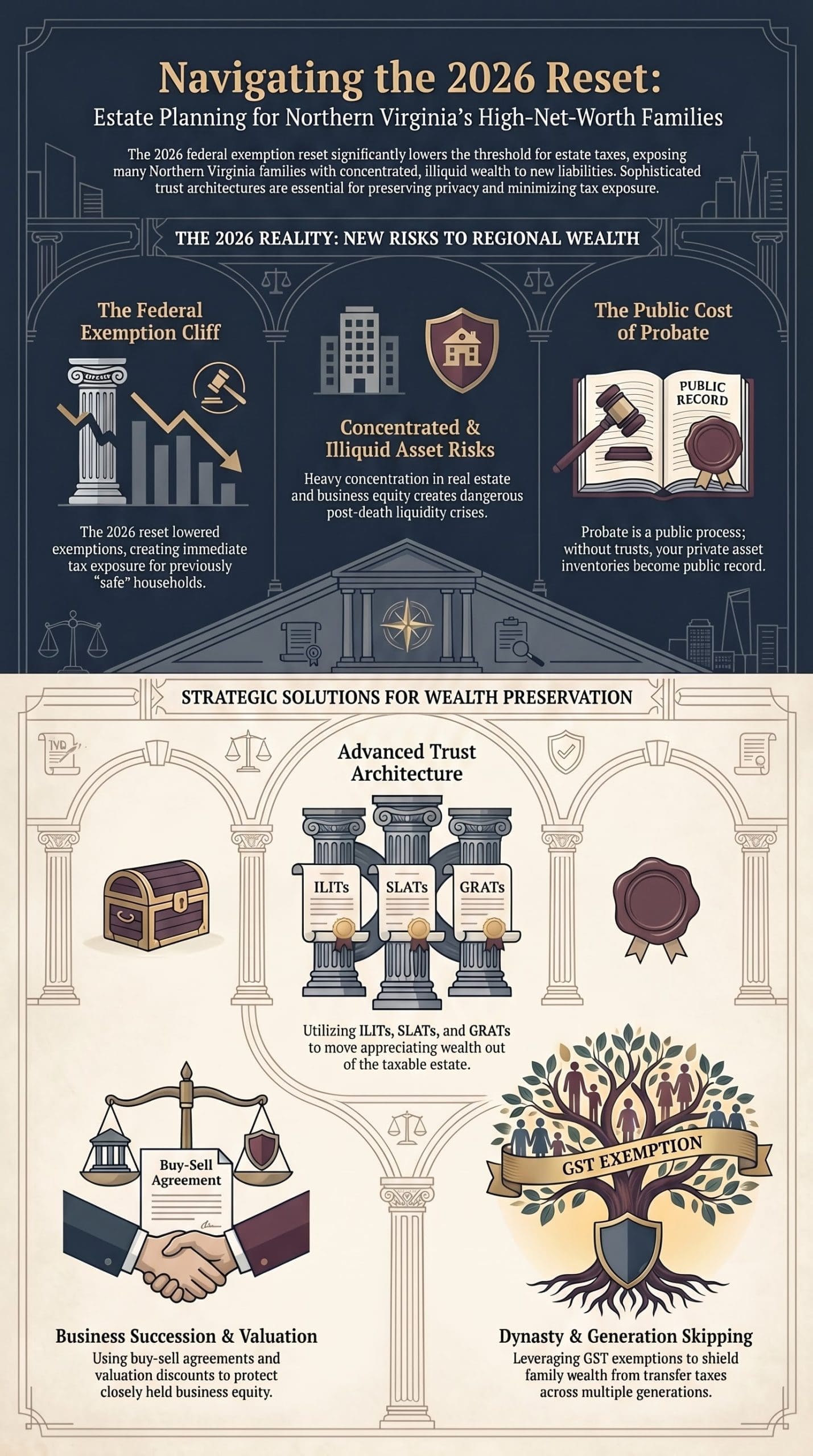
Table of Contents
- Northern Virginia’s HNW Estate Planning Reality
- Why Northern Virginia Wealth Looks Different
- The 2026 Federal Exemption Reset
- Trust Architecture for HNW Families
- Business Owner and Federal Contractor Planning
- Real Estate, Concentrated Positions, and Liquidity
- Generation Skipping and Dynasty Planning
- Charitable and Legacy Architecture
- Privacy, Probate Avoidance, and Public Filing Risk
- How Shin Law Office Approaches HNW Planning
Looking for the statewide framework? This page focuses on a specific area of Virginia estate planning. For the broader statewide guide that covers wills, trusts, probate, transfer on death deeds, powers of attorney, and high net worth tax planning under Title 64.2, see Virginia Estate Planning Lawyer: A Working Attorney’s Guide.
Chapter 1: Northern Virginia’s HNW Estate Planning Reality
High-net-worth estate planning in Northern Virginia is its own discipline. The four counties at the center of the region, Fairfax, Loudoun, Prince William, and Arlington, contain a concentration of wealth that the rest of Virginia does not produce and that very few jurisdictions outside the major coastal money centers can match. The wealth here comes from federal contractor equity, technology and data center holdings, real estate appreciated over decades of regional growth, professional services partnerships, government executive compensation packages, and family businesses that have grown alongside the region.
A family with five million dollars in assets faces different problems than a family with fifty million. A family with one main residence and a brokerage account faces different problems than a family with operating businesses, concentrated employer stock, real estate spread across multiple counties, and beneficiary family members in multiple states. A family whose wealth was built and is lived in the same household faces different problems than a family with adult children who have their own significant wealth and succession concerns. HNW estate planning aligns with the family’s architecture.
Across all four priority counties, the same patterns recur. The Fairfax federal contractor has a substantial concentrated position in employer stock. The Loudoun winery owner whose land appreciated tenfold over the last twenty years. The Prince William business owner who built an enterprise that now employs 40 people and generates $15 million in annual revenue. The Arlington federal executive whose deferred compensation, real estate, and concentrated retirement holdings push the household well above any prior estate tax safe harbor. None of these families is unusual in their county. They are typical, and the planning they need has to be calibrated to where they actually sit financially.
For a broader civil litigation context that often surrounds HNW estate planning, see my companion guides on Fairfax County property disputes, Loudoun County property disputes, Prince William County property disputes, and Arlington County property disputes. Real estate is often the largest single asset in a Northern Virginia HNW estate, and the property law issues that affect ownership, title, and use have direct downstream consequences for estate planning.
Chapter 2: Why Northern Virginia Wealth Looks Different
Northern Virginia HNW wealth has a distinctive shape that affects how estate planning has to be structured. Five recurring features come up across the four counties.
Federal Contractor and Government Executive Compensation
A significant share of Northern Virginia HNW wealth originates with federal contractors and federal employees in senior compensation tiers. These households often hold concentrated employer stock holdings, deferred compensation, restricted stock units that vest over a multi-year period, and government retirement benefits that produce predictable but inflexible income streams. The estate-planning consequence is that wealth is often illiquid, concentrated in a single employer, and tied to ongoing employment in ways that affect both lifetime gifting and post-death liquidity.
Real Estate Appreciation Across Decades
Northern Virginia real estate has appreciated substantially over the last several decades. A McLean home purchased for $400,000 in the late 1990s may be worth $3 million today. A Loudoun farm acquired before the data center boom may carry tax basis from the 1980s and current market value of fifteen million or more. The combination of low basis and high current value creates estate-planning issues that involve coordinating a step-up in basis at death, lifetime gifting strategies that may forgo a step-up, and family decision-making about whether to hold or sell the property.
Closely Held Business Equity
Many Northern Virginia HNW households derive significant value from closely held business equity. Federal services contractors, regional law firms and accounting practices, healthcare practices, technology services firms, and family businesses across construction, manufacturing, and consumer services all produce equity values that often dwarf the household’s liquid investment portfolio. The illiquidity of this equity, combined with the concentration risk and the succession planning challenges, drives much of the trust and entity architecture that HNW Northern Virginia families need.
Multi-State and International Family Footprints
Northern Virginia HNW families often have adult children, parents, or beneficiaries in multiple states or countries. Estate planning must account for state inheritance and estate tax differences, the conflict-of-laws issues that can arise between Virginia residents and beneficiaries in jurisdictions with different rules, and, in some cases, federal estate tax issues affecting non-citizen spouses and international beneficiaries.
Privacy and Public Filing Risk
Probate is a public process. Asset inventories, will provisions, and beneficiary identifications become part of the court file once probate begins. For HNW families with concentrated holdings, business interests, or sensitive beneficiary situations, the privacy cost of probate can be material. A trust-based architecture that bypasses probate offers practical privacy benefits beyond its tax and administrative benefits, and many Northern Virginia HNW families prioritize privacy as a planning objective in its own right.
Chapter 3: The 2026 Federal Exemption Reset
The federal estate and gift tax exemption changed at the start of 2026. The doubled exemption levels that applied through 2025 under prior law no longer apply automatically. The current inflation-indexed exemption is significantly lower than the level that protected most HNW Northern Virginia families over the previous several years.
For a working professional household with combined assets in the seven- to fifteen-million-dollar range, this change matters. Under the higher exemption that applied through 2025, a married couple could pass tens of millions of dollars to heirs federal estate tax-free with proper planning. Under the current lower exemption, the same household may have direct federal estate tax exposure that requires planning. Households that planned in the 2018 to 2025 window, when the exemption was at its peak, may have plans that no longer optimize for the current rules.
If your plan was last updated before 2026:
Have it reviewed against the current exemption framework. Plans that were appropriate when the exemption sat at its 2025 level may not produce the same outcome under the lower exemption that applies now, and the strategies that move wealth out of the taxable estate at lifetime gifting time can take time to implement. Waiting until the exemption picture is even less favorable narrows your options.
For a focused look at what the 2026 reset means for Northern Virginia families and the action items it produces, see my companion piece on what the 2026 federal estate tax sunset just changed for Northern Virginia families. The article that follows here drills into the trust architecture and planning techniques that work under the post-sunset rules.
Chapter 4: Trust Architecture for HNW Families
High-net-worth estate planning runs on trusts. Trusts move wealth out of the taxable estate, protect beneficiaries from creditors and divorce claims, manage distributions across generations, and provide privacy that probate-based plans cannot. The right architecture combines several trust types, each serving a specific purpose.
Revocable Living Trusts
The revocable living trust is the foundation of most HNW plans in Northern Virginia. The trust holds the household’s assets during the grantor’s lifetime, with the grantor typically serving as trustee and retaining full control. At death, the trust avoids probate, allowing a seamless transfer of assets to the named successor trustees and beneficiaries. The privacy benefit is substantial: trust administration is private, while probate is public. The revocable trust does not provide federal estate tax savings on its own, but it serves as the chassis on which the rest of the architecture is built.
Irrevocable Life Insurance Trusts (ILITs)
An irrevocable life insurance trust holds life insurance policies outside the insured’s taxable estate. For households in which life insurance is a significant component of the estate, an ILIT can yield substantial tax savings. Northern Virginia families with concentrated business equity often use ILITs to provide post-death liquidity for business succession or tax payment without inflating the taxable estate. For a focused discussion of how ILITs work specifically for Loudoun families, see my piece on how a life insurance trust protects Loudoun County families.
Spousal Lifetime Access Trusts (SLATs)
A spousal lifetime access trust allows one spouse to make a completed gift to a trust for the benefit of the other spouse and the other spouse’s descendants, removing the gifted assets from both spouses’ taxable estates while preserving indirect access through the beneficiary spouse. SLATs became particularly popular during the high exemption window through 2025 because they let couples lock in the higher exemption before it sunset. Under the current lower exemption, SLATs remain useful for couples who want to use their exemption strategically while preserving family access to gifted assets.
Grantor Retained Annuity Trusts (GRATs)
A grantor retained annuity trust transfers appreciating assets to beneficiaries while retaining an annuity stream for the grantor over a defined term. Properly structured, the technique can transfer significant appreciation to beneficiaries with minimal or zero gift tax cost. GRATs work particularly well for Northern Virginia families with concentrated employer stock, pre-IPO equity, or other assets expected to appreciate sharply during the GRAT term.
Dynasty Trusts and Generation Skipping Planning
A dynasty trust holds wealth for multiple generations of beneficiaries, with the proper allocation of generation-skipping transfer (GST) tax exemptions to shield the trust assets from federal transfer tax at multiple generations. Virginia, like most states, allows trusts to operate for extended periods, and the planning can produce multigenerational wealth preservation that would not be possible with successive estate-to-estate transfers.
Chapter 5: Business Owner and Federal Contractor Planning
Northern Virginia HNW estate planning is incomplete without addressing business owner equity. Federal services contractors in Reston, Tysons, Chantilly, Crystal City, and along the Dulles Corridor produce a steady supply of HNW founders whose principal asset is their company stock. Family businesses across the four counties produce founders whose company is both their largest asset and their daily occupation.
The Buy Sell Agreement
For multi-owner businesses, the buy-sell agreement is the central document that governs what happens to an owner’s interest at death, disability, retirement, or departure. A well-drafted buy-sell agreement coordinates with the estate plan to provide liquidity, protect the surviving owners, and offer the departing owner’s family a fair price. A poorly drafted buy-sell can leave the family with an illiquid interest worth a fraction of the company’s true value, or with a forced sale at a moment of grief.
Valuation Discounts
Closely held business interests can often be transferred at a discount to the underlying asset value due to their lack of marketability and control. The discount is based on the reality that a fractional interest in a private company cannot be sold quickly or for full proportional value. Properly documented and structured transfers can produce significant transfer tax savings, particularly when combined with a trust-based architecture that locks in the discount at gifting and removes future appreciation from the estate.
Federal Contractor Concentrated Position Planning
Northern Virginia federal contractor employees often hold concentrated positions in employer stock, which represents the bulk of their wealth. Proper planning addresses concentration risk through diversification strategies, lifetime gifting that reduces estate taxes while transferring appreciation to the next generation, and trust-based holding structures that preserve creditor protection while allowing tax-efficient distributions.
Succession Planning for Founder-Owned Companies
Founder-owned companies face the question of what happens when the founder steps back. Planning options include a sale to a third party, a sale to a private equity buyer, a sale to management or an employee stock ownership plan, a transfer to family members in the next generation, or a combination. Each option has different tax, governance, and family consequences, and the decision affects every other element of the estate plan.
Chapter 6: Real Estate, Concentrated Positions, and Liquidity
Northern Virginia HNW estates are often heavily weighted toward illiquid assets. Real estate, business equity, retirement accounts, and concentrated employer stock can together account for the majority of the household’s net worth, with relatively little held in liquid taxable accounts. Estate planning has to address the liquidity question because the federal estate tax, if owed, is generally due nine months after death in cash.
Liquidity Planning for Estate Tax
When a Northern Virginia HNW estate has federal estate tax exposure, but its assets are concentrated in real estate or closely held business equity, the family can face a forced sale at the worst possible moment to generate cash for tax payment. Liquidity planning techniques include life insurance held in an irrevocable trust to provide tax payment funds, lifetime gifting to reduce the taxable estate to within liquid asset coverage, installment payment of estate tax under Internal Revenue Code section 6166 for qualifying closely held business interests, and Graegin loans that create deductible interest expenses while providing cash flow.
Real Estate Holding Structures
Real estate held in HNW Northern Virginia estates often benefits from holding structures that combine asset protection, transfer tax efficiency, and management continuity. Limited liability companies, family limited partnerships, and trust-based holding structures all have different consequences for income tax, transfer tax, creditor protection, and management succession. The right structure depends on the family’s specific objectives and the property’s specific characteristics. For a focused look at how real estate inheritance planning works at the local level, see my piece on Leesburg real estate and inheritance: keeping property in the family without probate.
Family Farms, Wineries, and Equestrian Estates
Loudoun and the western parts of Prince William and Fauquier carry a category of HNW estate that does not exist in the same form in most American HNW jurisdictions: the family farm, winery, or equestrian property. These estates carry significant transfer tax exposure because of land value, may qualify for special use valuation under Internal Revenue Code section 2032A, and require continuity planning that addresses both the operating business and the family residence on the same land. For a focused look, see my piece on revocable living trusts for family farms and rural estates in Nokesville.
Chapter 7: Generation Skipping and Dynasty Planning
For Northern Virginia HNW families with the resources to plan beyond the first generation of beneficiaries, generation skipping and dynasty planning become a central element of the architecture. The federal generation skipping transfer (GST) tax was enacted to prevent families from skipping a generation of estate tax by transferring directly to grandchildren or more remote descendants. Each individual has a GST exemption that, properly allocated, can shield substantial wealth from transfer tax across multiple generations.
Allocating GST Exemption
The most powerful HNW planning often involves allocating GST exemption to a trust at the time of funding, with the goal of having the trust grow to many times the original exemption value across the lifetimes of children and grandchildren. A dollar of GST exemption allocated today protects the future value of whatever it covers, regardless of how much that value grows. For Northern Virginia families with significant concentrated stock or business equity expected to appreciate, the leverage on properly allocated GST exemption can be substantial.
Long-Term Trust Structures
Virginia, like most states, allows trusts to operate for extended periods. Properly drafted long-term trusts can hold wealth across multiple generations with continuing creditor protection, divorce protection, and centralized management. The terms of these trusts have to balance flexibility for changing family circumstances against the long-term tax and asset protection objectives. The trust drafting decisions made today affect family members not yet born, which is one of the reasons HNW estate planning rewards careful, experienced drafting.
Chapter 8: Charitable and Legacy Architecture
Charitable planning for HNW Northern Virginia families serves multiple purposes simultaneously: supporting causes the family cares about, generating current income tax deductions, reducing the taxable estate, and creating a vehicle for family involvement in philanthropy across generations. The available structures range from simple direct gifts to complex trust-based vehicles that combine charitable and family beneficiaries.
Charitable Remainder Trusts
A charitable remainder trust pays an income stream to non-charitable beneficiaries (typically the grantor and spouse) for a defined term, with the remainder going to charity at the term’s end. The technique is particularly useful for selling appreciated assets without immediate capital gains tax recognition, generating an immediate charitable deduction, and producing a long-term income stream.
Charitable Lead Trusts
A charitable lead trust pays an income stream to charity for a defined term, with the remainder passing to family beneficiaries at the end of the term. The technique is particularly useful for transferring appreciating assets to family members at a reduced gift tax cost while supporting charitable work during the trust term.
Donor Advised Funds and Private Foundations
For families seeking ongoing involvement in their charitable giving across generations, donor-advised funds and private foundations offer distinct operating models. Donor-advised funds offer simplicity, lower minimums, and tax efficiency, while private foundations offer greater family control, employment opportunities for family members, and the ability to operate as an institutional grantmaker.
Chapter 9: Privacy, Probate Avoidance, and Public Filing Risk
Probate is a public process. The will, the inventory of assets, the identities of beneficiaries, and the disposition of property all become part of the court file and are accessible to anyone who knows where to look. For HNW Northern Virginia families, the privacy cost of probate is high. Concentrated business interests, sensitive beneficiary situations, and substantial total wealth all benefit from being administered outside the public record.
Trust-Based Probate Avoidance
A properly funded revocable living trust can avoid probate entirely. The trust holds the assets during life, control passes to the named successor trustee at death, and distribution proceeds without court involvement. The process is private, faster than probate, and less subject to family conflict because the legal authority sits with the trustee rather than requiring court oversight. For more on how trust based probate avoidance works at the local level, see my piece on preserving privacy with revocable living trusts in Leesburg.
Beneficiary Designation Coordination
Retirement accounts, life insurance, and certain financial accounts pass by beneficiary designation rather than by will or trust. Coordinating those designations with the rest of the estate plan is essential. Outdated or inconsistent designations can produce results the family did not intend and can undermine the privacy and tax efficiency the rest of the plan was designed to achieve.
Title and Funding Discipline
An unfunded trust does not avoid probate. The single most common HNW estate planning failure I see is a beautifully drafted revocable trust that the family never actually retitled assets into. The trust document sits in a binder, while the assets remain titled to the individual, so probate still occurs, and the trust serves none of its intended purpose. Funding discipline, both at execution and on an ongoing basis as assets change, is essential.
Chapter 10: How Shin Law Office Approaches HNW Northern Virginia Planning
My approach to a Northern Virginia HNW estate planning engagement follows a five-step process, whether the assets are in the eight- or nine-figure range.
Step one is the asset and family inventory. Before I can recommend an architecture, I need a complete picture of what the family owns, how it is titled, what it is worth, its tax basis, who depends on it for income, and the family’s objectives for the next generation. Most HNW families have not assembled this picture in one place before. Doing it is the first step toward building a plan that actually fits.
Step two is the existing plan review. If the family has an existing plan, I review what is in place, when it was drafted, what assumptions it was built on, and how those assumptions have changed. Plans drafted between 2018 and 2025 were often built on the higher pre-2026 exemption and may need recalibration. Plans drafted earlier may not address generation skipping planning, dynasty trust opportunities, or modern asset protection structures that have become standard.
Step three is the architecture design. With the inventory in hand and the existing plan reviewed, I can map out the trust and entity architecture that fits this family. This usually involves a revocable trust as the foundation, irrevocable trusts to hold specific assets or accomplish specific objectives, entity structures for real estate and business holdings, and beneficiary designation coordination across all retirement, insurance, and financial accounts. The architecture is documented in writing so the family understands what each piece does.
Step four is the implementation. This is where most plans succeed or fail. Drafting the documents is the easier half. Funding the trusts, retitling assets, updating beneficiary designations, executing buy sell agreements, and obtaining the entity formations and tax filings is the harder half, and it is the step that determines whether the plan actually works at the moment it is needed. I work with clients through implementation rather than handing over a binder and walking away.
Step five is ongoing maintenance. HNW estate plans are not static. Assets change, family circumstances change, tax law changes, and the architecture has to be reviewed and updated periodically to remain effective. I treat estate planning as a relationship rather than a transaction, and the families I work with come back periodically to recalibrate as their situation evolves.
Summary: What to Take Away From This Guide
Three principles run through every chapter. The first is that HNW Northern Virginia estate planning has to be built around the specific shape of the family’s wealth, not assembled from generic templates. Federal contractor wealth, real estate held for decades, closely held business equity, and multi-state family footprints each produce planning needs that the standard plan does not address.
The second is that the 2026 federal exemption reset materially changed the planning calculus for many Northern Virginia HNW families. Plans calibrated to the higher pre-2026 exemption may not optimize under the lower exemption that applies today, and the time to recalibrate is now rather than later.
The third is that implementation matters as much as drafting. A beautifully drafted plan that is never funded accomplishes nothing. Funding discipline, beneficiary designation coordination, and ongoing maintenance are the steps that turn a plan on paper into a plan that actually works.
Frequently Asked Questions
My estate plan was last updated before 2026. Do I need to review it?
Probably yes. The federal estate and gift tax exemption changed at the start of 2026, and plans built on the higher exemption that applied through 2025 may produce different outcomes under today’s rules. A review with current counsel is the right starting point. The review can confirm that your plan still does what you intended or identify opportunities for recalibration.
What is the difference between a will and a revocable living trust?
A will directs how your assets pass at death and goes through probate, which is a public court process. A revocable living trust holds your assets during life under your control, and at death, the assets pass according to the trust’s terms without going through probate. For HNW Northern Virginia families, the privacy and administrative advantages of trust-based planning often justify the additional setup cost.
How does Virginia compare to other states for HNW estate planning?
Virginia does not impose a state estate or inheritance tax, which makes it more favorable than states that do. Virginia trust law accommodates most modern HNW planning structures, including dynasty trusts, asset protection trusts, and complex multigenerational arrangements. For families considering whether to remain Virginia residents or change domicile for tax purposes, the Virginia tax framework is generally favorable.
My business is my biggest asset. How do I plan for it?
Business owner planning combines a buy-sell agreement with the estate plan, valuation discount strategies for transferring fractional interests, liquidity planning for any estate tax that may be owed, and succession planning that addresses what happens to the business itself. The right combination depends on your business structure, your family circumstances, and your succession objectives. The conversation usually starts with the question of whether the business will remain family-owned or be sold.
What is the GST tax, and why does it matter?
The federal generation-skipping transfer tax applies to transfers that skip a generation, such as gifts or bequests to grandchildren rather than to children. Each individual has a GST exemption that, properly allocated, can shield substantial wealth from transfer tax across multiple generations. For HNW families with the resources to plan beyond the first generation of beneficiaries, GST allocation is a central element of the architecture.
How does life insurance fit into HNW planning?
Life insurance held in an irrevocable trust can provide liquidity after death for estate tax payments, business succession funding, or beneficiary equalization, without inflating the taxable estate. For Northern Virginia families with concentrated illiquid assets, such as real estate or closely held business equity, ILIT-held insurance can be the difference between an orderly estate administration and a forced sale of family assets.
What about charitable planning?
Charitable strategies serve multiple objectives at once: supporting causes the family cares about, generating current income tax deductions, reducing the taxable estate, and creating a vehicle for family involvement across generations. The available structures range from simple direct gifts to complex charitable remainder and lead trusts. The right approach depends on the family’s charitable objectives, the assets being contributed, and the income and transfer tax goals.
Do I need to fund my trust to make it work?
Yes. A revocable trust that is not funded does not avoid probate or accomplish its intended purposes. Funding the trust means retitling assets into the trust’s name and updating beneficiary designations on accounts that pass by designation. This is the step where many HNW estate plans fail in practice, and it is one of the things I focus on with clients to make sure their plan actually works at the moment it is needed.
How often should I review my estate plan?
For HNW Northern Virginia families, I recommend a substantive review at least every three to five years and more frequently when there are significant changes in family circumstances, asset values, business interests, or tax law. The 2026 exemption reset is a good example of the kind of change that warrants a comprehensive review for plans that were built on the prior framework.
What does it cost to engage HNW estate planning counsel in Northern Virginia?
Cost depends on the complexity of the family’s situation, the architecture being implemented, and the level of ongoing engagement needed. HNW planning is generally engaged on a fixed fee or hourly basis depending on scope. I provide an initial engagement assessment and a clear fee structure so clients know what to expect at each stage. Call 571-445-6565 to discuss your situation.
Talk to a Northern Virginia HNW Estate Planning Lawyer Today
The 2026 federal exemption reset changed the planning calculus for many Northern Virginia HNW families. Plans calibrated to the prior framework may no longer optimize under the rules in effect today, and the recalibration takes time to implement properly. Whether you are in Fairfax, Loudoun, Prince William, Arlington, or anywhere in Northern Virginia, the right time to review your plan is now.
Shin Law Office represents Northern Virginia families across the full HNW and ultra-HNW range. I have worked with federal contractor founders, multi-generational family businesses, real estate holding families, and government executive households on planning that fits the specific shape of their wealth.
Call 571-445-6565 or contact Shin Law Office to discuss your Northern Virginia estate planning matter.

References
Code of Virginia. (n.d.). Title 64.2. Wills, Trusts, and Fiduciaries. https://law.lis.virginia.gov/vacodefull/title64.2/
Internal Revenue Service. (n.d.). Estate Tax. https://www.irs.gov/businesses/small-businesses-self-employed/estate-tax
Internal Revenue Service. (n.d.). Generation Skipping Transfer Tax. https://www.irs.gov/businesses/small-businesses-self-employed/instructions-for-form-706-gst
Internal Revenue Code. (n.d.). Section 2032A. Valuation of certain farm, etc., real property. https://www.law.cornell.edu/uscode/text/26/2032A
Internal Revenue Code. (n.d.). Section 6166. Extension of time for payment of estate tax where estate consists largely of interest in closely held business. https://www.law.cornell.edu/uscode/text/26/6166
