


Prince William County Property Dispute Lawyer: A Complete Guide to Boundaries, Easements, Zoning, and Title Litigation
By Anthony I. Shin, Esq. | Civil Litigation & Real Estate Disputes | Shin Law Office
BOTTOM LINE UP FRONT
Property disputes in Prince William County run the full range. A boundary fight along an older Woodbridge cul-de-sac. A construction warranty failure in Haymarket. A zoning denial is connected to the Prince William Digital Gateway data center expansion. A clouded title that surfaces during a Gainesville refinance. A federal easement question along the Manassas Battlefield buffer. All of these run through the Prince William County Circuit Court in Manassas.
As a Northern Virginia attorney representing landowners, developers, and investors across Prince William, I built this guide to walk through the patterns I see most often in my office: boundary fights, easement conflicts, adverse possession claims, zoning and land use battles, quiet title actions, and HOA enforcement.
If your dispute involves a notice, a recorded deed, a survey, or a court filing, time is already working against you. Call 571-445-6565 or contact Shin Law Office today to discuss your situation.
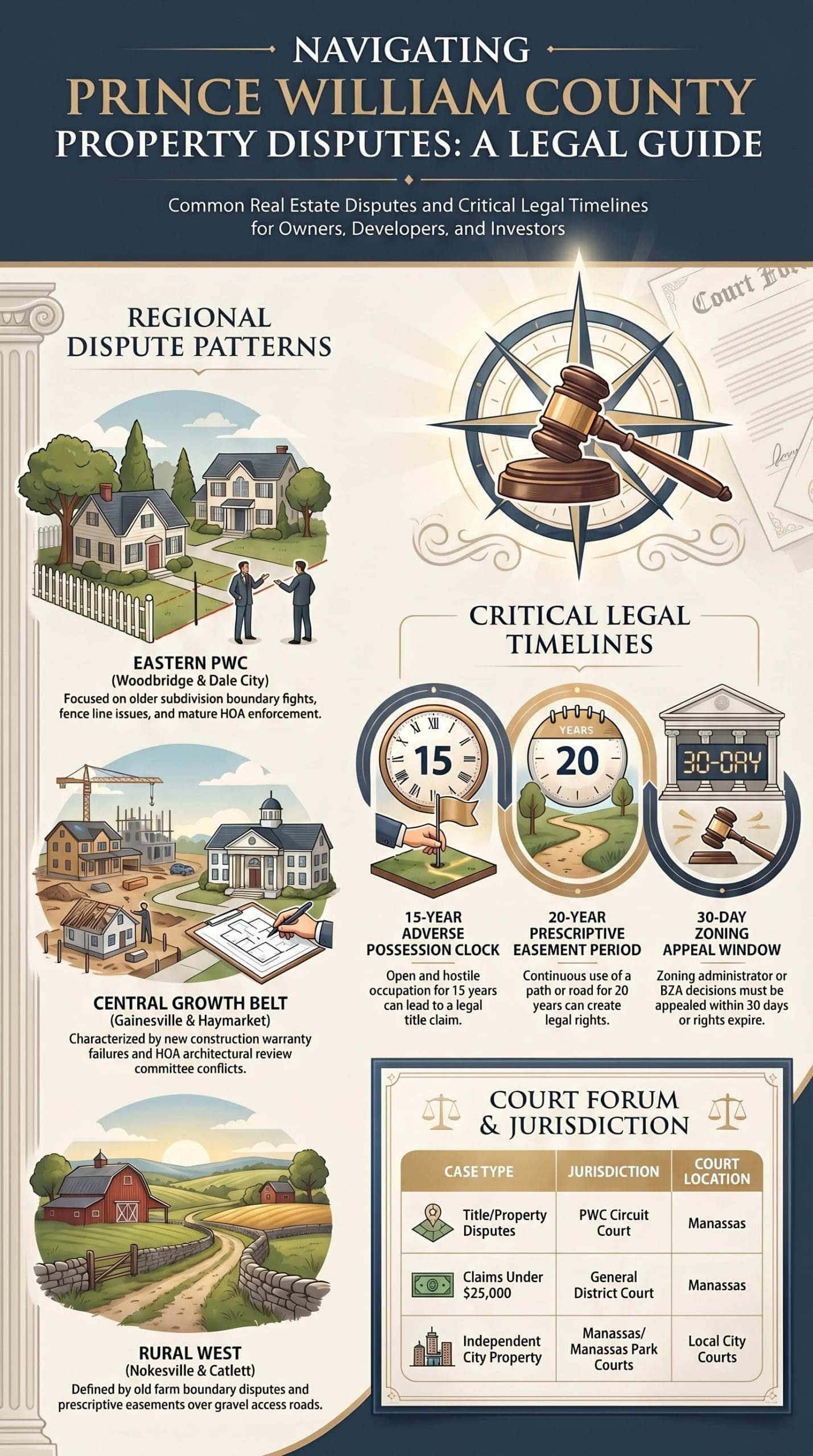
Table of Contents
- Prince William County’s Three Real Estate Markets
- Boundary Disputes in Prince William County
- Zoning, Land Use, and BZA Appeals
- Adverse Possession Claims Under Virginia Law
- Easement Disputes: Express, Implied, and Prescriptive
- Quiet Title Actions and Clouded Titles
- HOA Covenants and Restrictive Use Enforcement
- Virginia Property Law Foundations
- Navigating Prince William County Courts
- How Shin Law Office Resolves Prince William Property Disputes
Chapter 1: Prince William County’s Three Real Estate Markets
Prince William County is three real estate markets stacked on top of each other. The eastern half along the I-95 corridor, anchored by Woodbridge, Dale City, Lake Ridge, and Triangle, is the mature suburban market with a heavy mix of older subdivisions, established commercial corridors, and significant landlord-tenant volume. The central and western growth belt, running through Manassas, Bristow, Gainesville, and Haymarket, is one of the fastest-growing residential and mixed-use markets in Virginia. The rural west, around Nokesville, Catlett, and the unincorporated agricultural areas, retains the large parcel character of the county’s farming history.
The disputes I see in this office break across all three markets. In the eastern Woodbridge and Dale City neighborhoods, the fights tend to be subdivision boundary issues, older fence lines, retaining walls, and HOA enforcement actions in mature communities. In the growth belt around Bristow, Gainesville, and Haymarket, the fights are often over new-construction warranty failures, contract disputes with builders, and HOA architectural review committees in newer planned communities. In the rural west, the fights are over old farm boundaries, prescriptive easements over gravel access roads, and conservation issues that arise when family land is subdivided across generations.
All of these run through the Prince William County Circuit Court in Manassas for cases worth more than twenty-five thousand dollars or for any matter involving title to land. Smaller monetary disputes, unlawful detainer actions, and certain landlord tenant matters move through the Prince William County General District Court. Zoning disputes can begin at the Prince William County Board of Zoning Appeals before they ever reach a courtroom.
Two independent cities sit inside the county:
The City of Manassas and the City of Manassas Park are independent jurisdictions with their own court systems, zoning ordinances, and property records, even though they are surrounded by Prince William County. Property disputes inside the city limits are handled by the Manassas Circuit Court and the Manassas Park Circuit Court, not the Prince William Circuit Court. The first question I ask in any new case is which jurisdiction the property actually sits in.
If you want context on how these patterns play out across other Northern Virginia jurisdictions, see my companion Loudoun County property dispute lawyer guide, my Fairfax County property dispute lawyer guide, and the Northern Virginia real estate dispute FAQ that compares all four counties side by side. The chapters that follow drill into the specific civil litigation patterns I see most often in Prince William.
Chapter 2: Boundary Disputes in Prince William County
A boundary dispute starts when two neighbors look at the same patch of ground and see two different property lines. In Prince William County, that disagreement almost always comes back to one of three documents: the recorded deed, the recorded plat, and a current boundary survey. When those three documents agree, there is no dispute. When they disagree, you have a case.
How These Disputes Start in Prince William
In the older eastern Prince William communities of Woodbridge, Dale City, Lake Ridge, and Occoquan, the trigger is often a subdivision plat that was recorded in the 1960s, 1970s, or 1980s. A homeowner orders a current survey before adding a fence, deck, or accessory structure, and the new survey reveals that the existing fence line, hedge row, or garden bed has been sitting on the wrong side of the legal boundary for decades. In the newer growth belt subdivisions of Bristow, Gainesville, Haymarket, and Manassas, the trigger is usually a fresh installation that ran without a survey. A fence built using the original developer’s plat as a guide. A retaining wall placed at the visible edge of mowed grass. A driveway extension poured to the line a builder marked on a site plan years ago.
In the rural west, the trigger is older. A landowner inherits a property described in a deed recorded before modern survey standards. The deed references metes and bounds tied to physical landmarks that have shifted, eroded, or been removed. When the property is surveyed for the first time in decades, the new survey reveals that the fence line everyone has treated as the boundary for generations does not match the recorded description.
What the Survey Actually Proves
A survey is evidence, not a verdict. In Virginia, a licensed surveyor’s plat is admissible in court as the surveyor’s professional opinion of where the boundary sits based on the recorded documents and field measurements. Two competent surveyors can produce two different plats of the same Prince William property because they interpret ambiguous language in older deeds differently or choose different starting reference points. When that happens, the court has to decide which interpretation controls. That is what makes Prince William boundary litigation expensive. You are often paying for two surveys, two expert witnesses, and the legal work to argue why your survey is the more reliable one.
Legal Mechanisms Available
Virginia gives boundary owners several tools. An action for ejectment removes a trespasser or encroachment. A declaratory judgment action under Va. Code Section 8.01-184 asks the Prince William Circuit Court to declare where the boundary actually sits. A quiet title action settles competing claims of ownership in a single proceeding and produces a final, recordable judgment. Which tool fits depends on what you are trying to accomplish, who has the better paper title, and whether the encroaching party has been on the land long enough to assert an adverse possession defense.
Time matters more than people realize:
If a neighbor’s encroachment has existed for fifteen years or more, you may already be facing an adverse possession claim under Va. Code Section 8.01-236. The fifteen year clock runs whether you noticed the encroachment or not. The earlier you document, demand, and act, the more options remain available.
Chapter 3: Zoning, Land Use, and BZA Appeals
Prince William County’s zoning environment has been one of the most active in Virginia over the past decade, driven by data center development, the Innovation Park expansion near Manassas, and the controversial Prince William Digital Gateway redesignations along the Pageland Lane corridor. Property owners across the county face an environment in which the rules continue to evolve, and the value of a parcel can shift dramatically based on how the next round of approvals is interpreted.
The Prince William Zoning Map
Prince William’s zoning ordinance covers a wide range of districts. The Agricultural and Open Space districts cover the rural western parts of the county. The Suburban Residential districts cover most of the planned communities and traditional subdivisions. The Industrial districts cover the data center and manufacturing footprints, particularly in and around Innovation Park. Mixed use and commercial districts cover the I-95 corridor and the older town centers. A landowner who wants to convert agricultural land to commercial or industrial use, build accessory structures beyond what is permitted, or operate a use not listed in the zoning ordinance has to engage with the county’s land use process directly.
Permits, Special Exceptions, and Variances
A zoning permit denial is not the end of the road. If the county zoning administrator determines that your proposed use is not permitted, you can appeal to the Prince William County Board of Zoning Appeals. The BZA hears three primary categories of cases: appeals of zoning administrator determinations, applications for variances from strict zoning requirements, and applications for special exceptions where the ordinance specifies that the use requires BZA approval. The county’s published appeal materials state that completed appeal applications must be received no later than thirty days from receipt of a zoning determination, and the BZA hears appeal requests within ninety days of a completed application.
Appealing a BZA Decision to Circuit Court
Under Va. Code Section 15.2-2314, a party aggrieved by a BZA decision may petition the Prince William County Circuit Court for a writ of certiorari within thirty days of the decision. That window is jurisdictional and cannot be extended. Miss it and your appeal rights are gone. The Circuit Court reviews the BZA’s record to determine whether the BZA acted within its authority, applied the correct law, and based its decision on substantial evidence. The Circuit Court does not retry the case from scratch. That is why the BZA hearing itself is so important. Your evidence, your expert testimony, and your legal arguments at the BZA stage become the record on which the Circuit Court will rule.
Why Prince William zoning matters move quickly:
Data center development pressure has accelerated the county’s zoning workload over the past five years. Hearings are scheduled on rolling calendars, and continuances are rarely granted without good cause. If you receive a zoning notice or a stop work order, the appeal clock starts running immediately.
For a focused review of zoning appeals in Prince William, see my zoning determination appeals and BZA litigation guide.
Chapter 4: Adverse Possession Claims Under Virginia Law
Adverse possession is the doctrine that allows someone who has occupied another person’s land openly and continuously for fifteen years to claim legal title to that land. The fifteen year period comes from Va. Code Section 8.01-236, and it is the longest residential adverse possession period in any state east of the Mississippi. By the time anyone is asserting a claim, decades have usually passed, witnesses have died, and the documentary record is thin.
The Five Elements
A successful adverse possession claim in Virginia requires proof that the possession was actual, hostile, exclusive, visible and notorious, and continuous for the entire fifteen year period. Each element has to be proven by clear and convincing evidence, which is a higher standard than the preponderance standard that governs most civil cases. Actual means the claimant physically used the land in a manner consistent with the ownership of similar property. Hostile means the possession was without the true owner’s permission. Exclusive means the claimant did not share the use with the public or with the true owner. Visible and notorious means the use was open enough that a reasonable owner would have noticed. Continuous means the use did not stop, and tacking the use of one possessor to the next requires privity, usually a written conveyance.
Why Prince William Generates These Cases
In western Prince William, around Nokesville, Catlett, and the rural agricultural areas, adverse possession claims show up most often along old farm boundaries. A fence put up in the 1970s sits ten feet inside the legal boundary. The farmer on one side has been mowing, fencing, and grazing animals up to that fence for fifty years. The farmer on the other side never noticed. When one of the parcels sells and a new survey is performed, the fence becomes a problem.
In the older eastern Prince William neighborhoods of Woodbridge, Dale City, and Occoquan, the claims look different. A retaining wall in a subdivision that was built when the houses went up. A garden bed that has been tended for decades. A driveway extension that was paved before the current owners moved in. These older subdivision encroachments often have everything they need to satisfy the elements of an adverse possession claim if a record owner waits too long to act.
Defending Against an Adverse Possession Claim
If you are the record owner being threatened with an adverse possession claim, you have several available defenses. Permissive use defeats the hostile element. If you can show that the occupying party had your permission or your predecessor’s permission, the clock never started. Interruption of possession defeats the continuous element. If the record owner or the public used the disputed area at any point during the fifteen year period, the clock resets. Insufficient possession defeats the actual or visible elements. The earlier you act, the more of these defenses you preserve.
Chapter 5: Easement Disputes: Express, Implied, and Prescriptive
An easement is a right held by one party to use a portion of another party’s land for a specific purpose. Driveways. Utility lines. Drainage ditches. Conservation restrictions. Walking paths. In Prince William County, easement disputes carry particular weight because the county hosts substantial federal land adjacencies that produce easement scenarios you rarely see anywhere else.
Express Easements
An express easement is created by a written document, usually recorded in the land records, that describes the easement, identifies the dominant and servient estates, and states what the easement holder may do. Express easements are the cleanest category to litigate because the document itself is the primary evidence. The fights are usually over interpretation. What does the easement actually permit? Can the dominant estate widen the driveway? Can the servient estate gate the entrance? When the language is ambiguous, the court applies Virginia’s rules of construction, looks at the parties’ conduct over time, and reaches a result based on what the original parties most likely intended.
Implied Easements and Easements by Necessity
When a single tract is divided into two parcels and one parcel becomes landlocked, Virginia law recognizes an easement by necessity over the other parcel to provide access. Implied easements can also arise where a use was apparent and continuous before the division of the parent tract. These doctrines come up often in western Prince William, where large family estates have been subdivided across multiple generations and access roads were never formally documented.
Prescriptive Easements
A prescriptive easement is the easement equivalent of adverse possession. It arises when one party has used another party’s land for a specific purpose openly, continuously, and adversely for twenty years. This is five years longer than the adverse possession period for ownership claims. Prescriptive easements often involve gravel access roads, footpaths, or drainage channels that have been used for decades without any recorded grant. The party claiming the prescriptive easement must prove the use was adverse, not permissive.
Federal Adjacency Easements
Prince William County is bordered by significant federal land. Marine Corps Base Quantico in the southeastern portion of the county. Manassas National Battlefield Park in the central county. Prince William Forest Park to the south. These federal properties carry buffer easements, scenic easements, view shed protections, and access restrictions that affect every adjoining private parcel. Disputes involving federal easements often involve takings questions, just compensation issues, and federal jurisdictional considerations that do not arise in ordinary easement cases.
Why this matters in Prince William specifically:
Federal land adjacency creates legal complications that go beyond standard Virginia easement law. A property owner near the Manassas Battlefield faces view shed and historic preservation easements that limit what can be built. A property owner near Quantico may face military operating area restrictions that limit certain uses. Understanding which framework applies is the first step in any case involving these properties.
Chapter 6: Quiet Title Actions and Clouded Titles
A quiet title action is a civil lawsuit that asks the court to determine the rightful owner of real estate when the title is clouded. A clouded title is one with some defect, ambiguity, or competing claim that prevents the owner from selling, refinancing, or developing the property without resolving the issue. Prince William quiet title actions are filed in the Prince William County Circuit Court in Manassas.
When You Need One in Prince William
Several scenarios produce a clouded title in Prince William. A deed in the chain of title contains a defective legal description that no later instrument cured. An old mortgage was paid off in the 1980s but the release was never recorded, and the lender no longer exists. A relative inherited an interest in the property but cannot be located. A subdivision plat from the 1970s shows lots that overlap with a neighboring tract. A judgment lien was recorded thirty years ago and was never properly released. An easement was recorded but the parties dispute whether the easement still binds the property.
In each of these cases, a title insurance company will refuse to insure the title until the cloud is removed, and a buyer or lender will refuse to close until the title company is satisfied. The quiet title action is the path that gets the property back to marketable.
How the Action Works
The plaintiff files a complaint in the Prince William County Circuit Court identifying the property, describing the cloud, and naming all parties who might have a claim against the title. Notice has to be served on every named defendant. If a named defendant cannot be located after a diligent search, Virginia procedure permits service by publication in a newspaper of general circulation. The court then conducts a hearing or trial, weighs the competing claims, and issues a judgment that establishes the rightful owner. Once recorded in the Prince William land records, that judgment removes the cloud and restores marketable title.
Chapter 7: HOA Covenants and Restrictive Use Enforcement
A significant portion of Prince William County residential real estate sits inside a homeowners association. Lake Ridge, Montclair, Heritage Hunt, Stonewall Manor, Sheffield Manor, Westridge, and dozens of other planned communities operate under recorded declarations that establish architectural standards, use restrictions, and assessment obligations.
Architectural Review and Restrictive Covenants
An owner wants to install a fence, paint the exterior, build an addition, add a shed, or change the landscaping. The HOA architectural review committee denies the application or requires modifications the owner cannot accept. The recorded declaration governs what the HOA can and cannot require. Virginia’s Property Owners’ Association Act, codified at Va. Code Section 55.1-1800 and following, provides procedural protections that the HOA must follow before enforcing a covenant. When the HOA does not follow those procedures, the owner has a defense.
Construction Warranty Disputes in Newer Communities
Prince William’s growth belt communities of Bristow, Gainesville, and Haymarket have produced a steady volume of new construction warranty disputes that overlap with HOA enforcement issues. A homeowner discovers moisture intrusion, foundation movement, or HVAC failures within the first few years of ownership. The builder’s warranty response is slow or inadequate. The HOA pressures the homeowner about the visible issues while the homeowner is still trying to get the builder to honor the warranty. Read about a Haymarket warranty case I have written about in Haymarket’s fastest growing neighborhood has a warranty problem.
Landlord Tenant and Eviction Issues
Prince William County’s General District Court handles a significant landlord tenant docket, particularly along the I-95 corridor where residential rental properties are concentrated. The procedural rules under the Virginia Residential Landlord and Tenant Act and the unlawful detainer statutes are technical and unforgiving. A landlord who skips a notice step, delivers a defective notice, or files in the wrong court can lose months on what should have been a straightforward eviction. For a focused walkthrough of these issues, see my Prince William landlord tenant and eviction litigation guide.
Chapter 8: Virginia Property Law Foundations
Every property dispute in Prince William County rests on the foundation of Virginia substantive law. The five concepts below are the ones I find myself explaining most often to new clients, and the ones that most often determine the outcome of a case before trial begins.
The Statute of Frauds for Real Estate
Virginia Code Section 11-2 requires that any contract for the sale of real estate, any conveyance of an interest in real estate, and any easement granted for more than five years be in writing and signed by the party to be charged. Oral agreements about real estate are almost always unenforceable. The handful of exceptions, including part performance and promissory estoppel, are narrow and difficult to prove. If your dispute hinges on something the other party promised verbally, the Statute of Frauds is probably the first defense you will face.
Statutes of Limitation
Virginia property law operates on a complex set of limitation periods. Adverse possession requires fifteen years. Prescriptive easements require twenty. A breach of a written contract has a five year limitation period. A declaratory judgment action has no specific limitation period but can be barred by laches when the delay prejudices the other side. Trespass actions have a five year limitation period. Each of these clocks starts running on a different triggering event.
The Recording Act
Virginia’s Recording Act, codified at Va. Code Section 55.1-407 and following, is a notice statute. A subsequent purchaser without notice of an unrecorded instrument takes title free of that instrument’s effects. This is why recorded easements bind subsequent purchasers and unrecorded easements often do not. It is also why the careful examination of the public Prince William land records is the single most important step in any title dispute.
Available Remedies
Virginia courts have a full set of remedies available in property cases. Specific performance compels a party to perform a contractual obligation involving real estate, which is generally available because each parcel of real estate is unique. Ejectment removes a trespasser or encroacher from the land. Declaratory judgment determines the legal rights of the parties without ordering specific relief. Injunctive relief prevents future conduct, such as continued trespass or interference with an easement. Money damages compensate for diminution in value, lost use, and consequential harm.
Mitigation and Punitive Damages
Virginia law requires a plaintiff to mitigate damages where reasonable. A property owner who knows about an encroachment and lets it continue for years before filing suit may have a difficult time recovering damages for that entire period. Punitive damages are available in property cases involving willful, intentional, or malicious conduct, but Virginia caps punitive damages at $350,000 per case across all defendants.
Chapter 9: Navigating Prince William County Courts
Where you file a Prince William property dispute matters as much as how you file it. Each forum has its own procedures, monetary limits, and pace. The independent cities of Manassas and Manassas Park add a jurisdictional layer that does not exist in most Virginia counties.
Prince William County General District Court
The General District Court hears civil cases up to a $25,000 jurisdictional limit, plus unlawful detainer actions involving residential and commercial premises. The court is housed in Manassas and moves at a faster pace than the Circuit Court. Trials are bench trials, meaning a judge decides the case without a jury. Most boundary and easement disputes worth less than the jurisdictional cap, plus most landlord tenant disputes, end up here.
Prince William County Circuit Court
The Circuit Court is the trial court of general jurisdiction for Prince William County. Any property dispute involving title, any case worth more than the General District Court limit, and any case requiring equitable relief such as a quiet title action, declaratory judgment, or injunction is filed here. The Circuit Court conducts both bench trials and jury trials, depending on the parties’ preferences and the nature of the relief sought.
Manassas and Manassas Park Courts
If your property sits inside the City of Manassas or the City of Manassas Park, the case goes to the Manassas Circuit Court or the Manassas Park Circuit Court rather than the Prince William County Circuit Court. Each independent city has its own General District Court and Circuit Court, its own zoning ordinance, and its own land records. The first question I ask in any new Prince William area case is which jurisdiction the property actually sits in.
Federal Court and Removal
Property disputes occasionally end up in the United States District Court for the Eastern District of Virginia in Alexandria. Federal jurisdiction exists when the parties are from different states and the amount in controversy exceeds $75,000, or when the case presents a federal question such as a takings claim against a government entity or a fair housing claim against an HOA. Prince William cases involving federal land adjacencies, such as Quantico or Manassas Battlefield, sometimes end up in federal court for that reason.
Chapter 10: How Shin Law Office Resolves Prince William Property Disputes
My approach to a Prince William County property dispute follows the same five step process whether the case ends up in the General District Court for an unlawful detainer or in the Circuit Court for a multi million dollar quiet title action.
Step one is the document review. Before I can give a client a meaningful assessment of the case, I need to see every relevant deed, plat, survey, easement, declaration, correspondence, and recorded document. The Prince William land records are the first place I look. Most clients have not seen what is actually recorded against their property, and that is where the case usually starts.
Step two is the factual investigation. I want to know who has been using what, for how long, with what permission, and what physical evidence remains. A site visit, photographs, and conversations with prior owners and neighbors often produce the evidence that will decide the case. The earlier this work happens, the better the chance of preserving evidence that might otherwise disappear.
Step three is the legal analysis. Once I have the documents and the facts, I can map the case onto Virginia law. Which causes of action are available? Which defenses does the other side have? What remedies make sense for what the client wants to accomplish? Where should the case be filed? What is the realistic timeline and cost? These questions get answered before I file anything.
Step four is the resolution effort. Most property disputes do not need to go to trial. A clear, well documented demand letter that lays out the legal position and the evidence often produces a workable settlement. When the other side will not engage, mediation can produce a resolution at a fraction of the cost of trial. I push for resolution at every stage where resolution is achievable on terms my client can accept.
Step five is litigation when litigation is the only path forward. When the other side refuses to engage in good faith, when the legal issues require a court order, or when the client’s rights cannot be protected outside court, I file the case and try it.
Summary: What to Take Away From This Guide
Three principles run through every chapter of this guide. The first is that time matters more than people realize. Statutes of limitation, the fifteen year adverse possession clock, the twenty year prescriptive easement clock, and the thirty day BZA appeal window all operate on rigid timelines. The day a Prince William property dispute begins is the day the clock starts running on at least one of these timelines, and the smartest clients act quickly enough to preserve every available option.
The second is that documentation matters more than memory. Recorded deeds, recorded easements, recorded declarations, and historical surveys carry weight in court that conversations and verbal understandings simply do not. The Statute of Frauds and the Recording Act decide cases. If your strongest evidence is something a previous owner told you, your case is in trouble.
The third is that forum matters. Whether your case belongs in the Prince William County General District Court, the Prince William County Circuit Court, the Manassas or Manassas Park courts, the Board of Zoning Appeals, the Eastern District of Virginia, or in mediation depends on the relief you need, the amount at stake, and the procedural posture. Filing in the wrong forum costs time and money, and sometimes forecloses the strongest available remedy.
Frequently Asked Questions
How long do I have to file a property dispute case in Prince William County?
It depends on the type of claim. Adverse possession requires fifteen years of possession. Prescriptive easements require twenty years of use. Trespass actions and breach of written contract claims have a five year limitation period. BZA appeals have a thirty day window. The safest approach is to consult counsel as soon as a dispute becomes apparent.
Does my property fall in Prince William County or in Manassas?
The Cities of Manassas and Manassas Park are independent jurisdictions surrounded by Prince William County. If your property falls inside the city limits of either independent city, the case goes through that city’s court system rather than the Prince William County courts. The first step in any Prince William area case is verifying the actual jurisdiction.
Do I need a survey before filing a boundary dispute lawsuit?
Almost always yes. A current boundary survey by a Virginia licensed surveyor is the strongest evidence available in a boundary case, and most courts will require one before issuing any order that establishes the boundary. The cost of the survey is one of the first investments in the case, and the quality of the survey often determines the outcome.
Can I lose my property to a neighbor’s adverse possession claim?
Yes, if the neighbor can prove all five elements for the full fifteen year period by clear and convincing evidence. The earlier you act after noticing an encroachment, the more defenses remain available. Permissive use, interruption of the possession, and inadequate possession can all defeat the claim.
How do I appeal a Prince William zoning decision?
Most zoning administrator determinations are appealed to the Prince William County Board of Zoning Appeals within thirty days. BZA decisions can then be appealed to the Prince William County Circuit Court by petition for writ of certiorari under Va. Code Section 15.2-2314, which must also be filed within thirty days. Both windows are jurisdictional and cannot be extended.
What is a quiet title action and when do I need one?
A quiet title action is a lawsuit asking the court to determine the rightful owner of real estate when the title is clouded by some defect, ambiguity, or competing claim. You need one whenever a title insurer or a buyer’s lender refuses to proceed because of an issue in the chain of title that cannot be resolved through ordinary corrective recordings.
What if my dispute involves federal land like Quantico or the Manassas Battlefield?
Federal land adjacency creates legal complications that go beyond standard Virginia property law. View shed easements, historic preservation easements, military operating area restrictions, and federal jurisdictional considerations may all apply. These cases sometimes end up in the United States District Court for the Eastern District of Virginia rather than state court.
Can my HOA force me to take down a fence I built?
Possibly. The recorded declaration governs what the HOA can require, and the Property Owners’ Association Act provides procedural protections. If the HOA followed its declaration and complied with statutory procedures, it likely has the authority to enforce. If the HOA failed to follow its own rules, applied them selectively, or skipped a required notice, you may have a defense.
How long does a Prince William County real estate lawsuit take?
A General District Court case typically reaches resolution within three to six months. A Circuit Court case typically takes twelve to twenty four months from filing to trial, though many cases resolve through mediation or settlement before trial. Cases with multiple defendants, complex title issues, or federal land questions can take longer.
What does it cost to hire a property dispute lawyer in Prince William County?
Cost depends on the complexity of the dispute, the amount of discovery required, whether expert witnesses are needed, and whether the case settles or goes to trial. I provide an initial case assessment and then a clear engagement structure so clients know what to expect at each stage. Call 571-445-6565 to discuss your specific situation.
Talk to a Prince William County Property Dispute Lawyer Today
Property disputes do not get easier with time. Statutes of limitation run, evidence disappears, and the other side gains the advantage of every day you wait. Whether you are facing a boundary fight in Woodbridge, a warranty dispute in Haymarket, an adverse possession claim in Nokesville, a zoning denial connected to data center development, or a clouded title that is blocking a sale in Manassas, the right time to call is now.
Shin Law Office represents landowners, developers, investors, and businesses in property disputes across Prince William County and Northern Virginia. I have handled cases from suburban residential lots to multi parcel commercial development sites, and I bring the same focused, evidence based approach to every matter.
Call 571-445-6565 or contact Shin Law Office to discuss your Prince William County property dispute.

References
Code of Virginia. (n.d.). Section 8.01-184. Declaratory judgment. https://law.lis.virginia.gov/vacode/title8.01/chapter11/section8.01-184/
Code of Virginia. (n.d.). Section 8.01-236. Limitation on entry on or recovery of lands. https://law.lis.virginia.gov/vacode/title8.01/chapter4/section8.01-236/
Code of Virginia. (n.d.). Section 11-2. When written contract or memorandum required. https://law.lis.virginia.gov/vacode/title11/chapter1/section11-2/
Code of Virginia. (n.d.). Section 15.2-2314. Certiorari to review decision of board. https://law.lis.virginia.gov/vacode/title15.2/chapter22/section15.2-2314/
Code of Virginia. (n.d.). Section 55.1-407. Effect of recording on subsequent purchasers. https://law.lis.virginia.gov/vacode/title55.1/chapter4/section55.1-407/
Code of Virginia. (n.d.). Title 55.1, Chapter 18. Property Owners’ Association Act. https://law.lis.virginia.gov/vacodefull/title55.1/chapter18/
Prince William County Government. (n.d.). Circuit Court. https://www.pwcva.gov/department/circuit-court
Prince William County Government. (n.d.). General District Court. https://www.pwcva.gov/department/general-district-court
Prince William County Government. (n.d.). Board of Zoning Appeals. https://www.pwcva.gov/department/board-zoning-appeals
