


Protective Orders in Hampton Roads, Virginia: A Working Attorney’s Guide to the Three-Tier Framework, Federal Consequences, and Local Court Practice
By Anthony I. Shin, Esq. | Shin Law Office | Notes from a Virginia Attorney on the Protective Order Cases That Shape Safety, Careers, and Family Stability Across the Seven Cities
BOTTOM LINE UP FRONT
Hampton Roads is a region of roughly 1.8 million people centered on the largest natural deep-water harbor in the world. The seven core cities (Norfolk, Virginia Beach, Chesapeake, Portsmouth, Suffolk, Newport News, and Hampton) are joined by York County, Williamsburg, James City County, Poquoson, and the broader Peninsula. The military and federal civilian workforce in this region is among the largest concentrations in the United States: Naval Station Norfolk is the largest naval installation in the world, NAS Oceana is the Navy’s master jet base, Joint Expeditionary Base Little Creek-Fort Story is the Navy’s principal amphibious base, Joint Base Langley-Eustis combines Air Combat Command with the Army Transportation Center and TRADOC, Naval Weapons Station Yorktown and Coast Guard Training Center Yorktown anchor the upper Peninsula, Portsmouth Naval Shipyard is the Navy’s oldest continuously operating shipyard, and HII Newport News Shipbuilding employs roughly 25,000 workers building and refueling nuclear-powered aircraft carriers and submarines. When protective orders enter this environment, the federal consequences under 18 U.S.C. § 922(g)(8), the Lautenberg Amendment, SF-86 reporting requirements, security clearance adjudication, and command-level military reactions can produce career-altering outcomes that extend well beyond the family law context.
Virginia’s protective order framework operates in two main tracks. Family abuse protective orders under Va. Code Title 16.1 are heard in the Juvenile and Domestic Relations District Court and apply to family or household members. Non-family protective orders under Va. Code Title 19.2 (covering stalking, sexual assault, and threats from non-family parties) are heard in the General District Court. Each track follows a three-tier framework of Emergency, Preliminary, and Final orders, with progressively longer durations and more substantive process. The seven Hampton Roads cities each have their own courts, judges, and local practices, but the substantive law applies uniformly across the region.
If you are a Hampton Roads petitioner seeking protection or a respondent facing a protective order petition, your case deserves counsel familiar with the local courts and the federal framework. Call Shin Law Office at 571-445-6565.
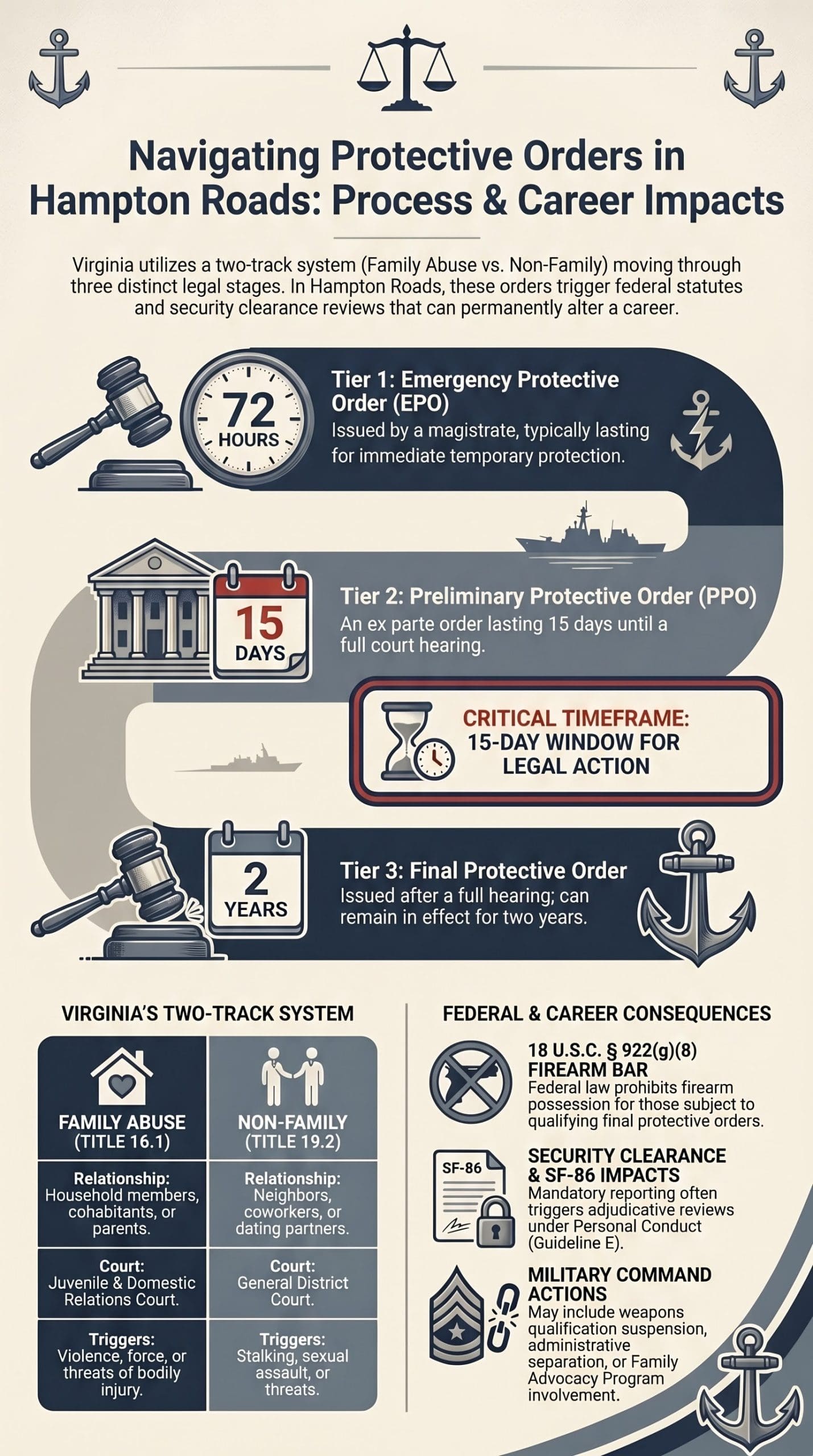
Table of Contents
- The Hampton Roads Region in Protective Order Context
- The Two-Track Framework: Family Abuse vs. Non-Family
- The Three Tiers: Emergency, Preliminary, and Final Orders
- Family Abuse Protective Orders Under Va. Code Title 16.1
- Stalking, Sexual Assault, and Non-Family Protective Orders Under Va. Code Title 19.2
- The Procedural Path Through Hampton Roads Courts
- Federal Firearm Consequences and the Lautenberg Amendment
- Security Clearance and Military Career Consequences
- Defense Strategy for Hampton Roads Respondents
- How Shin Law Office Approaches Hampton Roads Protective Orders
- Summary
- Frequently Asked Questions
- References
Chapter 1: The Hampton Roads Region in Protective Order Context
Hampton Roads sits at the mouth of the Chesapeake Bay where the James, Nansemond, and Elizabeth Rivers join the bay. Geographically, the region splits between the Southside (Norfolk, Virginia Beach, Chesapeake, Portsmouth, Suffolk) and the Peninsula (Newport News, Hampton, York County, Poquoson, James City County, Williamsburg). Each city operates its own Juvenile and Domestic Relations District Court for family abuse protective orders, its own General District Court for non-family protective orders, and its own Circuit Court for appeals and related matters. Each court has its own clerk’s office, local rules, and judge assignments. While the substantive Virginia law applies uniformly, the local practice varies meaningfully from one courthouse to another.
Why this matters across the seven cities specifically:
A Norfolk J&D R judge and a Virginia Beach J&D R judge can apply the same statute and reach different practical outcomes because they have different experiences, different scheduling pressures, and different views on what evidence carries weight. Counsel familiar with each courthouse can navigate these differences. Counsel unfamiliar with local practice cannot.
Norfolk and the Naval Station Workforce
Norfolk is home to Naval Station Norfolk, the largest naval base in the world by personnel and area, with more than 75 ships and roughly 134 aircraft based there. The Atlantic Fleet headquarters, U.S. Fleet Forces Command, and a substantial portion of the Atlantic-area Navy operate from Norfolk. Norfolk Naval Shipyard activities, support contractor workforces, and the broader military-civilian community produce a steady stream of family law and protective order cases at the Norfolk J&D R Court on St. Paul’s Boulevard. The mix of active duty Sailors, Navy civilians, defense contractors, and shipyard support workers means that protective order respondents in Norfolk frequently face career-altering federal consequences alongside the immediate family law concerns.
Virginia Beach and Oceana, Little Creek-Fort Story
Virginia Beach hosts NAS Oceana (the Navy’s master jet base for F/A-18 Super Hornets) and Joint Expeditionary Base Little Creek-Fort Story (the Navy’s primary amphibious training base and home to Naval Special Warfare Group 2 and SEAL Team Two, Four, Eight, and Ten). The Princess Anne Courthouse complex houses the Virginia Beach J&D R Court and General District Court. The mix of Navy aviators, SEAL operators, naval special warfare support personnel, civilian DoD employees, and a substantial defense contractor workforce produces protective order cases where the SF-86 implications, weapons qualification suspensions, and career consequences are particularly meaningful.
Chesapeake, Portsmouth, and Suffolk
Chesapeake’s J&D R Court at the Chesapeake Judicial Center handles a meaningful volume of protective order cases for the city’s roughly 250,000 residents, many of whom commute to the Norfolk and Portsmouth military and shipyard communities. Portsmouth hosts Norfolk Naval Shipyard (the Navy’s oldest continuously operating shipyard, built in 1767), the U.S. Coast Guard Atlantic Area Headquarters at Base Portsmouth, and a substantial concentration of shipyard, government, and military families. The Portsmouth Civic Center houses the J&D R Court that handles Portsmouth protective order cases. Suffolk, geographically the largest city in Virginia, has a smaller military concentration but produces its own steady volume of family abuse and stalking protective order cases at the Suffolk Courthouse.
The Peninsula: Newport News, Hampton, and the Surrounding Communities
Newport News is anchored by HII Newport News Shipbuilding (roughly 25,000 employees, the largest industrial employer in Virginia) and the Fort Eustis side of Joint Base Langley-Eustis. The Newport News J&D R Court at 2501 Washington Avenue handles a substantial volume of protective order cases involving shipyard families, Army personnel, and the broader Peninsula community. Hampton hosts the Langley side of JBLE (Air Combat Command, the F-22 Raptor mission), NASA Langley Research Center, and Hampton VA Medical Center, with the Hampton J&D R Court handling cases for the Hampton workforce. The York County, Poquoson, James City County, and Williamsburg courts handle protective order cases for those communities, often involving military families from Naval Weapons Station Yorktown and Coast Guard Training Center Yorktown. For broader Peninsula family law context, see our Newport News family law cornerstone guide and our Virginia Beach family law cornerstone guide.
Chapter 2: The Two-Track Framework: Family Abuse vs. Non-Family
Virginia’s protective order framework operates in two main tracks based on the relationship between the petitioner and the respondent. Each track has its own statutory basis, its own procedural rules, and its own court of original jurisdiction. The choice of track is determined by the underlying facts rather than the petitioner’s preference, and a petition filed in the wrong track will be dismissed or transferred.
Family Abuse Track Under Va. Code Title 16.1
Family abuse protective orders apply when the parties are family or household members as defined at Va. Code § 16.1-228. The definition is broad and includes spouses (including former spouses), parents, stepparents, children, stepchildren, brothers, sisters, half-brothers, half-sisters, grandparents, grandchildren, in-laws who reside in the same home, persons who have a child in common (regardless of marriage), persons who cohabit or have cohabited within the previous twelve months, and any individual related by consanguinity or affinity who resides in the same home. The relationship triggers the family abuse track and routes the case to the J&D R Court.
Non-Family Track Under Va. Code Title 19.2
Non-family protective orders apply when the parties are not family or household members. The non-family track covers stalking, sexual assault, and threatening conduct by parties outside the family relationship. Common scenarios include former dating partners who do not meet the cohabitation threshold, neighbors, coworkers, acquaintances, and strangers who have engaged in stalking or other threatening behavior. The non-family track routes cases to the General District Court rather than the J&D R Court, with corresponding procedural differences.
Chapter 3: The Three Tiers: Emergency, Preliminary, and Final Orders
Both tracks (family and non-family) follow a three-tier procedural structure that allows for immediate temporary relief while building toward a final determination through a full hearing. The three tiers serve different functions and have progressively longer durations, more substantive process, and greater consequences.
Tier One: Emergency Protective Order
An Emergency Protective Order can be issued by a magistrate based on telephonic or in-person contact, typically initiated by law enforcement at the scene of a domestic incident or by a petitioner who has been to the magistrate’s office. The Emergency order under Va. Code § 16.1-253.4 (family abuse) or § 19.2-152.8 (non-family) lasts up to 72 hours, with extension to the next business day if the 72-hour period would otherwise end on a weekend or holiday. The Emergency order serves as immediate temporary protection until the petitioner can pursue a Preliminary Protective Order through the court.
Tier Two: Preliminary Protective Order
A Preliminary Protective Order is issued by a J&D R judge (family abuse, under Va. Code § 16.1-253.1) or a General District Court judge (non-family, under Va. Code § 19.2-152.9) after an ex parte hearing on a sworn petition. The Preliminary order is issued without notice to the respondent and based solely on the petitioner’s evidence. The order lasts up to fifteen days, during which the respondent must be served and the full hearing scheduled. The 15-day window between preliminary issuance and the full hearing is critical for the respondent’s defense preparation, evidence gathering, and strategic positioning.
Tier Three: Final Protective Order
A Final Protective Order is issued after a full hearing where both parties have notice and opportunity to be heard, present evidence, call witnesses, and cross-examine the other party’s witnesses. The hearing under Va. Code § 16.1-279.1 (family abuse) or § 19.2-152.10 (non-family) is the substantive proceeding where the case is decided. The Final order can last up to two years, after which the petitioner can seek an extension if circumstances warrant. The Final order is the order with the most substantial consequences and the order against which all defense effort should be directed.
Chapter 4: Family Abuse Protective Orders Under Va. Code Title 16.1
Family abuse protective orders are the most common protective orders issued in Hampton Roads. The framework at Va. Code § 16.1-228 et seq. defines the conduct that supports an order, identifies who can petition, and sets out what the order can require.
The Family Abuse Definition
Va. Code § 16.1-228 defines family abuse as any act of violence, force, or threat that results in bodily injury or places one in reasonable apprehension of death, sexual assault, or bodily injury, committed by a family or household member. The definition includes both completed acts and threats. Reasonable apprehension is judged from the perspective of a reasonable person in the petitioner’s circumstances. The conduct does not have to rise to the level of criminal assault to support a protective order, although criminal assault clearly satisfies the standard.
What the Order Can Require
Va. Code § 16.1-279.1 lists the conditions that a family abuse protective order can impose on the respondent. Common conditions include prohibiting acts of family abuse or criminal offenses that result in injury to person or property, prohibiting contact with the petitioner and the petitioner’s family or household members, granting temporary possession of the residence to the petitioner, requiring the respondent to provide suitable alternative housing for the petitioner and the petitioner’s family or household members, requiring temporary support, granting temporary custody of children to the petitioner, and any other relief necessary to address the safety and welfare of the petitioner and any minor children in the household.
Mutual Protective Orders
Under Va. Code § 16.1-279.1(B), the court can issue mutual protective orders only after both parties file petitions and the court makes detailed findings that each party committed family abuse and that neither party acted primarily in self-defense. Mutual orders are disfavored because they can complicate enforcement and can produce ambiguity about which party is the primary aggressor. In most cases, the court should determine which party is the petitioner and which is the respondent based on the underlying facts.
Chapter 5: Stalking, Sexual Assault, and Non-Family Protective Orders Under Va. Code Title 19.2
Non-family protective orders address conduct between parties who are not family or household members. The framework at Va. Code § 19.2-152.7:1 et seq. parallels the family abuse framework but operates through the General District Court rather than the J&D R Court.
Qualifying Conduct
A non-family protective order can be issued when the petitioner shows by a preponderance of the evidence that the respondent committed an act of violence, force, or threat that resulted in bodily injury or placed the petitioner in reasonable apprehension of death, sexual assault, or bodily injury. The conduct must rise to one of the qualifying categories: stalking under Va. Code § 18.2-60.3, sexual battery under Va. Code § 18.2-67.4, sexual assault, or threatening conduct that places the petitioner in reasonable fear. Mere unpleasantness, business disputes, or relationship conflicts that do not involve violence or threats do not support a protective order.
Common Hampton Roads Scenarios
Common non-family protective order scenarios in Hampton Roads include former dating partners who did not cohabit (and thus do not meet the family or household member definition), neighbors with escalating disputes that have crossed into threats, coworkers in workplace conflicts that have moved beyond professional boundaries, online acquaintances whose contact has become threatening, and individuals with no prior relationship who have engaged in stalking. Each scenario requires careful evaluation of whether the conduct meets the statutory threshold and whether the General District Court is the proper forum.
Chapter 6: The Procedural Path Through Hampton Roads Courts
Understanding the procedural path is essential for both petitioners and respondents. The path moves from initial petition through service, hearing, and either entry of a final order or dismissal.
Filing the Petition
Family abuse petitions are filed at the J&D R Court of the city where the petitioner resides, where the respondent resides, or where the abuse occurred. Non-family petitions are filed at the General District Court of the corresponding city. Filing for protective orders is generally without fee. Court intake services help petitioners complete the forms, although counsel can substantially improve the petition’s effectiveness by ensuring all relevant facts are presented and the legal threshold is clearly met.
Ex Parte Hearing for Preliminary Order
After filing, the petitioner appears before a judge for an ex parte hearing on the request for a Preliminary Protective Order. The hearing is typically brief, often the same day or the next business day. The petitioner testifies under oath about the qualifying conduct and the need for protection. If the judge finds that the statutory threshold is met, the Preliminary order is entered. The respondent is not present and has no opportunity to contest the order at this stage.
Service on the Respondent
The Preliminary order is served on the respondent by sheriff’s deputy or police officer. Service is typically prompt because the order takes effect upon service. For Hampton Roads respondents who are active duty military, federal civilians, or shipyard workers, service can occur at home, at work, or in transit between the two. Service at a military installation requires coordination with the installation’s security forces, though service typically proceeds without obstruction.
The Full Hearing
The full hearing is scheduled within fifteen days of the Preliminary order. Both parties appear, with counsel if represented. The petitioner presents evidence first, including testimony, documentary evidence (text messages, emails, photographs), witnesses, and any other relevant material. The respondent then presents their case. Cross-examination is allowed. The judge applies the preponderance-of-the-evidence standard and decides whether to enter a Final Protective Order.
Time matters more than people realize:
The fifteen-day window between Preliminary issuance and the full hearing moves quickly. For the respondent, every day counts. Identifying witnesses, gathering documentary evidence, preparing direct and cross-examination, and developing the legal theory all have to happen in this short window. Counsel engaged on day one of the fifteen has a meaningfully better chance than counsel engaged on day twelve.
Appeal to Circuit Court
Either party can appeal a Final Protective Order from the J&D R Court or General District Court to the Circuit Court within ten days of entry. The Circuit Court appeal is de novo, meaning the case is reheard from scratch rather than reviewed for error. The de novo appeal provides a second opportunity to present evidence and argue the case before a different judge.
Chapter 7: Federal Firearm Consequences and the Lautenberg Amendment
The federal firearm consequences of a Hampton Roads protective order can be the single most significant practical consequence for the respondent, particularly for military service members, law enforcement personnel, federal civilians in security roles, and HII security workforce members. Two federal statutes establish the framework.
18 U.S.C. § 922(g)(8): The Protective Order Firearm Bar
18 U.S.C. § 922(g)(8) makes it a federal crime for a person subject to a qualifying protective order to possess a firearm or ammunition. The order qualifies if it was issued after notice and hearing, if it restrains the person from harassing, stalking, or threatening an intimate partner or child of the intimate partner, and if it includes a finding that the person represents a credible threat to the physical safety of the partner or child or by its terms explicitly prohibits the use, attempted use, or threatened use of physical force. The Preliminary Protective Order issued ex parte typically does not qualify because it is not after notice and hearing. The Final Protective Order was issued after the full hearing under Va. Code § 16.1-279.1 typically does qualify, with the federal firearm bar taking effect immediately upon entry of the qualifying order.
18 U.S.C. § 922(g)(9): The Lautenberg Amendment
The Lautenberg Amendment at 18 U.S.C. § 922(g)(9) imposes a lifetime federal firearm ban on individuals convicted of a misdemeanor crime of domestic violence. The lifetime ban survives the protective order’s expiration. For Hampton Roads respondents who face both a protective order proceeding and parallel criminal charges (assault and battery against a family or household member under Va. Code § 18.2-57.2), conviction in the criminal case can produce a permanent firearm bar that no expiration of the protective order will lift. Defense strategy must address both proceedings together because outcomes in one affect the other.
Practical Consequences for Hampton Roads Respondents
For Naval Station Norfolk Sailors, NAS Oceana aviators, JBLE Airmen and Soldiers, Naval Special Warfare operators at Little Creek, Coast Guard personnel at Portsmouth or Yorktown, and any other Hampton Roads service members in roles requiring firearms qualification, the federal bar can produce immediate weapons qualification suspension, removal from arms-bearing duties, and potential administrative separation. For HII security personnel, contracted protective service workers, and law enforcement officers across the region, the bar can mean immediate inability to perform job duties. The collateral consequences of the federal bar can substantially exceed the direct consequences of the protective order itself.
Chapter 8: Security Clearance and Military Career Consequences
Beyond the federal firearm framework, Hampton Roads protective orders produce security clearance and military career consequences that affect a substantial share of the regional workforce.
SF-86 Reporting
SF-86 (Questionnaire for National Security Positions) requires disclosure of police involvement, court proceedings, and various other matters relevant to security clearance eligibility. A protective order is generally a reportable event, with the disclosure flowing into the periodic reinvestigation cycle and any continuous evaluation systems. Failure to report a reportable event is itself a clearance issue under Guideline E (Personal Conduct), so silence is not an option. The specific reporting requirements depend on the clearance level and the agency involved.
Adjudicative Guidelines
The Adjudicative Guidelines for Determining Eligibility for Access to Classified Information (DoD Manual 5200.02) treat protective orders as relevant under several guidelines, principally Guideline E (Personal Conduct), Guideline J (Criminal Conduct) when criminal charges accompany the order, and potentially Guideline G (Alcohol Consumption) or Guideline I (Psychological Conditions) when those factors are involved. The clearance is not automatically lost. Adjudication considers the full circumstances, the severity of the conduct, the timing relative to the clearance review, evidence of mitigation, and the broader pattern of behavior.
Command-Level Consequences for Active Duty
For active duty Sailors at Naval Station Norfolk, NAS Oceana, Little Creek, Portsmouth Naval Shipyard, JBLE, NWS Yorktown, or any other Hampton Roads installation, command-level consequences typically include reporting to the unit commander, suspension of weapons qualification (if applicable), suspension of access to certain facilities, and consideration of administrative action. The specific consequences depend on the service branch, the rank, the role, and the command. The Family Advocacy Program may become involved. The case may trigger a Lautenberg-driven flag preventing arms-bearing duty assignments.
HII Newport News Shipbuilding Considerations
For HII Newport News Shipbuilding workers in clearance-required roles (a substantial portion of the engineering, program management, and security workforce on the carrier and submarine programs), a protective order produces immediate clearance review obligations. The reporting flows to the cognizant security officer, the clearance is reviewed against the adjudicative guidelines, and continued access to classified work depends on the outcome of the review. Workers in non-clearance roles still face employment consequences if the order creates workplace tension or if its conditions conflict with workplace presence.
Chapter 9: Defense Strategy for Hampton Roads Respondents
Effective defense of a protective order petition is the difference between a Final order with career-altering consequences and a dismissal that allows the respondent to move forward. Defense work is concentrated in the 15-day window between Preliminary issuance and the full hearing.
Read the Petition Carefully
Defense begins with a thorough reading of the petition to identify every factual claim. Each claim becomes a question for evidence development: is the claim accurate, is there documentary evidence that contradicts it, are there witnesses who can speak to it, and what is the petitioner’s source of information for the claim? The petition is the petitioner’s roadmap, and a careful reading allows the respondent to anticipate what evidence will be presented at the full hearing.
Gather Documentary Evidence Promptly
Text messages, emails, voicemails, social media posts, photographs, video recordings, and other documentary evidence often provide the most compelling evidence at a protective order hearing. Defense counsel should advise the respondent to preserve all relevant electronic evidence immediately and to provide it to counsel for review. Communications that show a different relationship dynamic than the petition claims, communications that contradict specific allegations, and communications that show the petitioner’s own conduct can substantially affect the case outcome.
Identify Witnesses
Witnesses who observed the relationship can provide context that the petitioner’s narrative omits. Family members, friends, neighbors, coworkers, and others who have observed the parties in relevant settings can testify to what they saw. Defense counsel should interview potential witnesses, identify which ones have admissible testimony, and prepare them for the full hearing. Witness preparation respects the duty to elicit truthful testimony while ensuring the witness presents their testimony effectively.
Prepare for Cross-Examination
Cross-examination of the petitioner is often the most important moment in the hearing. The cross-examination should test the petitioner’s account against documentary evidence, prior inconsistent statements, and the broader context of the relationship. Effective cross-examination is built on detailed preparation rather than improvisation, and the preparation requires understanding both the petitioner’s narrative and the evidence available to challenge it.
Consider the 922(g)(8) Drafting Question
If a Final order is likely to be entered regardless of defense efforts, careful attention to the order’s specific language can sometimes avoid triggering the federal firearm bar at 18 U.S.C. § 922(g)(8). The federal bar applies based on specific findings (credible threat or explicit prohibition on use of physical force). Orders that achieve the petitioner’s safety goals without including the triggering language may be negotiated. Counsel familiar with the federal framework can identify these opportunities.
Chapter 10: How Shin Law Office Approaches Hampton Roads Protective Orders
Protective order cases in Hampton Roads are not simple. They affect safety, careers, families, and futures. The right approach respects the seriousness of the case while doing the technical work that produces good outcomes for the client.
For Petitioners: Building a Strong Case
Petitioners deserve counsel who builds the case carefully, presents the evidence professionally, and protects the petitioner during the often difficult process of testifying about the underlying conduct. Counsel can help identify relevant evidence the petitioner may have overlooked, prepare the petitioner for direct and cross-examination, and present the case in a way that maximizes the likelihood of a Final order that provides meaningful protection.
For Respondents: Mounting an Effective Defense
Respondents deserve counsel who understands the federal consequences of a Final order, develops the case quickly within the fifteen-day window, and presents the defense effectively at the full hearing. For Hampton Roads service members, federal civilians, shipyard workers, and other clearance-required respondents, the defense work has to address both the immediate proceeding and the downstream career implications. Counsel familiar with both areas produces substantially better outcomes than counsel handling only the family law side.
Tough Cases Require Tough Attorneys
The firm’s tagline applies in protective order cases as much as anywhere else. Both petitioners and respondents in Hampton Roads protective order cases need counsel willing to do the hard work: reading the evidence carefully, preparing thoroughly, presenting effectively, and being ready for whatever the full hearing produces. Posturing does not produce outcomes. Substantive preparation does.
Summary
Protective orders in Hampton Roads, Virginia operate under a two-track framework, with family abuse cases under Va. Code Title 16.1 routed to the Juvenile and Domestic Relations District Court and non-family cases under Va. Code Title 19.2 routed to the General District Court. Each track follows a three-tier procedural structure of Emergency, Preliminary, and Final orders, with the Final Protective Order being the substantive determination after a full hearing under Va. Code § 16.1-279.1 or § 19.2-152.10. Each of the seven Hampton Roads cities (Norfolk, Virginia Beach, Chesapeake, Portsmouth, Suffolk, Newport News, Hampton) and the surrounding Peninsula jurisdictions have their own courts with local practices, but the substantive Virginia law applies uniformly.
For Hampton Roads respondents in particular, the federal consequences of a qualifying Final Protective Order can produce immediate and substantial career impacts. The federal firearm prohibition at 18 U.S.C. § 922(g)(8) takes effect upon entry of a qualifying order. The Lautenberg Amendment at 18 U.S.C. § 922(g)(9) imposes a lifetime ban for misdemeanor domestic violence convictions. SF-86 reporting obligations and security clearance adjudication under DoD Manual 5200.02 affect the substantial cleared workforce at Naval Station Norfolk, NAS Oceana, Joint Expeditionary Base Little Creek-Fort Story, Joint Base Langley-Eustis, Naval Weapons Station Yorktown, Coast Guard Training Center Yorktown, Portsmouth Naval Shipyard, and HII Newport News Shipbuilding. The collateral consequences regularly exceed the direct consequences of the order itself.
Whether you are a petitioner seeking protection or a respondent facing a petition, the time to engage counsel is now. The fifteen-day window between Preliminary issuance and the full hearing moves quickly, and effective preparation requires attention to evidence, witnesses, and the legal framework from the earliest possible moment. Done right, protective order cases produce outcomes that protect what needs to be protected and avoid consequences that exceed what the underlying conduct warrants.
Frequently Asked Questions
Where do I file for a protective order in Hampton Roads?
For family abuse cases (involving family or household members), file at the Juvenile and Domestic Relations District Court of the city where you reside, where the respondent resides, or where the abuse occurred. For non-family cases (stalking, sexual assault, threats from non-family parties), file at the General District Court of the corresponding city. Each of the seven Hampton Roads cities has its own courts with their own intake services.
How long does an Emergency Protective Order last?
Up to 72 hours, with extension to the next business day if the 72-hour period would otherwise end on a weekend or holiday. The Emergency order is a short-term bridge that gives the petitioner time to pursue a Preliminary Protective Order through the court.
My ex filed a Preliminary Protective Order against me without notice. Is that legal?
Yes. The Preliminary order is issued ex parte (without notice to the respondent) under Va. Code § 16.1-253.1 (family abuse) or § 19.2-152.9 (non-family). The respondent’s opportunity to contest the order comes at the full hearing, which must be held within fifteen days of the Preliminary order. The fifteen-day window is the critical defense preparation period.
I am a Naval Station Norfolk Sailor. What command-level consequences could a protective order produce?
Possible actions include suspending weapons qualification, restricting access to certain facilities, involving the Family Advocacy Program, and considering administrative action. The specific consequences depend on the rank, role, and command. Engaging counsel familiar with both the family law and military justice framework allows coordination with command JAG.
Will a protective order affect my security clearance?
Probably yes, although not necessarily fatally. SF-86 reporting requirements apply, and the clearance review considers the conduct under the adjudicative guidelines in DoD Manual 5200.02. With proper mitigation and presentation, many cleared workers retain their clearances after protective order proceedings. Counsel familiar with both areas substantially helps.
Can I appeal a Final Protective Order?
Yes. Either party can appeal from the J&D R Court or General District Court to the Circuit Court within ten days of entry. The appeal is de novo, meaning the case is reheard from scratch in Circuit Court rather than reviewed for error. The de novo appeal gives the parties a second opportunity to present evidence and argument before a different judge.
Do I need a lawyer to file or defend a protective order?
No, but counsel substantially improves outcomes for both petitioners and respondents. For petitioners, counsel helps build the case effectively and present it professionally. For respondents, counsel handles the time-sensitive defense work that the fifteen-day window requires. The stakes (safety, career, family) generally justify the investment in counsel.
My HII supervisor heard about my pending protective order. Can he take action against my employment?
Possibly, depending on your role and clearance status. HII security personnel and clearance-required workers face different employment consequences than other workers. The reporting obligations and adjudicative review can produce administrative action even before any final court order. Engaging counsel early allows coordination with HR and the security office.
Can a Final Protective Order be modified or terminated early?
Yes, in some cases. Either party can petition for modification based on changed circumstances. The court considers whether modification serves the safety interests that supported the original order. Modification is more likely when both parties agree, when substantial time has passed without further incident, and when the underlying circumstances have changed meaningfully.
When should I contact a Hampton Roads protective order attorney?
As early as possible. For petitioners, before filing if possible, so the petition is drafted effectively. For respondents, immediately upon learning that a Preliminary order has been issued or a petition has been filed, so the fifteen-day defense preparation window can be used effectively. Early engagement is the foundation of effective representation in these cases.
Hampton Roads Protective Order Attorney
Whether you are seeking protection from a family member, household member, former dating partner, stalker, or non-family threat, or whether you are facing a petition that could affect your career, your firearms rights, your security clearance, or your military service, you deserve counsel who knows the Hampton Roads courts and the federal framework that operates around them.
Tough cases require tough attorneys. Shin Law Office handles protective order matters across Norfolk, Virginia Beach, Chesapeake, Portsmouth, Suffolk, Newport News, Hampton, York County, Williamsburg, James City County, Poquoson, and the broader Hampton Roads region.
Call 571-445-6565

References
Code of Virginia. (2024). Title 16.1, Section 16.1-228: Definitions. Virginia General Assembly. https://law.lis.virginia.gov/vacode/title16.1/chapter11/section16.1-228/
Code of Virginia. (2024). Title 16.1, Section 16.1-253.1: Preliminary protective orders in cases of family abuse. Virginia General Assembly. https://law.lis.virginia.gov/vacode/title16.1/chapter11/section16.1-253.1/
Code of Virginia. (2024). Title 16.1, Section 16.1-253.4: Emergency protective orders. Virginia General Assembly. https://law.lis.virginia.gov/vacode/title16.1/chapter11/section16.1-253.4/
Code of Virginia. (2024). Title 16.1, Section 16.1-279.1: Protective orders in cases of family abuse. Virginia General Assembly. https://law.lis.virginia.gov/vacode/title16.1/chapter11/section16.1-279.1/
Code of Virginia. (2024). Title 19.2, Section 19.2-152.7:1 et seq.: Protective orders in cases of stalking, sexual assault, and other non-family situations. Virginia General Assembly. https://law.lis.virginia.gov/vacode/title19.2/
Code of Virginia. (2024). Title 19.2, Section 19.2-152.8: Emergency protective orders for non-family. Virginia General Assembly. https://law.lis.virginia.gov/vacode/title19.2/
Code of Virginia. (2024). Title 19.2, Section 19.2-152.9: Preliminary protective orders for non-family. Virginia General Assembly. https://law.lis.virginia.gov/vacode/title19.2/
Code of Virginia. (2024). Title 19.2, Section 19.2-152.10: Final protective orders for non-family. Virginia General Assembly. https://law.lis.virginia.gov/vacode/title19.2/
Code of Virginia. (2024). Title 18.2, Section 18.2-57.2: Assault and battery against a family or household member. Virginia General Assembly. https://law.lis.virginia.gov/vacode/title18.2/
Code of Virginia. (2024). Title 18.2, Section 18.2-60.3: Stalking. Virginia General Assembly. https://law.lis.virginia.gov/vacode/title18.2/
18 U.S.C. § 922(g)(8) (Federal firearm prohibition for protective order respondents). https://www.govinfo.gov/app/collection/uscode
18 U.S.C. § 922(g)(9) (Lautenberg Amendment lifetime ban for misdemeanor domestic violence). https://www.govinfo.gov/app/collection/uscode
Department of Defense Manual 5200.02. (2024). Procedures for the DoD Personnel Security Program. https://www.esd.whs.mil/
Standard Form 86. (2024). Questionnaire for National Security Positions. U.S. Office of Personnel Management. https://www.opm.gov/forms/pdf_fill/sf86.pdf
Naval Station Norfolk. (2024). Installation overview. https://cnrma.cnic.navy.mil/Installations/NS-Norfolk/
Naval Air Station Oceana. (2024). Installation overview. https://cnrma.cnic.navy.mil/Installations/NAS-Oceana/
Joint Expeditionary Base Little Creek-Fort Story. (2024). Installation overview. https://cnrma.cnic.navy.mil/Installations/JEB-Little-Creek-Fort-Story/
Joint Base Langley-Eustis. (2024). Installation overview. https://www.jble.af.mil/
Norfolk Naval Shipyard. (2024). Shipyard overview. https://www.navsea.navy.mil/Home/Shipyards/Norfolk/
Huntington Ingalls Industries. (2024). Newport News Shipbuilding overview. https://nns.huntingtoningalls.com/
