


Gray Divorce in Hampton Roads, Virginia: A Tidewater Attorney’s Guide for the Couple Approaching or In Retirement
By Anthony I. Shin, Esq. | Shin Law Office | Notes from a Virginia Attorney on the Late-Life Divorce Cases That Decide What the Next Twenty Years Look Like for the Couple Who Built a Life Together
BOTTOM LINE UP FRONT
If you are reading this from a kitchen table in Kingsmill or Ford’s Colony or Governor’s Land while the morning paper sits unread, from a back porch in Carolina Forest in Suffolk where you and your spouse have been thinking about selling, from a condo near the oceanfront where you moved a few years after the kids left, or from anywhere in Hampton Roads where the marriage that brought you through three decades is now coming apart, you are not alone. Pew Research Center analysis shows that the divorce rate for adults age 50 and over has more than doubled in the United States since 1990, and has tripled for those over 65. The cases are common enough now that the term gray divorce is widely used among family law attorneys, financial planners, and people living through them.
Hampton Roads sees a substantial volume of these cases for specific reasons. The region is home to large retired military communities, including Naval Station Norfolk, NAS Oceana, JEB Little Creek-Fort Story, Joint Base Langley-Eustis, Naval Weapons Station Yorktown, the Coast Guard Training Center Yorktown, and Norfolk Naval Shipyard. It holds large retired federal civilian populations from those same installations, as well as from NASA Langley, Jefferson Lab, the Hampton VA Medical Center, and Joint Base Langley-Eustis. It includes large numbers of retired healthcare workers from Sentara, Riverside, Bon Secours, and the Children’s Hospital of the King’s Daughters. It holds the Williamsburg-area retiree communities in James City County and York County, the Sandbridge and Cape Charles retirement enclaves, and the broader influx of people who chose to retire in this region because of the climate, the coastline, the military and federal civilian retiree benefit infrastructure, and the cost of living relative to other coastal markets.
When these long-married Hampton Roads couples decide to divorce, the law, the technical work, and the planning are different from a younger family’s divorce. The retirement accounts are larger and more complicated. The pensions may already be in pay status. Social Security claiming decisions are imminent or in motion. Medicare and long-term care are part of the picture. The estate plan set up twenty years ago needs a complete reset. Whether you are the spouse who is leaving, the spouse who has been told the marriage is over, or the couple deciding together that the next chapter looks different, your case deserves a Virginia attorney who handles late-life divorce. Call Shin Law Office at 571-445-6565.
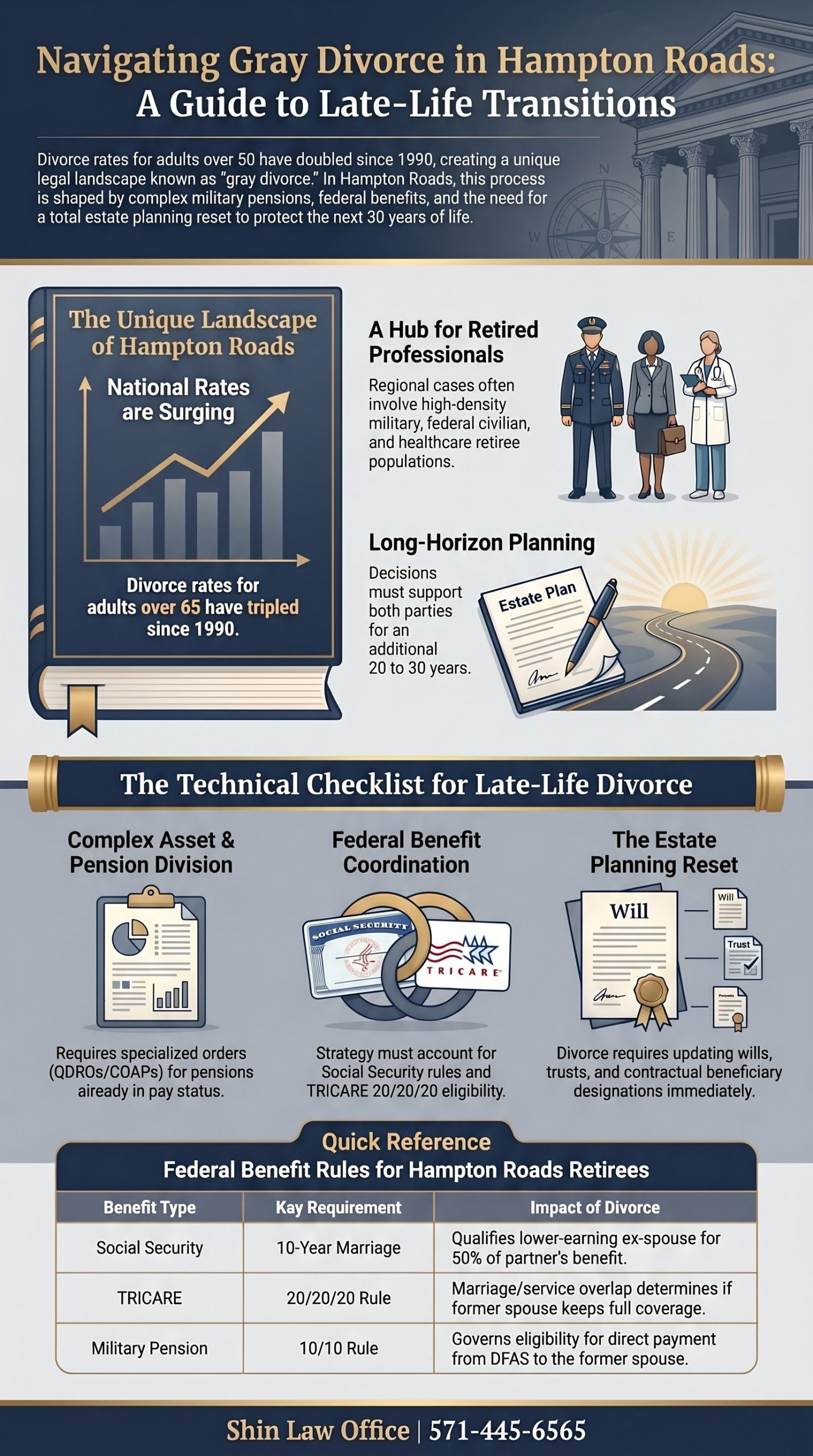
Table of Contents
- The Couple Who Built a Life Together and Now Want Different Things
- Why Hampton Roads Sees More Gray Divorces
- The Long-Marriage Asset Inventory: What Thirty Years Has Accumulated
- Retirement Account Division and the RMD Timing Issue
- Pension Division for Already-Retired Spouses
- Social Security Divorced Spouse Benefits and Claiming Strategy
- Medicare, Long-Term Care, and the Healthcare Transition
- Estate Planning Coordination and the Will and Trust Reset
- What I Tell Hampton Roads Couples in the First Late-Life Divorce Meeting
- Summary
- Frequently Asked Questions
- References
Chapter 1: The Couple Who Built a Life Together and Now Want Different Things
They came to my office together, which is more common in late-life divorces than in younger ones. He was 63, retired from the Navy three years earlier as an O-5 surface warfare officer, with most of his career flagged at Naval Station Norfolk. She was sixty-one, retired earlier that year from a long career as a nurse manager at Sentara Norfolk General. They lived in Ford’s Colony in James City County, in the house they had moved into when he turned 25, and they finally got off the orders carousel. They had three grown children, six grandchildren, and a quiet, paid-off house with a screened porch and a magnolia in the front yard.
They had been married thirty-six years. They had decided, in the same conversation rather than as a fight, that they wanted different things for the next stretch of their lives. He wanted to travel. He had a list. She wanted to stay near the grandchildren, to volunteer at the church and the library, and to slow down rather than speed up. They had tried for a year to make a single plan work. It had not. Neither was angry. Both were tired of pretending. They came to me to ask whether divorce was the answer, what it would look like if they did it, whether the financial picture would actually support both of them living separately, and whether they could keep the rest of the family from being damaged in the process.
I told them what I tell every Hampton Roads couple who walks in with a similar story. The legal framework is Virginia divorce law, the same equitable distribution under Va. Code § 20-107.3, the same spousal support analysis under Va. Code § 20-107.1, the same residency and venue rules. The work is different from a younger divorce in specific and predictable ways. The retirement accounts are larger and more layered. His military pension is already in pay status with the Defense Finance and Accounting Service. Her Sentara pension is being drawn. Both Social Security claiming decisions are within the next several years, and the choices interact. Medicare is on the horizon for her in three years and is here for him. Their wills, drafted in 1998 and lightly updated in 2009, are wholly inadequate for where they are now. The house, paid off and worth four times what they paid for it, is the simplest piece of the picture, not the hardest. Most of the work will happen within the retirement and benefits structure they spent their careers building.
Their case took about nine months. We pulled the complete picture of the military pension, the civilian pension, the IRAs, the joint brokerage account, the Roth conversion she had done in 2018, the long-term care policies they had each taken out in their fifties, and the estate plan documents. We coordinated the DFAS military pension division order with appropriate handling for the in-pay-status timing. We drafted a QDRO for her Sentara pension, and the plan administrator accepted it on first submission. We did the IRA division through transfer-incident-to-divorce protocols under 26 U.S.C. § 408(d)(6). We mapped out the Social Security claiming choices for both of them. We sold the house in Ford’s Colony, with appropriate credit for the contributions each had made, and split the proceeds so that each of their downsized housing situations was funded. He bought a smaller place in the same neighborhood. She moved into a townhouse in New Town a few miles away, near two of the grandchildren. They both attended the youngest grandchild’s baptism six months after the decree entered. The marriage did not survive, but the family did, and the financial framework they walked away with supported both of them for the next twenty or thirty years. For a broader background on divorce law in this region, see our cornerstone guide on divorce law in Hampton Roads, Virginia.
Chapter 2: Why Hampton Roads Sees More Gray Divorces
Gray divorce is a national trend. The reasons it has more than doubled in the United States since 1990 and tripled among adults over 65 are well studied. Hampton Roads sees the trend at a higher volume than the national average for reasons specific to the region.
The National Drivers
Life expectancy is longer than it was a generation ago. A couple who reach age 60 together can reasonably expect another twenty to thirty years of life ahead. The decision to spend those years differently than the prior thirty has a different weight than it once did. Women’s financial independence has increased substantially over the same period, with higher lifetime earnings, greater retirement accumulation in their own names, and greater confidence in their ability to support themselves outside marriage. Adult children are typically out of the household, removing a major reason couples historically stayed together through difficult years. Cultural and social acceptance of divorce has shifted, particularly for older adults who would have felt social pressure to stay married a generation ago. None of these factors is unique to Hampton Roads, but all apply here.
The Hampton Roads Retired Military Population
Hampton Roads has one of the largest concentrations of military retirees in the United States. Decades of careers based at Naval Station Norfolk, NAS Oceana, JEB Little Creek-Fort Story, Joint Base Langley-Eustis, Naval Weapons Station Yorktown, the Coast Guard Training Center Yorktown, and Norfolk Naval Shipyard produce a substantial retired population that did not move away when their service ended. Many of these couples spent careers running on an operational tempo that was hard on marriages, with deployments, sea duty, PCS moves, and the cumulative pressure of a service life. Some of these marriages were sustained, in part, by the structure of work itself. When the work ends, and the structure goes, what is left can be a marriage that the couple has not actually examined in years. Some of those examined marriages do not survive the examination.
The Federal Civilian Retiree Population
The retired federal civilian population in Hampton Roads is similarly substantial. NASA Langley alumni, Jefferson Lab retirees, retired Norfolk Naval Shipyard workers, retired Newport News civilian DoD personnel, retired Hampton VA Medical Center staff, and retired federal civilians from across the regional installations make up tens of thousands of households. These retirees often have FERS or CSRS pensions in pay status, Thrift Savings Plan balances they are drawing from or about to draw from, and the Federal Employees Health Benefits coverage that continues into retirement. The same career-end inflection point that affects military retirees also affects many of these civilian retirees.
The Healthcare Workforce
The Hampton Roads healthcare workforce is one of the largest non-military and non-federal employment sectors in the region. Sentara Healthcare, Riverside Health, Bon Secours Mercy Health, Children’s Hospital of the King’s Daughters, the Eastern Virginia Medical School community, and the Hampton VA Medical Center together employ tens of thousands. Many of these employees follow long careers, accumulate substantial retirement assets through 403(b) plans and hospital pensions, and reach retirement age with marriages that have been stretched by years of shift work and high-stress practice. The gray divorces that emerge from this population follow patterns similar to those in the military and federal civilian populations.
The Williamsburg-Area Retiree Communities
James City County and York County have become substantial retiree destinations. Williamsburg attracts retirees from across the country with its history, climate, and cultural amenities. Communities like Ford’s Colony, Governor’s Land, Kingsmill, Stonehouse, and Greensprings host substantial retired populations, including many from outside the region. When these in-migrating retirees divorce, the case is filed in the Williamsburg-James City County Circuit Court or the York-Poquoson Circuit Court, and the analysis often involves out-of-state retirement accounts, premarital separate property from earlier careers, and inheritance issues from the parties’ families. The work is the same Virginia framework but the inputs are often more complicated than for couples whose entire careers were in Hampton Roads.
The Coastal and Beach Retirement Enclaves
Sandbridge in Virginia Beach, the Cape Charles area on the Eastern Shore (technically Northampton County rather than the formal Hampton Roads MSA, but adjacent), the Carolina Forest area in Suffolk, and various other beach-adjacent communities draw retirees seeking coastal access. These cases often involve vacation rental property, second-home complexity, and asset profiles that differ from those of suburban retiree households.
Chapter 3: The Long-Marriage Asset Inventory: What Thirty Years Has Accumulated
The first substantive task in any late-life divorce is the asset inventory. Long marriages accumulate more than younger ones, and the categorization is more complicated.
Real Estate
For couples who have been in the same house for decades, the home is typically paid off or close to it, with substantial appreciation since purchase. A house bought in Williamsburg in 1992 for $185,000 is worth perhaps $650,000 today. The basis questions matter for capital gains analysis if the home is sold, with the federal home sale exclusion at $500,000 for a married couple under 26 U.S.C. § 121 reduced to $250,000 for a single filer post-divorce. Vacation property, time-share interests, and rental property add complexity. For couples with property in multiple jurisdictions, jurisdictional questions can arise about which state has jurisdiction over the division.
Retirement Accounts
The retirement account picture is typically the most complicated piece. A long-married couple may have a 401(k) from one or both spouses, a 403(b) from a healthcare or education employer, multiple traditional IRAs (often including rollovers from prior employer plans), Roth IRAs, possibly a SEP-IRA from self-employment, and Health Savings Accounts. Each account has its own tax characteristics, division mechanism, and timing implications. The total retirement picture for a Hampton Roads professional couple at age 60, with 30 years of work behind them, often runs into seven figures.
Pensions
Defined-benefit pensions are increasingly rare among younger workers but remain meaningful for the gray-divorce population. Military pensions, federal civilian FERS or CSRS pensions, hospital pensions from older employers like Sentara and Riverside, teacher pensions from Virginia Retirement System, and corporate pensions from earlier-career employers may all be in the picture. Some of these pensions may already be in pay status, which would substantially change the mechanics of the division.
Investment and Savings Accounts
Joint and individual brokerage accounts, money market accounts, savings accounts, and certificates of deposit accumulate over decades. Cost basis matters for taxable accounts because future capital gains tax liability varies with the allocation of cost basis. For accounts with appreciated holdings purchased decades ago, the embedded gain can be substantial.
Inherited and Gifted Assets
Many gray divorce cases involve assets that one or both spouses inherited from parents who died during the marriage. Under Va. Code § 20-107.3, inherited property is generally separate property of the spouse who inherited it, but if it was commingled with marital funds or if both spouses contributed to its preservation or improvement, it may be hybrid property. The classification analysis of inherited assets in long marriages can be technically complicated and often accounts for a substantial portion of the case.
Insurance and Annuities
Whole life and universal life insurance policies have cash values that are part of the marital estate. Annuities accumulated for retirement income may have surrender charges that affect the practical valuation. Long-term care insurance policies, addressed in more detail in Chapter 7, are themselves valuable assets that should be accounted for in the planning.
Personal Property
Thirty years of shared life accumulate personal property. Furniture, vehicles, art, jewelry, family heirlooms, recreational equipment, collections of various kinds. The personal property inventory rarely accounts for a large share of total wealth in a gray divorce, but it accounts for a meaningful share of the emotional friction. Couples can negotiate the financial aspects of divorce, only to get stuck over who keeps the dining table they bought in 1995. Counsel can help structure a process to efficiently resolve these questions.
Debts
Debts accumulated during the marriage are also subject to equitable distribution. For couples who have run up credit card debt, are paying down a mortgage on the marital residence, have outstanding car loans, or have personal loans, the debt picture is part of the analysis under Va. Code § 20-107.3. For older couples, the debt picture is typically smaller than for younger couples but should not be overlooked.
Chapter 4: Retirement Account Division and the RMD Timing Issue
For gray divorce couples, dividing retirement accounts is often the largest piece of work. The mechanics differ depending on the type of account.
ERISA Plans Require a QDRO
Employer-sponsored retirement plans subject to the Employee Retirement Income Security Act, including 401(k) plans, 403(b) plans, and private-sector defined benefit pension plans, require a Qualified Domestic Relations Order to divide. The QDRO is drafted to comply with the plan’s QDRO procedures, submitted to the plan administrator, and processed in accordance with ERISA standards. For private-sector plans in which the employee is still working, the QDRO typically establishes an alternate payee account that the receiving spouse can manage going forward. For plans in which the employee has already retired and is in pay status, the QDRO must be drafted to address the in-pay-status situation, which differs from plan to plan.
IRA Division Under Section 408(d)(6)
Traditional IRAs and Roth IRAs are not ERISA-governed and do not require a QDRO. IRA division happens through a transfer incident to divorce under 26 U.S.C. § 408(d)(6). The transfer is non-taxable and does not trigger the 10 percent early-withdrawal penalty under 26 U.S.C. § 72(t). The receiving spouse can roll the transferred amount into their own IRA. The mechanics are simpler than for ERISA plans, but the divorce decree must contain the specific transfer language and the receiving institution must process the transfer correctly.
Roth Versus Traditional Tax Treatment
Traditional and Roth balances have different tax characteristics. A dollar in a traditional 401(k) or IRA is pre-tax and will be taxed at distribution. A dollar in a Roth account is post-tax and qualified distributions come out tax-free. Equal dollar amounts of traditional and Roth are not actually of equal economic value. For fair division, the Roth and traditional balances should be allocated proportionally between the spouses, or handled explicitly to account for their tax characteristics. For couples who have done substantial Roth conversions, the analysis can be technically complicated.
The RMD Timing Issue
Required Minimum Distributions (RMDs) under 26 U.S.C. § 401(a)(9) apply to traditional retirement accounts (not Roth IRAs during the original owner’s lifetime) starting at the applicable age. The SECURE Act 2.0, enacted in December 2022, raised the RMD start age to 73 for individuals reaching that age in 2023 or later, with a further increase to 75 for individuals reaching 75 in 2033 or later. For gray divorce couples whose accounts are subject to RMDs, the division has to handle the in-progress distribution stream. If RMDs have already been calculated for the year of divorce, the parties have to coordinate the allocation of that year’s RMD between the pre-division and post-division periods. For accounts that will become subject to RMDs in coming years, the division should consider how each spouse’s post-divorce account will produce its own RMD calculation.
Health Savings Accounts
HSA balances accumulated during the marriage are marital property subject to equitable distribution. HSA division is generally straightforward and can be handled through transfer between spouses’ HSAs, with no tax consequences when done as part of the divorce.
Coordination With Pension Division
For couples with both retirement accounts and pensions, the division of one affects the analysis of the other. If one spouse takes a larger share of the retirement accounts in exchange for the other spouse taking a larger share of the future pension stream, the trade-off has to be analyzed for present-value equivalence and tax-adjusted basis. This kind of off-set arrangement is common in gray divorces and benefits from careful planning.
Chapter 5: Pension Division for Already-Retired Spouses
When one or both spouses are already retired and receiving pension payments, the pension division work is technically more complicated than dividing a pension that has not yet entered pay status. The mechanics depend on the type of pension.
Military Pension Already in Pay Status
For a military retiree already drawing a pension, the Defense Finance and Accounting Service (DFAS) processes the division order under 10 U.S.C. § 1408 (USFSPA). The 10/10 Rule for direct payment is met automatically for any couple with a 10+ year marriage that overlaps 10+ years of creditable service, which is virtually always met for gray divorce military families. The Frozen Benefit Rule (effective for divorces after December 23, 2016) applies, but for retirees already in pay status, the relevant calculation is based on the pay grade and service at retirement, which is fixed at the time of retirement rather than at the time of divorce. The DFAS order specifies when the former spouse’s share begins, typically the next available pay cycle after DFAS accepts the order. For more on military pension division generally, see our companion guide on USFSPA military pension division.
Federal Civilian FERS or CSRS Pension Already in Pay Status
For a federal civilian retiree already drawing FERS or CSRS pension, the Office of Personnel Management processes the division order through a Court Order Acceptable for Processing (COAP) under 5 CFR Parts 838 (CSRS) and 839 (FERS). The COAP for an already-retired employee differs from a COAP for an active employee in that the calculation is based on the actual pension amount being paid rather than a projected amount, and the former spouse’s share begins in the next available pay cycle after OPM accepts the order. For FERS and CSRS pension division generally, see our companion guide on FERS, CSRS, and TSP federal pension division.
Private Pension Already in Pay Status
For private-sector pensions in pay status (older Sentara pensions, Newport News Shipbuilding HII pensions for retirees, corporate pensions from earlier employers), the QDRO is processed by the plan administrator. Each plan has its own procedures for in-pay-status QDROs, and some plans have stricter requirements than others. The QDRO has to be drafted to comply with the specific plan’s procedures, and the timing of when the former spouse begins receiving payments depends on the plan’s processing.
Survivor Benefit Plan and Survivor Annuity Considerations
For military retirees, the Survivor Benefit Plan (SBP) under 10 U.S.C. §§ 1447 et seq. provides a continuing monthly annuity to the designated beneficiary after the retiree’s death. If the retiree elected SBP for the spouse at retirement, the divorce raises the question of whether to convert the election to a former spouse SBP election, with specific time frames for the election. Without former spouse SBP coverage, the former spouse’s share of the pension ends at the retiree’s death. For federal civilian retirees, an analogous Former Spouse Survivor Annuity (FSSA) under 5 U.S.C. § 8341(h) for CSRS and 5 U.S.C. § 8445 for FERS provides similar protection. Private pensions typically have their own survivor election structures handled through the plan’s QDRO procedures.
VA Disability and the Howell Issue
For military retirees who receive Department of Veterans Affairs disability compensation, the VA waiver issue affects the divisible pension. Federal law requires retirees to waive an equal amount of military retired pay when receiving VA disability compensation. The waived portion is not divisible under USFSPA. The Howell v. Howell Supreme Court decision (2017) established that state courts cannot order indemnification of the former spouse for amounts lost to a post-divorce VA waiver. For gray divorce military families with significant disability ratings, the issue is particularly relevant because many military retirees apply for disability ratings in the years following retirement, and rating increases over time can reduce the divisible pension share over time.
Chapter 6: Social Security Divorced Spouse Benefits and Claiming Strategy
Social Security claiming decisions are central to gray divorce planning. The federal framework provides specific divorced spouse benefits under 42 U.S.C. § 402(b) for divorced spouses who meet the eligibility requirements, and the claiming strategy interacts with the divorce in ways that benefit from advance planning.
The Ten-Year Marriage Rule
To qualify for divorced-spouse Social Security benefits, the marriage must have lasted at least 10 years. Most gray divorce couples meet this requirement easily, but the threshold matters in late-life divorce planning when one spouse is considering whether to file before reaching the ten-year mark or to wait. Filing before 10 years preserves all the same Virginia divorce rights but disqualifies the lower-earning spouse from divorced-spouse Social Security benefits.
The Divorced Spouse Benefit Amount
A divorced spouse who meets the eligibility requirements can claim a benefit equal to up to 50 percent of the higher-earning ex-spouse’s Primary Insurance Amount (PIA) at the divorced spouse’s Full Retirement Age (FRA). Claiming earlier reduces the benefit. The divorced spouse benefit is independent of the worker spouse’s claim, meaning the worker spouse does not have to have claimed for the divorced spouse to claim, although the parties must have been divorced for at least two years if the worker spouse has not yet claimed (the two-year rule under 42 U.S.C. § 402(b)(1)).
The Deemed Filing Rule
For individuals who reached age 62 on or after January 2, 2016 (effectively most current and future gray divorce filers), the deemed filing rule requires that when a person claims either their own retirement benefit or a spouse or divorced spouse benefit, they are deemed to have claimed both. The Social Security Administration pays the higher of the two. This eliminated the previous file-and-suspend strategies that allowed strategic timing of separate claims. For gray divorce couples planning their claiming strategy, the deemed filing rule simplifies the analysis but also reduces flexibility.
Working Spouse Versus Divorced Spouse Comparison
For divorced spouses with their own substantial earnings record, the comparison between their own retirement benefit and the divorced-spouse benefit (50 percent of the ex-spouse’s PIA) can favor either, depending on the circumstances. A divorced spouse whose own PIA is at or above 50 percent of the ex-spouse’s PIA gets nothing additional from the divorced spouse benefit. A divorced spouse whose own PIA is well below 50 percent of the ex-spouse’s PIA can benefit substantially from the divorced spouse benefit. In Hampton Roads, gray divorce cases involving a long-career professional spouse and a spouse who reduced or paused their career to support the family, the divorced spouse benefit can produce a meaningful income increase.
Survivor Benefits After the Ex-Spouse’s Death
If the higher-earning ex-spouse dies, the divorced spouse can claim survivor benefits equal to 100 percent of the deceased ex-spouse’s PIA, subject to the widow or widower benefit framework. This survivor benefit is preserved even if the divorced spouse remarries after age 60. For gray divorce planning, the survivor benefit is sometimes an important part of the long-term picture, particularly for spouses with health concerns or significantly older ex-spouses.
Government Pension Offset and Windfall Elimination
Some Hampton Roads gray divorce cases involve a spouse who worked in non-Social-Security-covered employment (older CSRS federal civilians, some state and local government employees, some teachers in certain pension systems). The Government Pension Offset (GPO) and Windfall Elimination Provision (WEP) reduce or eliminate Social Security benefits for these workers and their spouses or divorced spouses. The Social Security Fairness Act enacted in early 2025 substantially reformed GPO and WEP, eliminating them for most affected workers, but the historical effect on benefits earned over a long career can still apply to specific situations. The analysis is technical and benefits from coordination with Social Security planning expertise.
Chapter 7: Medicare, Long-Term Care, and the Healthcare Transition
Healthcare planning is one of the most important and most overlooked elements of gray divorce. Couples in their fifties, sixties, and seventies have to coordinate Medicare eligibility, supplemental coverage, long-term care planning, and the transition from spouse-of-employee or spouse-of-retiree status to individual status.
Medicare Eligibility Is Individual
Medicare eligibility under 42 U.S.C. § 1395 begins at age 65 (with limited earlier eligibility for disability, end-stage renal disease, and ALS) and is based on the individual’s own work history. Each spouse’s Medicare eligibility is independent of the marriage. Divorce does not affect Medicare eligibility for either spouse. For gray divorce couples where both spouses are 65 or older, each is on Medicare and the divorce does not change that. For couples in which one spouse is 65 or older and the other is not, the younger spouse needs separate health coverage planning.
Pre-65 Coverage for the Younger Spouse
For gray divorce couples where one spouse is younger than 65 and was covered under the older spouse’s employer plan or retiree plan, the younger spouse needs replacement coverage at divorce. Options include continuation under the prior plan through COBRA (typically up to 36 months for divorce-qualifying events), enrollment in an Affordable Care Act marketplace plan with potential premium tax credits depending on income, enrollment in the younger spouse’s own employer plan if available, or other coverage options. The COBRA enrollment window is short (typically 60 days from the qualifying event), and missing it produces loss of the option.
TRICARE for Military Retiree Former Spouses
For former spouses of military retirees, the 20/20/20 Rule under 10 U.S.C. § 1072 governs TRICARE eligibility. To qualify for full TRICARE benefits, the marriage must have lasted at least 20 years, the service member must have completed at least 20 years of creditable service, and the marriage and service must overlap by at least 20 years. For most gray divorce military families, all three conditions are met. The 20/20/15 Rule provides one year of transitional coverage for spouses meeting 15 years of overlap. The Continued Health Care Benefit Program (CHCBP) under 10 U.S.C. § 1078a provides up to 36 months of post-divorce coverage at the former spouse’s expense for those who do not qualify under 20/20/20 or 20/20/15.
FEHB for Federal Civilian Retiree Former Spouses
For former spouses of federal civilian retirees, the Federal Employees Health Benefits (FEHB) spouse equity provisions under 5 U.S.C. § 8901(10) allow continued FEHB coverage for former spouses who meet specific marriage duration and prior coverage requirements. The Temporary Continuation of Coverage (TCC) program provides up to 36 months of continued coverage at the former spouse’s expense. Both elections have short deadlines that must be met after the divorce.
Long-Term Care Insurance
Many Hampton Roads couples in their fifties or sixties have purchased long-term care insurance policies to address the substantial cost of nursing home or in-home care later in life. These policies are typically individual policies (each spouse owns their own), but are sometimes spouse-linked or have shared benefit pools. The divorce does not automatically affect coverage, but the settlement must address premium payment responsibility, beneficiary designations, and policy decisions. For couples who have purchased long-term care policies with substantial value (rated to provide hundreds of thousands of dollars in future benefits), the policies themselves are valuable assets that should be accounted for.
Medicaid Spend-Down Considerations
For couples where one spouse anticipates needing long-term care covered by Medicaid (typically nursing home care for the spouse with declining health), the divorce can affect Medicaid eligibility analysis. Virginia Medicaid spousal protection rules and the federal Medicaid framework include specific provisions for community spouse and institutionalized spouse situations. Strategic divorce planning is sometimes used as a Medicaid planning tool, but the analysis is technical and benefits from coordination with elder law expertise.
Medicare Part B IRMAA Effects
Medicare Part B and Part D Income-Related Monthly Adjustment Amounts (IRMAA) apply higher premiums for beneficiaries with income above specific thresholds. IRMAA is calculated based on the individual’s tax filing status and modified adjusted gross income. The divorce changes the filing status and may change income, which affects IRMAA calculations. For gray divorce couples with substantial retirement income, the IRMAA effect of the divorce can produce premium changes that should be considered in the settlement.
Chapter 8: Estate Planning Coordination and the Will and Trust Reset
Every gray divorce requires a complete estate planning reset. Wills written during the marriage, revocable living trusts, beneficiary designations on retirement accounts and insurance, powers of attorney, and advance medical directives all need to be reviewed and updated. Without the reset, the estate plan that had the spouse as the central beneficiary, executor, trustee, and decision-maker continues to operate after the divorce, often with results neither party would want.
Wills and the Statutory Revocation
Under Va. Code § 64.2-412, a divorce or annulment automatically revokes provisions of a will that benefit the former spouse, treating the former spouse as having predeceased the testator. This automatic revocation is helpful but incomplete. The will may have contingent beneficiaries who are not appropriate for the post-divorce situation. Executors named jointly with the spouse may need to be replaced. Specific bequests may need to be reconsidered. The will needs to be redrafted to reflect the new family structure.
Revocable Living Trusts
For couples who have a revocable living trust, the trust document needs to be amended or replaced to reflect the divorce. Joint trusts typically have to be partitioned into separate trusts for each former spouse. Successor trustees may need to be changed. Distribution provisions need to be revised. The trust amendment process is technical and benefits from estate planning counsel familiar with the post-divorce situation.
Beneficiary Designations on Retirement Accounts and Insurance
Beneficiary designations on 401(k) plans, IRAs, life insurance policies, and similar accounts are contractual designations that pass property by contract rather than by will. These designations are not automatically affected by the will revocation statute. Federal law under the Supreme Court’s Egelhoff v. Egelhoff Sr. decision (2001) preempts state laws that attempt to revoke these designations on divorce, meaning that an outdated beneficiary designation can pay the former spouse the full benefit even after the divorce. For ERISA plans, the federal preemption is comprehensive. Each beneficiary designation should be reviewed and updated as part of the post-divorce work, with the new designation submitted directly to the plan administrator or insurance company.
Powers of Attorney
Durable powers of attorney for financial matters and for healthcare typically name the spouse as the agent during marriage. After divorce, these documents should be revoked and replaced with new powers of attorney naming an appropriate agent (an adult child, a sibling, a trusted friend, or a professional fiduciary). Without the replacement, the former spouse may retain the legal authority to make financial or healthcare decisions in an emergency.
Advance Medical Directives and HIPAA Authorizations
Advance medical directives that name the spouse as the healthcare agent need to be revised. HIPAA authorizations that allowed the spouse access to medical records need to be revised. For gray divorce couples where one or both spouses have ongoing health issues, the medical decision-making framework matters. The post-divorce medical directives should reflect who the individual now wants to make those decisions.
Coordination With Children and Grandchildren
For families with grown children and grandchildren, the estate planning reset is also an opportunity to consider direct gifts and bequests to descendants. Annual exclusion gifts under 26 U.S.C. § 2503(b) (currently $19,000 per recipient per donor for 2025), 529 plan contributions, and direct payment of medical or educational expenses under 26 U.S.C. § 2503(e) can be part of the post-divorce estate planning strategy. For Hampton Roads families with grandchildren in college or approaching college, these mechanisms can be meaningful tools.
Coordinating With the Firm’s Estate Planning Practice
The estate planning reset is its own area of practice that complements the family law work. For Shin Law Office clients in gray divorce, we coordinate the family law side with the estate planning side so that the divorce decree, the new will, the trust amendments, and the beneficiary designations all reflect the same intended outcome. The work is part of what makes a gray divorce settlement actually function the way the parties intended.
Chapter 9: What I Tell Hampton Roads Couples in the First Late-Life Divorce Meeting
When a Hampton Roads couple in their fifties, sixties, or seventies comes to my office for a divorce consultation, I tell them six things in the first meeting.
First, the work is different from a younger family’s divorce. The retirement and pension picture is the largest part of what we will do. The Social Security claiming decisions are part of the planning. Medicare and long-term care are part of the picture. The estate planning reset has to happen in coordination with the divorce. None of this is grim. It is technical, and the technical work pays off in the long-term financial security of both of you.
Second, we are going to inventory everything. Every retirement account. Every pension. Every brokerage account. Every piece of real estate. Every insurance policy. The cost basis on the taxable accounts. The tax characteristics of the retirement accounts. The pension projections from each plan. The Social Security earnings records for both of you. The estate planning documents. The complete picture is the foundation for everything else.
Third, we are going to think about the next twenty or thirty years rather than just the next twelve months. A gray divorce is a long-horizon planning exercise. The settlement that looks fair on paper today should also produce a workable financial picture for both of you when one of you is 75 and dealing with a health issue, when the other is 85 and considering moving to assisted living, when grandchildren are in college, and when the long-term care policies are being claimed. The horizon matters.
Fourth, we will coordinate the divorce work with the financial planning expertise you each bring to the table. Many of my gray divorce clients have a relationship with a financial advisor, an accountant, or a retirement income planner. The divorce work and the planning work should be coordinated. The settlement that is best for you may not be the one that maximizes a single number on a spreadsheet, but instead the one that produces the most secure long-term picture given everything in the planning.
Fifth, we will do the estate planning reset alongside the divorce. The new will. The trust amendments. The beneficiary designations. The powers of attorney. The advance medical directives. None of this can wait until after the decree. All of it has to happen so that on the day the divorce is final, the rest of your legal framework reflects who you are now rather than who you were when these documents were written.
Sixth, we are going to handle the case with the dignity and discretion that long marriages deserve. Most gray divorces settle. The conversations are professional. The documentation is thorough. The court appearances are brief. The result is a clean decree, a clean estate plan, and a financial framework that supports both of you through the next chapter. None of this requires public conflict. The work is private and methodical, and that is how it should be. For the broader regional family law framework, see our Hampton Roads divorce cornerstone, and for the firm’s family law practice generally, see our family law practice page.
Summary
Gray divorce, the term for divorce after age 50, has more than doubled in the United States since 1990 according to Pew Research Center analysis, and the rate has tripled for adults over 65. Hampton Roads sees the trend at higher than average volume because of the large retired military population from Naval Station Norfolk, NAS Oceana, JEB Little Creek-Fort Story, Joint Base Langley-Eustis, Naval Weapons Station Yorktown, the Coast Guard Training Center Yorktown, and Norfolk Naval Shipyard, the large retired federal civilian population from those installations and from NASA Langley, Jefferson Lab, and the Hampton VA Medical Center, the large retired healthcare workforce from Sentara, Riverside, Bon Secours, and Children’s Hospital of the King’s Daughters, and the Williamsburg-area retiree communities in James City County and York County.
When these long-marriage couples divorce, Virginia divorce law (Va. Code § 20-91 grounds, Va. Code § 20-107.3 equitable distribution, Va. Code § 20-107.1 spousal support) applies, layered with retirement account division through ERISA QDRO procedures and 26 U.S.C. § 408(d)(6) for IRAs, pension division for benefits in pay status under DFAS, OPM, or private plan administrator procedures, Required Minimum Distribution coordination under 26 U.S.C. § 401(a)(9) and SECURE Act 2.0, Social Security divorced spouse benefits under 42 U.S.C. § 402(b) with the ten-year marriage rule and deemed filing rule, Medicare and long-term care planning under 42 U.S.C. § 1395, and the estate planning reset under Va. Code Title 64.2 covering wills, trusts, beneficiary designations, powers of attorney, and advance medical directives.
Done correctly, a Hampton Roads gray divorce produces a settlement that supports both former spouses for the next 20 or 30 years, with clean retirement and pension division orders, properly timed Social Security claiming decisions, appropriate healthcare coverage continuity, and a complete estate planning reset. Done casually, it produces rejected pension orders, missed CHCBP or COBRA enrollment deadlines, outdated beneficiary designations that pay the former spouse, and financial outcomes that haunt one or both parties for the rest of their lives.
Frequently Asked Questions
My spouse and I have been married 32 years and we are both retired. How is the pension and retirement account picture handled?
Each retirement vehicle is divided through its own mechanism. ERISA-governed 401(k), 403(b), and private pension plans require a Qualified Domestic Relations Order. IRAs are divided through transfer incident to divorce under 26 U.S.C. § 408(d)(6). Military pensions in pay status are divided through DFAS under 10 U.S.C. § 1408. Federal civilian pensions in pay status are divided through OPM under 5 CFR Parts 838 and 839. The orders have to be drafted to comply with each plan’s specific requirements, and for pensions already in pay status, the in-pay-status mechanics differ from pre-retirement division.
Do I qualify for divorced spouse Social Security benefits?
If your marriage lasted at least 10 years, you can claim divorced spouse benefits under 42 U.S.C. § 402(b) when you reach age 62, with full benefits at your Full Retirement Age. The benefit can be up to 50 percent of your ex-spouse’s Primary Insurance Amount at your FRA, although the deemed filing rule means the Social Security Administration pays the higher of your own benefit or the divorced spouse benefit. After your ex-spouse’s death, you may be entitled to survivor benefits up to 100 percent of your ex’s PIA, subject to the widow or widower benefit framework.
Will I keep TRICARE if my military retiree spouse and I divorce after 25 years?
Yes, if you also meet the 20/20/20 Rule. To qualify for full TRICARE benefits indefinitely, the marriage must have lasted at least 20 years, the service member must have completed at least 20 years of creditable service, and the marriage and service must overlap by at least 20 years. For most long-marriage gray divorce military families, all three conditions are met. If 20/20/20 is not met but 20/20/15 is, you get one year of transitional coverage. Otherwise, CHCBP under 10 U.S.C. § 1078a provides up to 36 months of post-divorce coverage at your expense.
My spouse is already taking RMDs from a traditional IRA. How does that affect division?
The Required Minimum Distribution stream is in progress. The division has to handle the in-progress distribution by allocating the year-of-divorce RMD between pre-division and post-division periods. After the division, each spouse’s resulting account produces its own RMD calculation going forward. Under SECURE Act 2.0, the RMD age is currently 73 for individuals reaching that age in 2023 or later, with a further increase to 75 effective for individuals reaching 75 in 2033 or later. The IRA division itself is non-taxable under 26 U.S.C. § 408(d)(6) when handled as a transfer incident to divorce.
My spouse and I have a long-term care insurance policy. What happens to it in the divorce?
Long-term care insurance policies are typically individual policies, with each spouse owning their own. Some are spouse-linked or have shared benefit pools. The divorce does not automatically affect coverage, but the settlement should address premium payments going forward, beneficiary designations (if applicable), and any policy decisions that need to be made. For couples whose policies have substantial accumulated value, the policies are valuable assets that should be accounted for in the equitable distribution analysis.
Will I lose Medicare coverage if I divorce my spouse who is on Medicare?
No. Medicare eligibility under 42 U.S.C. § 1395 is individual and based on each person’s own work history. Divorce does not affect Medicare eligibility for either spouse. If you are 65 or older, your Medicare continues unaffected. If you are under 65 and were on your spouse’s employer plan, you need separate coverage planning for the gap period.
My will names my spouse as primary beneficiary and executor. Does the divorce automatically fix that?
Partly. Under Va. Code § 64.2-412, divorce or annulment automatically revokes provisions of a will that benefit the former spouse, treating the former spouse as predeceased. This automatic revocation is helpful but incomplete. Contingent beneficiaries may not be appropriate. Executors named jointly with the spouse may need to be replaced. The will needs a complete redraft. More importantly, beneficiary designations on retirement accounts and life insurance are contractual designations that the will revocation statute does not affect, and federal preemption under the Supreme Court’s Egelhoff decision means an outdated designation can still pay the former spouse. Each beneficiary designation must be updated separately.
My spouse and I have a paid-off house in Williamsburg that has appreciated substantially. How is it handled?
The home is marital property subject to equitable distribution under Va. Code § 20-107.3. The value is the fair market value at the date set by the court (typically the date of evidentiary hearing or another specified date), often determined through appraisal. Options include sale of the home with proceeds split, one spouse buying out the other’s interest, or continued joint ownership for a transitional period. The federal home sale exclusion under 26 U.S.C. § 121 ($500,000 for married couples, $250,000 for single filers) affects the tax planning. For Williamsburg-area homes that have appreciated dramatically since purchase, the capital gains analysis can be meaningful.
My spouse and I have separate inheritances from our parents. Are those marital or separate?
Generally, separate property under Va. Code § 20-107.3, but the analysis depends on what happened to the inheritance during the marriage. Inherited assets that were kept separate, never commingled with marital funds, and never improved with marital effort typically remain separate. Inherited assets that were commingled with marital funds, deposited into joint accounts, or used to acquire marital property may be wholly or partly marital under the hybrid property doctrine. In long marriages, the commingling history can be technically complex, and the classification analysis often requires substantial effort.
When should I contact a Hampton Roads gray divorce attorney?
As soon as you and your spouse have started seriously considering divorce, ideally before either of you has filed. Early consultation does not commit you to filing. It gives you the information to make decisions with the long-term picture in mind. For gray divorces especially, the planning work pays off substantially when started early, because retirement, pension, Social Security, healthcare, and estate planning decisions interact in ways that benefit from advance coordination.
Hampton Roads Gray Divorce Attorney for Tidewater Couples Approaching or In Retirement
Whether you are a retired military officer in Williamsburg, a retired federal civilian in Hampton, a retired Sentara nurse in Norfolk, a long-career teacher or administrator in Virginia Beach, or a long-marriage couple anywhere across the Tidewater region, your divorce deserves counsel who handles late-life cases with the technical attention that retirement and pension division requires and the dignity that long marriages have earned.
Tough cases require tough attorneys. Shin Law Office handles gray divorce, retirement and pension division, military and federal civilian retiree divorces, Social Security claiming coordination, healthcare transition planning, estate planning reset, and the full range of family law and estate matters across Hampton Roads, Northern Virginia, and the Commonwealth.
Call 571-445-6565

References
Code of Virginia. (2024). Title 20, Section 20-91: Grounds for divorce from bond of matrimony. Virginia General Assembly. https://law.lis.virginia.gov/vacode/title20/chapter6/section20-91/
Code of Virginia. (2024). Title 20, Section 20-107.1: Spousal support and maintenance. Virginia General Assembly. https://law.lis.virginia.gov/vacode/title20/chapter6/section20-107.1/
Code of Virginia. (2024). Title 20, Section 20-107.3: Court may decree as to property and debts of the parties. Virginia General Assembly. https://law.lis.virginia.gov/vacode/title20/chapter6/section20-107.3/
Code of Virginia. (2024). Title 64.2, Section 64.2-412: Effect of dissolution of marriage on devises and bequests. Virginia General Assembly. https://law.lis.virginia.gov/vacode/title64.2/
26 U.S.C. § 121 (Exclusion of gain from sale of principal residence). https://www.govinfo.gov/app/collection/uscode
26 U.S.C. § 401(a)(9) (Required minimum distributions). https://www.govinfo.gov/app/collection/uscode
26 U.S.C. § 408(d)(6) (Transfer of IRA incident to divorce). https://www.govinfo.gov/app/collection/uscode
42 U.S.C. § 402(b) (Wife’s and divorced wife’s insurance benefits). https://www.govinfo.gov/app/collection/uscode
42 U.S.C. § 1395 (Medicare program). https://www.govinfo.gov/app/collection/uscode
10 U.S.C. § 1408 (Uniformed Services Former Spouses’ Protection Act). https://www.govinfo.gov/app/collection/uscode
10 U.S.C. § 1072 (TRICARE definitions and former spouse eligibility). https://www.govinfo.gov/app/collection/uscode
10 U.S.C. § 1078a (Continued Health Care Benefit Program). https://www.govinfo.gov/app/collection/uscode
10 U.S.C. §§ 1447 et seq. (Survivor Benefit Plan). https://www.govinfo.gov/app/collection/uscode
5 U.S.C. § 8341(h) (Survivor annuities under CSRS for former spouses). https://www.govinfo.gov/app/collection/uscode
5 U.S.C. § 8445 (Survivor annuities under FERS for former spouses). https://www.govinfo.gov/app/collection/uscode
5 U.S.C. § 8901(10) (FEHB former spouse eligibility under spouse equity provisions). https://www.govinfo.gov/app/collection/uscode
5 CFR Part 838 (Court Orders Affecting Retirement Benefits under CSRS). https://www.ecfr.gov/current/title-5/chapter-I/subchapter-B/part-838
5 CFR Part 839 (Statutory Court Orders Affecting Retirement Benefits under FERS). https://www.ecfr.gov/current/title-5/
SECURE 2.0 Act of 2022, Public Law 117-328, Division T. https://www.congress.gov/bill/117th-congress/house-bill/2617
Egelhoff v. Egelhoff Sr., 532 U.S. 141 (2001). https://www.supremecourt.gov/
Howell v. Howell, 581 U.S. 214 (2017). https://www.supremecourt.gov/opinions/16pdf/15-1031_hejm.pdf
Pew Research Center. (2017). Led by Baby Boomers, divorce rates climb for America’s 50+ population. https://www.pewresearch.org/short-reads/2017/03/09/led-by-baby-boomers-divorce-rates-climb-for-americas-50-population/
Defense Finance and Accounting Service. (2024). Garnishment guidance for former spouses under USFSPA. https://www.dfas.mil/garnishment/usfspa/
U.S. Office of Personnel Management. (2024). Court orders affecting federal retirement. https://www.opm.gov/retirement-services/court-orders/
U.S. Social Security Administration. (2024). Benefits for a divorced spouse. https://www.ssa.gov/benefits/retirement/planner/applying7.html
Williamsburg-James City County Circuit Court. https://www.jamescitycountyva.gov/200/Circuit-Court
Virginia Beach Circuit Court. https://www.vbgov.com/government/departments/clerk-court/
Norfolk Circuit Court. https://www.norfolk.gov/CircuitCourt
