


By Anthony I. Shin, Esq. | Shin Law Office | Notes from a Virginia Attorney on the Family Law Cases That Decide Where Newport News Shipyard, Fort Eustis, and Peninsula Families End Up
BOTTOM LINE UP FRONT
Newport News is its own kind of place, and family law here reflects it. The largest industrial employer in Virginia, Huntington Ingalls Industries at Newport News Shipbuilding, anchors a workforce of roughly 25,000 people who build and refuel nuclear-powered aircraft carriers and submarines. Joint Base Langley-Eustis, with the Fort Eustis side located in Newport News, supports thousands more military families. Christopher Newport University faculty, NASA Langley scientists at the adjacent Hampton facility, Jefferson Lab researchers, and the engineers and tradespeople who fill the Peninsula’s workforce all deal with the same family law system, anchored at the Newport News Circuit Court at 2500 Washington Avenue, the Newport News Juvenile and Domestic Relations District Court, and the General District Court.
Whether you live in Hilton Village or Denbigh, Hidenwood or Riverside, City Center at Oyster Point or Lee Hall or Warwick, your divorce, custody case, support matter, property division, or protective order proceeding goes through Newport News courts and is governed by Virginia statutes that interact with federal law in ways that affect Peninsula families differently from civilians elsewhere in the Commonwealth. The shipyard’s irregular shift work, the federal civil service overlay at Fort Eustis, the security clearance requirements that touch a substantial portion of the workforce, and the proximity of York County, Hampton, Poquoson, Williamsburg, James City County, and the broader Peninsula community all shape how these cases get decided.
If your family law matter is in Newport News or the Peninsula, you deserve counsel who understands the local courts, the local employers, and the substantive law that controls. Call Shin Law Office at 571-445-6565.
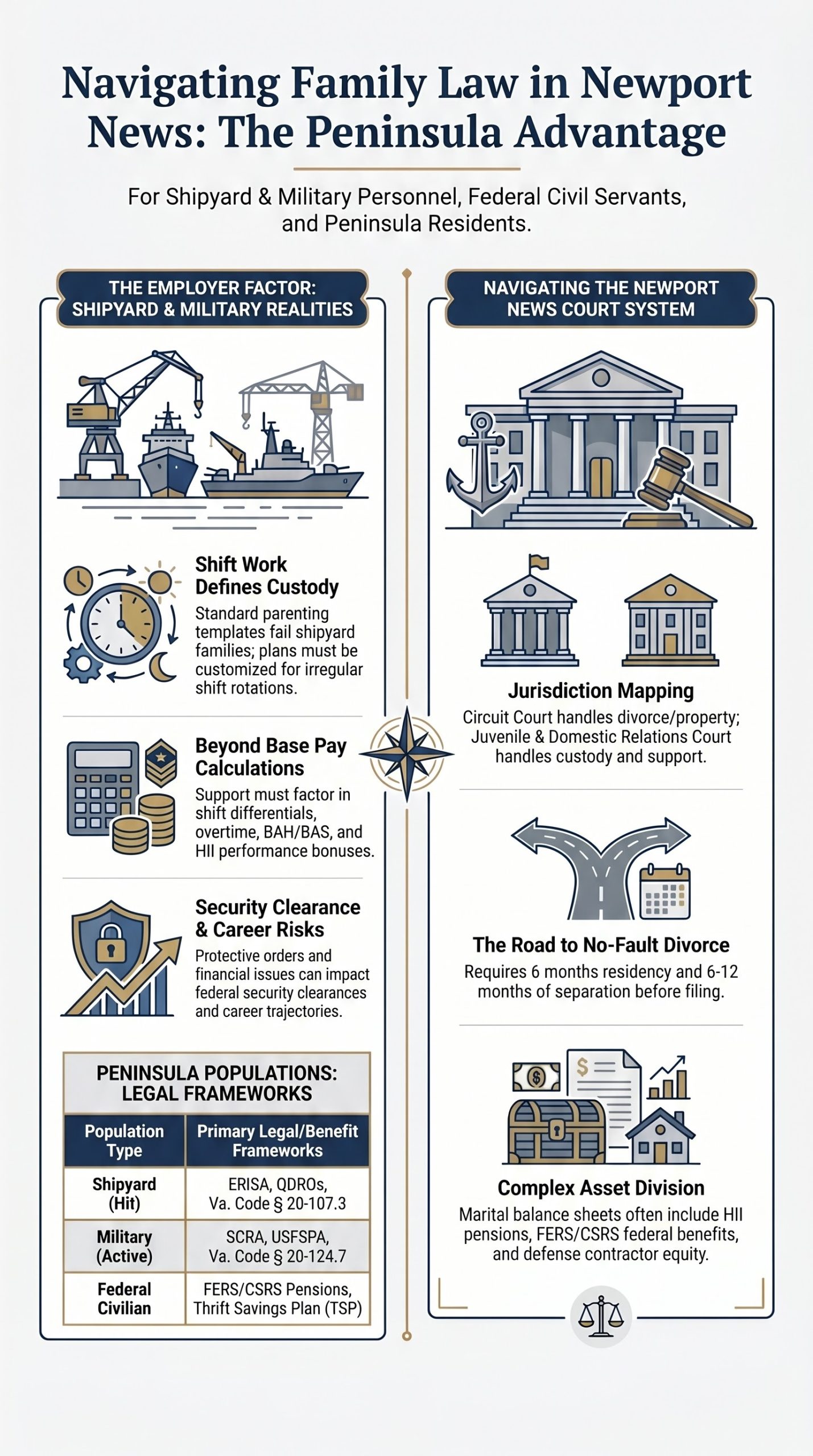
Table of Contents
- The Peninsula in Family Law Context: Newport News and the Cities Around It
- The Shipyard Family: HII Newport News Shipbuilding and What Makes It Different
- Joint Base Langley-Eustis Families and Federal Civil Service Households
- Divorce in Newport News: Grounds, Residency, and Procedure
- Custody and Visitation Under Va. Code § 20-124.3
- Child Support and Spousal Support on the Peninsula
- Equitable Distribution and the Peninsula Marital Balance Sheet
- Protective Orders, Family Abuse, and the Newport News Courts
- Adoption, Paternity, and Other Peninsula Family Matters
- How Shin Law Office Approaches Newport News Family Law
- Summary
- Frequently Asked Questions
- References
Chapter 1: The Peninsula in Family Law Context: Newport News and the Cities Around It
When a family from Newport News walks into my office, I have learned to listen for a few specific things in the first few minutes. Where does the working spouse’s paycheck come from. Whether anyone in the household holds a security clearance. What the schedule actually looks like, because shipyard shift work and military duty rotations produce schedules that look nothing like a nine-to-five office job. Whether the family lives north or south of Mercury Boulevard often signals different community connections, schools, and commuting patterns. These small details turn out to matter a lot when we get to the substance of a divorce, a custody case, or a property division.
Newport News stretches roughly 25 miles up the Virginia Peninsula, from the southern downtown shipyard along the James River, through the Hilton Village area where many of the older shipyard families have lived for generations, past the Hidenwood and Riverside neighborhoods, through the City Center at Oyster Point and Port Warwick commercial cores, and out to Denbigh, Lee Hall, and the Fort Eustis military post that anchors the city’s northern boundary. Each of these neighborhoods has its own character. Some of them feel like small towns inside the larger city. The geography matters because Virginia’s equitable distribution under Va. Code § 20-107.3 has to deal with the marital home, and the marital home in Newport News can be anything from a 1920s bungalow in Hilton Village to a four-bedroom new construction off Jefferson Avenue to a townhome at City Center. The valuation, the buy-out economics, and the strategic positioning all flex with what kind of property we are actually dividing.
Beyond Newport News itself, the Peninsula community is tightly connected. Hampton sits to the immediate east, sharing the air at Joint Base Langley-Eustis. York County, with its towns of Yorktown and Tabb, sits to the north and east. Williamsburg and James City County, with their colonial heritage and large retiree populations, sit further north. Poquoson, the small city on the lower Peninsula, sits to the east. When a Newport News family law case involves a non-resident parent, that parent often lives in one of these adjacent jurisdictions, and the cases routinely involve cross-jurisdictional service, cross-jurisdictional custody arrangements, and the practical question of which court is the right court for the next motion.
The Newport News courts handle the substantive family law work. The Newport News Circuit Court at 2500 Washington Avenue handles divorce, equitable distribution, and appeals from the lower courts. The Newport News Juvenile and Domestic Relations District Court handles custody, visitation, support, paternity, family abuse protective orders, and cases involving minors. The Newport News General District Court handles non-family protective orders. Each of these courts has its own routines, clerks, and practices that affect how cases are scheduled, heard, and resolved.
Chapter 2: The Shipyard Family: HII Newport News Shipbuilding and What Makes It Different
Newport News Shipbuilding is the soul of the city. The yard has been building Navy ships on the James River since 1886. Today, operated by Huntington Ingalls Industries (HII), it is the only shipyard in the United States capable of designing, building, and refueling nuclear-powered aircraft carriers, and one of two shipyards capable of building nuclear submarines. The yard employs roughly 25,000 people across welders, pipefitters, machinists, engineers, naval architects, project managers, planners, and the supporting administrative workforce. Many of those workers come from families that have worked at the yard for two, three, or four generations.
Shift Work and Custody Schedules
The single most distinctive feature of shipyard family law cases is shift work. The yard runs first shift, second shift, and third shift across most production trades. Workers may rotate. Overtime is common, sometimes mandatory. The schedule an HII worker actually keeps is rarely a clean Monday-through-Friday daylight schedule. When custody and visitation arrangements have to fit around real shift schedules, the standard parenting plan templates do not work. We have to build something custom that respects the work schedule, the child’s school and activity schedule, and the practical realities of how families on second or third shift actually live.
Income Calculation Beyond Base Pay
Income for support purposes under Va. Code § 20-108.2 has to capture more than base hourly pay. Shipyard workers typically receive shift differentials for second and third shift work, overtime premiums, hazard pay for certain assignments, performance bonuses, and contributions to defined benefit and defined contribution retirement plans. A child support calculation that looks only at the base wage on a single pay stub will substantially understate income and produce an incorrect support number. Pulling the full year of pay records, the W-2, and the year-end statement is the foundation of an accurate calculation.
Stock and Equity Compensation
For salaried HII engineers, program managers, and senior technical professionals, equity compensation is often a meaningful share of total compensation. Stock options, restricted stock units, performance share units, and nonqualified deferred compensation arrangements regularly appear on the marital balance sheets of Newport News Shipbuilding families. The classification, valuation, and distribution of these awards under Va. Code § 20-107.3 takes careful work and frequently expert input. For a closer look at this issue, see our companion guide on defense contractor stock options and RSUs in Hampton Roads divorces.
Pension and 401(k) Considerations
HII has historically maintained both a defined benefit pension plan for long-tenure workers and a 401(k) plan for current contributions. Long-tenure shipyard families often have both. Division of these accounts requires careful drafting of Qualified Domestic Relations Orders that comply with both ERISA and the specific plan administrator’s procedures. Mistakes in this area can produce real economic shifts that the parties did not intend.
Security Clearance Considerations
A substantial portion of the HII engineering and management workforce holds security clearances because of the classified nature of nuclear submarine and carrier work. Family law events that affect clearance eligibility, including protective orders, certain financial issues, and certain conduct issues, can affect employability and career trajectory in ways that go beyond the immediate divorce or custody outcome. Counsel handling these cases should understand both the family law and the clearance implications.
Chapter 3: Joint Base Langley-Eustis Families and Federal Civil Service Households
Joint Base Langley-Eustis is a combined Air Force and Army installation. The Langley side, located in Hampton, supports Air Combat Command and the F-22 Raptor mission. The Fort Eustis side, located in Newport News, hosts Army Transportation, the U.S. Army Aviation Logistics School, and Training and Doctrine Command (TRADOC). Thousands of active duty service members, their families, civilian Department of Defense employees, and contractors live and work on or near the base. Many of them live in Newport News, Yorktown, Tabb, or the Hampton neighborhoods adjacent to the base.
Active Duty Military Considerations
Active-duty service members at Fort Eustis and Langley face the same federal-state interactions that affect active-duty families everywhere. The Servicemembers Civil Relief Act (SCRA) at 50 U.S.C. § 3901 et seq. provides procedural protections during deployment. Va. Code § 20-124.7 protects deployed parents from custody changes arising from their deployment. The Uniformed Services Former Spouses Protection Act (USFSPA) at 10 U.S.C. § 1408 governs the division of military retirement. All of these federal frameworks interact with Virginia’s equitable distribution and custody law in ways that produce different outcomes than purely civilian cases. For a deeper treatment of one of these issues, see our companion piece on USFSPA military pension division.
Federal Civilian Employees
Civilian Department of Defense employees and federal contractors at Joint Base Langley-Eustis participate in different benefit programs than active duty members. Federal Employees Retirement System (FERS) pensions, Civil Service Retirement System (CSRS) pensions for older employees, the Thrift Savings Plan, and various federal health and life insurance programs all enter the marital balance sheet in divorce cases. Division of FERS and CSRS pensions requires a Court Order acceptable for Processing under federal regulations, with specific drafting requirements that differ from those for private QDROs.
Reservists and National Guard
The Peninsula has substantial Army Reserve and Virginia National Guard populations. Reservists who hold civilian jobs while serving have compensation streams from both employments, retirement contributions from both, and potential SCRA protections during periods of active duty service. The reservist family law case is structurally similar to the active duty case but with additional moving parts.
NASA Langley and Jefferson Lab
NASA Langley Research Center, located adjacent to the base in Hampton, employs scientists, engineers, and technical staff whose compensation includes federal pension benefits, performance awards, and specialized retention incentives. Jefferson Lab in Newport News operates as a federally funded research and development center managed by Jefferson Science Associates. These institutions employ a high-education-level workforce with distinctive compensation patterns, and family law cases involving these workers benefit from counsel who understand the specific employer structures.
Chapter 4: Divorce in Newport News: Grounds, Residency, and Procedure
Newport News divorces are governed by Virginia statutes that apply uniformly across the Commonwealth, but the local court practices in Newport News Circuit Court shape how cases actually move through the system. Understanding both the substantive law and the local practice is essential.
Residency Requirements
Virginia requires that at least one party be a bona fide resident of the Commonwealth for at least six months before filing for divorce, under Va. Code § 20-97. Active duty service members stationed in Virginia typically satisfy this requirement. For non-military spouses, the residency requirement is straightforward. The complaint is then filed in the Circuit Court of the county or city where the parties last cohabited as husband and wife or where the defendant resides.
Grounds for Divorce
Virginia recognizes both fault grounds and no-fault grounds for divorce under Va. Code § 20-91. No-fault divorce requires either six months of separation (if the parties have no minor children and have entered a written separation agreement) or one year of separation (in all other cases). Fault grounds include adultery, sodomy or buggery committed outside the marriage, conviction of a felony resulting in confinement of more than one year, cruelty, willful desertion, and abandonment. Fault grounds can be relevant to issues like spousal support and the equitable distribution award, but most Newport News divorces proceed on no-fault grounds because the practical and emotional cost of litigating fault often exceeds the marginal benefit.
Pendente Lite Relief
During the pendency of a divorce, courts can enter pendente lite orders addressing temporary custody, temporary spousal and child support, exclusive use of the marital residence, and other interim matters. Pendente lite hearings move faster than the final divorce hearing and frequently set the practical baseline for how the parties live during the often year or more it takes to resolve the case fully.
Discovery and Disclosure
Virginia divorce procedure includes formal discovery, including interrogatories, requests for production of documents, requests for admissions, and depositions. For high-asset Newport News divorces, particularly those involving HII shipyard equity compensation, federal pensions, retirement accounts, and substantial real estate holdings, discovery is where most of the substantive work gets done. Compelling, complete, and timely disclosure is often the single most important strategic question in the case.
Settlement Versus Trial
Most Newport News divorces settle. Some go to trial. The decision to settle versus litigate depends on the specific issues in dispute, the strength of the evidence, the personalities involved, and the cost-benefit calculation that has to factor in attorney fees, time, and the emotional toll on the parties and any children. A skilled family law attorney prepares every case to be tried while working hard to achieve a fair settlement. The negotiating position developed through trial preparation often leads to a settlement.
Chapter 5: Custody and Visitation Under Va. Code § 20-124.3
Custody and visitation are determined under the best-interest-of-the-child standard at Va. Code § 20-124.3. The statute lists ten factors that the court must consider, and the court must communicate the basis of its decision in light of those factors. Understanding how Newport News J&DR judges apply these factors in practice is essential to building a custody case.
The Statutory Factors
Va. Code § 20-124.3 directs the court to consider the age and physical and mental condition of the child, the age and physical and mental condition of each parent, the relationship existing between each parent and the child, the needs of the child including other important relationships, the role each parent has played and will play in the upbringing and care of the child, the propensity of each parent to actively support the child’s contact with the other parent, the relative willingness and demonstrated ability of each parent to maintain a close and continuing relationship with the child, the reasonable preference of the child of suitable age and intelligence, any history of family abuse, and other factors the court considers necessary and proper.
Legal Versus Physical Custody
Virginia distinguishes between legal custody (decision-making authority on major issues like education, medical care, and religious upbringing) and physical custody (where the child lives). Either can be sole or joint. Most Newport News custody outcomes involve joint legal custody with primary physical custody to one parent, although joint physical custody arrangements with substantially shared time are increasingly common.
Newport News Schools and the Custody Decision
The school district question matters in custody cases. Newport News Public Schools serves the city, with elementary, middle, and high schools distributed across the various neighborhoods. Some Peninsula families also use the magnet programs, the Aviation Academy at Denbigh, the Achievable Dream Academy, or private schools. Custody arrangements that involve substantial commuting between parents’ homes on school days must account for school start times, after-school activities, and the practical realities of getting children to where they need to be.
Military Deployment Custody
For Fort Eustis and Langley families, deployment custody is governed by Va. Code § 20-124.7, which protects deployed parents from custody changes based solely on the deployment and provides for temporary delegation of visitation to family members. Family Care Plans required by service regulations must be coordinated with civilian custody orders and require careful attention. For more on this, see our companion guide on military deployment custody in Hampton Roads.
Modification
Custody orders can be modified upon a showing of a material change in circumstances since the last order and that modification is in the child’s best interest. The threshold is intentionally meaningful because constant relitigation is bad for children. Successful modification petitions in Newport News J&DR Court typically involve concrete changes (relocation, school changes, evolving developmental needs of the child, demonstrated parenting concerns) rather than dissatisfaction with the existing order.
Chapter 6: Child Support and Spousal Support on the Peninsula
Support calculations follow Virginia statutory guidelines, but the application to Peninsula families requires careful work to capture the full income picture and the actual costs of raising children in Newport News.
Child Support Guidelines
Child support is calculated under Va. Code § 20-108.2 using a formula that considers the gross income of both parents, the cost of work-related child care, the cost of health insurance for the children, and the parenting time arrangement. Above a certain combined income threshold, the guidelines provide a starting point that the court can deviate from based on case-specific factors. Most Newport News child support cases are resolved within or near the guideline result, with deviations requiring specific factual support.
Income Verification for Shipyard and Military Workers
For HII shipyard workers, the income calculation needs to capture base wages, shift differentials, overtime, performance bonuses, and any other regular compensation. For active duty military, income includes base pay, Basic Allowance for Housing (BAH), Basic Allowance for Subsistence (BAS), special pays, and any combat or hazardous duty pays. For federal civilian employees, income includes base pay, locality pay, performance awards, and any special incentives. Pulling complete income records is essential.
Spousal Support
Spousal support in Virginia is awarded based on the factors listed at Va. Code § 20-107.1, including the financial obligations of each party, the standard of living established during the marriage, the duration of the marriage, the contributions of each party to the well-being of the family, the property interests of the parties, the earning capacity of each, and other factors. Spousal support can be temporary, durational, or permanent. The pendente lite spousal support guidelines under Va. Code § 16.1-278.17 provide a starting point for temporary support, but final support determinations are not formula-driven and require careful presentation of the relevant evidence.
Modification of Support
Both child support and spousal support can generally be modified upon a material change in circumstances. For Peninsula families where the working spouse’s employment may shift (HII workforce reductions, military reassignments, federal civilian budget impacts), the modification provisions matter. Anticipating likely future changes during the original support negotiations can prevent costly modification litigation later.
Enforcement
Support orders are enforceable through wage garnishment, contempt proceedings, and the assistance of the Virginia Division of Child Support Enforcement (DCSE). For Newport News families, enforcement options are practically meaningful when the obligor is reluctant to pay voluntarily. Building enforceable orders in the first place, with clear payment terms and clear consequences for nonpayment, is the front-end work that makes back-end enforcement work.
Chapter 7: Equitable Distribution and the Peninsula Marital Balance Sheet
Virginia is an equitable distribution state, not a community property state. Under Va. Code § 20-107.3, the court classifies all property as marital, separate, or hybrid, then equitably divides the marital share based on the statutory factors. Equitable does not mean equal, although the practical result in many Newport News cases is close to fifty-fifty.
Classification
Marital property is generally property acquired during the marriage from marital sources. Separate property is generally property acquired before the marriage, by gift, by inheritance, or in exchange for separate property. Hybrid property is property that has both marital and separate components, often through commingling, contribution from both sources, or active appreciation during the marriage of separate property contributed during the marriage. Classification disputes are common in cases involving inherited assets, premarital homes, and businesses brought into the marriage.
The Newport News Marital Home
The marital home is often the largest single asset on the Peninsula marital balance sheet. Whether the home is in Hilton Village, Hidenwood, City Center, Denbigh, Lee Hall, or anywhere else in Newport News, the equitable distribution analysis has to value the home, identify any separate-property contribution, and determine whether one spouse will buy out the other or whether the home will be sold and proceeds divided. The local real estate market and the availability of refinancing options affect what options are realistic.
Retirement Accounts and Pensions
Defined benefit pensions (HII pension plan, FERS, CSRS, military retirement) and defined contribution plans (401(k), TSP, IRA) all require careful classification, valuation, and division. The marital share is generally the portion attributable to service during the marriage. Division typically requires a Qualified Domestic Relations Order or, for federal employees, a Court Order Acceptable for Processing. The order has to comply with the specific plan administrator’s requirements, and rejected orders produce real delay and frustration.
Equity Compensation
For HII engineering and management families, defense contractor families with employers like BAE Systems Norfolk Ship Repair or General Dynamics NASSCO, and federal contractors at Jefferson Lab, equity compensation can be a substantial component of the marital balance sheet. Stock options, RSUs, PSUs, and deferred compensation arrangements all require careful work. The companion defense contractor equity compensation guide covers this area in depth.
Hidden Assets
In some Peninsula divorces, the working spouse attempts to conceal income, assets, or both. Forensic accounting, careful discovery, subpoenas to financial institutions, and lifestyle analysis can expose hidden assets. The discovery work is often the highest-value strategic activity in a contested high-asset divorce.
Debts
Marital debt is divided alongside marital assets. Mortgages, home equity lines, credit card balances, vehicle loans, and any business debts all require classification and allocation. The party who is awarded the asset securing the debt typically takes the debt as well, although the analysis can be more complicated when the secured asset has changed in value or when the debt was incurred for non-marital purposes.
Chapter 8: Protective Orders, Family Abuse, and the Newport News Courts
Protective orders in Newport News are heard primarily in the Newport News Juvenile and Domestic Relations District Court for family abuse cases and in the General District Court for non-family situations. Virginia’s three-tier framework (Emergency, Preliminary, Final) applies uniformly across the Commonwealth.
Family Abuse Definition
Va. Code § 16.1-228 defines family abuse as any act of violence, force, or threat that results in bodily injury or places one in reasonable apprehension of death, sexual assault, or bodily injury, committed by a family or household member. The statute defines family or household member broadly, including spouses, former spouses, persons with a child in common, and others.
The Procedural Framework
An Emergency Protective Order can be issued by a magistrate based on telephonic contact, lasting up to 72 hours. A Preliminary Protective Order can be issued by a J&DR judge after an ex parte hearing on a sworn petition under Va. Code § 16.1-253.1, lasting up to fifteen days until the full hearing. A Final Protective Order can be issued after a full hearing under Va. Code § 16.1-279.1, lasting up to two years. Each of these orders carries different consequences for both parties.
Federal Firearm and Career Implications
For Joint Base Langley-Eustis service members, federal civil servants with security clearances, defense contractors, and HII workers in clearance-required roles, a protective order can produce career-altering consequences through 18 U.S.C. § 922(g)(8) federal firearm prohibition, SF-86 reporting obligations, administrative separation review, and the Lautenberg Amendment lifetime ban for misdemeanor domestic violence convictions. For a deeper treatment of these consequences, see our companion guide on protective orders and military careers.
Defending Against Petitions
When a Newport News service member, shipyard worker, or clearance holder is the respondent on a protective order petition, the defense has to start immediately. The fifteen day window between preliminary issuance and the full hearing is short, and it is the only window in which evidence can be developed, witnesses can be identified, and the strategic posture can be set. Reading the petition carefully, gathering electronic and documentary evidence, and preparing for cross-examination at the full hearing are the foundation of an effective defense.
Chapter 9: Adoption, Paternity, and Other Peninsula Family Matters
Beyond divorce, custody, support, property division, and protective orders, Newport News families regularly need help with adoption, paternity, and several other family law matters that the Peninsula’s distinctive demographics produce in particular volume.
Stepparent Adoption
Stepparent adoption under Va. Code § 63.2-1241 et seq. allows a stepparent to adopt the biological child of a spouse, terminating the biological parental rights of the absent parent. For blended Peninsula families, particularly those formed after a divorce or the death of a parent, stepparent adoption can solidify the family’s legal structure. The proceeding requires either the consent of the biological parent whose rights are being terminated, the demonstration of statutory grounds for proceeding without consent (including extended absence and failure to support), or the death of the biological parent.
Paternity
Paternity establishment is governed by Va. Code § 20-49.1 et seq. Paternity can be established through voluntary acknowledgment, judicial determination based on genetic testing, or other statutory grounds. For unmarried Peninsula parents, paternity establishment is often the gateway to child support, custody, and visitation determinations.
Premarital and Postnuptial Agreements
Premarital agreements under Va. Code § 20-147 et seq. and postnuptial agreements allow couples to address financial questions before or during marriage. These agreements are particularly common among Peninsula couples where one or both parties have substantial premarital assets, business interests, equity compensation that will accrue during the marriage, or family wealth that requires planning. Properly drafted, these agreements provide significant clarity and reduce the cost of any future divorce. Improperly drafted, they can be challenged and set aside.
Grandparent and Third-Party Visitation
Va. Code § 20-124.2 governs custody and visitation petitions by persons other than parents, including grandparents and other family members. The standard for awarding such visitation is high, requiring a showing that denial would result in actual harm to the child. For Peninsula families where grandparent involvement is meaningful, navigating the standard requires careful presentation of the underlying relationship and the harm that disruption would cause.
Name Changes
Adult and child name changes are handled through Newport News Circuit Court under Va. Code § 8.01-217. Adult name changes are generally straightforward. Child name changes can be more complicated when both parents are involved and disagree about the proposed change.
Chapter 10: How Shin Law Office Approaches Newport News Family Law
Family law cases on the Peninsula are personal. They involve people’s marriages, their children, their homes, their retirement, their careers, and the relationships that define their lives. The right approach respects that, while still doing the technical work that produces good outcomes.
Listening First
When a Newport News family comes to my office, the first conversation is about understanding what is happening, what they are worried about, and what outcome they actually want. Not the outcome they think they should want, or the outcome someone else has told them to want, but the outcome that would actually allow them to move forward. Sometimes that is litigation. Sometimes that is settlement. Sometimes that is mediation. The right approach depends on the people, the facts, and the law, and the conversation has to start with listening.
Deep Local Knowledge
Newport News Circuit Court, the J&DR Court, and the General District Court each have their own routines, their own scheduling practices, and their own judges. Knowing the courts means knowing how cases actually move, what motions get heard quickly, what arguments resonate with which judges, and where the practical path of a case will lead. The Peninsula has its own bar, its own family law practitioners, and its own way of doing things. Counsel who knows that environment can navigate it efficiently.
Substantive Expertise
For Peninsula families, the family law work intersects with technical questions about HII compensation structures, military pay and benefits, federal civilian pensions, security clearance implications, equity compensation valuation, and the federal-state interaction that affects military and federal civil service families. Counsel who has handled these questions before can produce results that counsel without that experience cannot.
Tough Cases Require Tough Attorneys
The firm’s tagline reflects how I think about my work. Newport News families dealing with high-asset divorce, complex custody disputes, military and federal civil service complications, contested protective orders, or any other contested family law matter need counsel willing to do the hard work. Not posturing. Not aggression for its own sake. The actual hard work of preparing the case, marshaling the evidence, and being ready to try the matter if settlement does not produce the right result.
Working With Other Peninsula Communities
Many Newport News family law cases involve parties or property in adjacent jurisdictions: Hampton, York County, Williamsburg, James City County, or Poquoson. Cross-jurisdictional considerations frequently affect strategy, scheduling, and outcomes. Coordinating across the Peninsula is part of the work. For broader information about how the firm handles family law disputes across Hampton Roads, see our family law practice page and the cornerstone guide on Virginia Beach family law.
Summary
Newport News family law is shaped by the city itself: the largest industrial employer in Virginia at HII Newport News Shipbuilding, the Joint Base Langley-Eustis military presence with the Fort Eustis post inside the city limits, the federal civilian workforce at NASA Langley and Jefferson Lab, the academic community at Christopher Newport University, and the Peninsula geography that ties Newport News to Hampton, York County, Williamsburg, James City County, and Poquoson.
The substantive law is Virginia equitable distribution under Va. Code § 20-107.3, custody and visitation under Va. Code § 20-124.3, child support under Va. Code § 20-108.2, spousal support under Va. Code § 20-107.1, family abuse protective orders under Va. Code § 16.1-228 and § 16.1-253.1, and the broader statutory framework of Title 20 governing divorce. The federal overlay includes the Servicemembers Civil Relief Act, the Uniformed Services Former Spouses Protection Act, the federal firearm prohibitions at 18 U.S.C. § 922(g)(8) and § 922(g)(9), the SF-86 security clearance reporting requirements, and the various federal civilian benefit programs.
For Peninsula families dealing with divorce, custody, support, property division, protective orders, adoption, paternity, or other family matters, the right combination of local knowledge and substantive expertise produces the best outcomes. The Newport News courts handle the cases. The local employers shape the marital balance sheet. The Peninsula community is tightly connected, and the family law practitioners who work here regularly understand both the law and the local context.
Frequently Asked Questions
Where do Newport News divorces actually get filed?
Divorce complaints are filed in the Newport News Circuit Court, located at 2500 Washington Avenue. The Circuit Court has jurisdiction over divorce, equitable distribution, and Circuit Court appeals from the J&DR Court. Custody, visitation, support, and family abuse protective order matters are typically heard in the Newport News Juvenile and Domestic Relations District Court.
How long do I have to live in Virginia to file for divorce in Newport News?
Va. Code § 20-97 requires that at least one party be a bona fide resident of the Commonwealth for at least six months before filing. Active duty service members stationed in Virginia generally satisfy the residency requirement. The complaint is filed in the Circuit Court of the city or county where the parties last cohabited or where the defendant resides.
Is HII pension divisible in a Newport News divorce?
Yes, the marital portion of an HII pension is divisible under Va. Code § 20-107.3. The marital portion is generally the share attributable to service during the marriage. Division typically requires a Qualified Domestic Relations Order that complies with both ERISA and the specific HII plan administrator requirements.
My spouse is at Fort Eustis and is about to deploy. Can I still file for divorce?
Yes, but the Servicemembers Civil Relief Act may produce procedural protections that affect the timing of the case. A SCRA stay can postpone proceedings during the deployment period. The case can still be filed and progress in ways that do not require the deployed party’s active participation, but final hearings on substantive matters may need to wait until return from deployment.
Can my spouse take the kids to live with family in another state during our divorce?
Not without notice and either consent or court approval. Virginia courts can enter status quo orders that prevent unilateral relocation of children during the pendency of a custody case. Once a custody order is in place, relocation generally requires either the other parent’s consent or a court determination that relocation is in the child’s best interest.
How much does a Newport News divorce cost?
The cost depends entirely on the level of conflict and the complexity of the issues. Uncontested divorces with full settlement agreements can be resolved relatively economically. Contested high-asset divorces with disputed custody and complex property issues can cost substantially more. The right approach is to spend money where it produces value (preparation, evidence development, strategic positioning) and to avoid spending money on disputes that have no real economic upside.
Will my shipyard shift schedule affect my custody case?
It will affect the practical custody schedule, but it does not have to disadvantage you in the custody outcome. Newport News J&DR judges are familiar with shipyard shift work and other non-standard schedules. The right approach is a parenting plan that respects the work schedule while providing meaningful and regular contact with the child. Cookie-cutter plans rarely fit shipyard families well.
Can I serve a protective order petition on my spouse at his work at the shipyard?
Service of process at the workplace is procedurally permissible but practically sensitive. Service at HII can produce immediate command-level reactions, weapons qualification suspensions for security personnel, and other workplace consequences. Counsel can advise on whether workplace service is appropriate or whether other service methods would better serve the case strategy.
My spouse owns a small business in Newport News. How is that handled in divorce?
Business interests are valued and divided as part of the equitable distribution analysis. Valuation typically requires expert input, particularly for closely held businesses without easy market comparables. Distribution can be by buy-out, by sale of the business, or by ongoing income-sharing arrangements. The right approach depends on the nature of the business, the spouses’ involvement in it, and the practical realities of continued operation.
When should I contact a Newport News family law attorney?
As soon as you know your situation is heading toward family law proceedings. Early consultation produces better outcomes because important decisions made early in the process (separation arrangements, financial moves, communications with the other party) can affect the case for years afterward. Even if you are not sure you want to move forward, an early consultation gives you the information you need to make decisions deliberately.
Family Law Matter Coming in Newport News?
Whether you are an HII shipyard worker facing a divorce after years on the production floor, an engineer at Newport News Shipbuilding navigating a complex equity compensation division, an Army or Air Force service member at Joint Base Langley-Eustis dealing with deployment custody, a federal civilian employee with FERS pension questions, a Christopher Newport University faculty member, a NASA Langley scientist, or any Peninsula family member dealing with divorce, custody, support, property division, protective orders, or adoption, you deserve counsel who understands the local courts and the substantive law.
Tough cases require tough attorneys. Shin Law Office handles family law matters throughout Newport News, the Virginia Peninsula, Hampton Roads, and the Commonwealth.
Call 571-445-6565

References
Code of Virginia. (2024). Title 20: Domestic Relations. Virginia General Assembly. https://law.lis.virginia.gov/vacode/title20/
Code of Virginia. (2024). Title 20, Section 20-91: Grounds for divorce from the bond of matrimony. Virginia General Assembly. https://law.lis.virginia.gov/vacode/title20/chapter6/section20-91/
Code of Virginia. (2024). Title 20, Section 20-97: Domicile and residential requirements. Virginia General Assembly. https://law.lis.virginia.gov/vacode/title20/chapter6/section20-97/
Code of Virginia. (2024). Title 20, Section 20-107.1: Court may decree as to maintenance and support of spouses. Virginia General Assembly. https://law.lis.virginia.gov/vacode/title20/chapter6/section20-107.1/
Code of Virginia. (2024). Title 20, Section 20-107.3: Court may decree as to property and debts of the parties. Virginia General Assembly. https://law.lis.virginia.gov/vacode/title20/chapter6/section20-107.3/
Code of Virginia. (2024). Title 20, Section 20-108.2: Guideline for determination of child support. Virginia General Assembly. https://law.lis.virginia.gov/vacode/title20/chapter6.1/section20-108.2/
Code of Virginia. (2024). Title 20, Section 20-124.2: Court-ordered custody and visitation arrangements. Virginia General Assembly. https://law.lis.virginia.gov/vacode/title20/chapter6.1/section20-124.2/
Code of Virginia. (2024). Title 20, Section 20-124.3: Best interests of the child; visitation. Virginia General Assembly. https://law.lis.virginia.gov/vacode/title20/chapter6.1/section20-124.3/
Code of Virginia. (2024). Title 20, Section 20-124.7: Definitions; custody and visitation arrangements for deploying parents. Virginia General Assembly. https://law.lis.virginia.gov/vacode/title20/chapter6.1/section20-124.7/
Code of Virginia. (2024). Title 16.1, Section 16.1-228: Definitions. Virginia General Assembly. https://law.lis.virginia.gov/vacode/title16.1/chapter11/section16.1-228/
Code of Virginia. (2024). Title 16.1, Section 16.1-253.1: Preliminary protective orders in cases of family abuse. Virginia General Assembly. https://law.lis.virginia.gov/vacode/title16.1/chapter11/section16.1-253.1/
Code of Virginia. (2024). Title 16.1, Section 16.1-279.1: Protective orders in cases of family abuse. Virginia General Assembly. https://law.lis.virginia.gov/vacode/title16.1/chapter11/section16.1-279.1/
Code of Virginia. (2024). Title 63.2, Adoption. Virginia General Assembly. https://law.lis.virginia.gov/vacode/title63.2/
Servicemembers Civil Relief Act, 50 U.S.C. § 3901 et seq. https://www.govinfo.gov/app/collection/uscode
Uniformed Services Former Spouses Protection Act, 10 U.S.C. § 1408. https://www.govinfo.gov/app/collection/uscode
Federal firearm prohibition for protective order respondents, 18 U.S.C. § 922(g)(8). https://www.govinfo.gov/app/collection/uscode
Lautenberg Amendment, 18 U.S.C. § 922(g)(9). https://www.govinfo.gov/app/collection/uscode
Newport News Circuit Court. (2024). Court information and procedures. https://www.nnva.gov/186/Circuit-Court
Newport News Juvenile and Domestic Relations District Court. (2024). Court information. https://www.nnva.gov/188/Juvenile-Domestic-Relations-District-Cour
Huntington Ingalls Industries. (2024). Newport News Shipbuilding overview. https://nns.huntingtoningalls.com/
Joint Base Langley-Eustis. (2024). Installation overview. https://www.jble.af.mil/
Defense Finance and Accounting Service. (2024). Garnishment and former spouse benefits. https://www.dfas.mil/garnishment
U.S. Office of Personnel Management. (2024). Court orders and federal employee retirement benefits. https://www.opm.gov/retirement-services/
