

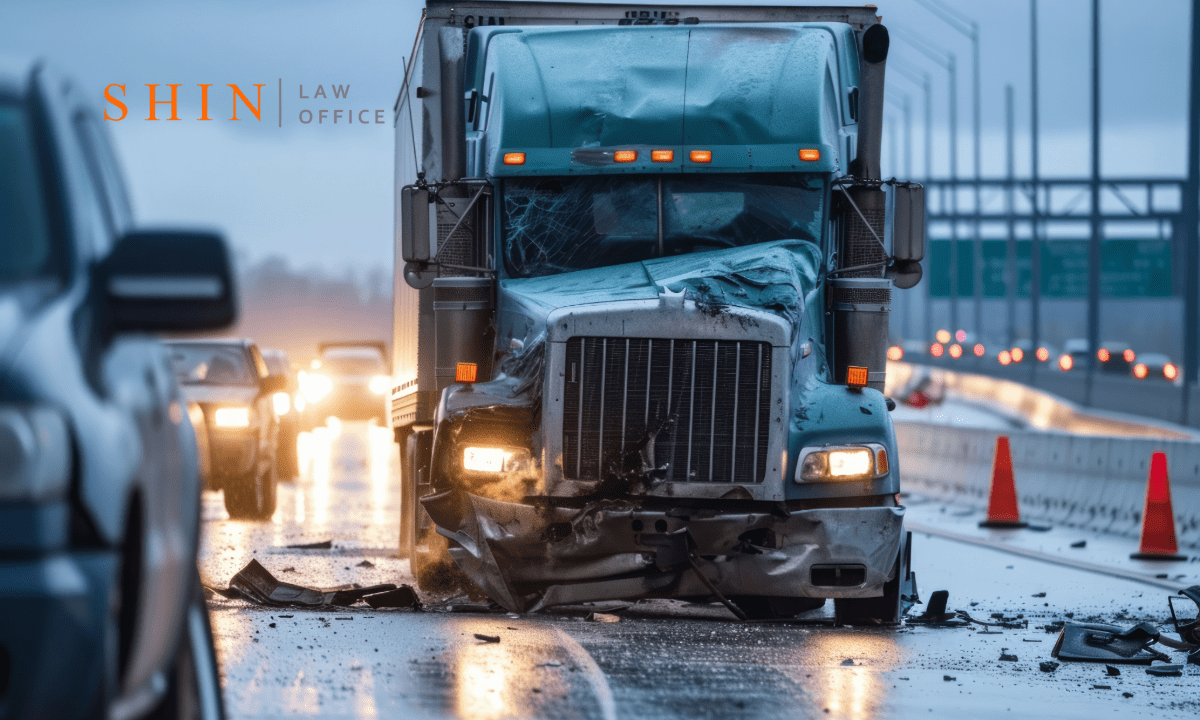
Hampton Roads Truck Accidents: A Virginia Attorney’s Guide for I-64, I-264, and I-664 Commercial Vehicle Cases
By Anthony I. Shin, Esq. | Shin Law Office | Notes from a Virginia Attorney on the Cases That Decide What Tidewater Families Recover After a Commercial Truck Crash
BOTTOM LINE UP FRONT
Commercial trucking accidents on the Hampton Roads interstate corridors produce some of the most serious personal injury cases in the region. The physics of an eighty-thousand-pound tractor-trailer impacting a passenger vehicle produces injury and damage patterns that auto-on-auto crashes do not. The legal framework for trucking cases differs from standard auto cases in several ways: the Federal Motor Carrier Safety Regulations under 49 C.F.R. Parts 350-399 set federal standards for commercial drivers and carriers, the minimum liability coverage requirements are substantially higher (federal regulations require minimum liability of $750,000 for general freight, with limits up to $5 million for hazardous materials and certain other categories), the potential defendants typically include not only the driver but also the motor carrier, the broker, the shipper, and sometimes the maintenance contractor, and the evidence sources include electronic logging devices, dispatch records, driver qualification files, and post-accident drug and alcohol testing results that are not available in standard auto cases.
If you or a family member was injured in a Hampton Roads trucking accident, your case deserves a Virginia attorney who handles these specific cases with the technical attention they require. Call Shin Law Office at 571-445-6565.
The Regional Trucking Corridors
Hampton Roads is a major trucking hub. The Port of Virginia at the Norfolk International Terminals and the Virginia International Gateway in Portsmouth produce substantial container and cargo truck traffic. The shipyard supply chains supporting Norfolk Naval Shipyard and Newport News Shipbuilding generate their own truck flows. The interstate network, including I-64, I-264, I-664, and U.S. Route 13, supports through-truck traffic moving along the Atlantic seaboard. The HRBT and MMMBT carry substantial truck traffic between the Peninsula and the Southside. Each corridor produces its own accident patterns.
The Federal Regulatory Framework
The Federal Motor Carrier Safety Regulations under 49 C.F.R. Parts 350-399 establish federal standards for commercial motor vehicles operating in interstate commerce. The regulations cover driver qualifications, including medical certifications and licensing, hours of service limits, including the eleven-hour daily driving limit and the fourteen-hour work day limit, electronic logging device requirements that automatically record driver hours and reduce the possibility of falsification under paper logs, vehicle maintenance and inspection requirements, drug and alcohol testing requirements, including post-accident testing, and other safety standards. Violations of the FMCSR can establish negligence per se in personal injury cases and frequently appear in trucking accident investigations.
Multiple Potential Defendants
Trucking cases typically involve multiple potential defendants. The driver who caused the accident is the obvious defendant, but the motor carrier (the company employing the driver) is generally liable under respondeat superior for the driver’s negligence in the course of employment. The motor carrier may also have direct liability for negligent hiring, training, supervision, or maintenance. Brokers who arranged the load may have liability under specific theories. Shippers who improperly loaded the cargo may be liable for cargo-shift accidents. Maintenance contractors who improperly serviced the vehicle may have liability for mechanical failures. Identifying all potential defendants matters because each may carry separate insurance, expanding the available coverage. For broader background on Hampton Roads personal injury law, see our Hampton Roads personal injury cornerstone guide.
The Higher Insurance Coverage
Federal regulations under 49 C.F.R. § 387.9 require minimum liability coverage of $750,000 for general freight motor carriers operating in interstate commerce, with higher minimums for specific cargo types: $1 million for oil, $5 million for certain hazardous materials. Many large carriers carry coverage substantially above the federal minimums. The higher coverage compared to standard auto cases means that trucking accident victims with serious injuries can often recover the full value of their cases rather than running into policy limits the way they might in standard auto cases.
The Evidence Preservation Issue
Trucking accidents produce evidence that does not exist in standard auto cases. Electronic logging device data shows the driver’s hours, locations, and stops in the days and weeks before the accident. Dispatch records document the trip planning, routing, and time pressures imposed on the driver. Driver qualification files document the driver’s medical history, training, and prior incidents. Post-accident drug and alcohol testing results document any impairment. Vehicle maintenance records document any mechanical issues. Each of these evidence sources is subject to retention schedules and corporate destruction policies. Effective trucking accident representation requires prompt preservation requests to prevent the routine destruction of evidence that would otherwise occur.
Frequently Asked Questions
A truck rear-ended me on I-64 in heavy traffic. The driver’s company is offering a quick settlement. Should I take it?
Almost certainly not without legal review. Trucking carriers and their insurers move quickly to resolve cases before the injured party fully understands the medical course or the available evidence. Early offers typically reflect a fraction of actual case value. The substantial coverage available in trucking cases means that proper case development typically produces recoveries far exceeding initial offers.
Can I sue the trucking company in addition to the driver?
Yes. The trucking company is generally liable under respondeat superior for accidents caused by its drivers in the course of employment. The company may also have direct liability for negligent hiring, training, supervision, or maintenance. Identifying all potential defendants is part of the early case investigation.
How quickly do I need to act after a trucking accident?
Promptly. While the two-year statute of limitations under Va. Code § 8.01-243(A) provides time to file suit, the evidence preservation in trucking cases is time-sensitive. Electronic logging device data, dispatch records, and other corporate records can be lost to routine retention policies within weeks or months. Early counsel engagement allows preservation requests before evidence is destroyed.
Hampton Roads Truck Accident Attorney
Whether your accident occurred on I-64, I-264, I-664, the bridge-tunnel approaches, or any other Hampton Roads roadway, your case deserves a Virginia attorney who handles trucking cases with the federal regulatory framework, the multi-defendant analysis, and the evidence preservation that these cases require.
Call 571-445-6565

References
Federal Motor Carrier Safety Regulations, 49 C.F.R. Parts 350-399. https://www.govinfo.gov/app/collection/cfr
49 C.F.R. § 387.9 (Financial Responsibility Limits). https://www.govinfo.gov/app/collection/cfr
Code of Virginia. (2024). Title 8.01, Section 8.01-243: Personal action for injury. Virginia General Assembly. https://law.lis.virginia.gov/vacode/title8.01/chapter4/section8.01-243/
Federal Motor Carrier Safety Administration. (2024). Safety Regulations. https://www.fmcsa.dot.gov/regulations
