


Looking for the statewide framework? This page focuses on personal injury law specifically in Hampton Roads. For the Virginia-wide guide that covers contributory negligence, the two year deadline, damages, sovereign immunity, and the first 30 day playbook, see Virginia Personal Injury Lawyer: A Working Attorney’s Guide.
Personal Injury Attorney in Hampton Roads, Virginia: A Comprehensive Tidewater Attorney’s Guide for Injured People and Their Families
By Anthony I. Shin, Esq. | Shin Law Office | Notes from a Virginia Attorney on the Personal Injury Cases That Decide What an Injured Tidewater Family Recovers When Someone Else Caused the Harm
BOTTOM LINE UP FRONT
Hampton Roads is one of the highest-volume personal injury markets in Virginia. The region holds roughly 1.7 million people across the Southside and the Peninsula, supports over a million daily commuter trips through the Hampton Roads Bridge-Tunnel, the Monitor-Merrimac Memorial Bridge-Tunnel, the James River Bridge, the Coleman Bridge, the I-64 corridor, the I-264 spine through Virginia Beach and Norfolk, and the I-664 western route. The region hosts the world’s largest naval base at Naval Station Norfolk, the largest concentration of military personnel in the country, multiple major hospital systems including Sentara, Riverside, Bon Secours, Children’s Hospital of the King’s Daughters, Eastern Virginia Medical School, the Hampton VA Medical Center, the Portsmouth Naval Medical Center, a year-round oceanfront tourism economy, two of the largest shipyards in the United States at Norfolk Naval Shipyard and Newport News Shipbuilding, and a residential population spread across nine cities and four counties. Each of these elements produces personal injury claims.
Virginia personal injury law has a few features that make it different from most of the country. The most important is the pure contributory negligence rule. Virginia is one of only four states (along with Alabama, Maryland, North Carolina) plus the District of Columbia that still applies pure contributory negligence, which means that a plaintiff found even one percent at fault recovers nothing. The two-year statute of limitations under Va. Code § 8.01-243(A) governs most personal injury claims, with the wrongful death two-year period under Va. Code § 8.01-244 running from the date of death rather than the date of injury. The medical malpractice damage cap under Va. Code § 8.01-581.15 limits total recovery in medical negligence cases (the cap rises annually and reached approximately $2.65 million for incidents in 2025). The punitive damages cap under Va. Code § 8.01-38.1 limits punitive recovery to $350,000 across most case categories. The uninsured and underinsured motorist coverage rules under Va. Code § 38.2-2206 produce specific Virginia features for auto cases. Each piece of the framework matters.
Whether you were hit on the HRBT, in a Virginia Beach intersection, on a job site at Norfolk Naval Shipyard, in a Sentara hospital corridor, on a wet floor at a tourist attraction, or anywhere else across Hampton Roads, your case deserves a Virginia attorney who handles personal injury matters with the technical attention these cases require. Call Shin Law Office at 571-445-6565.
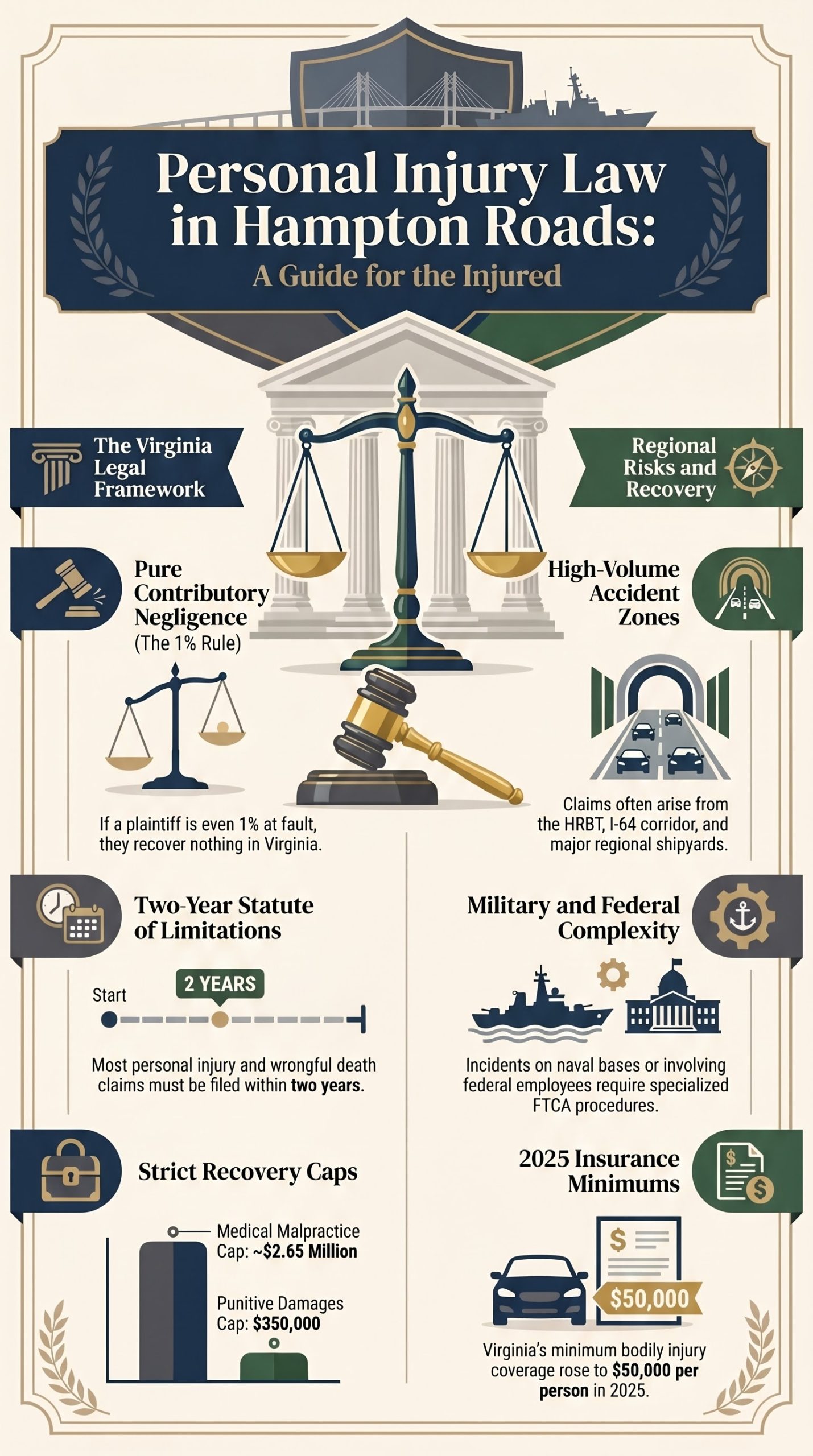
Table of Contents
- The Driver Rear-Ended on the HRBT Who Almost Lost Her Case
- Hampton Roads as a Personal Injury Region
- The Virginia Contributory Negligence Rule and Why It Matters Above Everything Else
- Statutes of Limitations and Pre-Suit Considerations
- Motor Vehicle Accidents: The Largest Category
- Premises Liability, Dog Bites, and Other Tort Categories
- Medical Malpractice and the Virginia Damage Cap
- Wrongful Death in Virginia
- Damages, Insurance Coverage, and How Recovery Actually Works
- How Shin Law Office Approaches Hampton Roads Personal Injury Cases
- Summary
- Frequently Asked Questions
- References
Chapter 1: The Driver Rear-Ended on the HRBT Who Almost Lost Her Case
She came to my office on a Friday morning. She was forty-three. She worked as a charge nurse at Sentara Norfolk General and lived with her husband and two teenagers in Aragona Village in Virginia Beach. Six months earlier, she had been driving home westbound through the Hampton Roads Bridge-Tunnel after a twelve-hour shift, doing the speed limit through the tube during evening congestion, when traffic ahead of her slowed to a near stop, the way it does at the Norfolk-side merge. She braked. The pickup truck behind her did not. He was looking at his phone. He hit her at about thirty miles per hour while she was nearly stopped.
Her injuries were significant. A herniated disc at C5-C6. Concussion symptoms that lasted four months. A six-week leave from work, then a graduated return that took another two months before she was back to full duty. Total medical bills around $48,000. Lost wages around $22,000. Ongoing physical therapy and a likely future fusion surgery somewhere on the horizon. The pickup truck driver was insured by a major national carrier. The carrier had paid her medical bills under MedPay up to her policy limit and then stopped responding to her requests for help with the broader claim. The adjuster who finally returned her call told her that her own actions had contributed to the accident because witnesses indicated she had braked harder than necessary, and that, under Virginia law, she would not be entitled to recover anything. The adjuster had offered $8,500 to close the file. She had said no. Then she had called my office.
I told her what I tell every Hampton Roads driver who walks in with a case where the carrier has invoked the contributory negligence defense. The defense exists in Virginia. It is real. It is also frequently invented by adjusters who are trained to assert it whether the facts support it or not, because the rule in Virginia is so plaintiff-hostile that any successful contributory negligence finding wipes out the entire case. The carrier had every incentive to argue she was at fault, and almost no risk in doing so, because the worst case for them was that we proved them wrong and they paid what they should have paid in the first place. The best case for them was that we accepted their account and went away. The strategic question for our side was whether the contributory negligence defense had any actual factual support, and what we needed to do to defeat it.
Her case took about fourteen months to resolve. We obtained the police report, the witness statements (none of which actually supported the carrier’s account), the cell phone records of the pickup driver showing the phone was active at the time of impact, the dashcam footage from the vehicle two cars behind, and the accident reconstruction expert’s analysis. We documented her medical course thoroughly through the treating providers at Sentara and her physical therapists. We addressed her likely future fusion surgery through expert testimony from a board-certified neurosurgeon. We filed suit in Norfolk Circuit Court before the two-year statute of limitations expired and proceeded through discovery. The defense theory of contributory negligence collapsed under the actual facts. The case settled at mediation for substantially more than the carrier had originally offered, in an amount that addressed her medical bills, lost wages, future medical care, and the pain and disruption the accident had caused her family. Her case was not unusual. It was an example of how Virginia personal injury cases proceed when the contributory negligence defense is asserted and the plaintiff’s counsel has the resources and the experience to defeat it.
Chapter 2: Hampton Roads as a Personal Injury Region
Hampton Roads is one of the most distinctive personal injury markets in Virginia, with a regional structure that produces high case volume and distinct patterns in claim types and defenses.
The Highway and Bridge-Tunnel Network
The Hampton Roads Bridge-Tunnel (HRBT) on I-64 is the regional artery between the Peninsula and the Southside, with the recent expansion to a third tube and broader approaches changing traffic patterns and producing new merge zones that have generated their own claim patterns. The Monitor-Merrimac Memorial Bridge-Tunnel (MMMBT) on I-664 provides the western alternative for the same crossing. The James River Bridge connects the Peninsula at Newport News with Isle of Wight County. The Coleman Bridge spans the York River between Yorktown and Gloucester. I-64 carries the regional spine east to Williamsburg and Richmond, with I-264 forming the spine through Norfolk and Virginia Beach, and I-664 forming the western corridor. U.S. Route 13 crosses the Chesapeake Bay Bridge-Tunnel to the Eastern Shore. Each corridor produces its own characteristic accidents.
Military Population and Federal Issues
The military population of Hampton Roads (active duty, reserve, retired, dependents, and federal civilians) produces unique personal injury issues. Accidents involving active duty service members on duty raise Federal Tort Claims Act issues if a federal employee or vehicle is involved. Accidents involving privately owned vehicles driven by service members typically proceed under standard Virginia tort law. Accidents on base property produce different rules depending on whether the base is treated as federal enclave land. The interaction of federal and state law in personal injury cases involving military parties is technical and benefits from counsel familiar with the framework.
The Healthcare Workforce and the Medical Malpractice Picture
Hampton Roads has a substantial healthcare infrastructure with Sentara Healthcare, Riverside Health, Bon Secours Mercy Health, Children’s Hospital of the King’s Daughters, Eastern Virginia Medical School, the Hampton VA Medical Center, the Portsmouth Naval Medical Center, and a substantial network of physician practices, surgery centers, and specialty providers. The healthcare landscape indicates that medical care for injured plaintiffs is generally accessible, but that medical malpractice claims arise regularly in the region. The Virginia medical malpractice framework, with its damage cap and specialized procedural rules, requires specific attention.
Tourism and Premises Liability
The Virginia Beach oceanfront, Colonial Williamsburg, and Busch Gardens in Williamsburg, the Norfolk waterfront, the various regional aquariums and museums, and the ocean- and bay-front rental properties support a substantial tourism economy. Tourism gives rise to premises liability claims (slip-and-fall incidents, swimming pool incidents, inadequate security theories for parking lot crimes, amusement-related injuries). The Virginia premises liability framework, with its strict invitee, licensee, and trespasser distinctions and its application of contributory negligence, shapes how these cases proceed.
Industrial and Maritime Work
Norfolk Naval Shipyard, Newport News Shipbuilding (a division of Huntington Ingalls Industries), and the various smaller shipyards and marine industry firms employ tens of thousands of workers in physically demanding industrial work. Workplace injuries in the shipyards typically proceed through workers’ compensation rather than tort, but third-party tort claims against vessel owners, equipment manufacturers, or contractors can produce substantial recoveries on top of the workers’ compensation benefits. The Longshore and Harbor Workers’ Compensation Act, under 33 U.S.C. §§ 901 et seq., applies to maritime workers, including shipyard workers in many cases, with its own framework that differs from Virginia’s workers’ compensation.
The Practice Implications
The combination produces a regional personal injury practice that deals with auto and trucking cases (the largest category), motorcycle accidents (with their specific contributory negligence vulnerabilities), pedestrian and bicycle accidents (often involving complex liability analyses), premises liability (slip and fall, inadequate security), medical malpractice (subject to the cap and the specialized procedural rules), wrongful death (with its specific statutory framework), product liability, dog bites, and the various other tort categories that produce injury claims. Counsel familiar with the regional patterns and the Virginia framework navigates these cases differently than out-of-state attorneys or general practitioners would.
Chapter 3: The Virginia Contributory Negligence Rule and Why It Matters Above Everything Else
If you take only one thing away from this guide, take this. Virginia is a pure contributory negligence state. A plaintiff who is even 1% at fault for the accident recovers nothing. There is no apportionment, no proportional reduction for fault, no comparative negligence framework. The rule is binary: prove the defendant fully responsible and the plaintiff free of negligence, and the case proceeds; show any negligence by the plaintiff that contributed to the harm, and the case is over.
How Virginia Differs From Most States
Most states adopted some form of comparative negligence over the second half of the twentieth century. Pure comparative negligence allows a plaintiff who was, say, sixty percent at fault to recover forty percent of damages from a defendant forty percent at fault. Modified comparative negligence systems allow recovery if the plaintiff was less than 50% or 51% at fault, with proportional reduction. Only four states (Virginia, Alabama, Maryland, North Carolina) and the District of Columbia retain pure contributory negligence. The doctrine traces back to the common law origin of negligence as a unitary fault concept, and Virginia courts have repeatedly declined to abandon it despite arguments for reform.
What This Means for Plaintiffs
For Hampton Roads plaintiffs, the rule means that any plausible argument that the plaintiff contributed to the accident is the defense’s primary tool. Insurance adjusters routinely assert contributory negligence at the claims stage, often with little factual support, because the rule is so favorable to defendants when it succeeds. Defense counsel in litigation makes the contributory negligence argument the centerpiece of every case where any plausible argument exists. Plaintiff’s counsel must prepare every case from the start, with the contributory negligence defense in mind, gathering evidence and developing the case theory to defeat it.
The Last Clear Chance Doctrine
Virginia recognizes the last clear chance doctrine as a limited exception to contributory negligence. Where the plaintiff has placed themselves in a position of peril through their own negligence, but the defendant has a last clear chance to avoid the harm and fails to do so, the plaintiff can still recover despite their own contributory negligence. The doctrine is narrowly applied and requires specific factual showings: that the plaintiff was helpless or inattentive in a position of peril, that the defendant saw or should have seen the plaintiff’s peril, that the defendant had a clear opportunity to avoid the harm, and that the defendant negligently failed to use that opportunity. The Virginia Supreme Court has applied the doctrine in pedestrian-vehicle cases, railroad cases, and certain other situations, but the doctrine is not available in every case where the plaintiff has some fault.
Willful and Wanton Conduct by the Defendant
Contributory negligence is not a defense to willful and wanton conduct or to gross negligence that rises to the level of willful and wanton conduct. Where the defendant acted with willful disregard for the safety of others, the plaintiff’s ordinary contributory negligence does not bar recovery. The doctrine applies in cases involving extreme drunk driving, intentional misconduct, and certain other categories of egregious defendant conduct, but it requires specific proof that the defendant’s conduct rose to the level of willful and wanton conduct rather than ordinary negligence.
Strict Liability Cases
Where strict liability applies (certain product liability cases involving abnormally dangerous activities, certain dog bite cases under the right factual showing), contributory negligence in the traditional sense is not a defense, although assumption of risk may be. The strict liability cases proceed under different doctrinal frameworks where the contributory negligence rule does not apply in the same way.
Practical Implications
For practical purposes, Virginia personal injury practice means that case selection matters more than in comparative negligence states, because cases with any meaningful contributory negligence exposure are inherently riskier. Pre-suit investigation matters more because evidence of the plaintiff’s conduct at the time of the accident must be developed early. Witness preparation matters more because plaintiffs need to be ready for the questioning about contributory negligence that will dominate their depositions and trial testimony. Damages presentation matters more, because cases are often binary (full recovery or zero) rather than the partial recoveries common in comparative negligence states.
Chapter 4: Statutes of Limitations and Pre-Suit Considerations
Virginia personal injury claims are governed by specific statutes of limitations. Failing to meet the statute of limitations is generally fatal to a case, regardless of the merits. Pre-suit considerations also matter for many case categories.
The Two-Year Personal Injury Statute
Va. Code § 8.01-243(A) provides that every action for personal injuries must be brought within two years after the cause of action accrues. The cause of action generally accrues at the time of the injury, although the discovery rule applies in limited circumstances such as foreign object medical malpractice cases. The two-year limit applies to most auto accidents, premises liability, dog bites, and similar claims. Filing suit one day late generally bars the claim entirely.
The Five-Year Property Damage Statute
Va. Code § 8.01-243(B) provides a five-year statute of limitations for property damage claims, including damage to vehicles and other property arising from an accident. The longer property damage limitation reflects the older Virginia framework. In practice, most Virginia plaintiffs file their personal injury and property damage claims together within the personal injury two-year window.
The Wrongful Death Statute
Va. Code § 8.01-244 provides a two-year statute of limitations for wrongful death actions, running from the date of death rather than the date of injury. In cases where the injury and death occur simultaneously (instantaneous-death cases), the limitations periods produce the same deadline. For cases where the injury occurred and the person survived for a period before dying, the wrongful death period runs from the date of death, while the personal injury period (which may have already started) runs from the injury. Coordination is technical.
Government Defendant Notice Requirements
Cases against state and local government defendants require pre-suit notice under the Virginia Tort Claims Act at Va. Code §§ 8.01-195.1 et seq. The notice must be filed within one year of the accrual of the cause of action and must contain specific information about the claim. The Tort Claims Act also imposes a $100,000 damage cap on state government claims. Cases against municipal defendants (cities and counties) follow related but distinct notice and immunity frameworks. Cases against federal defendants proceed under the Federal Tort Claims Act at 28 U.S.C. §§ 2671 et seq., with its own administrative claim presentment requirement under 28 U.S.C. § 2675 and a six-month exhaustion period before suit. The procedural requirements for government defendant cases are technical and unforgiving.
Tolling and Special Cases
Limited tolling rules can extend the limitations periods in specific situations. The minor’s tolling rule under Va. Code § 8.01-229(A)(1) allows minors to bring personal injury claims within two years of reaching age eighteen. Mental incapacity tolling under Va. Code § 8.01-229(A)(2) applies in narrow circumstances. The Servicemembers Civil Relief Act tolls limitations periods in some cases during active duty. The discovery rule applies to certain medical malpractice and similar cases where the injury was not reasonably discoverable at the time. Each tolling provision has specific factual requirements.
Pre-Suit Investigation
Effective Virginia personal injury cases benefit from substantial pre-suit investigation. Police reports, witness statements, photographs of the scene, vehicle damage documentation, medical records, employment records for lost wages, and various other pieces of evidence that build the case. Insurance carrier negotiations often begin pre-suit and can produce settlements that resolve the case without litigation in appropriate circumstances. Pre-suit demand letters set out the claim, the supporting evidence, and the demand for compensation. The decision to file suit, when to file, and where to file all depend on the specific case picture.
Chapter 5: Motor Vehicle Accidents: The Largest Category
Motor vehicle accidents are the largest category of personal injury cases in Hampton Roads. The regional highway and bridge-tunnel network, combined with the population density and the substantial daily commuting volume, produces a steady stream of auto, truck, motorcycle, pedestrian, and bicycle accidents.
Auto Accidents
The standard auto accident case involves a Hampton Roads driver injured by another driver’s negligence. Common patterns include rear-end collisions on bridge tunnels and interstates during congested traffic, intersection collisions in Virginia Beach and Norfolk’s heavily trafficked grids, lane-change accidents on the multi-lane portions of I-64 and I-264, and parking lot collisions at regional malls and tourist destinations. The liability analysis turns on the specific facts and the application of Virginia’s traffic and negligence law. Damages include medical expenses, lost wages, pain and suffering, future medical care, and the various other elements covered in Chapter 9.
Trucking Accidents
Commercial trucking accidents on I-64, I-264, I-664, and the bridge-tunnel approaches often result in particularly serious injuries due to the physics involved. Trucking cases bring federal regulatory framework into play, including the Federal Motor Carrier Safety Regulations under 49 C.F.R. Parts 350-399, hours-of-service rules, electronic logging device requirements, and licensing and qualification requirements. Trucking defendants typically include the driver, the motor carrier, and, in some cases, the shipper, broker, or maintenance contractor. The insurance coverage in trucking cases is typically substantially higher than in standard auto cases (federal regulations require minimum liability coverage of $750,000 for general freight and $1,000,000 to $5,000,000 for hazardous materials).
Motorcycle Accidents
Motorcycle accidents in Hampton Roads have specific challenges. The injuries tend to be more severe than in equivalent auto accidents because riders lack the protection of a vehicle frame. The contributory negligence defense is more aggressively asserted against motorcyclists because of jury bias against motorcyclists in some venues, with adjusters and defense counsel often arguing that the rider was speeding, lane-splitting (which is illegal in Virginia under Va. Code § 46.2-857), failed to use proper safety equipment, or otherwise contributed to the accident. The helmet law in Virginia. Code § 46.2-910 requires riders to wear helmets, and a rider not wearing a helmet may face contributory negligence arguments related to head injuries even if the rider was not at fault for the accident itself. Counsel handling motorcycle cases needs to understand the specific dynamics.
Pedestrian Accidents
Pedestrian accidents in Hampton Roads concentrate in the urban cores of Norfolk, Virginia Beach (particularly the oceanfront and Town Center), Newport News, and Hampton. Crosswalk and intersection cases, parking lot cases, and distracted-driving cases each produce distinct patterns. Virginia pedestrian-vehicle cases turn heavily on the pedestrian’s compliance with applicable rules under Va. Code §§ 46.2-924 et seq. (pedestrian crossing rules) and the driver’s compliance with the duties owed to pedestrians. The contributory negligence defense often centers on whether the pedestrian was crossing at a designated crosswalk, whether they had the right of way, and whether they were attentive to traffic. The last clear chance doctrine applies in some pedestrian cases.
Bicycle Accidents
Bicycle accidents follow patterns similar to pedestrian and motorcycle cases. Cyclists in Hampton Roads share the road with vehicles in most areas, with limited dedicated bicycle infrastructure outside the Virginia Beach oceanfront and certain Newport News and Hampton routes. Va. Code § 46.2-905 governs bicycle operation on highways. Common case patterns include drivers turning into cyclists, drivers passing cyclists too closely, drivers failing to yield at intersections, and dooring (drivers opening parked vehicle doors into cyclists’ paths). The contributory negligence defense in bicycle cases often centers on whether the cyclist was operating in compliance with applicable rules.
Drunk Driving Accidents
Drunk driving accidents (DUI cases on the civil side) bring punitive damages potential into the analysis under Va. Code § 8.01-44.5, which specifically authorizes punitive damages against drunk drivers in qualifying cases. Punitive damages in Virginia are subject to the $350,000 cap under Va. Code § 8.01-38.1. The criminal proceedings against the drunk driver typically run parallel to the civil case and can produce admissions and findings useful in the civil action. Dram shop liability against bars and restaurants that overserved the driver is generally more limited in Virginia than in some states, but specific factual showings can support claims.
Chapter 6: Premises Liability, Dog Bites, and Other Tort Categories
Beyond motor vehicle accidents, several other tort categories give rise to regular Hampton Roads personal injury cases. Each has its own framework.
Premises Liability
Premises liability cases involve injuries on someone else’s property due to unsafe conditions. Virginia maintains the traditional common-law distinction between invitees, licensees, and trespassers, with different duties owed to each. Invitees (typically business customers and commercial visitors) are owed a duty of reasonable care to maintain the premises in a reasonably safe condition and to warn of known dangers. Licensees (typically social guests) are owed a lesser duty to refrain from willful or wanton conduct and to warn of known hidden dangers. Trespassers (those without permission) are owed only the duty to refrain from willful or wanton conduct, with the attractive nuisance doctrine providing limited protection for child trespassers. Slip-and-fall cases at retail stores, restaurants, hotels, and similar commercial locations are the most common premises liability claims. Inadequate security cases against apartment complexes, parking facilities, and similar locations arise where criminal activity injures invitees and the property owner failed to provide reasonable security.
Dog Bites and Animal Attacks
Virginia dog bite law operates under a hybrid framework. Va. Code § 3.2-6540 addresses dangerous dogs and provides for the declaration of dogs as dangerous after specific incidents, with regulatory consequences. Civil liability for dog bites generally proceeds under common-law negligence and the one-bite rule rather than strict liability, although the rule is more nuanced than the simple one-bite formulation suggests. Owners with knowledge of their dog’s aggressive propensities owe heightened duties of care, and breaches of those duties give rise to liability. The contributory negligence defense applies in dog bite cases as in other negligence cases, with arguments often centering on whether the bitten person provoked the dog or otherwise contributed to the incident.
Product Liability
Product liability cases in Virginia proceed under theories of negligence, breach of warranty, and implied warranty. Virginia has not adopted strict products liability as many states have, though the practical results in many cases are similar. Manufacturing defects, design defects, and warning defects each give rise to distinct legal theories. Common Hampton Roads product liability cases involve auto components (airbags, seat belts, tire failures), industrial equipment (cranes, hoists, manufacturing machinery), medical devices, household products, and recreational equipment.
Boating and Maritime Accidents
Boating accidents on the Chesapeake Bay, the James River, the Elizabeth River, the Lynnhaven River, and the various other regional waterways produce personal injury cases that may be governed by federal admiralty law rather than Virginia state law, depending on the location, the type of vessel, and the type of activity. The Saving to Suitors Clause under 28 U.S.C. § 1333 allows certain admiralty cases to proceed in state court under state procedural rules but with admiralty substantive law applying. The Death on the High Seas Act, the Jones Act, and the Limitation of Liability Act each apply in specific factual contexts. Counsel handling regional boating cases should understand the interaction between the federal and state governments.
Workplace Injuries and the Workers’ Compensation Bar
Workplace injuries in Virginia are typically covered by workers’ compensation under the Virginia Workers’ Compensation Act, which provides exclusive remedies against the employer in most cases. Personal injury claims arising from workplace accidents typically proceed against third parties (equipment manufacturers, contractors, vehicle drivers in vehicle-related cases on the job) rather than the employer. For Hampton Roads shipyard workers, the Longshore and Harbor Workers’ Compensation Act under 33 U.S.C. §§ 901 et seq. provides the workers’ compensation framework, with potential third-party tort claims against vessel owners under Section 5(b) of the Longshore Act and against equipment manufacturers and other third parties.
Assault and Intentional Tort Claims
Civil claims for assault, battery, and other intentional torts proceed alongside any criminal prosecution. The two-year statute of limitations applies under Va. Code § 8.01-243(A). Punitive damages are typically available in intentional tort cases, subject to the $350,000 cap. Inadequate security cases (covered above under premises liability) intersect with intentional tort cases when criminal activity at a poorly secured property injures the plaintiff.
Chapter 7: Medical Malpractice and the Virginia Damage Cap
Medical malpractice claims in Virginia operate under a specialized framework that differs in important ways from general personal injury practice.
The Standard of Care
Va. Code § 8.01-581.20 governs the standard of care for healthcare providers. Healthcare providers are held to the standard of care of providers of similar qualification and circumstances, with expert testimony required to establish both the standard and the breach (with limited exceptions for conduct so obviously below the standard that lay jurors can recognize it). The expert witness must satisfy the qualification requirements under Va. Code § 8.01-581.20 and be licensed to practice in Virginia or a related state with similar standards.
The Damage Cap
Va. Code § 8.01-581.15 caps total recovery in medical malpractice cases. The cap is set on a sliding scale that increases each year. For incidents occurring in calendar year 2025, the cap is approximately $2.65 million. The cap rises by $50,000 each year for incidents occurring in subsequent years until reaching the legislatively set maximum in 2031. The cap applies to total damages including economic damages (medical expenses, lost wages, future earning capacity), non-economic damages (pain and suffering), and punitive damages. The cap has been challenged on constitutional grounds and upheld by the Virginia Supreme Court. For Hampton Roads medical malpractice plaintiffs with severe injuries, the cap can substantially limit recovery below what the actual damages would otherwise support.
The Certification of Merit Requirement
Va. Code § 8.01-20.1 requires that plaintiffs in medical malpractice cases obtain, before filing suit, a written opinion from a healthcare provider qualified to testify as an expert that the case has merit and that the alleged breach of the standard of care more likely than not caused the alleged injury. The certification must be obtained at or before service of process. Filing without the certification can result in dismissal. The certification requirement adds time and expense to medical malpractice case preparation but also screens out cases without expert support.
Common Medical Malpractice Categories
Hampton Roads medical malpractice cases arise across the regional healthcare system. Surgical errors (wrong-site surgery, retained foreign objects, surgical injuries to adjacent structures). Misdiagnosis or delayed diagnosis (cancer, heart attack, stroke, sepsis cases where earlier diagnosis would have changed the outcome). Birth injuries (cerebral palsy, brachial plexus injuries, hypoxic-ischemic encephalopathy from delivery complications). Medication errors (wrong medication, wrong dose, dangerous interactions). Hospital-acquired conditions (preventable infections, pressure ulcers, falls). Anesthesia complications. Each category has its own evidentiary patterns and expert witness requirements.
VA Hospital and Federal Healthcare Cases
Cases against the Hampton VA Medical Center, the Portsmouth Naval Medical Center, and other federal healthcare facilities proceed under the Federal Tort Claims Act at 28 U.S.C. §§ 2671 et seq. rather than under Virginia state law. The FTCA framework requires administrative claim presentment under 28 U.S.C. § 2675 to the responsible federal agency before suit, with a six-month exhaustion period. The FTCA applies the substantive law of the place where the act or omission occurred (Virginia law for Hampton Roads VA cases), but the procedural framework is distinct. The Virginia medical malpractice damage cap applies in FTCA Virginia medical malpractice cases under the Westfall Act framework.
Discovery Rule for Medical Malpractice
For medical malpractice claims involving foreign objects retained in the body or fraudulent concealment, the two-year statute of limitations may be tolled until the plaintiff knew or reasonably should have known of the injury and its connection to the medical care. The discovery rule is narrowly applied in Virginia and does not extend to ordinary diagnostic errors that took time to manifest. The interaction between the discovery rule and the various statute of limitations rules is technical.
Chapter 8: Wrongful Death in Virginia
When a Hampton Roads tragedy results in death, the Virginia wrongful death framework provides specific tools for the family.
The Virginia Wrongful Death Act
The Virginia Wrongful Death Act at Va. Code §§ 8.01-50 et seq. governs claims for deaths caused by wrongful act, neglect, or default of another. The action must be brought by the personal representative of the deceased (typically the executor under the will or the administrator if there is no will). The action proceeds for the benefit of the statutory beneficiaries identified under Va. Code § 8.01-53.
Statutory Beneficiaries
Va. Code § 8.01-53 establishes the order of statutory beneficiaries: first, the surviving spouse, children of the deceased, and children of any deceased child of the deceased; second, if no qualifying first-tier beneficiaries, the parents, brothers, and sisters of the deceased and any other relatives who were dependents; third, certain other relatives in further descending order. The statutory framework determines who receives wrongful death proceeds and in what proportions, with allocation generally made by the court if the parties cannot agree.
Damages
Va. Code § 8.01-52 establishes the categories of recoverable wrongful death damages. The categories include sorrow, mental anguish, and solace which may include companionship, comfort, guidance, kindly offices, and advice; compensation for reasonably expected loss of income and services, protection, care, and assistance; expenses for the care, treatment, and hospitalization of the deceased incident to the injury resulting in death; reasonable funeral expenses; and punitive damages where appropriate. The damages are determined based on the specific relationships between the deceased and the statutory beneficiaries.
The Two-Year Statute
The two-year statute of limitations under Va. Code § 8.01-244 runs from the date of death. For deaths that occur after a period of survival following injury, the wrongful death period runs from death rather than from the underlying injury. The personal representative must be qualified by the appropriate Virginia Circuit Court Clerk before filing suit, which adds a procedural step that can take several weeks if not anticipated.
Survival Actions
Separate from the wrongful death claim, the deceased’s pre-death pain and suffering and other personal claims may survive under Va. Code § 8.01-25, with the personal representative pursuing the survival action. The survival action proceeds for the benefit of the deceased’s estate rather than the wrongful death beneficiaries. Coordination between wrongful death and survival action claims is technical and benefits from counsel familiar with both frameworks.
Common Wrongful Death Categories
Hampton Roads wrongful death cases arise from auto accidents (the largest category), trucking accidents, motorcycle accidents, pedestrian accidents, drowning and boating accidents (regional waterway exposure), medical negligence cases where the medical error caused or accelerated death, premises liability cases involving fatal injuries, and product liability cases involving fatal product failures. Each category has its own evidentiary patterns and case preparation requirements.
Chapter 9: Damages, Insurance Coverage, and How Recovery Actually Works
Liability is only half the equation. The damages and insurance side determines what an injured Hampton Roads plaintiff actually recovers.
Categories of Damages
Virginia personal injury damages fall into three broad categories. Economic damages include medical expenses (past and future), lost wages, lost earning capacity, and other quantifiable financial losses. Non-economic damages include pain and suffering, mental anguish, loss of enjoyment of life, and the broader human experience of injury. Punitive damages are available in cases of willful, wanton, or malicious conduct, subject to the $350,000 cap under Va. Code § 8.01-38.1. Virginia does not impose a general cap on non-economic damages in personal injury cases (unlike some states), with the medical malpractice cap being the major exception.
Auto Insurance Minimums
Virginia’s auto insurance minimum coverage requirements have changed in recent years. Under Va. Code § 46.2-472 and the related insurance regulations, the minimum bodily injury liability limits rose to $30,000 per person and $60,000 per accident effective January 1, 2022, and rose again to $50,000 per person and $100,000 per accident effective January 1, 2025. The minimum property damage limit is $25,000, effective January 1, 2025. The increases reflect the higher cost of injuries and damages in modern accidents. For practical purposes, many Hampton Roads drivers carry minimum-limit policies, which means that the at-fault driver’s bodily injury coverage is often the limiting factor in serious injury cases and the plaintiff’s own uninsured and underinsured motorist coverage often becomes the source of recovery.
Uninsured and Underinsured Motorist Coverage
Va. Code § 38.2-2206 requires Virginia auto insurance policies to include uninsured motorist (UM) and underinsured motorist (UIM) coverage at limits at least equal to the bodily injury liability limits unless the insured rejects the higher limits in writing. UM coverage applies when the at-fault driver has no insurance or cannot be identified (hit-and-run cases). UIM coverage applies when the at-fault driver has insurance but the limits are insufficient to cover the plaintiff’s damages. UIM coverage is offset by the at-fault driver’s available coverage, with the UIM carrier paying the difference up to the UIM limit. For Hampton Roads plaintiffs with serious injuries, UM and UIM coverage on the plaintiff’s own policy is often the primary source of recovery.
Stacking
Virginia generally allows stacking of UM and UIM coverage across multiple vehicles on the same policy under Va. Code § 38.2-2206 and the Virginia Supreme Court’s framework. A plaintiff with two vehicles, each insured for $50,000 of UM coverage, can typically stack to $100,000 of available UM coverage. The specific stacking rules can be technical, particularly across multiple policies and in interactions between the plaintiff’s policy and any policy of a relative residing in the same household. A counsel familiar with the framework can identify all available coverage.
PIP and MedPay
Virginia is not a no-fault state. Personal Injury Protection (PIP) coverage is not mandated, but Medical Payments (MedPay) coverage is commonly purchased as an optional add-on. MedPay covers medical expenses up to the policy limit, regardless of fault, and provides quick access to medical bill coverage during the early phase of a case, before liability is established and the third-party claim is resolved. MedPay is subject to subrogation rules but is generally a useful first-payment source for injured plaintiffs.
Health Insurance Subrogation
Health insurance carriers (private insurance, Medicare, Medicaid, TRICARE for military beneficiaries, the VA for veterans receiving care, FEHB for federal civilians) typically have subrogation rights against personal injury recoveries. Federal programs (Medicare under 42 U.S.C. § 1395y(b) and Medicaid under 42 U.S.C. § 1396a(a)(25)) have particularly strong subrogation rights. The subrogation amounts are deducted from the injured person’s recovery and reduce the net amount actually received. Effective case settlement requires negotiation with the subrogated carriers to maximize the plaintiff’s net recovery.
Government Defendant Damage Caps
Cases against state government defendants are subject to the $100,000 cap under the Virginia Tort Claims Act at Va. Code § 8.01-195.3. Cases against municipal defendants typically face sovereign immunity defenses with limited exceptions for governmental versus proprietary functions. Cases against federal defendants under the FTCA are subject to the substantive Virginia law caps where applicable (medical malpractice cap) but are not subject to additional FTCA-specific damage caps in most cases.
Settlement Versus Trial
Most Hampton Roads personal injury cases settle without trial. The decision whether to settle and at what amount depends on the strength of liability, the contributory negligence exposure, the damages, the available insurance coverage, the venue, the specific judge and jury pool, and the costs of further litigation. Trials are appropriate when settlement offers do not reflect the case value or when liability or damages issues require resolution by a fact-finder. Counsel should prepare every case as if it might go to trial while pursuing settlement opportunities at appropriate stages.
Chapter 10: How Shin Law Office Approaches Hampton Roads Personal Injury Cases
Every personal injury case is different, but the work has a rhythm. Here is how the firm approaches personal injury matters in Hampton Roads.
Initial Consultation
The first conversation covers the accident, the injuries, the medical treatment to date, the insurance picture, the contributory negligence exposure, and the specific situation of the injured person and family. The conversation is privileged. The information stays between the lawyer and the client. The goal of the first meeting is to understand the case well enough to recommend an approach and to identify the immediate steps to protect the case.
Preserving the Case
Early case preservation matters. Police reports must be obtained while still available. Witness contact information must be captured before memories fade. Vehicle damage and accident scene photographs must be preserved. Medical records must be requested across all providers. Cell phone records, dashcam footage, and surveillance video from nearby businesses must be subpoenaed before they are erased. Insurance carrier communications must be documented. The early preservation work can determine whether evidence exists at the time of trial.
Medical Treatment and Documentation
The injured person’s medical treatment continues independently of the legal case, but the documentation matters. Treating providers should be aware of all symptoms and the connection to the accident. Imaging studies, specialist referrals, physical therapy progress notes, and follow-up records all build the medical evidence. Future medical care expectations should be documented through the treating providers and, where appropriate, life care planners and economic experts.
Insurance Investigation and Coverage Analysis
A complete coverage analysis identifies all potentially available insurance. The at-fault driver’s policy. Any commercial policies on a vehicle being used for business purposes. The plaintiff’s own UM and UIM coverage. MedPay or PIP. Health insurance subrogation. Umbrella policies. Coverage from the household members of either party (relatives in the same household have specific UM/UIM rules). The investigation is mechanical but essential, and the available coverage often determines the realistic ceiling on the case value.
Pre-Suit Negotiation
Once the medical course is sufficiently developed and the case is ready for evaluation, the pre-suit demand letter sets out the liability case, the contributory negligence response, the damages picture (medical, wages, future care, pain and suffering), and the demand for compensation. Insurance carriers respond, negotiations follow, and many cases settle pre-suit on terms that reflect the case value without litigation costs. For cases that do not settle pre-suit, the next step is filing.
Filing and Litigation
Cases that proceed to litigation are filed in the appropriate venue. The General District Court has jurisdiction for personal injury claims up to $25,000, with the Circuit Court having jurisdiction above that amount. Most serious injury cases are filed in Circuit Court. The Hampton Roads Circuit Courts in Virginia Beach, Norfolk, Chesapeake, Portsmouth, Suffolk, Newport News, Hampton, Williamsburg-James City County, and York-Poquoson handle the regional civil docket. Discovery, motion practice, mediation (often during discovery), expert witness preparation, and trial preparation each follow on schedule. Most cases settle at some stage; some go to a verdict.
Resolution and Distribution
When a case resolves through settlement or verdict, the funds flow through the firm’s trust account. Subrogation claims (health insurance, Medicare, Medicaid, MedPay) are negotiated and paid. Liens (medical providers, hospital, governmental) are addressed. The plaintiff’s net recovery is calculated and disbursed. The closeout includes the final accounting, the resolution of any outstanding issues, and the formal conclusion of the representation.
Summary
Hampton Roads is one of the highest-volume personal injury markets in Virginia, driven by the regional bridge-tunnel and highway network, the substantial military and federal civilian populations, the major hospital systems, the year-round oceanfront tourism, the industrial workforce at Norfolk Naval Shipyard and Newport News Shipbuilding, and the broader regional economy. Virginia personal injury law operates under the pure contributory negligence rule, which bars recovery to plaintiffs found even one percent at fault, making the contributory negligence defense the central strategic concern in every Virginia personal injury case. The two-year statute of limitations under Va. Code § 8.01-243(A) governs most personal injury claims, with the wrongful death two-year period under Va. Code § 8.01-244 running from the date of death.
Motor vehicle accidents are the largest category of cases, with auto, trucking, motorcycle, pedestrian, and bicycle cases each producing their own patterns. Premises liability, dog bites, product liability, boating and maritime accidents, workplace injuries with third-party exposure, and assault cases round out the broader tort categories. Medical malpractice cases operate under the specialized framework with the standard of care requirement under Va. Code § 8.01-581.20, the certification of merit requirement under Va. Code § 8.01-20.1, and the damage cap under Va. Code § 8.01-581.15 (approximately $2.65 million for incidents in 2025). Wrongful death cases proceed under the Virginia Wrongful Death Act at Va. Code §§ 8.01-50 et seq. with statutory beneficiaries, specific damage categories, and the two-year statute running from death.
Damages categories include economic damages, non-economic damages (no general cap in non-medical-malpractice cases), and punitive damages capped at $350,000 under Va. Code § 8.01-38.1. Auto insurance minimums rose to $50,000 per person and $100,000 per accident for bodily injury effective January 1, 2025, with corresponding property damage and uninsured motorist coverage increases. Uninsured and underinsured motorist coverage under Va. Code § 38.2-2206 frequently provides the primary source of recovery in serious injury cases involving minimum-limit at-fault drivers, with stacking across multiple vehicles often available. Done correctly, a Hampton Roads personal injury case identifies all available coverage, defeats the contributory negligence defense when asserted, develops the damages thoroughly, negotiates with insurance carriers strategically, and proceeds to trial when necessary.
Frequently Asked Questions
The insurance adjuster told me I was partly at fault and offered a lowball settlement. Should I accept it?
Probably not without legal review. Insurance adjusters routinely assert contributory negligence in Virginia cases, often with little factual support, because the rule produces a complete bar to recovery if it succeeds. The adjuster’s account of the facts is rarely the only account. An attorney can evaluate whether the contributory negligence defense has factual support, whether the offer reflects the actual case value, and what the realistic outcome would be if the case proceeded. Many cases settle for substantially more than the initial adjuster’s offer once they are properly evaluated and presented.
How long do I have to file a personal injury lawsuit in Virginia?
Generally two years from the date of the injury under Va. Code § 8.01-243(A) for personal injury claims, two years from the date of death under Va. Code § 8.01-244 for wrongful death claims, and five years from the date of damage under Va. Code § 8.01-243(B) for property damage claims. Government defendant cases have shorter notice periods (one year for state government claims under the Virginia Tort Claims Act, and federal claims have administrative presentment requirements). Filing late generally bars the claim entirely, so prompt action matters. Specific situations (minor plaintiffs, mental incapacity, fraudulent concealment, foreign object medical malpractice) can extend the limitations periods.
What is contributory negligence and why does it matter so much in Virginia?
Contributory negligence is the rule that a plaintiff who was even partly at fault for an accident cannot recover anything from a defendant who was also at fault. Virginia is one of only a handful of jurisdictions (Alabama, Maryland, North Carolina, Virginia, and the District of Columbia) that still applies pure contributory negligence. Most states use comparative negligence, which apportions damages based on each party’s relative fault. Under Virginia’s rule, even a 1% finding of plaintiff’s fault wipes out the entire recovery. This makes the contributory negligence defense the most important strategic issue in every Virginia personal injury case.
The other driver had only minimum insurance and my injuries are serious. What can I do?
Your own uninsured and underinsured motorist coverage is likely the next source of recovery. Va. Code § 38.2-2206 requires Virginia auto policies to include UM and UIM coverage at limits at least equal to the bodily injury liability limits unless rejected in writing. UIM coverage applies when the at-fault driver has insurance but not enough to cover the damages. Stacking across multiple vehicles on the same policy is generally available in Virginia and can multiply available coverage. A coverage analysis identifies all available sources, including relatives’ policies in the same household and any umbrella policies.
My injury happened on a federal installation in Hampton Roads. Whose law applies?
Cases against the federal government for injuries on federal property proceed under the Federal Tort Claims Act at 28 U.S.C. §§ 2671 et seq. The FTCA applies the substantive law of the place where the act or omission occurred (typically Virginia law for Hampton Roads cases), but the procedural framework is distinct, requiring administrative claim presentment under 28 U.S.C. § 2675 to the responsible federal agency before suit. Cases against private parties on federal property may proceed under Virginia law in state court, depending on the specific federal enclave status of the location and other technical factors. Counsel familiar with the federal-state interaction is essential.
My family member died because of someone else’s negligence. Who can bring the wrongful death claim?
Under Va. Code §§ 8.01-50 et seq., the personal representative of the deceased (the executor under the will or the administrator if there is no will) brings the wrongful death action for the benefit of the statutory beneficiaries identified under Va. Code § 8.01-53. The first-tier beneficiaries are the surviving spouse, children of the deceased, and children of any deceased child. If no first-tier beneficiaries exist, the deceased’s parents, brothers, and sisters, and any other relatives who were dependents, are the next tier. The personal representative must qualify with the appropriate Virginia Circuit Court Clerk before filing suit, which adds a procedural step that benefits from prompt attention.
Are there caps on damages in Virginia personal injury cases?
Limited caps. There is no general cap on non-economic damages in standard personal injury cases. Punitive damages are capped at $350,000 under Va. Code § 8.01-38.1 across most case categories. Medical malpractice cases are subject to the cap under Va. Code § 8.01-581.15, which applies to total damages and reaches approximately $2.65 million for incidents in 2025, rising annually. Cases against state government defendants are capped at $100,000 under the Virginia Tort Claims Act at Va. Code § 8.01-195.3. Federal Tort Claims Act cases follow the substantive Virginia caps where applicable but are not subject to additional FTCA-specific caps in most cases.
How are attorney’s fees handled in Virginia personal injury cases?
Most Virginia personal injury cases are handled on a contingency fee basis, meaning the attorney is paid a percentage of the recovery (typical contingency rates run from 33 percent to 40 percent, depending on the stage of resolution). The contingency fee aligns the attorney’s incentives with the client’s: no recovery means no fee. Costs (filing fees, expert witness fees, deposition costs, medical record costs) are separate from the fee and are typically advanced by the firm and reimbursed from the recovery at conclusion. The fee structure is set out in a written agreement at the start of the representation.
Will my case go to trial?
Most Hampton Roads personal injury cases settle without trial. Settlement timing varies: some cases resolve pre-suit through demand and negotiation, others settle during discovery, and some settle at mediation or on the eve of trial. Cases proceed to trial when the parties cannot agree on a reasonable settlement or when liability or damages issues require resolution by a fact-finder. Counsel should prepare every case as if it might go to trial while pursuing settlement opportunities at appropriate stages. The decision whether to accept a settlement offer or proceed to trial is the client’s, made with counsel’s advice on the strengths, weaknesses, and risks of the specific case.
When should I contact a Hampton Roads personal injury attorney?
As soon as possible after the accident or injury. Early engagement allows preservation of evidence, proper handling of insurance carrier communications, prompt medical documentation, and protection of the case before mistakes can be made. The two-year statute of limitations may seem like a long time, but evidence degrades quickly, witnesses become harder to find, and insurance carrier negotiations should be conducted with counsel rather than directly. There is no charge for the initial consultation, and the contingency fee structure means there is no out-of-pocket cost to engage counsel.
Hampton Roads Personal Injury Attorney for Tidewater Cases
Whether you were hit on the HRBT, in a Virginia Beach intersection, on a job site at Norfolk Naval Shipyard or Newport News Shipbuilding, in a hospital corridor, on a wet floor at a tourist destination, or anywhere else across Hampton Roads, your case deserves a Virginia attorney who understands the contributory negligence defense, the statute of limitations framework, the insurance coverage analysis, and the specific patterns of regional personal injury practice.
Tough cases require tough attorneys. Shin Law Office handles motor vehicle accidents, trucking accidents, motorcycle accidents, pedestrian and bicycle accidents, premises liability, dog bites, product liability, boating and maritime accidents, medical malpractice, wrongful death, and the full range of personal injury matters across Hampton Roads, Northern Virginia, and the Commonwealth.
Call 571-445-6565

Fatal accident claims across Hampton Roads run on the same statewide statute. Our wrongful death practice page explains it.
References
Code of Virginia. (2024). Title 8.01, Section 8.01-243: Personal action for injury to person or property generally; limitation. Virginia General Assembly. https://law.lis.virginia.gov/vacode/title8.01/chapter4/section8.01-243/
Code of Virginia. (2024). Title 8.01, Section 8.01-244: Limitation on action for wrongful death. Virginia General Assembly. https://law.lis.virginia.gov/vacode/title8.01/chapter4/section8.01-244/
Code of Virginia. (2024). Title 8.01, Sections 8.01-50 et seq.: Action for Death by Wrongful Act. Virginia General Assembly. https://law.lis.virginia.gov/vacode/title8.01/chapter3/
Code of Virginia. (2024). Title 8.01, Section 8.01-52: Damages recoverable in wrongful death actions. Virginia General Assembly. https://law.lis.virginia.gov/vacode/title8.01/chapter3/section8.01-52/
Code of Virginia. (2024). Title 8.01, Section 8.01-53: Statutory beneficiaries in wrongful death actions. Virginia General Assembly. https://law.lis.virginia.gov/vacode/title8.01/chapter3/section8.01-53/
Code of Virginia. (2024). Title 8.01, Section 8.01-25: Survival of causes of action. Virginia General Assembly. https://law.lis.virginia.gov/vacode/title8.01/chapter2/section8.01-25/
Code of Virginia. (2024). Title 8.01, Section 8.01-38.1: Limitation on punitive damages. Virginia General Assembly. https://law.lis.virginia.gov/vacode/title8.01/chapter3/section8.01-38.1/
Code of Virginia. (2024). Title 8.01, Section 8.01-44.5: Punitive damages for persons injured by intoxicated drivers. Virginia General Assembly. https://law.lis.virginia.gov/vacode/title8.01/chapter3/section8.01-44.5/
Code of Virginia. (2024). Title 8.01, Sections 8.01-195.1 et seq.: Virginia Tort Claims Act. Virginia General Assembly. https://law.lis.virginia.gov/vacode/title8.01/chapter18.2/
Code of Virginia. (2024). Title 8.01, Section 8.01-20.1: Certification of expert witness opinion in medical malpractice actions. Virginia General Assembly. https://law.lis.virginia.gov/vacode/title8.01/chapter2/section8.01-20.1/
Code of Virginia. (2024). Title 8.01, Section 8.01-581.15: Limitation on recovery in certain medical malpractice actions. Virginia General Assembly. https://law.lis.virginia.gov/vacode/title8.01/chapter21.1/section8.01-581.15/
Code of Virginia. (2024). Title 8.01, Section 8.01-581.20: Standard of care for healthcare providers. Virginia General Assembly. https://law.lis.virginia.gov/vacode/title8.01/chapter21.1/section8.01-581.20/
Code of Virginia. (2024). Title 38.2, Section 38.2-2206: Uninsured motorist insurance coverage. Virginia General Assembly. https://law.lis.virginia.gov/vacode/title38.2/chapter22/section38.2-2206/
Code of Virginia. (2024). Title 46.2, Section 46.2-472: Minimum amounts of liability insurance required. Virginia General Assembly. https://law.lis.virginia.gov/vacode/title46.2/chapter3/section46.2-472/
Code of Virginia. (2024). Title 3.2, Section 3.2-6540: Dangerous and vicious dogs. Virginia General Assembly. https://law.lis.virginia.gov/vacode/title3.2/chapter65/section3.2-6540/
Federal Tort Claims Act, 28 U.S.C. §§ 2671 et seq. https://www.govinfo.gov/app/collection/uscode
28 U.S.C. § 2675 (Administrative claim presentment requirement). https://www.govinfo.gov/app/collection/uscode
Longshore and Harbor Workers’ Compensation Act, 33 U.S.C. §§ 901 et seq. https://www.govinfo.gov/app/collection/uscode
Federal Motor Carrier Safety Regulations, 49 C.F.R. Parts 350-399. https://www.govinfo.gov/app/collection/cfr
Medicare Secondary Payer Statute, 42 U.S.C. § 1395y(b). https://www.govinfo.gov/app/collection/uscode
Medicaid Third Party Liability, 42 U.S.C. § 1396a(a)(25). https://www.govinfo.gov/app/collection/uscode
Virginia Bureau of Insurance. (2024). Auto Insurance Requirements in Virginia. https://www.scc.virginia.gov/pages/Auto-Insurance
Virginia State Police. (2024). Crash Data and Reports. https://www.vsp.virginia.gov/
