
Sister County Construction Litigation Guides Across Northern Virginia
Construction disputes follow different patterns across Northern Virginia depending on the county’s market profile, court system, and dispute volume. For comparable analysis in the other three priority counties:
Loudoun County Construction Litigation Lawyer — Ashburn data center construction, Brambleton and Stone Ridge residential, and rural west custom homes in Aldie, Middleburg, and Purcellville.
Prince William County Construction Litigation Lawyer — I-95 corridor logistics and warehouse construction, Innovation Park technology buildouts, and growth belt residential disputes.
Arlington County Construction Litigation Lawyer — Pentagon City and Crystal City high-rise condo work, Rosslyn-Ballston corridor mid-rise renovations, and pre-1985 building asbestos issues.
Fairfax County Construction Litigation Lawyer: A Complete Guide to Contract Disputes, Defects, Liens, and Change Orders
By Anthony I. Shin, Esq. | Civil Litigation & Construction Disputes | Shin Law Office
BOTTOM LINE UP FRONT
Fairfax County is the busiest commercial construction market in Virginia. Two thousand eight hundred sixty-one building permits were issued in 2024, and Fairfax County Circuit Court handles a higher volume of construction litigation than any other state court in the Commonwealth. The work runs from Tysons ‘ high-rise office and residential towers, to Reston’s continuous Planned Residential Community redevelopment, to Chantilly’s data center and defense corridor along Route 28, to commercial remodels in Centreville and Vienna, to high-end custom homes in McLean and Great Falls.
As a Northern Virginia attorney representing developers, owners, contractors, and subcontractors across Fairfax, I built this guide to walk through the patterns I see most often: contract fights, defect cases, mechanics lien claims, change order battles, cost overrun and schedule delay damages, and subcontractor payment disputes.
If your dispute involves a notice, a pay application, a lien deadline, or a court filing, time is already working against you. Call 571-445-6565 or contact Shin Law Office today to discuss your situation.
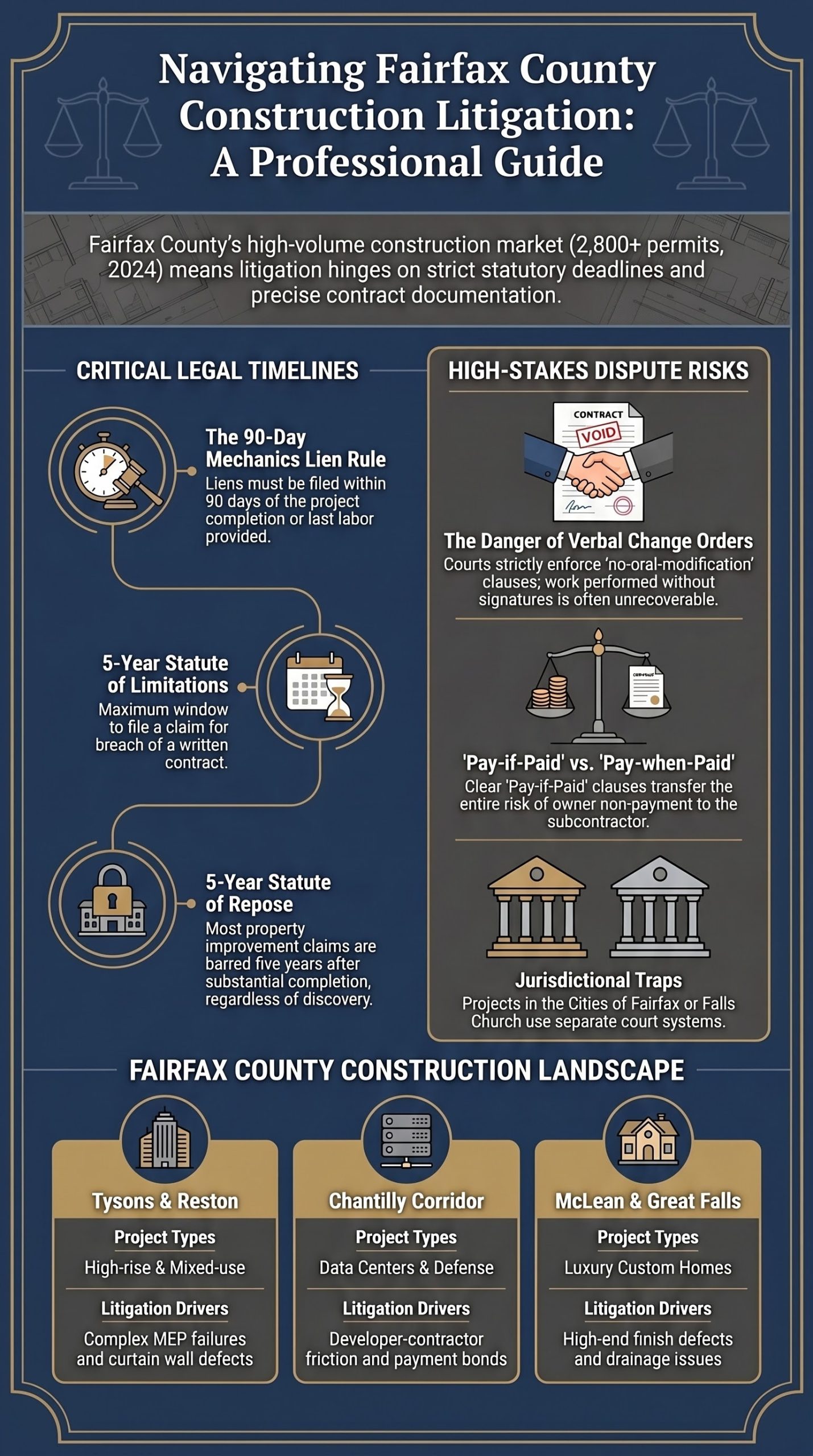
Table of Contents
- Fairfax County’s Construction Markets and What They Produce
- Construction Contract Disputes
- Construction Defects in Fairfax
- Mechanics Liens and Payment Disputes
- Change Order and Scope Disputes
- Cost Overruns and Schedule Delay Damages
- Subcontractor and Supplier Disputes
- Virginia Construction Law Foundations
- Navigating Fairfax County Courts
- How Shin Law Office Resolves Fairfax Construction Disputes
Chapter 1: Fairfax County’s Construction Markets and What They Produce
Fairfax County is several construction markets stacked into a single jurisdiction, and each one produces a different category of dispute. Tysons is Fairfax’s planned urban core, with a long-term build-out that anticipates up to 100,000 residents and 200,000 jobs by 2050 across high-rise office, residential, and mixed-use product types. Reston runs continuous Planned Residential Community redevelopment, with the Reston Association overlay adding architectural and use approval to the county’s permit process. The Dulles Suburban Center, along Routes 28 and 50 in the Chantilly and Herndon areas, hosts data center construction, defense ecosystem buildouts, and large commercial campuses. Centreville and Vienna handle a steady volume of commercial remodels and tenant fitouts. McLean and Great Falls run high end residential construction at price points that produce litigation when projects go wrong. Burke, Annandale, Fairfax City, Springfield, and Franconia round out the picture with established commercial corridors and mature residential subdivisions.
All of these markets feed cases into the Fairfax County Circuit Court, which handles a higher volume of civil and commercial litigation than any other state court in Virginia. Smaller cases valued at less than the jurisdictional limit are heard in the Fairfax County General District Court. Mechanics lien cases involve filing in the Circuit Court land records before any litigation begins.
Two independent cities sit inside the county footprint:
The City of Fairfax and the City of Falls Church are independent jurisdictions surrounded by Fairfax County. Each has its own permit office, zoning ordinance, and court system. A construction project within city limits is subject to that city’s permit and inspection process, and litigation is filed in that city’s Circuit Court rather than the Fairfax County Circuit Court. The first question I ask in any new case is which jurisdiction the project actually sits in.
For the broader civil litigation context surrounding construction work in this county, see my companion guide for a Fairfax County property dispute lawyer, which covers boundary, easement, zoning, adverse possession, and quiet title actions. For appellate work specific to construction cases, see my construction defect and change order appeals guide. For comparison with neighboring jurisdictions, see my Loudoun County construction litigation lawyer guide. The chapters that follow drill into the specific construction dispute patterns I see most often in Fairfax.
Chapter 2: Construction Contract Disputes
Most construction disputes in Fairfax County stem from the contract. The contract is what the parties signed at the beginning of the project. The dispute arises when the project does not behave as the contract anticipated. Whether the issue is a missed deadline, a rejected pay application, a scope dispute, a defective installation, or a refusal to release retainage, the analysis starts with what the contract says, what it does not say, and what Virginia law fills in for the gaps.
Why Fairfax Contract Disputes Carry Outsized Stakes
Fairfax handles some of the largest commercial construction projects in Virginia. A Tysons office tower, a Reston mixed-use development, a Chantilly data center campus, and a McLean luxury custom home all operate under contracts that allocate millions of dollars in risk between the parties. When those contracts include no-damage-for-delay clauses, broad indemnity provisions, liquidated damages without caps, pay-if-paid clauses, and dispute-resolution provisions that send disputes to forums with no procedural protections, the contractor or owner who signs without legal review has already lost ground before the first shovel hits the dirt.
Common Fairfax Construction Contract Issues
The recurring contract issues in Fairfax fall into a few categories. No-damage-for-delay clauses prevent contractors from recovering money for delays caused by the owner or third parties. Pay-if-paid clauses tie subcontractor payment to the general contractor’s receipt of payment from the owner, leaving subcontractors empty-handed when the prime project fails. Liquidated damages provisions impose daily damages for delays without requiring proof of actual harm. Indemnity provisions can shift liability for the owner’s or designer’s errors onto the contractor. Termination for convenience provisions let owners end the contract without cause but limit what the contractor can recover. Dispute resolution clauses can require arbitration in distant forums, waive the right to a jury trial, or impose short-notice deadlines for any claim.
Available Causes of Action
Virginia recognizes breach of contract, breach of express and implied warranties, fraudulent inducement, negligent misrepresentation, mutual mistake, unconscionability, violations of the Prompt Payment Act, and quantum meruit recovery for work performed without a binding contract. Which causes of action are available depends on what the contract says, what was promised outside the contract, and how the project actually unfolded. Where the dispute involves professional negligence by an architect, engineer, or designer, additional tort liability theories may apply. For a focused look at the line between contract and tort in Fairfax, see my piece on when professional negligence in Fairfax County leads to tort liability.
Chapter 3: Construction Defects in Fairfax
A construction defect is the building telling you the truth about how it was actually designed, built, and supervised. Cracks, leaks, settlement, mold, structural movement, mechanical failures, and finish failures are all evidence. Virginia gives owners and associations a limited window to investigate, document, and act, and the deadlines run faster than most people expect.
Patent vs. Latent Defects
Virginia law distinguishes patent defects, which are visible on reasonable inspection, from latent defects, which are hidden behind walls, beneath slabs, or inside mechanical systems and would not be discovered by a reasonable inspection. The distinction matters because the discovery rule for latent defects can extend the statute of limitations period, while patent defects are subject to ordinary limitations starting from completion. The line between patent and latent is often the central battleground in a defect case. For a foundational discussion, see my piece on how construction defects are evidence of how a project was really built.
Tysons High Rise Defects
Tysons high-rise construction has produced a category of defect litigation that requires specialized expertise. Curtain wall leaks, balcony deck waterproofing failures, podium structure cracking, post-tensioned slab issues, and high-rise mechanical system failures all carry consequences that compound across multiple floors and units. Mechanical, electrical, and plumbing system failures in commercial buildouts are a particular specialty of Tysons. I have written about these patterns in mechanical, electrical, and plumbing disputes in Tysons Corner commercial construction.
Residential Defects in Fairfax Subdivisions and Custom Homes
Across Fairfax’s mature subdivisions in Burke, Springfield, Annandale, Vienna, and Oakton, recurring residential defects involve moisture intrusion at window and door assemblies, foundation cracking and settlement, HVAC undersizing or improper installation, deck and balcony framing that does not meet code, roof flashing failures, and stucco or siding installation that traps water against sheathing. In McLean and Great Falls, custom home defect cases often involve high-end finishes, complex mechanical systems, smart home integration failures, and elaborate site work that produces drainage and grading issues at the seven-figure end of the market. Virginia’s implied warranties for new homes give owners specific rights, and the warranty claim sequence often runs in parallel with negligent construction and breach-of-contract claims.
Commercial Latent Defects in Herndon and the Dulles Corridor
Commercial property buyers in Herndon, Reston, and the Route 28 corridor face latent defect exposure that surfaces months or years after closing. Hidden HVAC issues, structural problems behind finish materials, deferred maintenance dressed up as cosmetic upgrades, and code violations that previous owners never disclosed routinely produce litigation. For a focused look at this issue, see my piece on how commercial property buyers in Herndon can spot and sue for latent defects.
The defect clock starts running before you notice the defect:
Virginia’s statute of limitations for breach of contract on a written agreement is five years. Virginia’s statute of repose under Va. Code Section 8.01-250 generally limits actions for damages arising out of improvements to real property to five years after substantial completion. Once the clock runs, even meritorious claims are barred. The earlier you document, investigate, and act, the more rights you preserve.
Chapter 4: Mechanics Liens and Payment Disputes
A mechanics lien in Virginia is a contractor’s, subcontractor’s, or supplier’s most powerful payment remedy. The lien attaches to the real property where the work was performed and creates a security interest that can ultimately be foreclosed if the debt is not paid. The lien is also one of the most procedurally unforgiving remedies in Virginia practice. Miss a deadline by a single day, and the lien is invalid.
The Lien Statute and the Ninety-Day Rule
Virginia’s mechanics lien statute, codified at Va. Code Section 43-1 and following, requires the lien claimant to file a memorandum of mechanics lien in the Fairfax County Circuit Court land records within ninety days of the last day of the month in which the claimant last performed labor or supplied materials, and within ninety days of the project’s substantial completion. The lien must include specific information identifying the property, the parties, the work performed, the amount owed, and the relevant dates. After the lien is recorded, the claimant has 6 months to file a bill in equity to enforce it, or it expires.
Tysons Payment Pressure and Why It Escalates
Tysons is a high pressure payment environment. The space is expensive, the schedules are compressed, and the consequences of missing turnover are immediate and large. A delayed draw, a rejected pay application, disputed change work, or withheld retainage can quickly turn into lien exposure, project slowdown, and full-scale commercial litigation. I have written in detail about payment disputes between contractors and subcontractors in Tysons.
Subcontractor Protection Strategies
Subcontractors in Chantilly, Reston, Tysons, and across Fairfax face the same recurring problem: the prime contractor stops paying, communication goes dark, and the lien window begins to close. Virginia law provides multiple parallel remedies, but only if the subcontractor acts before the deadlines run. The available tools include mechanics’ liens, payment bond claims on bonded projects, prompt payment act remedies, and direct contract claims against upstream parties. For Chantilly subcontractors specifically, see my guide on how subcontractors in Chantilly can protect themselves when the prime fails to pay.
The Virginia Prompt Payment Act
Virginia’s Prompt Payment Act sets statutory time limits on payments down the construction chain and provides interest and other remedies for late payment. On private projects, owners must pay general contractors within 45 days of receipt of an invoice, and general contractors must pay subcontractors within 7 days of receiving payment from the owner. Failure to comply produces interest at the legal rate and, in some cases, attorneys’ fees. The Act does not replace the mechanics lien remedy, but it can be used in parallel.
Chapter 5: Change Order and Scope Disputes
A change order is the formal mechanism for modifying the scope of work, the contract sum, or the contract time after the construction contract is signed. In a perfectly run project, every scope change is documented in a written change order signed by the owner, the architect, and the contractor before the work is performed. In a real project, change orders get verbal approval, written approval comes later or never, and the contractor performs the work in good faith, expecting payment.
The Written Change Order Requirement
Most construction contracts require change orders to be in writing and signed before the work is performed. The contract often contains a no-oral-modification clause stating that it cannot be amended verbally. Virginia courts generally enforce these provisions. When a contractor performs work without a written change order, the contractor faces an uphill battle to get paid for that work even if the owner asked for it. The available legal theories include waiver of the writing requirement based on the parties’ course of conduct, equitable estoppel based on detrimental reliance, and quantum meruit recovery for the reasonable value of the work performed.
Tysons Buildout and Centreville Remodel Patterns
In Tysons commercial buildouts and Centreville remodels, change order disputes follow a predictable arc. The tenant or owner directs scope expansion verbally because the schedule cannot wait for paperwork. The contractor performs the work expecting a written change order to follow. The change order never gets executed, or the parties cannot agree on the price after the work is done. The dispute must then be argued under waiver, estoppel, or quantum meruit theories, with all the documentation challenges those theories require. I have written about these patterns in commercial buildout disputes in Tysons Corner and commercial remodel disputes in Centreville.
Constructive Change Orders
A constructive change order is work performed because of an owner’s directive or interference that effectively requires extra work or extra time, even though no formal change order was issued. Examples include differing site conditions the owner did not disclose, defective design documents that required additional work to make them functional, owner interference with the contractor’s planned sequence, and overinspection that imposed standards beyond those required by the contract. Virginia recognizes constructive change order claims, but the contractor has to give timely notice and document the additional cost as it is incurred.
Cumulative Impact Claims
When a project experiences a large number of individual change orders, the cumulative effect on productivity, sequencing, and overhead can exceed the sum of the individual changes. Virginia recognizes cumulative impact claims, but they require careful documentation, expert testimony, and a methodology that the court will accept. These cases often turn on the contractor’s ability to prove the baseline productivity, the actual productivity during the impacted period, and the causal connection between the changes and the lost productivity.
Chapter 6: Cost Overruns and Schedule Delay Damages
Cost overruns and schedule delays are the most common source of large construction disputes in Fairfax County. Tysons towers, Reston mixed-use, Chantilly data centers, and McLean luxury custom homes all run on tight budgets and tight schedules. When either one slips, the dollars at stake are substantial.
Liquidated Damages
Most construction contracts include a liquidated damages provision that imposes a fixed daily amount for each day the project runs past the contract completion date. Virginia courts enforce liquidated damages provisions that represent a reasonable estimate of actual damages and are not so disproportionate to actual harm as to constitute a penalty. The contractor’s available defenses include excusable delay, owner caused delay, concurrent delay, and challenges to the reasonableness of the liquidated damages rate itself.
Actual Delay Damages
When the contract does not include a liquidated damages provision, or when the provision is unenforceable, the owner can pursue actual damages for delay. These damages typically include lost rent, lost revenue, additional financing costs, and additional supervision and management costs. Proving actual delay damages requires expert testimony, financial records, and a clear causal connection between the delay and the claimed loss.
No Damage for Delay Clauses
Many Fairfax construction contracts include no-damage-for-delay clauses that purport to bar the contractor from recovering monetary damages for delays caused by the owner. Virginia courts generally enforce these clauses, but several recognized exceptions can apply: delays caused by the owner’s bad faith, delays not contemplated by the parties, delays so unreasonable as to amount to abandonment, and delays caused by the owner’s active interference with the contractor’s work. The contractor’s ability to invoke an exception depends heavily on the project record and contemporary documentation.
Critical Path Analysis and Time Extensions
When a delay occurs, the contractor’s first response is usually a request for a time extension under the contract’s change order procedure. Whether the contractor is entitled to an extension depends on whether the delay was on the critical path, whether the delay was excusable, and whether the contractor gave timely notice. Critical path analysis using project scheduling software has become a standard expert tool in Virginia delay cases.
Chapter 7: Subcontractor and Supplier Disputes
Subcontractors and suppliers carry the most exposure on a construction project and the least leverage. They are paid last, they have the smallest margins, and they have the fewest contractual rights against the upstream parties whose decisions affect the work most. Fairfax’s high-volume construction environment makes the upstream pressure intense and the downstream consequences serious.
Pay if Paid vs. Pay When Paid
A pay if paid clause says the general contractor is only required to pay the subcontractor if and when the GC receives payment from the owner. A pay when paid clause says the GC will pay the subcontractor when the GC receives payment from the owner, but does not condition payment on receipt. The legal effect is dramatically different. Pay-if-paid clauses transfer the risk of owner nonpayment from the GC to the subcontractor. Pay when paid clauses do not. Virginia courts generally enforce pay-if-paid clauses if the contract language is clear and unambiguous.
Developer and Contractor Friction in Chantilly
In the Route 50 and Route 28 corridors around Chantilly, the high-intensity economic use surrounding the Dulles Suburban Center produces a steady stream of developer-to-contractor disputes that escalate quickly. Fights over money, schedule, scope, design changes, site conditions, approvals, and risk allocation are not small misunderstandings in this market. They are commercial disputes with significant downstream consequences. I have written in detail about the patterns in disputes between developers and contractors in Chantilly Virginia.
Backcharge Defenses
When the GC asserts a backcharge against a subcontractor, the subcontractor has several available defenses. Lack of notice, lack of opportunity to cure, failure to mitigate damages, lack of contractual basis for the charge, and unreasonable cost calculations are all common. The contract often dictates the procedure the GC must follow before imposing a backcharge, and a backcharge that skips required steps may not be enforceable.
Chapter 8: Virginia Construction Law Foundations
Every Fairfax construction dispute rests on the foundation of Virginia substantive law. The five concepts below are the ones I find myself explaining most often to new clients, and the ones that most often determine the outcome of a case before trial begins.
Statutes of Limitation
Virginia construction practice operates on a tight set of limitations periods. Breach of a written contract has a five-year limitation period under Va. Code Section 8.01-246. Breach of an oral contract has a three-year period. Fraud claims have a two year period from discovery. Negligence claims have a two-year period for personal injury and a five-year period for property damage. The mechanics lien window is ninety days from last work, and the bill in equity to enforce the lien must be filed within six months of recording.
Statute of Repose
Virginia’s statute of repose for actions arising out of improvements to real property, codified at Va. Code Section 8.01-250, generally limits actions for damages to five years after the project’s substantial completion. Unlike a statute of limitations, the statute of repose runs from completion regardless of when the defect was discovered.
Implied Warranties
Virginia law implies warranties on new home construction that the home will be built in a workmanlike manner and will be habitable. These warranties run from the builder to the original purchaser and to subsequent purchasers within the warranty period. Implied warranty claims are often the strongest claims a homeowner has in a residential construction defect case.
Available Remedies
Virginia courts have a full set of remedies available in construction cases. Money damages compensate for the cost to repair, the diminution in value, lost use of the property, additional financing costs, and consequential damages where contractually permitted. Specific performance is rarely available. Rescission can undo a contract that was procured by fraud. Mechanics’ liens provide security for unpaid claims. The Virginia Consumer Protection Act provides additional remedies including treble damages and attorneys fees in cases involving consumer transactions.
Punitive Damages and Attorneys Fees
Punitive damages are available in construction cases involving fraud, willful misconduct, or other intentional torts, but Virginia caps punitive damages at $350,000 per case, per defendant. Attorneys fees are not generally recoverable in Virginia unless the contract authorizes them or a specific statute provides for them. The Prompt Payment Act, the Virginia Consumer Protection Act, and certain bond claim statutes are common sources of statutory attorneys fees.
Chapter 9: Navigating Fairfax County Courts
Where you file a Fairfax construction dispute matters as much as how you file it. Each forum has its own procedures, monetary limits, and pace.
Fairfax County General District Court
The General District Court hears civil cases up to a $25,000 jurisdictional limit. The court is housed at the Fairfax County Judicial Center and moves at a faster pace than the Circuit Court. Trials are bench trials, meaning a judge decides the case without a jury. Smaller construction payment disputes, supplier disputes that fit within the cap, and warranty matters that fall under the limit can move efficiently through this court.
Fairfax County Circuit Court
The Circuit Court is the trial court of general jurisdiction for Fairfax County and the busiest state court in Virginia. Mechanics lien enforcement actions, large breach of contract cases, defect cases requiring expert testimony, and any matter involving title to land or equitable relief are filed here. The Circuit Court conducts both bench trials and jury trials. The court’s volume and the depth of construction litigation experience among the bench produce a body of trial-level decisions that experienced counsel can draw on when shaping arguments.
City of Fairfax and City of Falls Church Courts
If your project sits inside the City of Fairfax or the City of Falls Church, the case goes to that city’s Circuit Court rather than the Fairfax County Circuit Court. Each independent city has its own General District Court and Circuit Court, its own zoning ordinance, and its own land records. The first procedural question in any case involving these areas is whether the property is actually in Fairfax County or in one of the independent cities.
Federal Court and the Eastern District of Virginia
Construction disputes occasionally end up in the United States District Court for the Eastern District of Virginia, which is housed in the Albert V. Bryan Federal Courthouse in Alexandria. Federal jurisdiction exists when the parties are from different states and the amount in controversy exceeds $75,000, or when the case presents a federal question such as a Miller Act payment bond claim on a federal project. The Eastern District is known as the rocket docket for the speed at which it moves cases to trial. Fairfax construction cases involving federal projects, federally backed loans, or out of state parties often end up in this court.
Arbitration and Mediation
Many Fairfax construction contracts include mandatory arbitration provisions that send disputes to AAA, JAMS, or another arbitral forum rather than to court. Arbitration has different rules, evidence standards, discovery limits, and appeal rights than litigation. Mediation is often required as a precondition to arbitration or filing suit, and many cases resolve at mediation before consuming the expense of a full hearing.
Chapter 10: How Shin Law Office Resolves Fairfax Construction Disputes
My approach to a Fairfax construction case follows the same five-step process, whether the matter is a fifty-thousand-dollar mechanics lien or a multimillion-dollar Tysons defect case.
Step one is the document review. Before I can give a client a meaningful assessment, I need to see the contract, change orders, project schedule, pay applications, daily reports, RFI log, submittal log, punch list, warranty correspondence, and any expert reports already commissioned. Most construction cases are won and lost on the contemporaneous documentation, and the earlier I see what exists, the better.
Step two is the factual investigation. Site visits, photographs, conversations with project participants, and interviews with the people who were on the project day to day produce the evidence that fills in what the documents do not capture. Construction cases rely heavily on what a competent observer would have noticed and how the parties’ conduct departed from what the contract required.
Step three is the legal analysis. With the documents and the facts in hand, I can map the case onto Virginia law. Which causes of action are available? Which defenses does the other side have? What expert testimony will the case require? What is the realistic timeline and cost? Where should the case be filed, and on what theory? These questions get answered before any complaint is drafted.
Step four is the resolution effort. Most construction disputes are resolved before trial. A clear, well-documented demand letter that lays out the legal position and the evidence often produces a workable settlement. Mediation is often required by the contract and often produces a resolution at a fraction of the cost of full litigation. I push for resolution wherever resolution is achievable on terms my client can accept.
Step five is litigation when litigation is the only path forward. When the other side refuses to engage in good faith, when the legal issues require a court order, or when the client’s rights cannot be protected outside court, I file the case and try it.
Summary: What to Take Away From This Guide
Three principles run through every chapter of this guide. The first is that time matters more than people realize. Mechanics lien deadlines, prompt payment deadlines, statutes of limitation, and the five-year statute of repose all operate on rigid timelines. The day a Fairfax construction dispute begins is the day the clock starts running on at least one of these timelines.
The second is that documentation matters more than memory. Contracts, change orders, pay applications, daily reports, schedules, and contemporaneous correspondence carry weight in court that recollections of phone calls and site meetings simply do not. The contract decides cases. Documentation tells the court what the contract really meant in practice.
The third is that forum matters. Whether your case belongs in the Fairfax County General District Court, the Fairfax County Circuit Court, the City of Fairfax or City of Falls Church courts, the Eastern District of Virginia, an AAA or JAMS arbitration, or in mediation depends on the relief you need, the amount at stake, the contract’s dispute resolution provisions, and the procedural posture.
Frequently Asked Questions
How long do I have to file a mechanics lien in Fairfax County?
Virginia’s mechanics lien statute requires the memorandum of lien to be filed in the Fairfax County Circuit Court land records within ninety days of the last day of the month in which the claimant last performed labor or supplied materials, and within ninety days of the project’s substantial completion. After the lien is recorded, a bill in equity to enforce the lien must be filed within six months of recording. Both deadlines are jurisdictional.
How long do I have to sue for a construction defect in Virginia?
Breach of a written construction contract has a five-year limitation period under Va. Code Section 8.01-246. Virginia’s statute of repose at Va. Code Section 8.01-250 generally limits actions arising out of improvements to real property to five years after substantial completion. The discovery rule for latent defects can extend the limitations period in certain cases, but the statute of repose runs regardless of discovery.
My project is in the City of Fairfax or City of Falls Church. Are the rules different?
Substantive Virginia law remains the same, but the building permit process, zoning ordinance, and court system are administered by the city rather than Fairfax County. Each independent city has its own permit office, its own General District Court, and its own Circuit Court. The first question in any case is which jurisdiction the property actually sits in.
Can I recover for work I performed without a written change order?
It depends on what the contract says, what the parties did, and whether you gave timely notice. Virginia generally enforces no oral modification clauses, but available legal theories include waiver based on the parties’ course of conduct, equitable estoppel based on detrimental reliance, and quantum meruit recovery for the reasonable value of the work. The contractor’s documentation during the project is critical.
What is a no damage for delay clause, and is it enforceable in Virginia?
A no damage for delay clause purports to bar the contractor from recovering monetary damages for delays caused by the owner. Virginia courts generally enforce these clauses, but recognized exceptions can apply: delays caused by the owner’s bad faith, delays not contemplated by the parties, delays so unreasonable as to amount to abandonment, and delays caused by the owner’s active interference. Whether an exception applies depends on the project record and contemporary documentation.
What is a pay if paid clause and how does it affect my Tysons subcontract?
A pay if paid clause says the general contractor is only required to pay the subcontractor if and when the GC receives payment from the owner. Virginia courts generally enforce pay if paid clauses if the contract language is clear and unambiguous. The clause shifts the risk of owner non-payment from the GC to the subcontractor. The exact wording matters, and many contracts contain language that looks like pay if paid but is actually pay when paid, which is a different and less harsh provision.
Does the Virginia Consumer Protection Act apply to construction defects?
The Virginia Consumer Protection Act can apply to consumer construction transactions involving misrepresentation, fraud, or other deceptive practices. The Act provides for actual damages, treble damages in certain cases, and attorneys fees. Whether the Act applies to a specific case depends on the nature of the transaction, the parties involved, and the conduct alleged. Most pure breach of contract cases are not VCPA cases, but cases involving fraudulent inducement, concealed defects, or deceptive practices may qualify.
Can I recover attorneys’ fees in a Fairfax construction case?
Attorneys’ fees are not generally recoverable in Virginia unless the contract authorizes them or a specific statute provides for them. Common sources of statutory attorneys fees in construction cases include the Virginia Consumer Protection Act, the Prompt Payment Act, and certain payment bond claim statutes. Many construction contracts include attorneys fees provisions that operate either one way or both ways. Reading the contract carefully before filing or defending a claim is essential.
How long does a Fairfax construction case typically take?
A General District Court case typically reaches resolution within three to six months. A Circuit Court construction case typically takes twelve to twenty four months from filing to trial, though many resolve through mediation or settlement before trial. Cases involving multiple parties, complex defect issues, or significant expert testimony can take longer. Arbitration timelines vary by forum but are often faster than full Circuit Court litigation.
What does it cost to hire a construction litigation lawyer in Fairfax County?
Cost depends on the complexity of the dispute, the amount of discovery required, whether expert witnesses are needed, and whether the case settles or goes to trial. Construction cases tend to be document and expert heavy, which influences cost. I provide an initial case assessment and a clear engagement structure so clients know what to expect at each stage. Call 571-445-6565 to discuss your specific situation.
Talk to a Fairfax County Construction Litigation Lawyer Today
Construction disputes do not get easier with time. Lien deadlines run, evidence disappears, witnesses move on, and the other side gains the advantage of every day you wait. Whether you are facing a Tysons high rise contract dispute, a Reston warranty failure, a Chantilly mechanics lien problem, a Centreville remodel scope battle, or a McLean custom home defect, the right time to call is now.
Shin Law Office represents owners, developers, contractors, subcontractors, and suppliers in construction disputes across Fairfax County and Northern Virginia. I have handled cases from single family warranty claims to multimillion dollar commercial defect litigation, and I bring the same focused, evidence based approach to every matter.
Call 571-445-6565 or contact Shin Law Office to discuss your Fairfax County construction matter.

References
Code of Virginia. (n.d.). Section 8.01-246. Personal actions based on contracts. https://law.lis.virginia.gov/vacode/title8.01/chapter4/section8.01-246/
Code of Virginia. (n.d.). Section 8.01-250. Limitation on actions for damages arising out of defective or unsafe condition of improvements to real property. https://law.lis.virginia.gov/vacode/title8.01/chapter4/section8.01-250/
Code of Virginia. (n.d.). Title 43, Chapter 1. Mechanics’ liens. https://law.lis.virginia.gov/vacodefull/title43/chapter1/
Code of Virginia. (n.d.). Title 8.2. Commercial Code. https://law.lis.virginia.gov/vacodefull/title8.2/
Code of Virginia. (n.d.). Virginia Consumer Protection Act. https://law.lis.virginia.gov/vacodefull/title59.1/chapter17/
Fairfax County Government. (n.d.). Circuit Court. https://www.fairfaxcounty.gov/circuit/
Fairfax County Government. (n.d.). General District Court. https://www.fairfaxcounty.gov/generaldistrict/