


Bottom Line Up Front
A construction defect is the building’s way of telling the truth about how it was designed, built, and supervised. Virginia law gives owners, boards, and buyers a limited window to listen, investigate, and act. The stakes run from a leaking window to a collapsing balcony, and the deadlines run out faster than most property owners ever realize.
A building does not lie. Every stain on a drywall ceiling, every hairline crack in a basement slab, every soft spot on a balcony deck is a report card on how carefully that structure was designed, framed, weather-sealed, and supervised during construction. The building speaks quietly at first. It whispers through a discolored seam at the top of a window. It murmurs through a door that no longer latches cleanly after a rainstorm. By the time it is shouting, through a sagging roofline, an interior ceiling collapse, or a chunk of stucco that separates from the substrate and falls into a walkway, the legal clock has usually been running for years.
This guide is written for the homeowner who bought a new construction home in Loudoun County and is now fighting water in the basement. It is written for the condominium board in Arlington that recently received a reserve study flagging envelope repairs totaling seven figures. It is written for the commercial owner in Richmond, whose building engineer has been sounding alarms about a parking deck no one wants to discuss. It is written for the family in Virginia Beach whose balcony gave way during a cookout.
What follows is a ten chapter walk through Virginia construction defect law and practice. Chapters two through nine cover the twenty-six most common categories of construction defects that our firm, Shin Law Office, sees in cases across the Commonwealth. Chapter ten closes with a county-by-county overview of how these cases arise in every major Virginia jurisdiction.
Table of Contents
- When a Building Fails, The Anatomy of a Virginia Construction Defect Case
- Structural Failures, Foundation Settlement, and Framing Defects
- The Building Envelope, Where Water Finds Its Way In
- Windows, Doors, Flashing, Drainage, and the Hidden Mold That Follows
- Concrete, Masonry, and Exterior Cladding Defects
- Elevated Structures and Life Safety Failures
- HVAC, Plumbing, Electrical, and Insulation Defects
- Code Violations, Flooring, and Defective Materials
- Design Errors, Poor Workmanship, and Supervision Failures
- Virginia Construction Defect Law and a County-by-County Overview
Chapter 1: When a Building Fails, The Anatomy of a Virginia Construction Defect Case
Construction defect cases are not breach-of-contract cases dressed up in different clothing. They are hybrid cases that combine contract, warranty, negligence, and sometimes fraud or statutory consumer protection theories into a single action against a defined set of defendants. The typical defendants include the general contractor, one or more subcontractors whose work is at issue, the design professionals (architects, structural engineers, civil engineers, MEP engineers), the material supplier if a product defect is implicated, and, in new home and condominium cases, the developer or declarant.
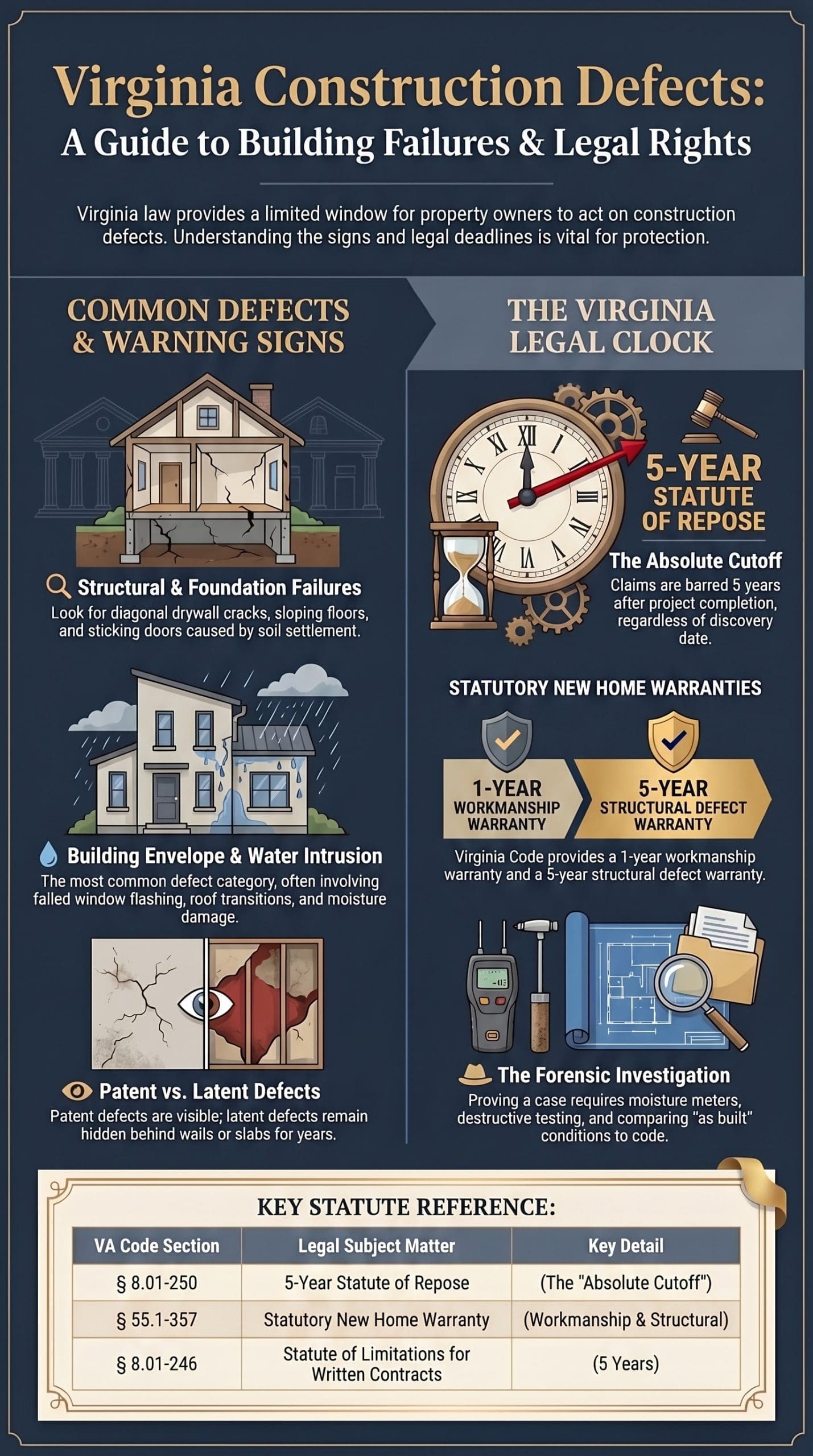
The work of proving a Virginia construction defect case is forensic. Walking a property with a flashlight and a moisture meter is step one. Step two is retaining a qualified expert to perform destructive testing, which usually involves opening up wall cavities, pulling back siding, cutting out flashings, and documenting what was built against what the plans and the Virginia Uniform Statewide Building Code required. Step three is comparing the as-built conditions to the governing standard of care, which is the intersection of the contract documents, the building code in force at the time of permitting, and the generally accepted practices of the trade.
Patent versus latent defects
Virginia law distinguishes between patent defects, which an ordinary buyer could discover through reasonable inspection, and latent defects, which are hidden in the walls, under the slab, above the ceiling, or behind the cladding. The two categories carry different deadlines, different proof burdens, and different strategic considerations. Most of the Commonwealth’s most expensive construction defect cases involve latent defects that were invisible at closing and only surfaced months or years later.
For every defect category that follows in chapters two through nine, the same analytical framework applies. What does the contract require? What does the building code require? What was actually built? What damage has the deviation caused? What will it cost to correct properly? And who, among the chain of parties that touched the project, is legally responsible? Virginia construction defect practice lives inside those five questions.
Chapter 2: Structural Failures, Foundation Settlement, and Framing Defects
Of all construction defects, structural failures are the ones that turn an uncomfortable conversation into an emergency. A crack in a load-bearing wall is not a cosmetic complaint. It is the structure telling the owner that the load path is no longer behaving the way the engineer drew it on sheet S 101.
Structural failures
Structural failures in Virginia residential and commercial construction most often involve undersized or improperly connected framing members, steel connections that were never tightened to specification, concrete poured at a lower strength than the mix design required, and load-bearing walls compromised by post-construction modifications the original engineer never reviewed. Each of these patterns leaves physical evidence that a qualified structural engineer can document through visual inspection, nondestructive testing, and, where warranted, long-term structural monitoring.
Foundation settlement and slab movement
Virginia’s soil conditions vary dramatically across the Commonwealth. Northern Virginia is underlain by a mix of clays, silts, and marine sediments. The Piedmont is underlain by residual soils weathered from bedrock. The Shenandoah Valley adds karst limestone with sinkhole potential. Hampton Roads sits on soft coastal plain soils with a high water table. Every one of these conditions requires a geotechnical investigation before construction begins and an engineered foundation design that accounts for the specific soil profile on the specific lot. When the geotechnical report is ignored, abbreviated, or overruled by a builder trying to save money, foundation settlement follows. Differential settlement, where one part of a foundation drops faster than another, produces diagonal drywall cracks, sticking doors, and sloping floors that appear 2 to 5 years after closing.
Slab-on-grade movement is its own category. Post-tensioned slabs can fail when tendons are not tensioned correctly or when post-construction modifications cut into the cable layout. Conventional slabs can fail when they are poured on inadequately compacted fill, when vapor barriers are omitted, or when control joints are misplaced.
Framing defects
Framing defects are the defects that live behind the drywall. Missing structural hardware, undersized headers, improperly cut top plates, joists that rest on less than the minimum required bearing, load-bearing walls that were never actually framed as load-bearing, and trusses that were field modified by a framer who did not understand that a factory-engineered truss cannot be cut or spliced without written approval from the truss engineer. Each of these defects is invisible at a walk-through. Each of them can produce significant structural consequences years later.
The framing inspection paradox
Virginia jurisdictions typically require a framing inspection before drywall goes up. That inspection is a snapshot. An inspector cannot see every joist hanger, every nail, or every connection. When a failure surfaces years later, the defense will invariably argue that the framing passed inspection and the claim should fail on that basis. Virginia courts have consistently rejected that argument. A building official’s inspection does not insulate a contractor from liability for defective work, because the inspection is a public health and safety check, not a warranty of quality to the owner.
Chapter 3: The Building Envelope, Where Water Finds Its Way In
If structural defects are the most dramatic construction failures, envelope defects are by far the most common. The building envelope is the continuous skin that separates the conditioned interior from the exterior environment. It includes the roof, exterior walls, windows, doors, foundation walls, and every flashing, sealant, and transition between those components. A single flaw anywhere on the envelope can admit water, and where water goes, damage follows.
Roof defects and roof leaks
Roof defect cases in Virginia fall into several recognizable patterns. Shingle roofs installed in cold weather without proper sealing, producing wind uplift failures the first time a significant storm rolls through. Low-slope roofs with inadequate positive drainage can lead to ponding water that degrades the membrane and allows water to migrate through seams. Metal roofs with improperly lapped panels or missing closure strips. Roof penetrations, including plumbing vents, HVAC curbs, and skylights, were flashed with caulk rather than with proper step flashing and counter flashing. And roof transitions, particularly where a roof meets a sidewall or a chimney, that were sealed rather than properly flashed.
Water intrusion and moisture damage
Water intrusion is rarely caused by a single defect. It is almost always caused by a chain of small failures that, together, allow water to reach the interior. A roof that admits a small amount of water might not produce visible damage for years if the attic ventilation is adequate and the insulation is intact. Add a failed vapor barrier, a blocked soffit vent, and a missing piece of flashing, and the same volume of water can produce rotted sheathing, compromised insulation, and eventually a mold claim that can exceed the original cost of the roof.
Building envelope failures
In commercial and multifamily construction, envelope failures are often systemic. The building was designed with a nominal envelope strategy that looked good on the architectural drawings but was not properly detailed at the transitions. The subcontractors responsible for each trade (roofers, siding installers, window installers, sealant applicators) each did their own work but no one coordinated the transitions between trades. Water finds the seams. A full envelope investigation on a mid size condominium building can identify dozens of individual defects, each of which is trivial in isolation but together produce the systemic water intrusion that drives an entire reconstruction project.
Condominium envelope cases, a category of their own
Condominium boards across Arlington, Alexandria, Fairfax, and every urbanized county in Virginia are increasingly filing envelope claims five to eight years after construction. These cases routinely carry repair estimates of seven and eight figures. The reason is simple. When an envelope is systemically defective on a hundred unit building, the cost to remediate the defect often requires removing and replacing the entire exterior skin, scaffolding the full height of the building, and temporarily relocating occupants. The cost scales quickly.
Chapter 4: Windows, Doors, Flashing, Drainage, and the Hidden Mold That Follows
Window and door installation defects
Window and door installation is one of the most failure-prone steps in residential and light commercial construction. The window itself is rarely the problem. The problem lies in the rough opening, the flashing sequence around the opening, and the integration of the window’s nail flange with the building’s weather-resistant barrier. A window installed without a sill pan flashing, with improper overlap of the house wrap at the head, or with sealant applied in the wrong location can look perfect from the interior and still leak every time it rains. We routinely find these defects in single-family homes in Loudoun, Fauquier, and Prince William Counties, as well as in multifamily buildings throughout Northern Virginia and Richmond.
Flashing and waterproofing failures
Flashing is the family of thin, shaped materials that direct water away from transitions in the envelope. Step flashing at a sidewall. Kick out flashing where a roof edge meets a wall. Pan flashing under a window. Through-wall flashing at a shelf angle. Waterproofing is the membrane or coating system that protects below grade walls, foundation slabs, and wet areas inside the building. Both categories share a single failure mode. The defect is almost never a wrong product. The defect is almost always improper installation, wrong sequencing, or the complete absence of the required flashing at a location where the drawings called for it.
Drainage and grading defects
Water that should have been directed away from the foundation instead flows toward it. Downspouts that discharge within three feet of the foundation wall. Final grade that slopes toward the house rather than away. Sump pumps that were never connected. Foundation drains that were crushed during backfill. French drains that were installed without filter fabric silted up within a year. These defects are individually small and collectively catastrophic. Once saturated soil loads a foundation wall, every other foundation and basement problem in Chapter Two becomes more likely.
Mold and hidden moisture conditions
Mold is not, in itself, a construction defect. Mold is a consequence of a construction defect. Where a building envelope fails, and water reaches a cellulose substrate (wood framing, paper-faced drywall, cellulose insulation), mold is typically present within forty-eight to seventy-two hours and continues to grow as long as the moisture source remains. Virginia mold litigation requires careful pleading. The plaintiff must tie the mold condition back to a specific construction defect, establish the causal path from defect to moisture to mold, and prove damages that include both remediation and, in appropriate cases, health impacts on occupants.
The “it’s just condensation” defense
When envelope claims are first reported, builders and their insurers frequently argue that the moisture is condensation rather than bulk water intrusion. Condensation is a real phenomenon in a tight building with inadequate ventilation, but it is also the defense industry’s favorite way to redirect responsibility from the installer to the occupant. A proper envelope investigation uses moisture meters, infrared thermography, and targeted water testing to distinguish condensation from bulk water intrusion. The two have different signatures, different remedies, and different parties responsible.
Chapter 5: Concrete, Masonry, and Exterior Cladding Defects
Concrete cracking and concrete failure
Concrete cracks. That alone is not a defect. Shrinkage cracks, plastic shrinkage cracks, and small temperature cracks are expected features of any concrete element. The defect analysis begins where the cracking exceeds what is normal for the element in question. Structural cracks that propagate across a beam or slab. Cracks that follow a grid pattern consistent with alkali silica reaction. Cracks that indicate corrosion of embedded reinforcing steel. Cracks that exceed the ACI allowable widths for the exposure category. Each pattern tells an expert a specific story about what went wrong during the mix, placement, or curing of the concrete.
Stucco, siding, and exterior cladding defects
Traditional three-coat stucco, synthetic stucco systems including EIFS (Exterior Insulation and Finish System), fiber-cement siding, vinyl siding, wood siding, and architectural metal panels all have their own installation standards and common failure modes. EIFS, in particular, has a long and troubled litigation history in Virginia, driven by early installations without drainage planes that trapped water behind the finish. Fiber cement siding is rarely defective as a material, but is often installed without the required clearance to grade, without the required gap at butt joints, or with fasteners driven through rather than against the plank. Each of these installation defects produces its own failure signature.
Masonry defects
Masonry defect cases involve brick, block, and stone veneer systems. Common defects include missing or misplaced weep holes that allow the masonry cavity to fill with water, shelf angles that were never properly flashed, wall ties that are either too few or improperly embedded, efflorescence that indicates a persistent moisture issue, and mortar mixes that were not appropriate for the wall type or the exposure. Masonry repair is among the most expensive envelope remedies because it often requires removing and replacing large sections of finished exterior wall.
Chapter 6: Elevated Structures and Life Safety Failures
Balcony, deck, and porch failures
Balcony and deck failures are among the most dangerous construction defects because they can produce catastrophic personal injury with little or no advance warning. The typical failure pattern involves a ledger board (the structural member that attaches the deck to the main building) that was fastened with nails instead of structural lag screws, attached through siding rather than directly to the band joist, or installed without proper flashing above and behind the ledger. Over time, water enters the gap, the band joist rots, and the entire deck eventually pulls away from the house under load.
Elevated concrete balconies in multifamily construction exhibit distinct failure modes. Post-tensioned concrete balconies can fail due to corrosion of the post-tensioning cables, particularly when the cable sheathing was damaged during construction or the end anchorages were not properly protected. Cantilevered steel balconies can fail due to corrosion of the steel embedded in masonry or fatigue at the connection to the primary structure. Virginia has seen several high-profile balcony collapses in the last decade, and each has led to litigation that traces the failure to a specific installation or design defect.
Unsafe stairways, handrails, and guardrails
Stair and guardrail defects are code-driven. The Virginia Uniform Statewide Building Code, which incorporates the International Building Code and International Residential Code, specifies minimum tread depth, maximum riser height, allowable tread and riser variation, guardrail height, guardrail opening dimensions (the so-called four-inch sphere rule), and handrail graspability requirements. Defects in any of these categories are frequently litigated after a fall injury, and the defense to such claims typically rests on whether the defect was patent or latent and whether the building official’s approval should be treated as conclusive.
Fire stopping and life safety defects
Fire stopping is the category of construction work that maintains the fire resistance rating of assemblies where penetrations (pipes, ducts, cables, conduits) pass through rated walls and floors. It is invisible. It is frequently the last thing installed. And it is one of the most commonly defective categories of construction work on multifamily and commercial projects. Missing fire stopping, unlisted fire stopping systems, and fire stopping installed around the wrong penetration type all compromise the compartmentalization required by building codes to contain fire and smoke. These defects do not produce water damage or structural failure. They pose fire and life-safety risks and are frequently the subject of focused investigation when a multifamily building experiences a fire or a near miss.
Why fire-stopping defects are the defects you cannot see
Fire stopping is hidden behind drywall, above ceilings, and inside shaft walls. A condominium board that never commissions a targeted fire stopping investigation may never learn that significant portions of its rated assemblies were never properly sealed. The defect is typically discovered only during an unrelated renovation, after a fire, or through a deliberate life safety audit. An audit of a multifamily building commissioned specifically to assess fire stopping compliance is one of the highest yield investments a board can make.
Chapter 7: HVAC, Plumbing, Electrical, and Insulation Defects
HVAC installation and ventilation defects
HVAC defects fall into four common categories. First, undersized or oversized equipment installed without a proper Manual J load calculation, producing comfort complaints and inefficient operation. Second, duct systems that were designed with inadequate return paths, leaky joints, or runs that violate the design static pressure, resulting in rooms that never reach the set point. Third, refrigerant line sets that were never pressure-tested and charged with insufficient refrigerant, leading to premature compressor failure. Fourth, ventilation systems (bath exhaust, kitchen exhaust, dryer exhaust, whole-house ventilation) that terminate in the attic or wall cavity rather than being ducted to the exterior, leading to moisture accumulation and eventual envelope damage.
Plumbing leaks and pipe installation defects
Plumbing defect cases in Virginia frequently involve three patterns. Failed supply line fittings, particularly on certain brands and generations of PEX crimp fittings and brass compression fittings, have been the subject of nationwide class action litigation. Failed drain waste vent systems, often involving improper slope, missing cleanouts, or air admittance valves used where not permitted. And failed hot water connections inside walls, where inadequate nailer protection allows a nail or screw to penetrate a water line during later trades.
Electrical defects and unsafe wiring
Electrical defects range from code violations that are primarily documentation issues (missing labels on circuits, inadequate working clearances at panels) to conditions that produce immediate fire and shock risk. Aluminum branch-circuit wiring installed in homes during the 1960s and 1970s is a known hazard and is frequently the subject of claims in older Virginia housing stock when renovations expose it. Arc fault circuit interrupters and ground fault circuit interrupters that were not installed where the code required them produce a different category of claim. And in multifamily construction, electrical defects often involve inadequate feeder sizing, improperly coordinated overcurrent devices, and noncompliant grounding and bonding.
Insulation defects
Insulation is one of the last trades to be installed before drywall and one of the least carefully inspected. Common defects include fiberglass batts compressed behind electrical boxes and plumbing, batts installed with gaps at the top or bottom of the cavity, closed-cell spray foam applied at the wrong thickness or in conditions outside the manufacturer’s specifications, and blown-in cellulose that settled below the design density. Each of these defects produces energy performance problems, comfort complaints, and in cold climates, ice dam formation that can drive additional envelope damage.
Chapter 8: Code Violations, Flooring, and Defective Materials
Code violations
Every Virginia construction project is governed by the Virginia Uniform Statewide Building Code (USBC), administered by the Virginia Department of Housing and Community Development. The USBC incorporates the International Building Code, the International Residential Code, the International Mechanical Code, the International Plumbing Code, the International Fire Code, and the National Electrical Code, each as adopted with Virginia-specific amendments. A violation of the USBC is a per se deviation from the standard of care and, in most cases, can also support a claim for breach of the implied warranty of habitability in new residential construction under Virginia Code § 55.1 357.
Flooring installation defects
Flooring defects are among the most visible construction defects because owners live on the floor every day. Hardwood floors that cup, crown, or separate because the subfloor moisture content exceeded the manufacturer’s specifications at the time of installation. Tile floors that crack across grout lines because the substrate was not adequately stiffened. Tile floors that debond because the tile was installed without the required mortar coverage, or with a mortar not rated for the exposure. Luxury vinyl plank that telegraphs every subfloor imperfection because the subfloor was not properly prepared. Each of these conditions has a specific installation standard, and each standard is well documented by the relevant trade association.
Defective materials
Some construction defects trace back not to poor workmanship but to a defective product incorporated into the building. Chinese drywall, certain generations of fire sprinkler pipe, certain EIFS systems, PEX fittings produced by specific manufacturers, and asphalt shingles from specific production runs have all been the subject of major product liability litigation affecting Virginia properties. When a defective material case is present, the analysis expands to include the manufacturer, distributor, and, sometimes, the specifier, and the legal theories may include strict product liability in addition to negligence and contract remedies.
Chapter 9: Design Errors, Poor Workmanship, and Supervision Failures
Design errors and specification failures
Not every construction defect is a contractor defect. A meaningful percentage of Virginia construction defect claims trace back, in whole or in part, to a design professional’s error or omission. Architectural details that do not work when translated into actual construction. Structural engineering that used the wrong load combination or the wrong exposure category. MEP design that did not coordinate with the structural or architectural scope. Specification sections that contradicted each other. Design professionals in Virginia owe their clients the care and skill ordinarily exercised by similarly situated architects and engineers, and claims against them require expert testimony from a design professional in the same discipline.
Poor workmanship
Poor workmanship is the catch-all category that captures defects where the plans were correct, the materials were proper, and the building code would have been satisfied if the work had been performed to industry standard, but the work was simply done badly. Crooked cuts. Sloppy sealant application. Fasteners overdriven through finished surfaces. Mitered corners that never closed. Grout that was never struck. These defects are individually minor. Aggregated across a project, they can drive a significant repair budget and, more importantly, they often indicate that other, hidden work on the same project was also performed carelessly.
Project supervision and coordination failures
The general contractor’s primary obligation on any project is to supervise and coordinate subcontractor work. When that supervision fails, the building envelope suffers most, because the envelope is built across multiple trades that need to be sequenced carefully. The house wrap installer, window installer, siding installer, and sealant applicator each do their own work, and the general contractor is supposed to ensure that each trade integrates properly with the next. When that coordination fails, water finds the seams, and the resulting claim is not against any one subcontractor but against the general contractor for failing to perform the supervisory role for which it was paid.
Why every Virginia construction defect case names multiple parties
Modern construction defect litigation almost never names only one defendant. A properly developed case identifies every party whose work or decisions contributed to the defect, joins them in a single action, and allows them to allocate responsibility among themselves. This approach maximizes recovery for the owner, preserves the owner’s leverage in settlement discussions, and prevents the empty-chair defense, in which one defendant blames an absent party the owner chose not to sue.
Chapter 10: Virginia Construction Defect Law and a County by County Overview
The statutes that govern the case
Four Virginia statutes shape almost every construction defect case in the Commonwealth. Virginia Code § 8.01 246 governs the statute of limitations for contract-based claims, five years for written contracts and three years for oral contracts, measured from the date of breach. Virginia Code § 8.01 243 governs tort-based claims, with a five-year limitations period for injury to property and a two-year limitations period for personal injury. Virginia Code § 8.01 250 is the statute of repose, which bars any action against designers, builders, or material suppliers more than five years after performance or furnishing of the services, regardless of when the defect was discovered. And Virginia Code § 55.1 357 creates the statutory warranty for new residential construction, a one-year warranty against defects in workmanship and a five-year warranty against structural defects.
The five year statute of repose, the deadline that ends more cases than any other
Virginia’s five year statute of repose is one of the shorter construction repose periods in the country. It begins to run from the date performance was completed, not the date the defect was discovered. A latent defect that surfaces in year six is barred, regardless of when the owner first had reason to know about it. This is the single most important reason property owners with concerns about their construction should consult counsel promptly. Waiting costs cases.
How construction defect cases arise across Virginia
Below is a working overview of how construction defect cases arise in the major Virginia counties and independent cities where our firm most frequently practices and accepts referrals.
|
Fairfax CountyTysons and Reston high rise envelope claims, single family new construction disputes across McLean, Vienna, and Oakton, condominium fire stopping and balcony cases.
|
Loudoun CountyNew home defect claims in Ashburn, Brambleton, and South Riding, data center envelope and MEP disputes, foundation and drainage claims in hillside developments.
|
|
Prince William CountyLarge tract residential development claims, commercial buildout disputes in Manassas and Woodbridge, warehouse and industrial envelope failures.
|
Arlington CountyHigh rise condominium envelope cases, balcony and parking deck claims, fire stopping deficiencies in mid rise residential.
|
|
Alexandria (City)Historic district renovation defects, condominium envelope and flashing claims, waterfront development moisture cases.
|
Stafford and SpotsylvaniaNew home claims in rapidly growing subdivisions, foundation and grading failures on sloping lots, roofing and envelope claims in production builder housing.
|
|
Fauquier CountyCustom home defect claims, equestrian facility structural and envelope cases, well and septic installation disputes.
|
Culpeper CountyNew home and production builder claims, agricultural building structural and envelope cases, rural commercial construction disputes.
|
|
Albemarle and CharlottesvilleUVA adjacent multifamily envelope cases, custom home structural and moisture claims, renovation defects in historic housing stock.
|
Henrico and HanoverShort Pump area commercial and residential envelope claims, production builder new home cases, commercial buildout disputes.
|
|
Chesterfield CountyMidlothian and Chester production home claims, drainage and grading disputes in new subdivisions, industrial and commercial envelope cases.
|
Richmond (City)Historic building renovation defects, downtown multifamily envelope claims, commercial buildout and MEP coordination disputes.
|
|
James City and WilliamsburgActive adult community new home claims, resort and hospitality construction defect cases, tourist district renovation disputes.
|
Virginia Beach (City)Oceanfront condominium envelope and balcony cases, high water table foundation claims, hospitality and resort construction disputes.
|
|
Norfolk and ChesapeakeWaterfront and marine construction defect cases, naval and shipyard adjacent commercial claims, foundation and drainage failures in coastal soils.
|
Frederick and ClarkeKarst and limestone foundation cases, production builder new home claims, agricultural and orchard building envelope disputes.
|
|
Prince George CountyIndustrial and warehouse envelope cases, Fort Gregg Adams adjacent commercial construction disputes, residential subdivision claims.
|
Every jurisdiction in the Commonwealth has its own circuit court, with its own scheduling conventions, jury pool, and local bar. An attorney who has litigated construction defect cases in Fairfax may not understand how the docket works in Chesterfield, and vice versa. Experienced Virginia construction counsel accounts for those differences in every case strategy, from the choice of experts to the timing of mediation.
Frequently Asked Questions
How do I know whether what I am seeing is a real construction defect?
Real defects almost always come with a physical trace. Staining, cracking, sagging, sticking, or a persistent odor are the most common first indicators. A qualified construction defect attorney, working with the right investigator or engineer, can distinguish normal aging and maintenance issues from true construction defects. The early investigation is rarely expensive relative to what a mature case can recover.
How long do I have to bring a construction defect case in Virginia?
The shortest applicable deadline is typically the five-year statute of repose under Virginia Code § 8.01 250, which runs from the date of substantial completion, regardless of when the defect is discovered. Contract-based claims run on their own schedule under § 8.01 246, and tort-based claims under § 8.01 243. The new home statutory warranty operates on separate one-year and five-year schedules. In most cases, the earliest of these deadlines governs.
My HOA or condominium board is investigating defects. Do we need to file suit, or can we negotiate?
Many construction defect matters resolve without litigation, but only when the party in a strong position is prepared to file. Filing a suit protects against the statute of repose, preserves evidence, and shifts the negotiation dynamic. An experienced attorney can evaluate whether a formal notice, a demand letter, or a full filing makes sense for your particular fact pattern and your timing.
Will I have to sue my neighbor, my builder, or my close business relationship?
Virginia construction defect claims are, in most cases, fundamentally insurance-driven. The builder’s general liability insurance and the design professional’s professional liability insurance are the usual sources of recovery. The personal financial position of the individual builder or designer is rarely the issue that drives settlement.
What does it cost to pursue a construction defect case?
Fee structures vary. Some construction defect cases are handled on a contingency basis, some on an hourly basis, and some on a hybrid basis that aligns the attorney’s incentives with the client’s recovery. The most important cost driver is usually the expert investigation, which can range from a few thousand dollars for a single-family home to several hundred thousand dollars for a large multifamily project. Our firm discusses the fee structure openly at the initial consultation and provides a written engagement letter before any representation begins.
Speak With a Virginia Construction Defect Attorney
If you own a home, manage a condominium, or operate a commercial property anywhere in Virginia and you are seeing signs of construction defects, the time to consult counsel is now. Shin Law Office handles construction defect cases across every major county in the Commonwealth.

Sources and Further Reading
Virginia Code § 8.01 246. Statute of limitations for contract based actions, five years for written contracts and three years for oral contracts.
Virginia Code § 8.01 243. Statute of limitations for personal and property tort claims.
Virginia Code § 8.01 250. Five year statute of repose for actions against architects, engineers, contractors, and material suppliers arising from improvements to real property.
Virginia Code § 55.1 357. Statutory new home warranty, including one year workmanship and five year structural provisions.
Virginia Uniform Statewide Building Code (13 VAC 5 63). Statewide building code incorporating the International Code Council family of codes with Virginia specific amendments. Administered by the Virginia Department of Housing and Community Development. dhcd.virginia.gov.
International Code Council. International Building Code, International Residential Code, International Mechanical Code, International Plumbing Code, and International Fire Code. iccsafe.org.
National Fire Protection Association. NFPA 70 (National Electrical Code) and NFPA 101 (Life Safety Code). nfpa.org.
American Concrete Institute. ACI 318 (Building Code Requirements for Structural Concrete) and related standards on concrete quality and crack control. concrete.org.
American Society of Civil Engineers. ASCE 7 (Minimum Design Loads and Associated Criteria for Buildings and Other Structures).
Virginia Supreme Court Reports. Published opinions on construction defect claims, contributory negligence, statute of repose, and economic loss doctrine. vacourts.gov.
This article is provided for general educational purposes and does not constitute legal advice. Every construction defect matter is fact specific, and no attorney client relationship is formed by reading this material. For advice on a specific Virginia construction defect matter, consult a licensed Virginia attorney.
