
BLUF
Tysons is not a low-stakes remodel market. Fairfax County’s plan is to transform Tysons into a dense urban center with up to 100,000 residents and 200,000 jobs by 2050, and the county continues to track major rezonings, active development, and implementation across the district. In that environment, commercial buildout disputes tend to move fast because the space is expensive, the schedules are compressed, and the business consequences of delay are immediate.
-
Why Tysons Buildout Fights Escalate So Quickly
That tension is not random. Fairfax County treats Tysons as its urban center and long-term downtown, with transit-oriented mixed-use growth tied closely to land use, phasing, and implementation. Those conditions create exactly the kind of pressure that turns a routine office, retail, restaurant, or medical buildout into a dispute over scope, schedule, cost, and responsibility.
What a Tysons Commercial Buildout Dispute Usually Looks Like
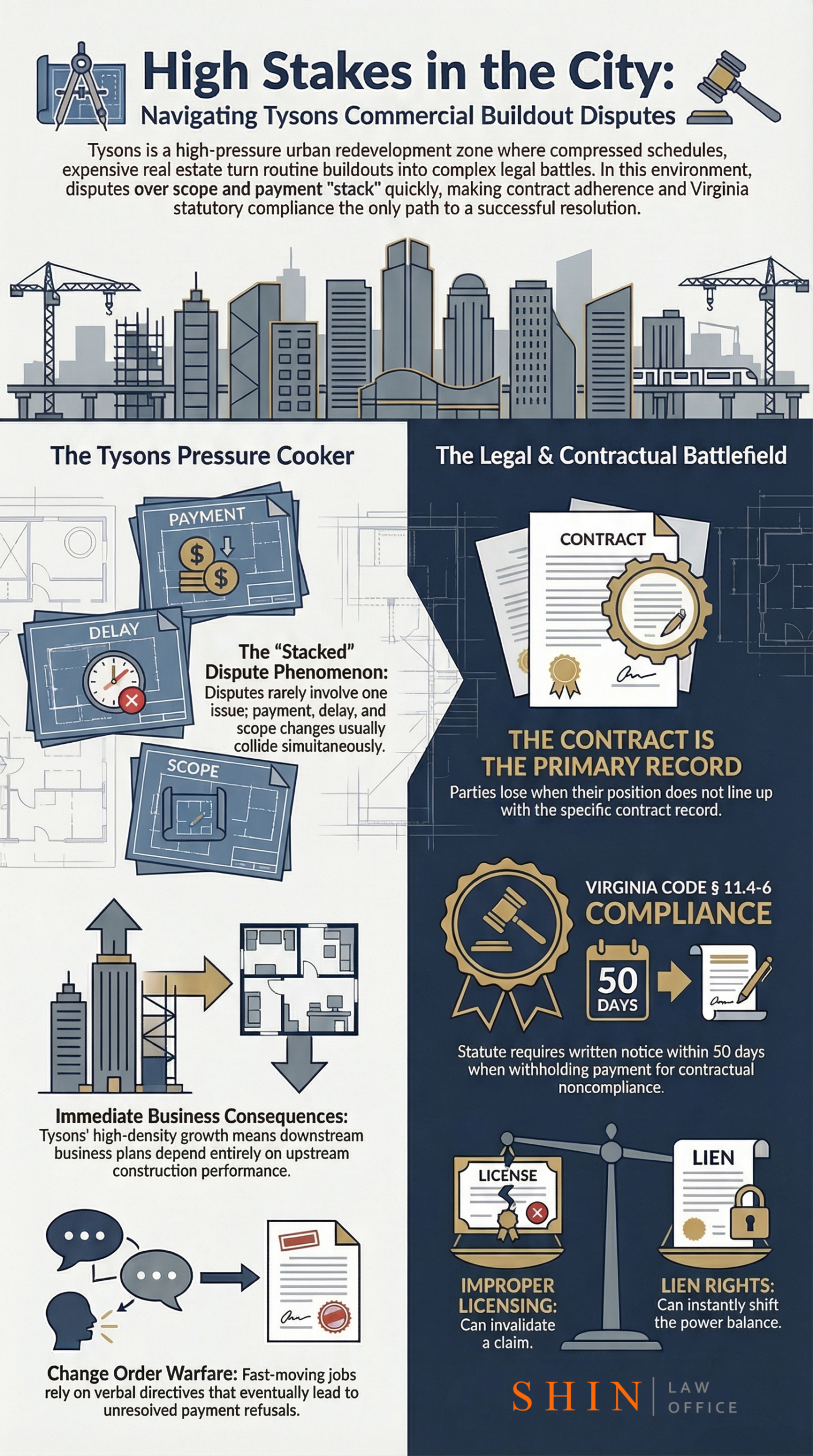
In Tysons, these disputes rarely remain confined to a single issue. They usually stack.
A tenant says the space was supposed to be ready for opening, occupancy, staffing, or revenue generation. The landlord says the contractor or tenant caused the drift. The contractor says the drawings changed, the approvals came late, the site conditions were different, or the owner kept directing extra work without formally pricing it. By the time the parties realize the job is no longer on track, the dispute usually involves five things at once: payment, delay, change orders, workmanship, and closeout.
The Contract Decides More Than Most Parties Want to Admit
In a Tysons buildout case, the contract is usually where the real fight lives.
I look first at the scope language, allowance language, tenant improvement obligations, notice requirements, payment provisions, substantial completion definition, punch list treatment, change order process, and default clause. Most parties do not lose these disputes because they had no argument. They lose because their position does not line up with the contract record.
Virginia law sharpens that analysis. Under Code of Virginia § 11-4.6, construction contracts must contain payment timing provisions, and payment by the upstream party is generally not a condition precedent to payment to a subcontractor unless a narrow insolvency or bankruptcy exception applies.
The Most Common Buildout Dispute Issues in Tysons
Tenant improvement scope drift
The project starts as a straightforward fit-out, then the use evolves, the layout changes, branding shifts, utilities need rework, or the existing conditions do not support the intended plan. The contractor calls it added scope. The owner or tenant calls it included work.
Change order warfare
Tysons buildouts move fast, and fast jobs generate verbal directives. A field decision gets made to keep the project moving. Weeks later, the written change order is still unresolved. Then someone refuses to pay because the paper never caught up to the work.
Payment disputes
The invoice goes out. The receiving party cuts it down. Then everyone starts arguing about completion, backup, lien waivers, stored materials, unresolved items, and whether the withheld amount is supported.
Delay claims
These jobs often sit on hard lease dates, opening targets, move-in requirements, and financing assumptions. One delay can cascade into multiple claims. In Tysons, where development is tied to dense mixed-use activity and high-cost commercial occupancy, delay damages can escalate quickly.
Defective work claims
A buildout can look finished and still fail operationally. Lighting may not perform correctly. HVAC may not support the intended occupancy. Doors, glazing, flooring, millwork, and life safety details may all become post-turnover flashpoints.
Punch list disputes
This is where many parties lose perspective. The owner or tenant says the list proves the job is not done. The contractor says the items are minor and are being used as leverage to hold major money.
Subcontractor Rights Can Change the Power Balance
Virginia’s lien statutes can alter leverage fast. Section 43-4 governs perfection of certain mechanics lien rights through recordation and notice. Section 43-11 can create personal liability exposure in some circumstances when the statutory notice path is properly used.
Licensing Problems Can Destroy an Otherwise Good Case
Virginia contractor licensing law is not decorative. Under Code of Virginia § 54.1-1115, contracting or bidding on covered work without the required license or proper class of license is prohibited. In the right case, a licensing problem can become a devastating defense or a serious offensive issue.
What Businesses Commonly Get Wrong
The first mistake is treating a buildout dispute as a project management annoyance rather than a legal exposure.
The second mistake is continuing to rely on informal directives after the job has clearly become adversarial.
The third mistake is waiting too long. In Tysons, the economics of delay can deteriorate quickly, and statutory remedies do not improve with age.
Closing Summary
Commercial buildout disputes in Tysons usually come down to one hard question: who is bearing the cost of a project that no longer aligns with the original assumptions?
In Tysons, that question gets expensive fast. If your Tysons buildout is breaking down over payment, scope, schedule, defects, or completion, the smart move is to evaluate the contract, notices, payment trail, and available remedies before the dispute hardens any further.
Part of Shin Law Office’s Northern Virginia Commercial Litigation Guide
This article connects to a broader guide on commercial contract disputes across the region. See the complete resource: When the Contract Breaks: The Northern Virginia Commercial Litigation Guide — covering B2B disputes, federal contracting, teaming agreements, construction claims, mechanic’s liens, and toxic torts across Loudoun, Fairfax, Prince William, Arlington, Clarke, and Frederick Counties.

Principal Attorney | Shin Law Office
Call 571-445-6565 or book a consultation online today.
(This article is provided for general informational purposes and does not constitute legal advice. For advice on your specific situation, consult with a licensed Virginia attorney.)
References
Fairfax County, Virginia. (n.d.). Tysons Comprehensive Plan. https://www.fairfaxcounty.gov/tysons/comprehensive-plan
Fairfax County, Virginia. (n.d.). Development activity. https://www.fairfaxcounty.gov/tysons/development-activity
Virginia Law. (n.d.). § 11-4.6. Required contract provisions in construction contracts. https://law.lis.virginia.gov/vacode/title11/chapter1/section11-4.6/