
Bottom Line Up Front (BLUF)
Tysons is not a sleepy construction market. It is Fairfax County’s planned urban core, with long-term growth centered around transit, mixed-use redevelopment, public improvements, and large project delivery. In that kind of environment, payment disputes do not stay small for long. A delayed draw, a rejected pay application, disputed change work, or withheld retainage can quickly turn into lien exposure, project slowdown, and full-scale commercial litigation.
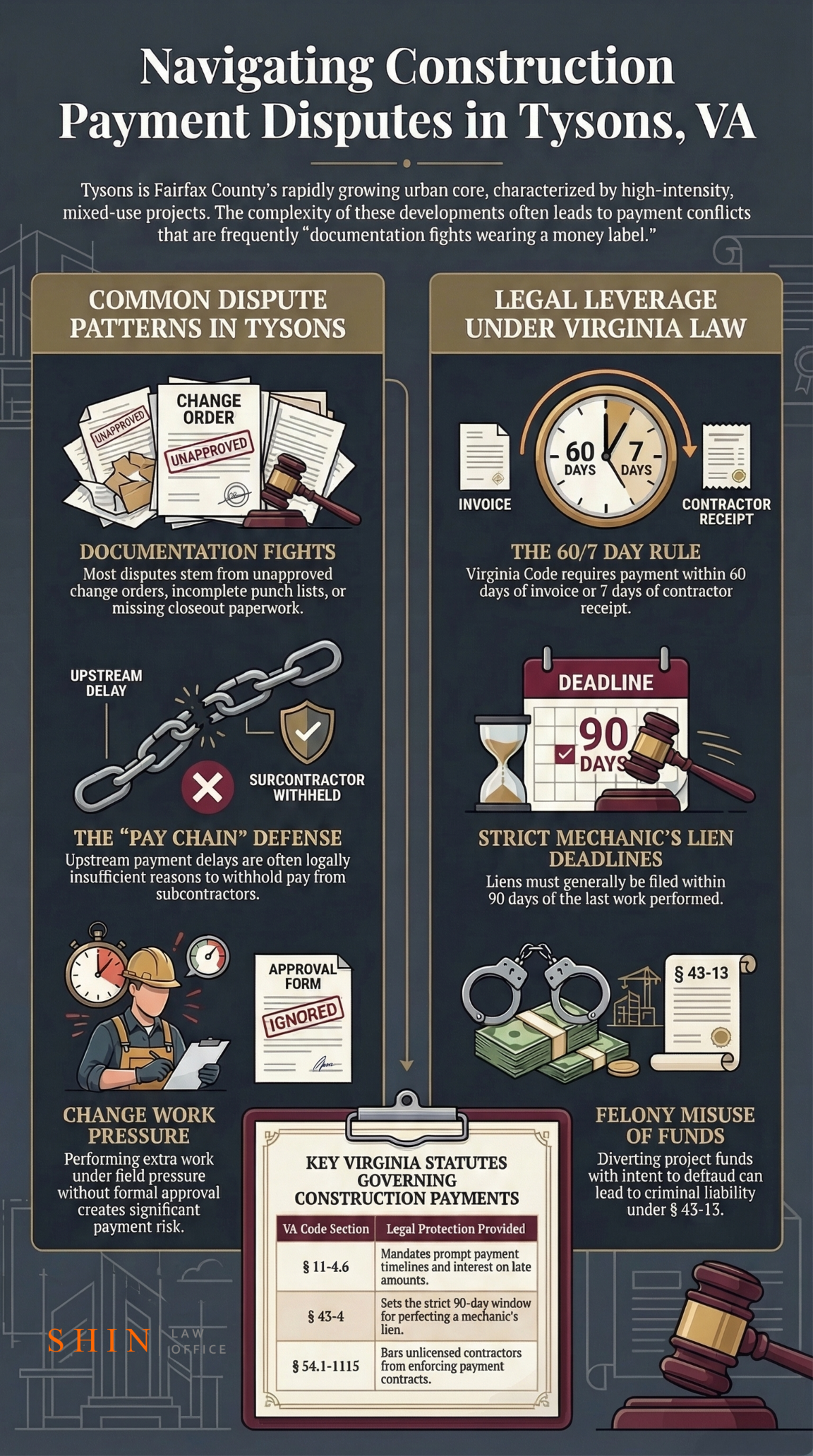
Why Tysons Creates High-Pressure Payment Disputes
I see Tysons for what it is: a dense commercial construction environment where owners, developers, general contractors, trade contractors, and suppliers are all operating on tight schedules and even tighter financial assumptions. Fairfax County’s plan for Tysons calls for a major long-term transformation into a high-intensity urban center with up to 100,000 residents and 200,000 jobs by 2050. That scale of redevelopment naturally produces more contracts, more billing layers, more scope changes, and more payment conflict.
What These Disputes Usually Look Like
Most contractor and subcontractor payment disputes in Tysons fall into a few recurring patterns. The first is the classic underbilling and rejection fight. The second is the change work fight, where extra work was performed under field pressure, but formal approval lagged behind the work. The third is a retainage dispute, where substantial completion is reached but money stays locked up because punch list items, closeout paperwork, or pass-through issues remain unresolved.
Virginia Law Gives Subcontractors Real Leverage
Virginia is not a state where a general contractor can always sit on a subcontractor invoice and blame the owner forever. Under Code of Virginia section 11-4.6, covered construction contracts must require payment to a subcontractor by the earlier of 60 days after receipt of an invoice following satisfactory completion of the invoiced work or seven days after the contractor receives payment for that work. That same statute also requires written notice when payment is withheld and provides for interest on unpaid amounts in many covered situations.
Mechanics Liens Can Change the Entire Case
When a subcontractor has not been paid, a mechanic’s lien can put real pressure on the project and the property. But Virginia lien law is technical, and technical mistakes can kill otherwise valid claims. A lien claimant generally must file a memorandum of lien within strict time limits, and a suit to enforce the lien then has its own deadline.
Subcontractors also have special statutory notice rights that can create personal liability for the owner or general contractor, up to the amount still owed upstream, if the statutory notice process is properly used. That is one reason payment disputes in Tysons can escalate fast.
Misuse of Construction Funds Can Become More Than a Contract Fight
Virginia law goes further than many people realize. Code section 43-13 states that funds paid to a contractor or subcontractor for a project must be used to pay those who performed labor or furnished materials for that project. If those funds are diverted with intent to defraud while project obligations remain unpaid, the conduct can expose the wrongdoer to criminal liability.
The Contract Usually Decides Who Bleeds First
Payment disputes are rarely won by the party who is angriest. They are won by the party whose contract, notices, schedules, and project records line up. I look first at the payment clause, the schedule of values, the change order language, the notice clause, the closeout requirements, the retainage language, the default provisions, and the dispute resolution section. Then I match those provisions against the project record.
Licensing Problems Can Destroy a Payment Claim
Virginia law states that a construction contract entered into by a person performing work without a valid Virginia contractor’s license is generally not enforceable by the unlicensed contractor. In a payment dispute, that can become a devastating defense.
Litigation in Fairfax County Is Often About Speed and Leverage
Tysons disputes often end up in Fairfax County litigation because the project, the parties, the property, or the performance occurred there. Commercial construction cases are rarely won by broad accusations. They are won by careful claims, defensible damages models, and pressure applied at the right time.
What Businesses Commonly Get Wrong
The first mistake is waiting too long because the parties want to preserve the relationship. But there is a difference between preserving a relationship and surrendering leverage. If deadlines run, notices are missed, or the record grows stale, your negotiating position can collapse.
The second mistake is treating the dispute as an accounting issue rather than a legal one. A disputed pay application can involve contract interpretation, statutory timing, lien rights, trust fund style misuse allegations, and licensing defenses all at once.
The third mistake is relying on informal jobsite conversations. On many projects, everyone “understood” the extra work would be paid. Then the people change, the project turns, and the file becomes the truth. If it is not documented, your case gets harder.
Closing Thoughts
Payment disputes in Tysons are rarely about one unpaid invoice alone. They are usually about leverage, timing, documentation, and risk allocation on high value commercial work. Virginia law gives parties real tools, but those tools only work if they are used correctly and on time.
If your company is dealing with withheld payment, disputed change work, retainage issues, lien exposure, or a breakdown between contractor and subcontractor on a Tysons project, contact Shin Law Office at 571-445-6565.
Part of Shin Law Office’s Northern Virginia Commercial Litigation Guide
This article connects to a broader guide on commercial contract disputes across the region. See the complete resource: When the Contract Breaks: The Northern Virginia Commercial Litigation Guide — covering B2B disputes, federal contracting, teaming agreements, construction claims, mechanic’s liens, and toxic torts across Loudoun, Fairfax, Prince William, Arlington, Clarke, and Frederick Counties.

Principal Attorney | Shin Law Office
Call 571-445-6565 or book a consultation online today.
(This article is provided for general informational purposes and does not constitute legal advice. For advice on your specific situation, consult with a licensed Virginia attorney.)
References
Fairfax County, Virginia. (n.d.). Tysons Comprehensive Plan. https://www.fairfaxcounty.gov/tysons/comprehensive-plan
Virginia Law. (n.d.). § 11-4.6. Required contract provisions in construction contracts. https://law.lis.virginia.gov/vacode/title11/chapter1/section11-4.6/
Virginia Law. (n.d.). § 43-13. Funds paid to general contractor or subcontractor. https://law.lis.virginia.gov/vacode/title43/chapter1/section43-13/