BLUF
In Tysons Corner, mechanical, electrical, and plumbing fights are not side issues. They are often the reason a commercial build-out misses turnover, fails inspection, blows the budget, or opens with systems that do not work the way the tenant expected. Tysons is planned as Fairfax County’s urban center, with long-term growth tied to dense office, retail, mixed-use, and transit-oriented development. In that kind of market, a problem above the ceiling, behind the wall, or below the slab can turn into a serious business dispute fast.
-
Why Tysons Corner Makes These Disputes Worse
A build-out in Tysons usually sits on a hard business deadline. A tenant wants staff in place. A retailer wants an opening date. A restaurant wants to start serving. Fairfax County treats Tysons as a high-density growth area expected to hold up to 100,000 residents and 200,000 jobs by 2050. That means many projects are moving inside larger redevelopment schedules, tight access conditions, and expensive lease commitments. When mechanical, electrical, or plumbing work slips, the damage often spreads beyond one trade.
Fairfax County’s permit system adds another layer. Commercial interior alterations and new tenant layouts usually need a commercial addition or alteration permit, and separate trade permits are often needed for electrical, mechanical, and plumbing work. If that is not handled correctly, the project can fail inspection.
Mechanical Disputes in Tysons Corner Build Outs
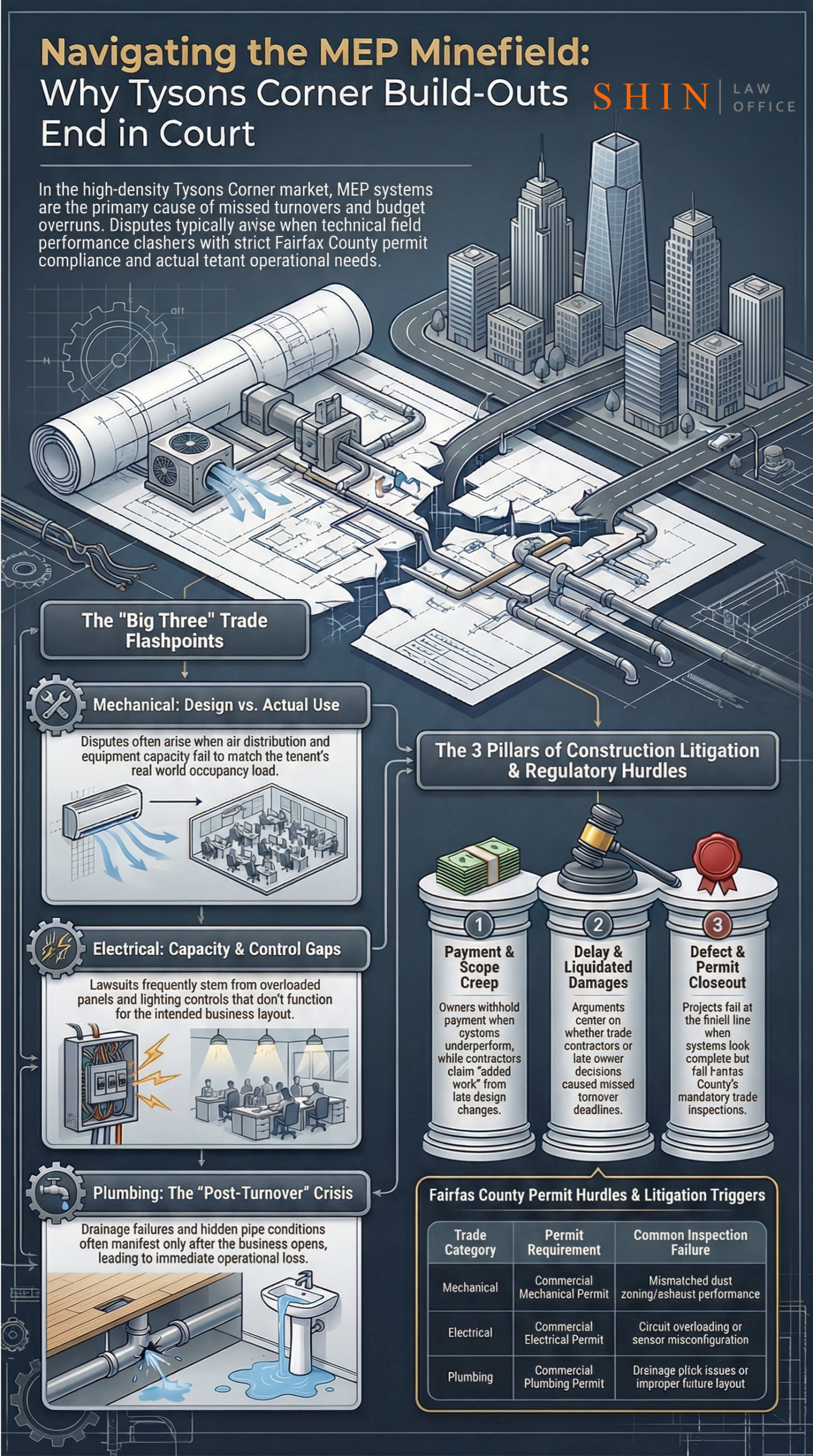
Mechanical fights usually come from one basic problem. The tenant expects the space to feel comfortable and operate normally. The contractor says the system installed matches the plans. The owner or tenant says the installed system does not match the space’s actual use.
Common mechanical build-out issues include air distribution that does not match the new layout, existing heating and cooling equipment that cannot support the tenant’s use, exhaust and ventilation work that is wrong or incomplete, and condensate drainage problems. Each of these can produce payment disputes, delay claims, and defect litigation in Fairfax County courts.
Electrical Disputes in Tysons Corner Build Outs
Electrical disputes are some of the sharpest on commercial jobs because tenants notice them right away. Lights fail. Breakers trip. Equipment will not run. Data rooms run hot. Signs do not energize. Access control and life safety interfaces do not finish cleanly.
Common electrical issues include service or panel capacity that does not support the tenant load, lighting and controls that do not match the intended use, dedicated circuits that are missing or wrong, and finish trim-out that looks complete but leaves testing and coordination unfinished.
Plumbing Disputes in Tysons Corner Build Outs
Plumbing fights tend to escalate quickly because they affect sanitation, public use, food service, drainage, and water damage risk. Common plumbing issues include restroom and fixture work that does not match the approved plan, drainage problems that show up only after the space opens, water line routing or fixture connection problems, and hidden plumbing conditions that blow up the schedule and price.
Where These Trade Disputes Usually Turn Into Lawsuits
Mechanical, electrical, and plumbing claims usually harden into litigation in four places: the first is payment withheld because the system is not performing or passing inspection; the second is delay, where the owner says the trade contractor slowed the project; the third is scope, where the owner says the disputed item was included; and the fourth is defect and closeout, where the space looks done but the systems are not.
Closing Summary
In Tysons Corner commercial construction, mechanical, electrical, and plumbing disputes are where many build-out jobs either hold together or fall apart. The biggest fights usually come from air distribution that does not fit the final layout, electrical capacity that does not match the tenant load, and plumbing work that looks acceptable until the business actually opens. Add permit compliance, inspections, and a fast-moving Tysons schedule, and these trade issues can become expensive very quickly.
Part of Shin Law Office’s Northern Virginia Commercial Litigation Guide
This article connects to a broader guide on commercial contract disputes across the region. See the complete resource: When the Contract Breaks: The Northern Virginia Commercial Litigation Guide — covering B2B disputes, federal contracting, teaming agreements, construction claims, mechanic’s liens, and toxic torts across Loudoun, Fairfax, Prince William, Arlington, Clarke, and Frederick Counties.

Principal Attorney | Construction Litigation | Shin Law Office
Call 571-445-6565 or book a consultation online today.
(This article is provided for general informational purposes and does not constitute legal advice. For advice on your specific situation, consult with a licensed Virginia attorney.)
References
Fairfax County, Virginia. (n.d.). Tysons Comprehensive Plan. https://www.fairfaxcounty.gov/tysons/comprehensive-plan
Fairfax County, Virginia. (n.d.). Building and trade inspections. https://www.fairfaxcounty.gov/landdevelopment/building-and-trade-inspections