


Estate Planning for Hampton Roads Military Retirees: A Tidewater Attorney’s Guide for the Veteran Family
By Anthony I. Shin, Esq. | Shin Law Office | Notes from a Virginia Attorney on the Estate Planning Decisions That Decide What the Next Generation Inherits From a Career of Service
BOTTOM LINE UP FRONT
If you are reading this from a house in Larchmont where you settled after twenty-eight years of moves, from Croatan where you have spent the last decade since your last command tour at Oceana, from a quiet street in Yorktown after a career that spanned the Coast Guard and several reserve commands, or from anywhere across Hampton Roads where a military retirement check arrives on the first of every month, you are part of a community estimated at over 100,000 retired Sailors, Marines, airmen, soldiers, and Coast Guardsmen who chose to stay in the region after service. Estate planning for your family is more than what civilian estate planning addresses. The military pension and benefits structure that supports your family during your life has its own framework for what happens to that support after you are gone, and the planning has to coordinate the federal benefits framework with the Virginia state law framework that governs the rest of the estate.
The framework includes the Survivor Benefit Plan (SBP) under 10 U.S.C. §§ 1447 et seq., which determines whether your military pension continues to your spouse after your death. Dependency and Indemnity Compensation (DIC) under 38 U.S.C. § 1310, which provides a tax-free monthly payment to surviving spouses when the death is connected to military service. TRICARE for Life and the spouse’s continued coverage. The DD Form 93 (Record of Emergency Data) and Servicemembers’ Group Life Insurance (SGLI) or Veterans’ Group Life Insurance (VGLI) beneficiary designations. USFSPA pension division coordination if you have ever been divorced. The various other Veterans Affairs benefits for surviving family members. Each of these elements has its own rules, beneficiary designation procedures, and coordination requirements. None of them are covered automatically by a standard will.
Whether you are a recent retiree, a long-retired veteran reviewing a plan that needs updating, or a surviving spouse trying to understand how the benefits framework works after a recent loss, your case deserves a Virginia attorney who handles military retiree estate planning. Call Shin Law Office at 571-445-6565.
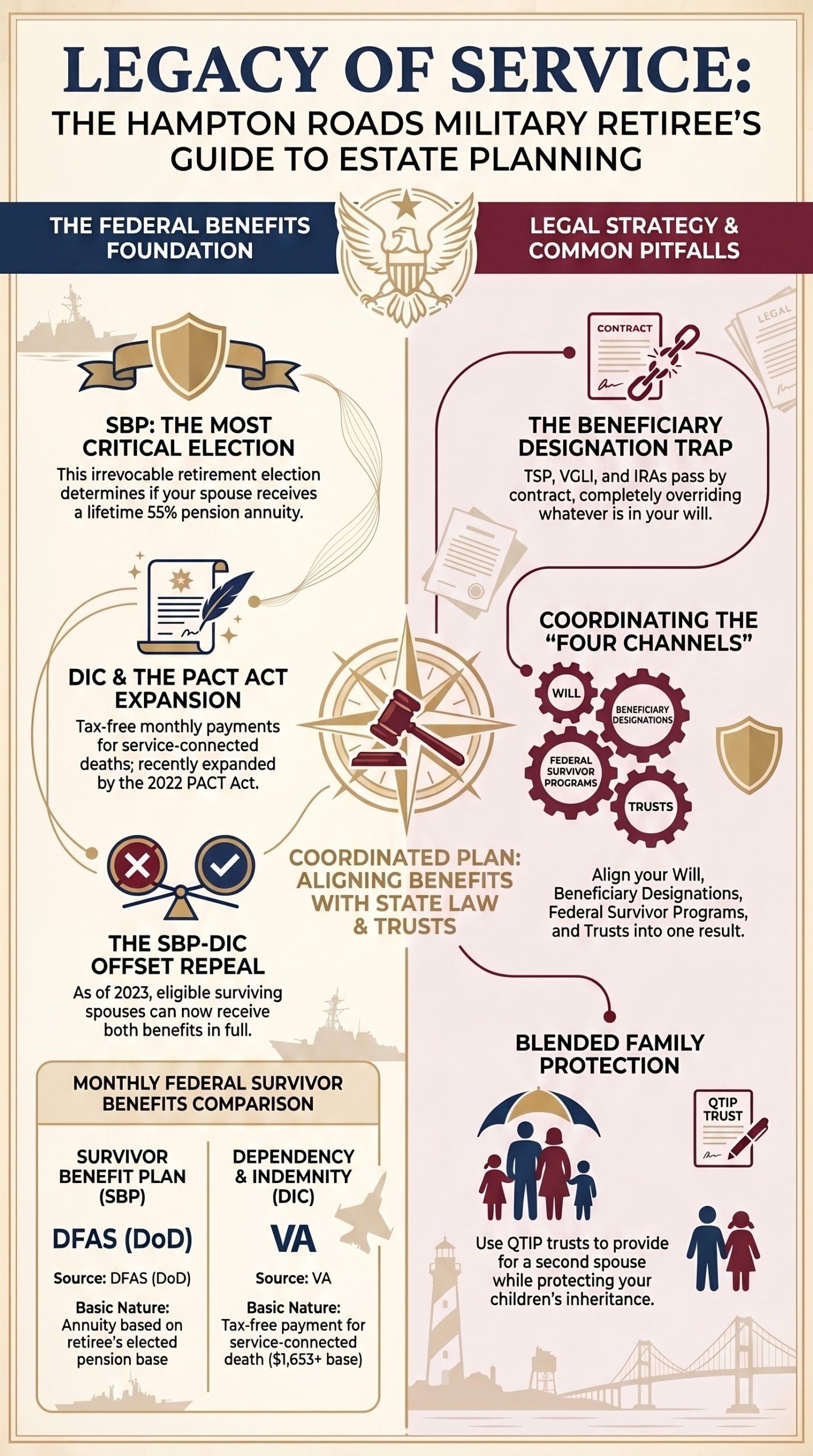
Table of Contents
- The Master Chief Who Retired Without an SBP Election
- The Hampton Roads Military Retiree Population and Why It Matters
- The Survivor Benefit Plan: The Most Important Election You Already Made
- VA Benefits for Surviving Spouses: DIC and the Other Programs
- TRICARE for Life and the Spouse’s Healthcare
- Beneficiary Designations: DD Form 93, SGLI, VGLI, TSP, and the Rest
- USFSPA, Former Spouse Issues, and Second Marriage Planning
- Coordinating the Federal Benefits Framework With Virginia Estate Planning
- What I Tell Hampton Roads Military Retiree Families in the First Meeting
- Summary
- Frequently Asked Questions
- References
Chapter 1: The Master Chief Who Retired Without an SBP Election
She came to my office on a Wednesday morning. She was sixty-two. Her husband had retired as a Master Chief Petty Officer six years earlier after thirty years in the surface fleet, most of them at Naval Station Norfolk. He had died ten weeks before she came in. Stage four pancreatic cancer, diagnosed in February, was gone by May. She brought a banker’s box full of paperwork she could find, including his 2018 retirement packet, his DD-214, the death certificate, and the letters she had received from DFAS, the VA, TRICARE, and other agencies in the weeks since.
She was there because the DFAS letter she had received that week informed her that the retirement pay deposits would stop with the next payment cycle. She had thought there was a survivor benefit. She had thought she would receive something continuing each month. The retirement officer at the base had told her husband at retirement that he could decline the SBP if he wanted, that the cost would reduce his retired pay by about 6%, and that they could buy life insurance with the difference. He had thought the math worked better with the life insurance. He had bought a $250,000 term policy that had expired five years before he died. He had not bought a replacement. The SBP election had declined at retirement, and the decline was irrevocable. The DFAS check that had been arriving every month for six years was about to stop, and there was no continuing benefit to replace it.
I told her what I tell every Hampton Roads surviving spouse who walks in with a similar story, which is more often than I would like. The SBP decline at retirement is essentially permanent. The decision he made in 2018 cannot be reversed now. There are some narrow circumstances where SBP elections can be reopened, but these are not among them. The DIC benefit from VA may be available because his cancer might qualify as service-connected if he had certain exposure history (presumptive service connection for various cancers based on Vietnam-era service, post-1991 Gulf War service, certain toxic exposure, or specific duty assignments), but that is a separate VA application process and not automatic. TRICARE coverage for her would convert to TRICARE for Life when she reached 65, but the next several years she would need to navigate an interim coverage situation. The estate side of the picture, his will and the assets in the joint accounts and the house, was relatively straightforward, but the income side of the picture had a hole in it that no estate planning could fully fill.
I helped her work through what we could. We filed the DIC application based on what we could document about his service-related exposures and built the strongest case for service connection that the records supported. We worked through the joint account access and the basic probate of his will. We coordinated her conversion to TRICARE for Life when the time came and identified interim coverage options. We rebuilt her financial picture based on what she actually had, rather than what she thought she had. The DIC application took most of a year to be approved, and when it was, the monthly payment partially compensated for the lost pension. She was going to be okay financially, but in a way different from what either she or her husband had assumed when he declined the SBP six years earlier.
The story is not unusual. Hampton Roads has tens of thousands of military retirees who made SBP elections years or decades ago. Many of those elections were made with limited information, under time pressure at retirement, with assumptions about replacement coverage that may not have held up. The election cannot generally be revisited later. Estate planning for military retirees has to start from where the SBP election actually is, not from where it should have been. For a broader background on Hampton Roads estate planning, see our Hampton Roads estate planning cornerstone, and for background on the related divorce framework that affects USFSPA-divided pensions and SBP elections, our Hampton Roads divorce cornerstone.
Chapter 2: The Hampton Roads Military Retiree Population and Why It Matters
Hampton Roads holds one of the largest concentrations of military retirees in the United States. The reason is simple: decades of careers at the regional installations have produced a substantial retired population that did not move when their service ended.
The Source Installations
Naval Station Norfolk (the world’s largest naval base) anchors the regional Navy retiree population. NAS Oceana (the East Coast master jet base) supports the Strike Fighter aviator and aircrew retiree community. JEB Little Creek-Fort Story supports the Naval Special Warfare and amphibious force retirees. Joint Base Langley-Eustis supports retired Air Force personnel from the Langley side and retired Army personnel from the Eustis side. Naval Weapons Station Yorktown and the Coast Guard Training Center Yorktown produce their respective retiree populations on the Peninsula. Norfolk Naval Shipyard, while primarily a federal civilian workforce, also has a substantial military retiree population among its support and security functions. Smaller installations and the various Reserve and Guard units add to the total.
Where the Retirees Live
Hampton Roads military retirees are spread across the region, with concentrations that match career and rank patterns. Senior officers often gravitate to Larchmont, Lochhaven, Croatan, Birdneck Point, Princess Anne, Chesopeian Colony, or established Williamsburg-area retirement communities. Mid-career and senior enlisted retirees often live in Aragona, Kempsville, Western Branch in Chesapeake, Cradock or Park View in Portsmouth, or the suburban areas of York County and James City County. Junior enlisted retirees and disabled veterans often live in more affordable neighborhoods across the region. The pattern is not strict but reflects the housing market and the typical career arc.
The Reasons for Staying
Hampton Roads attracts and retains military retirees for predictable reasons. The infrastructure of military retirement (Naval Station Norfolk’s commissary, Navy Exchange, MWR facilities, the regional medical facilities at Portsmouth Naval Medical Center and the Hampton VA Medical Center, and the various base-specific resources) is concentrated here. The climate is mild. The cost of living, while not low, is more reasonable than other coastal markets like the Northeast or California. The community of fellow veterans is substantial. Many retirees met their spouses, raised their children, or built civilian careers here during their service years and have ties that make staying the natural choice.
The Estate Planning Implications
The concentration produces specific estate planning implications. The substantive law applicable is Virginia law for the personal estate. The federal military benefits framework overlays it for the military-derived assets and benefits. Coordination between the two is the essence of military retiree estate planning. The volume of cases means that competent counsel familiar with the federal-state interaction is available, but it also means that the wrong choices made early in retirement (most importantly the SBP election) cannot be revisited later when the family begins thinking seriously about estate planning.
Chapter 3: The Survivor Benefit Plan: The Most Important Election You Already Made
The Survivor Benefit Plan (SBP) is the most important benefit decision a military retiree makes, and it is made at retirement, often before the retiree fully appreciates its long-term significance. Understanding the framework is essential for any estate planning conversation that involves a military retiree.
What SBP Is
SBP under 10 U.S.C. §§ 1447 et seq. is a survivor annuity program for military retirees. The retiree elects to participate at retirement, designating a beneficiary (typically a spouse, sometimes children, or, in some cases, a former spouse). The retiree pays a monthly premium, deducted from retirement pay, for the life of the SBP election. After the retiree’s death, the designated beneficiary receives a continuing monthly annuity equal to a percentage (up to 55 percent) of the retiree’s selected base amount. The annuity continues for the beneficiary’s life (in the case of a spouse beneficiary) or until specific terminating events.
The Cost Structure
SBP costs the retiree approximately 6.5 percent of the elected base amount each month, deducted from retired pay. The premium is paid until the retiree reaches the paid-up status (after 360 months of premium payments and the retiree has reached age 70), at which point the SBP is paid up and no further premiums are due, with the survivor annuity remaining in effect. The cost over the retiree’s lifetime can be substantial, but the value of the continuing annuity to the survivor is also substantial.
The Election at Retirement
SBP elections are made at retirement and are typically irrevocable thereafter. A married retiree who declines SBP must obtain spousal consent in writing, which means the spouse signs an acknowledgment of the decline. Many spouses sign without fully understanding the implications. The retiree can also elect reduced coverage levels (a smaller base amount and a smaller percentage), which produce correspondingly lower premiums but also smaller survivor benefits. The election decisions made at retirement are critical and benefit from careful thought rather than the time pressure of the retirement transition.
Limited Opportunities to Change
SBP elections can be modified in narrow circumstances. The 2002 NDAA created an open enrollment season that allowed certain retirees who had previously declined SBP to elect coverage. There have been other narrow open enrollment periods. Major life events (marriage, divorce, or the death of a beneficiary) trigger limited windows for changes. Outside these narrow opportunities, the SBP election made at retirement governs the retiree’s situation for life.
The Former Spouse SBP Election
For divorced retirees, SBP can be elected for the former spouse rather than for a current spouse. The former spouse’s SBP election is sometimes part of a divorce settlement and sometimes ordered by the court. The election has specific procedural requirements, including a deemed election filing under 10 U.S.C. § 1450(f)(3) within one year of the divorce or court order. Missing the deemed election deadline can result in loss of the SBP coverage for the former spouse. For retirees with prior divorces, this is one of the most common and most costly errors in the SBP framework.
SBP-DIC Offset and the Recent Repeal
For decades, SBP and DIC could not both be paid in full to a surviving spouse: the SBP was reduced by the amount of the DIC payment in what was called the SBP-DIC offset (the widow’s tax). Congress repealed the offset in the 2020 NDAA, with phased implementation completed in 2023. As of 2023, surviving spouses can receive both SBP and DIC in full. For surviving spouses in Hampton Roads receiving DIC, this change produced substantial monthly income increases that were sometimes overlooked or improperly claimed. Survivors should verify with DFAS that they are receiving the correct post-repeal amounts.
Estate Planning Implications
For estate planning purposes, the SBP coverage (or lack thereof) determines the income picture for the surviving spouse. A retiree with SBP for the spouse can plan around continuing income for the spouse’s lifetime. A retiree without SBP must plan to replace the lost pension income through other means: life insurance, sufficient savings to support the spouse without the pension, or other arrangements. The estate plan has to start from the actual SBP situation and work forward.
Chapter 4: VA Benefits for Surviving Spouses: DIC and the Other Programs
The Department of Veterans Affairs administers several benefit programs for surviving spouses and family members of deceased veterans. These programs are separate from the military retirement and SBP framework administered by DFAS, and the eligibility rules are technical.
Dependency and Indemnity Compensation (DIC)
DIC under 38 U.S.C. § 1310 is a tax-free monthly payment paid to surviving spouses, parents, and children when the veteran’s death is service-connected. The basic 2025 monthly DIC rate for a surviving spouse is approximately $1,653, with additional amounts for children, dependent parents, housebound or aid-and-attendance status, and certain other circumstances. DIC eligibility requires either that the death was caused by a service-connected condition, or that the veteran was rated 100 percent disabled for service-connected conditions for specific time periods before death (10 years for most conditions, with shorter periods in certain circumstances).
Service Connection for Death
For Hampton Roads veterans whose deaths from cancer, heart disease, or other conditions might be service-connected, the DIC application requires establishing the service connection. Presumptive service connection rules under various statutes (Agent Orange exposure for Vietnam veterans, Gulf War illness presumptive conditions, post-9/11 toxic exposure under the PACT Act of 2022) make the analysis easier in some cases. The PACT Act, in particular, substantially expanded presumptive service connection for veterans with toxic exposure, including burn pit exposure, in deployments from the Gulf War forward. For a Hampton Roads Navy veteran whose service included relevant deployments, presumptive service connection may apply to conditions that previously required individual proof. The DIC application should evaluate all available presumptive frameworks.
Survivors Pension
Survivors’ Pension under 38 U.S.C. § 1541 is a needs-based monthly payment for surviving spouses and unmarried children of deceased wartime veterans whose income falls below specified thresholds. The benefit is means-tested with both income and asset limits. Survivors Pension is less commonly applicable than DIC because most Hampton Roads military retiree surviving spouses have income from the retiree’s pension, SBP, or Social Security that exceeds the thresholds; however, for surviving spouses with limited income, Survivors Pension can be meaningful.
VA Burial Benefits
The VA provides burial benefits, including burial allowances, plot allowances, transportation reimbursement, and the provision of a headstone or marker. Burial in a national cemetery (including Hampton National Cemetery, the regional national cemetery option) is available at no cost to eligible veterans and certain family members. The Department of Veterans Affairs Norfolk Regional Office handles burial benefit claims for Virginia.
CHAMPVA
CHAMPVA (the Civilian Health and Medical Program of the Department of Veterans Affairs) under 38 U.S.C. § 1781 provides healthcare coverage for the spouses and children of certain disabled or deceased veterans who are not eligible for TRICARE. CHAMPVA is most relevant for surviving spouses of veterans who died from service-connected conditions or were rated permanently and totally disabled for service-connected conditions. The program is separate from TRICARE and serves a different population.
Education Benefits for Survivors
The VA Survivors’ and Dependents’ Educational Assistance program (DEA, also known as Chapter 35) under 38 U.S.C. § 3500 et seq. provides education benefits to dependents of veterans who died from service-connected causes or are permanently and totally disabled. For Hampton Roads families with children or surviving spouses pursuing education, DEA can be a meaningful benefit. The Survivor Benefit Plan transfer provisions for dependents, subject to specific eligibility criteria, provide an alternative benefit framework in certain circumstances.
Chapter 5: TRICARE for Life and the Spouse’s Healthcare
Healthcare coverage is a substantial component of military retiree estate planning, both for the retiree and for the spouse. The framework continues into widowhood with specific rules.
TRICARE for Life
TRICARE for Life (TFL) is the TRICARE program that supplements Medicare for military retirees and eligible family members age 65 and over. TFL acts as a Medicare wraparound: Medicare is the primary payer, and TFL pays most of what Medicare does not cover. Eligibility requires Medicare Part A enrollment (free for most beneficiaries based on work history) and Medicare Part B enrollment (premium-based, with income-related adjustments). For Hampton Roads military retirees and their spouses age 65 and over, TFL combined with Medicare provides substantial healthcare coverage at relatively modest cost.
Surviving Spouse TRICARE
Surviving spouses of deceased military retirees retain TRICARE eligibility, generally continuing the same TRICARE program (TRICARE Prime, TRICARE Select, or TRICARE for Life, depending on age and other factors) that they had during the retiree’s life. The surviving spouse enrollment is processed through DEERS (Defense Enrollment Eligibility Reporting System) and is updated when the surviving spouse provides a death certificate. The coverage continues regardless of remarriage in some categories and ends on remarriage in others, depending on the specific TRICARE program and the surviving spouse’s age.
Pre-65 Surviving Spouse Coverage
For surviving spouses under 65, TRICARE Select or TRICARE Prime continues until Medicare eligibility at 65, at which point they convert to TRICARE for Life. The pre-65 surviving spouse coverage is generally similar to retiree-family TRICARE with copays and enrollment fees that vary by program.
Children’s TRICARE
Children of deceased military retirees retain TRICARE coverage to age 21 (or 23 if enrolled full-time in college), with continued coverage available through TRICARE Young Adult (a premium-based program) up to age 26.
Coordination With CHAMPVA
For surviving spouses eligible for both TRICARE (because the retiree was a military retiree) and CHAMPVA (because the death was service-connected), the family must choose between the programs. The choice depends on the specific medical situation, the providers used, and the cost structures. Counsel can help analyze the options.
Long-Term Care
TRICARE does not cover most long-term custodial care. For Hampton Roads military retirees facing potential long-term care needs, planning has to include either long-term care insurance (purchased typically before age 70, while still insurable), Medicaid planning (which has its own framework with five-year look-back rules under 42 U.S.C. § 1396p(c)), VA Aid and Attendance for veterans needing aid for daily activities, or self-funding from accumulated assets. The Aid and Attendance benefit under 38 U.S.C. § 1521 in particular can provide meaningful monthly support for veterans needing assistance with activities of daily living.
Chapter 6: Beneficiary Designations: DD Form 93, SGLI, VGLI, TSP, and the Rest
Military retirees have a complex set of beneficiary designations across multiple government and private systems. The designations determine where assets go at death regardless of what the will says, and outdated designations are one of the most common estate planning failures.
DD Form 93 (Record of Emergency Data)
DD Form 93 is the Department of Defense form that records emergency contact information and unpaid pay/death gratuity beneficiaries for active duty service members. While DD Form 93 is primarily an active duty document, the most recent designation made before retirement may continue to govern certain unpaid pay items and the death gratuity if the retiree’s death occurs in narrow circumstances within the immediate post-retirement period. For most retirees, DD Form 93 is less directly relevant, but it should be reviewed as part of a comprehensive estate planning analysis.
SGLI and VGLI
Servicemembers’ Group Life Insurance (SGLI) is the active duty group life insurance program. At separation or retirement, eligible service members can convert SGLI to Veterans’ Group Life Insurance (VGLI), which continues coverage at retiree-paid premiums. VGLI maximum coverage is currently $500,000. Beneficiary designations on VGLI are made through the VA and should be reviewed and updated periodically. For Hampton Roads retirees who maintained VGLI coverage, the policy is part of the family’s life insurance protection.
Thrift Savings Plan
The Thrift Savings Plan beneficiary designation is made on TSP Form 3 directly with the Federal Retirement Thrift Investment Board (FRTIB). The designation is not affected by the will. TSP balances for Hampton Roads military retirees can be substantial, particularly for retirees who participated in the Blended Retirement System (BRS) with employer matching contributions. The post-death TSP rules differ for spouse and non-spouse beneficiaries: spousal beneficiaries have broader options, including continuing the account as their own, while non-spouse beneficiaries face more restrictive distribution rules.
SBP Beneficiary
The SBP beneficiary designation made at retirement governs who receives the SBP annuity after the retiree’s death. Changes to the SBP beneficiary are limited to specific life events and procedural windows. For retirees who married or divorced after retirement, the SBP beneficiary status should be confirmed and updated where the rules allow.
IRA and Civilian Retirement Beneficiaries
Many Hampton Roads military retirees also have civilian retirement accounts: rollover IRAs from prior civilian employment before military service, second-career employer retirement plans (401(k), 403(b) for retirees who took healthcare or education jobs), and other accounts. Each has its own beneficiary designation that must be coordinated with the overall plan. Federal law, under the Supreme Court’s Egelhoff v. Egelhoff Sr. decision (2001), preempts state laws on beneficiary designations, meaning that outdated designations on these accounts pay the named beneficiary regardless of subsequent divorces or remarriages.
Bank, Brokerage, and Other Accounts
Bank accounts, brokerage accounts, and similar civilian accounts may have transfer-on-death (TOD) or payable-on-death (POD) beneficiary designations. These designations pass property by contract outside probate, similar to retirement account designations. They should be reviewed for consistency with the overall plan.
The Comprehensive Beneficiary Review
A comprehensive beneficiary designation review is one of the most valuable parts of a military retiree’s estate planning. The review walks through every account, every policy, every benefit program, and every contractual designation, confirms the current beneficiary, and updates designations that no longer reflect the family. The work is mechanical but essential. The most common error in military retiree estate planning is not missing some advanced technique. It has an outdated beneficiary designation that pays the wrong person.
Chapter 7: USFSPA, Former Spouse Issues, and Second Marriage Planning
Military retirees with prior marriages have additional planning complexities. The Uniformed Services Former Spouses’ Protection Act (USFSPA) framework, the SBP former-spouse election rules, and other coordination issues require attention.
USFSPA Pension Division Continuing
For retirees who divorced and whose pensions were divided under USFSPA at 10 U.S.C. § 1408, the former spouse’s share of the pension continues to be paid by DFAS during the retiree’s life. The retiree’s death affects the situation depending on whether SBP for the former spouse was elected at the time of divorce or within the deemed election window. With former spouse SBP, the former spouse’s share continues as a survivor annuity. Without a former spouse’s SBP, the former spouse’s share ends at the retiree’s death. For more on USFSPA generally, see our companion guide on USFSPA military pension division.
Former Spouse SBP Coordination
For retirees with former spouse SBP coverage, the SBP slot is taken, and a current spouse cannot be added without specific changes. This produces planning issues for second marriages: the second spouse may not be covered by SBP if the SBP slot is allocated to the former spouse. The estate plan must address the second spouse’s income picture through alternative means, such as life insurance, separate property held in trust, or other arrangements.
QTIP Trusts for Blended Family Planning
Qualified Terminable Interest Property (QTIP) trusts are the standard tool for blended family planning involving prior marriages and children from those marriages. A QTIP trust provides the surviving spouse with income for life, with the remainder passing to the deceased spouse’s children at the surviving spouse’s death. The QTIP qualifies for the marital deduction at the first death, deferring estate tax until the second death, while ensuring that the deceased spouse’s children eventually receive the remainder. For Hampton Roads military retirees in second marriages with children from a prior marriage, QTIP trust planning is often the centerpiece of the estate plan.
Gray Divorce and Estate Planning Coordination
For retirees who are themselves going through or have recently completed a divorce, the estate planning has to coordinate with the divorce work. Beneficiary designations need to be updated. Wills typically need full redrafting. The SBP picture may need attention if a deemed election is required. The trust structure may need to change. For more on late-life divorce, see our companion guide on Hampton Roads gray divorce.
Children From Prior Marriages
Children from prior marriages have specific estate planning implications. Default dispositive provisions favoring the current spouse may not protect those children’s interests. Trust-based planning, specific bequests, and life insurance arrangements can ensure that children from prior marriages receive appropriate provision. Open communication during planning helps prevent misunderstandings and disputes after the retiree’s death.
Chapter 8: Coordinating the Federal Benefits Framework With Virginia Estate Planning
The federal military benefits framework and the Virginia estate planning framework operate in parallel rather than as a single integrated system. The estate planning work is largely about coordinating the two so that they produce the intended overall result.
What Goes Through the Will
The will under Va. Code §§ 64.2-401 et seq. governs probate property: real estate held in the retiree’s individual name, personal property, bank accounts without TOD designations, and similar assets. For most Hampton Roads military retirees, the probate estate is a substantial but not dominant portion of the overall picture. The will directs distribution of these probate assets, names the executor, names guardians for any minor children, and addresses related dispositive matters.
What Goes Through Beneficiary Designations
Retirement accounts (TSP, IRAs, civilian 401(k) and 403(b) plans), life insurance (SGLI/VGLI, civilian policies), and accounts with TOD or POD designations pass according to the beneficiary designations rather than according to the will. For most Hampton Roads military retirees, the beneficiary-designation portion of the estate is the largest portion of the overall picture, sometimes by a substantial margin.
What Goes Through Federal Survivor Benefit Programs
SBP, DIC, Survivors Pension, and the various other federal survivor benefit programs operate on their own application and approval processes. The will does not control these. The retiree’s prior elections and the surviving spouse’s eligibility under federal rules govern.
What Goes Through Trust
For retirees with revocable living trusts, assets transferred to the trust during life pass according to the trust provisions. The trust can hold real estate, investment accounts, business interests, and similar assets. Retirement accounts generally do not transfer to a revocable living trust during life (because the transfer would be a taxable event), but they can name the trust as a beneficiary at death in some situations. The interaction between trust and retirement account planning is technical.
The Coordinated Plan
The coordinated plan ensures that all four channels (will, beneficiary designations, federal survivor programs, and trust) work together to produce the intended overall result. A common failure mode is when the will provides for one disposition and the beneficiary designations provide for a different one, with the result that the actual distribution at death does not match what the retiree thought the plan provided. Coordination is what prevents this failure.
Federal Estate Tax Considerations
Federal estate tax under 26 U.S.C. §§ 2001 et seq. applies to estates exceeding the unified credit exemption ($13.99 million per person for 2025, scheduled to drop substantially when the 2017 Tax Cuts and Jobs Act provisions sunset in 2026 absent Congressional action). For most Hampton Roads military retirees, the estate is below the federal exemption and federal estate tax is not a current concern. For retirees with substantial estates, particularly those approaching or exceeding the post-sunset exemption levels, advanced planning techniques (SLATs, ILITs, and others) become relevant. The base estate planning still applies regardless of estate tax exposure.
Chapter 9: What I Tell Hampton Roads Military Retiree Families in the First Meeting
When a Hampton Roads military retiree family comes to my office for an estate planning consultation, I tell them six things in the first meeting.
First, the SBP picture is what it is. Whatever election was made at retirement governs the situation now. We work from where the SBP actually stands, not from where we wish it stood. If SBP is declined, we plan to replace the pension income at the retiree’s death through other means. If SBP were elected, we plan around the continuing pension annuity for the surviving spouse. The SBP-DIC offset repeal in 2023 may have resulted in changes that are not reflected in the family’s understanding, and we will verify that the current payment situation aligns with the rules as they now stand.
Second, we will inventory the federal benefits picture in its entirety. SBP. VA disability rating. DIC eligibility analysis. TRICARE for Life status. CHAMPVA if applicable. VGLI. TSP. The various other benefits. We need the complete picture before we can plan around it.
Third, we will conduct a comprehensive beneficiary designation review. Every account. Every policy. Every contractual designation. The most common estate planning failure for military retirees is an outdated beneficiary designation, and the solution is review.
Fourth, we will address the foundational documents. Will. Durable power of attorney. Advance medical directive. HIPAA authorizations. For retirees in their sixties and beyond, these documents need to be current and reflect the actual family situation rather than relying on documents drafted decades ago.
Fifth, we will consider whether trust-based planning fits the situation. For Hampton Roads military retirees with simple Virginia-only assets and basic distribution preferences, a will plus beneficiary designations may be sufficient. For retirees with out-of-state property, blended family situations, complex distribution preferences, or substantial estates, a revocable living trust may add value. The decision depends on the specifics.
Sixth, we are going to plan for the specific situations that affect this family. Long-term care. Adult children with specific needs. Charitable giving. Business succession if applicable. The plan should reflect the family that actually exists rather than a generic template. For more on the broader Hampton Roads estate planning framework, see our Hampton Roads estate planning cornerstone.
Summary
Hampton Roads has one of the largest concentrations of military retirees in the United States, including those from Naval Station Norfolk, NAS Oceana, JEB Little Creek-Fort Story, Joint Base Langley-Eustis, Naval Weapons Station Yorktown, the Coast Guard Training Center Yorktown, and Norfolk Naval Shipyard. Estate planning for these families requires coordination of Virginia substantive law (Va. Code Title 64.2 framework for wills, trusts, powers of attorney, and advance medical directives) with the federal military benefits framework (Survivor Benefit Plan under 10 U.S.C. §§ 1447 et seq., Dependency and Indemnity Compensation under 38 U.S.C. § 1310, TRICARE for Life, CHAMPVA, VA Survivors Pension, VGLI, TSP, the various other VA benefits for surviving family members).
The SBP election made at retirement is essentially irrevocable and is the central determinant of the surviving spouse’s income picture after the retiree’s death. The 2020 NDAA repeal of the SBP-DIC offset, fully implemented in 2023, allows surviving spouses to receive both SBP and DIC in full where eligible. The PACT Act of 2022 substantially expanded presumptive service connection for veterans with toxic exposure including burn pit exposure, broadening DIC eligibility for surviving spouses of Hampton Roads veterans whose deaths resulted from covered conditions. Beneficiary designations on TSP, VGLI, IRAs, life insurance, and other accounts pass property by contract outside probate, and outdated designations are the most common source of estate planning failures.
For retirees with prior marriages, USFSPA pension division continuation, former spouse SBP coordination, and QTIP trust planning for blended families address the additional complexity. Done correctly, a Hampton Roads military retiree estate plan provides for the family the way the retiree actually intends, coordinates the federal benefits framework with the Virginia substantive law, addresses long-term care and other specialized situations, and continues to function across the years and decades for which it is designed.
Frequently Asked Questions
My spouse retired without electing SBP. Is there any way to fix that now?
Generally no. SBP elections at retirement are typically irrevocable. There have been narrow open enrollment periods (the 2002 NDAA created one, and others have followed) that allowed certain retirees to elect coverage retroactively, but no current open enrollment is available. Major life events (marriage, divorce, or the death of a beneficiary) can trigger limited windows for change, but these windows are narrow. The estate plan has to start from where the SBP actually stands and address the loss of pension income at death through other means.
My husband died from cancer. Can I get DIC?
Possibly. DIC under 38 U.S.C. § 1310 requires that the death be service-connected. Cancer can qualify if the cancer is on the VA’s presumptive list for the veteran’s specific service period (Vietnam-era exposure to Agent Orange covers many cancers, post-9/11 toxic exposure under the PACT Act covers others, Gulf War service has its own presumptive list). Even if a presumption doesn’t apply directly, an individual service connection can be established with appropriate medical and service documentation. The DIC application is a VA process and benefits from counsel familiar with veterans’ benefit law and the recent PACT Act expansions.
What is the SBP-DIC offset and what changed in 2023?
For decades, surviving spouses receiving both SBP (from DFAS for the deceased retiree’s pension) and DIC (from the VA for service-connected death) had their SBP reduced by the DIC amount. This was called the widow’s tax. The 2020 NDAA repealed the offset with phased implementation completed in 2023. As of 2023, surviving spouses can receive both benefits in full. Surviving spouses receiving DIC who haven’t verified that their SBP has been restored should contact DFAS to confirm they are receiving the correct post-repeal amount.
My TSP beneficiary is my ex-spouse from a divorce 12 years ago. Will the divorce automatically have changed that?
No. Federal law under the Supreme Court’s Egelhoff v. Egelhoff Sr. decision (2001) preempts state laws that attempt to revoke beneficiary designations on divorce. The TSP designation continues until you affirmatively change it through TSP Form 3 directly with the Federal Retirement Thrift Investment Board. This is one of the most common and costly errors in post-divorce estate plans. The same principle applies to IRA, 401(k), 403(b), and life insurance beneficiary designations.
I am a retired O-5. Will my family face federal estate tax?
Probably not. The federal estate tax exemption for 2025 is $13.99 million per person, and most O-5 retirees have estates well below this threshold even when the SBP, retirement accounts, real estate, and other assets are combined. The 2026 sunset is scheduled to drop the exemption to approximately $7 million per person absent Congressional action, which still places most O-5 retiree estates below the threshold. For O-6 retirees with substantial second-career civilian success, business interests, or substantial real estate appreciation, the analysis becomes more individualized.
My current wife is my second wife. My first wife has former spouse SBP. Can I add my current wife to SBP?
No, generally. The SBP slot is one-at-a-time, and a former spouse SBP election ordered by a court or made voluntarily takes the slot. Your current wife cannot be added to SBP while the former spouse coverage remains in effect. The estate plan has to address the current wife’s income picture through alternative means: life insurance, separate property held in trust, or other arrangements. This is one of the most common second-marriage planning issues for Hampton Roads military retirees.
Will TRICARE cover long-term care?
Generally not. TRICARE does not cover most long-term custodial care including nursing home care for non-medical reasons. For Hampton Roads military retirees facing potential long-term care needs, planning has to include long-term care insurance (purchased typically before age 70 while still insurable), Medicaid planning with the five-year look-back rules under 42 U.S.C. § 1396p(c), VA Aid and Attendance for veterans needing aid for daily activities under 38 U.S.C. § 1521, or self-funding from accumulated assets. Counsel can help analyze the available frameworks.
My will is from before I retired. Does it need updating?
Almost certainly. A will from active duty years rarely reflects the post-retirement family situation accurately. The named executor may be deceased or no longer appropriate. Contingent beneficiaries may not match the current family. The dispositive provisions may not reflect changes in assets and circumstances. Beneficiary designations on retirement accounts and insurance may not coordinate with the will. A periodic review of estate planning documents every three to five years and after major life events is the standard practice. For documents from a decade or more ago, full redrafting is usually warranted.
My adult son is going through difficult times. Can I provide for him without giving him a lump sum?
Yes. Trust-based planning provides tools to support adult children with specific challenges (substance abuse, mental health concerns, financial irresponsibility, marriage instability) without direct distribution of large lump sums. Discretionary trusts with independent trustees, age-based or milestone-based distribution schedules, and other structured approaches allow you to provide for your son while protecting both the assets and your son from outcomes that direct distribution might produce. The drafting balances protection with respect for autonomy and is part of why trust-based planning provides flexibility that direct bequests cannot.
When should I contact a Hampton Roads military retiree estate planning attorney?
As soon as possible after retirement, with periodic reviews thereafter. Many retirees defer estate planning for years or decades, only to discover later that beneficiary designations are outdated, foundational documents are stale, or important federal benefits are not properly coordinated with the rest of the plan. Early engagement allows the planning to keep pace with the family situation. For surviving spouses navigating the post-death benefits picture, early engagement is also valuable to ensure that DIC, SBP, TRICARE, and the various other benefits are properly claimed and processed.
Hampton Roads Military Retiree Estate Planning Attorney
Whether you are a recently retired Sailor, a long-retired naval aviator, a special warfare retiree, an Air Force or Army retiree from Joint Base Langley-Eustis, a Coast Guard retiree, or the surviving spouse of any of these, your estate plan deserves a Virginia attorney who handles the federal military benefits framework alongside the Virginia state law framework with the technical attention these cases require.
Tough cases require tough attorneys. Shin Law Office handles military retiree estate planning, Survivor Benefit Plan coordination, DIC and VA benefits applications, TRICARE for Life integration, beneficiary designation review, blended family planning, long-term care planning, and the full range of estate matters across Hampton Roads, Northern Virginia, and the Commonwealth.
Call 571-445-6565

References
Code of Virginia. (2024). Title 64.2: Wills, Trusts, and Fiduciaries. Virginia General Assembly. https://law.lis.virginia.gov/vacode/title64.2/
Code of Virginia. (2024). Title 64.2, Sections 64.2-1600 et seq.: Uniform Power of Attorney Act. Virginia General Assembly. https://law.lis.virginia.gov/vacode/title64.2/chapter16/
Code of Virginia. (2024). Title 54.1, Sections 54.1-2981 et seq.: Health Care Decisions Act. Virginia General Assembly. https://law.lis.virginia.gov/vacode/title54.1/chapter29/
10 U.S.C. §§ 1447 et seq. (Survivor Benefit Plan). https://www.govinfo.gov/app/collection/uscode
10 U.S.C. § 1450(f)(3) (Former Spouse SBP deemed election). https://www.govinfo.gov/app/collection/uscode
10 U.S.C. § 1408 (Uniformed Services Former Spouses’ Protection Act). https://www.govinfo.gov/app/collection/uscode
10 U.S.C. § 1072 (TRICARE definitions). https://www.govinfo.gov/app/collection/uscode
38 U.S.C. § 1310 (Dependency and Indemnity Compensation). https://www.govinfo.gov/app/collection/uscode
38 U.S.C. § 1521 (Aid and Attendance and Housebound benefits). https://www.govinfo.gov/app/collection/uscode
38 U.S.C. § 1541 (Survivors Pension). https://www.govinfo.gov/app/collection/uscode
38 U.S.C. § 1781 (CHAMPVA). https://www.govinfo.gov/app/collection/uscode
38 U.S.C. §§ 3500 et seq. (Survivors’ and Dependents’ Educational Assistance). https://www.govinfo.gov/app/collection/uscode
42 U.S.C. § 1396p (Medicaid liens, transfers, and look-back). https://www.govinfo.gov/app/collection/uscode
26 U.S.C. §§ 2001 et seq. (Federal Estate and Gift Tax). https://www.govinfo.gov/app/collection/uscode
PACT Act, Public Law 117-168 (2022). Honoring our PACT Act. https://www.congress.gov/bill/117th-congress/senate-bill/3373
National Defense Authorization Act for Fiscal Year 2020, Public Law 116-92 (SBP-DIC offset repeal). https://www.congress.gov/bill/116th-congress/senate-bill/1790
Egelhoff v. Egelhoff Sr., 532 U.S. 141 (2001). https://www.supremecourt.gov/
Defense Finance and Accounting Service. (2024). Survivor Benefit Plan information. https://www.dfas.mil/RetiredMilitary/provide/sbp/
Department of Veterans Affairs. (2024). Dependency and Indemnity Compensation. https://www.va.gov/disability/dependency-indemnity-compensation/
Department of Veterans Affairs. (2024). VA Survivors Pension. https://www.va.gov/pension/survivors-pension/
Department of Veterans Affairs. (2024). CHAMPVA. https://www.va.gov/health-care/family-caregiver-benefits/champva/
Department of Veterans Affairs. (2024). VGLI Information. https://www.benefits.va.gov/insurance/vgli.asp
TRICARE. (2024). Survivor Benefits. https://www.tricare.mil/
Federal Retirement Thrift Investment Board. (2024). TSP Beneficiary Designations. https://www.tsp.gov/publications/
