


By Anthony I. Shin, Esq. | Shin Law Office | Notes from a Virginia Attorney on the Family Court Docket That Looks Different Than Anywhere Else in the Commonwealth
BOTTOM LINE UP FRONT
Virginia Beach family law is not the same as the one you find in Loudoun, Fairfax, or Prince William. The military presence at NAS Oceana, Joint Expeditionary Base Little Creek, Dam Neck Annex, and the proximity of Naval Station Norfolk produce a steady volume of cases governed by federal statutes that most family law attorneys rarely touch. The vacation rental economy in Sandbridge and the oceanfront produces hidden asset patterns that do not exist in inland Virginia. The seasonal hospitality workforce produces income calculation challenges that confuse judges in other jurisdictions. And the Princess Anne courthouse complex handles all of it through a court structure that splits family disputes across three different courthouses.
If you are facing a divorce, custody dispute, support modification, or protective order matter in Virginia Beach, the strategy that works in Northern Virginia or Richmond will not necessarily work for you. The court that hears your case, the assets at stake, the income calculations the judge will accept, and the federal protections that may apply to your spouse all depend on facts that are specific to this jurisdiction. This is what I have learned, and what I tell every Virginia Beach family law client.
Call Shin Law Office at 571-445-6565.
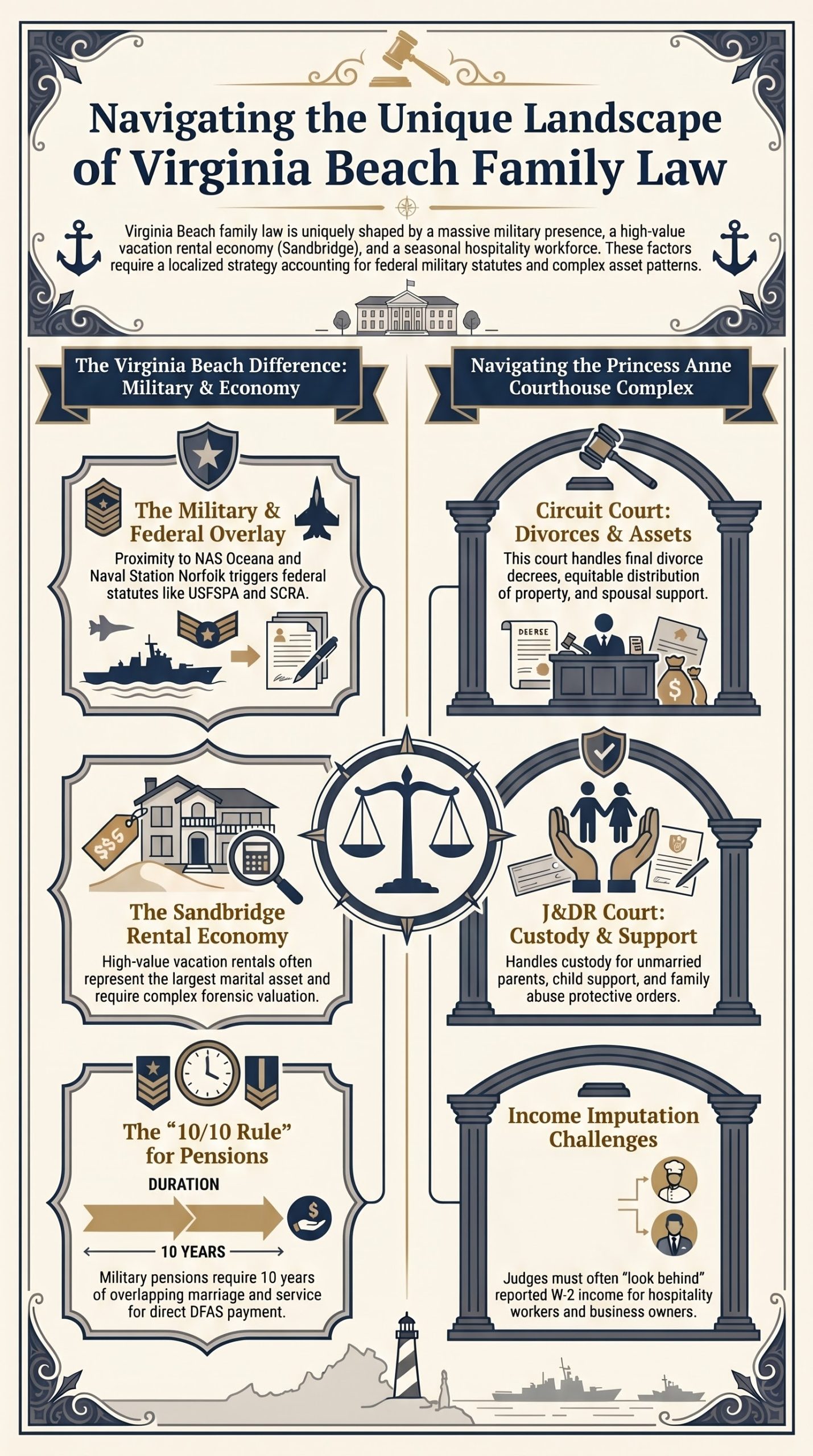
Table of Contents
- A Saturday Morning at the Princess Anne Courthouse
- How Virginia Beach’s Court System Handles Family Disputes
- The Reality of Divorce in Virginia Beach
- Equitable Distribution and Why Equitable Does Not Mean Equal
- Child Custody in Hampton Roads and the Military Reality
- Spousal Support and Alimony in Virginia Beach
- Child Support When Income Is Complicated
- Protective Orders and Family Abuse in Virginia Beach
- The Hidden Assets Problem in Virginia Beach Divorces
- How Shin Law Office Approaches Virginia Beach Family Law
- Summary
- Frequently Asked Questions
- References
Chapter 1: A Saturday Morning at the Princess Anne Courthouse
Years ago I sat in a hallway at the Virginia Beach Municipal Center waiting for a docket call, and I started paying attention to the rhythm of the place. A Navy chief in dress uniform was speaking quietly to his attorney about a custody schedule that needed to accommodate a six-month deployment to the Fifth Fleet. Two oceanfront restaurant owners sat at opposite ends of a wooden bench, both of them whispering with their lawyers about who really owned what part of the business. A young mother in jeans, holding a manila folder, was staring at the courtroom door with the kind of stillness that means someone is trying very hard not to cry. A defense contractor in business casual was on his phone with what sounded like his accountant, asking questions about Schedule E rental income.
That hallway told me something about Virginia Beach family law that I have spent the years since confirming: this jurisdiction is not like the rest of Virginia. The cases that come through these courthouses are shaped by realities that do not exist, or do not exist with the same intensity, in other parts of the Commonwealth. The military presence is enormous. NAS Oceana, located within the city limits, brings thousands of Navy aviators and their families. Joint Expeditionary Base Little Creek-Fort Story sits on the city’s northern boundary. Dam Neck Annex hosts intelligence and special operations work. Naval Station Norfolk is twenty minutes away by car. The civilian families connected to all of this work, the contractors, the federal employees, the spouses, the children, all live in Virginia Beach.
The economy is not just military, though. Virginia Beach is the most populous city in Virginia and one of the largest tourism destinations on the East Coast. The oceanfront and the boardwalk produce a hospitality workforce of restaurant servers, bartenders, hotel staff, and seasonal workers whose income comes through tips, cash, and inconsistent hours. The Town Center and Pembroke commercial district hosts professionals, lawyers, doctors, and business owners. Sandbridge produces a vacation rental economy unlike anywhere else in Virginia, with hundreds of beach houses generating substantial rental income that ends up on Schedule E and, often, at the center of property division disputes. Pungo and the rural southern parts of the city still hold farms and equestrian properties.
All of this lands in the same courthouse complex on Princess Anne Road. The judges hear the same factors at every divorce trial as they do in Loudoun or Fairfax. But the facts are different. The assets are different. The federal statutes that may apply to your spouse are different. The income calculations the judge will accept for child support are different. The hidden asset patterns are different.
If you are walking into a Virginia Beach family law dispute, you need a plan that fits this jurisdiction. Not a generic Virginia divorce strategy. Not a playbook borrowed from a Northern Virginia firm. A strategy that recognizes what makes Virginia Beach different and uses those differences strategically. That is what this article is about. Across the next ten chapters, I will lay out what I tell my Virginia Beach family law clients about divorce, custody, support, hidden assets, military families, and how the Princess Anne courthouse actually decides these cases. For broader information about the firm’s family law practice, see our family law services page.
Chapter 2: How Virginia Beach’s Court System Handles Family Disputes
One of the first things I tell new family law clients in Virginia Beach is that family disputes do not all go to one courthouse. Most people walk in expecting a single family court that handles everything. That is not how Virginia structures family law jurisdiction, and it is certainly not how Virginia Beach handles it. There are three different courts in this city that will likely matter to your case, and what each one does is fundamentally different.
The Virginia Beach Circuit Court
The Virginia Beach Circuit Court (Second Judicial Circuit) handles divorces. Equitable distribution of property, including the family home, the vacation rental in Sandbridge, the retirement accounts, the business interests, and the marital debt, is decided here. Spousal support disputes that arise in connection with a divorce filing are heard here. Contested final custody and visitation orders arising from a divorce can be heard here, although they are often referred to or originated in the Juvenile and Domestic Relations District Court. The Circuit Court is also where you appeal decisions made by the J&DR Court if you disagree with the result.
If you are getting divorced in Virginia Beach, your divorce case is in Circuit Court. Period. That courthouse is at the Virginia Beach Municipal Center on Princess Anne Road, in the same complex as the General District Court and the J&DR Court.
The Virginia Beach Juvenile and Domestic Relations District Court
The Virginia Beach Juvenile and Domestic Relations District Court (commonly called J&DR) handles a different set of issues. Custody and visitation disputes between unmarried parents are filed here. Initial child support orders for children of unmarried parents are decided here. Family abuse protective orders, the kind that involve domestic violence between household members, are filed here. Child welfare cases involving allegations of abuse or neglect are heard here. Termination of parental rights proceedings happen here. Juvenile delinquency matters happen here, although that is a different practice area from family law.
For married couples in divorce proceedings, custody and support questions can sometimes be raised in J&DR even while the divorce is pending in Circuit Court. The interaction between the two courts can be confusing, and getting the procedural posture right matters. I have watched cases get derailed because someone filed in the wrong court, or because they did not coordinate their J&DR custody case with their Circuit Court divorce case to achieve consistent results.
The Virginia Beach General District Court
The Virginia Beach General District Court handles protective orders that arise outside of family abuse situations under Va. Code § 19.2-152.8 et seq. If you are seeking protection from a stalker, a former dating partner who is not a household member, or someone who has threatened you in a non-family context, the General District Court is where that case lives. The court also handles smaller civil matters, but for family law purposes the protective order jurisdiction is the main reason your case might end up there.
What this means in practice:
Your Virginia Beach family law case may involve more than one of these courts at the same time. A divorce in Circuit Court, a temporary custody hearing in J&DR, a protective order in J&DR or General District. The strategy needs to coordinate across all of them. An attorney who is comfortable in only one of these courts is not enough for many Virginia Beach family law disputes. The Princess Anne courthouse complex puts these courts within a few hundred yards of each other, but the procedures, judges, and decision frameworks in each one are different.
Chapter 3: The Reality of Divorce in Virginia Beach
Most people who walk into my office for a Virginia Beach divorce believe two things that are partly correct and partly wrong. They believe the divorce will be faster than it actually will, and the result will be more equitable than it actually will. Both beliefs deserve a calibration before the case starts.
Grounds for Divorce in Virginia
Virginia recognizes both fault and no-fault grounds for divorce under Va. Code § 20-91. The most common no-fault path requires the parties to have lived separate and apart, without cohabitation and without interruption, for either six months (if there are no minor children and the parties have signed a separation agreement) or one year (in all other cases). The fault grounds include adultery, sodomy or buggery committed outside the marriage, conviction of a felony with confinement of more than one year, cruelty causing reasonable apprehension of bodily hurt, and willful desertion or abandonment for one year.
Most Virginia Beach divorces proceed on no-fault grounds even when fault grounds exist, because fault grounds are harder to prove and the practical outcomes for property division and support are often similar. There are exceptions. Adultery can affect spousal support eligibility, which I will return to later. Cruelty findings can affect both support and custody decisions. The decision about whether to plead and pursue fault grounds is strategic, not automatic.
Residency Requirements
To file for divorce in Virginia Beach Circuit Court, at least one spouse must have been a bona fide resident and domiciliary of Virginia for at least six months before filing. For service members stationed at Oceana, Little Creek, or Dam Neck, residency questions can get complicated. Federal law allows military service members to maintain a legal residence different from their station of duty. A Navy aviator stationed at Oceana whose state of legal residence is Florida may face questions about whether Virginia Beach Circuit Court has jurisdiction at all. These questions matter and need to be answered before filing rather than after a case is dismissed.
Contested vs Uncontested
A truly uncontested divorce, where both parties have agreed in writing on every issue, including property division, support, and custody, can move through the Virginia Beach Circuit Court fairly quickly once the separation period has run. A contested divorce, where the parties disagree on any material issue, can take a year or more to resolve depending on the complexity. The most common things that move a Virginia Beach divorce from uncontested to contested are disputes over the Sandbridge vacation rental, military pension division, custody of children with deployment-affected schedules, and undisclosed business interests.
Pendente Lite Relief
During the pendency of a divorce in Virginia Beach Circuit Court, the court can enter pendente lite (pending the litigation) orders for temporary spousal support, temporary child support, exclusive use of the marital home, restraints on dissipation of marital assets, and temporary custody or visitation. For families that need immediate financial protection while the divorce is unfolding, pendente lite relief is often the most important early step. I often file for pendente lite relief in the same complaint as the divorce itself, because in a contested case the case may take twelve to eighteen months to resolve and the family cannot wait that long for support to be determined.
Chapter 4: Equitable Distribution and Why Equitable Does Not Mean Equal
If there is one piece of Virginia divorce law that consistently produces unpleasant surprises, it is equitable distribution. The Virginia framework at Va. Code § 20-107.3 governs how marital property is divided in a divorce, and the word equitable in the statute does not mean equal. It means fair, as the court determines fairness based on a list of statutory factors. In a Virginia Beach divorce involving a Sandbridge rental property, a Navy spouse’s pension, a small business, and the marital home, the difference between an equal split and an equitable split can be substantial.
The Three-Step Equitable Distribution Process
Virginia courts conduct equitable distribution in three steps. First, they classify property as marital, separate, or hybrid. Marital property is generally property acquired during the marriage from the income or efforts of either spouse. Separate property is generally property owned before the marriage, gifts and inheritances received during the marriage from third parties, and property acquired after separation. Hybrid property is a mix, often resulting from separate funds being commingled with marital funds, or from a separately-owned asset being improved with marital labor or money.
Second, the court values the property as of the date of trial (with some exceptions). Valuation can be straightforward for cash and securities, more complicated for real estate, and very complicated for business interests, military pensions, and vacation rental properties.
Third, the court applies the eleven equitable distribution factors to determine how the marital portion should be divided. Those factors include the contributions of each spouse to the well-being of the family, the contributions of each spouse to the acquisition and care of the property, the duration of the marriage, the ages and physical and mental condition of the parties, the circumstances and factors that contributed to the dissolution, how and when each item of property was acquired, the debts and liabilities of the parties, the liquid or non-liquid character of the property, the tax consequences, and other factors the court considers necessary to do equity.
The Sandbridge Vacation Rental Problem
In Virginia Beach divorces, the Sandbridge vacation rental is often the largest single asset on the marital balance sheet. These properties produce substantial rental income through summer bookings, can be worth seven figures, and frequently have complicated ownership and management arrangements. The classification question, marital or separate or hybrid, depends on when the property was acquired and how it has been improved and maintained. The valuation question requires either an appraisal or an agreed value, and the rental income produces ongoing value that needs to be allocated. The distribution question typically involves either selling the property and dividing the proceeds, or one spouse retaining the property with offsetting equalization payment to the other.
Military Pensions Under USFSPA
For military families in Virginia Beach, the pension question is governed by the Uniformed Services Former Spouses Protection Act (USFSPA), codified at 10 U.S.C. § 1408. USFSPA permits state courts to treat military disposable retired pay as either marital or separate property and to divide it in divorce proceedings. The 10/10 rule allows direct payment from the Defense Finance and Accounting Service (DFAS) to a former spouse if the marriage lasted at least ten years and overlapped with at least ten years of military service. Below the 10/10 threshold, the court can still divide the pension, but payment runs through the service member rather than directly from DFAS.
VA disability compensation is treated differently. Federal law generally prohibits state courts from dividing VA disability pay as marital property, although it is counted as income for child support and spousal support purposes. The interaction between military disability ratings, military retirement pay, and equitable distribution can produce results that surprise both spouses. A service member who waives a portion of military retirement to receive VA disability is, in effect, converting marital property into non-divisible disability pay. The Supreme Court’s decision in Howell v. Howell (2017) held that state courts cannot order indemnification of a former spouse for the loss of expected pension payments resulting from a post-divorce VA disability waiver.
Other Common Virginia Beach Equitable Distribution Issues
Beyond the vacation rental and military pension questions, Virginia Beach divorces frequently involve small businesses (oceanfront restaurants, charter operations, contracting firms), Thrift Savings Plan accounts, defense contractor stock options, real estate in Pungo or the agricultural southern part of the city, and equipment used in commercial operations. Each category requires its own classification, valuation, and distribution analysis. The result, when done carefully, is rarely a simple fifty-fifty split.
Chapter 5: Child Custody in Hampton Roads and the Military Reality
Custody disputes in Virginia Beach occupy a category of their own because of the military presence. Roughly one in five custody cases I see in this jurisdiction involves at least one parent who is a current or former service member, with deployment realities, base assignments, and federal protections that simply do not arise in non-military jurisdictions. For service member parents, civilian parents married to service members, and the children caught in the middle, custody decisions in Virginia Beach require an understanding of both the Virginia best-interests framework and the federal statutes that overlay it.
The Virginia Best Interests Standard
All custody decisions in Virginia are governed by the best interests of the child standard at Va. Code § 20-124.3. The court considers ten statutory factors when determining custody and visitation: the age and physical and mental condition of the child; the age and physical and mental condition of each parent; the relationship between each parent and the child; the needs of the child; the role each parent has played in the child’s upbringing; the propensity of each parent to support the child’s contact with the other parent; the relative willingness and ability to maintain a close relationship; the reasonable preference of the child if the child is of reasonable intelligence and age; any history of family abuse; and any other factors the court considers necessary.
The court can award sole legal custody, sole physical custody, joint legal custody, joint physical custody, or any combination. Joint legal custody (shared decision-making about education, healthcare, and major life decisions) is increasingly the norm even in contested cases. Joint physical custody, where the child spends substantial time with both parents on a regular schedule, depends much more heavily on the parents’ geographic proximity, work schedules, and ability to cooperate.
The Deployment Problem
The single most common challenge in Virginia Beach custody cases involves deployment. A Navy parent stationed at Oceana may receive a six-month deployment order with sixty days’ notice. A Marine at Little Creek may face a thirty-six-month accompanied tour to Okinawa. A SEAL at Dam Neck may have ongoing operational deployments measured in weeks rather than months. None of these schedules fit comfortably into a standard Virginia custody order that allocates physical custody on a fixed weekly basis.
Virginia law accommodates this through deployment-specific custody provisions. Va. Code § 20-124.7 et seq. addresses custody and visitation when one parent is a deploying service member, including the right to delegate visitation to a family member during deployment, prohibitions on permanent custody changes based solely on deployment, and procedural rights to expedited hearings. The federal Servicemembers Civil Relief Act (SCRA) at 50 U.S.C. § 3901 et seq. also provides procedural protections, including the right to a stay of court proceedings when a service member’s military duties materially affect the ability to participate.
Family Care Plans
Service members with family responsibilities are required to maintain Family Care Plans documenting how dependents will be cared for during deployment, training, or other unaccompanied duty. These plans are usually drafted before any custody dispute arises, but they become important when deployment overlaps with a custody case. The plan can establish presumptive arrangements for short-term deployments and inform what permanent custody and visitation orders look like.
Coordinating Across Bases
Virginia Beach custody cases sometimes involve dual-military couples where both parents serve. When one is at Oceana and the other is at Norfolk, or when one is at Little Creek and the other has been transferred to a different state, the schedule has to accommodate both careers. The geographic realities of the Hampton Roads bases, the unaccompanied tour rotations, and the sea-shore rotation cycles for Navy personnel all need to be built into a workable schedule.
Custody and the Civilian Spouse
Civilian spouses of service members face their own custody challenges. The civilian spouse who has followed the service member from base to base, often sacrificing career development to support the family during multiple permanent change of station moves, may have built strong primary caregiver patterns that should be reflected in custody decisions. The civilian spouse may also be the parent who is most likely to remain in Virginia Beach if the service member’s next assignment moves them out of the area. These facts should be developed and presented to the court rather than assumed.
Chapter 6: Spousal Support and Alimony in Virginia Beach
Spousal support in Virginia is governed by Va. Code § 20-107.1 and the surrounding statutory framework. Unlike child support, which uses presumptive guidelines based on a formula, spousal support determinations require the court to weigh thirteen statutory factors and exercise judgment about what amount is fair under the circumstances. The result is less predictable than child support and more dependent on careful presentation of the facts.
The Statutory Factors
The thirteen factors include the obligations, needs, and financial resources of the parties; the standard of living established during the marriage; the duration of the marriage; the age and physical and mental condition of the parties and any special circumstances of the family; the extent to which earning capacity has been impaired by being away from the workforce; the contributions of each party to the well-being of the family; the property interests of the parties (taking into account equitable distribution); the provisions made with regard to marital property; the earning capacity, including the skills, education, and training of the parties; the opportunity for, ability of, and the time and costs involved in acquiring sufficient education and training to enable the spouse to find appropriate employment; the decisions regarding employment, career, economics, education and parenting arrangements made by the parties during the marriage; the contributions, monetary and nonmonetary, of each party to the well-being of the family; and any other factor the court considers necessary or appropriate.
Adultery and the Bar to Spousal Support
Virginia is one of the few remaining states where proven adultery can serve as an absolute bar to spousal support for the offending spouse, subject to a manifest injustice exception. Va. Code § 20-107.1(B). This rule produces some of the more dramatic outcomes I see in Virginia Beach divorces. A spouse who would otherwise be entitled to substantial support can be cut off entirely if adultery is proved. The proof requirements are demanding (clear and convincing evidence is required), and the manifest injustice exception sometimes applies, but the rule remains a real factor in Virginia Beach cases where fault grounds are pled.
The Military Spouse Earning Capacity Issue
Civilian spouses of long-time military members frequently face an earning capacity problem after divorce. The civilian spouse may have followed the service member through five or six permanent change of station moves over a 15-year career, working part-time or in lower-paying positions due to the constant geographic instability. By the time of divorce, the civilian spouse’s earning capacity is often well below what it would have been in a more stable career path. This pattern matters under several spousal support factors, particularly the impairment of earning capacity from being out of the workforce and the employment decisions made during the marriage. Virginia Beach Circuit Court judges generally understand this pattern, but it has to be developed in the record. Vocational expert testimony and economic projections often help.
Pendente Lite, Permanent, and Reservation
Spousal support in Virginia comes in several forms. Pendente lite support is awarded during the pendency of the divorce and lasts until final order. Permanent (rehabilitative or indefinite) support is awarded as part of the final divorce decree. Reservation of the right to receive spousal support, which is a form of contingent right that allows the court to award support later if circumstances change, is an important alternative when the immediate need is not present but future need is foreseeable.
Termination Events
Spousal support generally terminates upon the death of either party, the remarriage of the recipient, or, under Va. Code § 20-109(A), upon proof that the recipient has been habitually cohabiting with another person in a relationship analogous to marriage for one year or more. The cohabitation termination provision applies absent a contrary agreement, meaning both spouses need to consider it when negotiating a settlement.
Chapter 7: Child Support When Income Is Complicated
Child support in Virginia is calculated using presumptive guidelines codified at Va. Code § 20-108.2. The basic structure looks simple. The court determines each parent’s gross monthly income, applies the schedule of basic child support obligations based on combined income and the number of children, allocates that obligation between the parents according to their respective shares of combined income, and adjusts for child care costs, health insurance, and other allowable items. The result is a presumptive number that the court will adopt absent good reason to deviate.
The complication in Virginia Beach is rarely the formula. The complication is determining gross monthly income for parents whose pay does not arrive in conventional W-2 form.
Military Pay and Allowances
For service members, gross income includes base pay, BAH (Basic Allowance for Housing), BAS (Basic Allowance for Subsistence), and most special pays and bonuses. Virginia courts generally treat the full Leave and Earnings Statement as the starting point for income calculation. BAH is particularly important because it can be a substantial component of total compensation, and a service member who receives BAH at the with-dependents rate is receiving compensation specifically designed to support the dependent. VA disability compensation is also generally counted as income for child support purposes, even though it is excluded from equitable distribution.
Tip and Cash Income From Hospitality Work
Virginia Beach has a hospitality workforce that runs on tips and cash. Servers at oceanfront restaurants, bartenders, hotel staff, charter boat captains, and seasonal tourism workers all earn substantial portions of their income outside of W-2 reporting. The starting point for child support calculation is reported income, but courts have substantial authority to look behind the reported numbers when the lifestyle is inconsistent with what is being reported. Bank statements, credit card payments, mortgage applications, and other documentation can support an income calculation that exceeds what shows up on tax returns.
Self-Employment and Business Owner Income
For self-employed parents and business owners in Virginia Beach (oceanfront restaurant operators, contracting firm owners, charter operations, vacation rental owners), child support income calculations often differ significantly from the income reported on personal tax returns. Schedule C losses, depreciation deductions, business meal expenses, vehicle write-offs, and other tax planning techniques can substantially reduce reported personal income while the business owner enjoys substantial economic benefits. Virginia courts recognize this and have authority to recalculate income for child support purposes by adding back personal-benefit expenses and amortizing certain non-cash deductions.
Imputation of Income
When a parent is voluntarily underemployed or unemployed without good cause, Virginia courts can impute income at the level the parent could earn with reasonable effort. Imputation is particularly common when one parent quits a job after the other parent files for divorce, when one parent claims to be unable to find work despite a strong resume, or when one parent has been historically capable of substantial income but reports a much smaller current income. Vocational expert testimony often supports imputation arguments. The result can be a child support order based on what the parent should be earning rather than what the parent claims to be earning.
Shared, Split, and Sole Custody Worksheets
The child support worksheet that applies depends on the custody arrangement. Sole custody uses the standard worksheet. Shared custody (where the non-primary parent has the children for more than 90 days per year) uses a modified worksheet that accounts for the additional costs incurred by both parents. Split custody (where each parent has primary physical custody of at least one child) uses yet another worksheet. Picking the right worksheet matters because it changes the result by hundreds or thousands of dollars per month in many cases.
Chapter 8: Protective Orders and Family Abuse in Virginia Beach
Protective orders in Virginia are designed to provide fast, court-ordered protection from family abuse, threats, and harassment. The procedure is structured to move fast because the underlying need to move fast. Within hours of an incident, an emergency protective order can issue. Within fifteen days, a preliminary protective order can be entered after a brief hearing. Within several weeks, a final protective order of up to two years can be entered after a full evidentiary hearing.
The Three-Tier Structure
Virginia’s protective order framework is structured in three tiers. The Emergency Protective Order (EPO) is issued by a magistrate, typically based on telephonic or in-person contact, and lasts until the close of the next business day or up to 72 hours, whichever is later. EPOs are generally issued in connection with an arrest or in response to an immediate threat. The Preliminary Protective Order (PPO) is issued by a J&DR or General District Court judge after an ex parte hearing (meaning the respondent is not present) based on a sworn petition. PPOs last for fifteen days, until a full hearing on a permanent order. The Protective Order is issued after a full hearing at which both parties have had the opportunity to present evidence and can last for up to 2 years.
Family Abuse vs Other Protective Orders
The court that hears a Virginia Beach protective order case depends on the relationship between the petitioner and the respondent. Family abuse protective orders, which involve household members or family members as defined by Va. Code § 16.1-228, are heard in the Juvenile and Domestic Relations District Court under Va. Code § 16.1-253.1 et seq. Other protective orders, including those against stalkers, harassers, and former dating partners who do not qualify as household members, are heard in the General District Court under Va. Code § 19.2-152.8 et seq. The substantive standards are similar in many respects but the procedures and forms are different.
Effects of a Protective Order
A protective order can include a wide range of provisions. The most common include no-contact requirements, exclusion of the respondent from the petitioner’s residence, exclusion from the petitioner’s place of employment or school, temporary custody of children to the petitioner, and orders to surrender firearms. Federal law at 18 U.S.C. § 922(g)(8) prohibits a person subject to a qualifying protective order from possessing firearms, with serious consequences for service members, federal employees, and security clearance holders. For our Virginia Beach service member clientele, the firearm prohibition can affect ability to perform military duties and can result in administrative discharge. These collateral consequences must be carefully considered in protective order litigation.
Defending Against a Protective Order
Respondents in protective order proceedings often misunderstand the stakes. Even when the underlying allegations are false or exaggerated, the procedural posture (ex parte preliminary order followed by full hearing) and the speed of the system can produce serious legal consequences before the respondent has a real opportunity to be heard. Effective defense requires immediate action, careful presentation of contrary evidence, and attention to the collateral consequences of any order that does enter. I have represented respondents in protective order cases ranging from genuinely false allegations to mutual conflicts mischaracterized to allegations that did occur but did not warrant the order sought. Each requires a different defensive strategy. For more on the firm’s protective order practice, see our protective orders and family abuse practice page.
Chapter 9: The Hidden Assets Problem in Virginia Beach Divorces
Hidden assets are a common feature of Virginia Beach divorces, and the patterns here are different from what you find in other Virginia jurisdictions. The combination of vacation rental real estate, oceanfront business operations, military allowances, and a substantial cash economy creates opportunities for one spouse to conceal assets from the other in ways that require careful investigation to uncover. After years of representing both parties in these cases, I can sketch the patterns I have seen most often.
The Sandbridge Vacation Rental Income Problem
Vacation rentals in Sandbridge typically operate through a property management company that handles bookings, collects rent from renters, deducts management fees, pays utilities and maintenance, and sends the net to the property owner. The Schedule E filed with the federal tax return is supposed to capture this income, but the path from rental booking to Schedule E entry passes through several points where information can be obscured. Property management companies do not always send statements to both spouses. Rent payments can be deposited into accounts the other spouse does not know about. Maintenance and improvement expenses can be inflated to reduce reported net income. Forensic work on Sandbridge rental income often involves subpoenas to the property management company, review of the management agreement and statements, and reconciliation against bank deposits and tax returns.
Side Businesses Operated Under One Spouse’s Name
In Virginia Beach divorces involving small business owners, one common pattern is a side business that the non-owner spouse barely knew existed during the marriage. A charter operation registered to the husband but operated only on weekends. A consulting LLC the wife formed three years before separation. A vehicle wrap business run from the garage. These side businesses can have substantial value and produce undisclosed income. Discovery in a Virginia Beach divorce should always include questions about all business interests, all bank accounts, all credit cards, and all assets owned individually or jointly.
Cryptocurrency and Digital Assets
Cryptocurrency wallets are an increasingly common hidden asset in Virginia Beach divorces. They are easy to create, easy to fund, and historically difficult to trace. Discovery of cryptocurrency holdings often requires specific questions in interrogatories and document requests, review of bank statements for transactions with cryptocurrency exchanges, and sometimes forensic analysis of computers and phones. The legal framework for treating cryptocurrency as marital property is the same as any other asset, but the practical work of identifying and valuing the holdings is more involved.
TSP and Military Pension Issues
Service member spouses sometimes downplay or misrepresent the value of Thrift Savings Plan (TSP) accounts. Active duty TSP balances can be substantial, and the annual statements are sent to the service member’s address rather than to the civilian spouse. Civilian spouses going through divorce often do not know what the TSP balance actually is until discovery brings it to light. Similar issues arise with deferred compensation, military savings deposit programs, and post-service retirement transition benefits.
Cash Income and Lifestyle Analysis
When reported income does not match observed lifestyle, Virginia Beach divorce attorneys conduct a lifestyle analysis. The analysis compares reported income to actual spending (mortgage, vehicle payments, vacations, dining, gifts, donations, education costs) and identifies gaps. A gap of meaningful size suggests either undisclosed income or undisclosed assets. Lifestyle analysis is a standard component of contested divorce work in Virginia Beach when one spouse has reason to believe the other has been concealing income or assets. The work is detailed but produces results that judges find persuasive.
Chapter 10: How Shin Law Office Approaches Virginia Beach Family Law
Every Virginia Beach family law case at Shin Law Office starts with the same conversation. What does the client actually need? Not what they are angry about. Not what they want from the other spouse on the worst day. What do they need from this case to be in a stable position when it ends? The answer differs from client to client. For a Navy spouse facing deployment in three months and a contested custody dispute, the answer is often a workable schedule that protects the relationship with the children while accommodating the deployment. For a civilian spouse who has been the primary caregiver throughout a fifteen-year marriage, the answer is often a financial result that reflects the full economic contribution to the family and provides reasonable transitional support. For a business owner spouse, the answer is often preserving the ability to continue operating the business while resolving the marital claim against it.
From there we build a strategy that fits Virginia Beach. We identify which courts will hear which parts of the case. We identify the assets that require careful classification, valuation, and distribution. We identify the income calculation issues for child support and spousal support. We identify the federal statutes that may apply because of military service. We identify any protective order or family abuse considerations. We identify the discovery work needed to find hidden assets if there is reason to believe they exist. And we set realistic timelines for what the case will look like at three, six, and twelve months out.
Our family law practice draws on the firm’s broader experience in civil litigation when complex disputes require it. The Sandbridge vacation rental case that crosses into a partnership dissolution. The protective order case that gives rise to a defamation counterclaim. The divorce reveals a violation of the Virginia Consumer Protection Act. Family law cases do not always stay neatly within the family law statutory framework, and our broader practice background lets us handle those that fall outside its boundaries.
For Virginia Beach service member clients, we accommodate the realities of military schedules. Saturday consultations. After-hours phone calls. Coordination with the command on family care plan questions. Understanding of the LES, the BAH structure, and the special pay categories that affect support calculations. Familiarity with the Servicemembers Civil Relief Act and how to invoke its protections when appropriate.
For Virginia Beach high-asset clients, we work with appraisers, business valuation experts, forensic accountants, and vocational specialists when the case requires it. The Sandbridge property gets properly appraised. The military pension gets properly modeled. The small business gets properly valued. The earning capacity case gets properly developed. And the case is built for trial from the first day, even if it ultimately settles, because the strongest negotiating position is one supported by a case that could be tried and won if it had to be.
Summary
Virginia Beach family law is shaped by realities that do not exist with the same intensity in other Virginia jurisdictions. The military presence at NAS Oceana, Joint Expeditionary Base Little Creek, Dam Neck Annex, and the proximity of Naval Station Norfolk produce a steady flow of cases governed by federal statutes that most family law attorneys rarely encounter. The vacation rental economy in Sandbridge produces hidden asset patterns. The seasonal hospitality workforce produces income calculation challenges. And the Princess Anne courthouse complex handles all of it through a court structure that splits family disputes across three different courts.
If you are facing a divorce, custody dispute, support modification, or protective order matter in Virginia Beach, the strategy that works in Northern Virginia or Richmond is not necessarily the strategy that will work for you. The court that hears your case, the assets at stake, the income calculations the judge will accept, and the federal protections that may apply to your spouse all depend on facts that are specific to this jurisdiction.
The patterns I see most often involve Sandbridge vacation rental property as the largest asset on the marital balance sheet, military pensions divided under USFSPA, deployment-affected custody schedules requiring careful work under Va. Code § 20-124.7, hidden income from tip-based or self-employment sources, and protective orders with serious collateral consequences for service member careers. The cases are demanding, but they are also winnable for clients who get the strategy right early.
If your Virginia Beach family law matter is in any of these categories, do not navigate it alone. The decisions you make in the first thirty days substantially shape what the next twelve months will look like.
Frequently Asked Questions
How long does a Virginia Beach divorce take?
An uncontested divorce with no minor children and a signed separation agreement can be finalized within several months after the six month separation period runs. A contested divorce involving disputed property, custody, or support typically takes twelve to eighteen months from filing to final decree. The biggest variable is whether the parties reach settlement on contested issues or proceed all the way to trial.
Where do I file my Virginia Beach divorce?
Divorce cases in Virginia Beach are filed in the Virginia Beach Circuit Court at the Municipal Center on Princess Anne Road. The filing fee, the residency requirements, and the procedural rules are set by Virginia statute and local rules. If you have minor children, certain custody-related filings may also need to be coordinated with the Virginia Beach Juvenile and Domestic Relations District Court.
Is my military spouse’s pension divisible in a Virginia Beach divorce?
Generally yes, with conditions. The Uniformed Services Former Spouses Protection Act at 10 U.S.C. § 1408 allows state courts to divide military disposable retired pay as marital property. The 10/10 rule allows direct DFAS payment to a former spouse if the marriage lasted at least ten years and overlapped with at least ten years of military service. VA disability compensation is generally not divisible.
Can my spouse and I create our own custody and support agreement?
Yes. Virginia courts generally accept negotiated custody, visitation, and support agreements between parents who reach mutual decisions, provided the agreement serves the child’s best interests and does not violate the child support guidelines without good reason. Once approved by the court, the agreement becomes part of the custody and support order and is enforceable.
Will adultery affect my Virginia Beach divorce?
It can. Adultery is one of the fault grounds for divorce in Virginia under Va. Code § 20-91. Proof of adultery (which requires clear and convincing evidence) can serve as a bar to spousal support for the offending spouse, subject to a manifest injustice exception. Adultery generally does not affect equitable distribution of property unless the conduct involved dissipation of marital assets.
My spouse owns a Sandbridge rental property. Is it marital?
Often yes, but the answer depends on when and how the property was acquired and whether it has been improved or maintained with marital funds or labor. Property acquired during the marriage from marital income is generally marital. Property owned before the marriage may be separate, but improvements made during the marriage can create a hybrid character. The classification analysis is fact-specific.
My spouse received a deployment order. What happens to our custody case?
Virginia law at Va. Code § 20-124.7 et seq. provides specific protections for deploying service members in custody cases, including the right to delegate visitation to a family member during deployment and prohibitions on permanent custody changes based solely on deployment. The Servicemembers Civil Relief Act at 50 U.S.C. § 3901 et seq. provides additional procedural protections, including the right to a stay of proceedings in some circumstances.
Does my spouse’s BAH count as income for child support?
Generally yes. Virginia courts treat military Basic Allowance for Housing (BAH), Basic Allowance for Subsistence (BAS), and most other allowances and special pays as gross income for child support calculation purposes. The court typically begins with the Leave and Earnings Statement and adjusts as appropriate.
I am the respondent on a protective order petition. Should I represent myself?
Generally no. Protective orders carry serious legal consequences, including federal firearm prohibition under 18 U.S.C. § 922(g)(8), potential career consequences for service members and security clearance holders, and impact on custody and divorce proceedings. The procedure moves quickly and the stakes are significant. Counsel matters.
How long do I have to be a Virginia resident to file for divorce in Virginia Beach?
At least one spouse must have been a bona fide resident and domiciliary of Virginia for at least six months before filing. Service members stationed in Virginia for at least six months meet this requirement. Service members whose state of legal residence is somewhere other than Virginia may face jurisdictional questions that need to be resolved before filing.
Facing a Family Law Matter in Virginia Beach?
Whether you are a service member at Oceana facing a contested custody case, a civilian spouse with a long marriage and a Sandbridge vacation rental at stake, a hospitality worker dealing with a complicated child support calculation, or a respondent on a protective order petition, you deserve a Virginia attorney who understands what makes Virginia Beach family law different and how the Princess Anne courthouse actually decides these cases.
Tough cases require tough attorneys. Shin Law Office handles family law matters throughout Virginia Beach, Hampton Roads, and the broader Commonwealth.
Call 571-445-6565

References
Code of Virginia. (2024). Title 20, Chapter 6: Divorce, Affirmation, and Annulment. Virginia General Assembly. https://law.lis.virginia.gov/vacode/title20/chapter6/
Code of Virginia. (2024). Title 20, Section 20-91: Grounds for divorce from bond of matrimony. Virginia General Assembly. https://law.lis.virginia.gov/vacode/title20/chapter6/section20-91/
Code of Virginia. (2024). Title 20, Section 20-107.1: Court may decree as to maintenance and support of spouses. Virginia General Assembly. https://law.lis.virginia.gov/vacode/title20/chapter6/section20-107.1/
Code of Virginia. (2024). Title 20, Section 20-107.3: Court may decree as to property and debts of the parties. Virginia General Assembly. https://law.lis.virginia.gov/vacode/title20/chapter6/section20-107.3/
Code of Virginia. (2024). Title 20, Section 20-108.2: Guideline for determination of child support. Virginia General Assembly. https://law.lis.virginia.gov/vacode/title20/chapter6.1/section20-108.2/
Code of Virginia. (2024). Title 20, Section 20-124.3: Best interests of the child; visitation. Virginia General Assembly. https://law.lis.virginia.gov/vacode/title20/chapter6.1/section20-124.3/
Code of Virginia. (2024). Title 20, Section 20-124.7: Definitions; deploying parents. Virginia General Assembly. https://law.lis.virginia.gov/vacode/title20/chapter6.1/section20-124.7/
Code of Virginia. (2024). Title 16.1, Section 16.1-253.1: Preliminary protective orders in cases of family abuse. Virginia General Assembly. https://law.lis.virginia.gov/vacode/title16.1/chapter11/section16.1-253.1/
Code of Virginia. (2024). Title 19.2, Section 19.2-152.8: Emergency protective orders authorized in certain cases. Virginia General Assembly. https://law.lis.virginia.gov/vacode/title19.2/chapter9.1/section19.2-152.8/
Uniformed Services Former Spouses Protection Act, 10 U.S.C. § 1408. https://www.govinfo.gov/app/collection/uscode
Servicemembers Civil Relief Act, 50 U.S.C. § 3901 et seq. https://www.govinfo.gov/app/collection/uscode
Federal firearm prohibition for protective order respondents, 18 U.S.C. § 922(g)(8). https://www.govinfo.gov/app/collection/uscode
Howell v. Howell, 581 U.S. 214 (2017).
Virginia Beach Circuit Court. (2024). Court information and procedures. https://www.vbgov.com/government/departments/courts/circuit-court
Virginia Beach Juvenile and Domestic Relations District Court. (2024). Family law procedures. https://www.vbgov.com/government/departments/courts/jdr-court
Defense Finance and Accounting Service. (2024). Garnishment and former spouse benefits. https://www.dfas.mil/garnishment
U.S. Department of Veterans Affairs. (2024). Disability compensation. https://www.va.gov/disability/
