


Divorce Attorney in Hampton Roads, Virginia: A Comprehensive Guide for Tidewater, Southside, and Peninsula Families From a Virginia Attorney
By Anthony I. Shin, Esq. | Shin Law Office | Notes from a Virginia Attorney on the Divorce Cases That Decide What Happens Next for the Families of Hampton Roads
BOTTOM LINE UP FRONT
Hampton Roads is one of the most densely populated and military-heavy metropolitan regions in the United States, with roughly 1.7 million people spread across the Southside (Virginia Beach, Norfolk, Chesapeake, Portsmouth, Suffolk) and the Peninsula (Newport News, Hampton, Williamsburg, James City County, York County, Poquoson). When marriages in this region come apart, the legal framework is Virginia’s, but the practical texture of the cases is regional, and the lawyer who walks you through the divorce should understand both.
Virginia is both a no-fault and at-fault divorce state. Under Va. Code § 20-91, the no-fault path requires a six-month separation when there are no minor children and a written separation agreement, or a one-year separation in any other case. The at-fault grounds include adultery, willful desertion or abandonment, cruelty causing reasonable apprehension of bodily hurt, and conviction of a felony with at least one year of confinement. Equitable distribution of marital property is governed by Va. Code § 20-107.3. Spousal support is governed by Va. Code § 20-107.1. Custody and visitation are governed by Va. Code §§ 20-124.1 through 20-124.6. Child support is governed by Va. Code §§ 20-108 through 20-108.2. For military families, the Uniformed Services Former Spouses’ Protection Act (USFSPA) and the Servicemembers Civil Relief Act (SCRA) overlay additional protections and procedures.
Whether you are in Virginia Beach near NAS Oceana, in Norfolk near the world’s largest naval base, in Chesapeake or Suffolk, in Portsmouth near Norfolk Naval Shipyard, or anywhere on the Peninsula from Newport News to Williamsburg, the divorce framework that will decide what happens next is the same Virginia law. The lawyer you hire to walk through it with you should be a real Virginia attorney with regional experience. Call Shin Law Office at 571-445-6565.
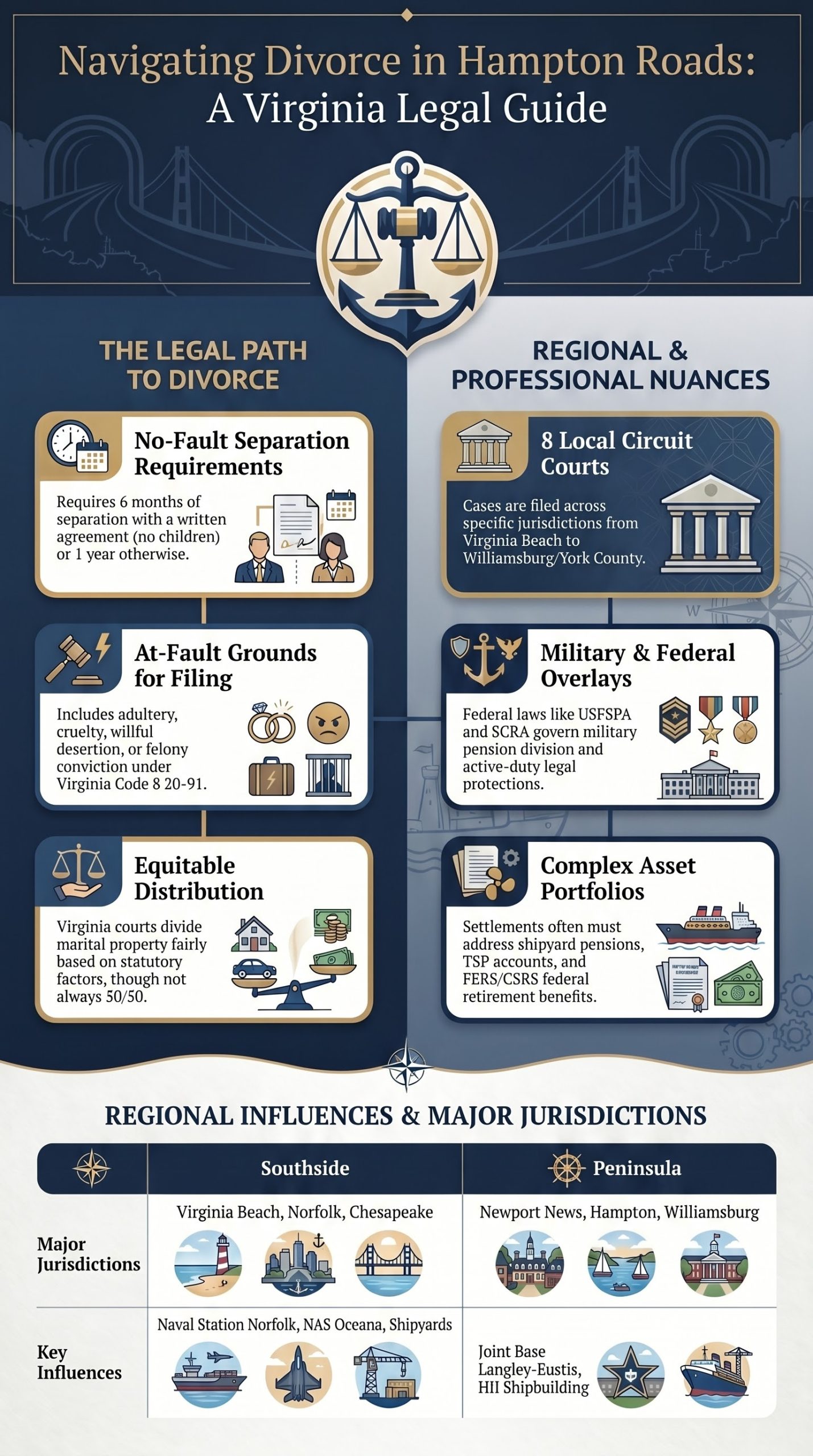
Table of Contents
- The Couple Who Met at the Bridge-Tunnel
- Hampton Roads as a Family Law Region
- Virginia’s Divorce Grounds: No-Fault and At-Fault
- Choosing the Right Court Across Eight Hampton Roads Circuit Courts
- Equitable Distribution Under Va. Code § 20-107.3
- Spousal Support Under Va. Code § 20-107.1
- Child Custody and Visitation
- Child Support
- Military Divorces: USFSPA, the SCRA, and Deployment Realities
- How Shin Law Office Handles Hampton Roads Divorces
- Summary
- Frequently Asked Questions
- References
Chapter 1: The Couple Who Met at the Bridge-Tunnel
She worked at Sentara Norfolk General. He worked at Newport News Shipbuilding. They had met 15 years earlier, when she was a nursing student at Old Dominion, and he was a third-year apprentice. They had bought their first house in Chesapeake because the schools were good and the commute was split in the middle. They had two kids. They had a marriage that, like many in this region, had been quietly running on parallel tracks for the last several years. They had stopped seeing each other much. They had stopped talking about the things that mattered. By the time they came into my office, the question was not whether the marriage was over. The question was what the divorce would look like.
What they wanted to know was the practical stuff. Where do we file? Who keeps the house? How does her pension at Sentara get divided? How does his stock and pension at HII get divided? What happens with the kids? How does support work when she makes one number and he makes another? How long does this take? How much does this cost? Are we going to be okay?
I told them what I tell every Hampton Roads couple who comes in with a similar story. The legal framework is Virginia law, the same law whether you live in Virginia Beach or Suffolk or Williamsburg. The court will be the Circuit Court for the city or county where you have established residence, with specific rules about jurisdiction and venue. The substantive issues will be equitable distribution under Va. Code § 20-107.3, spousal support under Va. Code § 20-107.1, custody under Va. Code §§ 20-124.1 to 20-124.6, and child support under Va. Code §§ 20-108 to 20-108.2. The work is the same work that happens in Loudoun, Fairfax, Norfolk, and Roanoke. The texture, though, is local. The lawyers know the courts. The courts know the workforce. The workforce, between the Navy bases and the shipyards and the federal civilians and the hospitals, is the texture of Hampton Roads.
We worked out the case over the next several months. Equitable distribution allocated the home, the cars, the savings, both pensions, the TSP, and his HII stock account. The custody schedule accommodated their respective shifts. The child support followed the guidelines. The decree was entered before the school year ended. They moved on with their lives, separately. The work of unwinding fifteen years of marriage was not painless, but it was orderly. That is most of what a divorce lawyer can promise: the work will be orderly, and the result will be one you can live with.
Chapter 2: Hampton Roads as a Family Law Region
Hampton Roads is the broad name for the metropolitan area centered on the harbor where the James, Nansemond, and Elizabeth Rivers meet the Chesapeake Bay. The Census Bureau formally calls it the Virginia Beach-Norfolk-Newport News, VA-NC Metropolitan Statistical Area. Roughly 1.7 million people live across the region’s two main subdivisions, the Southside and the Peninsula, connected by the Hampton Roads Bridge-Tunnel, the Monitor-Merrimac Memorial Bridge-Tunnel, and the James River Bridge. The region is also home to the largest concentration of military bases and personnel in the United States.
The Southside
The Southside includes Virginia Beach (the most populous city in Virginia), Norfolk (home to Naval Station Norfolk, the world’s largest naval base), Chesapeake, Portsmouth (home to Norfolk Naval Shipyard and Portsmouth Naval Medical Center), and Suffolk. Virginia Beach hosts NAS Oceana. Norfolk hosts the Naval Station, headquarters of US Fleet Forces Command, the bulk of the Atlantic Fleet, and major naval medical and support functions. Chesapeake is the largest city in Virginia by area and serves as a residential center for personnel from across the region. Portsmouth’s shipyard handles fleet maintenance and overhauls. Suffolk has grown rapidly as a residential and commercial center.
The Peninsula
The Peninsula includes Newport News (home to Huntington Ingalls Industries / Newport News Shipbuilding, the largest industrial employer in Virginia), Hampton (with Hampton University and the Hampton VA Medical Center), Williamsburg (a tourism, education, and history center anchored by the College of William & Mary and Colonial Williamsburg), James City County, York County, and Poquoson. Joint Base Langley-Eustis spans Hampton (Langley Air Force) and Newport News (Fort Eustis Army), Naval Weapons Station Yorktown and Coast Guard Training Center Yorktown sit in York County, NASA Langley Research Center is in Hampton, and Jefferson Lab is in Newport News.
Why the Regional Concentration Matters in Divorce
A higher proportion of Hampton Roads divorces involve military service members, military spouses, federal civilian employees, healthcare professionals, shipyard workers, and the contractors who serve all of the above. Each of these populations brings specific issues to the divorce: military pensions under USFSPA, FERS and CSRS pensions for federal civilians, hospital retirement plans for healthcare professionals, deferred compensation and stock awards for HII shipyard professionals, and security clearance considerations across multiple workforces. A divorce lawyer working in this region needs familiarity with all of these, as they appear in case after case.
Practical Geography
Many Hampton Roads families live in one jurisdiction and work in another. A Chesapeake resident may work at the shipyard in Portsmouth or at Naval Station Norfolk. A York County resident may work at Jefferson Lab in Newport News. A Virginia Beach resident may commute to Suffolk, or to Hampton, or across the Bridge-Tunnel to the Peninsula. The cross-jurisdictional patterns affect where divorce cases can be filed, where children attend school, where custody schedules will be most workable, and where post-divorce arrangements will hold up. The lawyer needs to understand the realities of cross-bridging to provide effective advice.
Chapter 3: Virginia’s Divorce Grounds: No-Fault and At-Fault
Virginia recognizes both no-fault and at-fault grounds for divorce under Va. Code § 20-91. Most modern divorces in Hampton Roads proceed on no-fault grounds, but the at-fault grounds remain in the statute and continue to be used in specific situations.
No-Fault Divorce: The Six-Month Path
Va. Code § 20-91(A)(9)(a) provides that the parties may obtain a no-fault divorce after a separation of six months if they have no minor children and have entered into a written separation agreement. This is the fastest path through the Virginia divorce process, and it is increasingly common for Hampton Roads couples in second marriages, empty-nest households, or marriages without children to use this path.
No-Fault Divorce: The One-Year Path
For couples with minor children or without a written separation agreement, the no-fault path requires a one-year separation. The separation must be continuous, and the parties must have lived separate and apart, without cohabitation or interruption, for the full year. Living in separate bedrooms in the same house can satisfy the separation requirement in some circumstances, but the more conservative practice is for one spouse to physically move to a separate residence.
Adultery, Sodomy, and Buggery
Virginia recognizes adultery, sodomy, and buggery committed outside the marriage as fault grounds for divorce. These grounds, when established, allow the court to enter a divorce without waiting for the no-fault separation period. Adultery requires proof by clear and convincing evidence, a higher standard than the preponderance standard that applies to most civil questions. The proof typically requires more than circumstantial suspicion; it requires evidence sufficient for a court to conclude that the conduct occurred.
Cruelty and Reasonable Apprehension of Bodily Hurt
Cruelty as a ground for divorce requires a course of conduct that endangers the spouse’s safety or makes continued cohabitation impossible. Single isolated incidents, while they may support other relief, generally do not establish cruelty as a ground for divorce. Reasonable apprehension of bodily harm is the parallel ground for spouses who have not yet been physically harmed but face a credible threat of harm. Both grounds are typically established with documented evidence, including police reports, medical records, photographs, and witness testimony.
Willful Desertion or Abandonment
Willful desertion or abandonment for one year is a fault ground. The desertion must be without justification and without consent of the deserted spouse. Constructive desertion, in which one spouse’s intolerable conduct effectively forces the other to leave, can also establish this ground in some cases. Hampton Roads cases often involve nuanced facts about who left, why they left, and whether the leaving was justified.
Felony Conviction
Conviction of a felony with confinement of more than one year, when the parties have not cohabited after the conviction, is a fault ground. This ground is less commonly invoked but exists in the statute.
When to Use Fault Grounds
Most Hampton Roads divorces proceed on no-fault grounds even when fault grounds exist. The reason is practical: fault grounds extend the case, increase the cost, and rarely change the equitable distribution result by enough to justify the additional time and money. Fault grounds matter most when they affect spousal support analysis (adultery can bar spousal support under Va. Code § 20-107.1(B) absent specific statutory exceptions) or when they support specific relief beyond what would otherwise be available. The strategic decision about whether to plead fault grounds is one of the early conversations in any contested divorce.
Chapter 4: Choosing the Right Court Across Eight Hampton Roads Circuit Courts
Hampton Roads divorces are filed in Circuit Court. The region has several Circuit Courts, each serving a specific city or county, each with its own clerks, judges, and procedural rhythms.
The Southside Circuit Courts
Virginia Beach Circuit Court at 2425 Nimmo Parkway handles cases for the most populous city in the Commonwealth. Norfolk Circuit Court at 100 St. Paul’s Boulevard handles cases for one of the busiest urban dockets in Virginia, including a substantial volume of military divorces, given the Naval Station presence. Chesapeake Circuit Court at 307 Albemarle Drive handles a residential-heavy docket. Portsmouth Circuit Court at 601 Crawford Street handles cases, including those involving the Naval Shipyard workforce. Suffolk Circuit Court at 150 N. Main Street serves the largest city by area in the Commonwealth.
The Peninsula Circuit Courts
Newport News Circuit Court at 2500 Washington Avenue handles a substantial military and shipyard divorce docket. Hampton Circuit Court at 101 Kings Way handles cases including those involving the Air Force component of Joint Base Langley-Eustis and the Hampton VA workforce. The Williamsburg/James City County Circuit Court at 5201 Monticello Avenue handles a varied docket, including a substantial population of College of William & Mary employees, retirees, and tourism-industry workers. York/Poquoson Circuit Court in Yorktown handles the more rural Peninsula jurisdictions, as well as the Naval Weapons Station and the Coast Guard workforce.
Jurisdictional and Venue Rules
Virginia requires at least one party to have been a resident of and domiciled in the Commonwealth for at least six months before filing for divorce. Once that requirement is met, venue is generally proper in the city or county where the parties last cohabited as spouses, or in the county where the defendant resides. For families who have lived in multiple Hampton Roads jurisdictions during the marriage, the choice of venue can affect the timeline and the judges available. For military families in which one spouse is on active duty, additional rules apply under the SCRA and Virginia’s specific provisions for military residency, addressed in Chapter 9.
Differences Between the Courts
While the substantive law is uniform across all Hampton Roads Circuit Courts, the procedural rhythms vary. Some courts have heavier dockets and longer time-to-trial intervals. Some courts have judges with particular interests or specialties. Some have more streamlined uncontested divorce procedures. An attorney with regional experience understands these differences and can advise on whether to file where venue is proper or, in cases where venue could lie in more than one place, where filing makes the most strategic sense.
Companion Courts: Juvenile and Domestic Relations
In addition to Circuit Court for the divorce itself, families with children typically interact with Juvenile and Domestic Relations District Court (J&DR) for custody, visitation, child support, and protective order matters. Each city and county has its own J&DR Court, which runs parallel to the Circuit Court. The two courts coordinate during a divorce, and an attorney has to navigate both systems together. For city-specific divorce-and-family-law guides, see our Virginia Beach family law cornerstone and our Newport News family law cornerstone.
Chapter 5: Equitable Distribution Under Va. Code § 20-107.3
Virginia is an equitable distribution state. Marital property is divided fairly between the spouses, which is not always equal. The framework is set out in Va. Code § 20-107.3, and the analysis runs through several distinct steps.
Identifying the Property
The first step is identifying everything either spouse owns. The marital home, the cars, bank accounts, brokerage accounts, retirement accounts (401(k), IRA, TSP, FERS, CSRS, military pension, hospital pension, shipyard pension), business interests, restricted stock and options (common for HII employees and certain federal contractors), insurance cash values, debts owed by either spouse, personal property, and inheritance accounts all enter the inventory.
Classifying the Property
The second step is classifying each asset as marital, separate, or hybrid. Marital property is generally property acquired during the marriage. Separate property is generally property owned before the marriage, plus inheritances and gifts received by one spouse during the marriage. Hybrid property is property that is partly marital and partly separate, often because separate property has appreciated in value during the marriage with marital effort, or because separate funds have been commingled with marital funds. The classification analysis can be technically complicated and is often the most contested part of an equitable distribution case.
Valuing the Property
The third step is valuation. For most assets, fair market value at a date set by the court (typically the date of the evidentiary hearing or another date specified in the case) determines the value. Real estate may require an appraisal. Business interests may require the services of business valuation experts. Pensions and retirement accounts have current values that are typically straightforward to determine, although future-value pensions, such as military and federal civilian pensions, may require actuarial calculations if the parties intend to value rather than divide.
Dividing the Property
The fourth step is the division itself. Virginia’s equitable distribution statute lists factors the court considers in deciding how to divide marital property, including the contributions of each party to the well-being of the family, contributions to acquisition and care of marital property, the duration of the marriage, ages and physical and mental conditions of the parties, the circumstances and factors that contributed to the dissolution of the marriage (including grounds for divorce), how and when the property was acquired, the debts of each party and their basis, the liquid or non-liquid character of all marital property, the tax consequences of any division, and other factors the court deems necessary to consider.
Hampton Roads Distinctive Issues
Several recurring issues come up in Hampton Roads equitable distribution cases. Military pensions are governed by USFSPA and the 10/10 Rule for direct payment from the military pay system. Federal civilian pensions require Court Orders Acceptable for Processing (COAPs) under 5 CFR Parts 838 and 839. Thrift Savings Plan accounts require separate Retirement Benefits Court Orders submitted to FRTIB. Shipyard pensions and 401(k) plans require Qualified Domestic Relations Orders under ERISA. Hospital pensions for Sentara and Riverside employees are administered in accordance with ERISA QDRO procedures. Restricted stock and stock options for HII employees and federal contractors require careful analysis of vesting schedules and tax characteristics. The order drafting work is technical and benefits from regional experience.
Chapter 6: Spousal Support Under Va. Code § 20-107.1
Spousal support, sometimes called maintenance or alimony, is governed by Va. Code § 20-107.1. The court has discretion to award support in an amount and for a duration appropriate to the circumstances.
When Spousal Support Is Available
Spousal support is available in cases where one spouse needs financial support and the other has the ability to pay. The need-and-ability framework is the core. Adultery generally bars spousal support to the offending spouse under Va. Code § 20-107.1(B), with limited statutory exceptions. Other fault grounds may affect the award but do not automatically bar it.
Factors the Court Considers
The statute lists factors the court considers, including the obligations, needs, and financial resources of the parties; the standard of living established during the marriage; the duration of the marriage; the ages and physical and mental conditions of the parties and any special circumstances; the contributions, monetary and non-monetary, of each party to the well-being of the family; the property interests of the parties; the provisions made with regard to marital property under § 20-107.3; the earning capacity, education, and employability of each party; the opportunity for, ability of, and the time and costs involved for the requesting party to acquire the appropriate education, training, and employment to obtain the skills necessary to enhance their earning capacity; the decisions made regarding employment, career, economics, education, and parenting arrangements during the marriage; and other factors necessary to consider the equities between the parties.
Types and Duration of Support
Virginia courts can award spousal support for a defined duration, for an indefinite period subject to modification, or as a lump sum. Defined-duration awards (sometimes called rehabilitative alimony) are common for shorter marriages or where one spouse needs time to develop earning capacity. Indefinite awards subject to modification are more common in long-duration marriages in which the dependent spouse cannot reasonably be expected to become self-sufficient. Lump-sum awards, less common, can resolve the support question in a single payment without ongoing obligation.
Pendente Lite Support
During the divorce, before final orders, the court can enter pendente lite (temporary) support orders under Va. Code § 20-103. These orders address immediate financial needs while the case is pending. Pendente lite support is particularly important for spouses who have been economically dependent and need financial stability while the case proceeds.
Modification and Termination
Spousal support orders are generally modifiable upon a showing of a material change in circumstances. Remarriage of the recipient terminates spousal support under Va. Code § 20-109. Cohabitation of the recipient with another person in a relationship analogous to marriage for one year or more can also terminate support. The death of either party generally terminates support unless the order specifies otherwise.
Chapter 7: Child Custody and Visitation
Custody and visitation are governed by Va. Code §§ 20-124.1 through 20-124.6. The court decides if the parties cannot agree. The standard the court applies is the best interest of the child.
Legal vs. Physical Custody
Virginia distinguishes between legal custody and physical custody. Legal custody is the right to make major decisions about the child’s upbringing (education, healthcare, religion). Physical custody is where the child lives and the daily caregiving authority. Both can be sole (one parent) or joint (shared between parents). Joint legal custody with primary physical custody to one parent is the most common arrangement in Virginia, but the variations are wide.
Best Interest Factors
Va. Code § 20-124.3 lists ten factors the court considers in determining best interest, including the age and physical and mental condition of the child; the age and physical and mental condition of each parent; the relationship existing between each parent and each child; the needs of the child, giving due consideration to other important relationships; the role each parent has played and will play in the child’s upbringing; the propensity of each parent to actively support the child’s contact with the other parent; the relative willingness and ability of each parent to maintain a close and continuing relationship with the child; the reasonable preference of the child of suitable age and discretion; any history of family abuse or sexual abuse; and any other factors as the court deems necessary.
Visitation Schedules
Visitation schedules in Hampton Roads vary widely depending on the parents’ schedules, the children’s ages and activities, and the geographic distance between the parents’ homes. Standard schedules include alternating weekends, mid-week visits, and shared holidays and summer time. Equal-time schedules (50/50, week-on/week-off, 2-2-3) are increasingly common when both parents have flexible work arrangements and live close enough to support school continuity. Long-distance schedules apply when the parents live in different jurisdictions or one parent’s work requires geographic separation.
Hampton Roads Specific Considerations
For military families, deployment cycles, sea duty, and Permanent Change of Station (PCS) orders affect custody planning. For shipyard families, shift schedules and outage schedules affect day-to-day caregiving. For federal civilian families, telework and travel patterns affect availability. The custody schedule that works has to fit the actual life of the family, not a textbook template. Newport News and Virginia Beach, in particular, see substantial military divorce dockets where these issues recur.
Modification of Custody
Custody orders are modifiable upon a showing of material change in circumstances and that the modification serves the child’s best interest. The standard limits frivolous modifications but accommodates real changes such as relocation, changes in work schedules, the child’s evolving needs, and other meaningful developments.
Chapter 8: Child Support
Child support in Virginia is governed by guidelines set out in Va. Code §§ 20-108 through 20-108.2. The guidelines produce a presumptive amount based on the parties’ incomes, the number of children, and the custody arrangement.
The Income Shares Model
Virginia uses an income shares model. The combined gross monthly income of both parents is calculated. The guidelines table specifies the basic child support obligation for that combined income at the relevant number of children. Each parent is responsible for a share of the basic obligation in proportion to their share of the combined income. Health insurance premiums, work-related childcare, and other specified add-ons are factored in. The non-custodial parent’s net obligation, after appropriate adjustments, becomes the support amount.
Income Definitions
Gross income for guideline purposes includes wages, salary, bonuses, commissions, military allowances (BAH and BAS for active duty service members under specific rules), self-employment income, rental income, interest and dividend income, and most other forms of regular income. Imputed income can be used when a parent is voluntarily underemployed. The income calculations get technical for shipyard workers with overtime and shift differentials, military service members with non-cash allowances, and federal civilians with locality pay and various supplements.
Shared Custody Adjustments
When physical custody is shared (each parent has the child more than 90 days per year), Va. Code § 20-108.2(G)(3) provides a shared custody calculation that adjusts the support obligation to reflect the shared time. The calculation can yield substantial differences from the sole-custody calculation, and this is one reason custody schedule decisions affect the long-term economic outcome.
Deviation From Guidelines
The guidelines produce a presumptive amount, but the court can deviate when application of the guideline would be unjust or inappropriate. Va. Code § 20-108.1 lists factors that can support deviation, including the actual monetary support of children, debts of either party arising during the marriage for the benefit of the child, custody arrangements, special needs of the child, independent financial resources of the child, standard of living the child is accustomed to, earning capacity, voluntary unemployment or under-employment, debts incurred for production of income, special needs of either parent, tax consequences, and a written agreement of the parties. Deviation is not automatic and requires specific findings.
Modification of Child Support
Child support is modifiable upon a showing of material change in circumstances, generally including a change in either party’s income or in the custody arrangement. Hampton Roads families with military or shipyard incomes that fluctuate with deployments, overtime, and operational tempo see modification petitions more often than average.
Chapter 9: Military Divorces: USFSPA, the SCRA, and Deployment Realities
Hampton Roads has the largest concentration of military divorces in Virginia and one of the largest in the United States. Naval Station Norfolk, NAS Oceana, Joint Base Langley-Eustis, Norfolk Naval Shipyard, Portsmouth Naval Medical Center, Naval Weapons Station Yorktown, the Coast Guard Training Center Yorktown, and the Joint Expeditionary Base Little Creek-Fort Story together support tens of thousands of active duty and reserve service members and their families. Military divorces follow the same Virginia substantive law as civilian divorces, but several federal statutes overlay specific procedures and protections.
The Servicemembers Civil Relief Act
The Servicemembers Civil Relief Act (SCRA), 50 U.S.C. §§ 3901 et seq., provides protections for active duty service members in civil litigation. The most relevant provision in divorce cases is the right to a stay of proceedings when active-duty service materially affects a service member’s ability to participate. The stay is not automatic; the service member must request it and provide a statement that current military duties materially affect the service member’s ability to appear, along with a date when the service member will be available. Courts in Hampton Roads, given the volume of military cases, are familiar with SCRA practice.
USFSPA and Military Pension Division
The Uniformed Services Former Spouses’ Protection Act (USFSPA), 10 U.S.C. § 1408, allows state courts to treat military retired pay as marital property subject to division. Virginia courts apply Va. Code § 20-107.3 to determine whether to divide a military pension and in what proportion. The 10/10 Rule (10 years of marriage overlapping 10 years of military service) is the threshold for direct payment from the Defense Finance and Accounting Service to the former spouse. Below the 10/10 threshold, the former spouse can still receive a share, but the service member must make the payment directly. The Frozen Benefit Rule (effective for divorces after December 23, 2016) governs the calculation methodology.
TRICARE and Military Benefits
A former spouse’s eligibility for TRICARE health benefits depends on the 20/20/20 Rule (20 years of marriage, 20 years of service, 20 years of overlap) for full benefits, or the 20/20/15 Rule for transitional benefits. These rules are federal, not Virginia, but they affect the practical economics of the divorce settlement. Other benefits, including the Survivor Benefit Plan (SBP), commissary and exchange privileges, and dependent ID cards, have their own rules and timelines.
Custody During Deployment
Va. Code § 20-124.7 et seq. (the Virginia Military Parents Equal Protection Act) addresses custody and visitation during deployment. The statute generally prohibits courts from using deployment as a factor weighing against the deploying parent. Temporary modifications during deployment can be entered without prejudicing the long-term custody arrangement. Federal law (the Servicemembers Civil Relief Act and related provisions) reinforces these protections.
Federal Civilian Divorces
For Hampton Roads federal civilian families (NASA Langley, Jefferson Lab, Joint Base Langley-Eustis civilians, Naval Weapons Station Yorktown, Coast Guard Training Center Yorktown, Hampton VA Medical Center, and the various civilian DoD positions), the FERS, CSRS, and TSP frameworks apply. Court Orders Acceptable for Processing (COAPs) are submitted to OPM for FERS or CSRS division, and Retirement Benefits Court Orders are submitted to FRTIB for TSP division. For more details on the federal civilian retirement division, see our companion guide on FERS, CSRS, and TSP division for Peninsula civilians. For detailed military pension division coverage, see our guide on USFSPA military pension division.
Chapter 10: How Shin Law Office Handles Hampton Roads Divorces
Every divorce case is different, but the work has a rhythm. Here is how the firm approaches Hampton Roads divorce matters.
Initial Consultation
The first conversation covers what is happening, what each spouse owns and earns, the family’s makeup, the children’s situation, and the client’s goals and concerns. The conversation is privileged. The information stays between the lawyer and the client. The goal of the first meeting is to understand the case well enough to give the client a realistic picture of the path ahead.
Strategy and Filing
The strategy decisions include whether to file or wait for the other spouse to file, whether to use no-fault or fault grounds, where venue lies and where filing makes sense, and what immediate temporary orders may be needed. For Hampton Roads families with cross-jurisdictional realities, the venue analysis takes specific care.
Discovery and Documentation
The discovery phase gathers the documentation that supports equitable distribution, support, and custody. Bank statements, retirement account statements, pension and benefit documents, military and federal personnel records, real estate documents, business records, tax returns, and other documents are obtained either voluntarily or through formal discovery. For military and federal civilian families, the personnel record (LES, SF-50, leave and earnings statement, retirement benefit estimates) anchors the financial picture.
Negotiation and Settlement
Most Hampton Roads divorces settle. Settlement negotiations may proceed informally between counsel, through formal mediation, or through a structured collaborative divorce process. A negotiated settlement that resolves all the issues produces a Property Settlement Agreement and (in cases with children) a custody and visitation agreement. The agreements are incorporated into the final divorce decree.
Trial
For cases that do not settle, trial in the Circuit Court resolves the disputed issues. In Virginia divorce cases, the trial is before a judge, not a jury. The court hears the evidence, reviews the exhibits, and enters findings on each contested issue. The work to prepare for trial is substantial, and most cases that come close to trial settle on the courthouse steps.
Final Decree and Implementation
The final divorce decree resolves the case but is rarely the end of the work. QDROs, COAPs, military pension division orders, real estate transfers, retirement account divisions, beneficiary designation updates, and other implementation steps continue for weeks or months after the decree. Coordinating the implementation work is part of what the lawyer does to make sure the final result the decree describes actually happens.
After the Divorce
Some cases require post-decree work. Modifications to custody, visitation, or support are common as circumstances change. Enforcement actions may be needed if the other party fails to comply with the decree. Relocation cases arise when one parent’s career or family situation changes. The relationship with the firm can extend years past the divorce as life continues to require legal attention.
Summary
Hampton Roads divorce cases run through the Circuit Courts of Virginia Beach, Norfolk, Chesapeake, Portsmouth, Suffolk, Newport News, Hampton, Williamsburg/James City County, and York/Poquoson, applying Virginia’s substantive divorce law. The legal framework includes no-fault grounds (six months without minor children and a separation agreement, or one year otherwise) and at-fault grounds (adultery, desertion, cruelty, felony conviction) under Va. Code § 20-91, equitable distribution under Va. Code § 20-107.3, spousal support under Va. Code § 20-107.1, custody and visitation under Va. Code §§ 20-124.1 to 20-124.6, and child support under Va. Code §§ 20-108 to 20-108.2.
The regional concentration of military service members at Naval Station Norfolk, NAS Oceana, Joint Base Langley-Eustis, Norfolk Naval Shipyard, Portsmouth Naval Medical Center, Naval Weapons Station Yorktown, the Coast Guard Training Center Yorktown, and the Joint Expeditionary Base Little Creek-Fort Story makes military divorces a substantial component of the regional caseload. The Servicemembers Civil Relief Act, USFSPA, the Frozen Benefit Rule, the 10/10 Rule for direct pension payment, the 20/20/20 and 20/20/15 Rules for TRICARE, and the Virginia Military Parents Equal Protection Act all overlay the standard Virginia framework. For federal civilian families, FERS, CSRS, and TSP divisions, through Court Orders Acceptable for Processing and Retirement Benefits, Court Orders add another layer.
The work of a Hampton Roads divorce, done well, is methodical. The case proceeds through initial consultation, strategy and filing, discovery, negotiation or trial, final decree, and post-decree implementation. Most cases settle. Some go to trial. All benefit from counsel who knows both the substantive Virginia law and the regional texture of Tidewater family law practice.
Frequently Asked Questions
How long does a divorce take in Hampton Roads?
Uncontested no-fault divorces with no minor children and a written separation agreement can be finalized as quickly as a few months after the six-month separation period ends. Contested divorces with custody, support, and complex property division typically take a year or longer from filing to final decree, with substantial variation depending on the complexity of the issues and the docket of the relevant Circuit Court.
Can I file for divorce in Virginia if my spouse is stationed overseas?
Yes, with care. Virginia residency for the filing spouse satisfies the residency requirement. Service of process on a deployed service member follows specific procedures. The Servicemembers Civil Relief Act allows the deployed spouse to request a stay of proceedings if active duty materially affects ability to participate. Many Hampton Roads divorces involve a deployed or sea-duty spouse, and the procedural rhythm accommodates this.
My spouse has been having an affair. Will adultery affect the divorce?
Possibly. Adultery is a fault ground for divorce under Va. Code § 20-91 and generally bars spousal support to the offending spouse under Va. Code § 20-107.1(B), with limited statutory exceptions. Adultery can also be a factor in equitable distribution analysis. Proving adultery requires clear and convincing evidence, a higher standard than ordinary civil cases. Whether to plead adultery is a strategic decision based on the strength of the evidence and the practical effect on the case.
What is equitable distribution and how is it different from community property?
Virginia is an equitable distribution state, not a community property state. Marital property is divided fairly between the spouses, which can but does not have to be equal. The court considers a list of statutory factors under Va. Code § 20-107.3 in deciding how to divide marital property. Community property states (such as California and Texas) start from a 50/50 presumption. Equitable distribution begins with the question of what division would be fair under the specific facts of the case.
My spouse is in the Navy. How does the military pension get divided?
The marital portion of military retired pay is divisible as marital property under Va. Code § 20-107.3, with the federal framework provided by USFSPA. The 10/10 Rule (10 years of marriage overlapping 10 years of service) is the threshold for direct payment from the Defense Finance and Accounting Service to the former spouse. Below 10/10, the service member must pay the former spouse directly. The Frozen Benefit Rule applies to divorces entered after December 23, 2016. The order dividing the pension has specific drafting requirements.
Can my spouse take the kids out of state during the divorce?
Generally not without notice and either consent or court approval, particularly once the divorce is filed and the court has jurisdiction. Virginia courts can enter orders preventing relocation during the pendency of the case. Permanent relocation after the divorce is governed by specific custody modification standards. For Hampton Roads families where one spouse may want to relocate to another state for a new job or family situation, the relocation analysis is one of the most important early conversations.
Do we have to go to court, or can we settle our divorce out of court?
Most Hampton Roads divorces settle without trial. Settlement can happen through direct negotiation between counsel, through formal mediation, or through collaborative divorce processes. A settled case still requires court entry of the divorce decree, but the contested issues are resolved by agreement rather than by trial. Cases that do not settle proceed to trial in front of a Circuit Court judge.
How is child support calculated in Virginia?
Virginia uses an income shares model under Va. Code §§ 20-108 to 20-108.2. The combined gross income of both parents is determined, the guideline obligation for that combined income at the relevant number of children is found in the statutory table, and each parent is responsible for a proportional share. Health insurance premiums and work-related childcare are factored in. Shared custody arrangements (each parent for over 90 days per year) are calculated separately under Va. Code § 20-108.2(G)(3). Deviation from guidelines requires specific findings.
My spouse owns a business. How does that get divided?
Business interests acquired during the marriage are marital property subject to equitable distribution under Va. Code § 20-107.3. The valuation typically requires a business valuation expert. The division can take several forms: an offset against other marital assets to keep the business intact with one spouse, a buyout arrangement, or in some cases continued joint ownership post-divorce. For Hampton Roads families with closely held businesses, the valuation and division work can be the most substantive part of the case.
When should I contact a Hampton Roads divorce attorney?
As soon as you know the marriage is heading toward divorce. Early consultation does not commit you to filing. It gives you the information to make decisions with the long-term picture in mind. Decisions made in the early days, before counsel is involved, can significantly affect the case. The first conversation is private and the information stays privileged.
Hampton Roads Divorce Attorney for Tidewater Families
Whether you are in Virginia Beach near NAS Oceana, in Norfolk near the Naval Station, in Chesapeake or Suffolk, in Portsmouth near the Naval Shipyard, in Newport News near HII or NASA Langley, in Hampton near Joint Base Langley, or anywhere across the Peninsula and Southside, the legal framework that will decide what happens next in your divorce is Virginia law. The lawyer you hire to walk it through with you should be a real Virginia attorney with regional experience.
Tough cases require tough attorneys. Shin Law Office handles divorce, equitable distribution, spousal support, child custody, child support, military pension division, federal civilian pension division, protective orders, and the full range of family law matters across Hampton Roads, Northern Virginia, and the Commonwealth.
Call 571-445-6565

References
Code of Virginia. (2024). Title 20, Section 20-91: Grounds for divorce from bond of matrimony. Virginia General Assembly. https://law.lis.virginia.gov/vacode/title20/chapter6/section20-91/
Code of Virginia. (2024). Title 20, Section 20-103: Court may make orders pendente lite. Virginia General Assembly. https://law.lis.virginia.gov/vacode/title20/chapter6/section20-103/
Code of Virginia. (2024). Title 20, Section 20-107.1: Spousal support and maintenance. Virginia General Assembly. https://law.lis.virginia.gov/vacode/title20/chapter6/section20-107.1/
Code of Virginia. (2024). Title 20, Section 20-107.3: Court may decree as to property and debts of the parties. Virginia General Assembly. https://law.lis.virginia.gov/vacode/title20/chapter6/section20-107.3/
Code of Virginia. (2024). Title 20, Sections 20-108 through 20-108.2: Child support guidelines. Virginia General Assembly. https://law.lis.virginia.gov/vacode/title20/chapter6/
Code of Virginia. (2024). Title 20, Sections 20-124.1 through 20-124.6: Custody and visitation. Virginia General Assembly. https://law.lis.virginia.gov/vacode/title20/chapter6.1/
Code of Virginia. (2024). Title 20, Sections 20-124.7 et seq.: Virginia Military Parents Equal Protection Act. Virginia General Assembly. https://law.lis.virginia.gov/vacode/title20/chapter6.1/
Servicemembers Civil Relief Act, 50 U.S.C. §§ 3901 et seq. https://www.govinfo.gov/app/collection/uscode
Uniformed Services Former Spouses’ Protection Act, 10 U.S.C. § 1408. https://www.govinfo.gov/app/collection/uscode
Defense Finance and Accounting Service. (2024). Garnishment guidance for former spouses under USFSPA. https://www.dfas.mil/garnishment/usfspa/
U.S. Office of Personnel Management. (2024). Court orders affecting federal retirement. https://www.opm.gov/retirement-services/court-orders/
Federal Retirement Thrift Investment Board. (2024). TSP and court orders. https://www.tsp.gov/publications/
Virginia Beach Circuit Court. https://www.vbgov.com/government/departments/clerk-court/
Norfolk Circuit Court. https://www.norfolk.gov/CircuitCourt
Chesapeake Circuit Court. https://www.cityofchesapeake.net/departments/general-services/circuit-court
Newport News Circuit Court. https://www.nnva.gov/186/Circuit-Court
Hampton Roads Planning District Commission. (2024). Regional overview. https://www.hrpdcva.gov/
U.S. Census Bureau. (2024). Virginia Beach-Norfolk-Newport News, VA-NC Metropolitan Statistical Area. https://www.census.gov/
