

Virginia Beach Divorce for JEB Little Creek-Fort Story Naval Special Warfare Families: A Hampton Roads Attorney’s Guide for the Operator and the Spouse
By Anthony I. Shin, Esq. | Shin Law Office | Notes from a Virginia Attorney on the Special Warfare Family Divorces That Decide What Happens Next for the Operator and the Spouse Holding Things Together
BOTTOM LINE UP FRONT
If you are reading this from a kitchen table in Pungo or Red Mill or Strawbridge while the kids are at school, from a hotel during a training detachment, from a friend’s house because home is not safe to think in right now, or from somewhere else where the schedule has finally given you a quiet moment, you are part of one of the most demanding workforces in the United States military. Joint Expeditionary Base Little Creek-Fort Story in Virginia Beach is the East Coast home of Naval Special Warfare and the Atlantic Fleet amphibious force. The marriages built around this work run on a tempo that does not match a calendar. The deployments come with little notice. The training is constant. The career arc is intense. The stress on families is real, and the divorces that come out of these households often reflect years of accumulated pressure that finally exceeded what the marriage could absorb.
When these marriages end, Virginia divorce law (Va. Code § 20-91 grounds, Va. Code § 20-107.3 equitable distribution, Va. Code § 20-107.1 spousal support, Va. Code §§ 20-124.1 to 20-124.6 custody, Va. Code §§ 20-108 to 20-108.2 child support) applies. The Servicemembers Civil Relief Act at 50 U.S.C. §§ 3901 et seq. provides protection during operational periods. The Uniformed Services Former Spouses’ Protection Act at 10 U.S.C. § 1408 governs the division of military pensions, with the 10/10 Rule, the Frozen Benefit Rule, and the 20/20/20 and 20/20/15 Rules for TRICARE. Special operations compensation, including Special Duty Assignment Pay (SDAP) under 37 U.S.C. § 307a, hazardous duty incentive pay for parachute, demolition, and diving duties under 37 U.S.C. § 301, and other special pays, affects both income and equitable distribution analyses. The Virginia Military Parents Equal Protection Act at Va. Code §§ 20-124.7 et seq. protects the deploying parent’s relationship with the children. The Virginia Beach Circuit Court at 2425 Nimmo Parkway handles most of these cases.
Whether you are the operator or the spouse who has been holding things together, your case deserves a Virginia attorney who handles special warfare divorces with the discretion the work demands. Call Shin Law Office at 571-445-6565.
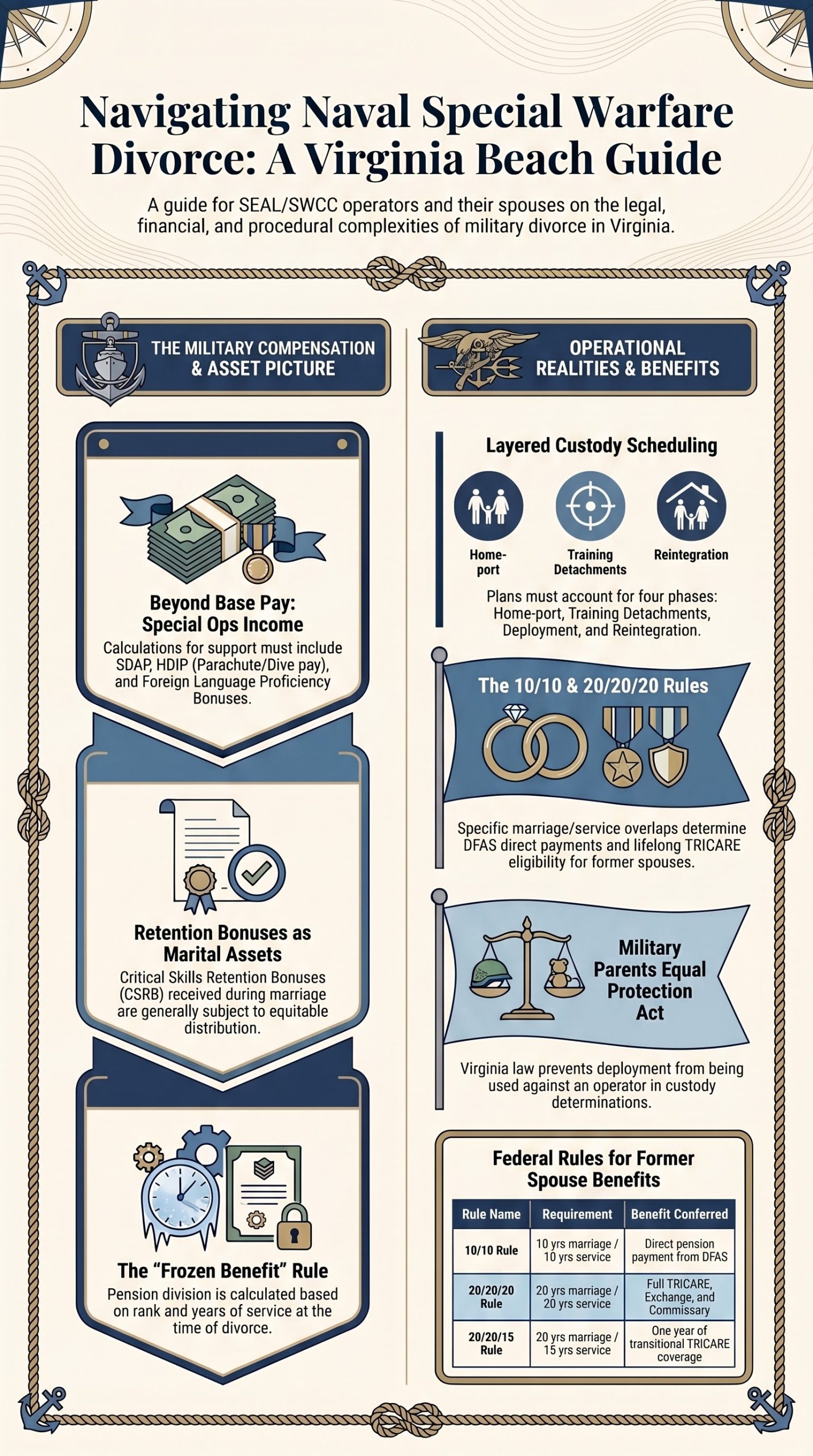
Table of Contents
- The Spouse Who Knew the Schedule Better Than Anyone Should Have To
- JEB Little Creek-Fort Story and the Naval Special Warfare Footprint
- Special Operations Compensation: SDAP, HDIP, and What Counts as Income
- The Operational Tempo and Custody Realities
- USFSPA Pension Division for Special Warfare Operators
- OPSEC, Court Records, and Discretion in the Proceeding
- TRICARE, the Survivor Benefit Plan, and the Other Benefits
- What I Tell Special Warfare Families in the First Meeting
- Summary
- Frequently Asked Questions
- References
Chapter 1: The Spouse Who Knew the Schedule Better Than Anyone Should Have To
She came to my office on a Wednesday afternoon when the kids were in school, and her husband was somewhere she could not name. They had been married for fourteen years. He had been in the Teams since before they met. Their oldest was twelve. Their youngest was six. She had the calendar memorized for ten years running. The pre-deployment workups. The detachments to the West Coast and overseas. The deployments themselves. The brief recovery periods always seemed to get cut short by the next training cycle. She had stopped trying to make plans more than two weeks out. She had stopped explaining to the extended family why he missed birthdays. She had stopped expecting him to be the person he was when they got married because that person had been worn down, year by year, by the work he loved.
She was not angry. She was tired. She loved him and she did not know how to be married to him anymore. She came to me because she wanted to understand what would happen if she filed. Whether her kids’ lives would change. Whether the house in Pungo where they had finally settled would be hers or his or theirs to sell. Whether the pension that he had been earning since before they met would be split. Whether his career would suffer because of the divorce, and whether his career suffering would come back on the kids. Whether anything she said in court would create problems with his clearance or his unit. Whether the people in their unit’s family network would treat her differently. Whether she was doing the right thing.
I told her what I tell every special warfare spouse who comes in with a similar story, and what I tell every operator on the other side of it. The marriage that ended is not the same as the divorce that begins. The work he does, the work she has done holding the family together, the years of accumulated pressure, all of that is the context. It is not the case. The case is a Virginia divorce, governed by Virginia law and the federal military framework, that will be resolved through equitable distribution under Va. Code § 20-107.3, spousal support under Va. Code § 20-107.1, custody under Va. Code §§ 20-124.1 to 20-124.6, and child support under Va. Code §§ 20-108 to 20-108.2. The protections of the SCRA exist for him when his duties prevent him from showing up. USFSPA exists to give her a share of the pension that the work produced. The 10/10 Rule means DFAS will pay her directly when the marriage and service overlap meet the threshold. None of this is consolation for the marriage. It is the framework for what comes next.
Her case took most of a year. The substantive work was front-loaded around the available windows in his schedule. The pension division order was drafted to comply with DFAS requirements and accepted on first submission. The custody schedule built in flexibility for his irregular tempo while preserving the kids’ school routine. The house in Pungo was sold and the proceeds split with appropriate credit for separate-property contributions. He kept his career. The unit family network treated her the way most do, which is to say they understood. The marriage ended quietly because both of them, in the end, wanted that more than they wanted to fight. For broader background on divorce law in this region, see our cornerstone guide on divorce law in Hampton Roads, Virginia, and for Virginia Beach family law in particular, our Virginia Beach family law cornerstone.
Chapter 2: JEB Little Creek-Fort Story and the Naval Special Warfare Footprint
Joint Expeditionary Base Little Creek-Fort Story consolidated under the 2009 BRAC the former Naval Amphibious Base Little Creek and the former Fort Story Army installation. The Little Creek side sits on the Chesapeake Bay in Virginia Beach. The Fort Story side sits at Cape Henry, also in Virginia Beach, where the Atlantic meets the Bay. The combined installation supports a wide range of Atlantic Fleet expeditionary, amphibious, and special warfare commands.
Naval Special Warfare Group TWO
Naval Special Warfare Group TWO (NSWG-2) is the East Coast operational command for Naval Special Warfare. NSWG-2 directs the East Coast SEAL Teams, including Teams TWO, FOUR, EIGHT, and TEN, which are publicly identified as based at Little Creek. The SEAL community is built around the Sea, Air, Land mission set, with operators going through an initial training pipeline that includes Basic Underwater Demolition/SEAL (BUD/S) and SEAL Qualification Training (SQT) before earning the Special Warfare Insignia (the Trident) and joining a fleet team.
Special Boat Team TWENTY and the SWCC Community
Special Boat Team TWENTY (SBT-20) is the East Coast Special Warfare Combatant-craft Crewmen unit, supporting maritime mobility and combat operations from a range of small craft. The SWCC community has its own training pipeline (Basic Crewman Training and Crewman Qualification Training) and earns the Special Warfare Combatant-craft Crewman pin on completion. SWCC operators work closely with SEAL Teams and provide the maritime insertion and extraction capability that supports much of the special warfare mission.
Naval Beach Group TWO and the Amphibious Force
Naval Beach Group TWO (NBG-2) and its supporting commands form the Atlantic Fleet amphibious-force support structure. The Beach Master Unit, Assault Craft Unit, and Naval Construction Force units that fall under the Beach Group support amphibious operations from the beach side. While these units are not part of the special warfare community in the strict sense, they are co-located at Little Creek and share many of the operational realities that affect family life: detachments, exercises, and forward presence rotations.
EOD and Other Specialized Units
Explosive Ordnance Disposal (EOD) units, including elements supporting special operations, also have a presence in the Hampton Roads region with connections to the Little Creek base. Other specialized units rotate through the installation in accordance with operational requirements.
Where Special Warfare Families Live
Special warfare families spread across Virginia Beach with concentrations that vary by rank and family situation. Junior enlisted often live closer to the base in Bayside, Little Neck, or military housing. Mid-career operators (E-6 to E-7, or O-3 to O-4 for officers) often gravitate to Princess Anne, Red Mill, Strawbridge, Lago Mar, or rental homes in similar suburban neighborhoods. Senior operators (E-8 and above, or O-5 and above) often live in Pungo for the rural feel, in Sandbridge for the beach access, or in the more established Princess Anne and Cavalier-area neighborhoods. The neighborhood pattern reflects the operational schedule (proximity to the base matters when notice is short), school preferences, and the family’s stage in the career arc.
The Spouse Who Made It Work
Behind every special warfare operator is a family that has built a life around an unpredictable schedule. Spouses run the household at an irregular pace. They handle the moves between assignments. They support the time-intensive professional development the work demands. Many special warfare spouses have substantially modified or set aside their own careers to support the moves and the schedule. When the marriage ends, the spouse’s contribution to the family’s well-being is one of the factors Virginia courts consider in equitable distribution under Va. Code § 20-107.3 and in spousal support under Va. Code § 20-107.1. The non-monetary contribution to the marriage is real, and the law recognizes it.
Chapter 3: Special Operations Compensation: SDAP, HDIP, and What Counts as Income
Special warfare and special operations compensation includes elements that do not appear in standard military pay and affects both income calculations for support and the marital asset analysis when bonuses or accumulated allowances are at issue.
Special Duty Assignment Pay (SDAP)
Special Duty Assignment Pay under 37 U.S.C. § 307a is paid to enlisted members performing duties assigned by the Secretary of the Navy as warranting extra pay. SEAL operators, SWCC, EOD, and other special operations enlisted personnel typically qualify. The rate varies by SDAP level (categorized SDAP-1 through SDAP-6 based on the demands of the duty), and the rates are set in published Navy pay tables. For Virginia divorce purposes, SDAP is regular monthly income included in gross income for child support guideline calculations under Va. Code §§ 20-108 to 20-108.2 and is part of the income picture for spousal support analysis under Va. Code § 20-107.1. Officers do not typically receive SDAP, with their special operations contribution recognized through other compensation mechanisms.
Hazardous Duty Incentive Pay: Parachute, Demolition, Diving
Hazardous Duty Incentive Pay (HDIP) under 37 U.S.C. § 301 includes monthly payments for personnel performing parachute jumps (Static Line and HALO/HAHO Free Fall qualifications carry different rates), explosive demolition duties, and diving duties. Special warfare operators frequently hold multiple HDIP qualifications and accordingly receive multiple monthly HDIP payments. Each is regular monthly income for support purposes, and the cumulative effect for a multi-qualified operator can be substantial.
Career Sea Pay
Operators in fleet positions assigned to ships or to units that operate from sea-going platforms receive Career Sea Pay during deployed periods at sea, paid as a monthly allowance with rates that increase with cumulative sea service. Career Sea Pay is part of the income picture during periods when it is being paid.
Foreign Language Proficiency Bonus
Special operations operators with certified foreign language proficiency receive a Foreign Language Proficiency Bonus (FLPB) for strategic languages. The amounts vary by language and proficiency level. For operators with multiple languages or with strategic-language certification, FLPB can add a meaningful monthly amount to base pay.
Critical Skills Retention Bonus and Selective Reenlistment Bonus
Special warfare communities often participate in Critical Skills Retention Bonus (CSRB) programs offering substantial retention payments to operators with critical specialties who agree to extend their service obligations. Selective Reenlistment Bonus (SRB) similarly offers payments at reenlistment for personnel in specific ratings and skill sets. Bonus payments received during the marriage are generally marital income subject to equitable distribution analysis. The treatment of bonus structures with multi-year obligations can be complicated, with arguments on both sides about how to allocate.
BAH and BAS
Basic Allowance for Housing (BAH) at the Virginia Beach rate and Basic Allowance for Subsistence (BAS) are non-cash allowances that, under Virginia child support guidelines, are generally included in gross income for the active duty service member. The Virginia Beach BAH rate reflects the local cost of housing.
Combined Income Picture
For a senior special warfare operator with SDAP at the highest tier, multiple HDIP qualifications, FLPB, BAH at the Virginia Beach rate, and BAS, plus any active CSRB or SRB obligations, the gross monthly income picture can be substantially higher than base pay alone suggests. Properly capturing all of the components matters for both child support and spousal support calculations. The Leave and Earnings Statement (LES) is the primary documentation, but it can be technical to read for an operator with the full mix of special pays, and discovery may be useful to confirm the complete picture.
Chapter 4: The Operational Tempo and Custody Realities
The operational tempo of Naval Special Warfare and the amphibious force differs from the more predictable cycles of surface fleet, submarine, or aviation operations. Custody schedules for these families have to account for the difference.
Irregular and Short-Notice Deployments
Special warfare deployments do not always follow the publicly visible carrier deployment cycle. Operators may deploy on short notice, return on short notice, and rotate through schedules that the family cannot fully anticipate. For non-special-warfare amphibious force units, the schedule is typically more predictable but still subject to operational adjustments. The custody schedule has to be designed with this irregularity in mind.
Pre-Deployment Workups and Training Detachments
Outside of deployments, special warfare operators spend substantial time on training detachments at locations including the Naval Special Warfare Center training ranges, joint training facilities, and specialized schools. These detachments are typically a few days to several weeks at a time. They accumulate over the course of a tour and significantly affect availability for parenting time.
The Virginia Military Parents Equal Protection Act
Va. Code §§ 20-124.7 et seq., the Virginia Military Parents Equal Protection Act, generally prohibits courts from using deployment as a factor weighing against the deploying operator parent in custody decisions. The statute also allows for temporary modifications during deployment without prejudicing the long-term custody arrangement. Standby custodian designations during deployment provide legal authority for the non-deploying parent or another caregiver to make decisions during the operator’s absence.
Designing the Special Warfare Custody Schedule
A workable custody schedule for a special warfare family typically has several layers. A baseline schedule covers home-port periods when the operator is in normal training and operational rotation. A modified schedule applies during workup and detachment periods. A deployment schedule applies during the absence, with primary physical custody to the non-deploying parent. A return-from-deployment transition handles reintegration. The order should specify how the schedule moves between these layers and how communication during away periods will be structured. For this community more than most, schedules built around fixed weekly patterns tend to fail because the operational reality does not respect the calendar. Schedules built around adjustable windows of availability tend to hold up better.
School and Activities Stability
For school-age children, school continuity matters. Virginia Beach City Public Schools serve a substantial military family population including special warfare children, and the schools have experience accommodating military families. The custody schedule should preserve school enrollment and routine, with the non-deploying parent providing the daily structure during the operator’s absences.
When the Operator Is Recovering From Injury
Special warfare operations are physically demanding, and operators sometimes return from injury or recovery periods that affect their availability for parenting time differently than deployment. These recovery periods should be addressed in the custody framework, with provisions for adjustment as the operator’s medical status changes.
Chapter 5: USFSPA Pension Division for Special Warfare Operators
The Uniformed Services Former Spouses’ Protection Act (USFSPA) at 10 U.S.C. § 1408 governs military pension division for special warfare operator divorces. The framework is the same as for other military divorces, with attention to the specific compensation profile.
The Marital Portion
Virginia courts apply Va. Code § 20-107.3 to determine the marital portion of military retired pay. The general approach uses a coverture fraction with months of marital service over total months of creditable service, applied to the pension when it begins. For operators who married before pinning their Trident or earning their SWCC pin, the marital portion may be the entire pension or close to it. For operators who married after substantial career time, the marital portion is the share attributable to service during the marriage.
The 10/10 Rule
The 10/10 Rule under 10 U.S.C. § 1408(d)(2) governs whether the Defense Finance and Accounting Service (DFAS) will pay the former spouse directly. To qualify for direct payment, the parties must have been married for at least 10 years and the service member must have at least 10 years of creditable service during the marriage. For special warfare operators with long careers and long marriages, 10/10 is typically met.
The Frozen Benefit Rule
For divorces entered after December 23, 2016, the Frozen Benefit Rule (the 2016 NDAA amendment) applies. Under this rule, the marital portion of the pension is calculated based on the service member’s pay grade and years of service at the time of divorce, rather than at retirement. This means that promotions, pay raises, and additional service after the divorce do not increase the former spouse’s share. For an enlisted operator who divorces mid-career and continues progressing toward senior enlisted ranks, the difference between the Frozen Benefit and the unfrozen approach can be significant.
DFAS Order Drafting
The court order dividing military retired pay must meet specific drafting requirements set out in 10 U.S.C. § 1408 and DFAS published guidance. The order must identify the parties by full legal name and Social Security Number, identify the service member’s branch (US Navy), specify the marital share or fixed dollar amount in a manner DFAS can compute, address the Survivor Benefit Plan election, and contain specific certification language required for DFAS acceptance. Improperly drafted orders are rejected, requiring amendment and re-submission. For more on USFSPA generally, see our companion guides on USFSPA military pension division and on Norfolk Navy divorce for Naval Station Norfolk Sailors.
VA Disability and the Howell Issue
Special warfare careers produce cumulative physical wear, and many retired operators receive Department of Veterans Affairs disability compensation. The VA waiver issue can affect the divisible pension. Federal law requires retirees to waive an equal amount of military retired pay when receiving VA disability compensation. The waived portion is not divisible under USFSPA. The Howell v. Howell Supreme Court decision (2017) established that state courts cannot order indemnification of the former spouse for amounts lost to a post-divorce VA waiver. For special warfare operators with conditions likely to produce significant disability ratings post-retirement, the analysis benefits from counsel familiar with the issue, and properly drafted divorce settlements can address the risk through specific provisions.
Combat-Related Special Compensation
Special warfare operators with combat-related disabilities may receive Combat-Related Special Compensation (CRSC) under specific eligibility rules. CRSC interacts with the VA waiver and the divisible portion of military retired pay in technical ways that can affect both the income picture during the marriage and the divisible pension after retirement.
Blended Retirement System
Special warfare operators who entered service after January 1, 2018, or who opted in during the 2018 transition window are in the Blended Retirement System (BRS). Under BRS, the basic pension annuity multiplier is 2.0 percent per year of service rather than 2.5 percent under the legacy High-3 system. BRS adds Thrift Savings Plan matching contributions and continuation pay at the 12-year mark. For BRS operators in divorce, the TSP balance becomes a meaningful asset alongside the basic pension, and TSP division requires a separate Retirement Benefits Court Order submitted to the Federal Retirement Thrift Investment Board.
Chapter 6: OPSEC, Court Records, and Discretion in the Proceeding
Special warfare divorces raise discretion considerations that do not apply to most civilian or even most military divorces. Spouses on both sides of a special warfare divorce sometimes worry that the proceedings will surface operational details, unit identifiers, or other sensitive information. The reality, handled correctly, is that the proceedings should not.
What Court Records Actually Cover
A divorce proceeding addresses the marital relationship, the property and debts, the income and support, the children, and the related issues. It does not address the operator’s professional duties beyond what is necessary to establish service for USFSPA purposes (years of service, pay grade, dates of marriage and service overlap). The Leave and Earnings Statement is unclassified. The DD-214 at retirement is unclassified. The pension projection is unclassified. None of the documentation needed to handle a divorce properly is operationally sensitive.
When Operational Information Could Surface
Operational information could become relevant only in narrow situations. If a spouse alleges conduct that occurred during a deployment, dates and locations may come up. If income includes deployment pay tied to specific exercises, the reference might be in the LES. If custody disputes invoke the operator’s specific duties, the framing has to be handled carefully. In each of these situations, the practical solution is to handle the issue at the level of generality the case requires, without unnecessary specificity. Most special warfare divorces never reach a point where operational specificity matters.
Sealing or Restricting Records
For cases where specific filings would benefit from restricted access, Virginia courts have procedures to seal individual documents or to restrict portions of the record. Va. Code § 17.1-208 governs court records access generally, and the court has authority to issue protective orders for specific documents on a showing of good cause. Most special warfare cases do not require sealing because the underlying issues do not implicate sensitive material in the first place.
Communications With Counsel
Communications between an operator and their attorney are protected by the attorney-client privilege under Virginia law. The privilege covers confidential communications for the purpose of obtaining legal advice. Operators concerned about discussing their work with counsel should know that the attorney-client privilege gives the conversation a strong protection. The attorney does not need to know operational details to handle the divorce. The conversation can stay focused on the legal issues without invading sensitive territory.
Discretion in Conduct
Beyond the legal protections, the conduct of the case matters. Public conflict, social media activity, or behavior that draws attention can produce consequences that the legal framework does not control. Special warfare divorces benefit from being handled with discipline. The discipline is part of professional conduct in the proceeding, not because the law requires it specifically, but because the work culture and the family network expect it. Counsel familiar with the community understands this expectation.
Chapter 7: TRICARE, the Survivor Benefit Plan, and the Other Benefits
The Navy retirement benefits package includes more than the basic pension. Several other benefits affect special warfare family economics and require attention.
TRICARE and the 20/20/20 Rule
A former spouse’s eligibility for TRICARE depends on the 20/20/20 Rule under 10 U.S.C. § 1072. To qualify for full TRICARE benefits, the marriage must have lasted at least 20 years, the service member must have completed at least 20 years of creditable service, and the marriage and service must overlap by at least 20 years. For long-marriage special warfare divorces, 20/20/20 is often met. For shorter marriages or for cases where the operator divorces before the 20-year mark, full TRICARE is generally not available, and the 20/20/15 Rule may provide one year of transitional coverage.
CHCBP for Spouses Who Do Not Qualify
For spouses who do not qualify under 20/20/20 or 20/20/15, TRICARE coverage ends at divorce. The Continued Health Care Benefit Program (CHCBP) under 10 U.S.C. § 1078a provides up to 36 months of post-divorce health coverage at the former spouse’s expense, with a 60-day enrollment deadline after divorce. After CHCBP ends, civilian coverage through employer plans, Affordable Care Act marketplace plans, or other options applies.
Children’s TRICARE
Children of an active duty operator remain eligible for TRICARE coverage until age 21 (or 23 if enrolled full-time in college), regardless of the parents’ divorce.
The Survivor Benefit Plan
The Survivor Benefit Plan (SBP) under 10 U.S.C. §§ 1447 et seq. provides a continuing monthly annuity to a designated beneficiary after the retired operator’s death. Without SBP, the former spouse’s share of the pension ends at the operator’s death. With a former spouse SBP election, the annuity continues for life. The election has specific time frames after divorce, and missing them produces loss of the option. For long-marriage special warfare divorces where the former spouse will rely on the pension share for retirement income, SBP is essential. For special warfare operators specifically, SBP can also matter because of the cumulative physical demands of the work.
Servicemembers’ Group Life Insurance
Servicemembers’ Group Life Insurance (SGLI) is the standard life insurance program for active duty service members. The beneficiary designation should be reviewed during a divorce. Operators sometimes maintain a former spouse beneficiary designation as part of the divorce settlement, particularly when the former spouse is also raising children together. The designation is the operator’s to make, but the divorce decree can include provisions about the maintenance of the coverage with a specific beneficiary.
Commissary, Exchange, and MWR Privileges
Former spouses who meet the 20/20/20 Rule retain commissary, exchange, and Morale, Welfare, and Recreation privileges in addition to TRICARE. For Virginia Beach former spouses, the JEB Little Creek-Fort Story commissary, the Mid-Atlantic Region Navy Exchange, and the MWR facilities offer meaningful financial value.
Chapter 8: What I Tell Special Warfare Families in the First Meeting
When an operator or operator spouse comes to my office for a divorce consultation, I tell them six things in the first meeting.
First, the special warfare life is part of the picture. The years of detachments. The deployments. The training that happens on top of the deployments. The cumulative wear of a high-tempo career. The years one of you put your career on hold so the other could move through fleet tours and selection pipelines. The bonuses that paid for the truck or that are sitting in the savings account. None of this is irrelevant. Virginia equitable distribution under Va. Code § 20-107.3 considers the contributions, monetary and non-monetary, of each party to the well-being of the family. Both contributions count.
Second, we are going to pull the complete picture of compensation. The LES with all of the special pays. Any active CSRB or SRB obligations. The cumulative HDIP and SDAP picture. Any FLPB. Any reserve service. The complete income picture matters for support and for the broader analysis.
Third, we are going to design the case timeline around the operational reality. If a deployment or major training cycle is approaching, we may want to front-load substantive proceedings before the SCRA stay framework activates. If the schedule is fundamentally unpredictable, we plan for that with flexibility built into the procedural calendar. The case can wait when it has to, but we do not let it drift.
Fourth, we are going to address USFSPA, SBP, and TRICARE before the decree enters. For long-marriage cases meeting 20/20/20, TRICARE and the related benefits continue. For shorter cases, CHCBP enrollment within 60 days bridges to commercial coverage. SBP elections have specific time frames and have to be made deliberately, not by default. The pension division order has to comply with DFAS requirements to avoid rejection.
Fifth, we are going to design a custody schedule that fits the actual operational tempo, not a textbook template. Baseline. Modified for training periods. Deployment schedule. Return-from-deployment transition. The Virginia Military Parents Equal Protection Act protects the deploying parent’s relationship. Standby custodian designations provide authority during deployment. The schedule we design should be one the family can actually live, with the flexibility the work requires.
Sixth, we are going to handle the case with discretion. The community is small. The unit family network knows what it knows. The chain of command will be aware to the extent that command notification is required for things like pendente lite support orders. We control the conduct of the proceedings, which should be professional, focused on the legal issues, and free of public conflict. Properly handled, the divorce is a private legal matter and not a community event. For more on the broader Hampton Roads divorce framework, see our Hampton Roads divorce cornerstone and the firm’s family law practice page.
Summary
Joint Expeditionary Base Little Creek-Fort Story is the East Coast home of Naval Special Warfare Group TWO, the SEAL Teams under it, Special Boat Team TWENTY and the SWCC community, Naval Beach Group TWO and the supporting amphibious commands, and the various other expeditionary units that make up the East Coast amphibious force. Special warfare and amphibious force families spread across Virginia Beach with concentrations in Pungo, Sandbridge, Red Mill, Strawbridge, Lago Mar, Princess Anne, and the surrounding neighborhoods. When these marriages end, Virginia divorce law applies, layered with federal protections under the Servicemembers Civil Relief Act, the Uniformed Services Former Spouses’ Protection Act, the 10/10 Rule, the Frozen Benefit Rule, the 20/20/20 and 20/20/15 TRICARE Rules, the Survivor Benefit Plan framework, and the Virginia Military Parents Equal Protection Act.
Special operations compensation including Special Duty Assignment Pay under 37 U.S.C. § 307a, hazardous duty incentive pay for parachute, demolition, and diving duties under 37 U.S.C. § 301, Foreign Language Proficiency Bonus, Career Sea Pay, and Critical Skills Retention Bonus or Selective Reenlistment Bonus structures all enter the income and equitable distribution analysis. The operational tempo, with irregular and short-notice deployments, frequent training detachments, and the cumulative demands of a high-tempo career, drives custody schedule design and case timing. OPSEC considerations rarely require formal restrictions on court records, but discretion in the conduct of the case matters as a function of the work culture and the small community.
Virginia Beach Circuit Court at 2425 Nimmo Parkway handles the cases. Done correctly, a special warfare family divorce produces clean orders that DFAS accepts on first submission, properly timed SBP and TRICARE elections, a custody schedule that fits the operational reality, discreet conduct of the proceedings, and a result that holds together as the operator’s career continues. Done casually, it produces rejected orders, missed deadlines, lost benefits, exposure of details that did not need to be exposed, and economic results that haunt one or both parties for decades.
Frequently Asked Questions
Will details about my spouse’s unit or operations come out in the divorce?
Generally no. A divorce proceeding addresses marital, property, custody, and support issues, not operational details. The unclassified Leave and Earnings Statement, DD-214, and pension projection are sufficient to establish what USFSPA needs (years of service, pay grade, dates). Operational specificity becomes relevant only in narrow situations, and Virginia courts have procedures to seal or restrict specific filings under Va. Code § 17.1-208 when good cause exists. Most special warfare divorces never reach a point where operational details matter.
My spouse is on a short-notice deployment. Can I still file?
Yes. You can file in Virginia if you meet the residency requirement (at least one party domiciled in Virginia for six months before filing). Your spouse can request a stay of proceedings under 50 U.S.C. § 3932 if active duty service materially affects ability to participate. Pendente lite orders under Va. Code § 20-103 can address immediate financial and custody issues even when the active duty spouse is unavailable for substantive proceedings.
My operator spouse just took a CSRB. How does that get treated?
A Critical Skills Retention Bonus paid during the marriage is generally marital income earned during the marriage, subject to equitable distribution analysis under Va. Code § 20-107.3. The treatment can be complicated when the lump-sum payment represents an obligation that extends past the divorce, with arguments on both sides about how to allocate the marital portion. The terms of the CSRB contract, the date of payment, and the obligation period all enter the analysis.
Will the divorce affect my spouse’s clearance or career?
Generally not, when the divorce is conducted professionally. Security clearances under Executive Order 12968 require holders to report adverse information including arrests, court orders, and significant personal conduct issues. Most divorces themselves do not trigger clearance issues, but specific elements like protective orders, allegations of substance abuse, financial issues, or criminal charges can produce reporting obligations under SEAD 3. The clearance question is the operator’s to manage with their facility security officer. The discipline of the proceedings matters.
My spouse is at NAS Oceana, not Little Creek. Does this guide apply?
The framework applies to any special warfare or special operations family, regardless of which Hampton Roads installation. For NAS Oceana naval aviator families specifically, see our companion guide on Virginia Beach divorce for NAS Oceana naval aviator families, which addresses the carrier air wing community.
We have been married 16 years and my spouse has been a SEAL for 18. Will I get TRICARE after the divorce?
It depends on the overlap. TRICARE under the 20/20/20 Rule requires 20+ years of marriage, 20+ years of service, and 20+ years of overlap. With 16 years of marriage and 18 years of service, you do not yet meet the 20-year marriage threshold. If the divorce proceeds now, full TRICARE is generally not available, although CHCBP can bridge for up to 36 months. If circumstances allow waiting, the calculation changes. The decision to file or wait should be made with the full long-term picture in mind.
My spouse has multiple HDIP qualifications. How do those count?
Each separate hazardous duty qualification produces its own monthly HDIP payment. An operator who is Static Line parachute qualified, demolition qualified, and dive qualified receives three separate monthly HDIP amounts. Each is regular monthly income for support purposes under Va. Code §§ 20-108 to 20-108.2 and Va. Code § 20-107.1. The cumulative effect for a multi-qualified operator can be substantial, and the calculation should capture all qualifications.
Should our custody schedule be the same as a regular Navy family?
Probably not. Special warfare operational tempo is different from surface fleet, submarine, or aviation operational tempo. The custody schedule should reflect the actual rhythm of training detachments, irregular deployments, and the unpredictable nature of the work. A schedule designed around a fixed weekly pattern often fails. A schedule designed around adjustable windows of availability tends to hold up better. The Virginia Military Parents Equal Protection Act protects the operator’s relationship with the children regardless of schedule design.
What if my spouse has VA disability after retirement?
VA disability compensation requires the retiree to waive an equal amount of military retired pay, which reduces the divisible pension under USFSPA. The Howell v. Howell Supreme Court decision (2017) established that state courts cannot order indemnification of the former spouse for amounts lost to a post-divorce VA waiver. Properly drafted divorce settlements can address this risk through specific provisions, but the analysis is technical and benefits from counsel familiar with the issue.
When should I contact a Virginia Beach divorce attorney?
As soon as you know the marriage is heading toward divorce. Early consultation does not commit you to filing. It gives you the information to make decisions with the full picture. For special warfare families, early engagement is particularly valuable because the operational tempo affects timing and discretion in handling the proceeding matters from the beginning.
Virginia Beach Special Warfare Divorce Attorney for the Operator and the Spouse
Whether you are an operator at one of the Little Creek SEAL Teams, a SWCC at Special Boat Team TWENTY, an EOD technician supporting special operations, a member of the Naval Beach Group, or the spouse of any of these, you deserve counsel who handles special warfare divorces with the discretion the work demands and the technical attention the case requires.
Tough cases require tough attorneys. Shin Law Office handles special warfare family divorces, USFSPA pension division, SBP elections, TRICARE transitions, deployment custody, and the full range of military and civilian family law matters across Virginia Beach, Norfolk, the Hampton Roads region, and the Commonwealth.
Call 571-445-6565

References
Code of Virginia. (2024). Title 20, Section 20-91: Grounds for divorce from bond of matrimony. Virginia General Assembly. https://law.lis.virginia.gov/vacode/title20/chapter6/section20-91/
Code of Virginia. (2024). Title 20, Section 20-103: Court may make orders pendente lite. Virginia General Assembly. https://law.lis.virginia.gov/vacode/title20/chapter6/section20-103/
Code of Virginia. (2024). Title 20, Section 20-107.1: Spousal support and maintenance. Virginia General Assembly. https://law.lis.virginia.gov/vacode/title20/chapter6/section20-107.1/
Code of Virginia. (2024). Title 20, Section 20-107.3: Court may decree as to property and debts of the parties. Virginia General Assembly. https://law.lis.virginia.gov/vacode/title20/chapter6/section20-107.3/
Code of Virginia. (2024). Title 20, Sections 20-124.1 through 20-124.6: Custody and visitation. Virginia General Assembly. https://law.lis.virginia.gov/vacode/title20/chapter6.1/
Code of Virginia. (2024). Title 20, Sections 20-124.7 et seq.: Virginia Military Parents Equal Protection Act. Virginia General Assembly. https://law.lis.virginia.gov/vacode/title20/chapter6.1/
Code of Virginia. (2024). Title 17.1, Section 17.1-208: Records open to inspection; exceptions; sealing of court records. Virginia General Assembly. https://law.lis.virginia.gov/vacode/title17.1/
Servicemembers Civil Relief Act, 50 U.S.C. §§ 3901 et seq., specifically 50 U.S.C. § 3931 (default judgment protections) and 50 U.S.C. § 3932 (stays of proceedings). https://www.govinfo.gov/app/collection/uscode
Uniformed Services Former Spouses’ Protection Act, 10 U.S.C. § 1408. https://www.govinfo.gov/app/collection/uscode
37 U.S.C. § 301 (Special and incentive pays including hazardous duty incentive pay for parachute, demolition, and diving duties). https://www.govinfo.gov/app/collection/uscode
37 U.S.C. § 307a (Special Duty Assignment Pay). https://www.govinfo.gov/app/collection/uscode
10 U.S.C. § 1072 (TRICARE definitions and former spouse eligibility). https://www.govinfo.gov/app/collection/uscode
10 U.S.C. § 1078a (Continued Health Care Benefit Program). https://www.govinfo.gov/app/collection/uscode
10 U.S.C. §§ 1447 et seq. (Survivor Benefit Plan). https://www.govinfo.gov/app/collection/uscode
Howell v. Howell, 581 U.S. 214 (2017). https://www.supremecourt.gov/opinions/16pdf/15-1031_hejm.pdf
Defense Finance and Accounting Service. (2024). Garnishment guidance for former spouses under USFSPA. https://www.dfas.mil/garnishment/usfspa/
Defense Finance and Accounting Service. (2024). Survivor Benefit Plan information. https://www.dfas.mil/RetiredMilitary/provide/sbp/
TRICARE. (2024). Eligibility for former spouses. https://www.tricare.mil/Plans/Eligibility
Joint Expeditionary Base Little Creek-Fort Story. (2024). Installation overview. https://www.cnic.navy.mil/regions/cnrma/installations/jeb_little_creek_fort_story.html
Naval Special Warfare Command. (2024). Command overview. https://www.nsw.navy.mil/
Virginia Beach Circuit Court. https://www.vbgov.com/government/departments/clerk-court/
