

By Anthony I. Shin, Esq. | Shin Law Office | Serving Subcontractors and Suppliers Across Virginia
BOTTOM LINE UP FRONT
Thomas Jefferson National Accelerator Facility (Jefferson Lab or JLab) is a Department of Energy national laboratory located in Newport News, dedicated to nuclear physics research using the Continuous Electron Beam Accelerator Facility (CEBAF). The lab is operated under a management and operating (M&O) contract by Jefferson Science Associates LLC, a partnership between the Southeastern Universities Research Association and PAE Applied Technologies. Jefferson Lab’s procurement footprint covers continuous accelerator upgrades, cryogenic systems supporting the world’s largest superconducting radio frequency linear accelerator, detector construction, scientific instrumentation, IT and computing infrastructure, facility maintenance, and specialty engineering services. The vendors and contractors who serve this market range from international scientific instrumentation firms to small Newport News and Hampton Roads businesses providing operational support.
National laboratory contracting operates under a distinct framework that differs from both ordinary federal contracting and from typical Defense Department subcontracting. Call Shin Law Office at 571-445-6565.
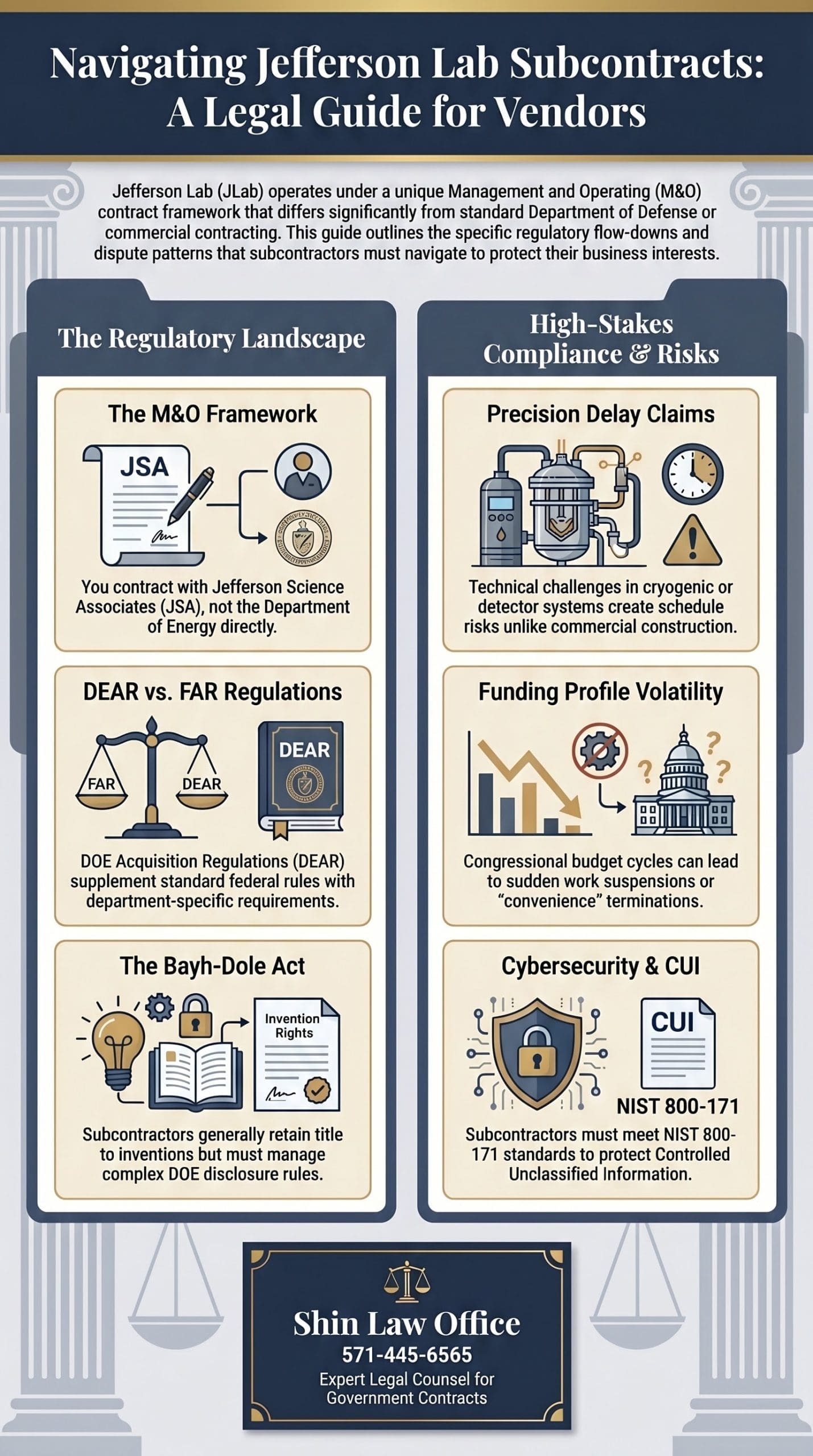
Table of Contents
- Jefferson Lab and the National Laboratory System
- The M&O Contract and DOE Acquisition Regulations
- Subcontract Flow-Downs and Specialty Provisions
- Delay Claims on Accelerator and Detector Programs
- Termination, Stop Work, and Funding Profile Issues
- Cybersecurity, CUI, and Export Control
- Cost Accounting and DOE Audit Issues
- How Shin Law Office Handles National Lab Disputes
- Summary
- Frequently Asked Questions
- References
Chapter 1: Jefferson Lab and the National Laboratory System
Jefferson Lab is one of 17 Department of Energy national laboratories that constitute the largest research enterprise in the United States. The Newport News facility was established in the 1980s and now operates the Continuous Electron Beam Accelerator Facility (CEBAF), the world’s most advanced superconducting radio frequency electron accelerator dedicated to nuclear physics research. The 12 GeV upgrade completed in the past decade pushed CEBAF’s beam energy to levels that support cutting-edge experiments examining the structure of protons, neutrons, and atomic nuclei.
The lab employs more than 700 staff, hosts thousands of visiting researchers from universities and laboratories worldwide, and operates four experimental halls (Halls A, B, C, and D) that conduct diverse research programs. The Electron-Ion Collider (EIC), planned for construction at Brookhaven National Laboratory, will draw on Jefferson Lab expertise and continue the lab’s role at the forefront of nuclear physics. The lab also conducts research in computational physics, applied physics, and accelerator science with applications beyond pure research.
Jefferson Lab’s procurement footprint reflects this scientific mission. Specialty cryogenic systems for the superconducting accelerator. Detector construction for experimental halls often involves precision components measured in microns. IT and computing infrastructure supporting the petabyte-scale data flows from experiments. Construction and facility maintenance for the 200-acre campus. Engineering services for accelerator upgrades, beam line modifications, and detector installations. Each procurement category has its own dispute patterns and regulatory frameworks.
National laboratory contracting differs from both ordinary federal contracting and from typical Defense Department subcontracting. The M&O contractor (Jefferson Science Associates) is a private contractor operating the laboratory under a long-term contract with DOE. JSA enters subcontracts using procedures derived from, but distinct from, standard FAR procedures, with DOE oversight and specific cost-reimbursement frameworks. Subcontractors who treat JLab work as ordinary commercial contracting miss the framework that controls many disputes. For a broader context on how national lab disputes fit into the wider Newport News legal market, see our complete guide to contract disputes in Newport News.
Chapter 2: The M&O Contract and DOE Acquisition Regulations
Jefferson Lab operates under a management and operating contract between DOE and Jefferson Science Associates LLC. The M&O contract is a unique federal contracting instrument that governs the operation of national laboratories. M&O contractors operate the laboratory facilities, manage the staff, conduct the scientific programs under DOE direction, and handle procurement on behalf of DOE. The M&O contractor is not a typical prime contractor; it is more like a stewardship arrangement under federal direction.
The DOE Acquisition Regulation at 48 C.F.R. Chapter 9 supplements the FAR for DOE-specific procurement. The DEAR addresses topics such as DOE-specific contract clauses, the M&O contractor procurement framework, classified and unclassified information requirements specific to DOE work, and other operational issues. Subcontractors performing work for JLab are subject to DEAR requirements that flow down from the M&O contract.
M&O contractor purchasing systems undergo periodic DOE review and approval. Approved purchasing systems allow JSA to make many procurement decisions without specific DOE pre-approval, while certain large or sensitive procurements still require DOE concurrence. Subcontractors should understand the procurement category in which their work falls and the level of DOE involvement, which affects timing, documentation, and decision-making.
DOE Order 414.1D and related quality assurance requirements apply to JLab work. The order establishes a graded approach to quality assurance based on the importance of the work to facility operations, safety, and environmental protection. Subcontractors performing safety-significant or operationally critical work face stringent quality requirements; subcontractors performing routine work face proportionate but less intensive requirements.
Subcontract dispute procedures differ from ordinary FAR cases. The M&O contractor framework means that disputes flow through JSA’s internal procedures, with DOE involvement on issues affecting the underlying M&O contract. Subcontractors with disputes should understand whose decision actually controls and how internal review interacts with potential litigation.
Chapter 3: Subcontract Flow-Downs and Specialty Provisions
JSA subcontracts include flow-down provisions from the M&O contract, the FAR, and the DEAR. The flow-downs cover both standard topics (cost accounting, security, equal opportunity, environmental compliance) and DOE-specific topics (specialty quality assurance, technology transfer, cybersecurity, export control). Subcontractors should review the flow-downs carefully before signing to understand the scope of obligations they are accepting.
Technology transfer provisions are particularly important at national labs. The Bayh-Dole Act and related DOE provisions allow contractors and subcontractors to retain title to inventions made under federally funded research, subject to DOE march-in rights and other federal preserved interests. Subcontractors creating intellectual property in the course of their work face decisions about disclosure, election of rights, and licensing that affect their long-term commercial position. The provisions can be complex, and subcontractors developing potentially patentable innovations should engage counsel before substantial decisions are made.
DOE quality assurance flow-downs vary by work category. Safety significant work at JLab faces detailed quality assurance requirements that exceed commercial baseline practices. Subcontractors performing this work must implement quality programs meeting specified standards, document compliance, and undergo periodic audit. The cost of quality assurance compliance is substantial, and subcontractors should price their work to include the actual cost of meeting the requirements rather than the cost of commercial-equivalent quality work.
Equal Employment Opportunity flow-downs at federal contractors of any size have been substantial since the 1960s, with reporting and affirmative action requirements that affect subcontractors above defined thresholds. JLab subcontractors face these requirements through standard flow-downs. Compliance includes specific reporting, written affirmative action plans for federal contractors above certain sizes, and periodic Office of Federal Contract Compliance Programs (OFCCP) audits.
Cooperative research and development agreements (CRADAs) between JLab and private industry produce a related framework. CRADAs allow industry to collaborate with the lab on research with shared intellectual property and limited compensation flowing in either direction. CRADA disputes about IP ownership, technology transfer terms, and project deliverables follow distinct rules that subcontractors with CRADA exposure should understand.
Chapter 4: Delay Claims on Accelerator and Detector Programs
Subcontractor delay claims on accelerator upgrades and detector construction projects share many features with delay claims on commercial construction work, with additional complexity reflecting the unique nature of scientific instrumentation. Detectors built to micron-level precision tolerances. Cryogenic systems operating at temperatures within fractions of a degree of absolute zero. Beam line components requiring vacuum systems with extreme isolation. Each project presents technical challenges that produce schedule risks unlike anything in commercial construction.
Documentation discipline matters more in scientific instrumentation than in routine work. Test data records, process records, and quality verification records establish both the technical performance achieved and the schedule reality. Subcontractors who maintain disciplined records support stronger claims when delays produce cost impact. Subcontractors who operate informally face significant evidentiary disadvantages when claims arise.
Funding profile dependencies create distinctive issues at national labs. DOE budgets follow congressional appropriation cycles, with continuing resolutions, government shutdowns, and budget revisions affecting laboratory funding. JLab subcontracts often include provisions allowing adjustments, suspensions, or terminations based on funding availability. Subcontractors who experience suspensions or stretches due to funding profile changes face limited recovery options under standard contract terms.
Government-furnished equipment and materials issues recur. JLab often supplies subcontractors with components, fixtures, or materials that the subcontractor incorporates into deliverables. When GFP arrives late, in defective condition, or in quantities that differ from contract specifications, the resulting delays give rise to subcontractor claims subject to the FAR Government Property clauses (52.245-1 and related). Documentation of GFP receipt, condition, and use is essential to support these claims.
Schedule integration with accelerator operating schedules adds complexity. CEBAF runs operating cycles with periodic shutdowns for maintenance, upgrades, and major work. Subcontractors performing work that requires beam-off conditions face windows that cannot be missed without substantial schedule impact. Disputes over access during scheduled shutdowns, coordination with other contractors during the same shutdown, and recovery from missed windows all give rise to claims.
Chapter 5: Termination, Stop Work, and Funding Profile Issues
National laboratory subcontracts include termination clauses similar to standard FAR provisions, with adaptations for the M&O contractor framework. Termination for convenience produces FAR Part 49-style recovery of costs incurred, profit on completed work, and reasonable settlement expenses. Termination for default requires a material breach without excuse and follows procedural patterns similar to those in FAR cases.
Stop work orders are particularly common at JLab given the scientific research environment. JSA may issue stop-work orders when funding profiles change, scientific priorities shift, safety issues arise, or other circumstances temporarily suspend work. Subcontractors who comply with stop-work orders generally recover costs incurred during the suspension, provided they document actual costs.
Funding profile termination is a distinctive issue at national labs. DOE programs subject to annual appropriations can experience funding reductions or eliminations, which can affect subcontracted work. The contractual framework typically allows JSA to adjust or terminate subcontracts when changes in the funding profile affect the underlying program, with compensation determined under the termination clauses. Subcontractors with substantial program-specific investments can see their economic position affected significantly when programs change.
Government shutdowns occasionally affect laboratory operations directly. During extended shutdowns, JLab and similar labs sometimes furlough staff, suspend work, or operate at reduced capacity. Subcontractors with active work face questions about whether continued performance is appropriate, whether costs incurred during the shutdown are recoverable, and how the shutdown affects schedule and milestone payments. The specific contract language and the actual shutdown circumstances drive the analysis.
Anticipatory profit recovery issues arise when funding profile changes affect long-running multi-year subcontracts. A subcontractor counting on five-year revenue from a particular program may face termination when the program’s funding shifts. Recovery of anticipatory profit on the unperformed portion is generally not available in convenience termination cases under FAR Part 49 framework, although the M&O contract framework can produce different results in specific circumstances. Subcontractors should structure their pricing and operations to manage this risk rather than relying on full multi-year revenue.
Chapter 6: Cybersecurity, CUI, and Export Control
National laboratory work often involves Controlled Unclassified Information requiring specific protection under federal frameworks. Some JLab work involves classified information, with corresponding security clearance requirements for personnel and facilities. Most JLab work falls under the CUI category rather than full classification, but the requirements are still substantial.
DOE cybersecurity requirements affect subcontractor operations across multiple frameworks. NIST SP 800-171 establishes baseline requirements for protection of CUI in non-federal systems and organizations. DOE Order 205.1B addresses department-wide cybersecurity policy. Specific JLab requirements add to the baseline. Subcontractors handling JLab CUI must implement the specified controls, document compliance, and respond to incidents within tight timeframes.
Export control issues affect scientific instrumentation work. The Export Administration Regulations cover dual-use items, including many scientific instruments and components. The Nuclear Regulatory Commission and DOE export control programs address nuclear-specific items. Subcontractors performing work that touches controlled items must comply with licensing requirements, the deemed export rules for foreign-person access, and reporting obligations. Compliance failures produce both contract risk and potentially severe regulatory exposure.
Visiting scientist programs at JLab create additional dimensions. The lab hosts thousands of visiting researchers from universities and laboratories worldwide, including substantial numbers of foreign nationals. Subcontractors providing services to or working alongside visiting researchers must navigate the export control implications of interactions with foreign persons involving controlled information.
Foreign national employment by subcontractors raises specific issues. Subcontractors with a workforce that includes foreign nationals must carefully manage which employees can access controlled information. The deemed export rule treats sharing controlled technical data with a foreign person inside the United States as an export to that person’s country, requiring a license in many cases. Subcontractors who do not properly implement these controls face exposure when audits or inspections occur.
Chapter 7: Cost Accounting and DOE Audit Issues
Cost-reimbursable subcontracts at JLab subject the subcontractor to government cost accounting standards and to potential audit by DOE Inspector General, the Defense Contract Audit Agency in some cases, or other federal audit organizations. The accounting requirements affect what costs are recoverable from JSA and ultimately from DOE.
Cost Accounting Standards (CAS) at 48 C.F.R. Part 9904 apply to subcontractors above defined thresholds. The standards address direct and indirect cost allocation, depreciation methods, pension cost recognition, and many other technical accounting topics. Noncompliance can produce DOE findings, disallowed costs, and potential penalties.
DOE-specific cost principles supplement the FAR Part 31 framework. Some costs are entirely unallowable. Other costs are conditionally allowable subject to specific documentation and reasonableness analysis. DOE audits carefully examine these distinctions, with disallowed costs reducing the subcontractor’s recovery and potentially increasing future audit risk.
Indirect cost rate disputes are particularly common at universities and research institutions that perform work for national labs. Federal regulations cap certain indirect costs at percentages set by 2 C.F.R. Part 200 (the federal Uniform Guidance) and related provisions. Subcontractors operating in this space must manage indirect rates carefully to maintain compliance while recovering legitimate costs.
Defective pricing claims occasionally arise when audits find that subcontractor cost or pricing data was inaccurate or incomplete. The Truth in Negotiations Act and related provisions allow recovery of overpayments based on defective pricing. The defenses are technical and require careful analysis of the data provided, the data that should have been provided, and whether any discrepancies affected negotiated prices.
Chapter 8: How Shin Law Office Handles National Lab Disputes
Shin Law Office represents subcontractors and suppliers in disputes arising from work for Jefferson Lab and other federal research institutions. As a Virginia-licensed attorney, I represent clients in Virginia state courts and in the U.S. District Court for the Eastern District of Virginia, Newport News Division.
Our process begins with the subcontract itself. The flow-down provisions, the change order procedure, the disputes clause, the audit and records access provisions, and the termination clauses all establish the framework. We coordinate with technical, scheduling, and accounting experts when substantial claims require their input.
Pre-suit dispute resolution often produces results in national lab subcontract disputes. JSA generally prefers professional resolution over litigation given the program implications and ongoing relationship dynamics. A well-presented claim with documented support and a credible damages calculation often produces a settlement offer.
When litigation becomes necessary, we file in the appropriate court, with attention to the contract’s dispute-resolution procedure, any arbitration clauses, and any forum-selection provisions. The full range of our work is described on our civil litigation practice page.
Summary
National laboratory subcontract disputes at Jefferson Lab operate under the M&O contractor framework, FAR and DEAR flow-downs, DOE quality assurance and cybersecurity requirements, and the unique scientific research culture of national lab work. Subcontractors who treat these as ordinary commercial cases miss frameworks that often determine the outcome.
Three principles apply across every JLab subcontract dispute. First, documentation drives outcomes. Contemporaneous project records, schedule data, cost accounting records, and inspection documentation all establish the framework for recovery or defense. Second, framework matters. Subcontractors who understand the M&O contractor structure, DOE acquisition rules, and DOE-specific quality requirements have substantial advantages. Third, expertise matters. Substantial claims require technical, scheduling, and accounting expert support alongside legal analysis.
If you are a subcontractor or supplier with a dispute against Jefferson Lab or another DOE national laboratory, do not wait for the situation to clarify itself.
Frequently Asked Questions
Who do I contract with at Jefferson Lab?
Jefferson Science Associates LLC (JSA) is the M&O contractor that operates the laboratory. Subcontractors enter agreements with JSA, not directly with DOE, although DOE oversight affects many decisions. JSA’s purchasing organization handles most procurement.
What is the DOE Acquisition Regulation and how does it affect my contract?
The DEAR at 48 C.F.R. Chapter 9 supplements the FAR for DOE-specific procurement. It addresses DOE-specific contract clauses, the M&O contractor framework, classified and CUI requirements, and various operational issues. Many JLab subcontracts include flow-down provisions from the DEAR.
My subcontract was terminated due to funding profile changes. What can I recover?
Generally costs incurred to date of termination, profit on completed work, and reasonable settlement expenses under termination for convenience principles. Anticipatory profit on the unperformed portion is typically not recoverable. The specific contract language and circumstances drive the analysis.
What happens during a government shutdown to my JLab subcontract?
During extended shutdowns, JLab may furlough staff and suspend work. Subcontractors with active work face questions about continued performance, recoverable costs during suspension, and schedule impact. The specific contract terms and shutdown circumstances drive the analysis.
Do I need a security clearance to work for Jefferson Lab?
Most JLab work does not require classified security clearances, although CUI handling requirements are common. Some work involving sensitive information requires Q or L clearances under DOE’s clearance framework. The specific subcontract identifies any clearance requirements.
What is the difference between Jefferson Lab and a Defense Department subcontract?
JLab subcontracts flow through the M&O contractor framework rather than typical DoD prime contractor structures. Cost accounting, audit, and dispute procedures follow DOE rather than DoD frameworks. Many substantive issues are similar but procedural details differ.
Where do I file a lawsuit against Jefferson Science Associates?
For state-law claims, the Newport News Circuit Court (Seventh Judicial Circuit). For federal questions or diversity cases, the U.S. District Court for the Eastern District of Virginia, Newport News Division. The subcontract may include arbitration or mediation provisions that must be honored before court action.
How long do I have to file a JLab subcontract claim?
Five years for breach of written contract under Va. Code § 8.01-246, with the period running from the date of breach. Specific contract dispute clauses may impose shorter notice periods that must be observed to preserve claims.
My intellectual property was developed under a JLab subcontract. Who owns it?
The Bayh-Dole Act and DOE provisions generally allow contractors and subcontractors to retain title to inventions made under federally funded research, subject to DOE march-in rights and other federal preserved interests. The specific contract terms and any disclosure obligations affect the analysis.
Can foreign nationals work on my JLab subcontract?
Often yes for work not involving controlled information, but export control rules affect access to specific items and information. Subcontractors with foreign national employees must carefully manage which employees can access controlled information. Compliance failures produce contract risk and potential regulatory exposure.
Facing a National Laboratory Subcontract Dispute?
Whether you are a Newport News-area subcontractor with a delay claim against Jefferson Science Associates, a scientific instrumentation supplier facing termination, or a small business contractor working through a funding profile dispute, you deserve a Virginia attorney who understands the M&O contractor framework, DOE acquisition rules, and the practical realities of these disputes.
Tough cases require tough attorneys. Shin Law Office handles federal subcontract disputes throughout the Commonwealth.
Call 571-445-6565

References
Federal Acquisition Regulation, 48 C.F.R. Chapter 1. https://www.acquisition.gov/far/
Department of Energy Acquisition Regulation, 48 C.F.R. Chapter 9. https://www.energy.gov/management/department-energy-acquisition-regulation-dear
DOE Order 414.1D, Quality Assurance. https://www.directives.doe.gov/
Cost Accounting Standards, 48 C.F.R. Part 9904. https://www.acquisition.gov/far/part-9904
Bayh-Dole Act, 35 U.S.C. § 200 et seq. https://www.govinfo.gov/app/collection/uscode
NIST SP 800-171: Protecting Controlled Unclassified Information. https://csrc.nist.gov/publications/detail/sp/800-171/rev-2/final
Federal Uniform Guidance, 2 C.F.R. Part 200. https://www.ecfr.gov/current/title-2/subtitle-A/chapter-II/part-200
Thomas Jefferson National Accelerator Facility. (2024). About Jefferson Lab. https://www.jlab.org/about
U.S. Department of Energy, Office of Science. (2024). National laboratories. https://www.energy.gov/science/national-laboratories
Code of Virginia. (2024). Title 8.01, Chapter 4: Limitations of actions. Virginia General Assembly. https://law.lis.virginia.gov/vacode/title8.01/chapter4/
U.S. District Court for the Eastern District of Virginia. (2024). Newport News Division. https://www.vaed.uscourts.gov/
