


FERS, CSRS, and TSP Division in Newport News Divorces: A Virginia Attorney’s Guide to Federal Civilian Pensions for Joint Base Langley-Eustis, NASA Langley, Jefferson Lab, Naval Weapons Station Yorktown, and the Peninsula Federal Workforce
By Anthony I. Shin, Esq. | Shin Law Office | Notes from a Virginia Attorney on the Federal Pension Division Cases That Decide What Peninsula Civil Servants Actually Have Left After Divorce
BOTTOM LINE UP FRONT
The Virginia Peninsula has one of the highest concentrations of federal civilian employees in the Commonwealth. Joint Base Langley-Eustis, with the Fort Eustis side located in Newport News and the Langley Air Force side in Hampton, supports thousands of civilian Department of Defense employees across Army Transportation Command, Training and Doctrine Command (TRADOC), Air Combat Command, and supporting functions. NASA Langley Research Center, the oldest NASA field center, employs roughly 3,400 civil servants and contractors in aerospace research. Jefferson Lab in Newport News operates the Continuous Electron Beam Accelerator Facility for the Department of Energy with hundreds of physicists, engineers, and technical staff. Naval Weapons Station Yorktown and the Coast Guard Training Center Yorktown employ thousands more federal civilians. The Hampton VA Medical Center adds federal healthcare workers across nursing, medicine, and administration.
When these federal civilian families divorce in Newport News, the Federal Employees Retirement System (FERS) basic annuity, the Civil Service Retirement System (CSRS) pension for older employees, the Thrift Savings Plan (TSP) defined contribution account, and the related survivor benefits, health insurance, and life insurance programs all enter the marital balance sheet. Division of these benefits requires a Court Order Acceptable for Processing (COAP) under federal regulations, with drafting requirements that differ meaningfully from a Qualified Domestic Relations Order under ERISA. Mistakes in this area cause real delays, real economic losses, and real frustration. Getting the work right takes counsel familiar with both Virginia equitable distribution under Va. Code § 20-107.3 and the federal regulatory framework at 5 CFR Parts 838 and 839.
If your Newport News divorce involves federal civilian retirement benefits, you deserve counsel who has handled these cases. Call Shin Law Office at 571-445-6565.
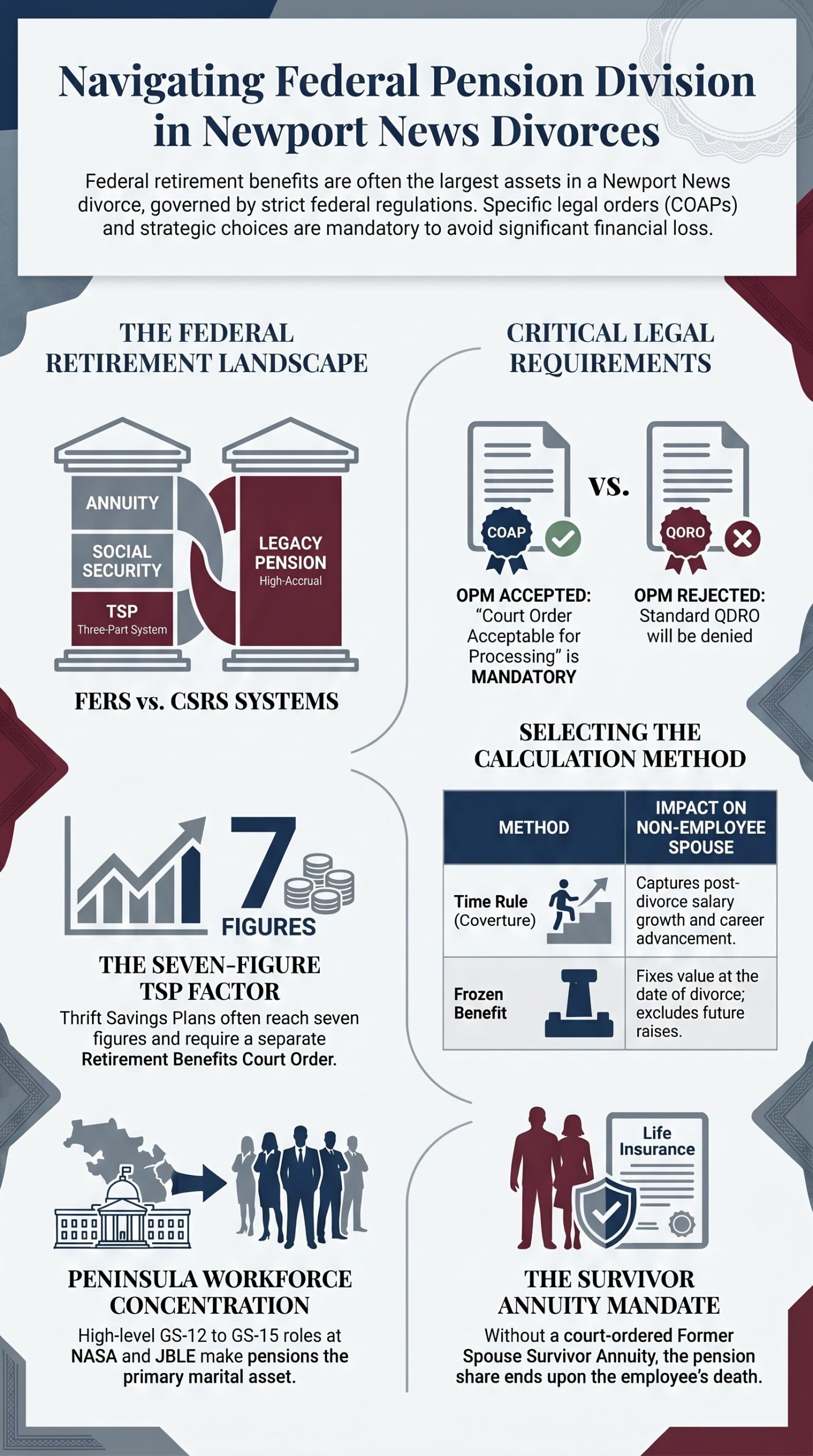
Table of Contents
- The NASA Langley Aerospace Engineer’s Pension Question
- The Federal Civilian Workforce on the Virginia Peninsula
- FERS, CSRS, and CSRS Offset Explained
- The Thrift Savings Plan and the Defined Contribution Side
- Calculating the Marital Share
- Court Order Acceptable for Processing: The COAP Drafting
- Survivor Annuity, FEHB, FEGLI, and Social Security Coordination
- What I Tell Peninsula Federal Civilian Couples in the First Meeting
- Summary
- Frequently Asked Questions
- References
Chapter 1: The NASA Langley Aerospace Engineer’s Pension Question
An aerospace engineer who had spent twenty-eight years at NASA Langley Research Center came to see me a few years ago. His twenty-six-year marriage was ending. His wife, a Newport News public school teacher, had filed first. They had a home in Hidenwood, two adult children who were past the custody and support analysis, and what, on the surface, looked like a manageable property division: a paid-down house, two cars, modest savings, and his federal pension. The straightforward part of the case was deceptive.
When we sat down with his most recent SF-50 personnel actions, his FERS service computation date, his Thrift Savings Plan statements, and his most recent estimated annuity calculation from the Office of Personnel Management, the actual financial picture became clearer. His FERS basic benefit, calculated on his high-three average salary as a GS-15 step 9 with twenty-eight years of credited service, was projected to produce roughly six figures of annual pension income at his planned retirement at age 62. The TSP balance, after twenty-eight years of contributions and the FERS automatic and matching contributions plus market appreciation, had grown into seven figures. The federal pension and TSP together were larger than the home, the cars, and the savings combined. They were the case.
His wife’s lawyer had proposed a settlement that addressed the home, the cars, and the savings, with a vague reference to “an equitable division of retirement benefits.” That phrasing, sitting in a settlement proposal, would have meant whatever the parties later agreed it meant, with the working spouse holding most of the practical bargaining power because the federal pension stays in the federal system until OPM receives a Court Order Acceptable for Processing. We rebuilt the case around the federal benefits. We pulled his complete service record. We projected the FERS basic annuity, the FERS Special Retirement Supplement, and the TSP under realistic assumptions. We addressed the survivor annuity election that had to be decided before the divorce decree entered. We drafted a COAP that complied with 5 CFR Part 839, as well as a separate Retirement Benefits Court Order for the TSP. The settlement that emerged was meaningfully different from the one originally proposed, and it held up correctly when the orders were submitted to OPM and to the Federal Retirement Thrift Investment Board (FRTIB).
That case taught me what I have seen consistently since: federal civilian families on the Peninsula have substantial retirement benefits that require technical work to divide properly, and the practitioners who handle these cases without that technical work produce results their clients regret. For broader background on family law in this region, see our cornerstone guide on family law in Newport News, Virginia.
Chapter 2: The Federal Civilian Workforce on the Virginia Peninsula
The Peninsula has one of the highest concentrations of federal civilian employees in Virginia. The institutions are large, established, and they employ the kind of workers whose retirement benefits make the federal pension division a meaningful component of family law work in Newport News.
Joint Base Langley-Eustis Civilian Workforce
Joint Base Langley-Eustis combines the former Langley Air Force Base in Hampton with the former Fort Eustis in Newport News. The Air Force side hosts Air Combat Command headquarters and the F-22 Raptor mission. The Army side hosts the Army Transportation Center and School, the Aviation Logistics School, and Training and Doctrine Command (TRADOC) headquarters. Beyond active-duty service members, the installation employs thousands of civilian Department of Defense employees in engineering, logistics, training development, intelligence support, contracting, financial management, human resources, and administrative functions that keep a major military installation running. Most of these civilians are FERS participants, hired under the system that began in 1987 for new federal employees.
NASA Langley Research Center
NASA Langley, founded in 1917 as the National Advisory Committee for Aeronautics Langley Memorial Aeronautical Laboratory, is the oldest NASA field center. Located in Hampton but drawing its workforce from across the Peninsula, it employs roughly 3,400 civil servants and contractors who conduct aerospace research, atmospheric science, and aeronautics development. The civil servant population is heavily weighted toward GS-12 through GS-15 scientists and engineers, with corresponding higher FERS and TSP balances at typical retirement.
Jefferson Lab
Thomas Jefferson National Accelerator Facility, located in Newport News, is a Department of Energy national laboratory operated by Jefferson Science Associates. The facility’s Continuous Electron Beam Accelerator Facility (CEBAF) supports nuclear physics research, and the staff includes hundreds of physicists, engineers, and technical professionals. Some staff are direct DOE federal employees with FERS coverage. Others are JSA contractor employees with employer-sponsored retirement plans. The distinction matters in family law because the procedural framework for dividing benefits differs between the two.
Naval Weapons Station Yorktown
Naval Weapons Station Yorktown, established in 1918, supports Navy munitions handling and storage operations. The installation employs civilian Department of the Navy workers in ordnance handling, security, engineering, and logistics. The civilian workforce is FERS-covered and includes both technical and skilled trade positions.
Coast Guard Training Center Yorktown
The Coast Guard Training Center Yorktown is the largest Coast Guard training facility, providing initial and advanced training for Coast Guard personnel. The facility employs civilian instructors, training development specialists, and supporting staff under Department of Homeland Security civilian personnel rules.
Hampton VA Medical Center
The Hampton VA Medical Center is a full Veterans Affairs medical facility that employs federal civilian healthcare workers, including physicians, nurses, pharmacists, mental health professionals, and administrative staff that support clinical operations. Many of these workers serve under Title 38 hybrid status that affects pension calculation in specific ways.
Why This Concentration Matters in Family Law
The concentration of federal civilians on the Peninsula means that a meaningful share of Newport News divorce cases involve at least one federal pension. The pension is rarely the only asset, but it is frequently the second- or third-largest, behind the marital home and roughly comparable to the TSP. When a federal employee has been in service for 20 or 30 years, the pension can be the largest asset on the balance sheet. Treating it casually produces wrong results.
Chapter 3: FERS, CSRS, and CSRS Offset Explained
The first technical question in any federal civilian pension case is which retirement system the employee is under. Three systems exist for current federal civilians, and each produces different mechanics for division.
Civil Service Retirement System (CSRS)
CSRS covers federal employees hired before January 1, 1984, who did not transfer to FERS. CSRS is a defined benefit pension with a relatively generous accrual formula. A typical CSRS retiree with thirty years of service receives roughly 56.25 percent of their high-three average salary. CSRS employees do not pay Social Security tax on their federal wages and do not earn Social Security credits for that service. They contribute roughly 7 percent of pay to CSRS. Few CSRS employees remain in active federal service in 2024 and beyond, but those who do tend to have substantial pension benefits because of the high accrual rate and long service.
Federal Employees Retirement System (FERS)
FERS covers federal employees hired on or after January 1, 1987, plus those hired between 1984 and 1986 who elected FERS coverage. FERS is a three-component system: the FERS Basic Annuity (a defined benefit pension with a smaller accrual rate than CSRS, generally 1 percent per year of service or 1.1 percent for retirements at or after age 62 with 20+ years), Social Security (FERS employees pay Social Security tax and earn benefits), and the Thrift Savings Plan (a defined contribution plan with employer matching). FERS produces a smaller defined benefit than CSRS but provides Social Security and a meaningful TSP balance for participants who contribute.
CSRS Offset
CSRS Offset applies to federal employees with prior CSRS service who returned to federal employment after a break of more than 365 days that ended after December 31, 1983. CSRS Offset employees pay both Social Security tax and a reduced CSRS contribution. At retirement, the CSRS pension is offset by a portion of the Social Security benefit attributable to the CSRS Offset service. The mechanics are complicated, and CSRS Offset cases require particular attention in division because the Social Security offset can create unexpected interactions with the marital share calculation.
FERS Special Retirement Supplement
FERS retirees who retire before age 62 with at least 20 years of service or who retire at the Minimum Retirement Age with 30 years of service receive the FERS Special Retirement Supplement, a payment that approximates the Social Security benefit the retiree would have earned from federal service, paid until age 62 when actual Social Security eligibility begins. The Supplement is divisible as part of the FERS benefit package and should be addressed in the COAP.
Identifying the Correct System
The employee’s SF-50 personnel actions, particularly the most recent one, identifies the retirement coverage. Common codes include “1” for CSRS, “K” for FERS, “C” for CSRS Offset, and various other codes for specialty groups. Pulling the SF-50 early in the case settles the system question and informs everything that follows. For Peninsula federal employees who have been in service since the 1980s, the answer is occasionally surprising and worth verifying.
Chapter 4: The Thrift Savings Plan and the Defined Contribution Side
The Thrift Savings Plan (TSP) is the federal government’s defined contribution retirement plan, comparable to a private sector 401(k). For FERS employees and CSRS Offset employees, the TSP is a substantial component of total retirement savings. For CSRS employees, TSP participation has historically been optional, though the agency does not match contributions for CSRS participants.
Account Structure
TSP accounts can hold both Traditional (pre-tax) and Roth (after-tax) balances. The two are tracked separately, and the tax treatment differs at distribution. For division purposes, the Roth and Traditional balances should be allocated proportionally between the spouses to maintain their tax characteristics, or handled explicitly if the parties prefer otherwise.
FERS Automatic and Matching Contributions
FERS employees receive a 1 percent automatic agency contribution regardless of whether they contribute themselves, plus matching agency contributions up to 4 percent based on employee contributions. The full 5 percent agency contribution is a meaningful retirement boost for FERS employees who maximize their own 5 percent contribution. The marital share of the TSP includes both the employee and agency contributions made during the marriage, plus associated investment earnings.
Investment Allocation and Performance
TSP participants can choose among the G Fund (government securities), F Fund (fixed income), C Fund (common stocks), S Fund (small-cap stocks), I Fund (international stocks), and the Lifecycle (L) Funds (target-date allocations). The investment allocation history affects the account balance and can be relevant in cases where one spouse alleges the other made imprudent investment decisions during the marriage.
Outstanding TSP Loans
TSP participants can borrow against their accounts. Outstanding loan balances at the time of divorce affect both the available account balance and the practical economics of distribution. If a loan is in default at separation, the unpaid balance is treated as a deemed distribution, with associated tax consequences and possible penalties. The COAP and any settlement agreement should address how outstanding loans are handled.
Separate Order Required
The TSP is administered by the Federal Retirement Thrift Investment Board (FRTIB), a separate agency from the Office of Personnel Management. Division of TSP requires a Retirement Benefits Court Order (RBCO) submitted to FRTIB, separate from the COAP submitted to OPM for the FERS or CSRS pension. The RBCO has its own format requirements set out in TSP regulations and the FRTIB’s published guidance.
Chapter 5: Calculating the Marital Share
Once the system is identified and the asset inventory is complete, the next question is the marital share. Virginia treats the portion of a federal pension attributable to service during the marriage as marital property under Va. Code § 20-107.3. Two main methods exist for calculating that share, and the choice between them produces outcomes that differ meaningfully.
The Time Rule (Coverture Fraction) Method
Under the time rule method, the marital share is calculated as a fraction with months of marital service as the numerator and total credited service at the time of benefit commencement as the denominator. The marital fraction is then applied to the pension benefit when it begins, capturing post-divorce salary growth and additional service. The non-employee spouse’s share is the marital fraction multiplied by the percentage allocated to that spouse, applied to the actual benefit. This approach effectively shares the post-divorce career advancement between the spouses.
The Frozen Benefit (Hypothetical Retirement) Method
Under the frozen benefit method, the pension is valued as if the employee retired at the time of divorce, using only the salary and service through the divorce date. The hypothetical accrued benefit is calculated, and the non-employee spouse receives a fixed dollar amount or percentage based on that frozen value. Post-divorce salary growth and additional service belong entirely to the working spouse. This approach effectively cuts off the non-employee spouse from career advancement after the divorce.
Choosing Between Methods
The two methods can produce substantially different long-run outcomes. For an employee with significant projected career advancement, the time rule method gives a larger share to the non-employee spouse because the share captures higher final salary. For an employee already near peak salary, the difference is smaller. The choice between methods is a strategic decision that should be made consciously rather than by default. Each side has legitimate arguments for the method that benefits them, and Virginia courts recognize both approaches.
Service Computation Date and Total Service
The Service Computation Date (SCD) on the SF-50 is the foundational data point for the calculation. It captures all creditable federal service, including any military service deposit, prior federal service buybacks, and other adjustments. The SCD does not always equal the date of first federal employment because of these adjustments. Pulling the SF-50 and verifying the SCD against the actual employment history settles the calculation foundation.
High-Three Average Salary
FERS and CSRS pensions are calculated on the employee’s “high-three” average salary, defined as the highest average annual rate of basic pay over any consecutive three years of service. For most employees, the high-three is the final three years of service, but for employees who reduced grade or salary near the end of their career, the high-three may be earlier years. Identifying the correct high-three matters for the projected benefit calculation in time rule cases and for the frozen benefit calculation in frozen benefit cases.
Chapter 6: Court Order Acceptable for Processing: The COAP Drafting
The order that divides a FERS or CSRS pension is a Court Order Acceptable for Processing (COAP). The COAP is governed by federal regulations at 5 CFR Part 838 (CSRS) and 5 CFR Part 839 (FERS). It is not a Qualified Domestic Relations Order (QDRO). The differences matter, and orders drafted under QDRO rules will be rejected by OPM.
OPM Acceptance Requirements
OPM publishes specific guidance for drafting COAPs, including the Handbook for Attorneys on Court-Ordered Retirement, Health Benefits, and Life Insurance under the Civil Service Retirement System, the Federal Employees Retirement System, the Federal Employees Health Benefits Program, and the Federal Employees’ Group Life Insurance Program. The Handbook (commonly referred to as the OPM Handbook) provides model language, identifies common errors, and explains what OPM will and will not accept. Drafting a COAP without consulting the Handbook is a recipe for rejection.
Required Elements
A COAP must identify the retirement system (CSRS or FERS) by name, identify the employee by full name and either Social Security Number or claim number if retired, identify the former spouse by full name and current address, specify the share allocation in a manner OPM can compute, address the survivor annuity election, address whether the order divides the FERS Special Retirement Supplement, and contain the magic language OPM requires for jurisdiction and finality. Missing any of these elements produces a rejection, and rejection means the order has to be amended and resubmitted, with potentially significant delay.
Common Drafting Errors
Common errors that produce OPM rejection include using QDRO language inappropriate for federal pensions, failing to address the survivor annuity, ambiguous share allocation that OPM cannot compute, failing to specify the correct retirement system, and including provisions OPM has no authority to enforce. Each rejection costs time and money. The careful work to get the COAP right the first time saves substantial cost over the long arc of a divorce.
Service of the COAP
After the COAP is entered, it must be served on OPM at the address specified in 5 CFR Parts 838 and 839, with the required documentation. OPM acknowledges the COAP, reviews it for compliance, and either accepts or rejects it. If accepted, the COAP is added to the employee’s retirement file and will be applied when retirement benefits commence or when the order otherwise specifies.
TSP Order Submission
The Retirement Benefits Court Order for the TSP is submitted to FRTIB separately from the COAP submission to OPM. FRTIB’s review process and acceptance criteria are different from OPM’s. Coordinating both submissions, with the right documentation packages, is part of the post-decree work that finalizes the benefit division.
Chapter 7: Survivor Annuity, FEHB, FEGLI, and Social Security Coordination
The retirement benefits package for federal civilians includes more than the basic pension and TSP. Several related benefits affect the family law analysis and require attention in the divorce.
Former Spouse Survivor Annuity (FSSA)
Without a court-ordered Former Spouse Survivor Annuity election, a former spouse’s share of the federal pension ends at the employee’s death. This can be a substantial loss for a former spouse who relies on the pension share for retirement income. The FSSA election preserves a survivor benefit for the former spouse, paid for life after the employee’s death, in exchange for an actuarial reduction of the basic annuity during the employee’s lifetime. The FSSA must be addressed in the COAP, and the election must occur within the time frame specified in 5 U.S.C. § 8341(h) and 5 U.S.C. § 8445.
FEHB Continued Coverage
The Federal Employees Health Benefits (FEHB) program covers federal employees and their families. Upon divorce, the former spouse’s coverage under the employee’s FEHB plan ends. Two paths to continued coverage exist. First, the spouse equity provisions allow a former spouse who was married to the employee for a sufficient period and had FEHB coverage during the marriage to continue coverage under FEHB if the requirements at 5 U.S.C. § 8901(10) are met. Second, the Temporary Continuation of Coverage (TCC) program allows up to 36 months of continued coverage at the former spouse’s expense. The election deadlines are short, and missing them results in a loss of coverage.
FEGLI
Federal Employees Group Life Insurance (FEGLI) provides life insurance coverage for federal employees. FEGLI is not divisible as marital property in the way the pension is, but the beneficiary designation can be addressed in a divorce. A federal employee who designated a spouse as a beneficiary may want to update the designation after divorce. Conversely, a divorce decree can require the employee to maintain coverage with a former spouse as beneficiary, often as security for support obligations.
Social Security for FERS Employees
FERS employees pay Social Security tax and earn Social Security benefits. Social Security is not divisible by court order as private pensions are, but former-spouse benefits exist independently. A former spouse married to the worker for at least 10 years may be entitled to Social Security divorced spouse benefits at age 62, equal to up to 50 percent of the worker’s primary insurance amount, without affecting the worker’s own benefit. This is a federal entitlement that does not require court action but should be understood in the broader context of retirement income.
CSRS and the Government Pension Offset
CSRS employees who do not pay Social Security tax may have spouse and survivor Social Security benefits reduced under the Government Pension Offset (GPO). The GPO can reduce or eliminate Social Security spouse benefits the CSRS retiree might otherwise receive based on a current or former spouse’s Social Security record. This complicates retirement planning for CSRS retirees and their former spouses, and the analysis should be part of the divorce planning. For the active duty military pension counterpart, see our companion guide on USFSPA military pension division.
Chapter 8: What I Tell Peninsula Federal Civilian Couples in the First Meeting
When a Peninsula federal civilian couple comes to my office for a divorce consultation, I tell them six things in the first meeting.
First, the federal pension is real, substantial, and almost certainly larger than you think. Whether you are the federal employee or the spouse of one, the FERS basic annuity, the CSRS pension, or the CSRS Offset benefit represents years of accrued value, and the work to value and divide it correctly takes effort. Anyone who tells you the federal pension is a side issue is wrong.
Second, we need the complete service record. The most recent SF-50, the Service Computation Date verification, the salary history, the most recent FERS or CSRS estimated annuity calculation, the TSP statements showing both Traditional and Roth balances, and the FEHB and FEGLI election documents. Most of this is accessible through your agency’s HR office and the OPM Services Online portal. Pulling it early gives us the foundation for everything else.
Third, we will make a conscious choice between the time rule method and the frozen benefit method. This is a strategic decision that affects the long-run economics meaningfully. The default in many practitioners’ settlements is the frozen benefit method, but it is not always the right answer. We will look at the projected career advancement, the salary trajectory, and the parties’ overall financial picture before settling on the method.
Fourth, we plan to place two separate orders. The COAP submitted to OPM divides the FERS or CSRS pension. A separate Retirement Benefits Court Order submitted to FRTIB divides the TSP. Each has its own drafting requirements. Each goes to a different agency. Coordinating both is part of the post-decree work, and confusion between the two produces real delay.
Fifth, we will address the survivor annuity election before the decree enters. The Former Spouse Survivor Annuity is the protection that keeps the non-employee spouse’s pension share alive after the employee’s death. Forgetting to address it is a costly oversight that cannot be easily corrected later. The election has to be in the COAP, with the right language.
Sixth, we will discuss the FEHB transition. If the non-employee spouse has been covered under the federal employee’s FEHB family plan, that coverage ends at divorce. Whether to elect spouse equity continuation or TCC, and how to handle the costs, must be decided before the divorce is final. Missing the election deadline produces loss of coverage that cannot be reversed. For broader Newport News family law context, the cornerstone guide on family law in Newport News, Virginia covers the surrounding issues, and the firm’s general family law practice page provides more on how we approach these matters.
Summary
For Newport News divorces involving federal civilian employees from Joint Base Langley-Eustis, NASA Langley Research Center, Jefferson Lab, Naval Weapons Station Yorktown, the Coast Guard Training Center Yorktown, the Hampton VA Medical Center, or any other Peninsula federal employer, the FERS or CSRS pension and the TSP are typically among the largest assets on the marital balance sheet. Division requires careful technical work that begins with identifying the correct retirement system, calculating the marital share under either the time rule or frozen benefit method, drafting a Court Order Acceptable for Processing that complies with 5 CFR Parts 838 and 839, and submitting a separate Retirement Benefits Court Order to the Federal Retirement Thrift Investment Board for the TSP.
The work does not end with the pension and TSP. The Former Spouse Survivor Annuity election under 5 U.S.C. § 8341(h) and 5 U.S.C. § 8445 protects the non-employee spouse’s share after the employee’s death and has to be addressed in the COAP. The FEHB transition for the non-employee spouse has its own elections and deadlines under 5 U.S.C. § 8901(10). Federal Employees Group Life Insurance designations, Social Security divorced-spouse benefits, and the Government Pension Offset for CSRS retirees all factor into the broader retirement picture and inform the settlement analysis.
Done correctly, federal pension division produces clean orders that OPM and FRTIB accept on first submission, fair allocation of marital share, and a benefit package that supports both former spouses through retirement. Done casually, it results in rejected orders, lost survivor benefits, missed FEHB elections, and economic consequences that haunt one or both parties for decades. The work to do it right is worth the effort.
Frequently Asked Questions
Is my federal pension divisible in a Newport News divorce?
Yes. The marital portion of a FERS or CSRS pension is divisible under Va. Code § 20-107.3 as marital property. Federal regulations at 5 CFR Parts 838 and 839 authorize state courts to divide federal pensions through a Court Order Acceptable for Processing. The marital portion is generally the share attributable to federal service performed during the marriage.
What is the difference between a COAP and a QDRO?
A Qualified Domestic Relations Order (QDRO) divides ERISA-governed private retirement plans. A Court Order Acceptable for Processing (COAP) divides federal civilian pensions under FERS or CSRS. The two have different governing law, different drafting requirements, and different submission processes. A QDRO submitted to OPM will be rejected, and a COAP submitted to a private plan administrator will not work either. Drafting the right type of order is essential.
Can my TSP be divided in the same order as my FERS pension?
No. The Thrift Savings Plan is administered by the Federal Retirement Thrift Investment Board (FRTIB), a separate agency from OPM. Division of TSP requires a Retirement Benefits Court Order submitted to FRTIB, separate from the COAP submitted to OPM. Both orders are typically prepared together and entered together, but they are processed by different agencies on different timelines.
What happens if I do not address the survivor annuity in my divorce?
Without a court-ordered Former Spouse Survivor Annuity election, the former spouse’s share of the federal pension ends at the employee’s death. The non-employee spouse loses ongoing income that had been counted on for retirement. The election must be addressed in the COAP and made within the time frames specified in 5 U.S.C. § 8341(h) for CSRS or 5 U.S.C. § 8445 for FERS. Forgetting this is a costly oversight.
My spouse is a NASA Langley scientist. What documentation do I need?
The most recent SF-50 personnel action, the Service Computation Date documentation, full salary history (preferably back to the start of marriage), the most recent FERS estimated annuity calculation from OPM Services Online, complete TSP statements showing Traditional and Roth balances, FEHB enrollment documents, and FEGLI coverage documents. Most of this is accessible through agency HR. Discovery in the divorce can compel production if voluntary disclosure is incomplete.
How long does OPM take to process a COAP?
OPM processing times vary depending on workload and the completeness of the submission. A clean COAP that complies with all formatting and content requirements is typically acknowledged within several weeks and accepted within a few months. A rejected COAP that requires amendment can take much longer because it requires re-drafting, re-entry by the court, and re-submission. The careful work to get the COAP right the first time saves significant time over the long run.
Can I keep FEHB coverage after divorce?
Possibly, through one of two paths. The spouse equity provisions allow a former spouse who meets specific marriage duration and prior coverage requirements to elect continued FEHB coverage. The Temporary Continuation of Coverage (TCC) program allows up to 36 months of continued coverage at the former spouse’s expense, regardless of marriage duration. Both elections have short deadlines after divorce, and missing the deadlines produces loss of coverage that cannot be reversed.
My spouse is at Jefferson Lab. Is that the same as a federal employee?
Not necessarily. Jefferson Lab is operated by Jefferson Science Associates (JSA), a contractor managing entity for the Department of Energy. Some Jefferson Lab staff are direct DOE federal employees with FERS coverage. Others are JSA contractor employees with employer-sponsored retirement plans rather than FERS. The procedural framework for benefit division differs between the two. Identifying the employment status early in the case avoids confusion later.
Should I use the time rule method or the frozen benefit method?
It depends on the facts of your case, particularly the projected career advancement of the federal employee and the parties’ overall financial position. The time rule method captures post-divorce salary growth in the marital share calculation, which generally favors the non-employee spouse when the employee has significant career advancement ahead. The frozen benefit method values the pension at the time of divorce, which generally favors the employee. The choice should be made consciously with attorney input, not by default.
When should I contact a Newport News family law attorney about federal pension division?
As early as possible in the divorce process. The federal benefits work takes time to develop, and the documentation, the strategic decisions, and the order drafting all benefit from being addressed throughout the case rather than at the end. Early consultation also gives you the option to address the survivor annuity, FEHB transition, and other elections before deadlines run.
Federal Civilian Pension at Stake in Your Newport News Divorce?
Whether you are a Joint Base Langley-Eustis civilian DoD employee, a NASA Langley aerospace engineer or scientist, a Jefferson Lab physicist or technical staff member, a Naval Weapons Station Yorktown civilian, a Coast Guard Training Center Yorktown employee, a Hampton VA Medical Center healthcare worker, or the spouse of any Peninsula federal civilian employee, you deserve counsel who has handled FERS, CSRS, and TSP division and knows how to draft orders that OPM and FRTIB will accept.
Tough cases require tough attorneys. Shin Law Office handles federal pension division and complex high-asset divorce matters throughout Newport News, the Virginia Peninsula, Hampton Roads, and the Commonwealth.
Call 571-445-6565

References
Code of Virginia. (2024). Title 20, Section 20-107.3: Court may decree as to property and debts of the parties. Virginia General Assembly. https://law.lis.virginia.gov/vacode/title20/chapter6/section20-107.3/
5 U.S.C. § 8341 (Survivor annuities under CSRS). https://www.govinfo.gov/app/collection/uscode
5 U.S.C. § 8345 (Payment of CSRS benefits subject to court order). https://www.govinfo.gov/app/collection/uscode
5 U.S.C. § 8445 (Survivor annuities under FERS). https://www.govinfo.gov/app/collection/uscode
5 U.S.C. § 8467 (Payment of FERS benefits subject to court order). https://www.govinfo.gov/app/collection/uscode
5 U.S.C. § 8901(10) (Definition of former spouse for FEHB spouse equity). https://www.govinfo.gov/app/collection/uscode
5 CFR Part 838 (Court Orders Affecting Retirement Benefits under CSRS). https://www.ecfr.gov/current/title-5/chapter-I/subchapter-B/part-838
5 CFR Part 839 (Statutory Court Orders Affecting Retirement Benefits under FERS). https://www.ecfr.gov/current/title-5/
U.S. Office of Personnel Management. (2024). Handbook for Attorneys on Court-Ordered Retirement, Health Benefits, and Life Insurance under the Civil Service Retirement System, Federal Employees Retirement System, Federal Employees Health Benefits Program, and Federal Employees’ Group Life Insurance Program. https://www.opm.gov/retirement-services/court-orders/
U.S. Office of Personnel Management. (2024). FERS Information. https://www.opm.gov/retirement-services/fers-information/
U.S. Office of Personnel Management. (2024). CSRS Information. https://www.opm.gov/retirement-services/csrs-information/
Federal Retirement Thrift Investment Board. (2024). Court orders and the TSP. https://www.tsp.gov/publications/
Social Security Administration. (2024). Government Pension Offset. https://www.ssa.gov/pubs/EN-05-10007.pdf
Social Security Administration. (2024). Benefits for divorced spouses. https://www.ssa.gov/benefits/retirement/planner/applying7.html
NASA Langley Research Center. (2024). About NASA Langley. https://www.nasa.gov/langley/
Thomas Jefferson National Accelerator Facility. (2024). About Jefferson Lab. https://www.jlab.org/about
Joint Base Langley-Eustis. (2024). Installation overview. https://www.jble.af.mil/
