
Looking for the Loudoun business framework? This page covers a specific Loudoun business scenario. For the broader county guide that walks through formation disputes, contract litigation, business torts under Va. Code 18.2-499, non-competes, fraud, and trade secrets, see Loudoun County Business Lawyer: A Working Attorney’s Guide.
Bottom Line Up Front
Northern Virginia is home to one of the most concentrated and complex commercial economies in the United States. From Ashburn’s data center corridor and Chantilly’s defense ecosystem to Prince William County’s industrial belt, Arlington’s federal agency hub, and the commercial anchors anchoring Clarke and Frederick Counties, this region moves billions of dollars through contracts every year. When those contracts break, the consequences are not abstract. Projects stop. Payments disappear. Federal awards are redirected. Teaming partners walk. This guide covers the full spectrum of commercial contract litigation that Shin Law Office handles across these six Virginia counties, including B2B corporate disputes, federal contracting and B2G claims, teaming agreement fights, commercial construction litigation, mechanic’s lien enforcement, the legal boundary between contract and tort theories, and toxic tort exposure in commercial environments.
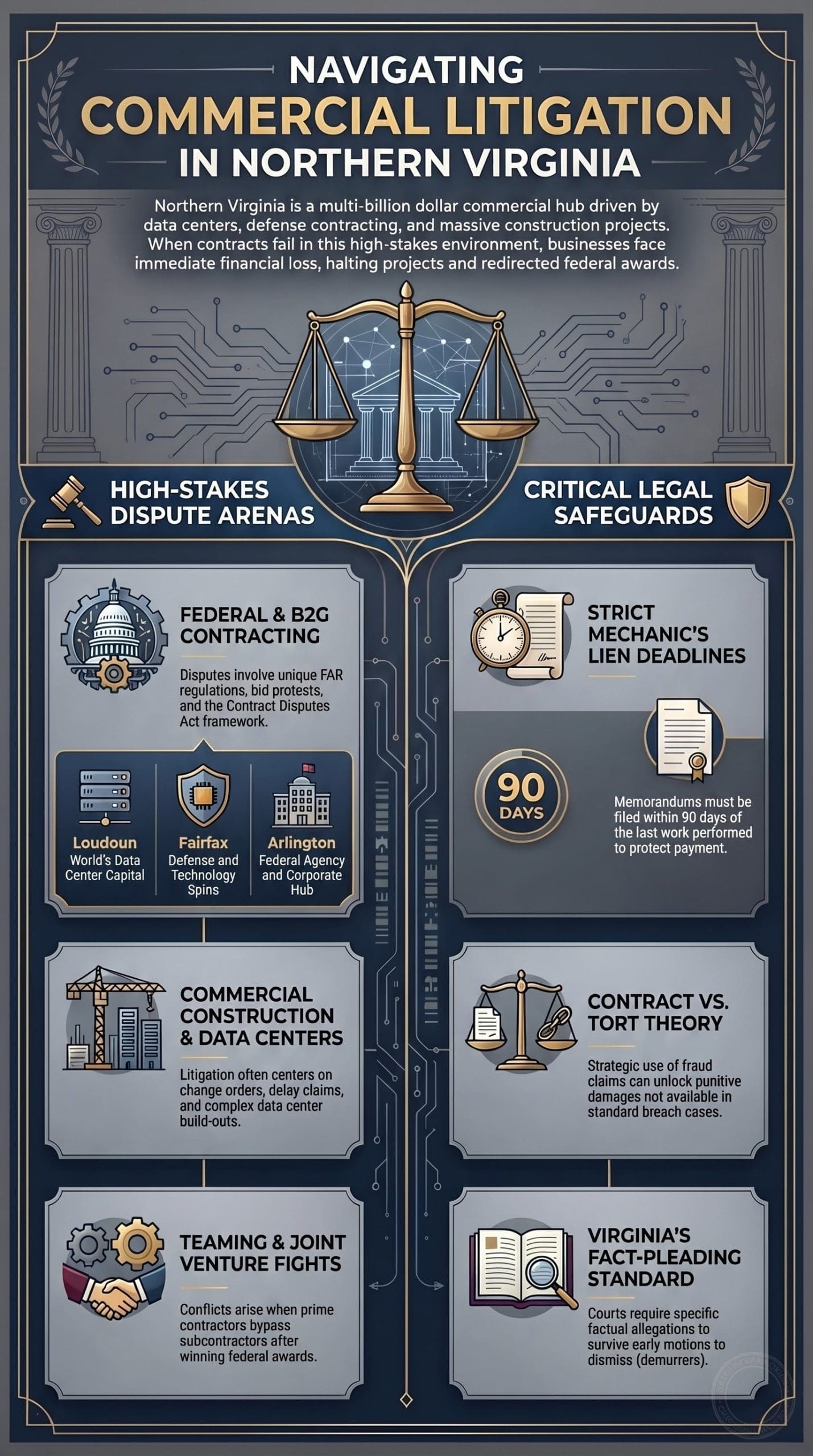
Table of Contents
- Northern Virginia’s Commercial Economy: Why the Stakes Are Always High
- B2B Contract Disputes: When Corporate Deals Fall Apart
- Business to Government (B2G) and Federal Contracting Disputes
- Teaming Agreements and Joint Venture Fights in Federal Contracting
- Commercial Construction Litigation: Change Orders, Cost Overruns, and Delay Claims
- Mechanic’s Liens: Protecting Payment Rights on Virginia Projects
- Contracts vs. Torts: Choosing the Right Legal Theory
- Toxic Torts in Commercial and Industrial Settings
- Civil Litigation Strategy: How Commercial Cases Move Through Virginia Courts
- Choosing Legal Representation for Commercial Disputes in Northern Virginia
- Summary
- References (APA)
Northern Virginia’s Commercial Economy: Why the Stakes Are Always High
You do not stumble into a commercial dispute in Northern Virginia. You land in one because someone made a decision that cut against your interests, and now the contract is the only thing standing between you and a serious financial loss. Understanding the commercial terrain of the region helps explain why these disputes arise so predictably and why the legal exposure is so large when they do.
Loudoun County: The Data Center Capital and Its Contract Ecosystem
Loudoun County is the data center capital of the world. Ashburn alone hosts more internet exchange traffic than nearly any other location on the planet. Companies like Equinix, CyberCore Technologies, QTS, and infrastructure arms of Amazon, Microsoft, and Google have built massive campuses along the Route 7 and Route 28 corridors. Sterling, Dulles, and Lansdowne host data facilities, logistics operations, and technology companies whose contracts span construction, equipment supply, managed services, power procurement, and security. Leesburg, the county seat, is a growing commercial hub with law firms, financial services, real estate developers, and government contractors. One Loudoun functions as a live, work, play mixed-use center with retail, office, and hospitality anchors. In this environment, contract disputes often involve enormous sums. A single data center project can involve hundreds of millions of dollars in construction contracts, dozens of subcontractors, and disputes that can halt a project’s commissioning timeline for months.
Fairfax County: The Defense and Technology Spine
Fairfax County is the economic engine of Virginia. Tysons Corner, the county’s urban center, hosts global financial institutions, commercial real estate developers, and technology company headquarters. McLean is home to the intelligence community’s contractors, hedge funds, and consulting firms. Reston and Herndon sit at the center of the Route 28 technology corridor, with companies serving everything from cybersecurity and cloud computing to federal program management. Chantilly and Centreville anchor the defense aerospace and logistics belt near Washington Dulles International Airport. Springfield handles major logistics and government contract operations near the I-95 and I-395 corridors. In Fairfax County, commercial disputes almost always involve significant dollar amounts, sophisticated parties, and contract documents that are dense and technical. Courts here are experienced with commercial litigation. Stakes are high from the opening brief.
Prince William County: Manufacturing, Data, and Logistics
Prince William County has positioned itself aggressively as a hub for data center development, advanced manufacturing, and logistics. The Prince William Digital Gateway project covers roughly 2,100 acres near Gainesville and Haymarket and has generated significant commercial and legal activity as landowners, developers, and government entities negotiate, dispute, and litigate terms. Manassas hosts the Virginia Advanced Technology Education Center and a growing technology manufacturing sector. Woodbridge is a major retail and commercial services center. The industrial and government-facing commercial activity in this county produces contract disputes involving construction, technology procurement, logistics, and land use that can move quickly and become expensive. The county’s Commercial Expedited Plan Review Program, relaunched in early 2026, has shifted additional risk downstream to contractors and subcontractors when projects move faster than their documentation.
Arlington County: The Federal Agency and Corporate Hub
Arlington County contains some of the most commercially valuable real estate in the country. Rosslyn is a dense financial and corporate office district directly across from Georgetown. Courthouse and Clarendon serve as mixed commercial and residential centers. Ballston has become a tech and government services hub. Pentagon City and Crystal City anchor the southern end, and the latter has transformed into National Landing, home to Amazon’s HQ2 and a growing technology and government contracting campus. In Arlington, commercial disputes often carry federal dimensions because so many businesses here either hold federal contracts or serve contractors who do. The county also has some of the highest commercial real estate values in Virginia, which means construction, lease, and vendor disputes can escalate to significant damages very quickly.
Clarke and Frederick Counties: Growing Commercial Anchors in the Shenandoah Region
Clarke County’s commercial center is Berryville, a small but active county seat. The county is home to agriculture-related businesses, equestrian properties, wineries, and small commercial operations that increasingly generate contract and business disputes as the region develops. Boyce and Millwood have growing commercial activity tied to tourism and agribusiness. Frederick County’s major commercial hub is the Winchester area, which sits at the junction of I-81 and I-66. Winchester is one of the most strategically located commercial nodes in western Virginia, hosting distribution centers, healthcare facilities, manufacturing operations, and government contractors serving both federal and state agencies. Stephens City and Middletown have growing industrial and commercial presences. Businesses in these counties are increasingly tied into the Northern Virginia commercial ecosystem through federal contracting, construction, and technology contracts.
Virginia circuit courts handle civil cases above $25,000. The Fairfax Circuit Court is one of the busiest commercial litigation venues in the state. Arlington Circuit Court handles high-value commercial disputes in one of Virginia’s most commercially dense jurisdictions. Prince William and Loudoun Circuit Courts see an increasing volume of construction and technology contract disputes as development activity in those counties grows.
B2B Contract Disputes: When Corporate Deals Fall Apart
Most commercial relationships start with optimism and paperwork. They end with a dispute when one side does not perform, changes direction, or decides the deal no longer serves its interests. B2B contract litigation in Northern Virginia spans a wide range of industries and deal structures, but the legal framework is anchored in Virginia contract law regardless of whether the parties are a startup in Reston or a defense prime in Chantilly.
What Constitutes a Breach in Virginia
Virginia recognizes both material breach and minor breach of contract. A material breach is one that goes to the heart of the agreement, giving the non-breaching party the right to treat the contract as terminated and pursue full damages. A minor breach entitles the non-breaching party to damages but does not excuse their own performance. In B2B disputes, determining which type of breach occurred is often the first contested question, and the answer can change everything about the litigation strategy. A technology vendor who delivers a software system three weeks late has committed a different kind of breach than one who delivers a non-functional system with fabricated test results. Virginia courts look at the nature of the breach, the extent of harm, and whether the contract itself defines materiality or addresses cure rights.
Merger and Acquisition Disputes
Northern Virginia’s technology and defense sectors generate a steady volume of M&A disputes. When acquisitions close and the post-closing adjustment period produces unexpected results, buyers and sellers end up in litigation over earnest money, working capital adjustments, indemnification obligations, and representations and warranties. Escrow disputes are common when the seller believes it has performed and the buyer has identified post-closing defects. In McLean, Tysons, Reston, and Herndon, these disputes often involve technology companies with complex revenue recognition practices, government contract portfolios with undisclosed risks, or workforce obligations that did not survive the transition as represented. M&A litigation requires an attorney who understands both the deal structure and how Virginia courts treat purchase agreement obligations.
Vendor, Supplier, and Service Agreement Fights
The most common B2B disputes in this region involve vendor or supplier agreements that break down over scope, pricing, delivery, or quality. A managed services provider in Herndon that stops responding to tickets is in breach. A construction materials supplier in Woodbridge that ships the wrong product and refuses to credit the invoice is in breach. A staffing agency in Leesburg that fails to provide qualified workers as represented in the staffing agreement is in breach. These disputes are sometimes straightforward and sometimes technically complex. The key in Virginia is acting quickly: the statute of limitations for written contract claims is five years, but delay can cost you evidence, witnesses, and leverage.
NDA and Confidentiality Violations
In a region saturated with technology companies, defense contractors, and government service firms, nondisclosure agreements are everywhere. When a former partner, vendor, or employee takes confidential information to a competitor, the NDA is the foundation of your case. Virginia courts enforce NDAs that are reasonable in scope, duration, and geographic coverage. The trade secret analysis under the Virginia Uniform Trade Secrets Act runs parallel to the NDA contract claim and can produce injunctive relief if you act fast. Businesses in Chantilly, McLean, and Reston that carry sensitive technology or government program information need to take NDA breaches seriously from day one.
Damages in B2B Contract Litigation
Virginia allows expectation damages, which put the non-breaching party in the position they would have been in had the contract been performed. In commercial disputes, this often means lost profits, costs of cover (what you had to pay someone else to perform), and out-of-pocket costs. Consequential damages are available if they were foreseeable at the time of contracting. Punitive damages for breach of contract are generally not available in Virginia unless the breach is accompanied by an independent tort such as fraud. Attorney’s fees are available only if the contract expressly provides for them or a statute allows them, which is one reason carefully drafted fee-shifting provisions matter in every commercial agreement.
Has a business deal broken against you?
Shin Law Office handles B2B contract disputes across Loudoun, Fairfax, Prince William, Arlington, Clarke, and Frederick Counties. The sooner you call, the more options you have.
Related reading: The Truth About Contract Disputes: How Virginia Companies Fight Back and When Business Deals Go Wrong: What Fairfax County Companies Need to Know.
Business to Government (B2G) and Federal Contracting Disputes
Northern Virginia is one of the most concentrated federal contracting markets in the world. Companies in Chantilly, Herndon, Reston, McLean, Arlington, and Ashburn hold billions of dollars in federal contracts spanning defense, intelligence, information technology, facility management, healthcare, and logistics. When those contracts generate disputes, the legal framework is entirely different from private commercial litigation. The government is not just a counterparty. It is a counterparty with statutory rights, regulatory defenses, and dispute resolution mechanisms that have no equivalent in private law.
The Federal Acquisition Regulation Framework
Every federal contract of significance is governed by the Federal Acquisition Regulation (FAR), a body of rules that governs pricing, performance, termination, changes, and disputes. Contractors who do not read the FAR clauses in their contracts carefully often find themselves bound by obligations they did not anticipate. The government’s right to terminate for convenience is one of the most consequential FAR provisions. Unlike a private breach of contract, a termination for convenience is not a wrongful act by the government. It is a unilateral right the government exercises when it determines that a continuation of the contract is no longer in the government’s interest. The contractor’s remedy is a termination settlement, not lost profits for the remaining contract period. Understanding this distinction is essential before you sign any federal agreement.
Filing a Claim Under the Contract Disputes Act
When a contractor has a monetary dispute with a federal agency, the mechanism for pressing that dispute is the Contract Disputes Act (CDA). A contractor must submit a certified claim to the contracting officer (CO) for any claim exceeding $100,000. The CO has a defined period to issue a final decision, and if the contractor disagrees, it may appeal to either the Armed Services Board of Contract Appeals (ASBCA), the Civilian Board of Contract Appeals (CBCA), or the U.S. Court of Federal Claims (COFC). These forums have their own procedural rules and body of case law. Experienced representation matters enormously. Missing a deadline or failing to certify a claim correctly can forfeit your right to recover, regardless of how strong your underlying position is.
Common Federal Contracting Disputes in Northern Virginia
The most frequent B2G disputes that Shin Law Office sees in this region involve scope disputes over what the contract required and what was actually delivered, modification and change order fights where the government ordered additional work but refused to increase the contract price, cost disallowances where the government’s audit office challenges the allowability or allocability of specific costs, performance disputes where the government issues a cure notice or show cause letter as a precursor to termination for default, and small business disputes involving set-aside requirements, subcontracting plan compliance, and challenges to agency procurement decisions. Small business contractors in Manassas, Herndon, and Leesburg that hold set-aside contracts under 8(a), SDVOSB, WOSB, or HUBZone programs face additional compliance obligations that can generate disputes with both the agency and the Small Business Administration.
Bid Protests
When a contractor loses a federal award it believes it should have won, a bid protest may be available. Bid protests can be filed with the Government Accountability Office (GAO), the procuring agency itself, or the Court of Federal Claims. GAO protests must be filed within strict time limits, typically 10 days from the date the protester knew or should have known the basis for the protest. A successful protest can result in a corrective action, a re-evaluation, or in rare cases, a re-award. Businesses in Northern Virginia’s defense and technology corridors file bid protests regularly, and having legal representation familiar with GAO and COFC bid protest practice is essential to a successful outcome.
Key Federal Contracting Venues
Armed Services Board of Contract Appeals (ASBCA) | Civilian Board of Contract Appeals (CBCA) | U.S. Court of Federal Claims (COFC) | Government Accountability Office (GAO) for bid protests
Related reading: Federal Contracts and Fine Print: What Fairfax County Contractors Must Understand.
Teaming Agreements and Joint Venture Fights in Federal Contracting
Teaming agreements are the handshake deals of federal contracting. Two companies agree to pursue a government contract together, with one serving as prime and the other as a designated subcontractor. If the team wins, the sub performs a defined work share. The arrangement exists because the prime may need the sub’s past performance, clearances, certifications, or technical capabilities to win the bid, and the sub needs the prime’s contracting vehicle or capacity to get on the contract. When those relationships break down, the resulting disputes are among the most contentious in federal contracting law.
What a Teaming Agreement Actually Promises
This is where many companies make a critical mistake. A teaming agreement typically commits the parties to work together to pursue a specific contract, but it does not automatically guarantee the sub will receive a subcontract if the team wins. Courts in Virginia and at the federal level have been inconsistent about whether teaming agreements create enforceable obligations to actually award subcontracts. Some agreements are specific enough to be binding. Others are held to be nothing more than an agreement to negotiate in good faith, which gives the disappointed sub very little to stand on. The language in the teaming agreement matters enormously, and the work share percentage, performance obligations, and exclusivity terms should all be negotiated and documented before the proposal is submitted.
When the Prime Cuts Out the Sub After Winning
The most common teaming dispute in Northern Virginia involves a prime contractor who wins a federal award using the sub’s past performance, clearances, or technical approach, and then walks away from the commitment to include the sub in the subcontract. The prime may argue that the teaming agreement was not binding, that the sub’s proposed work share could not be accommodated in the final task order structure, or that the sub failed to meet a condition precedent. The sub’s options depend heavily on the teaming agreement language, but may include breach of contract claims, promissory estoppel arguments, and in some cases, claims of fraudulent inducement if the prime never intended to honor the work share commitment.
Exclusive vs. Non-Exclusive Teaming
An exclusive teaming agreement prevents the sub from teaming with another prime on the same procurement while the agreement is in effect. A non-exclusive agreement allows the sub to hedge by participating in multiple competing teams. Primes generally prefer exclusivity. Subs generally prefer flexibility. This tension often produces either a poorly negotiated agreement or no written agreement at all, both of which create significant risk. In Northern Virginia’s competitive government contracting market, where the same small businesses with rare clearances and certifications are pursued by multiple primes for the same bid, exclusivity provisions can directly affect the sub’s entire business pipeline during a procurement cycle that might last two years or more.
Joint Ventures for Small Business Set-Asides
The SBA’s mentor-protege and joint venture programs allow a large business and an eligible small business to form a joint venture that competes as a small business for set-aside contracts. These structures generate their own category of disputes involving profit distributions, management disputes, work share compliance, and SBA affiliation analysis. In the Northern Virginia market, where set-aside programs are actively used across defense, intelligence, and civilian agency procurements, joint venture disputes can threaten the viability of both the joint venture entity and the underlying program relationships. The governing joint venture agreement, the SBA regulations on affiliation, and the agency’s small business program requirements all shape the legal analysis.
Was your teaming agreement honored?
If a prime contractor cut you out after winning a federal award using your capabilities, Shin Law Office can evaluate your options. Call 571-445-6565 today.
Commercial Construction Litigation: Change Orders, Cost Overruns, and Delay Claims
Commercial construction in Northern Virginia is one of the most dispute-prone industries in the region. Data center builds in Ashburn, mixed-use developments in Tysons and Reston, government facility construction near Quantico and the Pentagon, and commercial buildouts throughout the Dulles Corridor all share a common problem: the original contract never fully captures what actually happens during construction. Scope changes, unforeseen conditions, design revisions, and schedule compression produce a constant stream of disputes about who owes what and who caused what.
Change Orders: The Most Contested Area in Construction Contracts
A change order is the formal mechanism for adjusting the contract scope, price, or schedule when something changes. In theory, every change gets documented, priced, and signed. In practice, work gets done verbally, disputes arise about whether a change was authorized, and months later both sides are arguing about who owes money for work that was never properly documented. Owners argue that the contractor should have flagged the scope change and refused to proceed without written authorization. Contractors argue that the owner directed the work verbally and cannot now refuse to pay. Virginia courts look at the contract language governing change orders, the parties’ course of dealing, and whether there is evidence of actual direction and reliance. Failure to follow the contract’s written change order procedure does not automatically kill the contractor’s claim, but it can make recovery harder and more expensive to achieve.
Cost Overruns and Who Bears the Risk
A fixed-price contract shifts cost risk to the contractor. A cost-plus contract shifts it to the owner. But the real world rarely delivers such clean boundaries. Lump-sum contracts often contain unit prices for changed work. Cost-plus contracts often carry guaranteed maximum price (GMP) provisions that cap the owner’s exposure. When cost overruns occur, both sides reach for the provisions that support their position. In Northern Virginia’s commercial market, cost overruns are especially common in fast-track projects where design is still being finalized as construction begins, in projects with supply chain disruptions that drive material prices above bid estimates, and in data center construction where last-minute scope additions for power density, cooling, or security systems frequently add millions to the original contract price.
Delay Claims and Schedule Disputes
Delay claims are among the most technically complex disputes in construction litigation. An owner who suffers a project delay may seek liquidated damages from the contractor. A contractor who was delayed by the owner or by factors outside its control may seek time extensions, extended general conditions costs, and lost productivity damages. Concurrent delay, where both sides contributed to the delay, creates an especially difficult analysis. Virginia courts require a clear causal connection between the delay event, the specific costs claimed, and the responsible party. Schedule analysis often requires a construction scheduling expert who can perform a time-impact analysis on the project’s baseline schedule and as-built records. These disputes are expensive to litigate and expensive to lose, which is why early documentation of delays and their causes is one of the most important things a contractor or owner can do during a troubled project.
Failure to Pay: Retainage and Progress Payment Disputes
Failure to pay is one of the most straightforward breach of contract claims in construction, but it is rarely simple in practice. Owners and general contractors routinely withhold retainage beyond the contractual period, dispute the completion status of work that triggers final payment, or manufacture “open items” to justify holding funds. Subcontractors in Northern Virginia who are waiting on retainage from projects in Tysons, Chantilly, Reston, or Woodbridge face a real cash flow crisis while the dispute plays out. Virginia’s “pay-when-paid” and “pay-if-paid” clause distinctions matter significantly in subcontract payment disputes. A pay-when-paid clause delays the sub’s right to payment until the owner pays the prime but does not extinguish it. A pay-if-paid clause, if properly drafted under Virginia law, can eliminate the sub’s right to recover if the owner never pays the prime. The distinction is litigated frequently and the outcome turns on careful contract drafting.
Construction Defects in Commercial Projects
Commercial construction defect claims arise when completed work does not meet the contract requirements, the applicable building code, or the implied standard of good workmanship. In Northern Virginia, construction defect claims involving commercial office buildings, data centers, government facilities, and mixed-use developments can involve structural issues, roofing failures, facade defects, mechanical and electrical system failures, and fire protection deficiencies. Virginia law distinguishes between patent defects, which are discoverable on reasonable inspection, and latent defects, which are hidden and may not be discovered until years after completion. The statute of limitations and statute of repose for construction defect claims in Virginia requires careful attention to timing.
Related reading: Commercial Construction Lawsuits in Northern Virginia, Arlington County Construction Disputes Involving Fraud, Delay, and Nonpayment, and Commercial Construction Disputes in Prince William County.
Mechanic’s Liens: Protecting Payment Rights on Virginia Projects
Virginia’s mechanic’s lien statutes exist for one reason: contractors, subcontractors, and material suppliers who improve real property should have a legal mechanism to protect their payment rights against that property when payment is withheld. The mechanic’s lien attaches to the property itself, giving the lienholder a security interest that can ultimately force a sale of the property to satisfy the debt. In Northern Virginia’s commercial construction market, mechanic’s liens are a critical tool for anyone who has performed work or supplied materials and has not been paid.
Who Can File a Mechanic’s Lien in Virginia
Under Virginia Code § 43-3, any person who performs labor or furnishes materials for a building or structure pursuant to a contract has the right to file a mechanic’s lien. This includes general contractors, subcontractors of any tier, material suppliers, and in some cases equipment lessors. The scope of lien rights under Virginia law is broad, but the procedural requirements to perfect and enforce those rights are strict. Getting the categories right matters: a general contractor’s lien rights differ from a subcontractor’s lien rights in important ways, including the notice requirements and the amount that can be claimed.
Notice Requirements and Filing Deadlines
Virginia’s mechanic’s lien deadlines are strict and unforgiving. For most residential and commercial projects, a general contractor must file its mechanic’s lien memorandum within 90 days after the last day of the month in which the contractor last performed work or furnished materials. A subcontractor typically must provide a “notice of lien” to the owner and general contractor as a prerequisite to filing, and this notice must be served within specific time periods. Failing to meet these deadlines can permanently forfeit your lien rights. Northern Virginia’s active construction market means that disputes about when work was “last performed” or whether a supplier made a delivery within the lien window are common. Documenting your last date of work or delivery accurately and contemporaneously is one of the most important things any contractor or supplier can do.
Perfecting and Enforcing a Mechanic’s Lien
Filing the memorandum of mechanic’s lien with the circuit court clerk in the county where the property is located is the first step. For commercial projects in Loudoun County, that means the Leesburg courthouse. For Fairfax County projects, the Fairfax courthouse. For Prince William, the Manassas courthouse. For Arlington, the Arlington courthouse. But filing alone is not enforcement. To actually collect on a mechanic’s lien, the lienholder must file suit to enforce the lien within 180 days after the last day of the month in which the lien was recorded. The enforcement lawsuit must be filed in the circuit court of the county where the property is located. These deadlines cannot be missed, and the consequences of missing them are severe: the lien is extinguished and the payment security it provided is gone.
Lien Waivers and Their Consequences
Lien waivers are regularly required by owners and general contractors as a condition of payment. Signing a lien waiver without understanding its scope can permanently waive your right to file a mechanic’s lien for work already performed or materials already supplied. Virginia recognizes both conditional and unconditional lien waivers. A conditional lien waiver waives lien rights only upon receipt of a specified payment. An unconditional lien waiver waives lien rights regardless of whether payment is actually received. Contractors and subcontractors who sign unconditional lien waivers before payment clears have given away their most powerful payment protection tool. This mistake happens regularly on commercial projects in Northern Virginia’s fast-moving construction market.
Related reading: Payment Disputes Between Contractors and Subcontractors in Tysons Virginia and Performance Bonds and Surety Disputes in Fairfax County.
Contracts vs. Torts: Choosing the Right Legal Theory
One of the most consequential decisions in commercial litigation is whether to frame your claims as contract claims, tort claims, or both. The distinction is not just academic. It determines your available damages, your statute of limitations, your burden of proof, and in some cases whether your claims survive a motion to dismiss. Virginia has a well-developed body of law on this question, and understanding it before you file can change the outcome of your case.
The Economic Loss Rule
Virginia follows the economic loss rule, which generally prohibits a plaintiff from recovering purely economic losses in a tort action when those losses arise from a contractual relationship. If two companies have a contract, and one company’s negligent performance causes the other company to lose money, the proper claim is breach of contract, not negligence. The economic loss rule prevents tort claims from swallowing contract law and limits parties to the remedies they negotiated. In commercial construction and B2B disputes, defendants frequently invoke the economic loss rule to knock out negligence claims that are really just contract claims with a different label.
When Tort Claims Survive Alongside Contract Claims
The economic loss rule is not absolute. Virginia allows tort claims to proceed alongside contract claims when the conduct alleged goes beyond mere failure to perform a contract obligation. Fraud in the inducement, which is a misrepresentation made before the contract was signed to induce the other party to enter into it, supports an independent tort claim. Intentional interference with contract by a third party supports a separate tort claim. Conversion of property that belongs to one party but is wrongfully taken by another can support a tort claim even when a contract also governs the relationship. The analysis turns on whether the defendant’s conduct would have been actionable in the absence of any contract, and on whether the harm claimed is limited to economic disappointment or extends to property damage or personal injury.
Fraud in the Inducement
Fraud in the inducement is one of the most powerful claim theories in Virginia commercial litigation because it allows both rescission of the contract and damages, and because it can open the door to punitive damages that are not available for straight contract breach. To establish fraudulent inducement in Virginia, a plaintiff must show a false representation of a material fact, knowledge or belief that the representation was false, intention to induce the plaintiff to act, and actual reliance by the plaintiff causing damages. In B2B disputes, fraud in the inducement often arises in the context of misrepresentations about financial condition, certifications, past performance, or technical capabilities made during the negotiation of a significant business agreement.
Unjust Enrichment as an Alternative Theory
When there is no enforceable contract between the parties, or when the contract does not cover the dispute at hand, unjust enrichment provides a quasi-contractual remedy. If one party has conferred a benefit on another, the other party accepted that benefit, and it would be inequitable to allow the benefiting party to retain the benefit without compensation, Virginia courts can order restitution. In commercial disputes where work was performed before a formal contract was signed, where a contract was later found unenforceable, or where parties operated outside the written agreement’s scope for an extended period, unjust enrichment can be an important alternative theory.
Why This Choice Matters for Damages
Contract damages are typically limited to expectation damages and, with proper foreseeability, consequential damages. Tort claims can produce compensatory damages for broader categories of harm. Fraud claims can produce punitive damages. Choosing the right combination of theories can significantly change your damages picture and your settlement leverage.
Related reading: Unfair Business Practices and Deceptive Conduct in Arlington County and Virginia Consumer Protection Act in Fairfax and Loudoun: What Businesses Must Know.
Toxic Torts in Commercial and Industrial Settings
Northern Virginia’s commercial and industrial environments produce real exposure to hazardous substances. Older office buildings in Arlington and McLean may contain asbestos. Industrial operations near Manassas and Woodbridge have generated soil and groundwater contamination claims. Mold has been identified in commercial buildings throughout Fairfax County’s older office stock. Chemical storage and manufacturing operations near Winchester and Berryville create exposure risks for workers and neighboring property owners. When people are harmed by toxic exposure in these settings, the legal theory is the toxic tort.
What Makes a Toxic Tort Different from Other Personal Injury Claims
A standard personal injury case involves a discrete event. A car accident, a slip and fall, a surgical error. The injury is immediate and the cause is usually identifiable. A toxic tort case involves exposure to a substance over time, often in amounts that cannot be directly measured, with health consequences that may not appear for years or decades. This creates significant challenges for causation. A plaintiff in a toxic tort case must prove not only that they were exposed to a harmful substance, but that their specific health condition was caused by that specific exposure rather than by background exposure, genetic factors, lifestyle factors, or other environmental exposures. This causation challenge requires expert testimony, often from toxicologists, epidemiologists, and treating physicians. Virginia courts have developed a body of law on the admissibility of expert causation testimony that applies directly to toxic tort cases.
Mold in Northern Virginia Commercial Buildings
Mold exposure in office buildings is a recurring problem in Northern Virginia. Older commercial buildings in Arlington’s Rosslyn, Ballston, and Pentagon City corridors, Fairfax County’s Merrifield and Springfield office parks, and Reston’s commercial campus have all seen mold disputes. Mold thrives in Northern Virginia’s humid climate, especially in buildings with HVAC deficiencies, leaking roofs, or water intrusion from construction. When employees become sick from mold exposure in a commercial building, the legal questions involve building owner liability, landlord obligations under the lease, employer obligations under OSHA, and the intersection with workers’ compensation law. Tenants facing mold problems in their commercial spaces may also have lease-based claims against their landlords for breach of the covenant of quiet enjoyment and failure to maintain the premises.
Asbestos Exposure in Older Commercial Properties
Asbestos was widely used in commercial construction through the 1970s and into the 1980s. Many older commercial buildings in Arlington County, McLean, and central Fairfax County still contain asbestos-containing materials in floor tiles, pipe insulation, ceiling tiles, and joint compound. When renovation, demolition, or routine maintenance disturbs these materials without proper abatement protocols, workers and occupants may be exposed. Asbestos-related disease claims, including mesothelioma, lung cancer, and asbestosis, involve long latency periods and require sophisticated causation analysis. Virginia’s statute of limitations for asbestos claims accrues when the plaintiff knew or should have known of the disease and its connection to asbestos exposure, which can be years after the exposure itself occurred.
Chemical and Industrial Exposure in Prince William and Frederick Counties
Prince William County’s industrial operations along the Route 1 and I-95 corridors have generated contamination and exposure claims over the years. Dry cleaning solvents, petroleum products, and industrial chemicals have contaminated soil and groundwater at various commercial and industrial sites in Woodbridge, Manassas, and along Route 28. In Frederick County, agricultural operations and light manufacturing near Winchester and Stephens City have produced pesticide and chemical exposure concerns. When neighboring property owners, farm workers, or residents are harmed by these exposures, the responsible parties can include property owners, past operators, transportation companies, and chemical manufacturers. Virginia’s environmental liability framework intersects with common law toxic tort claims in complex ways that require counsel familiar with both bodies of law.
Related reading: Understanding Mold Exposure Inside Northern Virginia Office Buildings.
Civil Litigation Strategy: How Commercial Cases Move Through Virginia Courts
Understanding the procedural landscape of Virginia civil litigation is not a luxury. It is a prerequisite for protecting your interests effectively. Virginia circuit courts are the primary forum for commercial disputes above $25,000, and they operate under the Virginia Rules of Supreme Court, which impose specific pleading requirements, discovery procedures, and motion practice rules that differ meaningfully from the Federal Rules of Civil Procedure. If you know how these courts work, you can use the system strategically. If you do not, the system will use you.
Pre-Suit Strategy: Demand Letters and Preservation
Before a lawsuit is filed, the decisions you make in the first 30 to 60 days after a dispute crystallizes can determine the entire trajectory of the case. A demand letter that clearly establishes your legal position, identifies the breach, and sets a firm response deadline serves multiple functions. It preserves your leverage, creates a written record of the dispute, and in some cases triggers the other side to engage in settlement discussions before expensive litigation begins. At the same time, a poorly drafted demand letter can tip your hand, create admissions, or contain concessions that are used against you later. Litigation hold notices should be issued the moment a dispute is reasonably anticipated, requiring your company to preserve all potentially relevant documents, communications, and records. Evidence destruction after a litigation hold is issued can produce severe sanctions in Virginia courts.
Virginia Pleading Requirements
Virginia is a fact-pleading state, which means a complaint must contain specific factual allegations that support each element of each cause of action. Unlike federal notice pleading, Virginia requires more than a short and plain statement. A Virginia plaintiff who files a vague complaint risks a demurrer, which is the Virginia equivalent of a motion to dismiss for failure to state a claim. Demurrers are commonly used by sophisticated commercial defendants to test the legal adequacy of the plaintiff’s claims before discovery begins. Filing a complaint that survives demurrer requires careful attention to the elements of each cause of action and a complaint narrative that covers those elements with specific, factual allegations.
Discovery in Commercial Cases
Commercial litigation in Virginia involves document requests, interrogatories, requests for admissions, and depositions. In complex commercial cases, document discovery can produce hundreds of thousands of pages of emails, contracts, financial records, project communications, and technical documentation. Virginia’s discovery rules require good-faith responses and impose sanctions for spoliation or improper withholding of responsive documents. Deposition strategy in commercial cases is particularly important because Virginia allows deposition testimony to be used at trial if the deponent is unavailable, which means key witness testimony is often taken once and used permanently. Electronic discovery involving business emails, accounting systems, project management platforms, and CRM systems is standard in Northern Virginia commercial litigation.
Arbitration and Mediation as Alternatives to Trial
Many commercial contracts in Northern Virginia include mandatory arbitration clauses or mediation prerequisites. Arbitration before AAA, JAMS, or other providers can produce faster and more confidential resolution of commercial disputes than circuit court litigation, but it trades away certain procedural protections and appeal rights. Virginia circuit courts will generally enforce valid arbitration agreements under the Federal Arbitration Act or the Virginia Uniform Arbitration Act. Mediation is widely used in commercial disputes and can be ordered by the court or agreed to by the parties. In Northern Virginia’s concentrated commercial market, mediation often succeeds because the parties have ongoing commercial relationships they want to preserve, or because the cost of extended litigation makes a negotiated resolution the economically rational choice for both sides.
Virginia Circuit Courts as Commercial Litigation Forums
Fairfax Circuit Court handles one of the largest volumes of commercial litigation in Virginia. Its judges are experienced with complex business disputes, construction claims, and contract litigation involving sophisticated parties. Arlington Circuit Court is a high-volume commercial court with judges who understand the federal contracting and technology company disputes that make up a significant portion of its docket. Loudoun Circuit Court in Leesburg has seen a significant increase in construction and technology contract disputes as Loudoun’s commercial development has accelerated. Prince William Circuit Court in Manassas handles construction, real estate, and business disputes arising from the county’s rapidly expanding commercial base. Clarke Circuit Court in Berryville and Frederick Circuit Court handle lower-volume commercial disputes with the attention and familiarity that smaller dockets allow.
Related reading: Civil Litigation Contract Disputes in Arlington County: What You Need to Know Before You File.
Choosing Legal Representation for Commercial Disputes in Northern Virginia
Commercial litigation is expensive, time-consuming, and outcome-determinative. The attorney you choose matters enormously, and the timing of that choice matters almost as much. Businesses that wait until a lawsuit is filed to engage counsel are almost always behind the party that moved first. The first 30 days after a commercial dispute becomes undeniable are when evidence is preserved, claims are evaluated, strategic positions are established, and settlement leverage is at its peak. What follows after that window narrows is a more expensive and more constrained path to resolution.
What to Look for in a Northern Virginia Commercial Litigation Attorney
You want an attorney who understands the specific commercial environment of Northern Virginia, not just general civil litigation. Federal contracting disputes require familiarity with the FAR, the CDA, the relevant agency boards, and the GAO and COFC bid protest process. Construction disputes require knowledge of Virginia’s mechanic’s lien statute, the contract documents that govern the project, and the county-specific permitting and code enforcement framework. B2B disputes in the technology and defense sectors require understanding of how these industries structure their deals, what matters commercially to the parties, and how Virginia courts have treated similar fact patterns. Representation that combines substantive legal knowledge with strategic judgment specific to this market produces measurably better outcomes than general-purpose litigation support.
Shin Law Office’s Approach to Commercial Litigation
Anthony I. Shin, Esq. represents businesses and individuals in commercial contract disputes, construction litigation, federal contracting disputes, and civil litigation across Northern Virginia. Shin Law Office serves clients in Loudoun, Fairfax, Prince William, Arlington, Clarke, and Frederick Counties from an office grounded in the Northern Virginia legal community. The firm’s approach starts with an honest case evaluation: what are your strongest claims, what are the weaknesses, what does recovery realistically look like, and what is the most efficient path to getting there. Not every dispute should go to trial. Many can be resolved through well-executed demand letters, focused negotiation, or mediation. When litigation is the right path, Shin Law Office prosecutes commercial cases with the preparation and precision that complex commercial disputes require.
When to Call
If a business deal has broken against you, a contractor stopped performing, a federal prime cut you out, a construction project generated change order or payment disputes, or a toxic exposure claim has been asserted against your commercial property, the time to call is now. Delay in commercial litigation almost always benefits the party who caused the problem, not the party who suffered it. Virginia’s statutes of limitations begin running when the claim arises, and some — like mechanic’s lien deadlines — run much faster than the general five-year contract period. There is no penalty for calling early and learning where you stand. There are real consequences for calling too late.
Ready to talk to a Northern Virginia commercial litigation attorney?
Shin Law Office handles contract disputes, construction claims, federal contracting fights, mechanic’s liens, and toxic tort cases across Loudoun, Fairfax, Prince William, Arlington, Clarke, and Frederick Counties. Call 571-445-6565 or contact us online to schedule a consultation.
Summary
Northern Virginia’s commercial economy generates a constant stream of high-stakes contract disputes across six counties. The region’s concentration of data center construction, defense and intelligence contracting, technology company operations, federal agency activity, and commercial development creates conditions where contracts are the connective tissue of every significant business relationship, and where the consequences of breach are measured in millions of dollars, collapsed timelines, and broken business partnerships.
B2B contract disputes between corporations require attention to Virginia’s breach and damages framework, the materiality of the breach, and the available remedies including specific performance, expectation damages, and equitable relief. Federal contracting and B2G disputes require knowledge of the FAR, the Contract Disputes Act, and the specialized forums that resolve disputes between contractors and the United States government. Teaming agreement litigation turns on the specific language of the agreement, whether the parties created enforceable obligations to actually perform, and whether the prime’s conduct in using and then abandoning its teaming partner rises to breach or fraud.
Commercial construction litigation in Northern Virginia covers change orders, cost overruns, delay claims, failure to pay, and construction defects across some of the most active development markets in the country. Virginia’s mechanic’s lien statutes provide powerful payment protection tools for contractors, subcontractors, and suppliers, but only if the strict procedural requirements are followed without exception. The distinction between contract and tort theories determines the available remedies and shapes litigation strategy from day one.
Toxic torts in the region’s commercial and industrial environments produce claims involving mold, asbestos, and chemical exposure that require specialized expert testimony, careful causation analysis, and attention to the intersection between tort law and environmental regulation. Civil litigation in Virginia circuit courts follows a specific set of procedural rules that reward preparation, strategic judgment, and early engagement of experienced counsel.
Shin Law Office serves businesses and individuals across Loudoun, Fairfax, Prince William, Arlington, Clarke, and Frederick Counties in all of these practice areas. If a contract dispute has reached the point where you need legal guidance, contact Shin Law Office at 571-445-6565.
References
Armed Services Board of Contract Appeals. (2024). ASBCA rules of procedure. U.S. Department of Defense. https://www.asbca.mil
Civilian Board of Contract Appeals. (2024). Rules of procedure for CBCA. U.S. General Services Administration. https://www.cbca.gov
Fairfax County, Virginia. (2025). Comprehensive plan: Tysons urban center. Fairfax County Department of Planning and Development. https://www.fairfaxcounty.gov/planning-development/
Government Accountability Office. (2024). Bid protest regulations, 4 C.F.R. Part 21. U.S. Government Accountability Office. https://www.gao.gov/legal/bid-protests
Loudoun County, Virginia. (2025). 2019 Comprehensive plan. Loudoun County Department of Planning and Zoning. https://www.loudoun.gov/compplan
Prince William County, Virginia. (2026). Commercial expedited plan review program. Building Development Division. https://www.pwcgov.org/building
Small Business Administration. (2024). SBA mentor-protégé program. U.S. Small Business Administration. https://www.sba.gov/federal-contracting/contracting-assistance-programs/sba-mentor-protege-program
U.S. Court of Federal Claims. (2024). Rules of the United States Court of Federal Claims. https://www.uscfc.uscourts.gov
Virginia Code § 43-1 et seq. (2024). Virginia mechanic’s lien statute. Code of Virginia. https://law.lis.virginia.gov/vacode/title43/
Virginia Code § 59.1-196 et seq. (2024). Virginia Consumer Protection Act. Code of Virginia. https://law.lis.virginia.gov/vacode/title59.1/chapter17/
Virginia Rules of Supreme Court. (2024). Rules of the Supreme Court of Virginia. Supreme Court of Virginia. https://www.vacourts.gov
Virginia Uniform Trade Secrets Act, Va. Code § 59.1-336 et seq. (2024). Trade secret protection under Virginia law. Code of Virginia. https://law.lis.virginia.gov/vacode/title59.1/chapter26/
48 C.F.R. Chapter 1. (2024). Federal Acquisition Regulation. U.S. General Services Administration, Department of Defense, National Aeronautics and Space Administration. https://www.acquisition.gov/far/
This article is written for general informational purposes and does not constitute legal advice. No attorney-client relationship is formed by reading this content. For advice on your specific situation, contact Shin Law Office at 571-445-6565 or visit shinlawoffice.com/contact.