

Bottom Line Up Front (BLUF)
Commercial construction projects in Northern Virginia often end up in court over contract breaches, construction defects, code violations, or zoning conflicts. As an attorney practicing in Fairfax, Loudoun, Prince William, Arlington, Clarke, and Frederick counties, I’ve seen how disputes ranging from unpaid invoices to structural failures and zoning battles get resolved (or exacerbated) through litigation. This overview highlights common issues – contract disputes, soil and structural problems, faulty electrical/plumbing/alarm systems, construction defects, and land use zoning fights – with high-level reviews of notable cases and Virginia law. The takeaway: thorough contracts, code compliance, and proactive legal strategy are vital to protect your investment.(By Anthony I. Shin, Esq.)
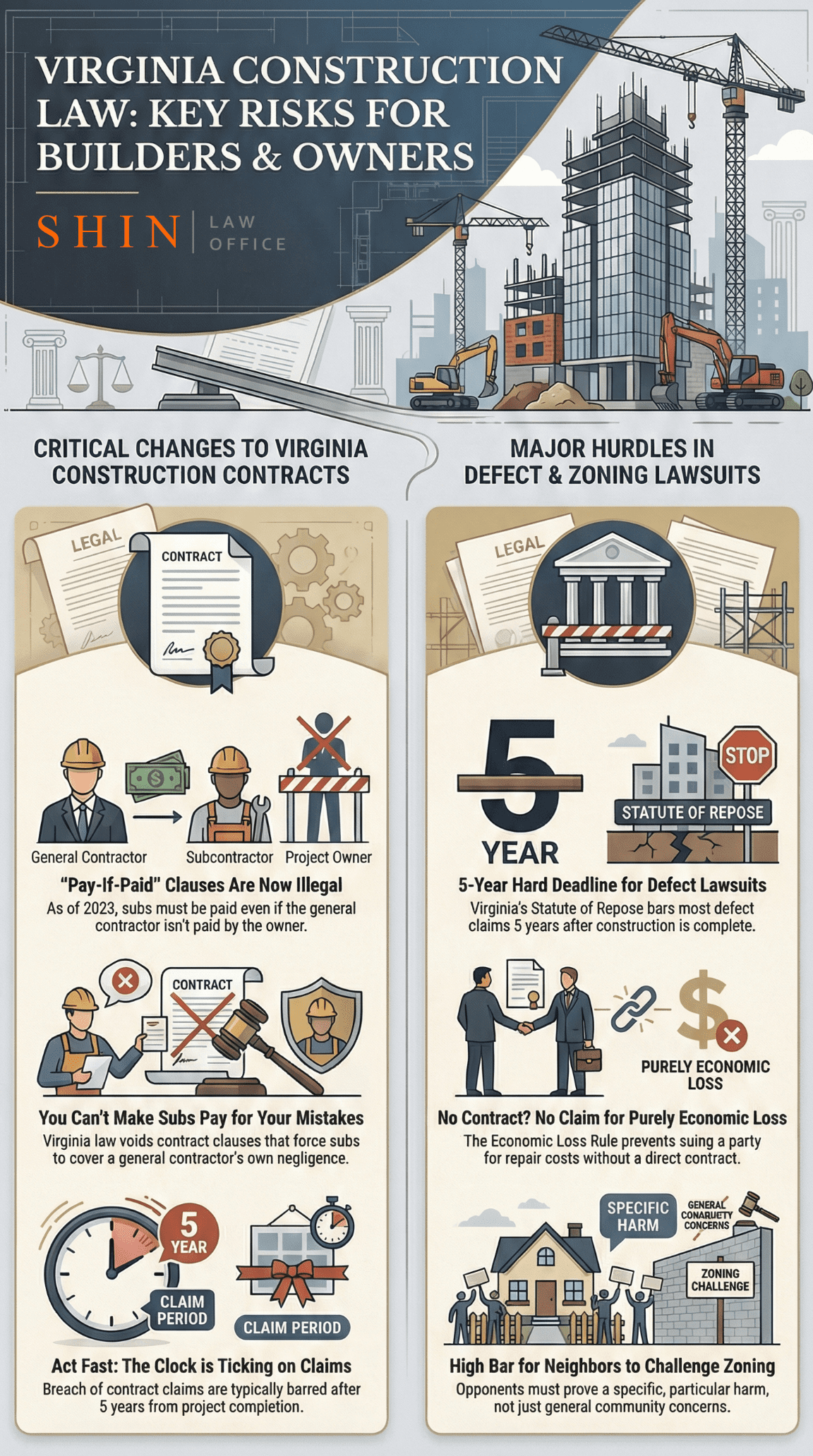
Table of Contents
- Contract Disputes in Commercial Construction
- Soil and Structural Issues: Foundations to Failures
- Defective Workmanship: Electrical, Plumbing, and Alarm System Problems
- Construction Defect Litigation and Virginia’s Legal Barriers
- Zoning and Land Use Disputes
- Conclusion: Lessons for Builders and Owners
- References
Contract Disputes in Commercial Construction
Construction contract disputes are a staple of litigation in Fairfax, Loudoun, and surrounding counties. I frequently handle cases where developers, general contractors, and subcontractors clash over payment, delays, or scope changes. In Virginia, a party’s failure to fulfill the terms of a construction contract is a breach that can entitle the wronged party to expectation damages. I’ve seen disputes over “pay-when-paid” clauses and indemnification clauses. Virginia law has evolved significantly: the anti-indemnity statute (Va. Code § 11-4.1) makes it void to require a subcontractor to indemnify a GC for the GC’s own negligence, and effective January 1, 2023, pay-if-paid clauses are banned. Construction contract claims are subject to Virginia’s 5-year statute of limitations for written contracts.
Soil and Structural Issues: Foundations to Failures
Problems with a building’s foundation, soil, or structural integrity can spawn lawsuits across Northern Virginia. In Loudoun and Prince William counties, where development has sprawled into areas with varying geology, I’ve handled cases stemming from unstable soils, erosion, and structural collapses. These cases often require dueling expert witnesses to determine whether construction deviated from standards or whether an unforeseen soil condition was to blame. A high-profile Loudoun County example involved toxic mold from structural defects in Meng v. Drees Co. (Loudoun Cir. Ct. 2009), where a jury found the builder negligent for shoddy construction. In Fairfax County, many structural defect disputes involve commercial buildings and center on whether the contractor met the standard of care and contract requirements.
Defective Workmanship: Electrical, Plumbing, and Alarm System Problems
Not all construction defects are as dramatic as a cracked foundation. Often it’s the hidden workmanship issues in electrical, mechanical, or life-safety systems that lead to conflict. I’ve handled numerous disputes in Loudoun, Fairfax, and Frederick County buildings where something behind the walls was done wrong. These cases include improper wiring, faulty plumbing that causes leaks, and alarm and sprinkler systems that don’t function when needed. Virginia’s strict economic loss rule means that where losses are economic, the owner typically must rely on breach of contract or warranty claims. Code violations often strengthen an owner’s position in litigation.
Construction Defect Litigation and Virginia’s Legal Barriers
Virginia law imposes unique barriers and defenses in construction defect cases. The statute of repose (Va. Code § 8.01-250) bars claims filed more than five years after construction. The economic loss rule prevents purely economic tort claims without privity. Warranty and consumer protection claims are available in appropriate cases. The VCPA can apply when there is deception in connection with construction services. Insurance coverage battles over whether a CGL policy covers defective workmanship are also a common feature of these disputes.
Zoning and Land Use Disputes
Disagreements over zoning, land use, and permits can be just as contentious as those over bricks and mortar. In Fairfax and Arlington, and in Clarke and Frederick Counties, the approval process for commercial buildings often triggers legal challenges. Virginia courts set a high bar for neighbors to challenge development decisions. The Arlington Missing Middle case (2024–2025) and inverse condemnation cases across the region illustrate the procedural complexity and the weight that standing, notice, and particularized harm carry in land use litigation.
Conclusion: Lessons for Builders and Owners
Commercial construction is a high-stakes endeavor in Northern Virginia’s booming markets. The lessons: get everything in writing, document problems early, know the 5-year statute of repose, engage the right experts, and litigate strategically. With careful planning and knowledgeable counsel, you can greatly reduce the risk of finding yourself in the courtroom — or if you do, ensure that you are well-armed to protect your investment.
Principal Attorney | Shin Law Office
Call 571-445-6565 or book a consultation online today.
(This article is provided for general informational purposes and does not constitute legal advice. For advice on your specific situation, consult with a licensed Virginia attorney.)
References
- ConsensusDocs. (2022, July 11). Newly Enacted Virginia Legislation Bans “Pay-If-Paid” Clauses in Construction Contracts.
- Thomas, Thomas & Hafer LLP. (2026, January 5). Virginia eNotes: Fortune-Johnson, Inc. v. QFS, LLC.
- KPM Law. (2021, September 7). Statute of Repose: A Recent Case. (Discussing Potter v. BFK, Inc.).
- McGuireWoods LLP. (2025, June 25). Virginia Court of Appeals Overturns Arlington “Missing Middle” Decision.
- Hosh, K. A. (2009, March 13). Judge Cuts Award in Mold Case. The Washington Post.
Part of Shin Law Office’s Northern Virginia Commercial Litigation Guide
This article is part of a broader guide covering commercial contract disputes, federal contracting, construction litigation, mechanic’s liens, and toxic torts across Northern Virginia. See the complete resource: When the Contract Breaks: The Northern Virginia Commercial Litigation Guide — covering B2B disputes, federal contracting, teaming agreements, construction claims, mechanic’s liens, and toxic torts across Loudoun, Fairfax, Prince William, Arlington, Clarke, and Frederick Counties.
