
By Anthony I. Shin, Esq., Shin Law Office
There is a quiet that follows a wrongful firing. It settles in somewhere between the drive home and the moment you have to tell your spouse what happened. It is the silence of a career interrupted, of bills that will not pause, and of dignity that someone tried to take from you in a conference room.
I have sat across from hundreds of workers in that exact moment. Engineers from data centers in Loudoun County. Federal contractors in Fairfax. Healthcare workers in Prince William. Defense industry professionals in Arlington. They all arrive with the same question.
Was that even legal?
Sometimes the answer is no.
The Bottom Line Up Front
Virginia is an at-will employment state, but that does not mean your employer can fire you for any reason. If your termination violated federal anti-discrimination law, retaliated against you for protected activity, or breached your employment contract, you may have a claim worth pursuing.
The clock starts ticking the day you are fired. Missing a filing deadline can end a strong case before it begins. This guide tells you what to look for, what to preserve, and what your case might actually be worth across Fairfax County, Loudoun County, Arlington County, and Prince William County.
Chapter 1: The Day That Changed Everything
Most people who walk into my office did not see it coming. The performance review was glowing six months ago. The team was hitting numbers. The manager was smiling on Friday and gone by Monday. Then a Tuesday meeting on the calendar with HR, no agenda, and life turns sideways before lunch.
If that scene feels familiar, you are not alone. The Equal Employment Opportunity Commission received more than 88,500 charges of workplace discrimination in fiscal year 2023, the highest number in years (U.S. Equal Employment Opportunity Commission, 2024). Behind every charge is a person who walked out of an office wondering whether to fight back or just move on.
My job is to help you answer that question with facts rather than emotion. Some firings are legal even when they are unfair. Others are unlawful even when they look routine. The difference is rarely obvious from the outside, which is why workers so often miss strong cases or pursue weak ones. Let me walk you through the framework I use every time a new client sits down across from me.
Chapter 2: What Wrongful Termination Actually Means in Virginia
Most people use the term “wrongful termination” to describe any firing that feels unfair. The law sees it differently, and that gap between what feels wrong and what is legally actionable is where many cases get lost.
The At Will Rule and Why It Matters
Virginia follows the at-will employment doctrine. Under this rule, either you or your employer can end the relationship at any time, with or without cause, and with or without notice. That is the starting point of any analysis I run.
If your boss fires you because she does not like your tie, or because she had a bad morning, or because you reminded her of someone she once dated, the firing is generally legal. Cruel? Yes. Petty? Often. Unlawful? Usually not.
The Three Categories That Change Everything
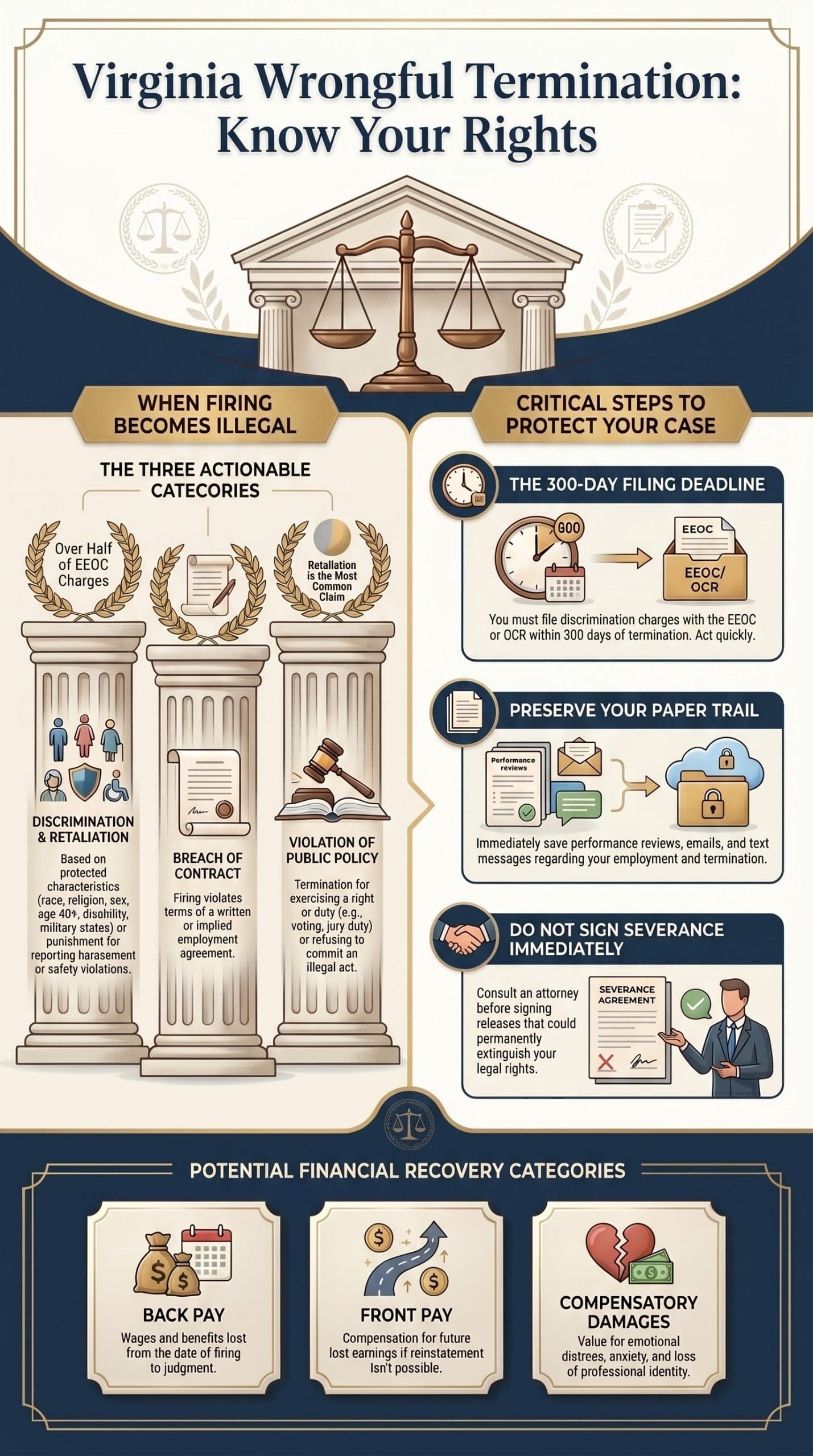
The at-will rule has powerful exceptions. Your firing crosses into wrongful termination territory when it falls into one of three categories:
- Discrimination based on a legally protected characteristic.
- Retaliation for engaging in a legally protected activity.
- Breach of an express or implied employment contract.
A fourth category exists in Virginia thanks to the Supreme Court of Virginia’s decision in Bowman v. State Bank of Keysville, 229 Va. 534, 331 S.E.2d 797 (1985). That ruling created a narrow public policy exception, allowing wrongful termination claims when an employer fires someone for refusing to violate the law or for exercising a statutory right. If your firing fits any of these categories, the at-will rule no longer protects your employer. It protects you.
Chapter 3: Discrimination Based Firings, When Your Identity Costs You Your Job
In 2020, Virginia transformed its civil rights laws with the Virginia Values Act. The Virginia Human Rights Act now provides some of the broadest workplace protections in the country, and the Virginia Office of Civil Rights enforces them with real teeth (Office of the Attorney General of Virginia, n.d.).
Federal Protections
Several federal statutes shield workers from discriminatory termination. Title VII of the Civil Rights Act of 1964 prohibits firing based on race, color, religion, sex, or national origin (42 U.S.C. § 2000e et seq.). Sex discrimination includes pregnancy, sexual orientation, and gender identity following the Supreme Court’s decision in Bostock v. Clayton County, 590 U.S. 644 (2020).
The Age Discrimination in Employment Act (29 U.S.C. § 621 et seq.) protects workers age 40 and older. The Americans with Disabilities Act (42 U.S.C. § 12101 et seq.) prohibits discrimination based on disability and requires reasonable accommodations. The Genetic Information Nondiscrimination Act (42 U.S.C. § 2000ff) bars firings based on genetic information or family medical history. Each statute carries its own procedural rules, its own deadlines, and its own remedies.
Virginia Protections
Virginia Code § 2.2-3905 prohibits employment discrimination based on race, color, religion, national origin, sex, sexual orientation, gender identity, marital status, pregnancy, childbirth or related medical conditions, age, military status, or disability. The state law often offers stronger remedies than federal law and applies to employers with as few as five employees for some claims, far below the federal threshold of fifteen.
How Discrimination Actually Looks
Discrimination rarely arrives wearing a name tag. The blatant cases happen, but most modern discrimination hides behind reorganizations, performance plans, and budget cuts. Watch for these warning signs:
- You were the only person in your protected class on the team, and you were the one let go.
- The reason given for your termination shifts each time someone explains it.
- You were placed on a performance improvement plan after announcing a pregnancy, requesting accommodations, or returning from medical leave.
- Younger or less qualified employees took over your duties after you were fired.
- Comments were made about your age, accent, religion, or family situation in the months before termination.
- You documented an incident of harassment, and within weeks you were gone.
If any of this sounds familiar, your firing may not have been the random event it appeared to be.
Chapter 4: Retaliation, Punished for Doing the Right Thing
Retaliation cases are now the most common type of charge filed with the Equal Employment Opportunity Commission, accounting for more than half of all charges in recent years (U.S. Equal Employment Opportunity Commission, 2024). The pattern is depressingly consistent. A worker speaks up. The employer pushes back. Within months, the worker is gone.
What Counts as Protected Activity
The list of activities protected from retaliation is broader than most workers realize. You engage in protected activity when you:
- Report discrimination or harassment, internally or to a government agency.
- File a workers’ compensation claim.
- Take leave under the Family and Medical Leave Act.
- Report safety violations to OSHA.
- Refuse to participate in illegal conduct.
- Cooperate with a government investigation.
- Discuss wages with coworkers, a right protected under the National Labor Relations Act.
Virginia’s whistleblower statute, Virginia Code § 40.1-27.3, provides additional protection for employees who report violations of state or federal law to a supervisor or government body, refuse to engage in criminal activity, or testify in legal proceedings. The statute carries its own one year deadline, separate from the deadlines that apply to federal claims.
Proving Retaliation
A retaliation case rests on three elements. First, you engaged in protected activity. Second, your employer took adverse action against you. Third, a causal connection exists between the two.
Timing matters. A firing that follows a complaint by days or weeks tends to support a retaliation claim. A firing that comes a year later requires more evidence. The closer in time the action, the stronger the inference.
I have handled cases where the termination paperwork was being prepared the same day a worker filed an internal complaint. That kind of evidence does not stay buried forever. It lives in metadata, in calendars, in email chains. If you suspect retaliation, the trail exists. Someone just has to know how to find it.
Chapter 5: Breach of Employment Contract, When Your Agreement Was Violated
Most workers in Virginia sign some form of employment document. Offer letters. Confidentiality agreements. Non-competes. Bonus plans. Each one creates rights, even when the document does not look like a traditional contract.
Express Contracts
If you have a written employment agreement that specifies a term of employment, defines termination grounds, or guarantees certain benefits, your employer cannot ignore those terms. A firing that violates the express provisions of your contract is actionable. Common breach scenarios include termination before the end of a fixed term contract, firing without the cause required by the agreement, failure to pay earned commissions or bonuses upon termination, refusal to honor severance provisions, and violations of notice requirements.
Implied Contracts and Employee Handbooks
Even without a formal contract, an employee handbook can create binding obligations on your employer. If the handbook promises progressive discipline, requires cause for termination, or establishes specific procedures, courts may treat those promises as enforceable, particularly when the employer has not included clear at-will disclaimers. The contents of the handbook in effect when you were hired matter as much as the version you were handed last year.
Non-Competes and Severance Disputes
Virginia tightened its non-compete rules in 2020 with Virginia Code § 40.1-28.7:7, which prohibits non-compete agreements for low-wage employees earning less than the average weekly wage in Virginia. For higher earners, the agreement must still be reasonable in scope, geography, and duration. If your former employer is using a non-compete to keep you out of work, or refusing to pay severance you negotiated, those issues belong on the table alongside any wrongful termination claim.
Chapter 6: Industry Realities Across Northern Virginia
Northern Virginia is not one job market. It is several, each with its own rhythms, risks, and patterns of wrongful termination. The county where you worked shapes both the legal procedure and the practical realities of your case.
Loudoun County and the Data Center Corridor
Loudoun County hosts the largest concentration of data centers in the world, with an estimated seventy percent of global internet traffic flowing through the region (Loudoun County Department of Economic Development, n.d.). The companies behind these facilities, along with the cloud providers and tech firms that serve them, employ thousands of workers across engineering, operations, security, and project management roles.
The wrongful termination cases I see in Loudoun often involve high earners who signed complex equity, bonus, and non-compete agreements. When these workers are pushed out before vesting events or paid below contract terms, the dollars at stake can be substantial. Cases proceed in Loudoun County Circuit Court in Leesburg or in the United States District Court for the Eastern District of Virginia, Alexandria Division, depending on the claims.
Fairfax County and the Federal Contracting Hub
Fairfax County is home to a vast federal contracting ecosystem. From Tysons Corner to Reston to Chantilly, contractors hold security clearances, manage classified work, and serve nearly every cabinet level agency. The county’s economy includes professional services, biotechnology, telecommunications, and aerospace alongside the contracting sector.
Wrongful termination cases in this sector often involve clearance issues, retaliation against workers who raise compliance concerns, and discrimination cases tied to government contracts that mandate equal opportunity employment under Executive Order 11246. Cases typically proceed in Fairfax County Circuit Court or the federal court in Alexandria.
Arlington County and the Defense and Tech Corridor
Arlington County contains one of the densest concentrations of defense, intelligence, and technology employers in the country, including the Pentagon, Amazon’s HQ2 expansion in National Landing, and a steady stream of professional services firms. Hospitality and real estate development add another layer of major employers.
I see retaliation claims tied to whistleblower disclosures, contract disputes involving stock and signing bonuses, and ADA cases involving workers whose accommodations were denied or ignored. Arlington Circuit Court handles state law claims, while federal claims move to the Alexandria federal courthouse.
Prince William County and the Logistics and Healthcare Sector
Prince William County mixes major employers in defense (the Quantico corridor), logistics, healthcare, and construction. The county’s hospitals and medical practices employ thousands of nurses, technicians, and administrative staff. Manufacturing and distribution continue to grow along the Interstate 95 corridor.
Healthcare retaliation cases are particularly common, especially involving nurses who report patient safety issues, refuse to falsify records, or push back on staffing levels that endanger patients. Cases proceed in Prince William County Circuit Court in Manassas or in federal court depending on the claims.
A Note on Where Your Case Will Be Heard
Wherever you work in Northern Virginia, the law follows you home. The county where you were fired determines which courthouse will hear your case, but the legal protections apply equally across the region. Federal claims involving Title VII, the ADA, and the ADEA almost always proceed in the United States District Court for the Eastern District of Virginia, often referred to as the “Rocket Docket” because of how quickly cases move through it.
Chapter 7: The Evidence That Wins Cases
Wrongful termination cases are won and lost on documentation. The employer almost always has more paperwork than you do. The good news is that the law gives us tools to even the playing field through formal discovery, but the work begins with what you can preserve right now.
What to Preserve Immediately
The moment you suspect a wrongful firing may be coming, or the moment after it happens, start preserving:
- Every email, text, and chat message between you and your supervisors, HR, and coworkers about your performance, complaints you raised, or accommodations you requested.
- Performance reviews going back at least three years.
- The employee handbook in effect when you were hired and any updated versions.
- Your offer letter and any amendments.
- Bonus plans, equity grants, and commission schedules.
- Calendar invites and meeting notes from any disciplinary or HR conversations.
- Pay stubs and benefits documentation.
- Names and contact information of coworkers who witnessed key events.
Do not take confidential employer documents that go beyond your own personnel file. That can create a separate legal problem. Stick to documents you generated, received, or had legitimate access to as part of your work.
Comparator Evidence
In a discrimination case, comparator evidence often makes or breaks the claim. A comparator is a coworker outside your protected class who engaged in similar conduct but was treated differently. Identifying these workers, and documenting their treatment, builds the foundation of a strong disparate treatment case.
The Power of the Paper Trail
I once represented a worker who was told her firing was about performance. Her file said otherwise. Three years of “exceeds expectations” reviews, signed by the same supervisor who later claimed she was failing. The pattern was clear once we had the records side by side. Your records can tell the same kind of story, but only if you have them.
Chapter 8: The Statute of Limitations Trap
Nothing kills a wrongful termination case faster than a missed deadline. The clocks here are short, they overlap, and they run from the date of the adverse action.
Federal Discrimination Claims
For Title VII, ADA, and ADEA claims, you must file a charge with the Equal Employment Opportunity Commission within 300 days of the discriminatory act in Virginia (U.S. Equal Employment Opportunity Commission, n.d.). Virginia is a deferral state because it has its own civil rights agency, which extends the standard 180 day federal deadline. After the EEOC issues a right to sue notice, you have 90 days to file a lawsuit in federal court. Miss either deadline and your case is over.
Virginia Human Rights Act Claims
VHRA charges must be filed with the Virginia Office of Civil Rights within 300 days. After receiving a notice of right to file a civil action, you have 90 days to bring suit. Filing with both agencies through a “dual filing” arrangement is common and preserves both sets of claims.
Whistleblower and Common Law Claims
Virginia’s whistleblower statute requires lawsuits to be filed within one year. Bowman public policy claims generally fall under the two year statute applicable to personal injury actions. Breach of contract claims have different limits depending on whether the contract is written (five years) or oral (three years), under Virginia Code § 8.01-246.
Why You Should Not Wait
The earlier we get involved, the better. Documents disappear. Witnesses leave companies. Memories fade. Even if your deadline is months away, building the case takes time. Waiting until the last week to call rarely produces the best outcome, and sometimes it produces no outcome at all.
Chapter 9: What Your Case Could Be Worth
Workers often ask me what their case is worth before we have gathered enough information to answer. The honest response is that no two cases value out the same way. But the categories of recovery are well established under both federal and Virginia law.
Back Pay
Back pay covers wages and benefits you lost from the date of termination through the date of judgment or settlement. It includes salary, bonuses, commissions, the value of health insurance, retirement contributions, and any other compensation you would have earned. The longer the case takes, the larger the back pay calculation often becomes.
Front Pay
Front pay compensates for future lost earnings when reinstatement is not feasible. The calculation considers your career trajectory, the difficulty of finding comparable work, and the time it will take to rebuild your professional standing.
Compensatory Damages for Emotional Distress
The law recognizes that wrongful termination causes harm beyond the paycheck. Anxiety, depression, sleep disruption, damaged relationships, and the loss of professional identity all carry real value. Federal law caps these damages based on employer size, ranging from $50,000 to $300,000 under Title VII and the ADA. Virginia law allows uncapped compensatory damages under the VHRA in some circumstances.
Punitive Damages
When an employer acted with malice or reckless indifference to your rights, punitive damages may be available. These are designed to punish and deter, not to compensate. Virginia caps punitive damages at $350,000 in most cases under Virginia Code § 8.01-38.1.
Attorney’s Fees
Federal civil rights statutes and the VHRA allow prevailing employees to recover their attorney’s fees and costs. This provision exists to make it economically possible for ordinary workers to challenge powerful employers. It is one of the reasons we can take strong cases without requiring you to bring a checkbook to the first meeting.
Reinstatement
In some cases, getting your job back is the right outcome. Reinstatement is rare in practice because the relationship is usually too damaged, but it remains an available remedy when both sides can move forward.
Chapter 10: What to Do Right Now
If you are reading this in the days or weeks after a firing that feels wrong, here is what I want you to do.
First, Stop Talking to Your Former Employer
Do not sign a severance agreement without legal review. Do not give recorded statements. Do not respond to invitations to “discuss your termination” without an attorney present. Anything you say can become evidence against you, and severance agreements typically include broad releases that extinguish your claims forever.
Second, Preserve Everything
Forward work emails to a personal account if your access has not been cut off, and only do so for emails you generated or that were sent to you personally. Print out documents you have legitimate access to. Save text messages. Take screenshots of your LinkedIn endorsements and recommendations before they disappear. Build a written timeline of events while the details are fresh.
Third, Apply for Unemployment
File for unemployment benefits with the Virginia Employment Commission (Virginia Employment Commission, n.d.). Your former employer may contest your claim, particularly if they fired you for “cause.” That contest itself can become evidence in your wrongful termination case, because it forces the employer to commit to a story under oath.
Fourth, Call Us
I have spent my career representing workers across Fairfax County, Loudoun County, Arlington County, and Prince William County who were fired in violation of their rights. Some cases settle in weeks. Others go the distance through litigation in state and federal court. Every case begins with a conversation, and there is no substitute for getting an attorney’s eyes on your facts before you make any irreversible decisions.
Tough Cases Require Tough Attorneys
Talk to Shin Law Office About Your Wrongful Termination Case
We represent workers across Fairfax County, Loudoun County, Arlington County, and Prince William County in wrongful termination, discrimination, retaliation, and breach of contract cases. Bring us the facts, and we will tell you the path forward.
Offices in Leesburg and Fairfax, Virginia. Serving the DC, Maryland, and Virginia region.

References
Age Discrimination in Employment Act of 1967, 29 U.S.C. § 621 et seq.
Americans with Disabilities Act of 1990, 42 U.S.C. § 12101 et seq.
Bostock v. Clayton County, 590 U.S. 644 (2020).
Bowman v. State Bank of Keysville, 229 Va. 534, 331 S.E.2d 797 (1985).
Genetic Information Nondiscrimination Act of 2008, 42 U.S.C. § 2000ff et seq.
Loudoun County Department of Economic Development. (n.d.). Data centers in Loudoun County. https://biz.loudouncounty.gov/key-business-sectors/data-centers/
Office of the Attorney General of Virginia. (n.d.). Office of Civil Rights. https://www.oag.state.va.us/programs-initiatives/civil-rights
Title VII of the Civil Rights Act of 1964, 42 U.S.C. § 2000e et seq.
U.S. Equal Employment Opportunity Commission. (n.d.). Filing a charge of discrimination. https://www.eeoc.gov/filing-charge-discrimination
U.S. Equal Employment Opportunity Commission. (2024). EEOC releases fiscal year 2023 enforcement and litigation data. https://www.eeoc.gov/newsroom/eeoc-releases-fiscal-year-2023-enforcement-and-litigation-data
Virginia Code § 2.2-3905 (Unlawful discriminatory practices).
Virginia Code § 8.01-38.1 (Limitation upon certain awards of punitive damages).
Virginia Code § 8.01-246 (Personal actions based on contracts).
Virginia Code § 40.1-27.3 (Retaliatory action against employee prohibited).
Virginia Code § 40.1-28.7:7 (Covenants not to compete prohibited as to low-wage employees).
Virginia Employment Commission. (n.d.). Information about unemployment insurance. https://www.vec.virginia.gov/
Disclaimer: This article is provided for general informational purposes and does not constitute legal advice. Reading it does not create an attorney client relationship between you and Shin Law Office. Every case turns on its own facts, and the law changes. To discuss your situation, contact our office directly.