Cybersecurity and Data Breach Litigation in Virginia: A Business and Civil Litigation Attorney’s Guide
By Anthony I. Shin, Esq. | Business Litigation & Civil Litigation | Shin Law Office
BOTTOM LINE UP FRONT
A cyber incident, a data breach, or a missed compliance obligation rarely stays a technical problem for long. It turns into a lawsuit. In Virginia that usually means one or more of five things at once: a False Claims Act case, a consumer class action, a fight over an indemnification or limitation of liability clause in a contract, a shareholder derivative suit, or a regulatory investigation that runs alongside the civil claims. Each of those is a business litigation and civil litigation matter, and they often arrive together.
This guide is written for the business that is already in a dispute, or can see one coming. It walks through how these cases actually get litigated in Virginia courts, where the money and the risk sit, and how a company protects its position before and after a claim lands. The compliance frameworks (VITA, the Virginia Consumer Data Protection Act, NIST 800-171, CMMC, DFARS, and the state breach notification statute) matter here as the backdrop that the litigation is fought over, not as a checklist.
Shin Law Office represents Virginia businesses, contractors, and vendors in the disputes that grow out of cyber, data, and contract failures. If you are facing a claim, an investigation, or a contract fight, call 571-445-6565 or contact Shin Law Office to talk through where you stand.
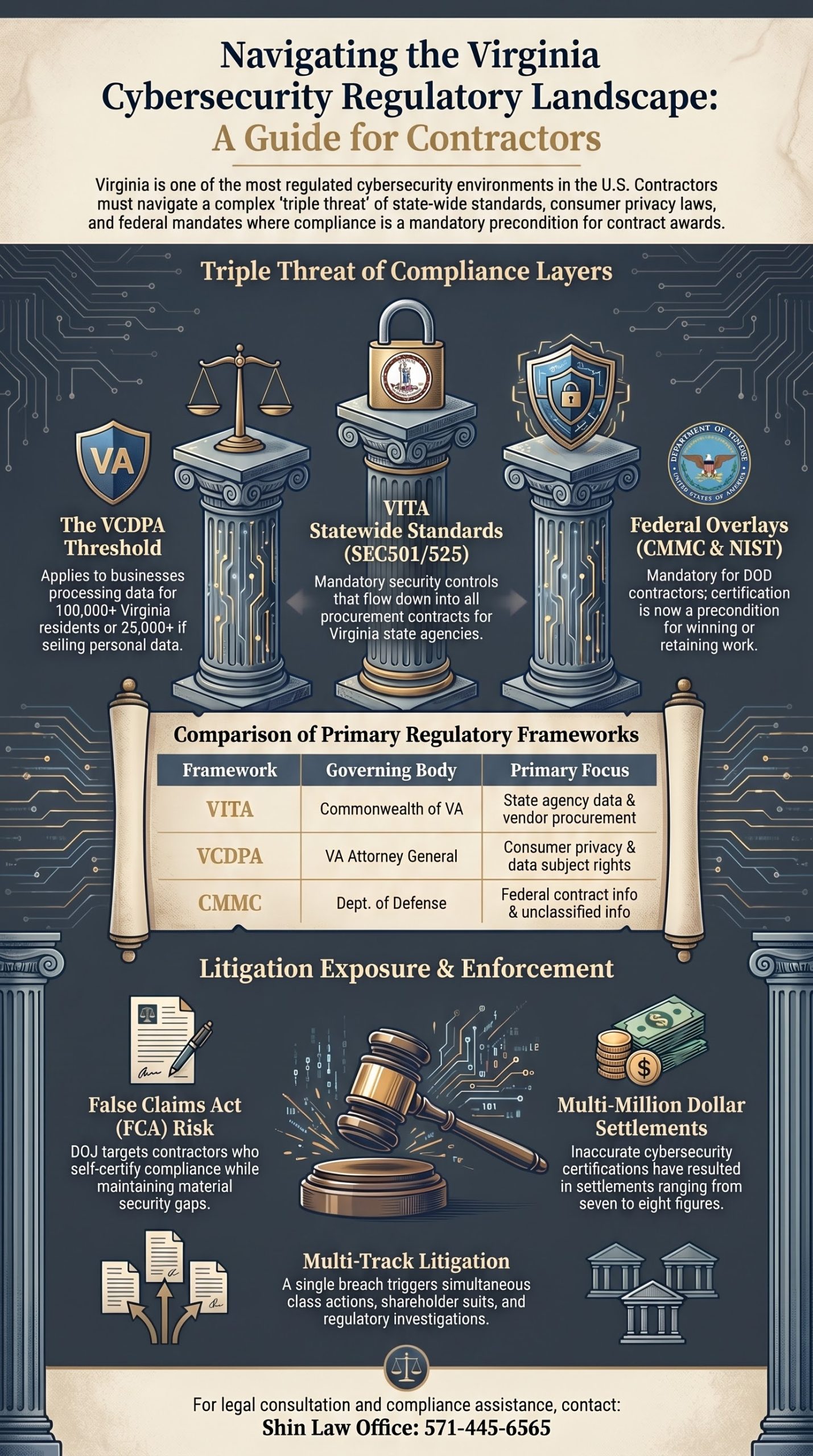
Table of Contents
- When a Cyber or Data Problem Becomes a Lawsuit
- False Claims Act Litigation and the Cyber-Fraud Initiative
- Data Breach Class Actions in Virginia Courts
- Contract, Indemnification, and Vendor Disputes
- Shareholder and Derivative Litigation Over Cyber Oversight
- Regulatory Investigations Running Alongside Civil Claims
- The Compliance Backdrop That Drives the Litigation
- Where These Cases Are Litigated in Virginia
- How Businesses Should Protect Their Position
- How Shin Law Office Handles These Disputes
Chapter 1: When a Cyber or Data Problem Becomes a Lawsuit
Most businesses think about cybersecurity as an IT and compliance subject right up until the day it becomes a legal one. The shift happens fast. A vendor reports a breach. A whistleblower files a sealed complaint. A customer demands indemnification under a contract nobody has read closely in three years. A regulator opens an inquiry. From that point forward the problem is not about controls and certifications. It is about claims, defenses, damages, and which court the fight will be heard in. That is civil litigation, and when it involves a company’s contracts, vendors, and commercial relationships, it is business litigation.
Virginia produces more of this litigation than almost any other state, for three reasons. It hosts the densest concentration of federal contractors in the country, which drives False Claims Act exposure. It was one of the first states with a comprehensive consumer privacy statute, which shapes how data breach claims are framed. And the federal courts here, the Eastern District of Virginia in particular, move cases to trial faster than almost any docket in the nation, which changes the strategy on both sides from the first filing.
This guide treats the dispute as the main event. The chapters that follow walk through each litigation track a Virginia business is likely to face, the contract and compliance material those cases turn on, where the cases are heard, and how a company keeps itself in the strongest possible position. For the broader picture of how the firm approaches commercial disputes, see my business litigation and transactions practice and my civil litigation practice.
Chapter 2: False Claims Act Litigation and the Cyber-Fraud Initiative
For Virginia federal contractors, the False Claims Act is the single largest litigation exposure that grows out of a cybersecurity problem. The Department of Justice launched its Civil Cyber-Fraud Initiative in October 2021, and it has produced a steady run of settlements with contractors whose cybersecurity certifications turned out to be inaccurate. Settlement figures have run from the low seven figures into the high eight figures.
The fact pattern repeats. A contractor self-certified compliance with NIST 800-171 or with the cyber requirements in DFARS 252.204-7012, often by submitting a score into the Supplier Performance Risk System, and the actual implementation had material gaps. Under the implied false certification theory, that inaccurate certification can support FCA liability. The qui tam structure of the statute means a former employee or a competitor can file the case under seal, which creates exposure even when the government never brings its own action.
Why this is litigation, not compliance:
Once a qui tam complaint is filed, the contractor is a defendant. The work becomes investigation response, document preservation, witness preparation, damages analysis, and settlement negotiation under the treble damages and per-claim penalty structure of the statute. The compliance documents become evidence. The earlier a business brings litigation counsel into that picture, the more options it keeps.
Chapter 3: Data Breach Class Actions in Virginia Courts
When a breach affects Virginia consumers, class action filings follow. They are usually built on common-law theories: negligence, breach of contract, breach of implied contract, and unjust enrichment. The Virginia Consumer Data Protection Act does not give consumers a private right of action, so plaintiffs do not sue under it directly. That narrows the menu of claims but does not remove the exposure, because the common-law theories carry the case.
Plaintiffs in Virginia federal courts have regularly survived motions to dismiss when they plead concrete harm, such as identity theft or unauthorized account activity, rather than the bare risk of future harm. Class certification has been mixed, but the settlements have been substantial, particularly in the Eastern District of Virginia. The defense work centers on standing, the adequacy of the harm alleged, the causal link between the breach and the claimed injury, and the suitability of the class for certification.
Chapter 4: Contract, Indemnification, and Vendor Disputes
This is the most common business litigation track and the one most businesses underestimate. A single cyber incident sets off a chain of contract questions among primes, subcontractors, vendors, and customers. Who has to indemnify whom. Whether a limitation of liability clause caps the exposure. Which party owed notification to which constituency. How the cooperation and audit clauses are read. These provisions sit dormant in the contract until the day of an incident, and then they decide who pays.
For contractors, the flow-down problem is sharp. When a subcontract incorporates the prime contract by reference, or incorporates DFARS, CMMC, or NIST 800-171 obligations specifically, the subcontractor is bound by those obligations whether or not anyone read them closely before signing. Virginia courts and the federal courts in the Eastern District of Virginia generally enforce well-drafted flow-down provisions. The practical defense is built at two points: careful contract review at the start of the relationship, and clean documentation of performance throughout it.
These disputes belong to the same family as any other commercial contract fight, and they are litigated the same way. For the broader framework, see my Northern Virginia commercial contract disputes guide and, for business owners in the county, the Loudoun County business lawyer hub.
Chapter 5: Shareholder and Derivative Litigation Over Cyber Oversight
Companies with shareholders face a further track. After a significant breach, shareholders bring derivative suits claiming the board failed to oversee cybersecurity risk and breached its fiduciary duties. The Caremark line of authority is the main vehicle for these claims, and recent Delaware Chancery Court decisions have sharpened what counts as adequate board oversight. The defense turns heavily on the record: whether board materials, minutes, and committee charters show that the directors actually engaged with cyber risk rather than rubber-stamping management reports. Building that record is something a company does long before any suit, and litigating around it is squarely civil litigation work.
Chapter 6: Regulatory Investigations Running Alongside Civil Claims
Civil litigation rarely arrives alone. A Virginia Attorney General inquiry under the Consumer Data Protection Act, a sectoral regulator investigation from the SEC, FTC, HHS, or a banking regulator, and follow-up activity tied to federal incident reporting can all run in parallel with the private suits. The Attorney General enforces the VCDPA and can seek civil penalties of up to 7,500 dollars per violation plus fees and costs, with a cure period that has been revised more than once by the General Assembly.
The hard part is coordination. Documents created during a regulatory investigation are frequently discoverable in the civil cases, and positions taken in one forum can be used in another. Running these tracks together, rather than letting each proceed in isolation, is a core part of defending the company well.
Chapter 7: The Compliance Backdrop That Drives the Litigation
The litigation above is fought over a set of compliance frameworks. A business does not need to master them to understand its exposure, but it helps to know what the cases turn on.
Virginia state frameworks
The Virginia Information Technologies Agency sets statewide information security standards under Va. Code Title 2.2 Chapter 56, and those standards flow down to vendors through procurement contracts. The Virginia Consumer Data Protection Act, in effect since January 1, 2023, governs businesses that process the data of large numbers of Virginia consumers. The state breach notification statute, Va. Code Section 18.2-186.6, requires notice to affected residents and, for breaches affecting more than 1,000 residents, to the Attorney General, without unreasonable delay.
Federal contractor frameworks
NIST 800-171 sets the baseline for protecting Controlled Unclassified Information and applies through DFARS 252.204-7012. The Cybersecurity Maturity Model Certification program adds third-party verification and has moved from policy into binding contract clauses on a phased schedule. The Cyber Incident Reporting for Critical Infrastructure Act adds short reporting timelines for covered critical infrastructure entities as its rules take effect. These are the obligations that, when certified inaccurately or missed, produce the False Claims Act and contract litigation described earlier.
Sectoral overlays
Healthcare entities answer to HIPAA, financial institutions to GLBA, public companies to SEC disclosure rules, and schools to FERPA. A Virginia business in a regulated sector often has to satisfy several notification regimes at once, and the coordination of multi-track notice under tight timing is one of the harder things to do well in the first hours of an incident, and one of the first things plaintiffs scrutinize afterward.
Chapter 8: Where These Cases Are Litigated in Virginia
Forum shapes strategy. Cybersecurity and data disputes in Virginia land in a few predictable places, and each one changes how a case is run.
The Eastern District of Virginia. Most federal claims, including False Claims Act cases and many class actions, are heard here. The court is known for its fast trial schedule, often called the rocket docket. Cases move quickly, discovery windows are short, and a defendant who waits to engage loses ground that is hard to recover. Speed favors the party that is prepared first.
Virginia Circuit Courts. Contract, indemnification, and many shareholder disputes are litigated in the Circuit Courts, with the General District Courts handling smaller-dollar matters. Venue and choice of forum clauses in the underlying contracts often decide where the fight happens, which is one more reason those clauses matter before any dispute begins.
Removal and arbitration. A case filed in state court may be removable to federal court, and many commercial contracts contain arbitration clauses that send the dispute out of court entirely. Deciding whether to remove, whether to compel arbitration, and how those choices affect the company’s position is part of the early strategy in nearly every one of these matters.
Chapter 9: How Businesses Should Protect Their Position
Five steps separate the businesses that come through a cyber dispute in good shape from the ones that do not.
Step one: keep your compliance record accurate and contemporaneous. In an FCA case, the difference between a defense that holds and one that fails is whether the documentation matches what was certified to the government. Security plans, remediation milestones, scan results, and training records should be maintained with the same discipline as financial books, because they become evidence.
Step two: read your contracts before you need them. Indemnification clauses, limitation of liability caps, notification duties, and flow-down provisions decide who pays after an incident. A contract-by-contract review, done while there is no dispute, is far cheaper than discovering the terms during one.
Step three: build incident response with the litigation in mind. Notification timelines under Virginia law, federal frameworks, and individual contracts can run at once. Rehearsing that response under realistic pressure, and doing it in a way that preserves privilege and creates a clean record, materially improves the company’s position if the matter is later litigated.
Step four: preserve evidence the moment a claim is foreseeable. The duty to preserve documents attaches early. A business that issues a litigation hold promptly avoids the spoliation arguments that can sink an otherwise defensible case.
Step five: coordinate insurance with the legal picture. Cyber policies have tightened, with more exclusions and more aggressive subrogation, and FCA settlements tied to qui tam recoveries are commonly excluded or capped. Reviewing coverage against realistic dispute scenarios before an incident is far stronger than discovering a gap in the middle of one.
Chapter 10: How Shin Law Office Handles These Disputes
My approach to a cyber or data dispute follows the same path whether the matter is an active lawsuit, an FCA investigation, a contract fight, or readiness work before a claim arrives.
First, I take a clear inventory of the claims and the contracts. Before I can advise, I need to see what is being alleged and the agreements that govern the company’s obligations: prime contracts, subcontracts, customer and vendor agreements, insurance policies, and any compliance attestations the company has made. The dispute starts with what the company committed to in writing and what the other side says it failed to do.
Second, I map the exposure across every track at once: False Claims Act, class action, contract and indemnification, derivative, and regulatory. Cyber disputes almost never sit in a single lane, and a defense built for one track can undercut another if the tracks are not handled together.
Third, I move on forum and timing. In the Eastern District of Virginia the schedule is fast, so decisions about removal, arbitration, motions to dismiss, and document preservation get made early and deliberately rather than reactively.
Fourth, I build the factual and documentary record that the case will be won or lost on, working with the company’s IT, security, and finance teams to line up the proof and close the gaps that the other side will look for.
Fifth, I drive toward resolution, whether that is dismissal, a favorable settlement, or trial, with a clear view of the damages exposure and the company’s commercial interests throughout.
Summary: What to Take Away From This Guide
A cyber or data problem becomes a legal problem the moment a claim, a complaint, or an investigation appears, and in Virginia it usually appears on several fronts at once. The False Claims Act drives the largest contractor exposure, consumer class actions follow most breaches, contract and indemnification fights decide who actually pays, shareholder suits test board oversight, and regulators run alongside the civil cases.
The compliance frameworks are the ground the litigation is fought over, not the point of it. What decides these cases is the strength of the company’s contracts, the accuracy of its records, the speed of its response, and the quality of the litigation strategy once a claim is on file.
The businesses that protect their contracts, keep clean records, and bring litigation counsel in early are in a far stronger position, both before a dispute and after one, than the businesses that wait. If you are facing one of these matters now, the time to get advice is before the next deadline passes.
Frequently Asked Questions
A whistleblower filed a False Claims Act case against my company over our cybersecurity certifications. What happens now?
The case is usually filed under seal while the government decides whether to intervene, so you may learn of it through a document request or a subpoena before you see the complaint. From that point the work is litigation: preserving documents, responding to the investigation, lining up the people and records that show what was actually implemented, and analyzing the damages exposure under the treble damages and penalty structure. Bringing litigation counsel in early, before positions harden, keeps the most options open.
Can consumers sue my company in Virginia over a data breach even though the VCDPA has no private right of action?
Yes. Consumers do not sue under the Consumer Data Protection Act itself, but they bring class actions under common-law theories such as negligence, breach of contract, and unjust enrichment. Plaintiffs who plead concrete harm, like identity theft or unauthorized account activity, have regularly survived motions to dismiss in Virginia federal courts. The absence of a VCDPA private right of action narrows the claims but does not remove the exposure.
A customer is demanding indemnification after a breach. Are these clauses really enforceable?
In most cases yes. Virginia courts and the federal courts in the Eastern District of Virginia generally enforce well-drafted indemnification and flow-down provisions, including obligations a subcontractor took on by incorporating a prime contract by reference. Whether the demand holds depends on the exact wording of the clause, any limitation of liability cap, the notice and cooperation terms, and the facts of the incident. This is a contract dispute, and it is litigated as one.
Where will my cybersecurity dispute be heard?
It depends on the claim. False Claims Act cases and many class actions go to the Eastern District of Virginia, which runs a fast trial schedule. Contract and shareholder disputes are usually heard in the Virginia Circuit Courts, subject to any venue or arbitration clause in the underlying agreement. Early decisions about removal to federal court or compelling arbitration can change the course of the case, so forum is one of the first things to address.
My board is worried about a shareholder suit after our breach. What protects the directors?
Derivative suits over cyber oversight run on the Caremark line of authority, and the defense lives in the record. Board minutes, committee charters, and materials that show directors actually engaged with cybersecurity risk, rather than receiving a single passing report, are what answer the claim. That record is built before any suit, which is why oversight documentation is worth getting right now rather than after an incident.
A regulator opened an investigation at the same time we were sued. How do we handle both?
Carefully and together. Documents produced to a regulator are often discoverable in the civil case, and a position taken in one forum can be used against you in the other. The two tracks need a coordinated strategy from the start so that responding to the investigation does not weaken the litigation defense, and vice versa.
Will our cyber insurance cover the lawsuit and any settlement?
Coverage varies a great deal by policy and carrier. Many policies cover defense costs and some regulatory penalties, but settlements tied to False Claims Act qui tam recoveries are commonly excluded or capped. The time to review coverage against likely dispute scenarios is before an incident. During an active matter, coordination between coverage counsel and litigation counsel affects what you can actually recover under the policy.
What does it cost to engage a business and civil litigation attorney for a matter like this in Northern Virginia?
Cost depends on the posture: readiness work, active litigation, an FCA defense, or a regulatory investigation each carry different fee structures. I provide an initial assessment of the matter and a clear fee structure so you know what to expect at each stage. Call 571-445-6565 to discuss your situation.
Talk to a Virginia Business and Civil Litigation Lawyer
A cyber incident, a data breach, or a compliance failure can set off a False Claims Act case, a consumer class action, a contract and indemnification fight, a shareholder suit, and a regulatory investigation, often at the same time. The businesses that come through these disputes in the strongest position are the ones that protected their contracts, kept clean records, and brought litigation counsel in early.
Shin Law Office represents Virginia businesses, contractors, and vendors in the disputes that grow out of cyber, data, and contract failures, from readiness work and contract review through active litigation in the Eastern District of Virginia and the Virginia Circuit Courts. Whether you are a Loudoun data center operator, a Fairfax federal services contractor, an Arlington business, a Prince William company, or a vendor anywhere in the Commonwealth, the right time to get advice is now.
Call 571-445-6565 or Schedule a Consultation to discuss your matter.

References
U.S. Department of Justice. (2021). Civil Cyber-Fraud Initiative. https://www.justice.gov/opa/pr/deputy-attorney-general-lisa-o-monaco-announces-new-civil-cyber-fraud-initiative
Code of Virginia. (n.d.). Title 59.1, Chapter 53. Consumer Data Protection Act. https://law.lis.virginia.gov/vacodefull/title59.1/chapter53/
Code of Virginia. (n.d.). Section 18.2-186.6. Breach of personal information notification. https://law.lis.virginia.gov/vacode/title18.2/chapter6/section18.2-186.6/
Code of Virginia. (n.d.). Title 2.2, Chapter 56. Virginia Information Technologies Agency. https://law.lis.virginia.gov/vacodefull/title2.2/chapter56/
National Institute of Standards and Technology. (2020). Special Publication 800-171, Revision 2. https://csrc.nist.gov/publications/detail/sp/800-171/rev-2/final
U.S. Department of Defense. (n.d.). Cybersecurity Maturity Model Certification (CMMC) Program. https://dodcio.defense.gov/CMMC/
U.S. Court of Appeals and U.S. District Court for the Eastern District of Virginia. (n.d.). Court information and local rules. https://www.vaed.uscourts.gov/