
Riverside Health System Physician Employment and Healthcare Vendor Disputes: A Guide for Virginia Peninsula Providers and Suppliers
By Anthony I. Shin, Esq. | Shin Law Office | Serving Physicians, Healthcare Providers, and Vendors Across Virginia
BOTTOM LINE UP FRONT
Riverside Health System anchors the Newport News and broader Virginia Peninsula healthcare market with Riverside Regional Medical Center (a 510-bed tertiary care hospital), Riverside Doctors’ Hospital Williamsburg, Riverside Walter Reed Hospital in Gloucester, Riverside Tappahannock Hospital, the Riverside Medical Group of more than 750 employed physicians and advanced practice providers, and a network of outpatient facilities, urgent care centers, and specialty programs across the Peninsula and Middle Peninsula regions. The contract relationships that support this enterprise generate substantial dispute activity. Physician employment agreements with detailed restrictive covenants. Hospital service agreements covering radiology, anesthesiology, emergency department coverage, hospitalist services, and other specialty programs. IT and electronic health record vendor contracts. Medical device, pharmaceutical, and clinical supply agreements. Managed care and payer contracts. Each category produces its own legal framework with substantial regulatory overlay.
Call Shin Law Office at 571-445-6565.
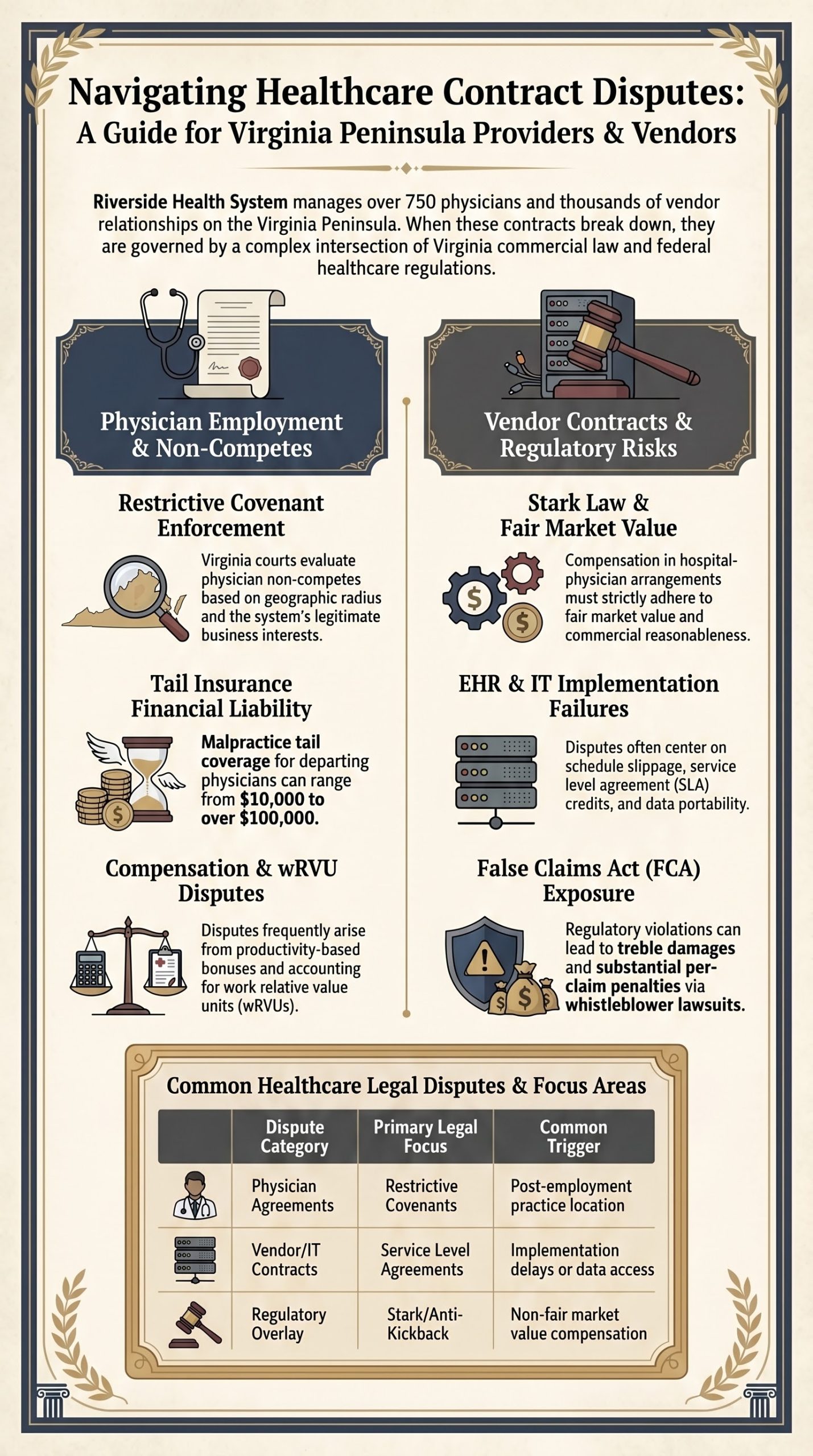
Table of Contents
- Riverside Health System on the Virginia Peninsula
- Physician Employment Agreement Disputes
- Restrictive Covenants and Non-Compete Enforcement
- Hospital Service Agreements and Specialty Coverage
- EHR, IT, and Health Tech Vendor Contracts
- Medical Device, Pharmaceutical, and Supply Disputes
- Stark Law, Anti-Kickback, and Regulatory Overlay
- How Shin Law Office Handles Healthcare Disputes
- Summary
- Frequently Asked Questions
- References
Chapter 1: Riverside Health System on the Virginia Peninsula
Riverside Health System has served the Virginia Peninsula for more than a century, with origins tracing back to the early 20th century. Today the system operates Riverside Regional Medical Center as its flagship 510-bed tertiary care hospital in Newport News, Riverside Doctors’ Hospital Williamsburg, Riverside Walter Reed Hospital in Gloucester County serving the Middle Peninsula, and Riverside Tappahannock Hospital, plus various long-term care, rehabilitation, and outpatient facilities across the broader region.
Riverside Medical Group employs more than 750 physicians and advanced practice providers across primary care, specialty care, and hospital-based services. The employed physician model has expanded substantially over the past two decades, transforming what was historically a community-physician hospital arrangement into an integrated delivery system with employed providers across nearly every specialty.
The contract relationships that support Riverside extend across thousands of vendors and suppliers. Hospital service agreements with specialty physician groups. EHR and IT vendor contracts. Medical device and pharmaceutical supply agreements. Construction and facility maintenance contractors. Specialty service contracts include dietary, environmental services, security, and biomedical engineering. Managed care and payer contracts.
When these relationships break down, the resulting disputes operate under a framework that combines ordinary commercial contract law, healthcare-specific regulatory overlays, and the practical realities of healthcare delivery in a tightly integrated market. For broader context on how healthcare disputes fit into the wider Newport News legal market, see our complete guide to contract disputes in Newport News.
Chapter 2: Physician Employment Agreement Disputes
Physician employment agreements with Riverside and similar large health systems run for substantial multi-year terms with detailed provisions covering compensation, productivity expectations, call coverage, restrictive covenants, malpractice insurance, and termination procedures. The agreements look like ordinary employment contracts in many respects but include provisions specific to healthcare delivery that drive most disputes.
Compensation structures typically combine base salary with productivity-based bonuses calculated on work relative value units (wRVUs), collections, or other metrics. The specific formula and its application in actual practice patterns lead to ongoing accounting disputes. Physicians who feel they are not receiving credit for work actually performed face claims for unpaid compensation. Health systems facing physicians whose productivity falls short of expectations face questions about how to address performance under contract terms.
Call coverage and after-hours obligations generate persistent dispute activity. The contract typically specifies expected call frequency, with additional call beyond the threshold producing additional compensation or scheduling adjustments. Disputes arise when actual call patterns differ from contract expectations, when health system needs require call coverage beyond what physicians are willing to provide, and when disputes over specific call assignments escalate.
Termination procedures are a critical area. Physician employment agreements typically include both with-cause and without-cause termination provisions, often with notice periods of 60 to 180 days. The procedural requirements for termination, the substantive grounds that constitute cause, and the consequences of termination (including effects on benefits, deferred compensation, and post-employment obligations) all give rise to disputes. Physicians facing termination should engage counsel before responding to notice or attempting to resolve issues informally with the system.
Tail malpractice insurance is a recurring contested issue. Physicians leaving a practice need tail coverage to address potential malpractice claims from prior patient care that surface after departure. The contract may specify which party bears this cost, with substantial financial implications. Tail coverage for a primary care or specialty physician can run from tens of thousands to over $100,000 depending on the practice and the policy.
Chapter 3: Restrictive Covenants and Non-Compete Enforcement
Physician restrictive covenants are among the most heavily litigated areas of healthcare employment law. The standard provisions restrict departing physicians from practicing within a defined geographic radius for a specified period, typically 12 to 24 months. The agreements may also restrict solicitation of patients, employees, or referral sources. The enforceability of these provisions depends on Virginia non-compete law and the specific provisions of the contract.
Virginia courts evaluate physician non-competes under standards that consider the geographic, temporal, and substantive scope of the restriction. The legitimate business interests the system asserts (protecting patient relationships, recovering investment in physician recruitment, preserving referral networks) must be balanced against the physician’s right to practice and the public interest in physician availability. Restrictions that exceed what is necessary to protect legitimate interests face enforcement challenges.
Geographic scope analysis examines whether the radius reasonably reflects the physician’s actual patient catchment and the system’s legitimate competitive concerns. A 25-mile radius from Newport News may be reasonable for a primary care physician with a defined local patient base; the same radius for a subspecialist drawing patients from across the Mid-Atlantic may be excessive. Courts examine the actual facts rather than mechanically applying templates.
Liquidated damages provisions in physician non-competes have produced substantial litigation. Some agreements specify that physicians who violate the non-compete must pay defined damages calculated on the physician’s prior compensation or other formulas. Virginia courts evaluate whether such provisions reflect reasonable estimates of damages or function as penalties. Substantial liquidated damages amounts that exceed reasonable estimates of harm are subject to enforceability challenges.
Federal Trade Commission rulemaking on non-competes added uncertainty in 2024 to 2025. The FTC’s attempted ban on most employment non-competes has faced legal challenges, producing shifting guidance. Healthcare-specific provisions in the FTC framework added further complexity. Physicians and systems should consult counsel on the current state of federal and state law before assuming traditional non-compete enforcement remains available. Virginia statutory developments, including Va. Code § 40.1-28.7:7, which limits non-competes for low-wage employees, add further considerations depending on the specific factual context.
Why this matters in Newport News specifically:
The Virginia Peninsula has a relatively concentrated healthcare market, with Riverside as the dominant system, Sentara entering the market through acquisitions, and a smaller number of independent practices. Physician noncompetes in this concentrated market can substantially affect departing physicians’ practice options. The interplay between Riverside, Sentara, and the smaller systems shapes the practical analysis of where physicians can practice after restrictive covenant periods.
Chapter 4: Hospital Service Agreements and Specialty Coverage
Hospital service agreements between Riverside and specialty physician groups cover services that the hospital does not directly employ physicians to provide. Common agreements cover anesthesiology, emergency department physician coverage, hospitalist services, radiology interpretation, pathology services, and other specialty services. The agreements typically run for multi-year terms with provisions covering exclusive or non-exclusive arrangements, financial terms, performance standards, and termination procedures.
Exclusive arrangements are common but not universal. Anesthesiology and emergency department coverage are typically exclusive, with one group providing all services for the contracted hospital. Radiology and other diagnostic services may be exclusive or non-exclusive depending on the specific arrangement. Exclusivity affects both the financial structure (with the group typically receiving compensation for the exclusive position) and the analysis of contract disputes when relationships break down.
Termination disputes in hospital service agreements can be substantial. A specialty group that has invested in equipment, personnel, and integration with the hospital faces significant losses when terminated. The hospital faces substantial transition challenges when changing specialty providers. Both sides have strong interests in negotiating workable termination procedures rather than litigating after termination occurs.
Performance standards in hospital service agreements often include specific metrics for response times, coverage availability, quality measures, and patient satisfaction. Disputes arise when measurement methodologies are contested, when standards are not consistently applied, or when corrective action processes are not properly followed. Documentation of actual performance, communication about performance issues, and use of contractual procedures for addressing concerns all matter.
Subsidies and stipends hospitals pay to specialty groups create a regulatory overlay that complicates disputes. Stark Law and Anti-Kickback Statute considerations affect how subsidies can be structured and how disputes about them can be resolved. Substantial financial arrangements that appear to be ordinary contract provisions may have regulatory implications that require specialized analysis.
Chapter 5: EHR, IT, and Health Tech Vendor Contracts
Electronic health record systems and supporting IT infrastructure represent some of Riverside’s largest single contract relationships. The integrated EHR environment supporting hospitals, employed physicians, and outpatient facilities is supported by multi-year contracts with substantial annual values. Disputes in this area can significantly affect operations.
Implementation and conversion projects produce a substantial share of EHR-related disputes. The transition from one EHR to another, or the implementation of a new module within an existing EHR, involves complex technical integration, staff training, and clinical workflow changes. Schedule slippage, cost overruns, and performance shortfalls during implementation often lead to vendor-customer disputes. The contract terms governing implementation deliverables, acceptance criteria, and remedy for non-performance drive most analyses.
Service-level agreement disputes recur throughout the life of EHR relationships. Uptime guarantees, response times for support requests, and resolution times for incidents all create commitments that vendors must meet. When performance falls below the committed levels, contracts typically provide for service-level credits or other remedies. Disputes arise over measurement methodologies, root-cause attribution, and the application of contractual remedies.
Data portability at termination is increasingly contested. EHR vendors typically retain control over the technical formats in which patient data is stored, with proprietary structures that complicate transitions to different systems. Customers seeking to switch vendors face substantial costs and risks if data extraction is difficult. Modern contracts include data portability provisions, but the specifics matter substantially when actual transitions occur.
HIPAA Business Associate Agreement obligations overlay all EHR and health IT vendor contracts. The BAA imposes specific obligations on vendors that handle protected health information, including breach notification requirements, audit rights, and termination provisions. Disputes about BAA compliance, breach response, and termination consequences add complexity to ordinary contract analysis.
Chapter 6: Medical Device, Pharmaceutical, and Supply Disputes
Medical device and pharmaceutical supply contracts operate under FDA regulation, group purchasing organization (GPO) frameworks, and supply chain dynamics that produce distinctive dispute patterns. Riverside, like most large health systems, participates in GPO arrangements that aggregate purchasing power across multiple member institutions. The GPO contracts and the underlying vendor agreements interact to determine pricing, supply commitments, and dispute resolution procedures.
Product recall and FDA enforcement actions produce immediate operational and contractual issues. When a device or medication is recalled, the hospital must respond promptly to identify affected products, assess the clinical implications for patients who may have been exposed, and pursue appropriate remedies under the supply agreement. The contractual framework for handling recalls, including responsibility for inventory replacement, patient notification costs, and any clinical follow-up, drives the financial allocation.
Backorders and supply shortages have become increasingly common during the post-pandemic period. Supply chain disruptions affecting specific medications, medical devices, or supplies create operational challenges that ripple through hospital operations. The contract terms governing supply commitments, force majeure, and remedies for non-supply determine how these situations are resolved.
340B Drug Pricing Program issues affect some hospital medication contracts. The federal 340B program allows certain qualifying entities to purchase outpatient drugs at substantially reduced prices. Disputes among hospitals, pharmaceutical manufacturers, and contract pharmacies over 340B eligibility, scope, and pricing have led to extensive litigation in recent years. Riverside’s participation in 340B (where applicable to specific facilities) creates contract dispute exposure that requires specialized analysis.
Quality and warranty issues with medical devices generate dispute activity. When devices fail to perform as warranted, when quality issues affect patient outcomes, or when documentation problems surface during regulatory inspections, the contractual framework for warranty, indemnification, and remedy determines the financial allocation. Medical device manufacturers typically include substantial liability limitations in their contracts; hospitals push back on those limitations, particularly when patient safety is at stake.
Chapter 7: Stark Law, Anti-Kickback, and Regulatory Overlay
Healthcare contracts operate under federal regulatory frameworks that affect how arrangements can be structured and how disputes can be resolved. The Stark Law (Physician Self-Referral Law) at 42 U.S.C. § 1395nn prohibits physicians from referring designated health services to entities with which they have a financial relationship, subject to extensive exceptions. The federal Anti-Kickback Statute at 42 U.S.C. § 1320a-7b prohibits remuneration for referrals of items or services payable by federal health care programs, with safe harbors that protect specific arrangements.
Compliance with Stark and Anti-Kickback affects most contracts between hospitals and physicians or physician groups. Compensation must be at fair market value. Arrangements must be commercially reasonable. Specific structural requirements (including written agreements, defined terms, and, in some cases, exclusivity provisions) must be satisfied. Failures in these areas create both contract-dispute exposure and potentially severe regulatory exposure, including civil False Claims Act liability and criminal exposure.
Fair market value disputes recur in healthcare contracts. When parties disagree about the appropriate compensation for specific services, the FMV analysis becomes a contested expert issue. Compensation surveys, valuation methodologies, and case-specific factors all factor into the analysis. Substantial deviation from established benchmarks can support claims that an arrangement violates Stark or Anti-Kickback even when the parties have reached agreement on the dollar amount.
False Claims Act exposure adds severe consequences for regulatory violations. Healthcare providers and vendors who submit claims to federal health care programs for services provided under arrangements that violate Stark or Anti-Kickback face FCA liability, including treble damages and substantial per-claim penalties. Whistleblower claims under the FCA can produce litigation initiated by employees, former employees, or competitors with knowledge of compliance issues.
HIPAA and patient privacy issues affect many healthcare contracts. Vendors that handle protected health information must comply with the HIPAA Security and Privacy Rules, with substantial penalties for violations. The Office for Civil Rights actively enforces HIPAA, with negotiated resolutions sometimes totaling substantial sums. Vendors and providers should structure their relationships to maintain HIPAA compliance and respond appropriately when incidents occur.
Chapter 8: How Shin Law Office Handles Healthcare Disputes
Shin Law Office represents physicians, healthcare vendors, and other parties in disputes with Riverside Health System and other Virginia healthcare providers. As a Virginia-licensed attorney, I represent clients in Virginia state courts (including the Newport News Circuit Court for Newport News matters) and in the U.S. District Court for the Eastern District of Virginia, Newport News Division.
Our process begins with the contract or relationship at issue. Physician employment agreements, hospital service agreements, vendor contracts, and BAAs all establish frameworks that drive the analysis. We coordinate with healthcare regulatory counsel when Stark, Anti-Kickback, or HIPAA issues affect the dispute, and with valuation experts when fair market value or commercial reasonableness analysis is needed.
For physicians facing employment disputes, the work focuses on the contract terms, the actual circumstances of the dispute, and the strategic considerations affecting future practice opportunities. Many physician disputes are resolved through structured negotiation that protects the physician’s economic interests while preserving professional reputation. Litigation is reserved for cases where settlement is not possible.
For vendors with contract disputes, the work focuses on the substantive contract terms, any regulatory overlays affecting the analysis, and the relationship implications of pursuing the dispute. Healthcare vendor relationships often span multiple products or services, and aggressive litigation about one issue can affect broader business relationships. The full range of our work is described on our civil litigation practice page.
Summary
Healthcare contract disputes at Riverside Health System and similar large Virginia healthcare systems operate under ordinary commercial contract law combined with substantial healthcare-specific regulatory overlay. Physician employment, hospital service agreements, EHR and IT vendor contracts, medical device and pharmaceutical supply, and managed care all generate dispute patterns that require both Virginia contract experience and healthcare regulatory awareness.
Three principles apply across every healthcare contract dispute. First, the contract controls. Specific contract terms drive most analyses, even when regulatory frameworks affect the substantive scope. Second, regulatory overlay matters. Stark Law, Anti-Kickback, HIPAA, and FCA considerations affect both how arrangements can be structured and how disputes can be resolved. Third, relationship considerations matter. Healthcare markets are tightly integrated, and disputes that damage broader relationships can have consequences beyond the immediate matter.
If you are a physician, healthcare vendor, or other party with a dispute against Riverside Health System or another Virginia healthcare system, do not wait.
Frequently Asked Questions
Are physician non-compete agreements enforceable in Virginia?
Often yes when the geographic scope, time duration, and substantive scope are reasonable in light of the legitimate business interests being protected. Virginia courts evaluate physician non-competes case by case rather than mechanically applying templates. Recent FTC rulemaking and Virginia statutory developments have added complexity that requires current counsel.
My Riverside employment was terminated. Can I still practice in Newport News?
It depends on the specific terms of your employment agreement and the enforceability of any restrictive covenants. Termination by Riverside without cause may produce different outcomes than termination by you or termination for cause. Engage counsel before responding to a termination notice or making practice plans that could be affected by restrictive covenants.
Who pays for tail malpractice insurance when a Riverside physician leaves?
The contract specifies tail coverage allocation. Terms vary across employment agreements, with some requiring the physician to pay, some requiring the system to pay, and some requiring sharing based on circumstances of departure. Document the tail coverage obligation clearly and confirm coverage is in place before departure.
My specialty group lost its hospital service agreement. What can we recover?
Recovery depends on the contract terms and the circumstances of termination. Wrongful termination claims may produce substantial recovery for lost profits and consequential damages. Termination consistent with contract terms may produce limited recovery. Document the circumstances carefully and engage counsel before responding to the termination notice.
My EHR vendor failed to deliver promised functionality. What are my remedies?
Contract terms typically include specific provisions for non-delivery including service level credits, contractual remedies, and termination rights. Most enterprise software contracts include substantial limitations on direct and consequential damages. Pursuing the contractual remedy framework before claiming general damages typically produces better outcomes.
What is the Stark Law and how does it affect my hospital contract?
The Stark Law prohibits physicians from referring designated health services to entities with which they have financial relationships, subject to extensive exceptions requiring fair market value compensation, commercial reasonableness, and specific structural elements. Compliance affects how physician-hospital arrangements can be structured.
Can a former employee or competitor sue under the False Claims Act based on healthcare contracts?
Yes, FCA whistleblower (qui tam) provisions allow private parties to file claims based on alleged false claims to federal programs. Healthcare providers and vendors who submit claims based on arrangements that violate Stark or Anti-Kickback face severe FCA liability with treble damages and per-claim penalties.
Where do I file a lawsuit against Riverside Health System?
For state-law claims involving the Newport News operations, the Newport News Circuit Court (Seventh Judicial Circuit). For Williamsburg-area claims, the Williamsburg Circuit Court or James City County Circuit Court. For federal questions or diversity cases, the U.S. District Court for the Eastern District of Virginia, Newport News Division.
How long do I have to file a lawsuit for a healthcare contract in Virginia?
Five years for breach of written contract under Va. Code § 8.01-246, with the period running from the date of breach. Two years for fraud and Virginia Consumer Protection Act claims. Specific employment dispute claims may have shorter EEOC and similar agency exhaustion deadlines.
My medical device contract has a liability cap. Is that enforceable?
Liability caps in commercial contracts are generally enforceable when conspicuous and not contrary to public policy. Caps may face challenge when patient safety issues are involved or when the cap leaves no meaningful remedy for substantial breaches. Specific contract analysis is required.
Facing a Riverside Health System or Virginia Healthcare Contract Dispute?
Whether you are a physician with an employment dispute, a specialty group facing termination of a hospital service agreement, an EHR or IT vendor working through a service level disagreement, a medical device or pharmaceutical supplier with a contract issue, or any party with substantial healthcare contract exposure, you deserve a Virginia attorney who understands healthcare contracts, regulatory overlays, and the practical realities of these disputes.
Tough cases require tough attorneys. Shin Law Office handles healthcare contract disputes throughout the Commonwealth.
Call 571-445-6565

References
Stark Law, 42 U.S.C. § 1395nn. https://www.govinfo.gov/app/collection/uscode
Anti-Kickback Statute, 42 U.S.C. § 1320a-7b. https://www.govinfo.gov/app/collection/uscode
False Claims Act, 31 U.S.C. §§ 3729-3733. https://www.govinfo.gov/app/collection/uscode
HIPAA Privacy Rule, 45 C.F.R. Part 164. https://www.ecfr.gov/current/title-45/subtitle-A/subchapter-C/part-164
Code of Virginia. (2024). Title 8.01, Chapter 4: Limitations of actions. Virginia General Assembly. https://law.lis.virginia.gov/vacode/title8.01/chapter4/
Code of Virginia. (2024). Title 40.1, Section 28.7:7: Restrictive covenants for low-wage employees. Virginia General Assembly. https://law.lis.virginia.gov/vacode/title40.1/chapter3/section40.1-28.7:7/
340B Drug Pricing Program, 42 U.S.C. § 256b. https://www.hrsa.gov/opa
Riverside Health System. (2024). About Riverside. https://www.riversideonline.com/
U.S. Department of Health and Human Services, Office for Civil Rights. (2024). HIPAA enforcement. https://www.hhs.gov/hipaa/
U.S. Department of Health and Human Services, Office of Inspector General. (2024). Compliance and enforcement. https://oig.hhs.gov/
Federal Trade Commission. (2024). Non-compete clause rule. https://www.ftc.gov/legal-library/browse/rules/non-compete-rule
U.S. District Court for the Eastern District of Virginia. (2024). Newport News Division. https://www.vaed.uscourts.gov/