
By Anthony I. Shin, Esq. | Shin Law Office | Serving Clients Across Virginia
BOTTOM LINE UP FRONT
Suffolk is Virginia’s largest city by land area, covering more than 400 square miles that stretch from the Hampton Roads harbor at Bennett’s Creek to the North Carolina border at the edge of the Great Dismal Swamp. The city is undergoing one of the Commonwealth’s fastest economic transformations. The same ground that grew Virginia peanuts for generations is being optioned for hyperscale data centers. The Harbour View and Bennett’s Creek corridors have become booming exurban commercial markets. Historic communities at Driver, Whaleyville, Holland, Chuckatuck, Hobson, and Crittenden still operate on small-town terms while Amazon and Target distribution centers, fiber backbones, and Smithfield Foods adjacent operations reshape the surrounding land.
The contract disputes arising from this transformation sit at the intersection of frameworks that rarely meet elsewhere. Multi-generational farmland sale and option agreements collide with hyperscale ground leases. Conservation easements interact with new development pressure. Section 404 Clean Water Act wetlands permitting overlays the Great Dismal Swamp adjacency. Distribution and logistics contracts run along the Route 58 and Route 460 corridors. Small-town professional and commercial relationships in historic villages give rise to disputes with social weight that purely commercial cases do not carry. All of it funnels through the 5th Judicial Circuit, which uniquely covers Suffolk, Isle of Wight County, Southampton County, and the City of Franklin.
This guide covers every major category of contract dispute affecting Suffolk and Western Tidewater businesses and residents. Call Shin Law Office at 571-445-6565 or book your case review online at shinlawoffice.com/meet-our-team/contact.
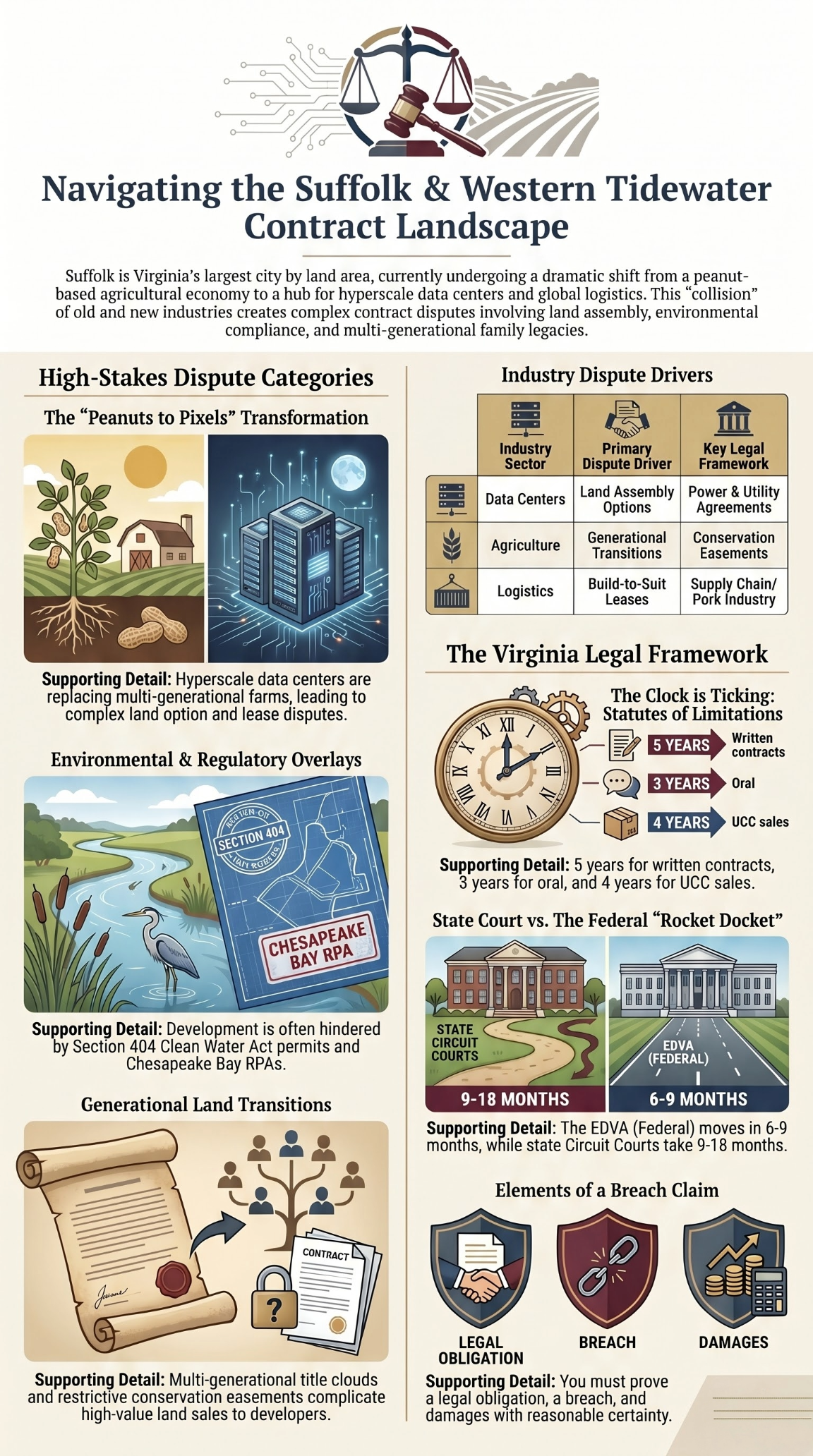
Table of Contents
- The Suffolk Contract Dispute Environment
- Data Center Development and Hyperscale Infrastructure Contracts
- Agricultural Land, Timber, and Generational Farm Transition Disputes
- Distribution, Logistics, and Manufacturing Contract Disputes
- Northern Suffolk Construction and Land Development Disputes
- Wetlands, Stormwater, and Environmental Compliance Disputes
- Small-Town Commercial Disputes in the Historic Communities
- Virginia Law on Breach of Contract and Available Remedies
- Navigating the 5th Judicial Circuit and the EDVA
- How Shin Law Office Resolves Contract Disputes
- Summary
- Frequently Asked Questions
- References
Chapter 1: The Suffolk Contract Dispute Environment
Suffolk is the largest city in Virginia by land area, larger than Norfolk, Newport News, and Portsmouth combined. The city covers 430 square miles, stretching from the Nansemond River and Bennett’s Creek in the northeast, where Suffolk meets the Hampton Roads harbor and the Western Branch corridor across from Portsmouth, all the way to the Great Dismal Swamp National Wildlife Refuge in the south, where the city ends at the North Carolina line. Within those boundaries sit the consolidated city’s downtown core on Main Street and Market Street, the booming Harbour View commercial district near the Monitor-Merrimac Memorial Bridge-Tunnel, and a rural belt of farmland, forests, and historic villages that stretches across most of the city’s land area.
The historic villages still mark the map. Driver sits along Bridge Road on the way to Bennett’s Creek, with its own post office and a small commercial center that has served the surrounding farmland for more than a century. Whaleyville, in the southwest corner of the city, was once an independent town and retains its village character. Holland, in the north-central part of Suffolk along Route 58, anchors a community of farms, churches, and small businesses. Chuckatuck, in the far north along Route 10, sits where Suffolk meets Smithfield in Isle of Wight County. Hobson and Crittenden, near Bennett’s Creek and the Nansemond River, still feel like the maritime communities they were when oysters and seafood drove the local economy. These villages are not separate municipalities. They are all part of the consolidated City of Suffolk, but they retain identities and commercial cultures that the courthouse on Main Street downtown does not always reflect.
The economic transformation underway in Suffolk is the most dramatic in any Virginia city. For nearly a century, Suffolk’s identity was tied to the peanut. Planters Peanuts and Mr. Peanut himself were born here. Birdsong Peanuts and other processors anchored a regional agricultural economy that supported farms, peanut buying points, and processing facilities across Suffolk, Southampton County, and the surrounding Western Tidewater. Peanut farming continues, but it now shares the landscape with operations the founders of Planters could not have imagined. The Route 58 and Route 460 corridors carry steady traffic to and from Amazon distribution centers, Target Regional Distribution Center, and the Suffolk Logistics Park. Smithfield Foods operates major pork processing facilities just across the Isle of Wight line and draws a substantial Suffolk workforce. Most consequentially, the same flat, well-drained, fiber-accessible, power-grid-adjacent land that grew peanuts for a century is now being optioned, leased, and rezoned for hyperscale data center development. Suffolk is emerging as Virginia’s next data center market, following the dominant Loudoun County hub, and the resulting contract activity is reshaping the city’s commercial fabric.
The contract disputes arising from this collision look unlike anything found in either mainland Virginia Beach or Northern Virginia. A multi-generational family farm receives an offer from a hyperscaler under a long-term option agreement that ties the family’s land to a future development decision. A conservation easement granted to the Virginia Outdoors Foundation thirty years ago suddenly conflicts with a current generation’s interest in selling. A timber harvest contract on a 200-acre tract intersects with a Section 404 Clean Water Act wetlands delineation that no one anticipated when the contract was signed. A small contractor in Whaleyville who has worked on local farms for 40 years finds himself bidding on a data center site-preparation contract with terms unlike anything he has encountered before. A peanut buying point operator in Holland negotiates a multi-year supply agreement with a processor whose corporate parent has changed twice since the original deal was signed.
The court system reflects the regional structure rather than just the city. The 5th Judicial Circuit covers Suffolk, Isle of Wight County (including Smithfield, Carrollton, and Windsor), Southampton County, and the City of Franklin. That multi-jurisdictional structure means Suffolk Circuit Court judges hear cases from neighboring counties, and venue for any given dispute may run through any of the four jurisdictions depending on the parties and the property at issue. The U.S. District Court for the Eastern District of Virginia, Norfolk Division, handles federal cases for Suffolk, with the rocket docket pace that has made the EDVA famous among litigators. For readers who do business elsewhere in the Hampton Roads region, see our companion guides on contract disputes in Virginia Beach, contract disputes in Newport News, and contract disputes in Norfolk, all of which apply the same Virginia law to different regional economies.
Chapter 2: Data Center Development and Hyperscale Infrastructure Contracts
The data center transformation deserves first treatment because it is the single most consequential change happening in Suffolk’s commercial fabric, and because the contract disputes that flow from it are unlike anything in Virginia outside Loudoun County. Hyperscalers and colocation operators are evaluating Suffolk for the same reasons that pulled them to Northern Virginia: large flat parcels of cheap land, access to power transmission infrastructure, fiber connectivity, and proximity to subsea cable landings on the Hampton Roads coast. The Suffolk City Council has approved zoning changes and tax incentive packages designed to attract data center development, and a number of hyperscale projects have been announced or are in early site work along the Route 58, Route 460, and Route 13 corridors.
Land assembly disputes are the first category of dispute to surface. Hyperscalers do not buy small parcels. A modern data center campus consumes 200 to 1,000 acres or more, which means the developer must acquire and combine multiple parcels under option agreements that often run for several years before any actual closing. The option agreements are complex, with provisions covering due diligence rights, environmental assessments, title issues, zoning approvals, utility commitments, and price escalators that apply during the option period. When market conditions change, when one landowner refuses to close, when a critical infrastructure approval fails, or when the hyperscaler decides to pursue a different site, the option agreements produce litigation. Sellers who feel they were locked into below-market prices, buyers who lost development rights when zoning failed, and adjacent landowners who relied on assumptions about the project’s progress all generate claims when these arrangements unravel.
Power purchase agreements and utility infrastructure contracts are the second category. Data centers consume electricity at industrial scales that few other commercial facilities approach. A single hyperscale campus may demand 100 megawatts or more of dedicated capacity, requiring substantial new transmission infrastructure that takes years to plan, permit, and build. Dominion Energy is the dominant utility in Suffolk and the surrounding region, and the contract negotiations between Dominion and data center developers run far beyond ordinary commercial supply contracts. Disputes arise over capacity reservations, scheduling of new substation construction, recovery of grid upgrade costs through ratepayer mechanisms, and curtailment provisions that allocate risk during grid stress events.
Tax abatement and economic incentive performance contracts deserve specific attention. Suffolk and Virginia have offered substantial tax incentives to attract data center investment, including the state’s data center sales and use tax exemption under Va. Code § 58.1-609.3. The state and local incentives are typically conditioned on the operator meeting investment thresholds, employment commitments, and operational milestones over a defined period. When a project underperforms or scope changes, the question of whether the operator continues to qualify for the incentives can become contested. Recapture provisions, performance audits, and clawback mechanisms create legal exposure that can run into hundreds of millions of dollars on hyperscale projects. The Virginia Economic Development Partnership and Suffolk’s Department of Economic Development administer these programs, and disputes that reach litigation often involve administrative law dimensions alongside ordinary contract analysis.
Water and wastewater service contracts add another layer of contestation. Modern data centers consume substantial water for evaporative cooling, with hyperscale facilities sometimes drawing several hundred thousand to a million gallons per day. The Hampton Roads Sanitation District and Suffolk’s municipal water systems have capacity constraints, and the service agreements that data centers negotiate with these utilities address allocation, peak demand pricing, infrastructure cost-sharing, and treatment of process water. Disputes arise when usage exceeds projections, when treatment capacity fails to meet contractual commitments, or when neighboring users challenge the allocation of shared infrastructure.
Fiber easement and dark fiber license disputes round out the data center contract category. Data centers depend on fiber connectivity at multiple redundancy levels, with primary, secondary, and diverse-route fiber paths often provided by separate carriers under long-term agreements. Easements across rural Suffolk parcels for fiber installation, dark fiber license arrangements, and interconnection agreements at peering facilities all give rise to disputes when one party fails to perform. The intersection of telecommunications regulation, real property law, and commercial contract analysis makes these cases technical and document-intensive.
Why this matters in Suffolk specifically:
Suffolk is one of the few places in Virginia where the legal framework for data center development is actively being written through the deals that are happening right now. The contracts being signed in 2024 and 2025 will set precedents that govern this market for the next two decades. Landowners, developers, and adjacent property owners who do not understand what they are signing are making decisions today that future generations will live with. Getting counsel involved before signing, rather than after a dispute surfaces, often makes the difference between a transaction that builds wealth and a transaction that becomes a multi-year legal entanglement.
Chapter 3: Agricultural Land, Timber, and Generational Farm Transition Disputes
Suffolk’s farms have produced peanuts, cotton, soybeans, corn, sweet potatoes, and timber for generations. The families that own this land often hold title that traces back four or five generations, with the property assembled over decades through inheritance, marriage, and incremental purchases. The current generation faces decisions that previous generations did not have to make. Should the farm continue as a working operation? Should it be sold to a developer at a premium driven by data center demand? Should it be leased under a long-term arrangement that preserves agricultural use while monetizing future development potential? Should portions be placed under a conservation easement to protect what cannot be replaced? Each path produces its own contract framework and its own dispute patterns.
Multi-generational farm sales generate recurring disputes. The current owner of record may be one or two siblings, but the financial and emotional stakeholders often include cousins, in-laws, and descendants of grantors decades earlier. Sales contracts for family farms must navigate clouds on title, undivided fractional interests, mineral rights severed in transactions a century old, and easements granted without adequate documentation. Buyers conducting due diligence on Suffolk farmland routinely encounter title issues that simpler urban or suburban transactions never produce, and resolving those issues sometimes requires quiet title actions, partition proceedings, or collateral negotiations with previously unknown heirs.
Conservation easement disputes have intensified as land values have risen. The Virginia Outdoors Foundation, the United States Department of Agriculture’s Natural Resources Conservation Service, and various private land trusts hold conservation easements on substantial acreage in Suffolk. These easements were typically granted decades ago in exchange for federal income tax deductions, state tax credits, or direct payments. The easements are perpetual, run with the land, and restrict development, binding future owners. When current owners or buyers want to undertake activities that the easement restricts, the question of whether the activity is permitted becomes a contract interpretation issue with environmental and historic preservation overlays. The Virginia Land Conservation Foundation and the Internal Revenue Service have authority that affects modification or termination, and the legal analysis is technical.
Conservation Reserve Program contracts present a related issue. The CRP, administered by the USDA Farm Service Agency, pays landowners to take agricultural land out of production and convert it to conservation cover for ten to fifteen-year periods. Suffolk has substantial CRP enrollment given the city’s agricultural footprint. Contract disputes arise when landowners seek to terminate CRP contracts early to pursue development opportunities, when contract terms are violated through farming activity, or when transfers of ownership trigger CRP review and possible recapture.
Peanut buying point and processing contracts are a Suffolk-specific category that few outside the industry recognize. Birdsong Peanuts and other regional processors maintain long-term supply relationships with peanut farmers across Suffolk, Southampton, and the surrounding region. The contracts address pricing formulas, delivery scheduling, quality grading, and the seasonal cash flow that makes peanut farming financially viable. Disputes arise when grading at the buying point produces results that the farmer disputes, when contract pricing fails to track market changes, or when the processor’s parent company changes and the farmer faces a different counterparty than the one with whom the original relationship was built.
Timber harvest and sustainable forestry contracts generate distinct dispute patterns. Suffolk has substantial timber acreage, particularly in the southern part of the city and adjacent to the Great Dismal Swamp. Timber sale contracts address the volume and species mix to be cut, the access roads and skid trails the cutter may use, the time period for completion, the price per ton or per board-foot, and the responsibility for site restoration after harvest. Disputes arise when actual cut volumes deviate from contract terms, when site restoration is inadequate, or when timber theft occurs along property lines. Virginia Department of Forestry regulations interact with the contract framework, and Best Management Practice requirements affect the analysis when stream crossings, wetlands, or steep slopes are involved.
Chapter 4: Distribution, Logistics, and Manufacturing Contract Disputes
Suffolk’s combination of large, flat land parcels, interstate access via Routes 58 and 460, proximity to the Port of Virginia, and rail connectivity through Norfolk Southern has made the city one of the fastest-growing distribution and logistics markets in the Mid-Atlantic. Amazon operates a substantial fulfillment center along Route 58. Target operates a regional distribution center serving the Southeast. The Suffolk Logistics Park and various private industrial parks support smaller distribution and manufacturing operations. Smithfield Foods, headquartered just across the line in Isle of Wight County, draws a Suffolk workforce and operates supply chains that flow through Suffolk corridors.
Industrial site lease and build-to-suit disputes are the first major category. Distribution centers operate on long-term ground leases or build-to-suit arrangements that run twenty years or more. The contracts address tenant improvements, mechanical and electrical systems, dock door configurations, parking and trailer storage, and the operational specifications that determine whether the facility can support the tenant’s intended use. When actual operations differ from contract assumptions, when tenant improvement scope expands, or when one party’s operational needs change during the long lease term, the contracts give rise to disputes that require detailed analysis of intent and performance.
Supply chain and pork industry contracts have their own framework. Smithfield Foods operates pork processing facilities, hog production sites, and feed operations across the region, with contract relationships extending to independent producers, packaging suppliers, equipment vendors, and transportation providers. The Packers and Stockyards Act at 7 U.S.C. § 181 et seq. overlays ordinary commercial contract law for protein industry transactions, with specific protections for producers and prohibitions against certain practices that the United States Department of Agriculture’s Packers and Stockyards Division enforces. Disputes between independent hog producers and processors, between processors and their supply chain partners, and between processing facilities and equipment vendors all involve this regulatory layer.
Trucking and drayage contracts in Suffolk follow the same federal framework that governs trucking operations across the broader Hampton Roads region. The Carmack Amendment at 49 U.S.C. § 14706 controls cargo loss claims for interstate shipments. FMCSA Truth-in-Leasing regulations at 49 C.F.R. Part 376 govern owner-operator agreements. Federal preemption under 49 U.S.C. § 14501 limits state law claims against motor carriers and brokers. For a deeper treatment of trucking and freight contract disputes in the broader region, see our guide to trucking, drayage, and freight contract disputes in Chesapeake, Virginia, which addresses the federal preemption framework that controls interstate motor carrier disputes throughout Hampton Roads.
Industrial equipment and machinery contracts give rise to a steady stream of disputes. Distribution centers, processing facilities, and manufacturing operations rely on conveyor systems, automated storage and retrieval systems, packaging equipment, refrigeration systems, and similar industrial equipment that costs millions of dollars and takes months to install. When equipment fails to meet specifications, when installation runs over schedule, or when warranty claims arise after operations begin, the resulting disputes turn on the equipment supply contract, the installation services agreement, and the warranty terms. Virginia’s Uniform Commercial Code at Title 8.2 governs the sales aspects, with the four-year statute of limitations under Va. Code § 8.2-725 controlling the deadline for claims.
Chapter 5: Northern Suffolk Construction and Land Development Disputes
Northern Suffolk, anchored by Harbour View along Route 17 and the Bennett’s Creek corridor, is one of the fastest-growing residential and commercial markets in Hampton Roads. The Harbour View development includes substantial residential subdivisions, retail centers, office and medical complexes, and the Sentara BelleHarbour medical campus. The proximity to the Monitor-Merrimac Memorial Bridge-Tunnel makes Northern Suffolk a viable commute for workers employed across the harbor in Newport News, Norfolk, and Portsmouth, which has driven sustained demand for new housing inventory and the commercial services that support residential growth.
The construction contract disputes I see most often in Northern Suffolk follow patterns common to other rapidly developing suburban markets, with several Suffolk-specific dimensions. Master-planned community development contracts give rise to disputes among developers, builders, and homeowners over phasing schedules, amenity completion, common-area maintenance during build-out, and HOA formation. Residential subdivision disputes involve builder warranty claims, construction defect issues on production housing, and lot grading and drainage problems that surface only after several rainy seasons. Commercial construction in the Harbour View corridor produces the standard menu of delay claims, change order disputes, mechanic’s liens, and pay-when-paid clause enforcement.
Mechanic’s liens deserve attention because the deadlines are short and unforgiving. A memorandum of mechanic’s lien must be filed within 90 days of the last day of the last month in which work was performed or materials were furnished. A suit to enforce the lien must be filed within 6 months of recordation or 60 days from completion of the building, whichever is later. The Suffolk Circuit Clerk’s office maintains a busy lien docket, and the procedural rules are enforced strictly. I have walked through the precise mechanics of filing a Virginia mechanic’s lien before the clock runs out in a separate piece, and the same statutory windows apply to Suffolk projects.
HOA formation and transition disputes are particularly active in the Northern Suffolk master-planned communities. Virginia’s Property Owners’ Association Act at Va. Code § 55.1-1800 et seq. governs HOA structure and operations. The transition from developer control to homeowner control of the HOA board can produce friction when transition reserves are inadequate, common-area work is incomplete at transition, or governing documents reveal provisions homeowners did not anticipate when buying. Disputes that reach litigation often turn on whether the developer met its statutory and contractual obligations during the transition period.
Federal facility construction at Naval Support Activity Hampton Roads, the Northwest Annex, and other federal installations adjacent to Suffolk creates its own category of contracting issues. Subcontractors and material suppliers on federal projects do not have Virginia mechanic’s lien rights against government property, but they have rights under the Miller Act at 40 U.S.C. § 3131 et seq., which require prime contractors on federal projects over $150,000 to post payment bonds. The procedural deadlines and notice requirements differ from those in state mechanic’s lien practice, and contractors unfamiliar with the Miller Act framework can lose substantial recovery rights by missing the federal deadlines.
Residential construction disputes follow the patterns common across Virginia. Defective work in Suffolk residential construction can be expensive to investigate and repair, and Virginia’s implied warranty of habitability and workmanlike construction provides homeowners a substantive remedy alongside the express warranty terms. The Virginia Consumer Protection Act at Va. Code § 59.1-200 also applies to fraudulent or deceptive contractor conduct, with treble damages available for willful violations. For homeowners dealing with builder delays, cost overruns, or construction defects, the protections are substantial when the right claims are filed within the right deadlines.
Chapter 6: Wetlands, Stormwater, and Environmental Compliance Disputes
Suffolk has more environmentally sensitive land within its boundaries than perhaps any other Virginia city. The Great Dismal Swamp National Wildlife Refuge sits along the southern edge, with Lake Drummond at its heart. The Nansemond River and Bennett’s Creek drain substantial portions of the city into the Hampton Roads harbor and ultimately the Chesapeake Bay. Wetlands, both tidal and non-tidal, are scattered across thousands of acres of Suffolk farmland, forest, and undeveloped land. Stream corridors, intermittent drainages, and groundwater systems connect to broader regional hydrology, affecting almost every significant development project. The contract disputes that flow from this environmental footprint require analysis of frameworks that ordinary commercial litigators may not encounter often.
Section 404 Clean Water Act permitting under 33 U.S.C. § 1344 controls discharges of dredged or fill material into waters of the United States, including most wetlands. The U.S. Army Corps of Engineers’ Norfolk District handles permitting for projects in Suffolk, and the permit process can run from months for small projects to years for large ones. Contract disputes arise when Section 404 permits take longer or impose more conditions than developers anticipated, when delineations of wetland boundaries differ from initial assumptions, or when mitigation requirements expand the scope and cost of compliance. Land sale contracts, development agreements, and construction contracts that did not adequately address Section 404 risk often lead to litigation when the actual permit process deviates from expectations.
Mitigation banking is a related and increasingly active area. Section 404 permits typically require compensatory mitigation when wetland impacts cannot be avoided, with the most common mitigation method being the purchase of credits from approved mitigation banks. Suffolk has several mitigation banks within the city or in the surrounding region, and the contract relationships among bank operators, credit purchasers, regulatory agencies, and adjacent landowners produce their own disputes. Bank operators who cannot deliver credits at expected pricing, purchasers who find their projects require more credits than initially estimated, and adjacent landowners who challenge bank operations all generate claims.
Chesapeake Bay Preservation Act compliance affects Northern Suffolk, particularly the Bennett’s Creek corridor. The Act, codified at Va. Code § 62.1-44.15:67 et seq., establishes Resource Protection Areas (RPAs) and Resource Management Areas (RMAs) along tidal waters, with substantial restrictions on land disturbance, vegetation removal, and impervious surface within RPAs. Land sale contracts and development agreements that do not adequately address Bay Act constraints can lead to disputes when buyers discover, post-closing, that significant portions of a parcel are encumbered by Bay Act buffers.
Virginia Stormwater Management Act compliance is the third major environmental layer. The Act, with implementing regulations at 9 VAC 25-870, requires stormwater management plans for most land-disturbing activities, with quantity and quality controls that affect site design and construction. Disputes arise when stormwater infrastructure fails to perform as designed, when post-construction maintenance obligations are disputed between developers and HOAs, and when downstream property owners experience flooding or water quality impacts they attribute to upstream development.
Environmental indemnification disputes overlay all of these issues. Land sale contracts for Suffolk parcels routinely include environmental indemnification provisions allocating responsibility for known and unknown contamination, wetlands liabilities, and regulatory compliance issues. When post-closing investigations reveal conditions the buyer did not anticipate, the indemnification provisions become the focal point of dispute. The Comprehensive Environmental Response, Compensation, and Liability Act at 42 U.S.C. § 9601 et seq. and the Virginia Voluntary Remediation Program create overlapping federal and state frameworks that affect the analysis.
Chapter 7: Small-Town Commercial Disputes in the Historic Communities
Suffolk’s historic villages of Driver, Whaleyville, Holland, Chuckatuck, Hobson, and Crittenden, along with the surrounding rural commercial communities and the small towns of Smithfield, Carrollton, Windsor, and Franklin in the broader Western Tidewater, support a network of family-owned businesses that have operated for decades or generations. Restaurants, retail stores, professional services firms, agricultural service providers, equipment dealers, and trades businesses pass from one generation to the next under arrangements documented imperfectly or not at all. When the underlying relationships break down, the resulting disputes carry both legal and personal weight.
The small-business and partnership disputes I see most often in the Western Tidewater include LLC operating agreement disputes (especially when the agreement is silent on a question that matters); shareholder disputes in closely held corporations under the Virginia Stock Corporation Act; partnership dissolution disputes between long-time partners; family business succession disputes when a generation transition does not go as expected; buy-sell agreement disputes over valuation, triggering events, and payment terms; and employment disputes between owners who are also officers or employees.
Buy-sell agreements receive special attention in family businesses. A well-drafted buy-sell anticipates death, disability, divorce, retirement, voluntary withdrawal, and involuntary termination. It establishes the valuation methodology (formula, appraisal, fixed-price with adjustment), payment terms (lump sum, installment), and security for installment payments. Most family businesses I encounter in this region have buy-sell language that addresses some of these issues but not all, and the gaps surface when the trigger event arrives. The Virginia Supreme Court’s approach to ambiguous business agreements in Berry v. Klinger, 225 Va. 201 (1983), and similar authority drives the resolution. For more on contract formation issues that surface in business disputes, see our piece on contract formation and enforceability under Virginia law.
Fiduciary duty claims often accompany contract claims in closely held business disputes. Officers, directors, and controlling members owe duties to the company and to minority owners that go beyond the contract terms. A majority owner who diverts opportunities, pays excessive compensation to family members, or refuses to make reasonable distributions may be liable for breach of fiduciary duty even when the operating agreement language allows the conduct. The line between business fraud and breach of contract matters here, and the choice of theory affects the available remedies and the punitive damages exposure.
A reality of small-town disputes that bigger-market lawyers miss:
In Driver, Whaleyville, Holland, Chuckatuck, Smithfield, Windsor, and the surrounding communities, the parties to a business dispute often grew up together, attended the same churches, and watched their kids play on the same teams. Their families know each other. The dispute will be discussed at gas stations, hardware stores, and Sunday lunches long after the lawsuit is filed. Lawyers who treat these cases like impersonal commercial transactions miss the social dimension that affects how they actually resolve. The right approach respects both the legal substance and the relationships that exist beyond the courtroom, while still pursuing the client’s interests with the rigor the case requires.
Chapter 8: Virginia Law on Breach of Contract and Available Remedies
Every contract dispute in Suffolk and the Western Tidewater comes back to two questions: was there a breach, and what is the remedy? Virginia law answers both with a body of doctrine that is traditional, predictable, and often advantageous for the side that prepares thoroughly. I have published a detailed walkthrough of Virginia breach of contract claims that covers the elements, defenses, and damages calculations in depth. The summary below highlights what matters most for Suffolk cases.
Elements of a Breach of Contract Claim
The Virginia Supreme Court set out the elements in Filak v. George, 267 Va. 612 (2004): a legal obligation, a breach of that obligation, and resulting damages. The plaintiff must prove each element by a preponderance of the evidence. The contract itself, whether written or oral, establishes the obligation. The breach is the failure to perform as the contract requires. The damages must be proven with reasonable certainty, which is often the hardest of the three elements.
Statute of Limitations
Va. Code § 8.01-246 sets the deadline at five years for written contracts and three years for unwritten (oral) contracts. UCC sales of goods are limited to four years under Va. Code § 8.2-725. The clock starts on the date of breach, not the date of discovery, with limited exceptions. Virginia uses the breach rule, not the discovery rule, for most contract claims.
Statute of Frauds
Va. Code § 11-2 requires certain contracts to be in writing to be enforceable, including promises to answer for the debt of another, agreements that cannot be performed within one year, sales of land or any interest in land, and contracts for the sale of goods of $500 or more under Va. Code § 8.2-201. Email exchanges and other electronic records can satisfy the writing requirement under the Uniform Electronic Transactions Act at Va. Code § 59.1-479 et seq.
Available Remedies
Virginia recognizes compensatory damages that put the plaintiff in the position the contract promised; consequential damages for foreseeable losses flowing from the breach under the rule of Hadley v. Baxendale; liquidated damages when the contract specifies them and they are not a penalty; specific performance for unique items, including real estate; rescission to undo the contract when fraud or material breach justifies it; and reformation to correct mutual mistake in the written instrument.
Mitigation and Punitive Damages
Mitigation is required. A non-breaching party must take reasonable steps to reduce damages, and a court will deny recovery for losses that could have been avoided. Punitive damages are not available for breach of contract alone in Virginia. They require an independent tort, such as fraud in the inducement, that exists alongside the contract claim. The cap on punitive damages under Va. Code § 8.01-38.1 is $350,000.
Chapter 9: Navigating the 5th Judicial Circuit and the EDVA
Suffolk contract disputes can land in any of several courts, and the multi-jurisdictional structure of the 5th Judicial Circuit gives the choice of forum dimensions that single-jurisdiction circuits do not have. The procedural mechanics are similar to what I have described elsewhere about how Virginia courts resolve contract and business disputes, but Suffolk has its own venue rules and docket dynamics shaped by the circuit’s geography.
Suffolk General District Court
Located at the Mills E. Godwin Jr. Courts Building on Main Street in downtown Suffolk, this court hears civil cases with an amount in controversy up to $25,000 (exclusive of interest and attorney’s fees). Cases proceed without juries, follow a simplified procedure, and typically resolve within 60 to 120 days. Discovery is limited. Appeals from the General District Court go to the Circuit Court for a trial de novo, meaning the case starts over with full procedural rights. For consumer disputes, residential construction matters, and small commercial cases, the General District Court is often the right venue.
Suffolk Circuit Court (5th Judicial Circuit)
The Suffolk Circuit Court at the Godwin Courts Building hears civil cases over $25,000 and any case requiring equitable relief such as specific performance or injunctions. The 5th Judicial Circuit covers Suffolk, Isle of Wight County (Smithfield, Carrollton, Windsor), Southampton County, and the City of Franklin. Judges sit in each jurisdiction’s courthouse, and a single judge may hear cases from any of the four jurisdictions on a given week. Venue between the four jurisdictions turns on Va. Code § 8.01-262 factors including where the contract was executed, where performance was to occur, and where the defendant resides. Cases typically take 9 to 18 months from filing to trial.
Isle of Wight, Southampton, and Franklin Circuit Courts
Cases involving Smithfield Foods operations, Smithfield commercial real estate, Carrollton residential developments, or Windsor industrial sites typically venue in the Isle of Wight Circuit Court at the Isle of Wight Courthouse on Monument Circle. Cases involving Southampton County agricultural operations, the Franklin paper industry footprint, or the Boykins commercial corridor venue accordingly. Each courthouse has its own clerk’s office, its own scheduling rhythms, and its own local practice culture, but the substantive law and procedural rules are identical to those that apply in Suffolk.
U.S. District Court, Eastern District of Virginia, Norfolk Division
Federal cases for Suffolk and the Western Tidewater proceed in the EDVA Norfolk Division at 600 Granby Street in Norfolk. The Eastern District of Virginia is widely known among litigators as the rocket docket, with cases routinely reaching trial within 6 to 9 months of filing. Discovery deadlines are short, motion schedules are compressed, and continuances are rarely granted. For plaintiffs with strong cases, the speed is an advantage. For defendants, it can be punishing. Federal questions, federal subcontract disputes under the Miller Act, Section 404 Clean Water Act issues, Carmack Amendment cargo claims, and federal preemption disputes often belong in federal court.
Removal, Mediation, and Arbitration
Removal to federal court is available in diversity cases under 28 U.S.C. § 1441 and must be filed within 30 days of service of the complaint. Out-of-state defendants frequently remove Virginia state court contract cases to federal court, which, in the EDVA, means accepting the rocket-docket pace. Many commercial contracts contain arbitration clauses governed by the Federal Arbitration Act, 9 U.S.C. § 1 et seq., or the Virginia Uniform Arbitration Act at Va. Code § 8.01-581.01 et seq. These clauses are generally enforceable, and a court will dismiss or stay litigation when a valid arbitration agreement covers the dispute. Hyperscaler ground leases and large industrial contracts often include detailed multi-tier dispute resolution procedures that must be honored before the courthouse doors open.
Chapter 10: How Shin Law Office Resolves Contract Disputes
Shin Law Office serves clients throughout the Commonwealth of Virginia, including Suffolk, Smithfield, Carrollton, Windsor, Franklin, and the broader Western Tidewater region. As a Virginia-licensed attorney, I represent clients in any state court in Virginia and in the U.S. District Court for the Eastern District of Virginia, including the Norfolk Division. The full range of our work is described on our civil litigation practice page.
Our process for a Suffolk contract dispute follows a deliberate sequence. The work begins with an initial case assessment. When you call the firm, we collect the contract, the relevant communications, and a chronology of what happened. The first review tells us three things: whether you have a viable claim, what the realistic damages look like, and what the procedural posture is. If the matter falls outside our practice areas or is better handled by a different attorney, I will tell you that directly.
From there we move to pre-litigation strategy. A surprising number of contract disputes resolve before suit is filed. A well-drafted demand letter that cites the controlling Virginia statutes, attaches the key documents, and lays out a credible damages calculation often produces a settlement offer within 30 days. When the demand letter does not produce a result, we evaluate whether mediation, arbitration, or litigation is the right next step.
When litigation is necessary, we file in the court that gives our client the best procedural and substantive position. That choice depends on the amount in controversy, the desired speed, the availability of a jury, the discovery rules, and any forum selection or arbitration clauses in the contract. For Suffolk and Western Tidewater clients, the 5th Circuit (Suffolk, Isle of Wight, Southampton, Franklin), the General District Courts in each jurisdiction, and the EDVA Norfolk Division each have advantages depending on the case.
The discovery phase is where most contract cases are won or lost. We use depositions, document requests, interrogatories, and requests for admission strategically rather than reflexively. Summary judgment motions under Rule 3:20 of the Virginia Supreme Court Rules can resolve a case before trial when the contract language is clear and the material facts are undisputed. In the EDVA, summary judgment under Rule 56 of the Federal Rules of Civil Procedure operates on a similar standard with a tighter timeline.
Most contract disputes settle, often after discovery has narrowed the issues and clarified the damages exposure. When settlement is not possible, we try the case. I have represented clients in bench trials and jury trials across Virginia, and I prepare every case as if it will go to trial. When a trial result needs to be challenged, the appeal goes to the Court of Appeals of Virginia for civil cases under the 2022 jurisdictional expansion at Va. Code § 17.1-405. Federal appeals from the EDVA go to the U.S. Court of Appeals for the Fourth Circuit in Richmond.
The work is detailed, technical, and demanding. That is what tough cases require, and that is what we do.
Summary
Suffolk is the largest city in Virginia by land area and one of the Commonwealth’s fastest-transforming municipalities. The same ground that grew Virginia peanuts for generations is being optioned for hyperscale data centers. The Harbour View and Bennett’s Creek corridors have become booming exurban commercial markets. Historic communities at Driver, Whaleyville, Holland, Chuckatuck, Hobson, and Crittenden still operate on small-town terms. The contract disputes that arise from this transformation sit at the intersection of frameworks that rarely meet anywhere else: hyperscale ground leases and power purchase agreements, multi-generational farmland sales and conservation easements, distribution and logistics contracts along Route 58 and Route 460, Section 404 wetlands permitting and Chesapeake Bay Preservation Act compliance, and small-town commercial relationships in the historic villages and the surrounding Western Tidewater.
Three principles apply across every category of dispute discussed in this guide. First, the moment matters. Suffolk is in the middle of a transformation that is producing contract precedents that will govern this market for the next two decades. Decisions made today, including those made without legal advice, will bind future generations. Second, documentation matters. The party with the better contract file, the better contemporaneous record, and the better preserved communications usually wins, regardless of whether the dispute involves a 200-acre option agreement or a small-town partnership dissolution. Third, forum matters. The 5th Judicial Circuit’s coverage of four jurisdictions, combined with the rocket docket pace of the EDVA Norfolk Division, gives Suffolk litigants choices that are not available in single-jurisdiction circuits, and the strategic use of those choices can change everything about how a case proceeds.
If you are facing a contract dispute in Suffolk or the broader Western Tidewater, do not wait for the situation to clarify itself. The transformation underway in this region is producing contract structures that older legal frameworks have not fully addressed, and the early decisions you make will shape your options later. Get a lawyer involved early, when the evidence is fresh and the procedural options are still open.
Frequently Asked Questions
How long do I have to file a breach of contract lawsuit in Suffolk, Virginia?
Virginia gives you five years from the date of breach for a written contract and three years for an oral contract under Va. Code § 8.01-246. Sales of goods under the UCC are limited to four years under Va. Code § 8.2-725. The clock starts on the date of breach, not the date you discovered it, so the practical window is often shorter than it sounds.
Where do I file a contract lawsuit in Suffolk?
For amounts up to $25,000, the Suffolk General District Court at the Godwin Courts Building. For amounts over $25,000 or for equitable relief, the Suffolk Circuit Court (5th Judicial Circuit) at the same Godwin Courts Building. For matters involving Smithfield, Carrollton, Windsor, Franklin, or rural Southampton County, venue may run through the corresponding county or city circuit. For federal questions and diversity cases, the U.S. District Court for the Eastern District of Virginia, Norfolk Division.
A hyperscaler offered me a long-term option to buy my Suffolk farmland. Should I sign?
Not without counsel. Long-term option agreements with data center developers tie your land’s future use to the developer’s decisions for years, with provisions on price escalation, due diligence rights, environmental and zoning conditions, and termination that vary widely between deals. The version you are offered is the developer’s preferred form. Substantial revisions are routinely negotiated. Signing without representation can lock generations of your family into terms you would not have accepted with full information.
My family farm has a conservation easement granted to the Virginia Outdoors Foundation thirty years ago. Can we sell to a developer?
It depends on the specific easement terms. Conservation easements run with the land and are typically perpetual, but they only restrict activities specifically prohibited in the easement language. Some easements allow limited development; some prohibit all non-agricultural use; some include amendment procedures that the parties can invoke. The analysis turns on a careful reading of the easement, the grantor’s reserved rights, and the easement holder’s modification policies.
What is the 5th Judicial Circuit and why does it cover so many jurisdictions?
The 5th Judicial Circuit covers Suffolk, Isle of Wight County (Smithfield, Carrollton, Windsor), Southampton County, and the City of Franklin. Virginia’s circuit court system aggregates jurisdictions to enable efficient judicial coverage. Judges sit in each jurisdiction and may hear cases from any of the four. Venue analysis under Va. Code § 8.01-262 determines which courthouse hears a particular case.
Do I need a Section 404 wetlands permit before developing my Suffolk land?
Probably yes if your project involves discharge of dredged or fill material into waters of the United States, including most wetlands. The U.S. Army Corps of Engineers’ Norfolk District handles permitting. The first step is a wetlands delineation by a qualified consultant, followed by a jurisdictional determination from the Corps. Project design that avoids or minimizes impacts is generally preferable to mitigation. Land sale contracts that did not address Section 404 risk often produce litigation when the actual permit process diverges from expectations.
What is the Chesapeake Bay Preservation Act and how does it affect my Bennett’s Creek property?
The Bay Act, codified at Va. Code § 62.1-44.15:67 et seq., establishes Resource Protection Areas (RPAs) and Resource Management Areas (RMAs) along tidal waters, including the tidal portions of the Nansemond River and Bennett’s Creek. RPAs include 100-foot vegetated buffers along tidal shorelines and tidal wetlands, with substantial restrictions on land disturbance and impervious surface within the buffer. Suffolk implements the Act through its zoning ordinance, and compliance affects most Bennett’s Creek and Nansemond River-adjacent development.
Are buy-sell agreements enforceable for my family business in Whaleyville or Holland?
Yes, when properly drafted and supported by consideration. Buy-sell agreements address what happens upon death, disability, divorce, retirement, voluntary withdrawal, and involuntary termination. Most family businesses have buy-sell language that addresses some triggers but not all of them. The gaps surface when the trigger event arrives, and Virginia common law on contract interpretation governs the resolution. Periodic review and updating of buy-sell language is far less expensive than litigation when the gaps become contested.
What damages can I recover in a Virginia breach of contract case?
Compensatory damages, consequential damages within the rule of foreseeability, liquidated damages when the contract specifies them and they are not a penalty, specific performance for unique items, rescission, and reformation. Punitive damages are not available for breach of contract alone, but may be available if an independent tort like fraud is also pleaded and proven. Attorney’s fees are recoverable only if the contract or a statute provides for them.
Do I need an attorney to handle a contract dispute in Suffolk?
For matters under $5,000 in the General District Court, many people represent themselves successfully. Once the amount in controversy exceeds $25,000 and the case moves to Circuit Court or the EDVA, the procedural rules become significantly more demanding, and self-representation usually costs more than it saves. For data center development, multi-generational farmland transactions, conservation easements, wetlands matters, and complex commercial cases, an attorney is essential.
Ready to Resolve Your Suffolk or Western Tidewater Contract Dispute?
Whether you are a Suffolk farmer evaluating a hyperscaler option offer, a developer working through wetlands permitting on a Bennett’s Creek site, a family business owner in Whaleyville or Holland working through a partnership dissolution, a Smithfield contractor with a payment dispute, a homeowner in Harbour View facing builder defects, or a peanut farmer with a buying point grading disagreement, you deserve a Virginia attorney who understands the law and the unique character of the Western Tidewater.
Tough cases require tough attorneys. Shin Law Office handles contract disputes across the Commonwealth, including Suffolk, Smithfield, Carrollton, Windsor, Franklin, and the broader Hampton Roads region.
Call 571-445-6565 or book your case review online at shinlawoffice.com/meet-our-team/contact

References
Code of Virginia. (2024). Title 8.01, Chapter 4: Limitations of actions. Virginia General Assembly. https://law.lis.virginia.gov/vacode/title8.01/chapter4/
Code of Virginia. (2024). Title 8.2: Commercial Code, Sales. Virginia General Assembly. https://law.lis.virginia.gov/vacode/title8.2/
Code of Virginia. (2024). Title 11, Chapter 1: Statute of Frauds. Virginia General Assembly. https://law.lis.virginia.gov/vacode/title11/chapter1/
Code of Virginia. (2024). Title 43: Mechanics’ and Certain Other Liens. Virginia General Assembly. https://law.lis.virginia.gov/vacode/title43/
Code of Virginia. (2024). Title 55.1, Chapter 18: Property Owners’ Association Act. Virginia General Assembly. https://law.lis.virginia.gov/vacode/title55.1/chapter18/
Code of Virginia. (2024). Title 58.1, Section 609.3: Data center sales and use tax exemption. Virginia General Assembly. https://law.lis.virginia.gov/vacode/title58.1/chapter6/section58.1-609.3/
Code of Virginia. (2024). Title 59.1, Chapter 17: Virginia Consumer Protection Act. Virginia General Assembly. https://law.lis.virginia.gov/vacode/title59.1/chapter17/
Code of Virginia. (2024). Title 62.1, Chapter 3.1: Chesapeake Bay Preservation Act. Virginia General Assembly. https://law.lis.virginia.gov/vacode/title62.1/chapter3.1/
Clean Water Act, 33 U.S.C. § 1344 (Section 404 permits for discharges of dredged or fill material). https://www.govinfo.gov/app/collection/uscode
Comprehensive Environmental Response, Compensation, and Liability Act, 42 U.S.C. § 9601 et seq. https://www.govinfo.gov/app/collection/uscode
Miller Act, 40 U.S.C. § 3131 et seq. https://www.govinfo.gov/app/collection/uscode
Packers and Stockyards Act, 7 U.S.C. § 181 et seq. https://www.govinfo.gov/app/collection/uscode
Berry v. Klinger, 225 Va. 201 (1983).
Filak v. George, 267 Va. 612 (2004).
City of Suffolk. (2024). About Suffolk and economic development. https://www.suffolkva.us/
Suffolk Circuit Court. (2024). Fifth Judicial Circuit of Virginia. City of Suffolk. https://www.suffolkva.us/197/Circuit-Court
U.S. Army Corps of Engineers, Norfolk District. (2024). Section 404 regulatory program. https://www.nao.usace.army.mil/Missions/Regulatory/
U.S. Department of Agriculture, Natural Resources Conservation Service. (2024). Conservation easement programs. https://www.nrcs.usda.gov/programs-initiatives/acep-agricultural-conservation-easement-program
U.S. Department of Agriculture, Farm Service Agency. (2024). Conservation Reserve Program. https://www.fsa.usda.gov/programs-and-services/conservation-programs/conservation-reserve-program/
U.S. District Court for the Eastern District of Virginia. (2024). Norfolk Division. https://www.vaed.uscourts.gov/
U.S. Fish and Wildlife Service. (2024). Great Dismal Swamp National Wildlife Refuge. https://www.fws.gov/refuge/great-dismal-swamp
Virginia Department of Environmental Quality. (2024). Stormwater management program. https://www.deq.virginia.gov/our-programs/water/stormwater
Virginia Economic Development Partnership. (2024). Data center industry profile. https://www.vedp.org/industry/data-centers
Virginia Outdoors Foundation. (2024). About conservation easements. https://www.vof.org/conservation-easements/
Virginia Port Authority. (2024). About the Port of Virginia. https://www.portofvirginia.com/