By Anthony I. Shin, Esq. | Shin Law Office | Serving Clients Across Virginia
BOTTOM LINE UP FRONT
Newport News is the industrial anchor of the Virginia Peninsula, home to Huntington Ingalls Industries Newport News Shipbuilding (the only U.S. builder of nuclear aircraft carriers and one of two builders of nuclear submarines), Jefferson Lab, Christopher Newport University, the Port of Virginia’s Newport News Marine Terminal, Newport News/Williamsburg International Airport, and a substantial defense contractor ecosystem supporting the surrounding installations at Joint Base Langley-Eustis, Yorktown Naval Weapons Station, and the broader Hampton Roads military complex. Contract disputes here look different from anywhere else in the Commonwealth. Shipbuilding subcontractor and supply chain claims tied to multi-year carrier and submarine programs, defense contractor prime-sub flow-down disputes, port and terminal operations, healthcare contracts anchored by Riverside and Bon Secours hospitals, professional services and engineering firm disputes, residential and commercial real estate, and consumer matters all funnel through the 7th Judicial Circuit and the U.S. District Court for the Eastern District of Virginia, Newport News Division.
This guide covers every major category of contract dispute affecting Newport News businesses and residents, the Virginia statutes and federal frameworks that apply, and how a Virginia litigation attorney handles each type. Call Shin Law Office at 571-445-6565 or book your case review online at shinlawoffice.com/meet-our-team/contact.
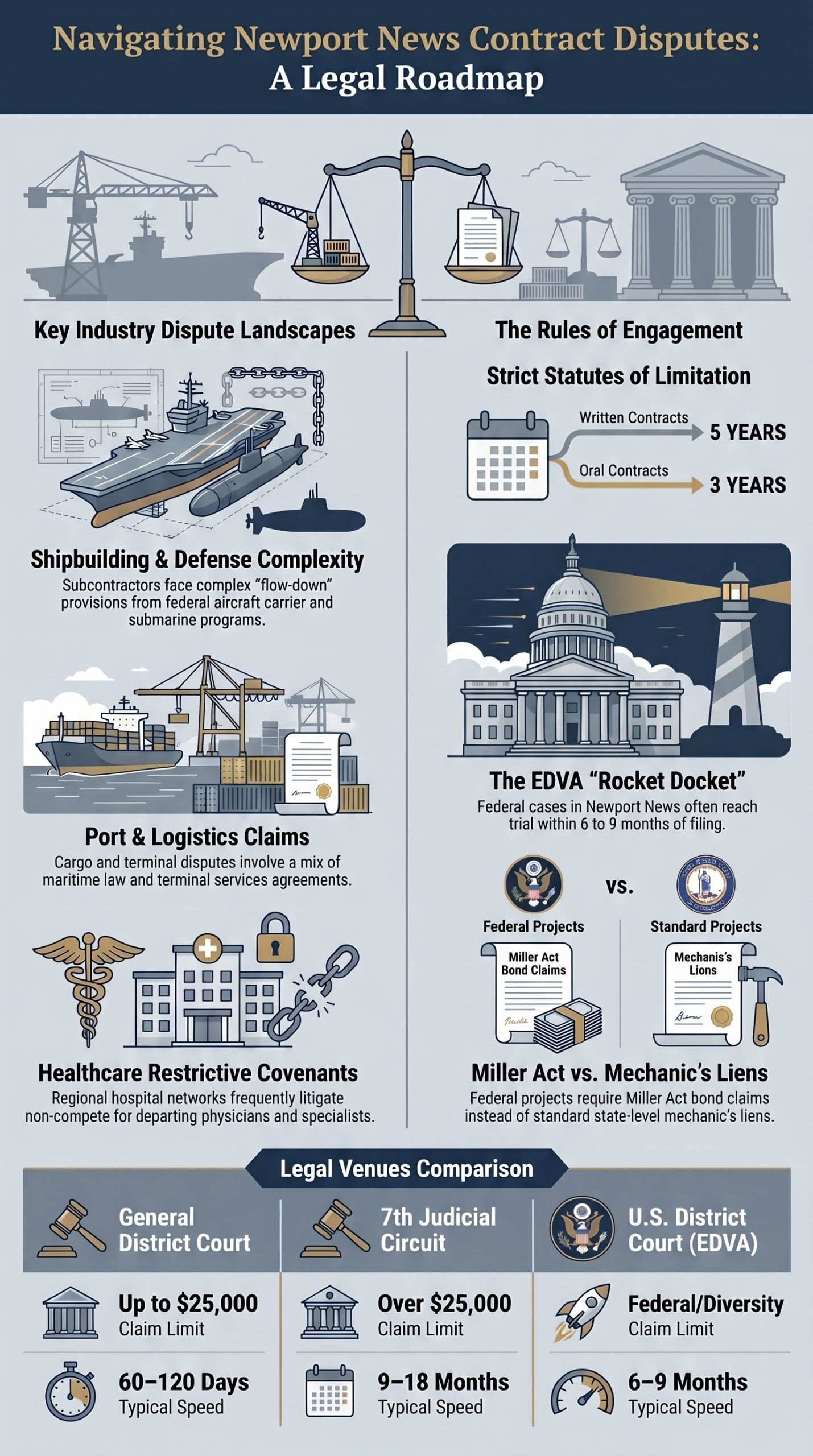
Table of Contents
- The Newport News Contract Dispute Environment
- Shipbuilding and Defense Contractor Disputes
- Port of Virginia Newport News Marine Terminal Disputes
- Engineering, Professional Services, and Research Contract Disputes
- Construction Contract Disputes on the Virginia Peninsula
- Healthcare and Medical Practice Contract Disputes
- Consumer Contract Disputes for Newport News Residents
- Virginia Law on Breach of Contract and Available Remedies
- Navigating Newport News’ Court System
- How Shin Law Office Resolves Contract Disputes
- Summary
- Frequently Asked Questions
- References
Chapter 1: The Newport News Contract Dispute Environment
Newport News stretches along the western shore of the Hampton Roads harbor, from the James River bridges in the south to the Mariners Museum and Christopher Newport University in the central area, up to Fort Eustis and the Yorktown boundary in the north. The city covers roughly 70 square miles, with the population concentrated along the harbor and the Mercury Boulevard, Jefferson Avenue, and Warwick Boulevard corridors that run the length of the peninsula. Few cities anywhere in the United States combine the shipbuilding presence, the federal research footprint, the deep-water port access, and the military-adjacent industrial base that Newport News supports.
The dominant economic force is Huntington Ingalls Industries Newport News Shipbuilding. With more than 25,000 employees on a 550-acre waterfront campus, HII Newport News is the largest industrial employer in Virginia and one of the largest in the entire mid-Atlantic. The shipyard is the only U.S. facility that builds nuclear-powered aircraft carriers, including the Gerald R. Ford-class, and one of only two facilities (with General Dynamics Electric Boat in Connecticut) that builds nuclear submarines, including the Virginia-class and the Columbia-class. The shipbuilding work supports a vast supplier network across Virginia and the broader region, with thousands of subcontractors, parts vendors, engineering firms, and specialty trades feeding work into the yard under contracts that often span years.
Beyond shipbuilding, the Newport News economy supports a substantial federal research footprint at Thomas Jefferson National Accelerator Facility (Jefferson Lab), a Department of Energy facility that operates the Continuous Electron Beam Accelerator Facility for nuclear physics research. NASA Langley Research Center, technically located in adjacent Hampton, draws scientific and engineering talent into the Newport News commuter shed. Christopher Newport University anchors the higher education sector. Riverside Health System and Bon Secours operate the dominant hospital networks. The Port of Virginia’s Newport News Marine Terminal handles bulk cargo, breakbulk shipments, and roll-on/roll-off vehicle traffic that complement the container operations at the Norfolk and Portsmouth terminals across the harbor.
The contract disputes that arise from this ecosystem reflect the city’s industrial character. Shipbuilding subcontractors who deliver components or services to the yard face complex prime-sub flow-down provisions, government cost accounting standards, and security clearance requirements that ordinary commercial subcontractors do not encounter. Defense contractors operating in support of Joint Base Langley-Eustis, Yorktown Naval Weapons Station, and the surrounding installations face Federal Acquisition Regulation flow-downs, Service Contract Act and Davis-Bacon Act compliance issues, and Defense Contract Audit Agency reviews. Engineering and research contractors at Jefferson Lab and the surrounding federal facilities operate under cooperative agreements, grant terms, and intellectual property frameworks that overlay ordinary contract law.
The court system reflects the city’s structure. The 7th Judicial Circuit covers Newport News exclusively, with both the Circuit Court and the General District Court located at the Newport News Courthouse on Washington Avenue downtown. The U.S. District Court for the Eastern District of Virginia, Newport News Division, is one of the four EDVA divisions, sitting at 2400 West Avenue. Federal cases here proceed at the rocket docket pace that has made the EDVA famous among litigators. The procedural rules and substantive law are identical to what applies elsewhere in Virginia, but the practical experience of litigating in Newport News differs from filing in Norfolk, Virginia Beach, or Northern Virginia. This guide covers ten categories of contract disputes that arise in Newport News and the surrounding Virginia Peninsula. For readers who do business in other parts of the Commonwealth, see our companion guides on contract disputes in Virginia Beach, on contract disputes in Norfolk and Hampton Roads, and on Northern Virginia commercial contract litigation.
Chapter 2: Shipbuilding and Defense Contractor Disputes
Shipbuilding contracts at Newport News operate on a different scale and timeline than ordinary commercial contracts. A new aircraft carrier program runs eight to ten years from initial cutting of steel to delivery, with subcontractor relationships extending across that entire period. A Virginia-class submarine takes roughly six to seven years. Columbia-class submarine work, currently ramping up at the yard, will support multi-year subcontractor commitments well into the next decade. The disputes that arise within this framework follow patterns that ordinary commercial litigators may not see in any other industry.
Subcontractor delay and disruption claims dominate the category. A subcontractor that experienced delays caused by the prime contractor’s failure to provide drawings, materials, or access at the contractually required time may have substantial damages from labor inefficiency, extended overhead, and disrupted schedules. The Federal Acquisition Regulation framework, the prime contract’s flow-down clauses, and any specific subcontract terms drive the analysis. The Eichleay formula and other delay damage calculation methods apply when extended overhead is at issue, but proving entitlement requires careful documentation of the project schedule, the actual cause of delay, and the resulting cost impact.
Differing site conditions claims arise when subcontractors encounter physical conditions that differ materially from what the contract documents represented. On a shipbuilding project, this might involve unexpected steel conditions, corrosion or damage discovered during refit work, hazardous material remediation requirements that exceed contract assumptions, or interface conditions between subcontractor work and other trades that complicate the work in ways the bid did not contemplate. The FAR’s differing site conditions clause and similar prime contract provisions allow recovery when the subcontractor can establish that the actual conditions materially differed from indications in the contract documents and the subcontractor reasonably relied on those indications in pricing the work.
Termination for convenience and termination for default are the second major dispute category. The federal government and the prime contractor can terminate subcontracts for convenience, with the subcontractor generally entitled to recover costs incurred to date, profit on work performed, and termination settlement expenses. Default terminations are more contested, because the prime contractor must establish that the subcontractor materially breached and that the breach was not excusable. Subcontractors facing default termination should preserve all communications about performance, capacity, and any directions from the prime that might have contributed to the situation. A wrongfully terminated subcontractor may recover the full benefit of the bargain, while a properly defaulted subcontractor may face reprocurement costs and other prime contractor damages.
Government cost accounting and audit issues create their own category of disputes. Defense Contract Audit Agency reviews of subcontractor incurred costs, indirect cost rates, and cost allocability decisions can produce disallowed costs that ripple through to subcontractor payment. Subcontractors who hold cost-reimbursable or time-and-materials contracts must maintain accounting systems that meet government cost accounting standards, with the ability to support every cost charged to the contract. Disputes between primes and subs over allowability, allocability, and reasonableness of incurred costs require technical analysis under FAR Part 31 and CAS frameworks that ordinary commercial accounting principles do not address.
Why this matters in Newport News specifically:
When a Newport News shipbuilding subcontractor disputes a prime contractor decision, the dispute often pulls in multiple frameworks at once. Virginia common law on contract interpretation. Federal Acquisition Regulation flow-downs. Government cost accounting standards. Security clearance and information handling requirements. The Contract Disputes Act if the underlying claim against the government becomes relevant. The intersection of these frameworks produces litigation that requires both Virginia contract experience and federal contracting experience. Subcontractors who treat these disputes like ordinary commercial cases miss the federal layer that often controls the outcome.
Chapter 3: Port of Virginia Newport News Marine Terminal Disputes
The Newport News Marine Terminal, operated by the Virginia Port Authority’s Virginia International Terminals subsidiary, handles bulk cargo, breakbulk shipments, project cargo, and roll-on/roll-off vehicle traffic. While the container business at the Port of Virginia concentrates at the Norfolk International Terminals and Virginia International Gateway across the harbor, Newport News handles substantial automobile imports and exports, agricultural commodity bulk shipments, military cargo, and oversized industrial cargo for energy and infrastructure projects. The contract disputes that arise around these operations differ from container drayage disputes because the cargo, the equipment, and the operational rhythms all differ.
Stevedoring and terminal services contracts are a recurring source of dispute. Cargo owners, ocean carriers, and terminal operators allocate responsibility for loading, discharging, securing, and storing cargo through detailed terminal services agreements. When cargo arrives damaged, when stevedoring operations cause damage, or when storage charges accrue beyond expectations, the contracts and the underlying federal maritime law together control the analysis. The Carriage of Goods by Sea Act, the Harter Act, the Pomerene Bill of Lading Act, and various Federal Maritime Commission regulations overlay the contract framework.
Roll-on/roll-off automobile cargo creates its own dispute pattern. Newport News is one of the largest auto import ports on the East Coast, handling vehicles from European and Asian manufacturers bound for U.S. dealers. Damage to vehicles during ocean transit, port handling, or onward inland transportation produces claims with multiple potential defendants, each blaming the others for damage that occurred under their custody. The vehicle pre-shipment inspection records, the discharge survey, and the dealer receiving documentation establish where in the chain of custody the damage actually occurred.
Project cargo and oversized cargo movements raise specialty issues. Wind turbine components, large industrial equipment, military rolling stock, and similar oversized cargo move through Newport News under contracts that address specialized lifting, securing, transportation, and route surveys. Disputes arise when the cargo cannot be discharged on schedule due to weather or equipment availability, when damage occurs during the specialized handling required, or when permit issues delay the inland movement after discharge. Project cargo disputes often involve substantial damages because the cargo itself is high-value and downstream project schedules depend on timely delivery.
Demurrage and detention disputes operate similarly to the container drayage context across the harbor, though the cargo and equipment differ. The Federal Maritime Commission’s 2020 Interpretive Rule on demurrage and detention practices and the Ocean Shipping Reform Act of 2022 apply equally to bulk and breakbulk operations as they do to container operations. Charges that bill operators during periods when the cargo cannot actually move due to terminal congestion, weather, or equipment unavailability face challenge under the federal framework.
Chapter 4: Engineering, Professional Services, and Research Contract Disputes
Newport News supports a substantial professional services and engineering sector built around the shipbuilding work, the federal research presence at Jefferson Lab, and the Virginia Peninsula’s broader technical economy. Engineering firms providing services to HII Newport News, to Jefferson Lab and other federal labs, to the Virginia Port Authority, and to the surrounding municipal governments operate under contracts that differ from ordinary commercial services agreements. The disputes that arise have technical and procedural dimensions that ordinary contract litigators may not see frequently.
Engineering firm scope-of-services disputes arise when a project’s actual requirements diverge from what the firm bid. A firm that contracted to provide design services for a specific scope of shipyard infrastructure may find that the project grew, that additional regulatory requirements emerged, or that interface conditions with other contractors required substantially more work than originally anticipated. Whether the firm can recover for the additional effort depends on the contract’s change-order procedures, the documentation of the original scope, and the firm’s contemporaneous communications about the expanding work. Firms that perform additional work without proper change orders often find themselves with strong factual claims and weak procedural positions.
Cooperative agreement and grant disputes affect the research-adjacent contractor population. Jefferson Lab operates under Department of Energy funding through Jefferson Science Associates, and the supporting contractors operate under arrangements that combine commercial contract terms with federal grant or cooperative agreement frameworks. When disputes arise over allowable costs, intellectual property rights, publication rights, or technology transfer issues, the federal framework can preempt or modify ordinary contract analysis. Contractors should review their underlying agreements carefully and identify which framework applies to which dispute.
Intellectual property allocation in research contexts deserves particular attention. Federal funding for research activities triggers the Bayh-Dole Act framework for inventions made under federal funding agreements. The contractor may retain title to inventions made under the agreement, but the government retains a non-exclusive, royalty-free license, and march-in rights apply in defined circumstances. Disputes between research contractors and federal sponsors over invention disclosure, election of title, and technology transfer rights have technical procedural dimensions that go well beyond ordinary contract law.
Standard professional services disputes, removed from the federal context, follow more familiar contract patterns. Engineering, architectural, and other professional services agreements include scope, fee, schedule, deliverables, and termination provisions that resolve under Virginia common law on contract interpretation. The professional standard of care creates an additional layer when negligence or malpractice issues overlap with breach of contract. Newport News professional services firms with substantial federal client bases should evaluate which framework applies before responding to a client demand or dispute.
Chapter 5: Construction Contract Disputes on the Virginia Peninsula
Construction in Newport News and the broader Virginia Peninsula faces a mix of waterfront, urban infill, and suburban development conditions, each with its own contract dispute patterns. Waterfront work along the James River and the Hampton Roads harbor involves marine and dredging contractors, FEMA flood zone considerations, and Chesapeake Bay Preservation Act requirements. Urban infill in the City Center at Oyster Point and the downtown waterfront redevelopment involves complex coordination between the city, private developers, and existing infrastructure. Suburban residential and commercial work from Hilton Village through Denbigh and into the Lee Hall and Yorktown corridors generates the steady stream of standard construction disputes that any growing market produces.
The construction contract disputes I see most often in Newport News include delay claims tied to weather, supply chain issues, and coordination problems between trades; differing site condition claims when subsurface conditions or existing structure conditions vary from the contract documents; mechanic’s lien filings under Va. Code §§ 43-1 through 43-23.2; pay-when-paid and pay-if-paid clause enforcement on commercial projects; change order disputes over scope, pricing, and authority issues; and warranty claims on residential and commercial work after completion.
Mechanic’s liens deserve attention because the deadlines are short and unforgiving. A memorandum of mechanic’s lien must be filed within 90 days of the last day of the last month in which work was performed or materials were furnished. Suit to enforce the lien must follow within six months of recordation, or 60 days from completion of the building, whichever is later. The 7th Circuit Clerk’s office in Newport News maintains a busy lien docket, and the procedural rules are enforced strictly. I have walked through the precise mechanics of filing a Virginia mechanic’s lien before the clock runs out in a separate piece, and the same statutory windows apply to Newport News projects.
Federal facility construction work creates its own dispute category. Construction projects at Joint Base Langley-Eustis, Yorktown Naval Weapons Station, and the various federal research facilities in the area proceed under federal contracting frameworks rather than purely state law. Subcontractors and material suppliers on federal projects do not have Virginia mechanic’s lien rights against the government property, but they have rights under the Miller Act at 40 U.S.C. § 3131 et seq. that require prime contractors on federal projects over $150,000 to post payment bonds, with claims against the bond available to unpaid lower-tier contractors. The procedural deadlines and notice requirements differ from state mechanic’s lien practice, and contractors who are unfamiliar with the Miller Act framework can lose substantial recovery rights by missing the federal deadlines.
Residential construction disputes follow the patterns common across Virginia. Defective work in Newport News residential construction can be expensive to investigate and repair, and Virginia’s implied warranty of habitability and workmanlike construction provides homeowners a substantive remedy alongside the express warranty terms. The Virginia Consumer Protection Act at Va. Code § 59.1-200 also applies to fraudulent or deceptive contractor conduct, with treble damages available for willful violations. For homeowners dealing with builder delays, cost overruns, or construction defects, the protections are substantial when the right claims are filed within the right deadlines.
Chapter 6: Healthcare and Medical Practice Contract Disputes
Riverside Health System and Bon Secours operate the dominant hospital networks serving Newport News and the Virginia Peninsula. Riverside Regional Medical Center sits at the geographic center of the city and supports a substantial network of outpatient facilities, physician practices, and ancillary providers across the peninsula. Bon Secours operates Mary Immaculate Hospital in the northern part of the city. Sentara Healthcare maintains a presence in adjacent Hampton at Sentara CarePlex. Around these institutions sits a substantial network of independent physicians, specialty groups, ancillary providers, and supply vendors, all working under written contracts that occasionally produce litigation.
The healthcare contract disputes I see most often in Newport News include physician employment and shareholder disputes within medical groups, hospital-physician services agreements (medical directorships, call coverage, professional services), restrictive covenant enforcement when physicians leave one practice for another, equipment supply and maintenance contracts (imaging, surgical, lab), payor contracts and reimbursement disputes with commercial insurers, and information technology contracts for electronic health records and billing systems.
Physician restrictive covenant disputes deserve special attention. Virginia enforces non-compete clauses that are reasonable in scope, duration, and geography, and that protect a legitimate business interest under Home Paramount Pest Control Cos. v. Shaffer, 282 Va. 412 (2011). For physicians on the Virginia Peninsula, a non-compete radius of fifteen or twenty miles can effectively force a departing physician across the harbor to the Southside (Norfolk, Virginia Beach, Chesapeake) or out of the region entirely. Courts evaluate whether such a clause protects a legitimate interest or improperly restrains the physician’s livelihood. The 2020 amendments to Virginia non-compete law at Va. Code § 40.1-28.7:8 do not exempt physicians, but they have shifted the broader analysis. I have written separately about Virginia’s 2020 non-compete law changes, which apply across the Commonwealth.
Medical practice partnership and shareholder disputes often surface when one physician retires, another wants to leave for a different practice, or the group considers a sale to a hospital system or to a private equity-backed platform. Buy-sell language drafted years ago rarely anticipates the current valuation environment, and the gaps in the agreement become the points of dispute. The Virginia Stock Corporation Act and the Virginia Limited Liability Company Act provide default rules where the agreement is silent, but those defaults often produce results that neither party wanted.
Chapter 7: Consumer Contract Disputes for Newport News Residents
Newport News residents face the same consumer contract problems found anywhere in Virginia, with regional variations driven by the city’s industrial workforce and its substantial military-adjacent population. The Virginia Consumer Protection Act (VCPA) at Va. Code § 59.1-196 et seq. provides the primary statutory framework, and its treble damages and attorney’s fee provisions for willful violations make smaller claims economically viable.
The consumer disputes I see most often from Newport News clients include home improvement contractor disputes (especially for roof replacements, window installations, and renovation work where the contractor took a deposit and never returned); auto purchase fraud at regional dealerships catering to shipyard workers and military buyers; service contract disputes with HVAC, pool, and lawn care providers; appliance and electronics retailer disputes; and gym, club, and subscription service disputes under Va. Code § 59.1-294 and similar provisions.
Military and federal worker consumer issues warrant separate treatment. Service members at Joint Base Langley-Eustis and Yorktown Naval Weapons Station, along with the substantial federal civilian workforce at Jefferson Lab, NASA Langley, and the various Department of Defense installations in the area, are sometimes targeted by predatory dealers, lenders, and service providers who count on the customer being deployed, relocated, or otherwise unable to pursue a dispute. The Servicemembers Civil Relief Act at 50 U.S.C. § 3901 et seq. provides protections for active-duty service members that overlap with the VCPA, and federal jurisdiction often follows when the federal statutes are properly invoked.
For residents pursuing a consumer claim, two procedural realities shape the strategy. The Newport News General District Court hears civil claims up to $25,000 with simplified procedure, no jury, and resolution typically within 60 to 120 days. Most consumer cases belong there. A well-drafted demand letter that cites the VCPA and identifies the willfulness facts often results in a settlement before suit is filed. When it does not, that letter becomes evidence of willfulness that supports treble damages at trial. For more on Virginia consumer protection claims, see our consumer protection guide.
Time matters more than people realize:
Virginia’s three-year statute of limitations on oral contracts and five-year limit on written ones at Va. Code § 8.01-246 sounds long, but it goes faster than most people expect. The VCPA carries a two-year limitations period from discovery under Va. Code § 59.1-204.1. Document the dispute, send the demand letter, and consult counsel before deadlines begin to close.
Chapter 8: Virginia Law on Breach of Contract and Available Remedies
Every contract dispute in Newport News comes back to two questions: was there a breach, and what is the remedy. Virginia law answers both with a body of doctrine that is traditional, predictable, and often advantageous for the side that prepares thoroughly. I have published a detailed walkthrough of Virginia breach of contract claims that covers the elements, defenses, and damages calculations in depth. The summary below highlights what matters most for Newport News cases.
Elements of a Breach of Contract Claim
The Virginia Supreme Court set out the elements in Filak v. George, 267 Va. 612 (2004): a legal obligation, a breach of that obligation, and resulting damages. The plaintiff must prove each element by a preponderance of the evidence. The contract itself, whether written or oral, establishes the obligation. The breach is the failure to perform as the contract requires. The damages must be proven with reasonable certainty, which is often the hardest of the three elements.
Statute of Limitations
Va. Code § 8.01-246 sets the deadline at five years for written contracts and three years for unwritten (oral) contracts. UCC sales of goods are limited to four years under Va. Code § 8.2-725. The clock starts on the date of breach, not the date of discovery, with limited exceptions. Virginia uses the breach rule, not the discovery rule, for most contract claims.
Statute of Frauds
Va. Code § 11-2 requires certain contracts to be in writing to be enforceable, including promises to answer for the debt of another, agreements that cannot be performed within one year, sales of land or any interest in land, and contracts for the sale of goods of $500 or more under Va. Code § 8.2-201. Email exchanges and other electronic records can satisfy the writing requirement under the Uniform Electronic Transactions Act at Va. Code § 59.1-479 et seq.
Available Remedies
Virginia recognizes compensatory damages that put the plaintiff in the position the contract promised; consequential damages for foreseeable losses flowing from the breach under the rule of Hadley v. Baxendale; liquidated damages when the contract specifies them and they are not a penalty; specific performance for unique items, including real estate; rescission to undo the contract when fraud or material breach justifies it; and reformation to correct mutual mistake in the written instrument.
Mitigation and Punitive Damages
Mitigation is required. A non-breaching party must take reasonable steps to reduce damages, and a court will deny recovery for losses that could have been avoided. Punitive damages are not available for breach of contract alone in Virginia. They require an independent tort, such as fraud in the inducement, that exists alongside the contract claim. The line between business fraud and breach of contract matters here, and the choice of theory affects available remedies. The cap on punitive damages under Va. Code § 8.01-38.1 is $350,000.
Chapter 9: Navigating Newport News’ Court System
Newport News contract disputes can land in any of several courts, and the choice of forum often determines the speed, cost, and outcome of the case. The procedural mechanics are similar to what I have described elsewhere about how Virginia courts resolve contract and business disputes, but Newport News has its own venue rules and docket dynamics shaped by the 7th Judicial Circuit and the EDVA Newport News Division.
Newport News General District Court
Located at 2500 Washington Avenue in downtown Newport News, this court hears civil cases with an amount in controversy up to $25,000 (exclusive of interest and attorney’s fees). Cases proceed without juries, follow simplified procedure, and typically resolve within 60 to 120 days. Discovery is limited. Appeals from the General District Court go to the Circuit Court for a trial de novo, meaning the case starts over with full procedural rights. For consumer disputes and small commercial matters, the General District Court is often the right venue.
Newport News Circuit Court (7th Judicial Circuit)
The 7th Judicial Circuit Court sits at the Newport News Courthouse on Washington Avenue and hears civil cases over $25,000 and any case requiring equitable relief such as specific performance or injunctions. The circuit covers the City of Newport News exclusively. Cases allow full discovery under the Virginia Rules of the Supreme Court Part Four, jury trials, and the full range of pretrial motions. Cases typically take 9 to 18 months from filing to trial.
U.S. District Court, Eastern District of Virginia, Newport News Division
The EDVA Newport News Division at 2400 West Avenue is one of the four divisions of the Eastern District of Virginia, sitting alongside the Norfolk, Richmond, and Alexandria Divisions. Federal cases here proceed at the rocket docket pace that has made the EDVA famous among litigators. Cases routinely reach trial within 6 to 9 months of filing. Discovery deadlines are short, motion schedules are compressed, and continuances are rarely granted. For plaintiffs with strong cases, this speed is an advantage. For defendants who need time to develop a defense, it can be punishing. Federal subcontract disputes, Carmack Amendment cargo claims, and federal preemption issues often belong in the Newport News Division.
Removal, Mediation, and Arbitration
Removal to federal court is available in diversity cases under 28 U.S.C. § 1441 and must be filed within 30 days of service of the complaint. Out-of-state defendants frequently remove Virginia state court contract cases to federal court, which in the EDVA means accepting the rocket docket pace. Many commercial contracts contain arbitration clauses governed by the Federal Arbitration Act, 9 U.S.C. § 1 et seq., or the Virginia Uniform Arbitration Act at Va. Code § 8.01-581.01 et seq. These clauses are generally enforceable, and a court will dismiss or stay litigation when a valid arbitration agreement covers the dispute. Subcontract disputes involving HII Newport News and other major defense contractors often include arbitration provisions or alternative dispute resolution requirements that must be honored before the courthouse doors open.
Chapter 10: How Shin Law Office Resolves Contract Disputes
Shin Law Office serves clients throughout the Commonwealth of Virginia, including Newport News, the Virginia Peninsula, and the broader Hampton Roads region. As a Virginia-licensed attorney, I represent clients in any state court in Virginia and in the U.S. District Court for the Eastern District of Virginia, including the Newport News Division. The full range of our work is described on our civil litigation practice page.
Our process for a Newport News contract dispute follows a deliberate sequence. The work begins with an initial case assessment. When you call the firm, we collect the contract, the relevant communications, and a chronology of what happened. The first review tells us three things: whether you have a viable claim, what the realistic damages look like, and what the procedural posture is. If the matter falls outside our practice areas or is better handled by a different attorney, I will tell you that directly.
From there we move to pre-litigation strategy. A surprising number of contract disputes resolve before suit is filed. A well-drafted demand letter that cites the controlling Virginia statutes, attaches the key documents, and lays out a credible damages calculation often produces a settlement offer within 30 days. When the demand letter does not produce a result, we evaluate whether mediation, arbitration, or litigation is the right next step.
When litigation is necessary, we file in the court that gives our client the best procedural and substantive position. That choice depends on the amount in controversy, the desired speed, the availability of a jury, the discovery rules, and any forum selection or arbitration clauses in the contract. For Newport News clients, the 7th Circuit, the General District Court, and the EDVA Newport News Division each have advantages depending on the case. Contract formation issues at this stage often determine the strength of the case, and the analysis I have laid out on contract formation and enforceability under Virginia law applies equally to disputes that arise on the Virginia Peninsula.
The discovery phase is where most contract cases are won or lost. We use depositions, document requests, interrogatories, and requests for admission strategically rather than reflexively. Summary judgment motions under Rule 3:20 of the Virginia Supreme Court Rules can resolve a case before trial when the contract language is clear and the material facts are undisputed. In the EDVA, summary judgment under Rule 56 of the Federal Rules of Civil Procedure operates on a similar standard with a tighter timeline.
Most contract disputes settle, often after discovery has narrowed the issues and clarified the damages exposure. When settlement is not possible, we try the case. I have represented clients in bench trials and jury trials across Virginia, and I prepare every case as if it will go to trial. When a trial result needs to be challenged, the appeal goes to the Court of Appeals of Virginia for civil cases under the 2022 jurisdictional expansion at Va. Code § 17.1-405. Federal appeals from the EDVA go to the U.S. Court of Appeals for the Fourth Circuit in Richmond.
The work is detailed, technical, and demanding. That is what tough cases require, and that is what we do.
Summary
Contract disputes in Newport News run through a regional economy unlike anywhere else in Virginia. Shipbuilding subcontracts and supply chain claims tied to multi-year carrier and submarine programs, defense contractor prime-sub flow-down disputes governed by Federal Acquisition Regulation provisions, port and terminal operations at the Newport News Marine Terminal, engineering and research contracts overlaying the Jefferson Lab and broader federal research footprint, healthcare contracts within the Riverside and Bon Secours networks, and a steady stream of construction and consumer matters combine to produce dispute patterns that are distinctly Newport News.
Three principles apply across every category of dispute discussed in this guide. First, the federal framework matters. Many Newport News contract disputes involve a federal layer (FAR flow-downs, Carmack Amendment, Miller Act payment bonds, SCRA protections) that ordinary commercial litigators may underestimate. Second, documentation matters. The party with the better contract file, the better contemporaneous record, and the better preserved communications usually wins. Third, forum matters. The choice between the 7th Circuit, the General District Court, and the EDVA Newport News Division can change everything about how a case proceeds.
If you are facing a contract dispute in Newport News, do not wait for the situation to clarify itself. Get a lawyer involved early, when the evidence is fresh and the options are still open.
Frequently Asked Questions
How long do I have to file a breach of contract lawsuit in Newport News, Virginia?
Virginia gives you five years from the date of breach for a written contract and three years for an oral contract under Va. Code § 8.01-246. Sales of goods under the UCC are limited to four years under Va. Code § 8.2-725. The clock starts on the date of breach, not the date you discovered it, so the practical window is often shorter than it sounds.
Where do I file a contract lawsuit in Newport News?
For amounts up to $25,000, the Newport News General District Court at 2500 Washington Avenue. For amounts over $25,000 or for equitable relief, the 7th Judicial Circuit Court at the same Newport News Courthouse. For federal claims, federal subcontract disputes, or diversity cases, the U.S. District Court for the Eastern District of Virginia, Newport News Division at 2400 West Avenue.
I am a subcontractor on an HII Newport News shipbuilding project. What law governs my contract disputes?
A combination of Virginia common law on contract interpretation, the prime contract’s flow-down provisions from the underlying federal contract, applicable Federal Acquisition Regulation provisions, government cost accounting standards if cost-reimbursable work is involved, and any specific dispute resolution procedures in the subcontract. The intersection of these frameworks requires careful analysis of which framework controls which issue.
Can I file a Virginia mechanic’s lien on a federal construction project at Joint Base Langley-Eustis?
No. Virginia mechanic’s liens cannot attach to federal government property. Subcontractors and material suppliers on federal projects over $150,000 have rights under the Miller Act at 40 U.S.C. § 3131 et seq. that require the prime contractor to post payment bonds, with claims against the bond available to unpaid lower-tier contractors. The procedural deadlines and notice requirements differ from state mechanic’s lien practice.
Are physician non-compete agreements enforceable in Newport News?
Yes, when reasonable in scope, duration, and geography, and when they protect a legitimate business interest under Home Paramount Pest Control Cos. v. Shaffer, 282 Va. 412 (2011). For Virginia Peninsula physicians, geography matters most. A non-compete with a fifteen or twenty-mile radius from a Newport News office can effectively force a physician across the Hampton Roads harbor to the Southside or out of the region. Courts evaluate each clause on its specific terms.
What is the EDVA “rocket docket” and how does it affect my contract case?
The U.S. District Court for the Eastern District of Virginia is one of the fastest civil dockets in the country. Cases routinely reach trial within 6 to 9 months of filing. The Newport News Division operates at the same pace as the Norfolk, Richmond, and Alexandria Divisions. For plaintiffs with strong cases, the speed is a significant advantage. For defendants, it compresses the time to develop a defense.
What damages can I recover in a Virginia breach of contract case?
Compensatory damages, consequential damages within the rule of foreseeability, liquidated damages when the contract specifies them and they are not a penalty, specific performance for unique items, rescission, and reformation. Punitive damages are not available for breach of contract alone, but may be available if an independent tort like fraud is also pleaded and proven. Attorney’s fees are recoverable only if the contract or a statute provides for them.
My subcontract on an HII Newport News project includes a mandatory dispute resolution procedure. Can I just file suit?
Probably not directly, but the answer depends on the specific contract language. Many shipbuilding subcontracts include staged dispute resolution procedures (negotiation, mediation, then arbitration or litigation), and federal courts will dismiss or stay suits filed in violation of these procedures. Review the dispute resolution clause carefully, comply with any pre-suit requirements, and preserve evidence and communications throughout the process.
How does the Virginia Consumer Protection Act help with Newport News contractor disputes?
The VCPA at Va. Code § 59.1-196 et seq. covers fraudulent and deceptive practices in consumer transactions. A homeowner who proves a willful violation can recover treble damages and attorney’s fees, which dramatically improves the economics of pursuing a contractor who walked off the job, took a deposit and disappeared, or did substandard work and refused to return.
Do I need an attorney to handle a contract dispute in Newport News?
For matters under $5,000 in the General District Court, many people represent themselves successfully. Once the amount in controversy exceeds $25,000 and the case moves to Circuit Court or the EDVA, the procedural rules become significantly more demanding, and self-representation usually costs more than it saves. For shipbuilding subcontract, defense contractor, healthcare, and complex commercial cases, an attorney is essential.
Ready to Resolve Your Newport News Contract Dispute?
Whether you are a Newport News shipbuilding subcontractor with a delay or disruption claim, a defense contractor working through a prime-sub flow-down dispute, an engineering firm with a scope-of-services disagreement, a physician facing a Riverside-area non-compete, a contractor chasing payment under the Miller Act, or a homeowner who paid a contractor who never finished the job, you deserve a Virginia attorney who understands the law and will fight for you.
Tough cases require tough attorneys. Shin Law Office handles contract disputes across the Commonwealth, including Newport News, the Virginia Peninsula, and the broader Hampton Roads region.
Call 571-445-6565 or book your case review online at shinlawoffice.com/meet-our-team/contact

References
Code of Virginia. (2024). Title 8.01, Chapter 4: Limitations of actions. Virginia General Assembly. https://law.lis.virginia.gov/vacode/title8.01/chapter4/
Code of Virginia. (2024). Title 8.2: Commercial Code, Sales. Virginia General Assembly. https://law.lis.virginia.gov/vacode/title8.2/
Code of Virginia. (2024). Title 11, Chapter 1: Statute of Frauds. Virginia General Assembly. https://law.lis.virginia.gov/vacode/title11/chapter1/
Code of Virginia. (2024). Title 13.1: Stock Corporations. Virginia General Assembly. https://law.lis.virginia.gov/vacode/title13.1/
Code of Virginia. (2024). Title 40.1, Section 28.7:8: Covenants not to compete. Virginia General Assembly. https://law.lis.virginia.gov/vacode/title40.1/chapter3/section40.1-28.7:8/
Code of Virginia. (2024). Title 43: Mechanics’ and Certain Other Liens. Virginia General Assembly. https://law.lis.virginia.gov/vacode/title43/
Code of Virginia. (2024). Title 59.1, Chapter 17: Virginia Consumer Protection Act. Virginia General Assembly. https://law.lis.virginia.gov/vacode/title59.1/chapter17/
Bayh-Dole Act, 35 U.S.C. § 200 et seq. https://www.govinfo.gov/app/collection/uscode
Federal Arbitration Act, 9 U.S.C. § 1 et seq. https://www.govinfo.gov/app/collection/uscode
Federal Acquisition Regulation, 48 C.F.R. Chapter 1. https://www.acquisition.gov/far/
Filak v. George, 267 Va. 612 (2004).
Home Paramount Pest Control Companies, Inc. v. Shaffer, 282 Va. 412 (2011).
Huntington Ingalls Industries. (2024). About Newport News Shipbuilding. https://nns.huntingtonigalls.com/
Miller Act, 40 U.S.C. § 3131 et seq. https://www.govinfo.gov/app/collection/uscode
Newport News Circuit Court. (2024). Seventh Judicial Circuit of Virginia. City of Newport News. https://www.nnva.gov/281/Circuit-Court
Newport News Economic Development Authority. (2024). City overview and major employers. https://www.nnva.gov/business
Riverside Health System. (2024). About Riverside. https://www.riversideonline.com/about-us
Servicemembers Civil Relief Act, 50 U.S.C. § 3901 et seq. https://www.govinfo.gov/app/collection/uscode
Thomas Jefferson National Accelerator Facility. (2024). About Jefferson Lab. https://www.jlab.org/about
U.S. District Court for the Eastern District of Virginia. (2024). Newport News Division. https://www.vaed.uscourts.gov/
Virginia Department of Professional and Occupational Regulation. (2024). Contractor licensing requirements. https://www.dpor.virginia.gov/Boards/Contractors/
Virginia Port Authority. (2024). Newport News Marine Terminal. https://www.portofvirginia.com/facilities/newport-news-marine-terminal/