
Bottom Line Up Front
A toxic tort is a lawsuit that connects a hidden exposure to a measurable injury, often across decades of latency. Virginia law recognizes these cases but enforces some of the strictest deadlines, causation standards, and expert witness gatekeeping rules in the country. The sooner the science and the statute meet a prepared lawyer, the better the chance of recovery.
A man who worked a Navy shipyard in Norfolk in 1974 is diagnosed with mesothelioma in 2026. A countertop fabricator in Fairfax County develops rapidly progressive silicosis at age thirty-four. A firefighter in Richmond carries two decades of diesel exhaust, PFAS, and combustion byproducts in his body and now has a kidney tumor. A family in rural Fauquier draws water from a well five hundred feet from an old agricultural dump. A young mother in Prince William walks past the dry cleaner that has operated next to her daughter’s daycare for 20 years, unaware that the soil beneath the parking lot tested above residential screening levels for tetrachloroethylene.
These are toxic tort cases. They are among the most scientifically complex, document-intensive, and emotionally demanding civil actions in American law. They require expert toxicologists, industrial hygienists, epidemiologists, treating physicians, and, often, a team of lawyers willing to absorb six- and seven-figure expert costs before a jury ever sees the case. They also require a plaintiff who finds counsel in time, because Virginia’s statutes of limitations and statute of repose have quietly ended more toxic tort claims than any defense motion ever filed.
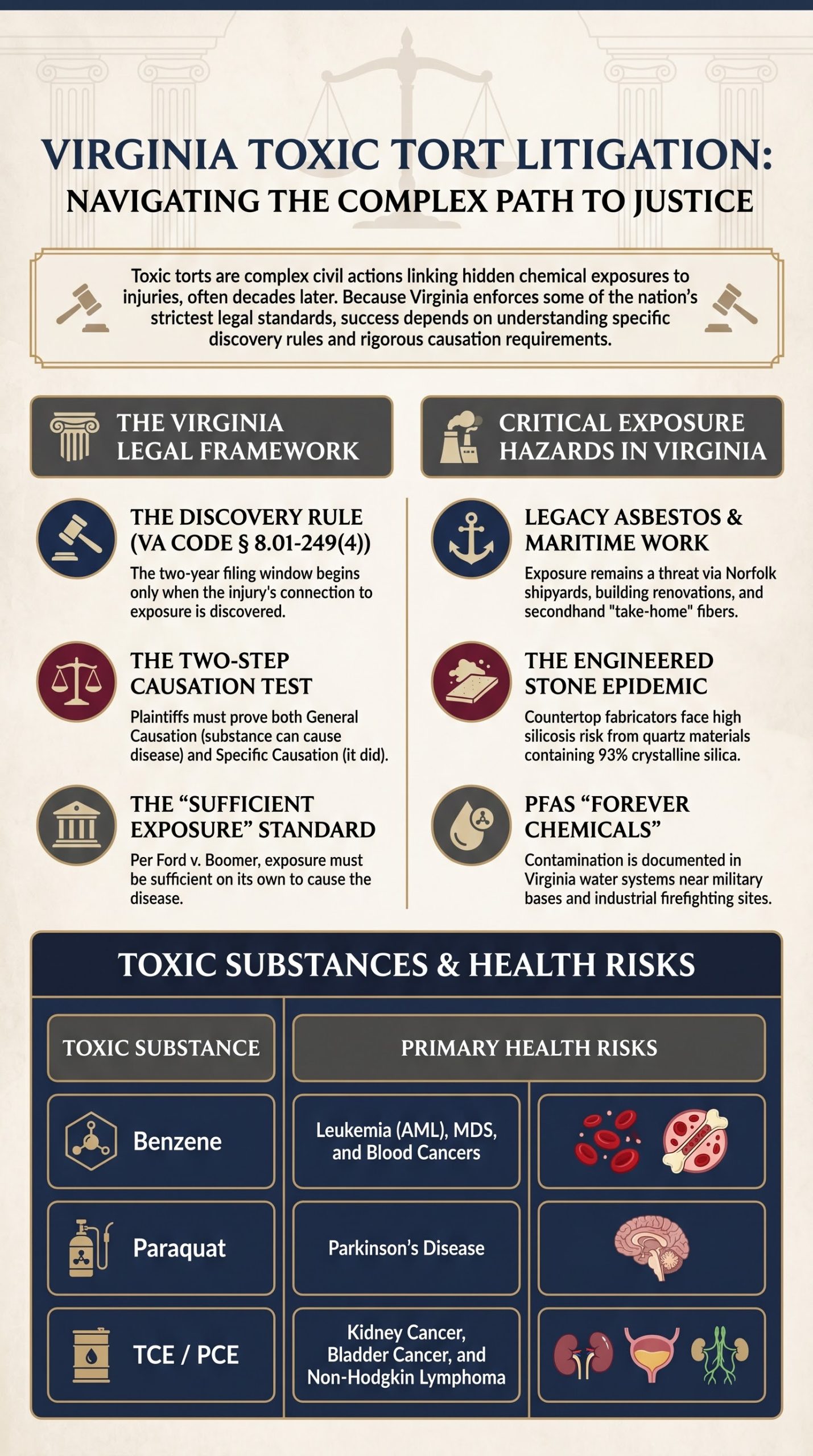
This ten-chapter guide walks through how toxic tort litigation actually works in Virginia. It covers statutes, leading cases, scientific frameworks, and the major exposure categories our firm, Shin Law Office, handles for clients and their families across the Commonwealth.
Table of Contents
- What a Toxic Tort Case Actually Is
- Asbestos, Mesothelioma, and Virginia’s Substantial Contributing Factor Test
- Benzene, Leukemia, and Blood Cancers
- Silica Dust, Silicosis, and the Engineered Stone Epidemic
- PFAS, Forever Chemicals, and Contaminated Drinking Water
- Lead Exposure in Homes, Water Systems, and Industrial Settings
- Indoor Air Quality, Mold, and Sick Building Cases
- Pesticides, Herbicides, and Agricultural Chemical Exposure
- Industrial Solvents, VOCs, Diesel Exhaust, and Welding Fumes
- Virginia Toxic Tort Law and a County-by-County Overview
Chapter 1: What a Toxic Tort Case Actually Is
A toxic tort is a civil action seeking damages for injuries caused by exposure to a harmful substance. The exposure may be occupational, environmental, consumer, or pharmaceutical. The substance may be a single chemical, a class of chemicals, a product containing a hazardous ingredient, or a contaminated site or water supply. The injury may be a signature disease closely linked to the exposure, or it may be a more general condition for which epidemiological evidence is needed to link it to the cause.
Every toxic tort case in Virginia turns on two kinds of causation. General causation asks whether the substance is capable of causing the disease in humans at the doses involved. Specific causation asks whether the substance actually caused the disease in the individual plaintiff. Both must be proved to a reasonable degree of scientific or medical probability, and both typically require qualified expert testimony subject to the admissibility framework set out in Daubert v. Merrell Dow Pharmaceuticals, Inc., 509 U.S. 579 (1993), and its Virginia analog under Spencer v. Commonwealth, 240 Va. 78 (1990), along with Virginia Rule of Evidence 2:702.
The legal theories
Plaintiffs in Virginia toxic tort cases typically plead several overlapping theories. Negligence addresses the defendant’s failure to exercise reasonable care in designing, manufacturing, warning about, or handling the substance. Strict product liability, which Virginia does not recognize as broadly as most states, is usually pleaded as breach of implied warranty of merchantability under Virginia Code § 8.2 314 and breach of implied warranty of fitness under § 8.2 315. Failure to warn addresses the manufacturer’s duty to inform foreseeable users of known hazards. Premises liability addresses the property owner’s or employer’s duty to provide a reasonably safe environment. Fraudulent concealment, where available, addresses a defendant who knew of the hazard and actively hid it.
Why latency changes everything
Many toxic tort diseases develop decades after the exposure that caused them. Mesothelioma typically surfaces twenty to fifty years after asbestos exposure. Benzene-related leukemia commonly appears five to fifteen years after meaningful exposure. Silicosis can appear within a few years of high-dose exposure or decades later for chronic lower-dose work. Latency is the defining feature of this field of law, and it is the reason Virginia’s special accrual rule under Virginia Code § 8.01 249(4) was enacted.
The discovery rule for toxic exposure
Virginia Code § 8.01 249(4) provides that in an action for injury to the person resulting from exposure to a harmful substance, the cause of action accrues when the person knew or should have known of the injury and its causal connection to the exposure. This is one of the few areas where Virginia departs from its otherwise strict date-of-injury accrual rule, and it is the statutory foundation that makes most toxic tort litigation possible in the Commonwealth.
Chapter 2: Asbestos, Mesothelioma, and Virginia’s Substantial Contributing Factor Test
Asbestos litigation is the oldest and most developed branch of American toxic tort law. The International Agency for Research on Cancer (IARC) classifies all forms of asbestos as Group 1 carcinogens, confirmed to cause mesothelioma, lung cancer, laryngeal cancer, ovarian cancer, and asbestosis. The United States Environmental Protection Agency banned most new uses of asbestos in 1989, and in March 2024 the EPA finalized a ban on chrysotile asbestos, the last form legally imported into the country, under the Toxic Substances Control Act (TSCA), 15 U.S.C. § 2601 et seq.
How asbestos exposure still happens in Virginia
Despite the ban on new products, Virginia residents are still exposed to asbestos through four pathways. Legacy exposure from decades of work at the Norfolk Naval Shipyard, Newport News Shipbuilding, and other maritime facilities across Hampton Roads. Renovation and demolition of older commercial and residential buildings that still contain asbestos floor tile, pipe insulation, boiler insulation, and vermiculite. Automotive repair work, particularly older brake and clutch components. And secondhand or take home exposure, where a family member was exposed to fibers carried home on a worker’s clothing, a pattern the U.S. Supreme Court addressed in Air & Liquid Systems Corp. v. DeVries, 139 S. Ct. 986 (2019).
Virginia’s causation standard after Ford v. Boomer
For decades, Virginia courts applied the “substantial contributing factor” test imported from John Crane, Inc. v. Jones, 274 Va. 581 (2007). In 2013, the Supreme Court of Virginia sharpened the rule in Ford Motor Co. v. Boomer, 285 Va. 141 (2013). The Court held that the proper causation standard in a mesothelioma case requires proof that the defendant’s product was a “sufficient” exposure, meaning it was sufficient on its own to cause the disease, not merely that it contributed in some degree. This is a more demanding standard than many neighboring states apply and is one of the defining features of Virginia asbestos practice.
Asbestos bankruptcy trusts
Most of the original asbestos manufacturers have passed through bankruptcy and now pay claims through court-approved trusts established under Section 524(g) of the U.S. Bankruptcy Code. A properly developed asbestos case in Virginia typically combines civil litigation against solvent defendants with trust claims against insolvent defendants. Collectively, these trusts have paid tens of billions of dollars to asbestos victims, and they remain a meaningful source of recovery for Virginia mesothelioma patients and their families.
Chapter 3: Benzene, Leukemia, and Blood Cancers
Benzene is a colorless, sweet smelling hydrocarbon classified by IARC as a Group 1 human carcinogen and identified by the National Toxicology Program as a known human carcinogen in every Report on Carcinogens since the program began. The U.S. Department of Health and Human Services, through the Agency for Toxic Substances and Disease Registry (ATSDR), has published a detailed Toxicological Profile for Benzene confirming the causal link between benzene exposure and acute myeloid leukemia (AML), myelodysplastic syndrome (MDS), and several lymphoproliferative disorders.
Where benzene exposure occurs
Benzene is a component of gasoline at concentrations typically below one percent, a feedstock and process chemical in petrochemical refining, a solvent historically used in printing, rubber manufacturing, and chemical synthesis, and a component of tobacco smoke and combustion byproducts. In Virginia, the most common occupational benzene exposure cases involve refinery and petrochemical workers, gasoline tanker drivers and terminal workers, printers and lithographers working before modern substitution, chemical plant workers, and certain categories of firefighters exposed through combustion smoke and foam.
The dose-response question
The OSHA permissible exposure limit for benzene is one part per million as an eight-hour time-weighted average under 29 C.F.R. § 1910.1028. The NIOSH recommended exposure limit is 0.1 ppm. Peer-reviewed epidemiology, including studies published by the National Cancer Institute and reviewed in the ATSDR Toxicological Profile for Benzene, demonstrates increased leukemia risk at cumulative doses below 10 ppm-years and, for certain subtypes, below 1 ppm-year. The dose response question is central to every benzene case and requires an industrial hygienist to reconstruct cumulative exposure and a hematologist or oncologist to tie that exposure to the specific diagnosis.
Chapter 4: Silica Dust, Silicosis, and the Engineered Stone Epidemic
Respirable crystalline silica is classified by IARC as a Group 1 carcinogen and is among the most thoroughly studied occupational hazards worldwide. OSHA’s current permissible exposure limit, set by the 2016 rule codified at 29 C.F.R. § 1910.1053 for general industry and § 1926.1153 for construction, is fifty micrograms per cubic meter as an eight-hour time-weighted average.
The engineered stone silicosis crisis
Over the last decade, a rapid epidemic of silicosis has emerged among workers who cut, grind, and polish engineered stone countertops. Engineered stone, typically marketed under brand names such as Silestone, Caesarstone, and Cambria, can contain up to 93% crystalline silica by weight, compared to roughly 30% in natural granite. Dry cutting or inadequate wet suppression can generate respirable dust at concentrations that exceed the OSHA PEL by orders of magnitude. The Centers for Disease Control and Prevention, through the National Institute for Occupational Safety and Health (NIOSH), has published multiple Morbidity and Mortality Weekly Reports on accelerated and progressive silicosis cases in this workforce, including cases of young workers requiring lung transplantation.
If you fabricate stone countertops in Virginia, read this
Virginia has dozens of countertop fabrication shops, concentrated in Fairfax, Loudoun, Prince William, Henrico, Chesterfield, and Virginia Beach. The workforce is disproportionately younger immigrant labor. If you or a family member has worked cutting or polishing quartz, engineered stone, or granite and is experiencing shortness of breath, cough, or unexplained fatigue, request a spirometry test and a high-resolution chest CT promptly. Silicosis is irreversible, but a timely diagnosis triggers critical legal and medical options that expire if the disease is not identified early.
Other silica exposure in Virginia
Beyond countertop fabrication, Virginia silica exposure cases arise from sandblasting operations, concrete cutting and grinding on large construction projects, tunneling and rock excavation (notably in the Washington and Richmond metro transit projects), ceramic and glass manufacturing, and historic foundry work.
Chapter 5: PFAS, Forever Chemicals, and Contaminated Drinking Water
Per and polyfluoroalkyl substances, known collectively as PFAS, are a family of thousands of synthetic chemicals that resist heat, water, and oil. They have been used since the 1940s in firefighting foam (aqueous film-forming foam, or AFFF), nonstick cookware, water-repellent fabrics, food packaging, and a wide range of industrial processes. They do not meaningfully degrade in the environment, which is why they are often called chemicals forever.
What science now says
In April 2024, the U.S. Environmental Protection Agency finalized the first National Primary Drinking Water Regulation for six PFAS compounds, setting enforceable Maximum Contaminant Levels of 4.0 parts per trillion for PFOA and PFOS individually, with additional limits for four other compounds. The regulation is codified at 40 C.F.R. Part 141, Subpart Z. The EPA’s underlying health assessment concluded that there is no safe level of exposure to PFOA or PFOS below which the risk of adverse health effects is zero.
The C8 Science Panel, established as part of a class action settlement involving DuPont’s PFOA releases from its Parkersburg, West Virginia plant, reached “probable link” conclusions between PFOA exposure and six human diseases: kidney cancer, testicular cancer, thyroid disease, ulcerative colitis, pregnancy-induced hypertension, and diagnosed high cholesterol. These determinations, published between 2011 and 2012, remain the most thoroughly litigated PFAS health findings in American tort law.
PFAS exposure in Virginia
The Virginia Department of Health and the Virginia Department of Environmental Quality have conducted and continue to conduct sampling of public water systems across the Commonwealth. Confirmed PFAS contamination has been documented in multiple Virginia water systems, with contamination sources traced to military installations that used AFFF firefighting foam (including sites associated with Naval Station Norfolk, Joint Base Langley Eustis, Naval Air Station Oceana, and Marine Corps Base Quantico), airports with historical foam use, and certain industrial facilities. The Virginia Department of Health publishes ongoing PFAS sampling results through its drinking water programs.
The AFFF multidistrict litigation
The federal AFFF multidistrict litigation, captioned In re Aqueous Film Forming Foams Products Liability Litigation, MDL No. 2873, is pending in the United States District Court for the District of South Carolina. Thousands of personal injury and water contamination cases have been consolidated into this MDL. Virginia plaintiffs with qualifying PFAS related diagnoses, including kidney cancer, testicular cancer, thyroid disease, and ulcerative colitis, may be eligible to join depending on exposure history.
Chapter 6: Lead Exposure in Homes, Water Systems, and Industrial Settings
Lead is a toxic metal with no known safe level of exposure in humans. The Centers for Disease Control and Prevention, through its Childhood Blood Lead Surveillance Program, uses a blood lead reference value of 3.5 micrograms per deciliter (updated from the prior 5 µg/dL threshold in 2021) to identify children with elevated lead levels requiring public health intervention. The National Toxicology Program and IARC classify lead and inorganic lead compounds as probable human carcinogens, and the association between childhood lead exposure and permanent cognitive, neurological, and behavioral deficits is among the most thoroughly established findings in modern toxicology.
Residential lead paint
The U.S. Consumer Product Safety Commission banned residential lead-based paint in 1978, but millions of homes in Virginia still contain it beneath newer coatings. Under the Residential Lead-Based Paint Hazard Reduction Act, 42 U.S.C. § 4851 et seq., sellers and landlords of pre-1978 housing must disclose known lead-based paint hazards and provide the EPA’s lead hazard information pamphlet. Violations of this disclosure obligation, combined with actual lead exposure to a child living in the property, form the foundation of many residential lead tort cases in Virginia.
Lead in drinking water
The Safe Drinking Water Act and the EPA Lead and Copper Rule, codified at 40 C.F.R. Part 141, Subpart I, require public water systems to monitor lead levels and implement corrosion control. The rule was substantially revised in 2021 and further strengthened in the Lead and Copper Rule Improvements finalized in 2024, which require the replacement of lead service lines nationwide. Older housing stock in Richmond, Alexandria, Norfolk, and parts of Northern Virginia still contains lead service lines and lead solder, and Virginia utilities are working through multi-year replacement programs.
Occupational lead exposure
OSHA regulates occupational lead exposure at 29 C.F.R. § 1910.1025 for general industry and § 1926.62 for construction, with a permissible exposure limit of fifty micrograms per cubic meter of air. Lead battery manufacturing, lead smelting, bridge repainting, radiator repair, firing range instruction, and demolition of lead-painted structures all generate occupational exposure claims in Virginia. The Commonwealth has a concentration of older steel bridges, and the abatement and repainting of that infrastructure result in periodic clusters of lead poisoning claims.
Chapter 7: Indoor Air Quality, Mold, and Sick Building Cases
Virginia’s humid subtropical climate makes indoor air quality and mold litigation a substantial part of the Commonwealth’s toxic tort docket. The Centers for Disease Control and Prevention, the World Health Organization, and the Institute of Medicine (now the National Academy of Medicine) have all recognized that persistent dampness and mold growth in indoor environments is associated with upper respiratory symptoms, cough, wheeze, and asthma exacerbation. The 2004 Institute of Medicine report Damp Indoor Spaces and Health remains the touchstone authority cited in Virginia mold litigation.
Commercial facilities where mold claims arise
Mold and indoor air quality claims arise across a wide spectrum of Virginia commercial settings. Hospitals, nursing homes, and assisted living facilities have chronic humidity control problems. Hotels and resorts along the Virginia Beach oceanfront and the Williamsburg hospitality corridor. Indoor pool facilities, fitness centers, and natatoriums. Food processing plants, breweries, and wineries with high process humidity. Office buildings with failed envelopes, particularly older Class B and C buildings across Northern Virginia and Richmond. Public schools, community colleges, courthouses, and government office buildings with deferred maintenance on roofs, windows, and HVAC systems. Warehouses and distribution centers with failed loading dock seals. Childcare centers, veterinary hospitals, places of worship, and event venues. Wherever a building combines a water source with cellulose substrate and human occupancy, mold claims eventually follow.
The limits of mold personal injury litigation
Virginia courts apply Daubert style scrutiny to mold causation testimony, and plaintiffs alleging anything beyond standard respiratory and allergic symptoms face a difficult scientific path. Claims for mycotoxicosis, neurocognitive injury, and systemic illness from indoor mold exposure have generally not fared well in Virginia litigation. Property damage claims, lost use and enjoyment claims, remediation cost claims, and aggravation of pre existing asthma claims, by contrast, are regularly prosecuted and settled.
Chapter 8: Pesticides, Herbicides, and Agricultural Chemical Exposure
Virginia is an agricultural state with a significant rural workforce and periodic residential, school, and municipal pesticide applications. Federal pesticide regulation falls under the Federal Insecticide, Fungicide, and Rodenticide Act (FIFRA), 7 U.S.C. § 136 et seq., administered by the EPA. Occupational pesticide exposure is addressed through the EPA Worker Protection Standard, 40 C.F.R. Part 170, which applies to agricultural workers and pesticide handlers on farms, forests, nurseries, and greenhouses.
Glyphosate (Roundup)
IARC classified glyphosate as probably carcinogenic to humans (Group 2A) in 2015, a classification set out in IARC Monograph 112. The EPA has maintained a different position, and the issue remains scientifically contested. Nonetheless, thousands of plaintiffs alleging non Hodgkin lymphoma following substantial glyphosate exposure have recovered through settlements and verdicts in the federal multidistrict litigation In re Roundup Products Liability Litigation, MDL No. 2741, and in state court actions across the country. Virginia farmers, landscapers, and golf course workers with substantial occupational exposure and a qualifying diagnosis remain candidates for this litigation, subject to statute of limitations analysis.
Paraquat
Paraquat dichloride is a highly toxic herbicide restricted to use by certified applicators under 40 C.F.R. § 156.212. A significant body of epidemiological literature, including studies published by the National Institute of Environmental Health Sciences, has associated occupational paraquat exposure with Parkinson’s disease. The federal paraquat multidistrict litigation, In re Paraquat Products Liability Litigation, MDL No. 3004, is pending in the Southern District of Illinois. Virginia applicators and farmworkers with qualifying exposure and a Parkinson’s diagnosis should consult counsel promptly.
Chlorpyrifos, organophosphates, and other pesticides
The EPA revoked all food tolerances for chlorpyrifos in 2021, effectively ending its agricultural use in the United States, following decades of evidence of neurodevelopmental harm. Older organophosphate exposure cases, along with cases involving carbamates and certain pyrethroids, continue to appear in Virginia practice, particularly in workers with documented cholinesterase depression or neurological sequelae.
Chapter 9: Industrial Solvents, VOCs, Diesel Exhaust, and Welding Fumes
Trichloroethylene and tetrachloroethylene
Trichloroethylene (TCE) and tetrachloroethylene (PCE, perchloroethylene) are chlorinated solvents with long industrial histories. TCE was used extensively as a degreaser in metal manufacturing, aerospace, and electronics, and was the primary contaminant in the Camp Lejeune water contamination addressed by Congress in the Honoring Our PACT Act of 2022, Pub. L. No. 117 168. PCE is the solvent historically used in most dry cleaning operations. Both are classified by the EPA IRIS program and by IARC as carcinogenic to humans, with documented associations to kidney cancer, non-Hodgkin lymphoma, and, for PCE, bladder cancer. Virginia has dozens of state-listed contaminated sites involving one or both of these solvents, and dry cleaner vapor intrusion into adjacent residential and commercial properties is a recurring Northern Virginia and Richmond metro fact pattern.
Diesel exhaust
IARC classified diesel engine exhaust as a Group 1 human carcinogen in 2012, based on sufficient evidence of causation for lung cancer and limited evidence for bladder cancer. Occupational diesel exhaust exposure claims in Virginia arise in trucking, railroad work (under the Federal Employers’ Liability Act, 45 U.S.C. § 51 et seq.), mining, heavy equipment operation, and firefighting, where diesel exhaust is one of several combustion byproducts addressed in fire service cancer presumption statutes.
Welding fumes and manganese
IARC reclassified welding fumes as a Group 1 human carcinogen in 2018, based on sufficient evidence for lung cancer. Manganese, a component of welding rods and fumes, is associated in substantial epidemiological literature with Parkinsonian neurological syndromes. Virginia has an active welding workforce in shipbuilding, pipeline construction, structural steel fabrication, and general manufacturing, and welding related claims appear regularly in our practice.
Camp Lejeune claims and Virginia veterans
The Camp Lejeune Justice Act, enacted as part of the Honoring Our PACT Act of 2022, permits individuals who lived or worked at Marine Corps Base Camp Lejeune, North Carolina, between August 1, 1953, and December 31, 1987, and who developed qualifying illnesses, to file claims in the United States District Court for the Eastern District of North Carolina. Many Virginia veterans and their families are eligible. The statutory filing period is strictly limited.
Chapter 10: Virginia Toxic Tort Law and a County-by-County Overview
The Virginia statutes that govern every case
Virginia Code § 8.01 243(A) provides a two year statute of limitations for personal injury. Virginia Code § 8.01 249(4), the discovery rule for toxic exposure, provides that the cause of action accrues when the plaintiff knew or should have known of the injury and its causal connection to the harmful substance. Virginia Code § 8.01 244 governs wrongful death actions arising from toxic exposure, requiring the action to be filed within two years of death. Virginia Code § 8.01 581.20 does not apply to toxic tort cases, which are not medical malpractice and are therefore not subject to the malpractice damages cap.
Contributory negligence, once again
Virginia’s pure contributory negligence rule applies in most toxic tort cases not governed by strict liability theories. Defendants routinely argue that the plaintiff failed to use appropriate personal protective equipment, ignored product warnings, or continued smoking in ways that materially contributed to the injury. A case that would be worth substantial damages in a comparative fault state can be defeated in Virginia if contributory negligence is accepted by the jury. Expert case preparation is the primary defense against this argument.
Workers’ compensation and the exclusive remedy bar
The Virginia Workers’ Compensation Act, Virginia Code § 65.2 100 et seq., covers occupational diseases under § 65.2 400 and provides the exclusive remedy against an employer for a work related injury or disease. This bar does not apply to claims against third parties, including manufacturers of toxic products, owners of premises other than the employer’s, contractors other than the employer, and any entity outside the employment relationship. A meaningful share of toxic tort recovery for injured Virginia workers comes through third party actions preserved alongside workers’ compensation claims.
How toxic tort cases arise across Virginia
|
Fairfax CountyCountertop fabrication silicosis, dry cleaner vapor intrusion cases, federal contractor occupational exposure, commercial office indoor air quality claims.
|
Loudoun CountyData center adjacent chemical exposure cases, well water contamination in rural subdivisions, residential lead paint claims in historic Leesburg housing, agricultural pesticide exposure.
|
|
Prince William CountyQuantico PFAS groundwater concerns, industrial exposure at Manassas manufacturing, dry cleaner and auto shop solvent cases, residential lead paint in older housing.
|
Arlington CountyCommercial office mold and indoor air claims, federal building occupational exposure, dense residential vapor intrusion cases near former industrial parcels.
|
|
Alexandria (City)Historic housing lead paint claims, waterfront industrial legacy exposure, dry cleaner vapor intrusion, shipyard adjacent asbestos history.
|
Fauquier and CulpeperAgricultural pesticide exposure, well water contamination, rural industrial legacy sites, equine and livestock facility chemical exposure.
|
|
Stafford and SpotsylvaniaPesticide exposure in landscaping and agriculture, older housing lead claims, legacy industrial site vapor intrusion.
|
Albemarle and CharlottesvilleUniversity laboratory exposure, historic housing lead paint, agricultural and vineyard pesticide claims, renovation asbestos exposure.
|
|
Henrico, Hanover, ChesterfieldRichmond metropolitan industrial exposure history, benzene at refinery and terminal operations, dry cleaner and auto shop solvent claims, school and courthouse indoor air cases.
|
Richmond (City)Historic housing lead paint cases, former tobacco and chemical manufacturing legacy, downtown commercial mold and indoor air claims, urban brownfield redevelopment exposure.
|
|
Prince George and HopewellChemical manufacturing legacy exposure, Kepone and historic pesticide contamination areas, industrial worker occupational disease claims.
|
James City and WilliamsburgHospitality indoor air quality, historic building renovation asbestos, residential lead paint in older housing, agricultural pesticide exposure.
|
|
Virginia Beach (City)Naval Air Station Oceana PFAS exposure concerns, oceanfront hospitality indoor air, Navy and military veteran asbestos and benzene exposure, residential mold claims.
|
Norfolk and ChesapeakeNorfolk Naval Shipyard asbestos legacy, maritime welding fume exposure, port adjacent diesel exhaust claims, dense legacy industrial site exposure.
|
|
Newport NewsShipbuilding asbestos and welding fume exposure, dense legacy industrial corridor, Joint Base Langley Eustis PFAS concerns.
|
Frederick, Clarke, ShenandoahAgricultural pesticide exposure, poultry processing chemical claims, orchard and vineyard operator disease, well water contamination.
|
Frequently Asked Questions
I was diagnosed with cancer decades after the exposure. Is it too late?
Not necessarily. Virginia Code § 8.01 249(4) provides a discovery rule for injuries from exposure to a harmful substance, meaning the two-year limitations period does not start until you knew or should have known of the injury and its connection to the exposure. Diagnosis is typically the trigger. Waiting after diagnosis shortens the window.
How do I prove that a specific chemical caused my specific disease?
Through a combination of industrial hygiene reconstruction (estimating your cumulative dose), peer-reviewed epidemiology (establishing general causation), and physician testimony linking your diagnosis to the exposure (specific causation). No single document wins these cases. The proof is built across multiple disciplines.
Can I sue my employer for making me sick?
Generally not directly, because the Virginia Workers’ Compensation Act is the exclusive remedy against your employer. You can, however, pursue third-party claims against the manufacturers of the products you used, owners of premises other than your employer’s, and other entities outside the employment relationship. Workers’ compensation and third-party claims often proceed in parallel.
I served at a military base with contamination. What should I do?
Veterans of Camp Lejeune and certain other installations have specific statutory remedies through the Honoring Our PACT Act and related legislation. Service at Virginia bases with PFAS or other documented contamination may support separate claims under federal or state law. Gather your service records, medical records, and any available base contamination reports, and consult counsel with specific experience in military and veteran toxic exposure cases.
What does a toxic tort case cost to pursue?
These are among the most expensive cases in civil litigation because of the expert work required. Our firm handles toxic tort matters on a contingency basis in appropriate cases, meaning the client owes no legal fee unless there is a recovery. Expert costs are advanced by the firm in most cases and are reimbursed out of any recovery under the terms of the engagement letter.
Speak With a Virginia Toxic Tort Attorney
If you have been diagnosed with an illness that may trace back to a toxic exposure anywhere in Virginia, the time to consult counsel is now. Shin Law Office evaluates these cases across every major county in the Commonwealth.

Sources and Legal Citations
Virginia statutes
Virginia Code § 8.01 243. Two year statute of limitations for personal injury.
Virginia Code § 8.01 244. Statute of limitations for wrongful death.
Virginia Code § 8.01 249(4). Discovery rule for actions arising from exposure to harmful substances.
Virginia Code §§ 8.2 314, 8.2 315. Implied warranties of merchantability and fitness for a particular purpose.
Virginia Code § 65.2 100 et seq.. Virginia Workers’ Compensation Act, including § 65.2 400 governing occupational diseases.
Virginia case law
Ford Motor Co. v. Boomer, 285 Va. 141 (2013). Virginia’s “sufficient exposure” causation standard in asbestos cases.
John Crane, Inc. v. Jones, 274 Va. 581 (2007). Earlier articulation of asbestos substantial contributing factor causation.
Spencer v. Commonwealth, 240 Va. 78 (1990). Virginia expert testimony admissibility framework.
Federal case law
Daubert v. Merrell Dow Pharmaceuticals, Inc., 509 U.S. 579 (1993). Federal standard for admissibility of expert scientific testimony.
Air & Liquid Systems Corp. v. DeVries, 139 S. Ct. 986 (2019). Maritime duty to warn addressing take home and bare metal asbestos claims.
Federal statutes and regulations
Toxic Substances Control Act, 15 U.S.C. § 2601 et seq. Federal chemical regulation framework, including 2024 chrysotile asbestos ban.
Safe Drinking Water Act, 42 U.S.C. § 300f et seq. Federal drinking water regulation framework, including the 2024 PFAS drinking water rule at 40 C.F.R. Part 141 Subpart Z.
Residential Lead Based Paint Hazard Reduction Act, 42 U.S.C. § 4851 et seq. Federal lead paint disclosure framework.
Federal Insecticide, Fungicide, and Rodenticide Act, 7 U.S.C. § 136 et seq. Federal pesticide regulation framework.
Honoring Our PACT Act of 2022, Pub. L. No. 117 168. Includes the Camp Lejeune Justice Act.
OSHA Standards. 29 C.F.R. § 1910.1028 (benzene), 29 C.F.R. §§ 1910.1053, 1926.1153 (crystalline silica), 29 C.F.R. §§ 1910.1025, 1926.62 (lead), 29 C.F.R. § 1910.1001 (asbestos).
Federal agencies and scientific authorities
U.S. Environmental Protection Agency, Integrated Risk Information System (IRIS). Peer-reviewed health assessments for toxic substances. epa.gov/iris.
Agency for Toxic Substances and Disease Registry (ATSDR). Toxicological Profiles for benzene, asbestos, lead, trichloroethylene, tetrachloroethylene, and other substances. atsdr.cdc.gov.
National Institute for Occupational Safety and Health (NIOSH). Recommended exposure limits, Morbidity and Mortality Weekly Reports on occupational disease clusters. cdc.gov/niosh.
International Agency for Research on Cancer (IARC). Monographs on the Evaluation of Carcinogenic Risks to Humans. monographs.iarc.who.int.
National Toxicology Program, Report on Carcinogens. Fifteenth Edition (2021) and successors. ntp.niehs.nih.gov.
Institute of Medicine, Damp Indoor Spaces and Health (2004). National Academy of Medicine evidence review on mold and indoor moisture.
C8 Science Panel. Probable link conclusions on PFOA and human disease (2011 to 2012). c8sciencepanel.org.
Federal multidistrict litigation
In re Aqueous Film Forming Foams Products Liability Litigation, MDL No. 2873 (D.S.C.). PFAS AFFF litigation.
In re Roundup Products Liability Litigation, MDL No. 2741 (N.D. Cal.). Glyphosate litigation.
In re Paraquat Products Liability Litigation, MDL No. 3004 (S.D. Ill.). Paraquat Parkinson’s litigation.
This article is provided for general educational purposes and does not constitute legal advice. Every toxic tort matter is fact specific, and no attorney client relationship is formed by reading this material. Citations to statutes, regulations, and case law are current as of the article’s publication date. For advice on a specific Virginia toxic tort matter, consult a licensed Virginia attorney.