


When negligence, recklessness, or misconduct claims a life or leaves a body permanently changed, Virginia law gives families a path forward. That path runs through every county in the Commonwealth, and it runs on deadlines, evidence, and the quality of counsel sitting across the table from the insurance company.
Every year, in every corner of Virginia, families receive the phone call that divides their lives into before and after. A husband never comes home from a job site. A mother does not wake up from surgery. A teenage daughter survives a wrong way driver on Interstate 95 but will never walk again. A welder in Prince William County loses both hands to a crane collapse that three people saw coming.
These are not abstract statistics. They are the cases that fill courthouses from Leesburg to Virginia Beach, from Fairfax to Chesterfield, from Arlington to Albemarle. They are the cases that our firm, Shin Law Office, handles for families across the Commonwealth, and they are the cases this guide is written for.
What follows is a ten chapter walk through Virginia wrongful death and catastrophic injury law. It is long because the subject demands length. Families facing this moment deserve answers that are thorough, honest, and written in plain English, not a brochure and a business card.
 Virginia Injury Law Overview Guide
Table of Contents
- The Weight of Sudden Loss and Life Altering Harm
- Virginia Wrongful Death Law, § 8.01 50 Explained
- Traumatic Brain Injuries, The Silent Catastrophe
- Spinal Cord Injuries and Paralysis
- Severe Burns, Amputations, and Crush Injuries
- Organ Damage and Permanent Disability
- How These Cases Arise Across Every Major Virginia County
- Proving Negligence, Recklessness, and Misconduct
- What a Life Altering Case Is Actually Worth
- Choosing the Right Virginia Attorney for Your Family
Chapter 1: The Weight of Sudden Loss and Life-Altering Harm
There is a particular kind of silence that settles over a hospital waiting room at two in the morning. Fluorescent lights hum. A vending machine clicks. A surgeon pushes through double doors, pulls down a mask, and says a sentence the family will replay for the rest of their lives. That silence, and what follows it, is the starting point of a wrongful death case.
For catastrophic injury, the silence comes later. First, there is noise. Sirens. Trauma bays. The clatter of a ventilator. Decisions that cannot be undone, made by exhausted doctors under impossible time pressure. Only weeks later, when the patient is transferred to a rehabilitation unit and a case manager starts using phrases like “new baseline” and “lifetime care plan,” does the family begin to understand that the old life is not coming back.
Virginia law cannot restore what has been taken. No statute, no jury, no settlement check can. What the law can do is impose accountability on the party or parties whose choices caused the harm, and transfer the financial catastrophe from the shoulders of an innocent family onto the shoulders of the people, companies, and insurers who caused it.
Why these cases matter beyond the money
Wrongful death and catastrophic injury cases do something no other area of law does. They establish, in a public record, that a preventable act of negligence or misconduct took a life or permanently broke a body. For many families, that acknowledgment matters as much as any dollar figure. The Commonwealth’s civil courts are the only venue where that formal finding can be entered.
This guide is written for the spouse reading it at 3 a.m. with a hospital bill in one hand and a police report in the other. It is written for the adult child who has just become a parent to their parent. It is written for the injured worker who does not yet know whether the term “catastrophic” applies to them. If you are one of those people, keep reading. The next nine chapters are meant to answer your questions one at a time.
Chapter 2: Virginia Wrongful Death Law, § 8.01 50 Explained
Wrongful death is a statutory creation, not a common law doctrine. Virginia’s wrongful death act lives in Title 8.01 of the Virginia Code, beginning at § 8.01 50 and continuing through § 8.01 56. Every wrongful death case brought in the Commonwealth, whether filed in Fairfax Circuit Court or the Eastern District federal courthouse in Norfolk, is governed by these sections.
Who may sue
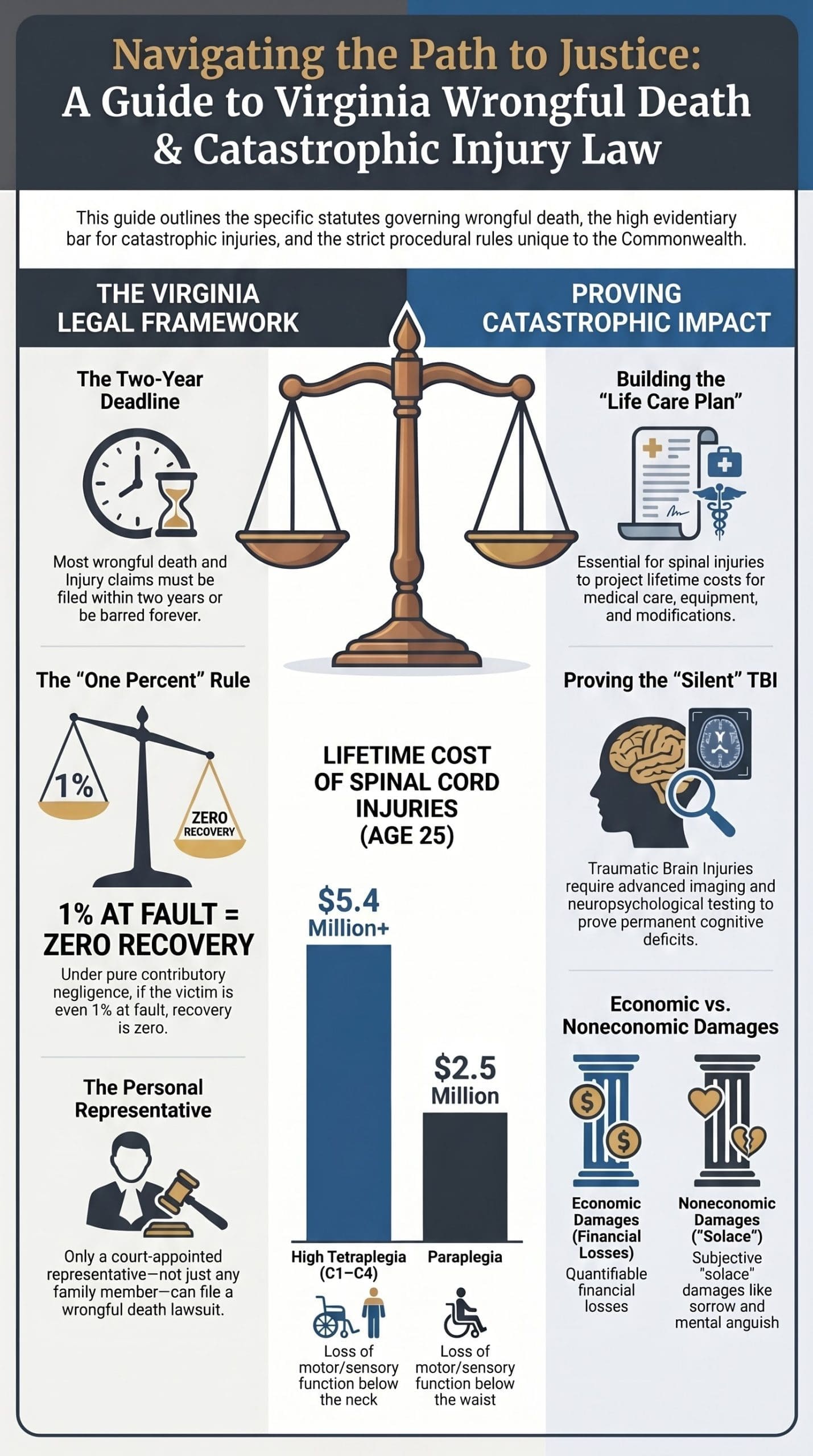
Only the personal representative of the decedent’s estate may file the wrongful death action. This is typically an executor named in the will or an administrator appointed by the Circuit Court in the county or city where the decedent resided. A grieving spouse cannot simply walk into a courthouse and file, even when the spouse is clearly the person most harmed by the loss. The personal representative must first be qualified, a process that can take one to three weeks and requires posting bond in most Virginia jurisdictions.
Who may recover
The statute identifies a specific class of beneficiaries, and only these beneficiaries share in any recovery. In order of priority, the beneficiaries are the surviving spouse, children, and grandchildren of children who predeceased the decedent. If none of those people exist, the class shifts to parents, siblings, and any relative who was a member of the decedent’s household and dependent on the decedent for support.
What damages are recoverable
Virginia wrongful death damages are broader than many clients expect. The statute allows a jury to award sorrow, mental anguish, and solace to surviving beneficiaries, which includes society, companionship, comfort, guidance, kindness, and advice. It also permits compensation for reasonably expected loss of income and services, medical expenses incurred between injury and death, and reasonable funeral expenses. Punitive damages are available where the defendant’s conduct was willful, wanton, or exhibited a conscious disregard for the rights of others.
The two year statute of limitations
A Virginia wrongful death action must generally be filed within two years of the date of death. Miss that deadline and the claim is barred forever, regardless of how strong the underlying liability case is. Catastrophic injury claims, by contrast, carry a two-year statute that typically runs from the date of the injury itself. Medical malpractice, product liability, and governmental defendants add procedural layers that further shorten effective deadlines. Waiting is the single most common way strong cases die.
Pure contributory negligence, Virginia’s hardest rule
Virginia is one of only four jurisdictions in the United States that still applies pure contributory negligence. If a jury finds that the decedent or the injured party was even one percent responsible for what happened, recovery is zero. This rule makes Virginia one of the most defense-friendly states in the country and is the reason experienced counsel matters so much. A case that would be worth seven figures in Maryland or North Carolina can be worth nothing across the Potomac or the Ohio River if contributory negligence is allowed to take root.
Chapter 3: Traumatic Brain Injuries, The Silent Catastrophe
Traumatic brain injury, or TBI, is the most commonly misunderstood catastrophic injury in the American courtroom. Unlike an amputation or a paralysis case, the outward signs of a TBI often fade within weeks. The patient walks out of the hospital. The patient looks like the patient. And then, slowly, the family learns that the person who came home is not the person who left.
Mild TBI is a misnomer. The Centers for Disease Control and Prevention estimates that roughly 15 to 20 percent of patients diagnosed with “mild” TBI experience persistent symptoms at one year, and a meaningful subset experience lifelong cognitive and emotional changes. Moderate and severe TBI carry far higher rates of permanent disability, and severe TBI has a mortality rate approaching 30 percent within thirty days of injury.
How TBI shows up in Virginia cases
In our personal injury practice, TBI appears most often in four fact patterns. The first is motor vehicle collisions, particularly rear end and side impact crashes on Interstate 66, Interstate 95, and the Capital Beltway. The second is falls, including falls at construction sites in Loudoun and Prince William County, slip and falls on poorly maintained commercial properties, and falls from defective ladders or scaffolding. The third is assaults, often arising in premises liability cases against apartment complexes or nightlife venues with inadequate security. The fourth is sports and recreation, particularly youth football, soccer, and ice hockey, where concussion protocols are sometimes ignored by coaches or administrators.
What proving a TBI actually requires
A courtroom TBI case is built on four pillars. Imaging, typically including diffusion tensor imaging and susceptibility weighted imaging, not just standard CT. Neuropsychological testing by a board-certified neuropsychologist produces objective evidence of cognitive deficits across attention, memory, executive function, and processing speed. Treating physician testimony establishing causation and permanence. And lay witness testimony, often from a spouse, parent, or coworker, describing the difference between the person before the injury and the person after.
The concussion was not “just a concussion.”
Insurance companies routinely argue that a loss of consciousness under thirty minutes, a negative CT scan, and a discharge within 24 hours means the injury was minor. This is wrong on medical grounds. Post-concussive syndrome, chronic traumatic encephalopathy, and diffuse axonal injury do not show up on standard emergency room imaging. If the patient’s life has not returned to baseline within two to three months, something more than a garden variety concussion is happening.
Chapter 4: Spinal Cord Injuries and Paralysis
Of all the catastrophic injuries handled in Virginia civil practice, spinal cord injuries may be the most financially punishing. The National Spinal Cord Injury Statistical Center reports that the average lifetime cost of a high tetraplegia (C1 to C4) injury, for a patient injured at age 25, exceeds 5.4 million dollars in 2024 figures, not adjusted for ongoing inflation. For paraplegia, the lifetime cost averages approximately 2.5 million dollars. These numbers are medical costs alone. They do not include lost earnings, home modifications, adaptive vehicles, or the value of lost independence.
Complete versus incomplete injuries
Spinal cord injuries are classified on the ASIA impairment scale, from A (complete) through E (normal). A complete injury at the cervical spine generally produces tetraplegia, loss of motor and sensory function below the neck, often including loss of diaphragmatic function requiring ventilator support. A complete injury at the thoracic or lumbar spine produces paraplegia, loss of motor and sensory function below the chest or waist. Incomplete injuries produce a highly variable clinical picture that can range from weakness in one limb to near-total functional loss.
The cases behind the diagnoses
Spinal cord injury cases in Virginia arise most commonly from high-speed motor vehicle collisions, rollover crashes, motorcycle crashes, falls from height, and diving accidents at pools or lakes. Trucking crashes on Interstate 81 through the Shenandoah Valley, Interstate 64 across central Virginia, and Interstate 95 through Northern Virginia produce a disproportionate share of the most severe injuries. Construction falls at high-rise projects in Arlington, Tysons, and downtown Richmond also generate a steady caseload.
The life care plan is the case
In spinal cord injury litigation, the single most important document is the life care plan, prepared by a certified life care planner working with the treating physiatrist. This document projects every dollar of future medical care, equipment, attendant care, and home modifications the patient will need from the date of trial through the patient’s life expectancy. Without a credible, defensible life care plan, a seven or eight-figure spinal cord injury case collapses into a six-figure nuisance settlement.
Chapter 5: Severe Burns, Amputations, and Crush Injuries
Burns, amputations, and crush injuries share a common feature that sets them apart from most other catastrophic injuries. They are visible. A jury that may have difficulty picturing the daily reality of a mild traumatic brain injury has no difficulty understanding the consequences of a below-knee amputation or a full-thickness burn across 40 percent of the body. That visibility changes the litigation dynamic and the insurance adjuster’s calculus.
Burn cases
Severe burn cases in Virginia most often arise from four sources. Workplace thermal burns are particularly common in welding, foundry, and industrial cooking settings. Electrical burns, including contact with downed power lines and inadequately marked live equipment at construction sites. Chemical burns from inadequately labeled industrial chemicals often involve product liability defendants in addition to premises defendants. And apartment fire cases, where landlord negligence with smoke detectors, egress routes, or fire suppression systems becomes the central issue.
Burn injuries are classified by depth, from superficial first degree through full-thickness fourth degree, and by percentage of total body surface area involved. A burn covering more than 20 percent of TBSA, or involving the face, hands, feet, or genitals, is generally classified as severe and warrants transfer to a specialized burn center. Virginia’s primary regional burn centers sit at VCU Medical Center in Richmond, UVA Health in Charlottesville, and Inova Fairfax Hospital.
Amputation cases
Traumatic amputation cases fall into two categories. Immediate amputations, where the limb is lost at the scene or during initial surgery, and delayed amputations, where the limb is lost days or weeks later due to infection, compartment syndrome, or failed revascularization. Both categories warrant careful case workup, but delayed amputations often involve a layer of medical causation defense that immediate amputations do not. The defendant will frequently argue that the patient’s underlying medical conditions, not the original trauma, drove the loss of the limb.
Crush injuries
Crush injury cases arise disproportionately in three settings. Construction, particularly trench collapses and equipment rollovers. Industrial accidents, including machinery entanglements in manufacturing and agricultural settings across the Shenandoah Valley and the Southside. And motor vehicle accidents, particularly pedestrian strikes and underride crashes involving commercial trucks. Rhabdomyolysis and compartment syndrome, two complications that can cause kidney failure and loss of the affected limb days after the original injury, are often missed in initial emergency evaluations and can form the basis of a medical malpractice case against the treating emergency physicians.
Chapter 6: Organ Damage and Permanent Disability
Some catastrophic injuries leave no external mark at all. A ruptured spleen, a lacerated liver, a contused kidney, a torn aorta. These injuries are often survivable in the acute setting, thanks to modern trauma surgery, but they can produce permanent organ dysfunction that shapes every day of the patient’s remaining life.
Common organ damage patterns
Blunt force trauma to the abdomen, typically from a steering wheel, a seat belt, or a direct impact, produces the largest category of organ damage cases. Splenectomy following splenic rupture is one of the most common, carrying a lifetime elevated risk of overwhelming post-splenectomy infection. Liver lacerations can heal with conservative management, but sometimes require partial hepatic resection and leave the patient with diminished hepatic reserve. Kidney injuries, ranging from renal contusion through complete laceration, can trigger acute kidney injury that progresses to chronic kidney disease months or years later.
Penetrating trauma, most often involving gunshot wounds in premises liability and negligent security cases, produces a different but equally serious constellation of organ injuries. Hollow viscus injuries to the bowel, pancreatic injuries, and vascular injuries to major abdominal vessels can all leave the patient with permanent consequences even after successful surgical repair.
Permanent disability as a legal concept
Virginia law recognizes permanent disability as a compensable element of damages, but the proof required is specific. The plaintiff must establish, through treating physician testimony to a reasonable degree of medical probability, that the disability is permanent, that it was caused by the defendant’s conduct, and that the functional limitations it produces are measurable. A finding of permanent impairment by an independent medical examiner, expressed as a percentage using the AMA Guides to the Evaluation of Permanent Impairment, is usually part of this proof but is rarely sufficient on its own.
The hidden case of chronic traumatic pain
Chronic pain syndromes, including complex regional pain syndrome and post-traumatic neuropathic pain, are among the most difficult catastrophic injuries to prove and to value. They are real, disabling, and often invisible to the naked eye. These cases require careful selection of treating and expert physicians, meticulous documentation of pain levels and functional limitations, and a jury trial presentation that makes the invisible visible.
Chapter 7: How These Cases Arise Across Every Major Virginia County
Wrongful death and catastrophic injury cases do not cluster in one region of the Commonwealth. They occur across every county and independent city, and the fact patterns vary with each jurisdiction’s geography, industry, and population density. Below is a working overview of how these cases arise in the counties where our firm most frequently practices and accepts referrals.
Jurisdiction matters in these cases for reasons that go well beyond geographic convenience. Each circuit court has its own judges, its own jury pool, its own pace of docket, and its own local customs around motion practice, discovery disputes, and trial scheduling. A Fairfax jury and a Chesterfield jury can value the same case very differently, and an experienced Virginia trial lawyer accounts for those differences in every settlement negotiation.
Chapter 8: Proving Negligence, Recklessness, and Misconduct
Every wrongful death and catastrophic injury case is built on proof of four elements. Duty, breach, causation, and damages. The defense will attack each of them, and the attack’s strength will scale with the potential recovery’s size.
Duty
Duty is the legal obligation owed by the defendant to the plaintiff. A driver owes a duty of ordinary care to other road users. A property owner owes a duty of reasonable care to invitees and, to a lesser extent, to licensees. A physician owes a duty to exercise the degree of skill and diligence ordinarily exercised by similarly situated Virginia physicians. A manufacturer owes a duty to design and warn about reasonably foreseeable uses of its product. Duty is usually the easiest element to establish and is rarely the battleground.
Breach
Breach is the failure to meet the applicable duty. In motor vehicle cases, breach often involves violations of specific Virginia Code provisions, such as § 46.2 830 (failure to obey traffic signals) or § 46.2 862 (reckless driving by speed). In premises cases, breach usually involves failure to inspect, repair, or warn of a known hazard. In medical malpractice, breach must be established through expert testimony that the care fell below the applicable standard. In product liability cases, breach may involve design defect, manufacturing defect, or failure-to-warn theories.
Causation
Causation has two components in Virginia law. Actual cause, meaning that the breach was a cause in fact of the injury, and proximate cause, meaning that the injury was a reasonably foreseeable consequence of the breach. In many catastrophic injury cases, causation is the battleground. The defense will frequently argue that a pre-existing condition, an intervening event, or a subsequent treatment decision broke the causal chain between the defendant’s conduct and the plaintiff’s current condition.
Damages
Damages close the proof, and they are the subject of Chapter 9.
Recklessness and misconduct open the door to punitive damages
Ordinary negligence supports compensatory damages only. When a defendant’s conduct crosses the line into willful, wanton, or reckless disregard for the safety of others, Virginia law permits punitive damages, subject to a statutory cap of $ 350,000 in most cases. Drunk driving cases, particularly those involving elevated blood alcohol levels, repeat offenders, or high-speed chases, often support punitive damages. Corporate misconduct cases, such as a trucking company that knowingly allowed a driver to operate beyond federal hours-of-service limits, can also support punitive damages.
Chapter 9: What a Life-Altering Case Is Actually Worth
Clients ask, reasonably, what their case is worth. Any lawyer who answers that question in the first meeting with a number is either lying, negligent, or both. Case valuation in wrongful death and catastrophic injury matters depends on a set of variables that cannot be known at intake. That said, the variables themselves can be described, and an experienced lawyer can give an informed range once the major unknowns have been resolved.
Compensatory damages, the core of every case
Compensatory damages are designed to make the plaintiff whole. They include past and future medical expenses, past and future lost earnings or lost earning capacity, past and future pain and suffering, and, in catastrophic cases, the cost of future attendant care and home modifications. For wrongful death cases, they include the statutory categories discussed in Chapter 2.
Economic damages
Economic damages are the quantifiable, documented losses. Medical bills, prescription costs, assistive equipment, home modifications, and lost wages. For catastrophic cases, economic damages are typically projected through trial by a forensic economist who works with the life care planner and vocational rehabilitation expert to build a defensible future damages figure.
Noneconomic damages
Non-economic damages cover pain, suffering, loss of enjoyment of life, disfigurement, and humiliation. Virginia does not cap noneconomic damages in ordinary personal injury cases, which places the Commonwealth in a more plaintiff-friendly posture than many neighboring states on this single variable.
The medical malpractice cap
Medical malpractice cases in Virginia are subject to a statutory cap set by § 8.01 581.15, which increases each July. For 2026, the cap is $ 2.70 million. This cap applies to the total recovery in the case, regardless of how many defendants are involved or whether the damages are economic or non-economic. The cap does not apply to ordinary negligence, product liability, or wrongful death cases that are not predicated on medical malpractice.
The punitive damages cap
Virginia Code § 8.01 38.1 caps punitive damages at 350,000 dollars in most cases. The cap does not apply to every case, and the interplay between the punitive cap and other statutory provisions is an active area of Virginia law.
Why early lowball offers are almost always wrong
Insurance carriers routinely make their first settlement offer before the plaintiff has reached maximum medical improvement, before future medical costs have been projected, before the vocational impact has been assessed, and before any expert has opined on permanence. These offers are designed to close the case at a fraction of its real value. Accepting one releases the defendant and the carrier from every future claim arising from the incident, including claims for complications that have not yet developed.
Chapter 10: Choosing the Right Virginia Attorney for Your Family
The lawyer a family chooses in the first two weeks after a catastrophic event will determine the trajectory of the case. This is not marketing language; it is a structural truth about how these cases develop. Evidence disappears. Witnesses move. Scene conditions change. Medical records are generated at a pace that no one outside the system understands. The lawyer on the case in week two decides which evidence to preserve and which to discard.
What to look for
A small number of attributes reliably separate effective Virginia catastrophic injury counsel from the rest of the field. Trial experience in Virginia circuit courts, not just settlement experience. Familiarity with Virginia’s contributory negligence rule and the ability to prepare a case from day one, assuming the defense will argue the plaintiff bears some fault. Working relationships with the specialized experts required in these cases, including life care planners, forensic economists, accident reconstructionists, biomechanical engineers, and a deep bench of treating and retained medical experts. The financial capacity to carry expert costs through trial, which in a serious case can exceed 100,000 dollars out of pocket before verdict. And a practice small enough that the lawyer on the billing statement is the lawyer who will actually try the case.
What to watch out for
High-volume personal injury mills that settle every case at the first reasonable offer. Attorneys who have never tried a wrongful death or catastrophic injury case to verdict in a Virginia circuit court. Firms that refer the case out to co-counsel without telling the client. And any lawyer who pressures the family to sign a representation agreement before they have had time to read it.
How Shin Law Office approaches these cases
Our firm handles wrongful death and catastrophic injury cases across every major county in Virginia.We do not offer consultations, because every consultation we provide is a substantive legal evaluation of the family’s situation, and we treat each one that way. Our principal, Anthony I. Shin, Esq., personally reviews every catastrophic case the firm accepts.
Frequently Asked Questions
How soon after a catastrophic injury should we contact a lawyer?
As soon as the patient is medically stable and a family member can make decisions without being pulled away from the bedside. In practical terms, this often means the first week. Evidence preservation, vehicle holds, surveillance video retrieval, and witness interviews all become harder with every passing day.
What if the person who died was partly at fault?
This is the hardest question in Virginia civil practice, and it is the reason contributory negligence preparation begins at intake. Even in cases where some fault appears possible on the face of the police report, careful investigation often reveals that the full picture supports a clean recovery. The analysis must be done case by case.
Does the wrongful death case affect the estate?
Wrongful death proceeds are distributed outside the probate estate, directly to the statutory beneficiaries, and are generally not subject to the decedent’s creditors. The exception is medical expenses incurred between the injury and death, which may be included in the estate’s assets. An experienced Virginia wrongful death attorney will coordinate the wrongful death action with the estate administration to protect the family from unnecessary creditor claims.
What if the defendant has no insurance or not enough insurance?
Virginia requires drivers to carry minimum liability coverage, and most automobile policies also include uninsured and underinsured motorist coverage. In catastrophic cases, UM and UIM coverage under the plaintiff’s own policy, as well as policies of resident relatives, often becomes a primary source of recovery. Commercial defendants frequently carry layered coverage, including primary and excess policies that can total tens of millions of dollars.
How long do these cases take?
A straightforward Virginia catastrophic injury case that settles before suit typically resolves within twelve to eighteen months of the date of injury. A case that goes to trial often takes two to three years from filing. Wrongful death cases can move faster, because the medical picture is complete at the time of filing, but complex multi defendant cases and medical malpractice cases can take longer.
Speak With a Virginia Catastrophic Injury and Wrongful Death Attorney
If your family is facing the aftermath of a preventable tragedy anywhere in Virginia, the time to consult counsel is now. Shin Law Office handles these cases across every major county in the Commonwealth.

Sources and Further Reading
Virginia Code § 8.01 50 through § 8.01 56. Virginia Wrongful Death Act, including beneficiary priority, damages framework, and procedural requirements. Virginia General Assembly, code.virginia.gov.
Virginia Code § 8.01 243. A general two-year statute of limitations for personal injury actions in Virginia.
Virginia Code § 8.01 581.15. Statutory cap on medical malpractice recoveries, with annual adjustment.
Virginia Code § 8.01 38.1. Cap on punitive damages in civil actions.
Centers for Disease Control and Prevention. Traumatic Brain Injury and Concussion. National data on incidence, prevalence, and long term outcomes. cdc.gov/traumaticbraininjury.
National Spinal Cord Injury Statistical Center, University of Alabama at Birmingham. Annual statistical report on spinal cord injury incidence, lifetime costs, and outcomes. nscisc.uab.edu.
American Burn Association. National Burn Repository and burn center referral criteria. ameriburn.org.
American Medical Association Guides to the Evaluation of Permanent Impairment. Sixth Edition. Standard reference for impairment rating in Virginia civil practice.
Virginia Supreme Court Reports. Published opinions on contributory negligence, punitive damages, and wrongful death beneficiary distribution. vacourts.gov.
Federal Motor Carrier Safety Administration. Hours-of-service regulations and crash causation studies relevant to Virginia trucking cases. fmcsa.dot.gov.
This article is provided for general educational purposes and does not constitute legal advice. Every case is unique, and no attorney client relationship is formed by reading this material. For advice on a specific Virginia wrongful death or catastrophic injury matter, consult a licensed Virginia attorney.
