


Contract Disputes in Virginia Beach, Virginia: A Complete Guide for Businesses and Residents
By Anthony I. Shin, Esq. | Shin Law Office | Serving Clients Across Virginia
BOTTOM LINE UP FRONT
Virginia Beach is the largest city in the Commonwealth, anchored by a tourism and resort economy at the oceanfront, a substantial military footprint at NAS Oceana and Joint Expeditionary Base Little Creek-Fort Story, the Sentara Healthcare hospital network, and a real estate market that includes both year-round homes and an extensive vacation rental sector. Contract disputes here look different from anywhere else in Virginia. Tourist season pressure on hospitality and restaurant contracts, military relocation cycles affecting leases and consumer agreements, hurricane and flood exposure shaping construction and insurance disputes, and short-term rental conflicts in oceanfront and Sandbridge neighborhoods all funnel through the 2nd Judicial Circuit and the Eastern District of Virginia, Norfolk Division.
This guide covers every major category of contract dispute affecting Virginia Beach businesses and residents, the Virginia statutes and courts that apply, and how a Virginia litigation attorney handles each type. Call Shin Law Office at 571-445-6565 or book your case review online at shinlawoffice.com/meet-our-team/contact.
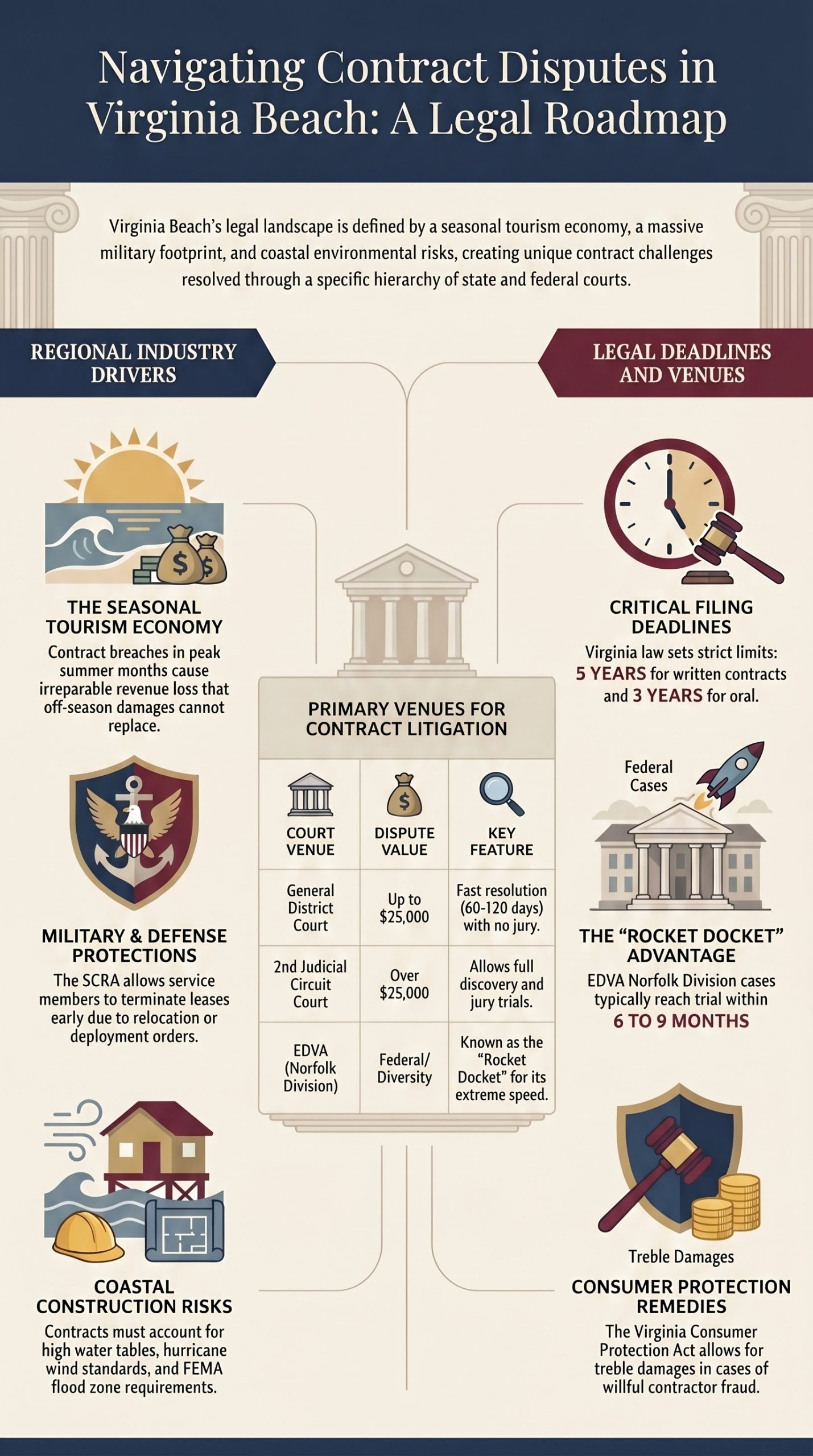
Table of Contents
- The Virginia Beach Contract Dispute Environment
- Tourism, Hospitality, and Resort Industry Contract Disputes
- Military-Adjacent and Defense Contractor Disputes
- Coastal Construction Contract Disputes
- Real Estate, Vacation Property, and Short-Term Rental Disputes
- Healthcare and Medical Practice Contract Disputes
- Consumer Contract Disputes for Virginia Beach Residents
- Virginia Law on Breach of Contract and Available Remedies
- Navigating Virginia Beach’s Court System
- How Shin Law Office Resolves Contract Disputes
- Summary
- Frequently Asked Questions
- References
Chapter 1: The Virginia Beach Contract Dispute Environment
Virginia Beach is the largest city in the Commonwealth by population and one of the most economically distinctive regions in the state. The city stretches from the Chesapeake Bay across nearly 250 square miles to the North Carolina border, taking in the Atlantic oceanfront resort district, the Town Center commercial core, the Sandbridge vacation rental community, the Pungo agricultural area, and a substantial military footprint that touches every corner of the local economy. The contract disputes that arise here reflect that geography in ways that surprise lawyers who have practiced only in Northern Virginia or the western parts of the state.
The dominant economic forces are tourism and hospitality at the oceanfront and along Atlantic Avenue, the military installations at NAS Oceana, JEB Little Creek-Fort Story, and Dam Neck Annex, healthcare anchored by Sentara Princess Anne Hospital and Sentara Virginia Beach General Hospital, an extensive real estate sector that includes resort condominiums and oceanfront single-family homes, and a defense contracting industry that supports the surrounding Hampton Roads naval and aviation operations. Tourism alone draws more than 19 million visitors a year to the city, generating contract activity across hotels, restaurants, event venues, charter operations, and short-term rentals at a volume that few Virginia cities approach.
Two regional realities shape Virginia Beach contract disputes in ways worth pointing out. First, the seasonal economy compresses business activity into a peak period from Memorial Day through Labor Day. A breached supply contract or a failed event venue agreement that occurs in June causes far more harm than the same breach in February, because the window to find an alternative provider is narrow and the lost revenue cannot be recaptured the following month. Courts in Virginia Beach see the same contract claims that arise in other parts of the Commonwealth, but the damages calculations often reflect this compressed timing. Second, the military relocation cycle creates a constant churn of new arrivals and departing service members, each of whom signs and sometimes breaks leases, service contracts, and consumer agreements on schedules driven by orders rather than by personal choice.
The court system reflects the city’s size and complexity. The 2nd Judicial Circuit covers the City of Virginia Beach exclusively, with both the Circuit Court and the General District Court located at the Virginia Beach Judicial Center on Nimmo Parkway. Federal cases for the region are heard at the U.S. District Court for the Eastern District of Virginia, Norfolk Division, which sits in Norfolk and is widely known among litigators as one of the fastest civil dockets in the country. The procedural rules and substantive law are identical to what applies elsewhere in Virginia, but the practical experience of litigating in Virginia Beach and the EDVA Norfolk Division differs significantly from filing in Fairfax, Roanoke, or Richmond.
This guide covers ten categories of contract disputes that arise in Virginia Beach and the surrounding region. For readers who do business in other parts of the Commonwealth, see our companion guides on contract disputes in Norfolk and Hampton Roads, on Northern Virginia commercial contract litigation, and on contract disputes in the Roanoke Valley, all of which apply the same Virginia law to different regional economies.
Chapter 2: Tourism, Hospitality, and Resort Industry Contract Disputes
The oceanfront resort district from Rudee Inlet to 42nd Street, along with the broader hospitality network that includes the Virginia Beach Convention Center, the Cavalier Hotel, the Marriott and Hilton oceanfront properties, hundreds of restaurants, and the Atlantic Park entertainment development, generates a contract footprint that no other Virginia city matches. When these contracts go sideways, the disputes hit the bottom line during a season that lasts only a few months.
The hospitality contract disputes I see most often in Virginia Beach include hotel and resort group booking agreements (corporate retreats, military reunions, sports tournaments) where blocks are released, attendance falls short, or attrition fees are contested; wedding and event venue contracts where deposits, cancellation terms, and force majeure language come into play; restaurant equipment supply, food service, and franchise agreements where seasonal demand strains delivery; charter fishing, boat rental, and water sports operator contracts; and convention services agreements with the Virginia Beach Convention Center and adjacent hotel partners.
Wedding and event venue disputes deserve their own attention because the contract dynamics are unusual. A bride or groom who signs a venue agreement two years out, pays a substantial non-refundable deposit, then cancels eight months before the date is asking the venue to absorb a loss the venue has already factored against. Virginia generally enforces non-refundable deposit clauses in event contracts, but the deposit amount must reflect a reasonable estimate of damages and not function as a penalty under Virginia common law. Force majeure clauses received fresh scrutiny after the COVID-19 closures of 2020 and 2021, and the case law in this area continues to develop. Couples who signed contracts before March 2020 and venues that drafted their force majeure language before then are still working through the resulting litigation in some cases.
Restaurant supply chain disputes intensify during peak season. A seafood supplier that fails to deliver on a Friday in July causes a different category of harm than the same failure in November. Virginia’s Uniform Commercial Code at Title 8.2 governs sales of goods, with the four-year statute of limitations under Va. Code § 8.2-725 and the right to cover under Va. Code § 8.2-712. A restaurant that pays premium prices to source replacement product on short notice can recover the cost difference plus consequential damages when foreseeability is established under the rule of Hadley v. Baxendale.
Why this matters in Virginia Beach specifically:
Tourism contract disputes carry asymmetric harm. The party that breaches in the off-season pays cash damages. The party that gets breached against in peak season loses the season. Demand letters and pre-suit negotiations that reflect this reality produce different settlement results than generic commercial demands.
Chapter 3: Military-Adjacent and Defense Contractor Disputes
NAS Oceana is the largest master jet base on the East Coast and home to the F/A-18 Hornet and Super Hornet squadrons that deploy from Hampton Roads. JEB Little Creek-Fort Story houses the Navy’s expeditionary forces and a substantial special operations footprint. Dam Neck Annex and the surrounding training complexes round out a military presence that supports tens of thousands of active-duty service members, civilian employees, and family members across Virginia Beach. The contract activity that flows from this presence touches almost every commercial sector in the city.
The military-adjacent contract disputes I see most often in Virginia Beach include defense subcontractor disputes (prime to sub, sub to sub, and supply chain claims on Department of Defense work); Service Contract Act and Davis-Bacon Act compliance disputes that bleed into contract performance arguments; service member lease and consumer contract issues governed by the Servicemembers Civil Relief Act at 50 U.S.C. § 3901 et seq.; military housing privatization contract disputes with Lincoln Military Housing and similar operators; and security clearance and personnel issues that affect performance under defense contracts.
The Servicemembers Civil Relief Act provides protections that civilian counterparties sometimes overlook until they are in court. A service member with a written lease can terminate early upon receipt of qualifying military orders (PCS or deployment of 90 days or more) by providing written notice and a copy of the orders. The lease ends 30 days after the next rental payment is due. Landlords who attempt to enforce early termination penalties or break-lease fees against a SCRA-covered tenant face statutory remedies that include actual damages, equitable relief, and attorney’s fees. Auto leases, cell phone contracts, and similar consumer agreements have parallel SCRA protections.
Defense subcontractor disputes follow a different procedural path than typical commercial litigation. The Contract Disputes Act, the Federal Acquisition Regulation, and the prime contract’s flow-down clauses establish the framework. When a sub disputes payment, work scope, or termination, the litigation often involves both the prime-sub relationship under Virginia law and the underlying federal claim against the government. The interplay can be complex, and the choice of forum (state court, federal court, or the Armed Services Board of Contract Appeals through the prime) affects the outcome.
Chapter 4: Coastal Construction Contract Disputes
Construction in Virginia Beach faces challenges that inland markets do not encounter. Coastal sites involve high water tables, sandy or organic soils that complicate foundation design, FEMA Special Flood Hazard Area requirements, hurricane wind loading standards under the Virginia Uniform Statewide Building Code, and stormwater management rules tied to the Chesapeake Bay Preservation Act and local ordinances. The premium that coastal construction pays in cost, time, and dispute exposure is real.
The construction contract disputes I see most often in Virginia Beach include delay claims tied to weather, hurricane interruptions, and supply chain issues; differing site condition claims when subsurface conditions vary from soil reports (especially common near the bay and along marshland); mechanic’s lien filings under Va. Code §§ 43-1 through 43-23.2; pay-when-paid and pay-if-paid clause enforcement on commercial projects; change order disputes over scope, pricing, and authority issues; and warranty claims on residential and commercial work after completion.
Mechanic’s liens deserve attention because the deadlines are short and unforgiving. A memorandum of mechanic’s lien must be filed within 90 days of the last day of the last month in which work was performed or materials were furnished. Suit to enforce the lien must follow within six months of recordation, or 60 days from completion of the building, whichever is later. The 2nd Circuit Clerk’s office in Virginia Beach maintains a busy lien docket, and the procedural rules are enforced strictly. I have walked through the precise mechanics of filing a Virginia mechanic’s lien before the clock runs out in a separate piece, and the same statutory windows apply to Virginia Beach projects.
Hurricane-related delay claims raise a recurring question: when does a weather event excuse performance, and when does it merely shift the schedule? Virginia courts apply the contract’s force majeure language first, then the doctrine of impossibility or commercial impracticability under Va. Code § 8.2-615 for sales of goods. A tropical storm that closes a job site for three days is rarely a force majeure event in itself. A direct hurricane hit that destroys delivered materials, makes the site inaccessible for weeks, or causes the local government to suspend permitting can satisfy the standard. The dispute often turns on the specific contract language and the documented timeline of impacts.
Residential coastal construction in Virginia Beach often involves oceanfront and bayfront homes, which carry their own dispute patterns. Defective work in these settings can be expensive to investigate and repair, and Virginia’s implied warranty of habitability and workmanlike construction provides homeowners a substantive remedy alongside the express warranty terms. The Virginia Consumer Protection Act at Va. Code § 59.1-200 also applies to fraudulent or deceptive contractor conduct, with treble damages available for willful violations. For homeowners dealing with builder delays, cost overruns, or construction defects, the protections are substantial when the right claims are filed within the right deadlines.
Chapter 5: Real Estate, Vacation Property, and Short-Term Rental Disputes
Virginia Beach’s real estate market is divided into several distinct submarkets, each with its own contract dispute patterns. The oceanfront condominium market draws investors and second-home buyers from across the Mid-Atlantic. Sandbridge, with its barrier-island vacation rental community, generates a steady stream of property management and HOA disputes. Town Center and the Pembroke area anchor the urban commercial core. The Princess Anne and Pungo areas support agricultural and equestrian properties along with rural homesites. Each submarket produces its own variations on common contract themes.
The real estate contract disputes I handle most often in Virginia Beach include commercial lease defaults for nonpayment, holdover tenancy, and unauthorized assignments; common area maintenance audit disagreements in Town Center and oceanfront mixed-use projects; build-out and tenant improvement disputes; condominium and HOA assessment, governance, and rule enforcement disputes; and real estate purchase contract disputes including earnest money allocation, disclosure obligations under the Virginia Residential Property Disclosure Act at Va. Code § 55.1-700 et seq., and specific performance actions when one party refuses to convey.
Short-term rental disputes have grown into one of the most active areas of property litigation in Virginia Beach over the last several years. The city’s zoning ordinance regulates short-term rentals through registration requirements, occupancy limits, parking standards, and overlay districts that establish where rentals are permitted by right and where conditional use permits are required. HOAs in oceanfront and resort condominium buildings have separate rules, and the conflict between owner expectations, HOA enforcement, and city zoning produces a steady stream of disputes. Property management agreements with VRBO, Airbnb, and local property management companies add another layer of contract issues over commission structures, marketing obligations, and damage handling.
Coastal real estate also raises flood and insurance issues that affect contract terms. FEMA flood maps designate substantial portions of Virginia Beach as Special Flood Hazard Areas, and elevation certificates, flood insurance premiums, and disclosure obligations follow. Properties that have experienced repetitive losses or that sit within Coastal Barrier Resources System units carry restrictions on federal flood insurance availability. Buyers and lenders who do not address these issues in the contract sometimes find themselves litigating after closing over what was disclosed and what was not.
Real estate purchase disputes that go to litigation often involve specific performance. Virginia courts grant specific performance in real estate cases because every parcel is treated as unique, making it a real option for buyers facing a seller’s breach on a property that meets specific Virginia Beach needs. The contract analysis under TM Delmarva Power, L.L.C. v. NCP of Virginia, L.L.C., 263 Va. 116 (2002), and related authority controls the equitable inquiry, and the remedy is granted or denied based on the conduct of both parties.
Chapter 6: Healthcare and Medical Practice Contract Disputes
Sentara Healthcare operates the dominant hospital network in Virginia Beach, with Sentara Princess Anne Hospital, Sentara Virginia Beach General Hospital, and a network of clinics, urgent care centers, and physician practices that serve the entire Hampton Roads region. Around these institutions sits a substantial network of independent physicians, specialty groups, ancillary providers, and supply vendors, all working under written contracts that occasionally produce litigation.
The healthcare contract disputes I see most often in Virginia Beach include physician employment and shareholder disputes within medical groups, hospital-physician services agreements (medical directorships, call coverage, professional services), restrictive covenant enforcement when physicians leave one practice for another, equipment supply and maintenance contracts (imaging, surgical, lab), payor contracts and reimbursement disputes with commercial insurers, and information technology contracts for electronic health records and billing systems.
Physician restrictive covenant disputes deserve special attention. Virginia enforces non-compete clauses that are reasonable in scope, duration, geography, and that protect a legitimate business interest under Home Paramount Pest Control Cos. v. Shaffer, 282 Va. 412 (2011). For physicians in the Hampton Roads region, the geographic question matters more than the duration. A non-compete that prohibits practice within a fifteen-mile radius of a Virginia Beach office may push a departing physician across the bay to the Peninsula or out of the region entirely. Courts evaluate whether such a clause protects a legitimate interest or improperly restrains the physician’s livelihood. The 2020 amendments to Virginia non-compete law at Va. Code § 40.1-28.7:8 do not exempt physicians, but they have shifted the broader analysis. I have written separately about Virginia’s 2020 non-compete law changes, which apply across the Commonwealth.
Medical practice partnership and shareholder disputes often surface when one physician retires, another wants to leave for an academic role at Eastern Virginia Medical School, or the group considers a sale to a private equity-backed platform. Buy-sell language drafted years ago rarely anticipates the current valuation environment, and the gaps in the agreement become the points of dispute. The Virginia Stock Corporation Act and the Virginia Limited Liability Company Act provide default rules where the agreement is silent, but those defaults often produce results that neither party wanted.
Chapter 7: Consumer Contract Disputes for Virginia Beach Residents
Virginia Beach residents face the same consumer contract problems found anywhere in Virginia, with regional variations driven by the tourist economy and the military population. The Virginia Consumer Protection Act (VCPA) at Va. Code § 59.1-196 et seq. provides the primary statutory framework, and its treble damages and attorney’s fee provisions for willful violations make smaller claims economically viable.
The consumer disputes I see most often from Virginia Beach clients include home improvement contractor disputes (especially for hurricane repair work, roof replacements, and oceanfront properties where the contractor took a deposit and never returned); auto purchase fraud at regional dealerships catering to military buyers; timeshare and vacation club disputes (the resort area produces these regularly); wedding and event venue cancellation disputes; service contract issues with HVAC, pool, and lawn care providers; and gym, club, and subscription service disputes under Va. Code § 59.1-294 and similar provisions.
Military consumer fraud is its own subcategory. Service members are targeted by predatory auto dealers, payday lenders, and timeshare resellers who count on the buyer being deployed or relocated before a dispute can be properly pursued. The Military Lending Act, the SCRA, and the VCPA provide overlapping protections, and a well-pleaded complaint can pursue claims under all three. Federal jurisdiction often follows when the federal statutes are properly invoked.
For residents pursuing a consumer claim, two procedural realities shape the strategy. Virginia Beach General District Court hears civil claims up to $25,000 with simplified procedure, no jury, and resolution typically within 60 to 120 days. Most consumer cases belong there. A well-drafted demand letter that cites the VCPA and identifies the willfulness facts often results in a settlement before suit is filed. When it does not, that letter becomes evidence of willfulness that supports treble damages at trial. For more on Virginia consumer protection claims, see our consumer protection guide.
Time matters more than people realize:
Virginia’s three-year statute of limitations on oral contracts and five-year limit on written ones at Va. Code § 8.01-246 sounds long, but it goes faster than most people expect. The VCPA carries a two-year limitations period from discovery under Va. Code § 59.1-204.1. Document the dispute, send the demand letter, and consult counsel before deadlines begin to close.
Chapter 8: Virginia Law on Breach of Contract and Available Remedies
Every contract dispute in Virginia Beach comes back to two questions: was there a breach, and what is the remedy. Virginia law answers both with a body of doctrine that is traditional, predictable, and often advantageous for the side that prepares thoroughly. I have published a detailed walkthrough of Virginia breach of contract claims that covers the elements, defenses, and damages calculations in depth. The summary below highlights what matters most for Virginia Beach cases.
Elements of a Breach of Contract Claim
The Virginia Supreme Court set out the elements in Filak v. George, 267 Va. 612 (2004): a legal obligation, a breach of that obligation, and resulting damages. The plaintiff must prove each element by a preponderance of the evidence. The contract itself, whether written or oral, establishes the obligation. The breach is the failure to perform as the contract requires. The damages must be proven with reasonable certainty, which is often the hardest of the three elements.
Statute of Limitations
Va. Code § 8.01-246 sets the deadline at five years for written contracts and three years for unwritten (oral) contracts. UCC sales of goods are limited to four years under Va. Code § 8.2-725. The clock starts on the date of breach, not the date of discovery, with limited exceptions. Virginia uses the breach rule, not the discovery rule, for most contract claims.
Statute of Frauds
Va. Code § 11-2 requires certain contracts to be in writing to be enforceable, including promises to answer for the debt of another, agreements that cannot be performed within one year, sales of land or any interest in land, and contracts for the sale of goods of $500 or more under Va. Code § 8.2-201. Email exchanges and other electronic records can satisfy the writing requirement under the Uniform Electronic Transactions Act at Va. Code § 59.1-479 et seq.
Available Remedies
Virginia recognizes compensatory damages that put the plaintiff in the position the contract promised; consequential damages for foreseeable losses flowing from the breach under the rule of Hadley v. Baxendale; liquidated damages when the contract specifies them and they are not a penalty; specific performance for unique items, including real estate; rescission to undo the contract when fraud or material breach justifies it; and reformation to correct mutual mistake in the written instrument.
Mitigation and Punitive Damages
Mitigation is required. A non-breaching party must take reasonable steps to reduce damages, and a court will deny recovery for losses that could have been avoided. Punitive damages are not available for breach of contract alone in Virginia. They require an independent tort, such as fraud in the inducement, that exists alongside the contract claim. The line between business fraud and breach of contract matters here, and the choice of theory affects available remedies. The cap on punitive damages under Va. Code § 8.01-38.1 is $350,000.
Chapter 9: Navigating Virginia Beach’s Court System
Virginia Beach contract disputes can land in any of several courts, and the choice of forum often determines the speed, cost, and outcome of the case. The procedural mechanics are similar to what I have described elsewhere about how Virginia courts resolve contract and business disputes, but Virginia Beach has its own venue rules and docket dynamics shaped by the 2nd Judicial Circuit and the EDVA Norfolk Division.
Virginia Beach General District Court
Located in the Virginia Beach Judicial Center on Nimmo Parkway, this court hears civil cases with an amount in controversy up to $25,000 (exclusive of interest and attorney’s fees). Cases proceed without juries, follow simplified procedure, and typically resolve within 60 to 120 days. Discovery is limited. Appeals from the General District Court go to the Circuit Court for a trial de novo, meaning the case starts over with full procedural rights. For consumer disputes and small commercial matters, the General District Court is often the right venue.
Virginia Beach Circuit Court (2nd Judicial Circuit)
The 2nd Judicial Circuit Court sits at the Virginia Beach Judicial Center and hears civil cases over $25,000 and any case requiring equitable relief such as specific performance or injunctions. The circuit covers the City of Virginia Beach exclusively. Cases allow full discovery under the Virginia Rules of the Supreme Court Part Four, jury trials, and the full range of pretrial motions. Cases typically take 9 to 18 months from filing to trial.
U.S. District Court, Eastern District of Virginia, Norfolk Division (the Rocket Docket)
The EDVA Norfolk Division at 600 Granby Street in Norfolk handles federal cases for Virginia Beach and the surrounding region. The Eastern District of Virginia is widely known among litigators as the rocket docket, and for good reason. Cases routinely reach trial within 6 to 9 months of filing. Discovery deadlines are short, motion schedules are compressed, and continuances are rarely granted. For plaintiffs with strong cases, this speed is an advantage. For defendants who need time to develop a defense, it can be punishing. The choice between EDVA and Virginia state court (when both have jurisdiction) often comes down to this timing question.
Removal, Mediation, and Arbitration
Removal to federal court is available in diversity cases under 28 U.S.C. § 1441 and must be filed within 30 days of service of the complaint. Out-of-state defendants frequently remove Virginia state court contract cases to federal court, which in the EDVA means accepting the rocket docket pace. Many commercial contracts contain arbitration clauses governed by the Federal Arbitration Act, 9 U.S.C. § 1 et seq., or the Virginia Uniform Arbitration Act at Va. Code § 8.01-581.01 et seq. These clauses are generally enforceable, and a court will dismiss or stay litigation when a valid arbitration agreement covers the dispute.
Chapter 10: How Shin Law Office Resolves Contract Disputes
Shin Law Office serves clients throughout the Commonwealth of Virginia, including Virginia Beach, the Hampton Roads region, and Norfolk. As a Virginia-licensed attorney, I represent clients in any state court in Virginia and in the U.S. District Court for the Eastern District of Virginia, including the Norfolk Division. The full range of our work is described on our civil litigation practice page.
Our process for a Virginia Beach contract dispute follows a deliberate sequence. The work begins with an initial case assessment. When you call the firm, we collect the contract, the relevant communications, and a chronology of what happened. The first review tells us three things: whether you have a viable claim, what the realistic damages look like, and what the procedural posture is. If the matter falls outside our practice areas or is better handled by a different attorney, I will tell you that directly.
From there we move to pre-litigation strategy. A surprising number of contract disputes resolve before suit is filed. A well-drafted demand letter that cites the controlling Virginia statutes, attaches the key documents, and lays out a credible damages calculation often produces a settlement offer within 30 days. When the demand letter does not produce a result, we evaluate whether mediation, arbitration, or litigation is the right next step.
When litigation is necessary, we file in the court that gives our client the best procedural and substantive position. That choice depends on the amount in controversy, the desired speed, the availability of a jury, the discovery rules, and any forum selection or arbitration clauses in the contract. For Virginia Beach clients, the 2nd Circuit, the General District Court, and the EDVA Norfolk Division each have advantages depending on the case. Contract formation issues at this stage often determine the strength of the case, and the analysis I have laid out on contract formation and enforceability under Virginia law applies equally to disputes that arise in Hampton Roads.
The discovery phase is where most contract cases are won or lost. We use depositions, document requests, interrogatories, and requests for admission strategically rather than reflexively. Summary judgment motions under Rule 3:20 of the Virginia Supreme Court Rules can resolve a case before trial when the contract language is clear and the material facts are undisputed. In the EDVA, summary judgment under Rule 56 of the Federal Rules of Civil Procedure operates on a similar standard with a tighter timeline.
Most contract disputes settle, often after discovery has narrowed the issues and clarified the damages exposure. When settlement is not possible, we try the case. I have represented clients in bench trials and jury trials across Virginia, and I prepare every case as if it will go to trial. When a trial result needs to be challenged, the appeal goes to the Court of Appeals of Virginia for civil cases under the 2022 jurisdictional expansion at Va. Code § 17.1-405. Federal appeals from the EDVA go to the U.S. Court of Appeals for the Fourth Circuit in Richmond.
The work is detailed, technical, and demanding. That is what tough cases require, and that is what we do.
Summary
Contract disputes in Virginia Beach run through a regional economy unlike anywhere else in Virginia. Tourism and hospitality contracts that compress damages into a peak season, military-adjacent agreements governed by overlapping federal protections, coastal construction shaped by hurricane and flood considerations, vacation rental and short-term rental disputes driven by zoning and HOA conflicts, and a Sentara-anchored healthcare network combine to produce patterns of disputes that are distinctly Virginia Beach.
Three principles apply across every category of dispute discussed in this guide. First, time matters. Virginia’s statutes of limitations are not generous, and several contract-adjacent claims (UCC sales, fraud, VCPA) run on shorter periods than the basic five-year written contract limit. The EDVA Norfolk Division compresses litigation timelines further once a federal case is filed. Second, documentation matters. The party with the better contract file, the better contemporaneous record, and the better preserved communications usually wins. Third, forum matters. The choice between the 2nd Circuit, the General District Court, and the EDVA Norfolk Division can change everything about how a case proceeds.
If you are facing a contract dispute in Virginia Beach, do not wait for the situation to clarify itself. Get a lawyer involved early, when the evidence is fresh and the options are still open.
Frequently Asked Questions
How long do I have to file a breach of contract lawsuit in Virginia Beach?
Virginia gives you five years from the date of breach for a written contract and three years for an oral contract under Va. Code § 8.01-246. Sales of goods under the UCC are limited to four years under Va. Code § 8.2-725. The clock starts on the date of breach, not the date you discovered it, so the practical window is often shorter than it sounds.
Where do I file a contract lawsuit in Virginia Beach?
For amounts up to $25,000, the Virginia Beach General District Court at the Judicial Center on Nimmo Parkway. For amounts over $25,000 or for equitable relief, the 2nd Judicial Circuit Court at the same Judicial Center. For federal claims or diversity cases, the U.S. District Court for the Eastern District of Virginia, Norfolk Division.
What is the EDVA “rocket docket” and how does it affect my contract case?
The U.S. District Court for the Eastern District of Virginia is one of the fastest civil dockets in the country. Cases routinely reach trial within 6 to 9 months of filing. For plaintiffs with strong cases, the speed is a significant advantage. For defendants, it compresses the time to develop a defense. The choice between Virginia state court and the EDVA, when both have jurisdiction, often turns on this timing.
Can a service member break a Virginia Beach lease early because of military orders?
Yes, under the Servicemembers Civil Relief Act at 50 U.S.C. § 3901 et seq. A service member with qualifying orders (PCS or deployment of 90 days or more) can terminate a written lease by providing written notice and a copy of the orders. The lease ends 30 days after the next rental payment is due. Landlords who attempt to enforce break-lease fees against a SCRA-protected tenant face statutory remedies including actual damages and attorney’s fees.
Are physician non-compete agreements enforceable in Virginia Beach?
Yes, when reasonable in scope, duration, and geography, and when they protect a legitimate business interest under Home Paramount Pest Control Cos. v. Shaffer, 282 Va. 412 (2011). For Hampton Roads physicians, geography matters most. A non-compete with a fifteen-mile radius from a Virginia Beach office may push a physician across the bay or out of the region entirely. Courts evaluate each clause on its specific terms.
Is my non-refundable wedding venue deposit really non-refundable?
Often yes, but not always. Virginia courts generally enforce non-refundable deposit clauses in event contracts, but the deposit must reflect a reasonable estimate of damages and not function as a penalty. If a venue collected a $15,000 deposit and rebooked the date with a comparable client, keeping the full deposit may exceed the venue’s actual losses. The contract terms, the cancellation timing, and the venue’s mitigation efforts all matter.
What damages can I recover in a Virginia breach of contract case?
Compensatory damages, consequential damages within the rule of foreseeability, liquidated damages when the contract specifies them and they are not a penalty, specific performance for unique items, rescission, and reformation. Punitive damages are not available for breach of contract alone, but may be available if an independent tort like fraud is also pleaded and proven. Attorney’s fees are recoverable only if the contract or a statute provides for them.
How does the Virginia Consumer Protection Act help with Virginia Beach contractor disputes?
The VCPA at Va. Code § 59.1-196 et seq. covers fraudulent and deceptive practices in consumer transactions. A homeowner who proves a willful violation can recover treble damages and attorney’s fees, which dramatically improves the economics of pursuing a contractor who walked off the job, took a hurricane repair deposit and disappeared, or did substandard work and refused to return.
Can my HOA stop me from running a short-term rental in Virginia Beach?
Possibly, depending on the HOA’s governing documents and the rules in effect when you bought the unit. Virginia Beach city zoning sets one layer of rules, and the HOA declarations and bylaws set another. HOAs can restrict or prohibit short-term rentals if the governing documents authorize the restriction, and Virginia courts generally enforce reasonable HOA rules. Conflicts often arise when HOAs adopt new rules after owners have built investment expectations on the prior regime.
Do I need an attorney to handle a contract dispute in Virginia Beach?
For matters under $5,000 in the General District Court, many people represent themselves successfully. Once the amount in controversy exceeds $25,000 and the case moves to Circuit Court or the EDVA, the procedural rules become significantly more demanding, and self-representation usually costs more than it saves. For healthcare, partnership, defense contractor, and complex commercial cases, an attorney is essential.
Ready to Resolve Your Virginia Beach Contract Dispute?
Whether you are a Virginia Beach hotel operator with a group booking dispute, a defense subcontractor chasing payment from a prime, an oceanfront homeowner facing builder defects after a hurricane repair, a physician working through a Sentara-area non-compete, a condo owner fighting an HOA over short-term rentals, or a service member protecting your rights under the SCRA, you deserve a Virginia attorney who understands the law and will fight for you.
Tough cases require tough attorneys. Shin Law Office handles contract disputes across the Commonwealth, including Virginia Beach, Norfolk, the Hampton Roads region, and beyond.
Call 571-445-6565 or book your case review online at shinlawoffice.com/meet-our-team/contact

References
Code of Virginia. (2024). Title 8.01, Chapter 4: Limitations of actions. Virginia General Assembly. https://law.lis.virginia.gov/vacode/title8.01/chapter4/
Code of Virginia. (2024). Title 8.2: Commercial Code, Sales. Virginia General Assembly. https://law.lis.virginia.gov/vacode/title8.2/
Code of Virginia. (2024). Title 11, Chapter 1: Statute of Frauds. Virginia General Assembly. https://law.lis.virginia.gov/vacode/title11/chapter1/
Code of Virginia. (2024). Title 13.1: Stock Corporations. Virginia General Assembly. https://law.lis.virginia.gov/vacode/title13.1/
Code of Virginia. (2024). Title 40.1, Section 28.7:8: Covenants not to compete. Virginia General Assembly. https://law.lis.virginia.gov/vacode/title40.1/chapter3/section40.1-28.7:8/
Code of Virginia. (2024). Title 43: Mechanics’ and Certain Other Liens. Virginia General Assembly. https://law.lis.virginia.gov/vacode/title43/
Code of Virginia. (2024). Title 55.1, Chapter 7: Virginia Residential Property Disclosure Act. Virginia General Assembly. https://law.lis.virginia.gov/vacode/title55.1/chapter7/
Code of Virginia. (2024). Title 59.1, Chapter 17: Virginia Consumer Protection Act. Virginia General Assembly. https://law.lis.virginia.gov/vacode/title59.1/chapter17/
Federal Arbitration Act, 9 U.S.C. § 1 et seq. https://www.govinfo.gov/app/collection/uscode
Filak v. George, 267 Va. 612 (2004).
Home Paramount Pest Control Companies, Inc. v. Shaffer, 282 Va. 412 (2011).
Naval Air Station Oceana. (2024). About NAS Oceana. Commander, Navy Installations Command. https://cnrma.cnic.navy.mil/Installations/NAS-Oceana/
Joint Expeditionary Base Little Creek-Fort Story. (2024). About JEBLCFS. Commander, Navy Installations Command. https://cnrma.cnic.navy.mil/Installations/JEB-Little-Creek-Fort-Story/
Sentara Healthcare. (2024). About Sentara and our Hampton Roads facilities. https://www.sentara.com/about-us.aspx
Servicemembers Civil Relief Act, 50 U.S.C. § 3901 et seq. https://www.govinfo.gov/app/collection/uscode
TM Delmarva Power, L.L.C. v. NCP of Virginia, L.L.C., 263 Va. 116 (2002).
U.S. District Court for the Eastern District of Virginia. (2024). Norfolk Division. https://www.vaed.uscourts.gov/
Virginia Beach City Circuit Court. (2024). Second Judicial Circuit of Virginia. City of Virginia Beach. https://www.vbgov.com/government/departments/courts/circuit-court/Pages/default.aspx
Virginia Beach City Convention & Visitors Bureau. (2024). Virginia Beach tourism economic impact. https://www.visitvirginiabeach.com/
Virginia Department of Professional and Occupational Regulation. (2024). Contractor licensing requirements. https://www.dpor.virginia.gov/Boards/Contractors/
