


By Anthony I. Shin, Esq. | Shin Law Office | Serving Clients Across Virginia
BOTTOM LINE UP FRONT
The Charlottesville-Lynchburg corridor runs roughly 70 miles along Route 29 through the central Virginia Piedmont, connecting two anchor cities that share almost nothing in common while jointly defining one of Virginia’s most economically diverse legal markets. Charlottesville brings the University of Virginia and its $9 billion endowment, the federal courthouse for the Western District of Virginia, the most concentrated wine and equestrian economy in the Commonwealth, and a research and technology overlay built around UVA’s medical center, the Darden School, and the surrounding innovation ecosystem. Lynchburg brings Liberty University with its 100,000-plus enrollment, Centra Health hospital network, BWX Technologies and the nuclear components industry, the Areva/Framatome footprint, and a manufacturing base built across more than a century of industrial operation. Between them sit Nelson County’s Route 151 wine and brewery corridor, Albemarle County’s vineyards and historic estates, Bedford County’s Smith Mountain Lake recreation economy, and the rural agricultural and timber economies of Amherst, Buckingham, Appomattox, and Campbell.
The contract disputes that arise here run on frameworks that few Virginia regions combine. University-related employment, research, and intellectual property disputes that overlay federal regulatory frameworks. Winery and brewery contracts shaped by Virginia ABC licensing and federal tied-house rules. Equestrian and farm transaction disputes affecting some of the most valuable agricultural real estate in the Commonwealth. Conservation easements granted to the Virginia Outdoors Foundation and private land trusts on properties that have been in the same families for two centuries. Liberty University and the broader Lynchburg manufacturing base producing employment, contractor, and supply chain disputes at industrial scale. Defense and nuclear-component contracts at BWX Technologies. Tourism, lodging, and event venue agreements at Wintergreen, Smith Mountain Lake, and the historic district hotels.
This guide covers every major category of contract dispute affecting the Charlottesville-Lynchburg corridor and the surrounding Central Virginia counties. Call Shin Law Office at 571-445-6565 or book your case review online at shinlawoffice.com/meet-our-team/contact.
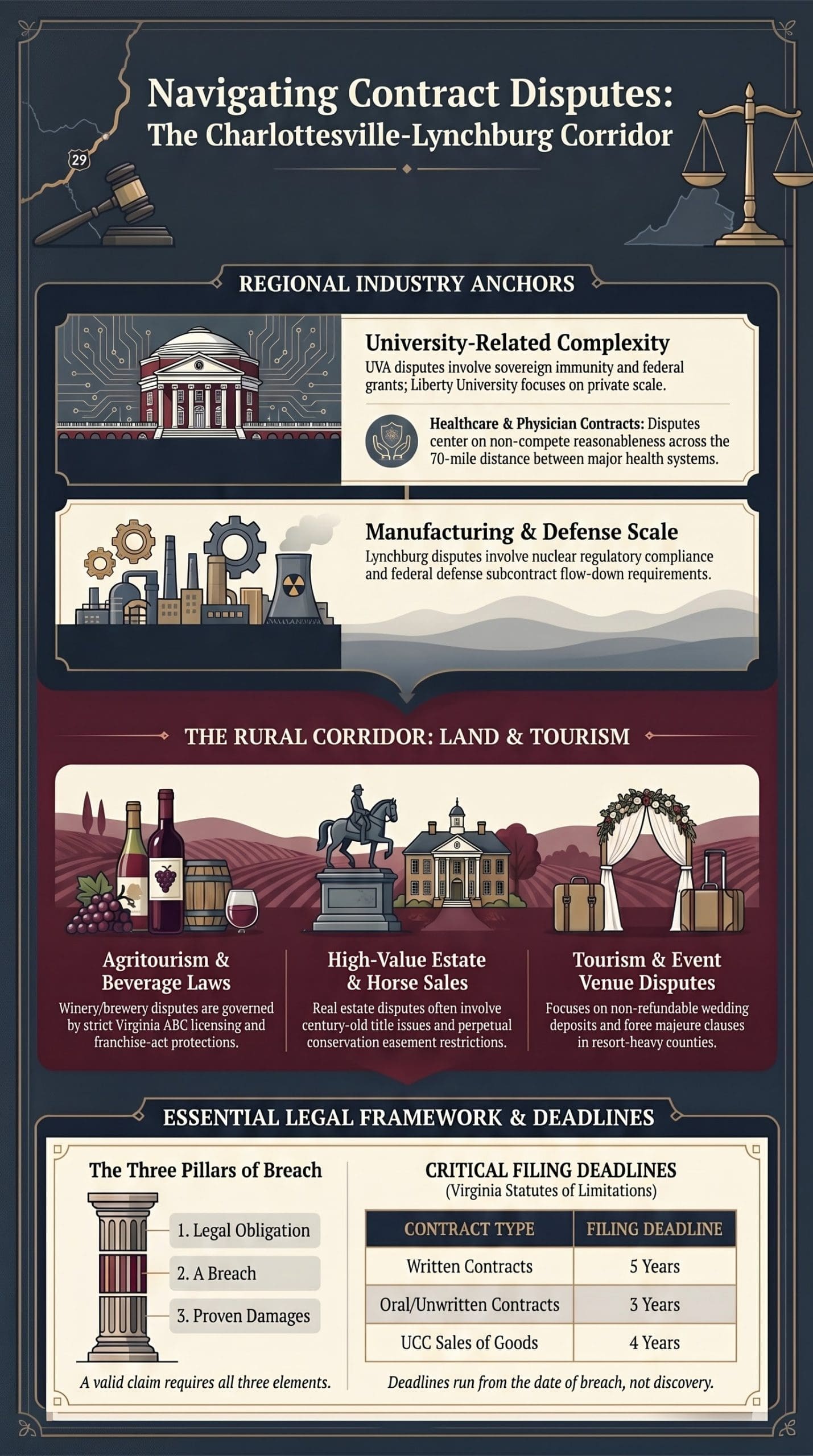
Table of Contents
- The Charlottesville-Lynchburg Corridor Contract Dispute Environment
- University-Related Contract Disputes (UVA and Liberty University)
- Winery, Brewery, Cidery, and Distillery Contract Disputes
- Equestrian, Estate, and Conservation Easement Disputes
- Manufacturing, Nuclear, and Defense Contractor Disputes
- Healthcare and Medical Practice Contract Disputes
- Tourism, Lodging, and Event Venue Disputes
- Virginia Law on Breach of Contract and Available Remedies
- Navigating the Multi-Circuit Court System
- How Shin Law Office Resolves Contract Disputes
- Summary
- Frequently Asked Questions
- References
Chapter 1: The Charlottesville-Lynchburg Corridor Contract Dispute Environment
Drive south on Route 29 from the bypass at Hollymead, through Albemarle County, past the wine country exits at Afton and Crozet, across Nelson County, through Amherst, into Madison Heights, and finally across the James River into downtown Lynchburg, and you have crossed one of the most economically and culturally diverse 70-mile stretches anywhere in Virginia. Charlottesville and Lynchburg are not really one market, but the Route 29 corridor that connects them functions as a single legal region for businesses, professionals, and residents who operate across the divide. The contract disputes that arise here reflect both anchor cities and the rural counties between them, producing a mix that raises legal questions single-market commercial litigators rarely encounter.
Charlottesville is the smaller of the two cities by population but the larger in economic gravity. The University of Virginia anchors the city’s economy, with more than 25,000 students, 13,000 faculty and staff at the academic enterprise, and another 8,000 at the UVA Health system. UVA’s federal research grants, its $9 billion endowment, the affiliated foundations and centers, the Darden School of Business, the Law School, and the medical center together generate contract activity at substantial scale, often involving federal grant frameworks, intellectual property rules under the Bayh-Dole Act, and the unique legal status of a Commonwealth-chartered public university. Around the University sits the Charlottesville innovation ecosystem, which includes biotechnology firms, software companies, defense and intelligence contractors, professional services firms, and the venture capital activity that supports them. The Charlottesville Downtown Mall, the Belmont and Fifeville neighborhoods, and the surrounding Albemarle County subdivisions support a residential population that skews high-income, well-educated, and demanding of high-quality professional services.
Albemarle County wraps Charlottesville on all sides, extending from the Blue Ridge to the west across to the Fluvanna County line in the east, and from Greene County in the north to Nelson County in the south. The county’s commercial fabric splits between Pantops and the Route 250 East corridor, the Crozet area in the west, the Hollymead and Forest Lakes communities along Route 29 North, and the rural southern county where vineyards, equestrian farms, and historic estates dominate. Albemarle County circuit court matters venue separately from City of Charlottesville matters, and the substantive law and procedural rules differ on certain local ordinance and zoning issues.
Nelson County sits between Albemarle and Amherst, taking in the Blue Ridge mountains and the foothills along the Rockfish River, the Tye River, and the upper James. The county is home to Wintergreen Resort, the Route 151 wine and brewery corridor (including Veritas, Cardinal Point, Pollak, Blue Mountain Brewery, Devils Backbone, and dozens more), and an emerging hospitality and agritourism economy that has transformed the county over the last twenty years. Nelson contract disputes often involve hospitality, ABC-licensed beverage operations, and the unique mix of agricultural, mountain recreation, and tourism uses.
Amherst County, between Nelson and Lynchburg, blends rural agriculture with Sweet Briar College, the Madison Heights commercial corridor opposite Lynchburg across the James River, and a substantial timber and agricultural footprint. Bedford County, west and southwest of Lynchburg, is dominated by Smith Mountain Lake, which generates a substantial vacation rental and recreational real estate economy similar in some respects to Sandbridge in Virginia Beach but in a freshwater mountain setting. The town of Forest in Bedford County serves as a Lynchburg-adjacent commercial submarket. Buckingham, Appomattox, and Campbell counties round out the rural belt, with their own agricultural, timber, and small-business economies feeding into the corridor’s broader commercial fabric.
Lynchburg is the regional commercial center for Central and Southwest Virginia. The city’s economic base is more industrial and more conservative than Charlottesville’s, with manufacturing, energy, and education driving the workforce. Liberty University, with more than 15,000 residential students and an additional 90,000-plus online enrollment, is the second-largest university in Virginia after Virginia Commonwealth University by total enrollment. Centra Health operates the dominant hospital network across the city and the surrounding counties. BWX Technologies, headquartered in Lynchburg, manufactures nuclear components for the United States Navy’s nuclear-powered fleet and supplies civilian nuclear reactor components. Framatome (formerly Areva NP) operates a major nuclear fuel and services facility in the city. Other manufacturers, including Babcock and Wilcox legacy operations, support a broad industrial base. Downtown Lynchburg’s revitalization, the historic Riverfront, and the Wyndhurst and Boonsboro Road residential corridors round out the city’s commercial structure.
The court system that handles disputes in this corridor reflects the multi-jurisdictional structure. The 16th Judicial Circuit covers Charlottesville and Albemarle County. The 24th Judicial Circuit covers Lynchburg, Amherst, Bedford, Campbell, and Nelson Counties. The 10th Judicial Circuit covers Appomattox and Buckingham Counties along with several others. The U.S. District Court for the Western District of Virginia, Charlottesville Division, sits in Charlottesville. The Western District’s Lynchburg Division sits in Lynchburg. Federal cases venue between the two divisions based on the underlying property and parties. The Western District operates at a more measured pace than the EDVA’s rocket docket, but it still moves cases efficiently and applies the Federal Rules rigorously.
For readers who do business elsewhere in the Commonwealth, see our companion guides on contract disputes in Virginia Beach, contract disputes in Newport News, contract disputes in Suffolk, and Northern Virginia commercial contract litigation.
Chapter 2: University-Related Contract Disputes (UVA and Liberty University)
The two anchor universities of the corridor produce dispute patterns that few other Virginia regions experience at this scale. UVA, as a public university chartered by the Commonwealth and an arm of the state, operates under sovereign immunity principles, the Virginia Tort Claims Act, the Virginia Public Procurement Act, and a constellation of state and federal regulatory frameworks. Liberty University, as a private religious institution, operates under different rules but produces an equally substantial volume of contract activity given its scale and its complex operational footprint.
University-vendor contract disputes are the first major category. UVA spends hundreds of millions of dollars per year on goods and services, ranging from construction and facilities work to research equipment, IT services, food service, and consulting. The Virginia Public Procurement Act at Va. Code § 2.2-4300 et seq. governs most of these procurements, with specific procedures for solicitation, bid evaluation, contract award, and dispute resolution. Vendors who feel that contracts were improperly awarded, that performance terms were unfairly modified, or that payment was unjustly withheld have administrative and judicial remedies that differ from those available against private parties. Sovereign immunity creates additional procedural complications. Pre-suit notice requirements under the Virginia Tort Claims Act do not apply to contract claims, but the limited waiver of sovereign immunity for contract claims affects the available remedies and the venue in which suit can be filed.
Faculty employment and tenure disputes are a second category that UVA generates with some regularity. Tenure-track and tenured faculty employment relationships are governed by the University’s Manual of Policy and Procedure, the academic department’s bylaws, college-level policies, and overlying University-wide rules. When a tenure denial is challenged, when a tenured faculty member faces post-tenure review consequences, or when administrative appointments are revoked, the legal analysis combines contract law, procedural due process for public employees, and the specific frameworks the University has adopted for faculty employment. Federal Title VII, the Americans with Disabilities Act, and other anti-discrimination statutes overlay the employment analysis when disparate treatment claims are present.
Federal research grant and intellectual property disputes are the third major UVA-driven category. UVA receives roughly $500 million annually in federal research funding, which triggers Bayh-Dole Act compliance for inventions made under federal funding agreements, federal cost accounting standards for research expenditures, and a complex web of subaward, subcontractor, and service-provider relationships. Disputes between UVA and federal sponsors, between UVA and industry partners, between UVA and faculty inventors over patent rights, and between UVA and the affiliated foundations that hold and license intellectual property all involve technical procedural dimensions that go beyond ordinary contract analysis. Bayh-Dole at 35 U.S.C. § 200 et seq. allows the contractor (UVA) to retain title to subject inventions, but the federal government retains a non-exclusive royalty-free license, and march-in rights apply in defined circumstances. Disputes over invention disclosure, election of title, and downstream technology transfer are governed by these federal frameworks.
Liberty University produces a different mix of contract disputes given its private status and its operational scale. Vendor contract disputes are common given the volume of construction, IT, food service, and academic services that the University procures. Faculty and staff employment relationships at Liberty involve at-will employment principles modified by University handbooks, contracts, and the religious institution dimensions that affect First Amendment and Title VII analysis. Student enrollment and tuition disputes occasionally surface, particularly involving the residential program and the online enrollment population. Athletic and broadcasting contracts, including conference affiliation arrangements and the football program’s broader contractual footprint, generate occasional litigation.
Student-related contract disputes are a fourth category that affects both universities. Tuition, room and board, and fee disputes between students and universities surge during periods of disruption, as the COVID-19 pandemic showed. The contractual relationship between a student and a university is governed by the catalog, the financial responsibility agreement, the housing contract, and the various policies the student has agreed to. Disputes over withdrawal refunds, academic dismissals with financial consequences, and disciplinary actions with collateral contractual effects all run on these frameworks. Federal Department of Education rules on Title IV financial aid overlay the analysis when federal student loans are involved.
Why this matters in the corridor specifically:
Two of the largest universities in Virginia anchor opposite ends of this corridor, and they generate contract activity that no other Virginia region produces at comparable density. UVA’s federal research footprint, its sovereign immunity status, and Liberty’s scale combine to create a legal market with capabilities and disputes that are distinctly Charlottesville-Lynchburg. Counsel who understands the federal grant framework, the Virginia Public Procurement Act, the Bayh-Dole Act, and the operational realities of large university enterprises operates in a different lane than counsel who handles only ordinary commercial contract work.
Chapter 3: Winery, Brewery, Cidery, and Distillery Contract Disputes
Virginia is the fifth-largest wine-producing state in the country, and the Charlottesville-Lynchburg corridor is the heart of that production. The Monticello American Viticultural Area, designated by the federal government, encompasses Albemarle County and portions of the surrounding counties. Nelson County’s Route 151 corridor between Crozet and Nellysford is one of the most densely concentrated wine and brewery destinations on the East Coast. Distilleries, including Virginia Distillery Company in Lovingston, have added another layer to the beverage industry. The contract disputes that arise from these operations are governed by frameworks that ordinary commercial litigators rarely encounter.
Virginia ABC licensing affects almost every winery, brewery, cidery, and distillery contract. The Virginia Alcoholic Beverage Control Authority regulates manufacturing licenses, retail licenses, distributor relationships, and the three-tier system that separates manufacturers, wholesalers, and retailers. Virginia ABC operates under Va. Code Title 4.1 with detailed rules on tied-house arrangements, exclusive territories, brand registration, and direct shipping. Federal Tax and Trade Bureau (TTB) rules at 27 C.F.R. Chapter 1 overlay the state framework. Disputes that involve transactions between manufacturers and distributors, between manufacturers and retailers, or between any of these and ABC enforcement personnel run on this regulatory layer.
Distribution and franchise agreement disputes are the most common winery and brewery category. Virginia franchise law governs the relationship between manufacturers and wholesalers, with substantial protections for wholesalers against unilateral termination, modification, and replacement. The Virginia Beer Franchise Act at Va. Code § 4.1-500 et seq. and the Wine Franchise Act establish good-cause requirements for termination and notice procedures that limit a manufacturer’s ability to switch wholesalers. Manufacturers who attempt to terminate a wholesaler without satisfying the statutory good-cause standard face injunctions, damages, and substantial fee-shifting exposure. Wholesalers who fail to perform under the contract face the limited but real remedies the statute allows.
Vineyard and grape supply contracts produce a separate dispute category. A winery that does not grow all of its own grapes contracts with vineyard owners for multi-year supply at agreed prices, with quality specifications and delivery terms. When the harvest comes in below expected quality due to weather, disease, or grower issues, when prices in the broader market diverge significantly from contract levels, or when one party wants to exit a long-term commitment, the contract terms and Virginia common law on contract interpretation drive the analysis. Force majeure language in supply contracts has received fresh attention since the 2020 pandemic disruptions, with courts continuing to develop the law on commercial impracticability for agricultural commodities.
Tasting room, event venue, and wedding contracts are a fourth recurring category. Many Virginia wineries and breweries derive substantial revenue from tasting rooms that serve as event venues, with weddings, corporate retreats, and private parties booked years in advance for peak weekends from May through October. The contracts that govern these events look superficially like ordinary venue agreements but include specific provisions on alcohol service liability, ABC compliance, food service requirements, deposit and cancellation terms, and force majeure language. When weather disrupts an outdoor event, when ABC enforcement issues affect a planned program, or when a couple cancels close to the date, the resulting disputes often involve substantial sums and emotional weight.
Direct-to-consumer shipping and online sales disputes have emerged as the corridor’s wineries have expanded direct shipping to other states. Virginia ABC and the various state ABC agencies impose detailed rules on direct-to-consumer wine shipping, with permit requirements, volume limits, age verification mandates, and tax remittance obligations. Disputes between Virginia wineries and consumers, between wineries and shipping companies, and between wineries and out-of-state regulators all flow from this expanding distribution channel. The framework continues to develop, particularly after the 2019 Supreme Court decision in Tennessee Wine and Spirits Retailers Association v. Thomas, 588 U.S. 504 (2019), which addressed the intersection of state alcohol regulation and the dormant Commerce Clause.
Chapter 4: Equestrian, Estate, and Conservation Easement Disputes
The countryside surrounding Charlottesville contains some of the most valuable agricultural and equestrian real estate in the eastern United States. Albemarle, Madison, Greene, Orange, Nelson, and Fauquier counties together form a region where farms regularly trade for $5 million to $50 million or more, where conservation easements protect tens of thousands of acres from development, and where multi-generational ownership produces transactions that intersect family law, tax law, and contract law in ways that simpler markets do not produce. Lynchburg-area estates and the rural counties to the south support a similar but smaller equestrian and farm economy.
Farm and estate sale disputes are the first major category. The contracts that govern transactions for substantial Albemarle or Nelson County properties run far beyond standard residential real estate agreements. Title issues that have accumulated over generations of inheritance, marriage, and incremental purchase often produce clouds that require quiet title actions or partition proceedings before closing can occur. Mineral rights, water rights, easements granted to neighbors decades ago without recorded documentation, and family member claims to portions of the property all surface during due diligence. Buyers who purchase without thorough title work can find themselves in litigation with previously unknown heirs years after closing.
Conservation easement disputes are a second active category. The Virginia Outdoors Foundation, the Piedmont Environmental Council, and various private land trusts hold conservation easements on substantial Albemarle and Nelson County acreage. These easements were typically granted in exchange for federal income tax deductions and Virginia Land Preservation Tax Credits, and they are perpetual restrictions that bind future owners. When current owners or buyers want to undertake activities the easement restricts (subdivision, additional dwellings, timber harvest, equestrian operations, agricultural changes, vineyard establishment, hospitality use), the question of whether the activity is permitted becomes a contract interpretation issue with environmental and historic preservation overlays. The Internal Revenue Service has authority over substantial modifications that affect previously claimed deductions, and the Virginia Department of Conservation and Recreation oversees the state-level frameworks. Modification or termination of perpetual easements is exceptionally difficult and produces complex litigation when attempted.
Equestrian transaction disputes are a third recurring category specific to the corridor. The horse industry in Albemarle, Madison, Orange, and the surrounding counties supports breeding operations, racing stables, hunt clubs, and competition facilities at substantial scale. Horse sale contracts, training and boarding agreements, breeding contracts, and partnership agreements among co-owners all produce litigation when relationships break down. The Uniform Commercial Code applies to horse sales as sales of goods, but the implied warranties under Va. Code § 8.2-314 (merchantability) and § 8.2-315 (fitness for particular purpose) interact with industry custom and the unique nature of equine transactions in ways that require specific experience. Pre-purchase examination disputes, hidden lameness or behavior issues that surface after sale, and breeding performance disputes all generate claims.
Equestrian liability and stable management disputes are the fourth category. Virginia’s Equine Activity Liability Act at Va. Code § 3.2-6202 limits operator liability for inherent equine activity risks, but the limitation does not apply when the operator’s negligence directly caused the injury, when faulty equipment was provided, when an unsuitable horse was provided to a rider whose ability the operator failed to assess, or in several other defined exceptions. Boarding agreements, training contracts, and lesson programs typically include releases that further limit liability, with enforceability depending on the specific facts and the contract language.
Multi-generational family ownership of farms produces the fifth distinctive category. Properties that have been in the same family for two centuries often have ownership structures that look nothing like ordinary commercial titling. Family trusts, undivided fractional interests held by dozens of cousins, life estates with contingent remainders, and informal family arrangements that were never properly documented all complicate transactions. Buy-sell agreements among family co-owners, partition disputes when one branch wants to sell and another wants to keep the property, and inheritance disputes when a generation transition does not go as expected all generate substantial litigation in the corridor.
Chapter 5: Manufacturing, Nuclear, and Defense Contractor Disputes
Lynchburg’s manufacturing base anchors the southern end of the corridor, with operations that few other Virginia cities support at comparable density. BWX Technologies manufactures nuclear reactor components for the United States Navy’s nuclear-powered fleet, supplies civilian nuclear reactor components, and operates a substantial defense and government services business. Framatome (formerly Areva NP) operates a nuclear fuel and reactor services facility. Babcock and Wilcox legacy operations, now operating under the BWXT umbrella in some respects, contributed to a century of nuclear and energy industry presence. Other manufacturers, including pharmaceutical, food, and industrial equipment operations, support a broader manufacturing economy.
Defense contractor and nuclear-component subcontractor disputes are the first major category. BWX Technologies operates under federal contracts that include detailed flow-down requirements affecting subcontractors at every tier. Federal Acquisition Regulation provisions, Department of Energy and Department of Defense supplements, security clearance and information handling requirements, and government cost accounting standards all overlay ordinary commercial subcontract relationships. When subcontractors and material suppliers face delays caused by upstream prime issues, when scope changes during long-running programs, or when termination for default or convenience surfaces, the resulting disputes require both Virginia contract experience and federal contracting experience. The Contract Disputes Act framework, prime contract dispute clauses, and the procedural distinctions between subcontract claims, prime claims, and government claims all affect strategy.
Nuclear regulatory compliance disputes overlay the contracting framework. The Nuclear Regulatory Commission, the Department of Energy, and the Naval Nuclear Propulsion Program impose detailed compliance requirements on manufacturers in this sector. Nonconformance reports, corrective action requirements, and the unique safety culture expectations of the nuclear industry produce contract performance disputes that ordinary manufacturing litigators rarely see. When a subcontractor’s part fails inspection, when a process control issue is identified after delivery, or when a documentation deficiency surfaces years after manufacturing, the resulting cost allocation and rework disputes can run into millions of dollars on individual programs.
Industrial supply and equipment disputes follow more familiar Uniform Commercial Code patterns, with the four-year statute of limitations under Va. Code § 8.2-725 controlling claim deadlines. Equipment supply contracts at the major Lynchburg manufacturers involve substantial sums, complex specifications, and installation, training, and warranty components that produce disputes when actual performance differs from contract assumptions. Long-term supply relationships often produce a course of dealing under Va. Code § 8.1A-303 that can modify or supplement express terms, and a careful review of the parties’ historical exchanges often produces evidence that alters the analysis.
Employment contract and non-compete disputes are a recurring category in the manufacturing sector. Engineers, technical specialists, and senior managers at BWX Technologies, Framatome, and other Lynchburg manufacturers often sign non-compete and confidentiality agreements that restrict post-employment activity. When these employees leave for competing operations, the resulting disputes turn on the reasonableness of the restrictions in scope, duration, and geography. Virginia’s 2020 amendments to non-compete law at Va. Code § 40.1-28.7:8 carved out lower-wage workers from non-compete enforcement, but the substantial workforce at the major Lynchburg manufacturers generally falls above that threshold. The 2011 decision in Home Paramount Pest Control Cos. v. Shaffer, 282 Va. 412, controls the broader analysis. I have written separately about Virginia’s 2020 non-compete law changes, which apply across the Commonwealth.
Chapter 6: Healthcare and Medical Practice Contract Disputes
UVA Health and Centra Health are the dominant healthcare systems at the two ends of the corridor, with Sentara, HCA, and other systems operating smaller facilities and physician networks throughout the region. UVA Health operates the academic medical center in Charlottesville, with affiliated hospitals at Culpeper Medical Center and the recently acquired Novant facilities, along with clinics across the surrounding counties. Centra Health operates Lynchburg General Hospital, Virginia Baptist Hospital, Bedford Memorial Hospital, the Centra Specialty Hospital, and an extensive network of clinics and physician practices across the Lynchburg region and the surrounding counties. Independent physicians, specialty groups, and ancillary providers fill out the regional healthcare contract activity.
The healthcare contract disputes I see most often in the corridor include physician employment and shareholder disputes within medical groups, hospital-physician services agreements (medical directorships, call coverage, professional services), restrictive covenant enforcement when physicians leave one practice for another, equipment supply and maintenance contracts, payor contracts and reimbursement disputes with commercial insurers, and information technology contracts for electronic health records and billing systems.
Physician restrictive covenant disputes deserve special attention in this market. Virginia enforces non-compete clauses that are reasonable in scope, duration, and geography, and that protect a legitimate business interest under Home Paramount Pest Control Cos. v. Shaffer, 282 Va. 412 (2011). For physicians in the Charlottesville-Lynchburg corridor, the geographic question matters most. The two metro areas are roughly 70 miles apart, and a non-compete radius that prohibits practice within twenty or thirty miles of one office may still leave the other anchor city open. A non-compete drafted to cover both metro areas effectively forces a departing physician out of Central Virginia entirely, often to Roanoke (60 miles southwest of Lynchburg), Richmond (70 miles east of Charlottesville), or out of the Commonwealth. Courts evaluate whether such broad geographic restrictions protect a legitimate interest or improperly restrain the physician’s livelihood. The 2020 amendments to Virginia non-compete law at Va. Code § 40.1-28.7:8 do not exempt physicians, but they have shifted the broader analysis.
UVA Health’s status as part of a public university adds dimensions that disputes with private health systems do not include. Sovereign immunity, the Virginia Public Procurement Act, and the unique position of the academic medical center in the broader UVA enterprise affect the procedural and substantive analysis of disputes with UVA Health. Vendors, contractors, and physicians dealing with UVA Health should evaluate the framework before pursuing claims that would be straightforward against private systems.
Medical practice partnership and shareholder disputes often surface when one physician retires, another wants to leave for an academic role at UVA Medical School or for a different practice, or the group considers a sale to a hospital system or to a private equity-backed platform. Buy-sell language drafted years ago rarely anticipates the current valuation environment, and the gaps in the agreement become the points of dispute. The Virginia Stock Corporation Act and the Virginia Limited Liability Company Act provide default rules where the agreement is silent, but those defaults often produce results that neither party wanted.
Chapter 7: Tourism, Lodging, and Event Venue Disputes
The corridor supports a substantial tourism, lodging, and event venue economy that generates its own dispute patterns. Charlottesville draws visitors for UVA football and athletic events, Monticello and the Jefferson historical sites, Michie Tavern, the Downtown Mall, the Boar’s Head Resort, the Omni, the Keswick Hall, and the surrounding wine country tours. Wintergreen Resort in Nelson County combines a year-round resort, ski operations, golf, and substantial vacation rental inventory. Smith Mountain Lake in Bedford County supports thousands of vacation rental homes, marinas, and resort amenities. Lynchburg’s Liberty University football schedule and graduations, the historic district hotels, and Appomattox Court House National Historical Park together draw tourism and event traffic at substantial scale.
Wedding and event venue contract disputes are a recurring category. The corridor contains some of the most sought-after wedding venues in the eastern United States, including the Inn at Pippin Hill, Castle Hill Cider, Veritas, King Family Vineyards, Pharsalia, and dozens more. The contracts that govern these events run for substantial sums, often $20,000 to $100,000 or more for premium dates. Non-refundable deposits, force majeure provisions, weather contingencies, and detailed cancellation policies all generate disputes when relationships break down. Virginia courts generally enforce non-refundable deposit clauses in event contracts, but the deposit amount must reflect a reasonable estimate of damages and not function as a penalty. Force majeure clauses received fresh scrutiny after the 2020 pandemic disruptions, with the case law continuing to develop.
Wintergreen and Smith Mountain Lake vacation rental disputes follow patterns familiar from other Virginia vacation markets. Property management commission disputes, trust account issues, HOA enforcement actions, short-term rental zoning compliance, and storm damage claims all produce litigation. Wintergreen has its own homeowners’ association structure, with assessment authority for road maintenance, common amenities, and architectural review that affects every property owner in the resort. Smith Mountain Lake operates without a single overarching HOA but with dozens of subdivision-level associations and individual property management arrangements that produce a complex regulatory environment for owners.
Boutique hotel, bed and breakfast, and independent lodging disputes are a third category. The corridor supports a substantial inventory of independent and small-chain lodging properties, particularly in the Charlottesville historic district, Wintergreen, the Route 151 wine corridor, the Lynchburg historic district, and the Smith Mountain Lake area. Operating these properties involves franchise agreements (when applicable), property management contracts, equipment leases, supply contracts, and the operational permits and licenses that ABC, food service, and lodging regulations require. Disputes between franchisors and franchisees, between owners and management companies, and between operators and key vendors all generate litigation.
University-related lodging surge issues affect both Charlottesville and Lynchburg. UVA football weekends, graduation, family weekend, and other major University events produce predictable surges in demand, with hotels, vacation rentals, and event venues filling months in advance at premium rates. Liberty University’s football schedule, graduations, and other major events produce comparable demand surges in Lynchburg. Contract disputes around these events often involve cancellations, no-shows, double-bookings, and rate disputes that the contracts and the Virginia Innkeeper Liability Act at Va. Code § 35.1-29 address differently than ordinary lodging law in slower markets.
Chapter 8: Virginia Law on Breach of Contract and Available Remedies
Every contract dispute in the corridor comes back to two questions: was there a breach, and what is the remedy. Virginia law answers both with a body of doctrine that is traditional, predictable, and often advantageous for the side that prepares thoroughly. I have published a detailed walkthrough of Virginia breach of contract claims that covers the elements, defenses, and damages calculations in depth. The summary below highlights what matters most for Charlottesville-Lynchburg corridor cases.
Elements of a Breach of Contract Claim
The Virginia Supreme Court set out the elements in Filak v. George, 267 Va. 612 (2004): a legal obligation, a breach of that obligation, and resulting damages. The plaintiff must prove each element by a preponderance of the evidence. The contract itself, whether written or oral, establishes the obligation. The breach is the failure to perform as the contract requires. The damages must be proven with reasonable certainty, which is often the hardest of the three elements.
Statute of Limitations
Va. Code § 8.01-246 sets the deadline at five years for written contracts and three years for unwritten (oral) contracts. UCC sales of goods are limited to four years under Va. Code § 8.2-725. The clock starts on the date of breach, not the date of discovery, with limited exceptions. Virginia uses the breach rule, not the discovery rule, for most contract claims.
Statute of Frauds
Va. Code § 11-2 requires certain contracts to be in writing to be enforceable, including promises to answer for the debt of another, agreements that cannot be performed within one year, sales of land or any interest in land, and contracts for the sale of goods of $500 or more under Va. Code § 8.2-201. Email exchanges and other electronic records can satisfy the writing requirement under the Uniform Electronic Transactions Act at Va. Code § 59.1-479 et seq.
Available Remedies
Virginia recognizes compensatory damages that put the plaintiff in the position the contract promised; consequential damages for foreseeable losses flowing from the breach under the rule of Hadley v. Baxendale; liquidated damages when the contract specifies them and they are not a penalty; specific performance for unique items, including real estate; rescission to undo the contract when fraud or material breach justifies it; and reformation to correct mutual mistake in the written instrument.
Mitigation and Punitive Damages
Mitigation is required. A non-breaching party must take reasonable steps to reduce damages, and a court will deny recovery for losses that could have been avoided. Punitive damages are not available for breach of contract alone in Virginia. They require an independent tort, such as fraud in the inducement, that exists alongside the contract claim. The cap on punitive damages under Va. Code § 8.01-38.1 is $350,000.
Chapter 9: Navigating the Multi-Circuit Court System
Contract disputes in the Charlottesville-Lynchburg corridor land in courts spread across multiple judicial circuits, with the choice of forum often determining the speed, cost, and outcome of the case. The procedural mechanics are similar to what I have described elsewhere about how Virginia courts resolve contract and business disputes, but the corridor’s geography distributes cases across at least three circuits and two federal divisions.
16th Judicial Circuit (Charlottesville and Albemarle County)
The 16th Judicial Circuit covers the City of Charlottesville and Albemarle County, with circuit courts sitting at the Charlottesville-Albemarle Joint Courthouse complex on East High Street. The circuit also covers Greene, Madison, Orange, Culpeper, Goochland, Louisa, and Fluvanna counties, giving it some of the broadest geographic coverage of any circuit in the Commonwealth. Civil cases over $25,000 venue here for matters arising in Charlottesville or Albemarle, with the General District Court handling matters up to $25,000 at the same complex.
24th Judicial Circuit (Lynchburg, Amherst, Bedford, Campbell, Nelson)
The 24th Judicial Circuit covers the City of Lynchburg, Amherst County, Bedford County, Campbell County, and Nelson County, with circuit courts sitting at each jurisdiction’s courthouse. The Lynchburg Circuit Court sits at the Lynchburg Court Plaza on Court Street downtown. The Amherst Circuit Court sits in the Amherst County Courthouse in the town of Amherst. The Bedford Circuit Court sits in the Bedford County Courthouse, with separate facilities in the town of Bedford and at the Bedford Courthouse Annex. The Campbell Circuit Court sits in the Campbell County Courthouse in Rustburg. The Nelson Circuit Court sits in the Nelson County Courthouse in Lovingston. Each courthouse has its own clerk’s office and local practice culture, but the substantive law and procedural rules are identical.
10th Judicial Circuit (Appomattox, Buckingham, and others)
The 10th Judicial Circuit covers Appomattox County, Buckingham County, and several other counties to the south and east of the corridor. Appomattox cases venue at the Appomattox County Courthouse near the Appomattox Court House National Historical Park. Buckingham cases venue at the Buckingham County Courthouse in Buckingham. The 10th Circuit’s substantive law and procedural rules are identical to the 16th and 24th Circuits, but the local practice culture and the docket dynamics differ.
U.S. District Court, Western District of Virginia, Charlottesville and Lynchburg Divisions
Federal cases for the corridor venue between two divisions of the Western District of Virginia. The Charlottesville Division sits at 255 West Main Street and handles federal cases for Charlottesville, Albemarle, and the surrounding counties. The Lynchburg Division sits at 1101 Court Street and handles federal cases for Lynchburg, Amherst, Bedford, Campbell, and the surrounding counties. The Western District operates at a more measured pace than the Eastern District’s rocket docket, but it still moves cases efficiently and applies the Federal Rules of Civil Procedure rigorously. Federal questions, federal subcontract disputes under the Miller Act, Bayh-Dole and federal grant disputes, ABC-related federal preemption issues, and diversity cases over $75,000 venue in the appropriate division.
Removal, Mediation, and Arbitration
Removal to federal court is available in diversity cases under 28 U.S.C. § 1441 and must be filed within 30 days of service of the complaint. Out-of-state defendants frequently remove Virginia state court contract cases to federal court. Many commercial contracts contain arbitration clauses governed by the Federal Arbitration Act, 9 U.S.C. § 1 et seq., or the Virginia Uniform Arbitration Act at Va. Code § 8.01-581.01 et seq. These clauses are generally enforceable, and a court will dismiss or stay litigation when a valid arbitration agreement covers the dispute. UVA-related contracts, large university procurements, and major manufacturing contracts often include detailed multi-tier dispute resolution procedures that must be honored before the courthouse doors open.
Chapter 10: How Shin Law Office Resolves Contract Disputes
Shin Law Office serves clients throughout the Commonwealth of Virginia, including Charlottesville, Albemarle County, Nelson County, Lynchburg, Amherst, Bedford, Campbell, Buckingham, Appomattox, and the broader Central Virginia Piedmont region. As a Virginia-licensed attorney, I represent clients in any state court in Virginia and in the U.S. District Court for the Western District of Virginia, including the Charlottesville and Lynchburg divisions. The full range of our work is described on our civil litigation practice page.
Our process for a Charlottesville-Lynchburg corridor contract dispute follows a deliberate sequence. The work begins with an initial case assessment. When you call the firm, we collect the contract, the relevant communications, and a chronology of what happened. The first review tells us three things: whether you have a viable claim, what the realistic damages look like, and what the procedural posture is. If the matter falls outside our practice areas or is better handled by a different attorney, I will tell you that directly.
From there we move to pre-litigation strategy. A surprising number of contract disputes resolve before suit is filed. A well-drafted demand letter that cites the controlling Virginia statutes, attaches the key documents, and lays out a credible damages calculation often produces a settlement offer within 30 days. When the demand letter does not produce a result, we evaluate whether mediation, arbitration, or litigation is the right next step.
When litigation is necessary, we file in the court that gives our client the best procedural and substantive position. That choice depends on the amount in controversy, the desired speed, the availability of a jury, the discovery rules, and any forum selection or arbitration clauses in the contract. For corridor clients, the 16th Circuit (Charlottesville/Albemarle), the 24th Circuit (Lynchburg/Amherst/Bedford/Campbell/Nelson), the 10th Circuit (Appomattox/Buckingham and others), and the Western District’s Charlottesville and Lynchburg Divisions each have advantages depending on the case. Contract formation issues at this stage often determine the strength of the case, and the analysis I have laid out on contract formation and enforceability under Virginia law applies equally to disputes that arise in Central Virginia.
The discovery phase is where most contract cases are won or lost. We use depositions, document requests, interrogatories, and requests for admission strategically rather than reflexively. Summary judgment motions under Rule 3:20 of the Virginia Supreme Court Rules can resolve a case before trial when the contract language is clear and the material facts are undisputed. In the Western District of Virginia, summary judgment under Rule 56 of the Federal Rules of Civil Procedure operates on a similar standard.
Most contract disputes settle, often after discovery has narrowed the issues and clarified the damages exposure. When settlement is not possible, we try the case. I have represented clients in bench trials and jury trials across Virginia, and I prepare every case as if it will go to trial. When a trial result needs to be challenged, the appeal goes to the Court of Appeals of Virginia for civil cases under the 2022 jurisdictional expansion at Va. Code § 17.1-405. Federal appeals from the Western District go to the U.S. Court of Appeals for the Fourth Circuit in Richmond.
The work is detailed, technical, and demanding. That is what tough cases require, and that is what we do.
Summary
Contract disputes in the Charlottesville-Lynchburg corridor run through a regional economy unlike anywhere else in Virginia. UVA’s federal research and sovereign immunity status, Liberty University’s residential and online enrollment scale, Nelson County’s Route 151 wine and brewery corridor, Albemarle County’s vineyards and equestrian estates, BWX Technologies’ nuclear-component manufacturing in Lynchburg, Centra Health’s regional hospital network, Wintergreen and Smith Mountain Lake’s resort and vacation rental economies, and the multi-generational farm and timber economies of Amherst, Buckingham, Appomattox, and Campbell counties combine to produce dispute patterns that are distinctly Central Virginia.
Three principles apply across every category of dispute discussed in this guide. First, the framework matters. Virginia ABC licensing rules for beverages, federal Bayh-Dole framework for university research, conservation easement perpetuity for protected farmland, federal nuclear regulatory standards for BWX subcontracts, and many other specialized frameworks overlay the ordinary contract law that controls disputes elsewhere. Counsel who understands which framework applies to which dispute starts with a substantial advantage. Second, geography matters. The corridor crosses three judicial circuits and two federal divisions, with each courthouse and each judge bringing distinct local practice cultures even though the substantive law is identical. Third, time matters. Virginia’s statutes of limitations are not generous, and several contract-adjacent claims (UCC sales, fraud, ABC enforcement, federal grant disputes) run on shorter periods than the basic five-year written contract limit.
If you are facing a contract dispute in the Charlottesville-Lynchburg corridor, do not wait for the situation to clarify itself. Get a lawyer involved early, when the evidence is fresh and the procedural options are still open.
Frequently Asked Questions
How long do I have to file a breach of contract lawsuit in Charlottesville or Lynchburg?
Virginia gives you five years from the date of breach for a written contract and three years for an oral contract under Va. Code § 8.01-246. Sales of goods under the UCC are limited to four years under Va. Code § 8.2-725. The clock starts on the date of breach, not the date you discovered it, so the practical window is often shorter than it sounds.
Where do I file a contract lawsuit in the Charlottesville-Lynchburg corridor?
Venue depends on the parties and the property involved. Charlottesville and Albemarle County matters venue in the 16th Circuit. Lynchburg, Amherst, Bedford, Campbell, and Nelson County matters venue in the 24th Circuit. Appomattox and Buckingham matters venue in the 10th Circuit. Federal cases venue in the Western District of Virginia, Charlottesville Division, or the Lynchburg Division depending on the underlying property and parties.
Can I sue UVA for breach of contract?
Yes, but the framework differs from suits against private parties. UVA, as a public university and an arm of the Commonwealth, has limited sovereign immunity. The Commonwealth has waived immunity for contract claims through specific statutory provisions, and the Virginia Public Procurement Act creates additional procedural pathways for procurement-related claims. The Virginia Tort Claims Act notice provisions do not apply to contract claims, but other procedural distinctions affect strategy. Consult counsel before pursuing a claim against UVA or any other Commonwealth agency.
A Virginia winery is trying to terminate my distribution contract. What protections do I have?
Substantial protections under Virginia franchise law. The Virginia Wine Franchise Act and the Beer Franchise Act at Va. Code § 4.1-500 et seq. establish good-cause requirements for termination, notice procedures, and dispute resolution mechanisms that limit a manufacturer’s ability to terminate or replace a wholesaler unilaterally. Manufacturers who attempt termination without satisfying the statutory good-cause standard face injunctions, damages, and substantial fee-shifting exposure.
My family farm in Albemarle County has a conservation easement granted thirty years ago. Can we change it now?
Conservation easements are perpetual restrictions, and modification or termination is exceptionally difficult. Some easements include amendment procedures that the parties can invoke, and some allow specific activities subject to approval by the easement holder. Substantial modifications that affect previously claimed federal income tax deductions or Virginia Land Preservation Tax Credits face IRS and state scrutiny. Termination is typically not available except in extraordinary circumstances. Consult counsel before any activity that the easement might restrict.
Are physician non-compete agreements enforceable in Charlottesville or Lynchburg?
Yes, when reasonable in scope, duration, and geography, and when they protect a legitimate business interest under Home Paramount Pest Control Cos. v. Shaffer, 282 Va. 412 (2011). For physicians in the corridor, geography matters most. The two metro areas are 70 miles apart, and a non-compete drafted to cover both effectively pushes a departing physician out of Central Virginia. Courts evaluate each clause on its specific terms.
Is my non-refundable wedding venue deposit at a Charlottesville winery really non-refundable?
Often yes, but not always. Virginia courts generally enforce non-refundable deposit clauses in event contracts, but the deposit must reflect a reasonable estimate of damages and not function as a penalty. If a venue collected a $20,000 deposit and rebooked the date with a comparable client, keeping the full deposit may exceed the venue’s actual losses. The contract terms, the cancellation timing, and the venue’s mitigation efforts all matter.
What is the difference between the Western District of Virginia and the Eastern District for federal cases?
The Eastern District of Virginia is the rocket docket, with cases routinely reaching trial within 6 to 9 months. The Western District operates at a more measured pace, with cases typically running 12 to 18 months from filing to trial. Charlottesville and Lynchburg cases venue in the Western District. The procedural rules are identical, but the timing differs substantially, which affects strategy.
What damages can I recover in a Virginia breach of contract case?
Compensatory damages, consequential damages within the rule of foreseeability, liquidated damages when the contract specifies them and they are not a penalty, specific performance for unique items, rescission, and reformation. Punitive damages are not available for breach of contract alone, but may be available if an independent tort like fraud is also pleaded and proven. Attorney’s fees are recoverable only if the contract or a statute provides for them.
Do I need an attorney to handle a contract dispute in the corridor?
For matters under $5,000 in the General District Court, many people represent themselves successfully. Once the amount in controversy exceeds $25,000 and the case moves to Circuit Court or the Western District, the procedural rules become significantly more demanding, and self-representation usually costs more than it saves. For UVA-related matters, Liberty University disputes, winery and brewery franchise issues, equestrian transactions, conservation easement matters, defense contractor cases, and complex commercial disputes, an attorney is essential.
Ready to Resolve Your Charlottesville-Lynchburg Corridor Contract Dispute?
Whether you are a UVA vendor with a Virginia Public Procurement Act dispute, a Liberty University contractor working through a payment issue, a Nelson County winery facing a distribution termination, an Albemarle County estate owner navigating a conservation easement question, a Lynchburg manufacturer with a defense subcontract delay claim, a Centra Health-area physician working through a non-compete, a Wintergreen or Smith Mountain Lake property owner facing a property management dispute, or a multi-generational farm family working through a generational transition, you deserve a Virginia attorney who understands the specialized frameworks that govern this corridor.
Tough cases require tough attorneys. Shin Law Office handles contract disputes across the Commonwealth, including Charlottesville, Lynchburg, the surrounding counties, and the broader Central Virginia Piedmont region.
Call 571-445-6565 or book your case review online at shinlawoffice.com/meet-our-team/contact

References
Code of Virginia. (2024). Title 2.2, Chapter 43: Virginia Public Procurement Act. Virginia General Assembly. https://law.lis.virginia.gov/vacode/title2.2/chapter43/
Code of Virginia. (2024). Title 3.2, Section 6202: Equine Activity Liability Act. Virginia General Assembly. https://law.lis.virginia.gov/vacode/title3.2/chapter62/section3.2-6202/
Code of Virginia. (2024). Title 4.1: Alcoholic Beverage Control Act. Virginia General Assembly. https://law.lis.virginia.gov/vacode/title4.1/
Code of Virginia. (2024). Title 4.1, Chapter 5: Wine and Beer Franchise Acts. Virginia General Assembly. https://law.lis.virginia.gov/vacode/title4.1/chapter5/
Code of Virginia. (2024). Title 8.01, Chapter 4: Limitations of actions. Virginia General Assembly. https://law.lis.virginia.gov/vacode/title8.01/chapter4/
Code of Virginia. (2024). Title 8.2: Commercial Code, Sales. Virginia General Assembly. https://law.lis.virginia.gov/vacode/title8.2/
Code of Virginia. (2024). Title 35.1, Section 29: Innkeeper Liability Act. Virginia General Assembly. https://law.lis.virginia.gov/vacode/title35.1/chapter4/section35.1-29/
Code of Virginia. (2024). Title 40.1, Section 28.7:8: Covenants not to compete. Virginia General Assembly. https://law.lis.virginia.gov/vacode/title40.1/chapter3/section40.1-28.7:8/
Code of Virginia. (2024). Title 59.1, Chapter 17: Virginia Consumer Protection Act. Virginia General Assembly. https://law.lis.virginia.gov/vacode/title59.1/chapter17/
Bayh-Dole Act, 35 U.S.C. § 200 et seq. https://www.govinfo.gov/app/collection/uscode
Federal Acquisition Regulation, 48 C.F.R. Chapter 1. https://www.acquisition.gov/far/
Federal Tax and Trade Bureau regulations, 27 C.F.R. Chapter 1. https://www.ttb.gov/regulations-laws
Filak v. George, 267 Va. 612 (2004).
Home Paramount Pest Control Companies, Inc. v. Shaffer, 282 Va. 412 (2011).
Tennessee Wine and Spirits Retailers Association v. Thomas, 588 U.S. 504 (2019).
Charlottesville Circuit Court. (2024). Sixteenth Judicial Circuit of Virginia. https://www.charlottesville.gov/178/Circuit-Court
Lynchburg Circuit Court. (2024). Twenty-Fourth Judicial Circuit of Virginia. City of Lynchburg. https://www.lynchburgva.gov/circuit-court
U.S. District Court for the Western District of Virginia. (2024). Charlottesville and Lynchburg Divisions. https://www.vawd.uscourts.gov/
University of Virginia. (2024). About UVA and the Health System. https://www.virginia.edu/
Liberty University. (2024). About Liberty University. https://www.liberty.edu/about/
Centra Health. (2024). About Centra Health. https://www.centrahealth.com/about
BWX Technologies. (2024). About BWXT. https://www.bwxt.com/about
Virginia Alcoholic Beverage Control Authority. (2024). Licensing and regulation. https://www.abc.virginia.gov/
Virginia Outdoors Foundation. (2024). Conservation easements. https://www.vof.org/conservation-easements/
Virginia Wine. (2024). Monticello American Viticultural Area. https://www.virginiawine.org/
Wintergreen Resort. (2024). About Wintergreen. https://www.wintergreenresort.com/
