


Trucking, Drayage, and Freight Contract Disputes in Chesapeake, Virginia
By Anthony I. Shin, Esq. | Shin Law Office | Serving Motor Carriers, Brokers, and Shippers Across Virginia
BOTTOM LINE UP FRONT
Chesapeake is the logistics and trucking hub of the Hampton Roads region. The city sits at the intersection of I-64, I-264, I-464, and I-664, with US-17 and US-13 feeding traffic south into North Carolina and the Outer Banks. Port of Virginia drayage operations push thousands of containers through Chesapeake terminals every week. Distribution centers along Greenbrier Parkway, Battlefield Boulevard, and the Centerville corridor employ tens of thousands of workers. The contract disputes that arise here run on a different legal framework than ordinary commercial disputes. The federal Carmack Amendment at 49 U.S.C. § 14706 preempts state law for interstate cargo loss claims. FMCSA Truth-in-Leasing regulations at 49 C.F.R. Part 376 govern owner-operator agreements. Federal preemption under 49 U.S.C. § 14501 limits state law claims against motor carriers and brokers. Owners and operators who treat trucking disputes like ordinary commercial cases miss the federal framework that controls the outcome.
This guide covers every major category of trucking, drayage, and freight contract dispute affecting Chesapeake businesses, the federal statutes and Virginia rules that apply, and how Shin Law Office handles them. Call Shin Law Office at 571-445-6565 or book your case review online at shinlawoffice.com/meet-our-team/contact.
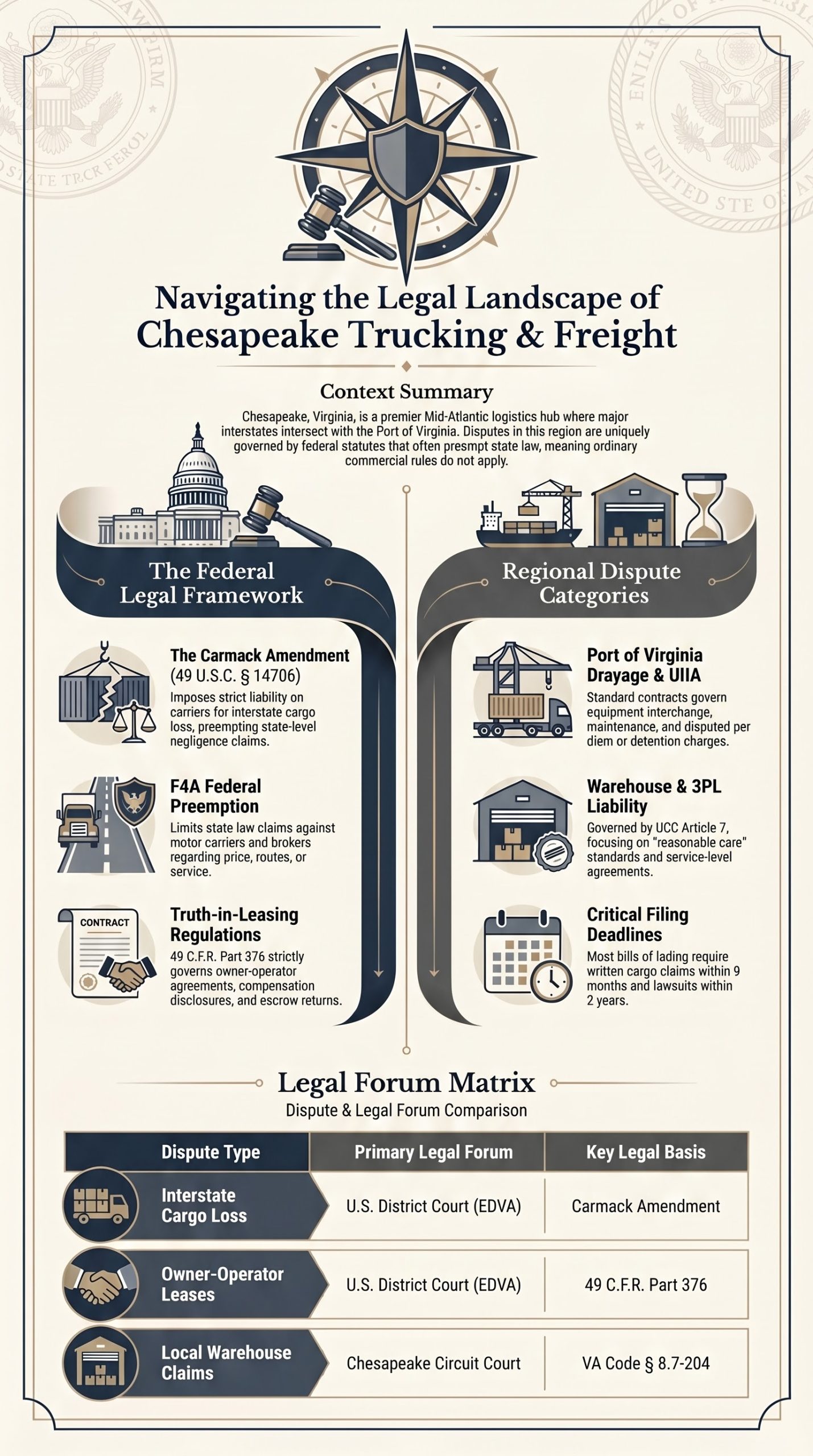
Table of Contents
- The Chesapeake Logistics and Trucking Environment
- The Carmack Amendment and Cargo Loss Claims
- Broker-Carrier Payment and Liability Disputes
- Port of Virginia Drayage and Intermodal Disputes
- Owner-Operator and Truth-in-Leasing Disputes
- FMCSA Compliance Issues That Become Contract Disputes
- Warehouse and Third-Party Logistics Contract Disputes
- How Shin Law Office Helps Chesapeake Trucking and Logistics Companies
- Summary
- Frequently Asked Questions
- References
Chapter 1: The Chesapeake Logistics and Trucking Environment
Chesapeake sits at the geographic and logistical center of Hampton Roads. The city covers more than 350 square miles, the second-largest land area of any independent city in Virginia, with the I-64 East-West corridor running across the northern half, I-664 connecting the Monitor-Merrimac Memorial Bridge-Tunnel to I-64 and I-264, I-464 providing direct access to Norfolk and the Port of Virginia terminals, and I-264 cutting east to Virginia Beach. US-17 and US-13 carry freight south through Suffolk into North Carolina and the Outer Banks. Few cities in the eastern United States offer this concentration of interstate access and port adjacency, and that combination has made Chesapeake one of the most active trucking and logistics markets in the Mid-Atlantic.
The city’s dominant operations reflect this geography. Drayage operators move containers between the Norfolk International Terminals, the Portsmouth Marine Terminal, the Virginia Inland Port at Front Royal, and shipper warehouses throughout Hampton Roads, with the bulk of the truck-side work staged out of Chesapeake yards. Distribution centers along Greenbrier Parkway, Battlefield Boulevard South, and the Centerville corridor support major retailers, e-commerce platforms, and third-party logistics providers. Long-haul carriers headquartered in Chesapeake run lanes north into the Northeast Corridor, west to the Midwest, and south to the Carolinas and Florida. Smaller operators handle local cartage, less-than-truckload (LTL) consolidation, and specialized services like flatbed, refrigerated, and hazardous materials transport.
The contract disputes arising from this ecosystem differ from those in other industries. Federal law preempts substantial portions of state contract law for motor carriers and brokers. The Carmack Amendment at 49 U.S.C. § 14706 controls cargo loss and damage claims for interstate shipments, displacing common law contract and tort theories. The Federal Aviation Administration Authorization Act of 1994, codified at 49 U.S.C. § 14501(c), preempts state laws “related to a price, route, or service of any motor carrier … or any motor private carrier, broker, or freight forwarder.” Truth-in-Leasing regulations at 49 C.F.R. Part 376 control the form and substance of agreements between motor carriers and owner-operators, with private rights of action under 49 U.S.C. § 14704 for noncompliance.
The court system that handles Chesapeake trucking disputes is split between state and federal forums. The Chesapeake Circuit Court (1st Judicial Circuit) and the Chesapeake General District Court both sit at the Chesapeake Judicial Center on Albemarle Drive. The U.S. District Court for the Eastern District of Virginia, Norfolk Division, handles federal cases at a rocket-docket pace that has made the EDVA famous among litigators. Carmack Amendment claims and most broker-carrier preemption disputes belong in federal court, while many state law contract claims and lien disputes proceed in state court. The choice of forum often turns on whether the federal preemption framework applies and whether the amount in controversy supports diversity jurisdiction.
For carriers and shippers operating across multiple jurisdictions, the federal framework brings predictability that pure state-law disputes do not. The same Carmack rules apply in Virginia, North Carolina, Pennsylvania, and every other state. The same FMCSA regulations govern interstate operations regardless of where the truck is registered or where the shipper is located. That uniformity is part of why federal preemption was adopted in the first place. For Chesapeake operators in particular, the federal framework reduces the risk of being whipsawed between state law variations on a multi-state run.
Chapter 2: The Carmack Amendment and Cargo Loss Claims
The Carmack Amendment, enacted in 1906 and now codified at 49 U.S.C. § 14706, governs liability for loss, damage, or delay to cargo on interstate shipments by motor carrier. The statute imposes strict liability on the carrier for actual loss or injury to the property, subject to a narrow set of common-law defenses (act of God, act of the public enemy, act of the shipper, act of public authority, and inherent vice or nature of the goods). Liability runs to the person entitled to recover under the bill of lading, regardless of which carrier in a multi-leg transit caused the harm.
Chesapeake carriers and shippers face Carmack issues in several recurring patterns. Cargo loss in transit due to theft from yards or rest areas. Damage to refrigerated loads when reefer units fail. Container damage during drayage from the port to the shipper’s warehouse. Pilferage of high-value loads, particularly electronics, pharmaceuticals, and consumer goods. Damage to industrial equipment and oversized loads where rigging or securement failed. Each of these scenarios gives rise to a Carmack claim if the shipment is interstate and the carrier had custody at the time of the loss.
Limited liability provisions complicate the analysis. Carriers can limit their Carmack liability under 49 U.S.C. § 14706(c) by establishing released value rates, with the shipper choosing between full-value coverage at higher rates and limited-value coverage at lower rates. The limitation is enforceable only when the carrier complies with specific procedural requirements, including providing the shipper with a reasonable opportunity to choose between rates and obtaining the shipper’s agreement on the limitation. Shippers who later discover the carrier did not follow the released value procedures can challenge the limitation and recover the full value of the loss.
Notice and limitations periods are strict. The bill of lading typically establishes a 9-month period for filing a written claim with the carrier and a 2-year period for commencing suit. These periods are minimums under federal regulation; the carrier cannot shorten them, but the bill of lading often matches them precisely. Failure to file a written claim within the contractual period is generally a complete defense, regardless of the underlying merits. Shippers who learn of damage but delay filing while pursuing informal resolution often find the limitations defense closes the door.
Federal preemption is the second major Carmack issue. Federal courts have consistently held that the Carmack Amendment preempts state law tort and contract claims arising from interstate cargo loss. Shippers cannot avoid the federal framework by pleading negligence, breach of contract, or Virginia Consumer Protection Act claims for the same underlying cargo damage. Connecting carrier liability under 49 U.S.C. § 14706(a)(2) extends responsibility through the chain when multiple carriers handle the shipment. Determining which carrier had custody at the time of the loss drives the practical recovery analysis.
A common Chesapeake Carmack pitfall:
Shippers often assume the cargo insurance carrier handles claims and the shipper does nothing. Insurance subrogation works only if the underlying claim against the trucking carrier is preserved. Late notice or failure to file a written claim can defeat both the shipper’s direct recovery and the insurer’s subrogation claim. Document the loss, file the written claim within the bill of lading period, and coordinate with the cargo insurer rather than assuming one will follow the other.
Chapter 3: Broker-Carrier Payment and Liability Disputes
The relationship between property brokers and motor carriers gives rise to a distinct category of disputes. Property brokers arrange transportation for shippers without taking direct possession of the freight. They contract with motor carriers to perform the actual movement, typically charging the shipper a higher rate than they pay the carrier and keeping the difference. The structure works smoothly when everyone gets paid on time. When the broker fails to pay the carrier, the shipper does not pay the broker, or a cargo claim arises involving all three parties, the disputes that follow turn on which legal framework applies.
Broker-carrier payment disputes are common. The broker collects the shipper’s payment, then delays remittance to the carrier or fails to pay altogether. The carrier’s options depend on the structure of the underlying contracts. Most broker-carrier agreements include a non-recourse provision under which the carrier looks only to the broker for payment, not to the shipper. When the broker becomes insolvent, the carrier may have no direct claim against the shipper, even though the shipper has not paid for the freight movement. Some broker-carrier agreements preserve direct shipper liability when the broker fails to remit, but the language must be clear.
The shipper’s protection against double payment is the second major issue. A shipper that paid the broker, only to find the broker did not pay the carrier, faces a potential claim from the carrier directly. Federal law provides limited but important protection. Where the shipper has paid the broker in full and the broker absconds with the funds, the shipper generally is not liable to the carrier for the same charges, provided the shipper acted in good faith and the broker had apparent authority to collect. The doctrine of double payment relief, articulated in cases such as Oak Harbor Freight Lines, Inc. v. Sears Roebuck & Co., and similar federal authority, protects shippers against unfair recovery by carriers in this scenario.
Broker liability for cargo loss is the third recurring issue. The Carmack Amendment imposes strict liability on motor carriers but does not directly apply to property brokers. A broker who simply arranges transportation is not a Carmack “carrier” and is not liable under the strict liability framework. Brokers can be liable on negligence theories when they failed to exercise reasonable care in selecting the motor carrier, particularly for high-value loads. Federal courts have developed a body of case law on broker negligence, with the analysis turning on what the broker knew about the carrier’s safety record, financial condition, and operational capacity at the time of selection.
Federal preemption under 49 U.S.C. § 14501(c) limits state-law claims against brokers, but its scope is contested. Recent federal court decisions, including the Eleventh Circuit’s analysis in Aspen American Insurance Co. v. Landstar Ranger, Inc. and similar cases, have addressed whether negligence claims against brokers for inadequate carrier vetting fall within the F4A’s safety regulatory exception. The legal landscape continues to develop, and Chesapeake brokers and shippers should evaluate the current state of federal preemption when claims involving broker negligence arise.
Chapter 4: Port of Virginia Drayage and Intermodal Disputes
The Port of Virginia is the third-largest container port on the East Coast, processing more than three million TEUs (twenty-foot equivalent units) per year through Norfolk International Terminals, Virginia International Gateway, and the Portsmouth Marine Terminal. The drayage operations that move containers between the port and inland destinations run primarily through Chesapeake yards and Chesapeake-based motor carriers. Intermodal disputes are a constant background reality for these operators.
The Uniform Intermodal Interchange and Facilities Access Agreement (UIIA) is the standard contract governing the relationship between motor carriers and equipment-providing parties (typically ocean carriers, leasing companies, or rail carriers). The UIIA addresses container interchange, equipment maintenance, damage allocation, per diem charges, demurrage, and detention. Disputes arise constantly over per diem charges, demurrage assessed when containers sit at terminals beyond free time, detention charges for chassis or container time at shipper warehouses, and damage allocation when containers come off the ship damaged or are damaged during inland transit.
Per diem and detention disputes have intensified since the Federal Maritime Commission’s 2020 Interpretive Rule on demurrage and detention practices, which clarified that charges must serve their intended purpose of incentivizing efficient cargo movement and equipment use. Charges that bill carriers or shippers during periods when cargo cannot actually move (terminal congestion, weather closures, equipment unavailability) are challenging under the federal framework. The Ocean Shipping Reform Act of 2022 strengthened these protections and created clearer enforcement mechanisms through the FMC.
Container damage allocation disputes are another recurring pattern. A container arrives at the port with prior damage that was not noted at terminal pickup. The motor carrier hauls it to the shipper, where the damage is discovered. The ocean carrier or container lessor pursues the motor carrier for the damage. The motor carrier insists the damage was preexisting. Resolution depends on the interchange documentation. The interchange receipt at terminal pickup should note any visible damage. Carriers who fail to document damage at pickup can find themselves responsible for damage that was actually caused by the prior chain of custody.
Operational disputes with terminal operators round out the drayage category. Terminal congestion, gate appointment systems, container availability, and TWIC card access at marine terminals all create friction between motor carriers and terminal operators. Most of these issues resolve through operational channels, but occasionally a substantial financial impact pushes a dispute toward litigation. Federal jurisdiction often follows when the dispute involves an interstate or international shipment and federal regulations apply.
Chapter 5: Owner-Operator and Truth-in-Leasing Disputes
Many Chesapeake motor carriers operate using owner-operator drivers, who own their tractors and lease them to the carrier under a contractual arrangement. The relationship is governed by the Truth-in-Leasing regulations at 49 C.F.R. Part 376, which the FMCSA enforces. The regulations govern the form and substance of the lease, disclosure obligations, compensation calculations, and escrow funds. Noncompliance creates private rights of action under 49 U.S.C. § 14704 with statutory damages and attorney’s fees recoverable.
Required lease provisions under 49 C.F.R. § 376.12 include clear identification of the parties, the equipment, the duration of the lease, the compensation arrangement, the responsibilities for fuel and insurance, and the procedures for handling chargebacks against the owner-operator’s pay. Carriers who use ambiguous or incomplete lease forms create exposure that surfaces when the relationship ends or a dispute arises. The regulations specifically prohibit certain practices, including chargebacks for items not specifically authorized in the lease, and require itemized settlement statements showing how compensation was calculated.
Escrow fund disputes are a frequent category. Many carriers require owner-operators to maintain an escrow fund as security for lease performance, with deductions from each settlement until the escrow reaches the contractually required amount. The Truth-in-Leasing regulations restrict how these funds can be used and require accounting and timely return when the lease terminates. Carriers who delay return of escrow funds, deduct unauthorized chargebacks, or fail to provide required accounting face statutory remedies that include the wrongfully retained amounts plus attorney’s fees.
Independent contractor classification is the third major issue. The owner-operator relationship is structured as an independent contractor arrangement, not employment. Federal and state misclassification challenges have intensified in recent years, with various jurisdictions adopting different tests for whether a worker is properly classified. Virginia has not adopted the strict ABC test that California uses under AB-5, but the federal Department of Labor’s classification analysis still applies for federal wage-and-hour purposes. Carriers operating in Chesapeake should evaluate their owner-operator arrangements against current federal standards, particularly the 2024 Department of Labor rule on independent contractor classification.
Lease-purchase programs add another complexity. Some carriers offer programs in which the owner-operator can purchase the equipment over time through deductions from settlement pay. These programs have produced significant litigation, including class action settlements involving major carriers, when the structure resulted in negative equity for the operator after years of payments. Programs structured to comply with federal regulations and to provide genuine ownership opportunities are defensible. Programs that primarily transfer financial risk to the operator, without a realistic path to ownership, are increasingly subject to legal scrutiny.
Chapter 6: FMCSA Compliance Issues That Become Contract Disputes
FMCSA compliance is primarily a regulatory matter, but compliance failures often surface as contract disputes when shippers, brokers, or insurers argue that the noncompliance excuses payment, voids coverage, or creates indemnity obligations. Operating authority lapses, insurance lapses, safety rating downgrades, and hours-of-service violations all create potential contract consequences beyond the regulatory penalty.
Operating authority lapses are particularly damaging. A motor carrier whose MC number is suspended for any reason, even briefly, faces broker contracts that automatically void coverage during the lapse period and shipper contracts that may treat the lapse as a material breach. Carriers should monitor their FMCSA registration status closely and address any compliance issues before they ripen into authority lapses. When a lapse does occur, the carrier should immediately notify affected counterparties and document the resolution.
Insurance lapses are similarly serious. Federal regulations require motor carriers to maintain BMC-91 or BMC-91X cargo insurance and BMC-32 or BMC-34 liability coverage at specified minimum levels. A lapse triggers automatic notice to the FMCSA and exposes the broker to penalties under contracts that require continuous insurance verification. Insurance disputes between carriers and their insurers over coverage limits, exclusions, and deductibles overlay regulatory requirements. Carriers facing insurance disputes should document the timelines for premium payments, coverage notifications, and any communications with the insurer regarding lapses or reinstatement.
Safety rating issues affect contract performance even when no specific violation occurs. The FMCSA’s Compliance, Safety, Accountability (CSA) program tracks carrier performance across seven Behavior Analysis and Safety Improvement Categories (BASICs), and elevated scores in these categories can affect the carrier’s ability to obtain favorable rates, win shipper contracts, or maintain broker relationships. Some shipper contracts include minimum safety rating requirements as a condition of continued business. Carriers whose CSA scores deteriorate may face contract termination on these grounds, with the dispute turning on whether the rating change constituted a material breach.
Hours-of-service violations rarely create contract disputes on their own, but they often overlap with cargo loss claims and accident-related issues. A carrier whose driver was over hours when an accident or cargo loss occurred faces enhanced exposure on both regulatory and civil fronts. Plaintiffs in cargo and personal injury cases routinely subpoena ELD records to demonstrate hours violations as part of the negligence theory. Carriers should maintain ELD compliance not only for regulatory purposes but also as a foundational risk management measure.
Chapter 7: Warehouse and Third-Party Logistics Contract Disputes
Many Chesapeake operations extend beyond pure trucking into warehousing and third-party logistics services. Distribution centers along Greenbrier Parkway, Battlefield Boulevard, and the Centerville corridor handle inventory, pick-and-pack operations, kitting, value-added services, and distribution to retail and e-commerce customers. The contract disputes arising from these operations follow different legal frameworks than those in pure motor carrier disputes.
Warehouse operator liability is governed primarily by Article 7 of the Uniform Commercial Code, codified in Virginia at Va. Code § 8.7-204. The warehouseman’s standard of care is reasonable care under the circumstances, and the warehouse receipt establishes the terms of bailment. Disputes commonly involve inventory shortages, damage to stored goods, claims for theft from the facility, and disputes over the calculation of storage charges. The warehouse receipt’s limitation-of-liability provisions are generally enforceable when properly disclosed, but they cannot be unconscionable or defeat the basic obligation of reasonable care.
Third-party logistics agreements are more complex than basic warehouse contracts. A 3PL provider may handle receiving, storage, inventory management, order fulfillment, transportation arrangements, returns processing, and value-added services for a customer. The contract typically runs to dozens of pages and addresses service level agreements, key performance indicators, capacity commitments, technology integration, and detailed pricing structures. Disputes arise over SLA failures, capacity disputes during peak seasons, technology integration problems, and pricing disagreements when actual volumes deviate from forecasts.
Service Level Agreement disputes deserve specific attention. SLA terms typically establish targets for order accuracy, pick speed, shipping cutoffs, inventory accuracy, and other metrics, with penalties for failing to meet them. The penalties are sometimes capped at a small percentage of the monthly fee, which creates a disincentive for customers to enforce the SLA seriously. Customers facing chronic SLA failures often need to pursue broader breach-of-contract theories rather than relying solely on the SLA penalty schedule. Termination rights, if properly preserved, can produce a stronger negotiating position than the limited SLA recovery.
Capacity disputes during peak seasons surface most often around Black Friday, Cyber Monday, and the holiday shopping ramp-up. A 3PL that commits to capacity for a customer’s peak volume but cannot actually meet demand causes substantial harm to the customer, including lost sales, expedited shipping costs to alternative fulfillment paths, and damaged customer relationships. The contract’s capacity commitment language and force majeure provisions drive the analysis. Customers should evaluate capacity contracts before peak season and document any indications that the 3PL is unable to meet commitments, while alternative arrangements remain feasible.
Chapter 8: How Shin Law Office Helps Chesapeake Trucking and Logistics Companies
Shin Law Office represents motor carriers, brokers, shippers, owner-operators, and 3PL providers across Virginia, including Chesapeake, the Hampton Roads region, and Northern Virginia. As a Virginia-licensed attorney, I represent clients in Virginia state courts and in the U.S. District Court for the Eastern District of Virginia, including the Norfolk Division. The full range of our work is described on our civil litigation practice page.
Trucking and logistics cases require attention to the federal preemption framework, which governs many substantive issues. The first review of any matter involves identifying which federal statutes apply (Carmack, F4A, Truth-in-Leasing), what state law is preempted, and what remains subject to Virginia common law. This analysis often determines the proper forum, the applicable statute of limitations, and the available remedies. Cases that begin in state court sometimes get removed to federal court when the federal questions become apparent, and cases that begin in federal court sometimes settle on terms that account for the substantial fee shifting available under federal statutes.
Many trucking disputes are resolved before litigation. A demand letter that cites the Carmack Amendment, attaches the bill of lading, identifies the loss with specificity, and calculates damages under the released value or full value framework often produces a settlement offer within 30 to 60 days. Broker-carrier payment disputes are frequently resolved through demand letters that cite the underlying broker-carrier agreement and the applicable federal preemption framework. Truth-in-Leasing escrow disputes are resolved when the carrier sees the statutory damages and attorney’s fees exposure under 49 U.S.C. § 14704.
When litigation is necessary, the choice of forum matters significantly. Carmack Amendment cases generally belong in federal court when the amount in controversy supports federal jurisdiction. Owner-operator Truth-in-Leasing cases similarly belong in federal court, given the federal statutory framework. Pure state-law contract disputes over commissions, warehouse charges, or service-level agreements typically belong in the Chesapeake Circuit Court (1st Judicial Circuit) or the General District Court for smaller amounts. The EDVA Norfolk Division’s rocket docket pace can be advantageous for plaintiffs with strong cases and challenging for defendants who need time to develop a defense.
Discovery in trucking cases focuses on the specific records that determine liability and damages. Bill of lading documents, delivery receipts, dispatch records, ELD data, terminal interchange records, and broker-carrier rate confirmations all establish what actually happened during a shipment. In owner-operator cases, the lease itself, the settlement statements, and the escrow accounting drive the analysis. We use targeted depositions and document requests to build the record without unnecessary expense, with the goal of producing a clear, focused case for resolution or trial.
Most trucking and logistics disputes settle once discovery has clarified the facts and the damages exposure. When a settlement is not possible, we try the case. I have represented clients in bench trials and jury trials across Virginia, and I prepare every case as if it will go to trial. The work is detailed, technical, and demanding. That is what tough cases require, and that is what we do.
Summary
Trucking, drayage, and freight contract disputes in Chesapeake are governed by a federal regulatory framework that preempts most state law and shapes the remedies available. The Carmack Amendment governs interstate cargo loss with strict carrier liability and contractually established notice and limitations periods. The F4A preempts state law claims related to motor carrier prices, routes, and services. Truth-in-Leasing regulations govern owner-operator agreements, providing private rights of action and statutory damages. Port of Virginia drayage operations involve their own ecosystem of UIIA disputes, per diem and detention claims, and container damage allocation issues. Warehouse and 3PL operations sit under UCC Article 7 and complex service-level contracts that produce their own dispute patterns.
Three principles apply across every category of dispute discussed in this guide. First, the federal framework matters. Operators who treat trucking disputes as ordinary commercial disputes miss the federal preemption framework that controls many substantive and procedural issues. Second, documentation matters. Bills of lading, interchange receipts, ELD data, settlement statements, and broker rate confirmations all establish the underlying facts. Operators who maintain disciplined documentation practices win cases that operators with sloppy records lose. Third, deadlines matter. The 9-month written claim period, the 2-year suit period, the 30-day removal window, and the various FMCSA procedural deadlines all run on schedules that are not generous. Acting early preserves options that close quickly when deadlines pass.
If you operate a trucking, brokerage, drayage, warehouse, or 3PL business in Chesapeake or the broader Hampton Roads region, do not wait for a dispute to clarify itself. Get a lawyer involved early, when the evidence is fresh and the federal procedural options are still open.
Frequently Asked Questions
How long do I have to file a Carmack Amendment cargo claim against a Chesapeake motor carrier?
The bill of lading typically establishes a 9-month period for filing a written claim with the carrier and a 2-year period for commencing suit, measured from the date the carrier denies the claim. These are minimums under federal regulation; the carrier cannot shorten them. Failure to file the written claim within the bill of lading period is generally a complete defense, regardless of the underlying merits.
Does the Carmack Amendment apply to intrastate shipments within Virginia?
No. The Carmack Amendment applies to interstate shipments. Intrastate shipments are governed by state law, primarily Virginia common law and applicable UCC provisions. Many Chesapeake operations involve interstate movements (port-to-inland points outside Virginia, or inland origins outside Virginia to Hampton Roads destinations), so Carmack often applies. Pure intrastate Virginia movements are governed by state law.
My Chesapeake broker did not pay me for completed loads. Can I sue the shipper directly?
It depends on the broker-carrier agreement and the shipper’s involvement. Many broker-carrier agreements include non-recourse provisions that limit the carrier to claims against the broker. Where the shipper has paid the broker in good faith, the shipper generally is not liable to the carrier for the same charges. Carriers facing broker payment defaults should review the underlying agreements and the broker’s apparent authority before pursuing the shipper.
Are property brokers liable for cargo loss in Chesapeake-arranged shipments?
Property brokers are generally not Carmack carriers and not liable under the Carmack Amendment’s strict liability framework. Brokers may face negligence liability for failing to exercise reasonable care in selecting a carrier, particularly for high-value loads. Federal preemption under 49 U.S.C. § 14501(c) limits state law claims against brokers, but the scope of preemption is contested in current federal litigation.
What is the difference between Truth-in-Leasing and a regular owner-operator contract?
Truth-in-Leasing regulations at 49 C.F.R. Part 376 establish federal requirements for the form and substance of agreements between motor carriers and owner-operators in interstate commerce. The regulations require specific lease provisions, prohibit certain chargebacks, mandate itemized settlement statements, and govern escrow fund handling. A regular owner-operator contract that does not comply with federal requirements creates federal violations with private rights of action under 49 U.S.C. § 14704.
My Chesapeake carrier withheld escrow funds after I terminated my owner-operator lease. What can I do?
Truth-in-Leasing regulations require the timely return of escrow funds upon lease termination, with detailed accounting of any deductions. Carriers who fail to return escrow within the required period or who deduct unauthorized chargebacks face statutory damages and attorney’s fees recoverable under 49 U.S.C. § 14704. Document the lease termination, request the escrow return in writing, and consult counsel if the carrier does not comply within a reasonable time.
What is per diem and detention, and when can I dispute the charges from Port of Virginia drayage?
Per diem and detention are charges assessed when containers, chassis, or trailers remain in possession beyond contractually allowed free time. The Federal Maritime Commission’s 2020 Interpretive Rule and the Ocean Shipping Reform Act of 2022 established that these charges must serve their intended purpose of incentivizing efficient cargo movement. Charges assessed during periods when cargo cannot actually move (terminal congestion, weather, equipment unavailability) face a challenge under federal law.
My 3PL provider in Chesapeake missed peak season SLAs. What are my remedies?
Start with the SLA penalty schedule in the contract, which typically caps recovery at a percentage of monthly fees. For substantial peak season failures, broader breach-of-contract theories often yield stronger recoveries, including consequential damages for lost sales and expedited shipping costs for alternative fulfillment paths. Termination rights, if properly preserved in the contract, can produce significant negotiating position. The specific contract language drives the analysis.
Where do I file a trucking lawsuit involving Chesapeake operations?
For Carmack Amendment claims and federal regulatory disputes, the U.S. District Court for the Eastern District of Virginia, Norfolk Division. For state law contract disputes up to $25,000, the Chesapeake General District Court. For state law contract disputes over $25,000 or for equitable relief, the Chesapeake Circuit Court (1st Judicial Circuit) at the Chesapeake Judicial Center. The choice often depends on whether federal preemption applies and the amount in controversy.
Are warehouse operator limitation of liability provisions enforceable in Virginia?
Generally yes, when properly disclosed in the warehouse receipt. Article 7 of the UCC, codified at Va. Code § 8.7-204, governs warehouse operator liability and permits limitations of liability. The limitation cannot defeat the basic obligation of reasonable care, and unconscionable limitations may be set aside. Disputes turn on whether the customer had notice of the limitation and whether the limitation amount is reasonable in light of the value of the stored goods.
Facing a Chesapeake Trucking or Freight Contract Dispute?
Whether you are a Chesapeake motor carrier with a Carmack cargo loss claim, a broker dealing with a payment default, an owner-operator pursuing escrow funds under Truth-in-Leasing, a shipper facing per diem charges from Port of Virginia drayage, or a 3PL customer dealing with peak season SLA failures, you deserve a Virginia attorney who understands the federal preemption framework that controls these disputes.
Tough cases require tough attorneys. Shin Law Office handles trucking, drayage, and freight contract disputes across the Commonwealth, including Chesapeake, Virginia Beach, Norfolk, and the broader Hampton Roads region.
Call 571-445-6565 or book your case review online at shinlawoffice.com/meet-our-team/contact

References
Carmack Amendment, 49 U.S.C. § 14706. https://www.govinfo.gov/app/collection/uscode
Federal Aviation Administration Authorization Act preemption, 49 U.S.C. § 14501. https://www.govinfo.gov/app/collection/uscode
Civil rights of action under federal motor carrier statutes, 49 U.S.C. § 14704. https://www.govinfo.gov/app/collection/uscode
Truth-in-Leasing regulations, 49 C.F.R. Part 376. https://www.ecfr.gov/current/title-49/subtitle-B/chapter-III/subchapter-B/part-376
Federal Motor Carrier Safety Administration. (2024). Compliance, Safety, Accountability program. https://csa.fmcsa.dot.gov/
Federal Maritime Commission. (2020). Interpretive Rule on demurrage and detention under the Shipping Act. https://www.fmc.gov/
Ocean Shipping Reform Act of 2022, Public Law 117-146. https://www.govinfo.gov/app/collection/plaw
U.S. Department of Labor. (2024). Employee or independent contractor classification under the Fair Labor Standards Act, final rule. https://www.dol.gov/agencies/whd/flsa/misclassification/rulemaking
Code of Virginia. (2024). Title 8.7: Warehouse Receipts, Bills of Lading, and Other Documents of Title. Virginia General Assembly. https://law.lis.virginia.gov/vacode/title8.7/
Code of Virginia. (2024). Title 8.01, Chapter 4: Limitations of actions. Virginia General Assembly. https://law.lis.virginia.gov/vacode/title8.01/chapter4/
Intermodal Association of North America. (2024). Uniform Intermodal Interchange and Facilities Access Agreement (UIIA). https://www.uiia.org/
Virginia Port Authority. (2024). About the Port of Virginia. https://www.portofvirginia.com/
Chesapeake Circuit Court. (2024). First Judicial Circuit of Virginia. City of Chesapeake. https://www.cityofchesapeake.net/government/city-departments/departments/circuit-court.htm
U.S. District Court for the Eastern District of Virginia. (2024). Norfolk Division. https://www.vaed.uscourts.gov/
Oak Harbor Freight Lines, Inc. v. Sears Roebuck & Co., 513 F.3d 949 (9th Cir. 2008).
Aspen American Insurance Co. v. Landstar Ranger, Inc., 65 F.4th 1261 (11th Cir. 2023).
