
Bottom Line Up Front (BLUF)
As a business attorney in Fairfax County, I’ll tell you the key difference plainly: a breach of contract is when someone fails to fulfill a promise in an agreement, whereas business fraud involves a deliberate lie or concealment of a fact that causes harm, separate from the contract itself. This distinction matters because Virginia law (and our Fairfax courts) treat these cases very differently – fraud is harder to prove but can lead to punitive damages and other remedies that a simple contract claim cannot. In short, not every broken promise constitutes fraud, and labeling a contract dispute as “fraud” when it’s not can lead to early dismissal of the claim. Knowing the difference helps business owners pursue the right legal strategy in Fairfax County’s courts.
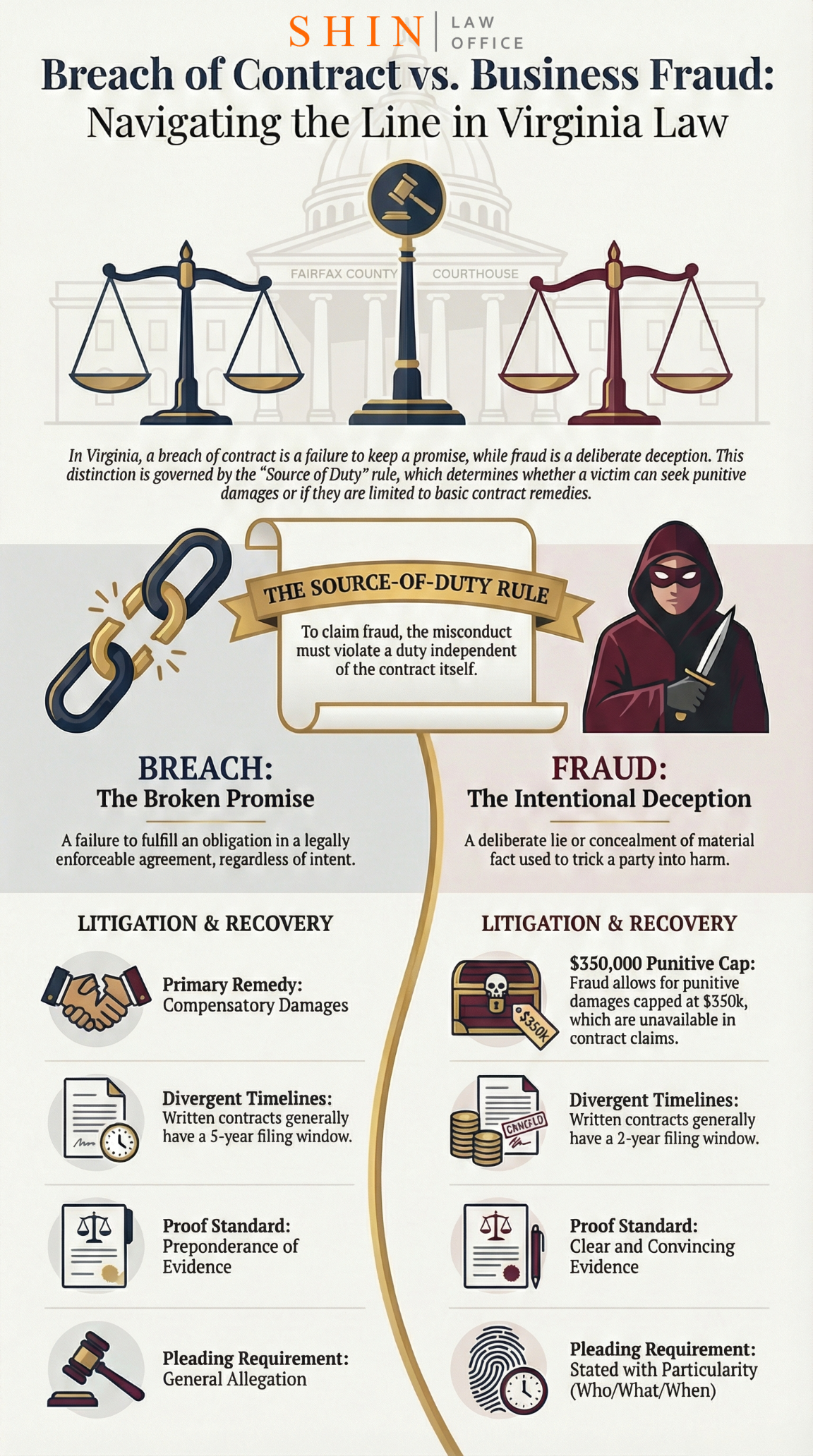
Table of Contents
Chapter 1: Understanding the Legal Basics of Contracts
Chapter 2: What Constitutes Business Fraud in Virginia
Chapter 3: How Misrepresentation and Concealment Turn a Contract Breach into a Tort
Chapter 4: Why This Distinction Matters in Fairfax County Courts
Chapter 5: Practical Examples from Real-World Disputes
Chapter 6: What Business Owners Should Do if They Suspect Fraud
References
Chapter 1: Understanding the Legal Basics of Contracts
I’m a Fairfax County attorney, and I’ve seen firsthand how a breach of contract can throw a business into turmoil. A contract is a legally enforceable agreement – essentially, a set of promises the law will uphold. Breach of contract means one party failed to fulfill their end of the bargain or interfered with the other’s performance.
To sue for breach of contract in Virginia, you generally must prove three things: (1) a valid contract existed, (2) the other party broke a promise or obligation under that contract, and (3) you suffered harm or damages because of that breach. Virginia courts will enforce contracts as written, and Fairfax judges are known to read the fine print and hold parties to their agreed terms. Importantly, a breach does not require proving ill intent – even an honest mistake can constitute a breach if it violates the contract.
Not all breaches are equal. A minor breach might be a slight delay or a trivial deviation that doesn’t defeat the contract’s main purpose. A material breach is a serious failure that goes to the heart of the deal, freeing the non-breaching party from further obligations. Virginia follows the “first material breach” rule: a party that commits a material breach can’t enforce the contract against the other side.
Remedies for breach aim to make the injured party whole. You can typically recover compensatory damages for direct losses and sometimes consequential damages for downstream losses that were foreseeable. What you generally cannot get for a pure breach of contract in Virginia is punitive damages – the law doesn’t punish breaching a contract, because a breach isn’t a crime or an independent tort by itself.
Chapter 2: What Constitutes Business Fraud in Virginia
Business fraud is a game-changer in a legal dispute. Unlike breach of contract, which simply violates a promise between the parties, fraud is a tort – a civil wrong based on a violation of common law duty not to deceive. In plain English, fraud means one party lied or concealed a material fact, with the intent to trick the other party, and that lie caused damage. Virginia courts have well-established elements that you must prove to succeed on a fraud claim:
- False Representation: The defendant made a false statement of present or past fact. It can also include hiding or concealing a fact when there was a duty to speak.
- Material Fact: The false statement was about something material – an important fact that a reasonable person would rely on in making a decision.
- Knowledge of Falsity: The person making the statement knew it was false, or at least made it with reckless disregard for the truth.
- Intent to Mislead: They made the misrepresentation intentionally, specifically to induce the other party to rely on it.
- Reliance: The victim actually relied on the false statement, and their reliance was reasonable under the circumstances.
- Resulting Damage: The falsehood caused measurable harm. No harm, no fraud claim.
Virginia’s Supreme Court has reiterated this six-part test many times. All six elements must be proven; miss one and the fraud claim fails. Additionally, fraud must be proven by “clear and convincing” evidence, a higher standard than the preponderance of the evidence in civil cases.
A few important nuances: The misrepresentation generally must be about a present or pre-existing fact, not just a promise of future action. If someone makes a promise and simply doesn’t keep it, that alone is not fraud – it’s a breach of contract. It becomes fraud only if you can show that, at the time the promise was made, the defendant never intended to perform (meaning the promise was a lie at the time it was made). Virginia courts are clear: a broken promise or prediction isn’t fraud unless there was present deceptive intent.
Chapter 3: How Misrepresentation and Concealment Turn a Contract Breach into a Tort
One of the most common questions I get is: “Can I sue for fraud and breach of contract together?” The answer is yes, but only under specific circumstances. Virginia law draws a line to prevent every breach of contract from being dressed up as a fraud claim. The legal test turns on the “source of duty” rule: to have a tort (fraud) claim alongside a contract claim, the falsehood or misconduct must violate a duty that exists independently of the contract.
Misrepresentations made during contract negotiations – before the contract is signed – are the classic example of an independent duty. Every party has a general duty not to commit fraud to induce someone into an agreement. So if someone lies about a material fact to get you to enter the deal, that duty to be truthful exists outside the contract. In that scenario, you can sue for breach of contract and for fraud (fraud in the inducement).
For example, imagine a Fairfax business is selling a commercial property and tells the buyer “our building’s occupancy rate is 95%” when in reality half the building is vacant. If the buyer relies on that lie and signs the contract, the seller has also violated a common-law duty not to deceive – which is a fraud tort. Virginia courts in Station #2, LLC v. Lynch (2010) and Abi-Najm v. Concord Condo. (2010) have permitted fraud claims to proceed alongside breach-of-contract claims when a party was alleged to have misrepresented facts before the contract was formed.
On the other hand, misrepresentations made after the contract is in place, about how the contract is being performed, usually do not give rise to a fraud claim if they are closely tied to the contract duties. The Supreme Court of Virginia drove this point home in Dunn Construction Co. v. Cloney (2009): the contractor’s false guarantee was about the performance of the contract itself – the lie was “entwined with the breach” and not an independent tort.
Chapter 4: Why This Distinction Matters in Fairfax County Courts
The breach vs. fraud distinction matters a great deal, both for legal strategy and outcomes. Fairfax County, being one of Virginia’s busiest commercial jurisdictions, sees its fair share of contract disputes and fraud allegations.
- Available Remedies and Damages: A breach of contract limits you to compensatory damages but no punitive damages. If you can establish fraud, you open the door to punitive damages (capped at $350,000 in Virginia), which can dramatically increase the stakes for the defendant.
- Burden of Proof and Litigation Hurdles: If you plead fraud, be prepared for a tougher fight at the outset. Fairfax judges often see defendants file demurrers targeting fraud counts that lack the required particularity.
- Credibility and Strategic Impact: In Fairfax, raising a fraud claim can send a strong signal – it essentially says “the other side didn’t just break a promise, they cheated.” This can put reputational pressure on a defendant and increase their exposure.
- Procedural and Court Considerations: If you layer on a fraud claim with a request for punitive damages, you’re likely pushing the case into Circuit Court for a jury trial and full discovery.
Chapter 5: Practical Examples from Real-World Disputes
- Example 1 – Simple Breach of Contract: You run a marketing firm in Fairfax. A client doesn’t pay on time after you deliver the agreed work. There’s no indication they lied to induce the contract; they just aren’t honoring the deal. Your remedy is to sue for breach, seek the fee owed plus any applicable interest.
- Example 2 – Fraudulent Inducement: You purchase a small IT company in Northern Virginia. The seller provides falsified financial statements showing $500,000 in annual revenue when it was actually $300,000. Here, you have more than just a disappointing deal; you were duped. You could sue for breach of the purchase agreement and for fraud, potentially allowing for punitive damages.
- Example 3 – Breach with Misrepresentation (No Independent Duty): You hire a contractor who uses cheaper materials but assures you they used the specified grade. Under Virginia’s source-of-duty rule, a court might treat this like Dunn: the duty to use specified materials was imposed by the contract, and the lie about it is essentially part of the contract breach, not a separate fraud.
- Example 4 – Concealment Leading to Fraud: A partner company hides a critical regulatory change to rush you into signing a contract. If they knew this information and had a duty to share it, Virginia courts have recognized that hiding a material fact can be as bad as lying.
Chapter 6: What Business Owners Should Do if They Suspect Fraud
If you’re a business owner in Fairfax County and you smell something fishy in a deal, you need to act promptly and prudently. Here’s my advice:
1. Preserve All Evidence: Document everything. Save emails, texts, contracts, invoices – any communication or paperwork related to the deal. Fraud cases often live or die on the paper trail and digital communications.
2. Don’t Take Their Word – Verify and Gather Facts: Once you suspect you’ve been lied to, start verifying claims independently. Retrace the promises made and see what evidence you can compile that those promises were false when made.
3. Consult a Business Attorney Early: Time is of the essence with fraud. In Virginia, the clock for fraud claims starts ticking when the fraud “is discovered or reasonably should have been discovered” – and it’s a 2-year statute of limitations in most cases.
4. Avoid Confrontational Self-Help: It’s natural to feel angry or betrayed if you suspect fraud. But be cautious in your initial response. Accusing the other party of fraud publicly or in writing without solid proof can lead to defamation claims.
5. Leverage Legal Tools in Discovery: If a lawsuit is filed, Virginia law and Fairfax procedures will allow discovery – the process of obtaining evidence from the other side. This can uncover internal emails, financial records, or other data that prove the fraud.
In summary, if you suspect fraud, act decisively but intelligently. Fairfax County offers a strong legal framework to address fraud, but the burden is on you as the claimant to navigate that framework effectively.
Part of Shin Law Office’s Northern Virginia Commercial Litigation Guide
This article connects to a broader guide on commercial contract disputes across the region. See the complete resource: When the Contract Breaks: The Northern Virginia Commercial Litigation Guide — covering B2B disputes, federal contracting, teaming agreements, construction claims, mechanic’s liens, and toxic torts across Loudoun, Fairfax, Prince William, Arlington, Clarke, and Frederick Counties.

Principal Attorney | Shin Law Office
Call 571-445-6565 or book a consultation online today.
(This article is provided for general informational purposes and does not constitute legal advice. For advice on your specific situation, consult with a licensed Virginia attorney.)
References
- Richmond Metropolitan Authority v. McDevitt Street Bovis, Inc., 256 Va. 553 (1998) – Source-of-duty rule.
- Dunn Construction Co. v. Cloney, 278 Va. 260 (2009) – Breach-entwined misrepresentation not actionable as separate fraud.
- Station #2, LLC v. Lynch, 280 Va. 166 (2010) – Fraudulent inducement actionable alongside breach of contract.
- Abi-Najm v. Concord Condominium, LLC, 280 Va. 350 (2010) – Pre-contract misrepresentations of existing facts support fraud claim.
- Evaluation Research Corp. v. Alequin, 247 Va. 143 (1994) – Six elements of actual fraud in Virginia.
- Va. Code Ann. § 8.01-246 (2024) – Statute of limitations for contracts.
- Va. Code Ann. § 8.01-38.1 (2024) – Cap on punitive damages ($350,000).