


By Anthony I. Shin, Esq. | Shin Law Office | Serving Vendors, Contractors, and Suppliers Across Virginia
BOTTOM LINE UP FRONT
The University of Virginia spends hundreds of millions of dollars per year on goods and services, ranging from construction and facilities work to research equipment, IT services, food service, professional consulting, and specialty supplies. The Virginia Public Procurement Act at Va. Code § 2.2-4300 et seq. governs most of these procurements. Vendors and contractors who do business with UVA operate under rules that differ significantly from those of ordinary commercial contracts. Sovereign immunity affects what claims can be filed and where. Bid protest procedures must be followed within tight deadlines. Payment claim procedures under Va. Code § 2.2-4363 requires specific written notice within strict time limits. The administrative process at UVA Procurement and Supplier Diversity Services often controls before any court hears the dispute.
This guide covers the VPPA framework for UVA vendor disputes, the limited sovereign immunity waiver for contract claims against the Commonwealth, the bid protest process, payment claim procedures, and the choice between administrative and judicial remedies. Call Shin Law Office at 571-445-6565.
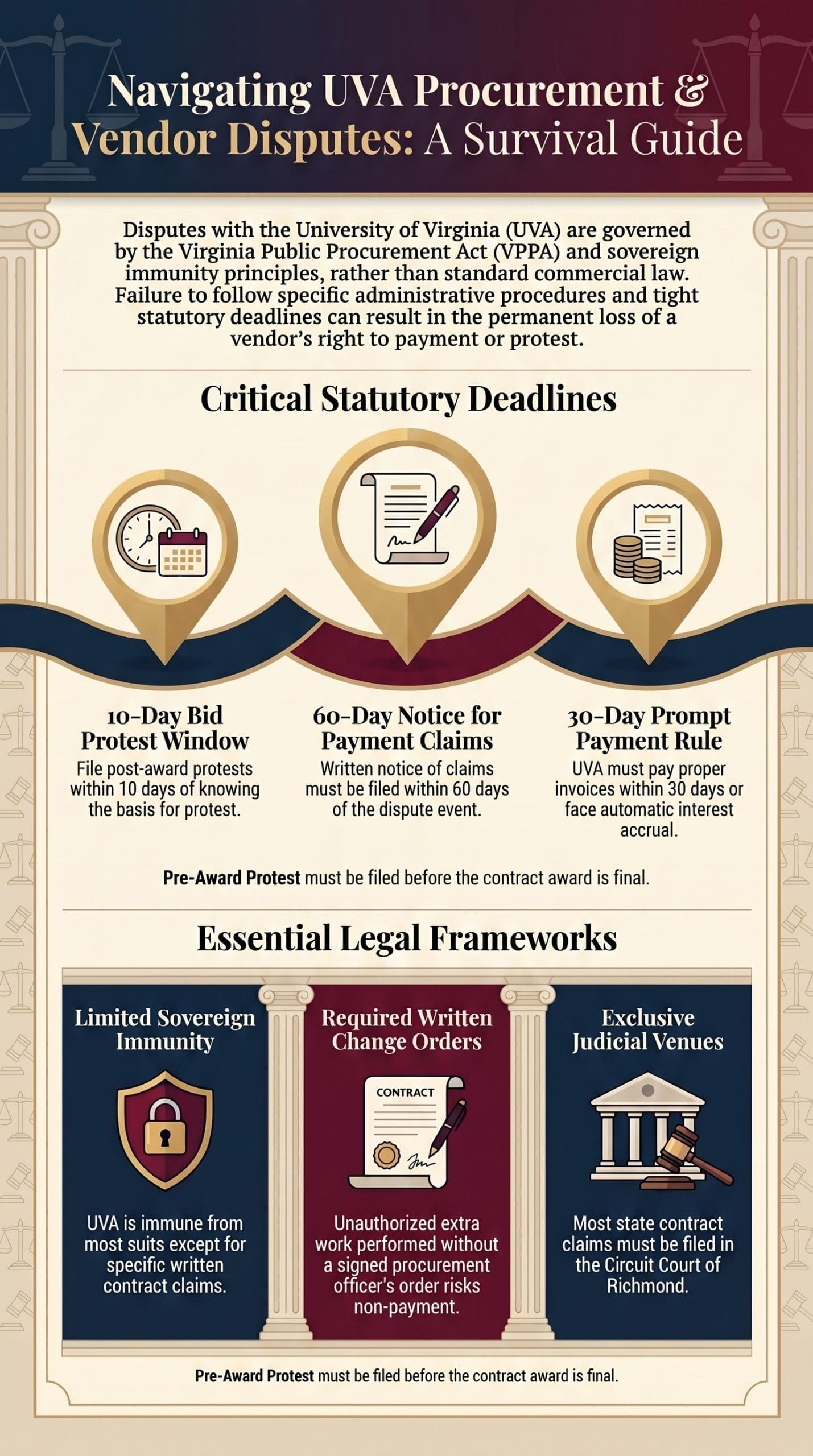
Table of Contents
- Why UVA Procurement Disputes Are Different
- The Virginia Public Procurement Act Framework
- Sovereign Immunity and Contract Claims Against UVA
- Bid Protest Procedures
- Payment Claims and Late Payment Issues
- Contract Modification, Termination, and Performance Disputes
- Choosing Between Administrative and Judicial Remedies
- How Shin Law Office Handles UVA Vendor Disputes
- Summary
- Frequently Asked Questions
- References
Chapter 1: Why UVA Procurement Disputes Are Different
The University of Virginia is the largest single purchaser of goods and services in the Charlottesville-Albemarle market and one of the largest in the entire Commonwealth. UVA’s annual procurement spend covers construction at the academic enterprise and the Health System, IT and software contracts that run into nine figures, food service operations across 17 dining locations, research equipment and laboratory supplies for thousands of grants, professional services for everything from architectural design to investment management, and specialty goods that no private buyer would ever procure at comparable scale. The vendors and contractors who serve this market range from international firms with dedicated higher education practices to small Charlottesville and Albemarle businesses that have served the University for decades.
When relationships with UVA work, they often produce stable revenue across multi-year contracts. When they break down, the resulting disputes look nothing like ordinary commercial contract litigation. UVA, as a public university chartered by the Commonwealth, operates under sovereign immunity principles that limit what claims can be filed and where. The Virginia Public Procurement Act creates specific procedures for solicitation, bid evaluation, contract award, and dispute resolution that displace ordinary commercial practice. Internal University procurement policies layered on top of the VPPA add another set of rules that vendors must navigate.
Vendors who treat UVA contract disputes like ordinary commercial cases miss several frameworks that often determine the outcome. The result is missed deadlines, lost rights, and unrecovered amounts that the proper procedure would have preserved. This guide walks through the substantive and procedural framework that controls these disputes, with particular attention to the deadlines and procedural requirements that close quickly. For broader context on how UVA-related contract disputes fit into the Charlottesville-Lynchburg corridor’s wider legal market, see our complete guide to contract disputes in the Charlottesville-Lynchburg corridor.
Chapter 2: The Virginia Public Procurement Act Framework
The Virginia Public Procurement Act, codified at Va. Code § 2.2-4300 et seq., establishes the statutory framework for purchasing by the Commonwealth and its agencies, including UVA. The Act addresses solicitation methods, bid evaluation, contract award, contract administration, and dispute resolution. UVA, as a Tier III restructured higher education institution under the 2005 Restructured Higher Education Financial and Administrative Operations Act, has greater flexibility within the VPPA framework than typical state agencies, but the core principles still apply.
Solicitation methods under the VPPA include competitive sealed bidding (the default for most goods and non-professional services contracts), competitive negotiation (for professional services and complex requirements), small purchase procedures (for transactions below threshold amounts), sole source procurement (when only one provider can meet the need), and emergency procurement (when delay would threaten public health, safety, or welfare). Each method has specific procedural requirements that the public body must follow, and material deviations can support a vendor protest.
Bid evaluation procedures vary by solicitation method. Competitive sealed bidding evaluates price and ability to perform, with the award typically going to the lowest responsive and responsible bidder. Competitive negotiation evaluates technical proposals against published criteria, often with cost as one factor among several. The evaluation process must be documented, the criteria must be applied consistently, and material deviations from published requirements can invalidate the award. Vendors who lose competitive procurements often have legitimate grievances about evaluation conduct, but the procedural deadlines for raising those grievances are short.
Contract administration provisions in the VPPA include requirements for change orders, modification procedures, performance bonds, payment bonds on construction contracts, and prompt payment standards. The prompt payment provisions at Va. Code § 2.2-4350 require state agencies to pay invoices within 30 days of receipt of a proper invoice or face interest accrual. UVA’s payment performance is generally strong, but disputes over what constitutes a proper invoice, when the receipt occurred, and whether deductions or withholdings are justified all generate vendor claims.
Dispute resolution procedures under the VPPA include both pre-award and post-award mechanisms. Pre-award disputes (bid protests) are governed at Va. Code § 2.2-4360. Post-award disputes generally proceed through the public body’s internal procedures first, then to administrative or judicial review, depending on the issue and the contract terms. The choice of forum often controls the practical outcome.
Chapter 3: Sovereign Immunity and Contract Claims Against UVA
UVA is an arm of the Commonwealth of Virginia and shares the Commonwealth’s sovereign immunity. The doctrine bars suit against the Commonwealth and its agencies except where immunity has been waived by statute. For contract claims, the General Assembly has waived immunity through specific provisions in the VPPA and through the general Commonwealth’s contractual capacity, but the waiver is not unlimited. Understanding what claims survive sovereign immunity is the threshold question in any UVA contract dispute.
The basic rule is that the Commonwealth can be sued on its written contracts in the manner provided by the contract or by statute. Most UVA procurement contracts include provisions that address dispute resolution, identify the venue for any litigation, and specify the procedures the parties must follow before filing suit. These provisions are generally enforceable. Vendors who fail to follow the contractual dispute resolution procedure risk dismissal even if the underlying claim has merit.
Sovereign immunity does not extend to UVA’s affiliated foundations, the UVA Health System Foundation, the UVA Investment Management Company, or the various other affiliated entities that operate alongside the academic enterprise. Vendors dealing with these entities operate under ordinary commercial contract principles, although the entities are closely connected to the University and may invoke privileges or defenses that surprise vendors who treat them as private parties. Contract claims against these entities follow the procedural rules applicable to private commercial disputes.
The Virginia Tort Claims Act notice provisions at Va. Code § 8.01-195.6 do not apply to contract claims, but vendors should be aware of related notice requirements that may apply. The 30-day pre-suit notice requirement of the Virginia Public Procurement Act for certain disputes, the contractual notice requirements that most procurement contracts include, and any specific notice provisions in the UVA terms and conditions all create deadlines that vendors miss at their peril. Documenting the date of any breach, the date the vendor learned of the breach, and the date written notice was provided to the procurement officer is essential to preserving the claim.
Punitive damages are not generally available in contract claims against the Commonwealth. Compensatory damages, breach of contract damages under Hadley v. Baxendale foreseeability rules, and contractually specified remedies are recoverable. Pre-judgment interest under Va. Code § 8.01-382 may apply at the court’s discretion. Attorney’s fees are recoverable only when the contract or a specific statute provides for them, which most state procurement contracts do not.
Chapter 4: Bid Protest Procedures
Vendors who lose competitive UVA procurements and believe the process was conducted improperly have two principal mechanisms for protest. The pre-award protest under Va. Code § 2.2-4360 challenges the conduct of the solicitation prior to award. The post-award protest under Va. Code § 2.2-4363 challenges the award decision after it is made. Both procedures have tight deadlines, and missing the window typically forecloses the protest.
Pre-award protests must be filed before the contract award is final, and the protest must identify the specific solicitation deficiency, the harm to the protesting vendor, and the relief sought. UVA Procurement and Supplier Diversity Services handles initial review. The procurement officer’s decision can be appealed to the head of the public body (typically a Vice President or designated officer) and, from there, to either administrative review or court action, depending on the contract terms and the nature of the protest.
Post-award protests must be filed within 10 days after the protesting vendor knew or should have known of the basis for the protest, and not later than the date the contract is awarded. The 10-day clock can be unforgiving. A vendor who learns of an evaluation issue at a debriefing meeting and waits to gather more information before filing often finds the deadline has passed. The wise practice is to file a preliminary protest within the deadline to preserve the issue, then supplement it as additional information becomes available.
Common bid protest grounds include solicitation requirements that improperly favored a particular vendor, evaluation criteria that were not consistently applied, scoring errors or miscalculations, conflicts of interest involving evaluators, late or non-compliant proposals from the awardee that should have been disqualified, and material deviations from solicitation requirements in the awardee’s proposal. Each ground requires specific factual support, and protest letters that simply complain about losing the procurement without identifying specific procedural defects rarely succeed.
Remedies for successful bid protests are limited. The protesting vendor may obtain an order setting aside the award and requiring re-solicitation or re-evaluation, recovery of bid preparation costs in some cases, and (rarely) lost profits if the case proceeds to court and the vendor can establish the elements. The remedies are not as broad as some vendors expect, and the cost of pursuing a protest can exceed the recoverable amount, even in a winning case. The strategic value of a protest is often as much about future procurements as about the immediate award.
Time matters more than people realize:
The 10-day post-award protest deadline runs from when the vendor knew or should have known of the basis for the protest. Vendors who request a debriefing, then take time to digest the information before deciding whether to protest, often discover that the clock has been running from the debriefing date. File a preliminary protest letter within the deadline to preserve the issue. The supplemental detail can come later.
Chapter 5: Payment Claims and Late Payment Issues
Most UVA vendor disputes that reach my office involve payment, not procurement. The vendor performed the work, submitted invoices, and either has not been paid or has had amounts deducted that the vendor believes were improper. The Virginia Public Procurement Act provides specific frameworks for these disputes that vendors must follow to preserve their claims.
Prompt payment requirements under Va. Code § 2.2-4350 require state agencies to pay invoices within 30 days of receipt of a proper invoice. The statute provides for interest accrual on late payments at the rate established by the State Comptroller. The interest provision is mechanical: payments not made within 30 days accrue interest, and vendors are entitled to claim that interest as part of their recovery. Many vendors do not pursue interest because the amounts seem small per invoice, but interest on chronic late payment over a multi-year contract can accumulate to substantial sums.
Disputed amounts and partial payments raise more complex issues. When UVA pays part of an invoice and disputes the rest, the vendor must decide whether to accept the partial payment as full satisfaction or preserve the right to pursue the disputed portion. Accord and satisfaction principles apply, and accepting a check labeled as full settlement of a disputed account can extinguish the vendor’s right to additional recovery. Vendors should consult counsel before depositing checks that include settlement language.
Withholding for performance issues is a recurring source of dispute. UVA contracts often allow withholding when the vendor fails to meet performance standards, deliverables are deficient, or corrective action is pending. The contractual basis for the withholding, the procedural steps that must be taken before withholding, and the documentation supporting the performance deficiency all matter. Vendors who face withholding should request the specific contractual basis and the supporting documentation in writing, then evaluate whether the withholding is justified.
Va. Code § 2.2-4363 establishes the procedure for vendor claims against state agencies. Claims must be submitted in writing to the procurement officer within 60 days of the event giving rise to the claim, and the procurement officer must issue a written decision within a reasonable time. The vendor can then appeal the decision through administrative channels or file suit in the Circuit Court for the City of Richmond, which has exclusive jurisdiction for many state agency contract claims, depending on the contract’s venue provisions and the type of claim.
Chapter 6: Contract Modification, Termination, and Performance Disputes
UVA contracts include change order procedures, modification provisions, and termination rights that affect the parties’ positions when scope or performance issues arise. Vendors who navigate these provisions well preserve their claims and protect their economic position. Vendors who proceed informally often surrender rights they did not realize they had.
Change orders must follow the procedures specified in the contract. UVA contracts typically require written change orders signed by an authorized procurement officer before additional work is performed, and they often include specific dollar thresholds above which additional approvals apply. Vendors who perform work outside the original scope without a written change order risk non-payment, even when the work was clearly required and clearly directed. The legal doctrine of waiver and the equitable concept of detrimental reliance can sometimes recover compensation for unauthorized changes, but the burden is high and the recovery is uncertain.
Termination-for-convenience clauses allow UVA to terminate contracts without cause, with the vendor entitled to compensation for completed work and certain wind-down costs. The contractual definition of allowable termination costs controls the recovery, and the Federal Acquisition Regulation principles that influence Virginia state procurement often guide the analysis even though they do not directly apply. Vendors facing termination for convenience should document costs incurred, lost profits on work performed, and reasonable settlement expenses, and then negotiate the termination settlement within the contractual framework.
Termination for default or cause is more contested. UVA must establish that the vendor materially breached and that the breach was not excusable under force majeure, mutual mistake, or other recognized defenses. Vendors facing default termination should preserve all communications about performance, capacity, and any directions from UVA personnel that might have contributed to the situation. A wrongfully terminated vendor may recover the full benefit of the bargain, while a properly defaulted vendor may face reprocurement costs and other damages.
Performance disputes during contract performance often resolve more efficiently than after termination. Early communication with the procurement officer about performance issues, scope ambiguities, or coordination problems creates a record that supports the vendor’s position if formal claims later become necessary. Silence or informal accommodations that are not documented in writing rarely help the vendor when the dispute escalates.
Chapter 7: Choosing Between Administrative and Judicial Remedies
Vendors with mature claims against UVA face a choice between administrative review (continuing through UVA Procurement, then potentially to the Office of the Attorney General or designated administrative review) and judicial action. The choice is often dictated by the contract terms, the type of claim, and strategic considerations.
Administrative review has several advantages. The cost is generally lower than litigation. The process is faster on most claims. The decision-makers are familiar with UVA procurement and the related state agency context. Many disputes resolve at the administrative level through reasoned dialogue between the vendor and the procurement officer, particularly when the vendor’s position has merit and is presented professionally.
Judicial action becomes necessary when administrative review fails to produce an acceptable result, when the contract specifies court action, or when the claim involves significant amounts that justify the cost of litigation. The Circuit Court for the City of Richmond has exclusive jurisdiction over many state contract claims under Va. Code § 8.01-192 and related provisions. The Albemarle County Circuit Court and the Charlottesville Circuit Court handle some matters, depending on the specific contractual venue provisions and the nature of the claim. Federal jurisdiction is available in diversity cases when an out-of-state vendor sues UVA, although removal and Eleventh Amendment issues complicate the analysis.
The U.S. District Court for the Western District of Virginia, Charlottesville Division, handles some federal claims arising from UVA contracts, particularly when federal questions overlay the state procurement framework. Federal grant disputes, Bayh-Dole intellectual property issues, and federal civil rights claims against UVA officials in their official capacities can land in federal court, where Eleventh Amendment immunity adds another procedural layer.
The strategic decision between administrative and judicial paths often turns on the relationship the vendor wants to maintain with UVA going forward. Vendors who hope to continue serving UVA after the dispute resolves often prefer the administrative path, which preserves working relationships and signals professional handling of the disagreement. Vendors who have effectively ended the relationship may prefer court action, which produces a more decisive outcome and a more public record.
Chapter 8: How Shin Law Office Handles UVA Vendor Disputes
Shin Law Office represents vendors, contractors, and suppliers in disputes with UVA and other Virginia state agencies. As a Virginia-licensed attorney, I represent clients in Virginia state courts, the U.S. District Court for the Western District of Virginia, and in administrative proceedings before procurement officers and agency heads.
Our process for a UVA vendor dispute follows a deliberate sequence. The work begins with an initial case assessment. When you call the firm, we collect the contract, the solicitation documents, relevant communications with UVA, and a chronology of events. The first review tells us three things: whether you have a viable claim, what the realistic damages or relief look like, and what the procedural posture requires. UVA disputes often have time-sensitive elements that require immediate action, particularly when bid protest deadlines are running or when payment dispute notice periods are about to close.
From there we move to procedural compliance. Many UVA disputes can be lost on procedural grounds before the merits are ever reached. Filing the bid protest within the 10-day window. Submitting the written claim under Va. Code § 2.2-4363 within 60 days. Follow the contract’s specific dispute resolution procedure before pursuing court action. We make sure the vendor’s procedural position is solid before turning to substantive arguments.
When administrative resolution is feasible, we pursue it through professional engagement with the UVA procurement officer and the relevant University officials. A well-presented vendor position, with documented support and a credible damages calculation, often results in a settlement or partial accommodation. When administrative resolution fails, we pursue judicial remedies in the appropriate court. The full range of our work in commercial and procurement litigation is described on our civil litigation practice page.
UVA cases present unique procedural and substantive challenges, but the underlying legal work follows the same disciplined approach we apply to commercial disputes generally. Document everything. Identify the controlling framework. Move within the deadlines. Build the record that supports the client’s position. Most cases settle once the framework is properly established and the damages exposure is clear. When a settlement is not possible, we try the case.
Summary
UVA procurement disputes operate under the Virginia Public Procurement Act, sovereign immunity principles, and University-specific procedures that combine to produce a framework distinctly different from ordinary commercial contract disputes. Bid protest deadlines run in 10-day windows. Written claim notice must be submitted within 60 days under Va. Code § 2.2-4363. Termination, change order, and modification procedures must be followed precisely. Sovereign immunity affects what claims can be filed and where.
Three principles apply across every UVA vendor dispute. First, the framework matters. Vendors who treat these as ordinary commercial cases miss procedural mechanisms that often determine the outcome. Second, deadlines matter. The 10-day bid protest window, the 60-day written claim period, and the various contract-specific notice provisions all run on schedules that close quickly. Third, the relationship matters. Many UVA vendors hope to continue serving the University after a dispute resolves, which favors professional administrative resolution over public litigation when feasible.
If you are a vendor or contractor with a dispute against UVA or another Virginia public university, do not wait for the situation to clarify itself. Get a lawyer involved early, when the procedural options are still open and the evidence is fresh.
Frequently Asked Questions
How long do I have to file a bid protest against a UVA procurement decision?
Post-award protests must be filed within 10 days after you knew or should have known of the basis for the protest, and not later than the date the contract is awarded. Pre-award protests must be filed before the contract award is final. Both deadlines are unforgiving. File a preliminary protest letter within the window even if you need additional information to fully develop the protest.
Can I sue UVA for unpaid invoices?
Yes, but the framework requires careful procedural compliance. Submit a written claim to the UVA procurement officer within 60 days under Va. Code § 2.2-4363. After receiving the procurement officer’s decision, follow the contract’s appeal procedure or file suit in the Circuit Court for the City of Richmond (which has exclusive jurisdiction over many state contract claims) or another court if the contract specifies different venue.
Does UVA pay interest on late invoice payments?
Yes, Va. Code § 2.2-4350 provides for interest accrual on payments not made within 30 days of receipt of a proper invoice. The interest rate is established by the State Comptroller. Interest claims are mechanical and recoverable, although many vendors do not pursue them because the per-invoice amounts seem small.
What is sovereign immunity and how does it affect my claim against UVA?
Sovereign immunity is the doctrine that bars suit against the Commonwealth of Virginia and its agencies except where immunity has been waived by statute. The General Assembly has waived immunity for written contract claims, allowing vendors to pursue such claims against UVA, but the waiver is subject to specific procedural requirements and venue limitations. Tort claims face additional restrictions, and punitive damages are not generally available.
UVA terminated my contract for convenience. What can I recover?
Termination for convenience clauses typically allow recovery of costs incurred to date of termination, profit on work completed, and reasonable wind-down expenses. The specific contractual definition of allowable termination costs controls. Document all costs incurred, work performed, and expenses related to closing out the contract. Negotiate the termination settlement based on the contractual framework.
UVA performed extra work outside the original scope. Can I get paid?
Probably yes if there is a written change order signed by an authorized procurement officer. Probably not if you performed the additional work without a written change order. The contract’s change order procedure controls, and verbal directions from project managers or other University personnel typically do not satisfy the contractual requirement. Document any directions in writing and obtain change-order approval before performing any additional work.
Are punitive damages available against UVA?
Generally no. Sovereign immunity principles bar punitive damages against the Commonwealth and its agencies in most circumstances. Compensatory damages, foreseeable consequential damages, contractually specified remedies, and pre-judgment interest are typically available. Plan damages calculations around recoverable categories.
Where do I file a lawsuit against UVA?
Many state contract claims venue exclusively in the Circuit Court for the City of Richmond under Va. Code § 8.01-192 and related provisions. Some claims can be filed in Albemarle County or the Charlottesville Circuit Court, depending on the contract’s venue language. Federal claims involving Bayh-Dole, federal grants, or federal civil rights issues may venue in the Western District of Virginia, Charlottesville Division.
What is the difference between UVA and the UVA Health System Foundation for contract purposes?
UVA is a public agency entitled to sovereign immunity. The UVA Health System Foundation, the UVA Investment Management Company, and other affiliated foundations are private entities operating alongside the academic enterprise. Vendors dealing with affiliated foundations operate under ordinary commercial contract principles, although the entities are closely connected to the University.
Can I continue serving UVA after a contract dispute is resolved?
In most cases, yes. UVA does not generally retaliate against vendors who professionally pursue legitimate disputes. Vendors who have litigated with UVA and continue to win contracts afterward are common. The way the dispute is handled matters more than the dispute itself. Professional, well-documented administrative resolution generally preserves the relationship better than aggressive public litigation.
Facing a UVA Vendor or Procurement Dispute?
Whether you are a Charlottesville contractor with a UVA payment dispute, a vendor protesting a recent procurement award, a supplier facing termination for convenience, or an out-of-state firm with a substantial UVA contract claim, you deserve a Virginia attorney who understands the Virginia Public Procurement Act, sovereign immunity, and the procedural framework that controls these disputes.
Tough cases require tough attorneys. Shin Law Office handles UVA and Virginia state agency procurement disputes throughout the Commonwealth.
Call 571-445-6565

References
Code of Virginia. (2024). Title 2.2, Chapter 43: Virginia Public Procurement Act. Virginia General Assembly. https://law.lis.virginia.gov/vacode/title2.2/chapter43/
Code of Virginia. (2024). Title 2.2, Section 4350: Prompt payment of bills by state agencies. Virginia General Assembly. https://law.lis.virginia.gov/vacode/title2.2/chapter43/section2.2-4350/
Code of Virginia. (2024). Title 2.2, Section 4360: Pre-award protests. Virginia General Assembly. https://law.lis.virginia.gov/vacode/title2.2/chapter43/section2.2-4360/
Code of Virginia. (2024). Title 2.2, Section 4363: Vendor claims. Virginia General Assembly. https://law.lis.virginia.gov/vacode/title2.2/chapter43/section2.2-4363/
Code of Virginia. (2024). Title 8.01, Section 192: Venue for actions against the Commonwealth. Virginia General Assembly. https://law.lis.virginia.gov/vacode/title8.01/chapter5/section8.01-192/
Code of Virginia. (2024). Title 23.1: Restructured Higher Education Financial and Administrative Operations Act. Virginia General Assembly. https://law.lis.virginia.gov/vacode/title23.1/
University of Virginia. (2024). Procurement and Supplier Diversity Services. https://www.procurement.virginia.edu/
Virginia Department of General Services. (2024). Vendors Manual and procurement guidance. https://dgs.virginia.gov/procurement/
Office of the Attorney General of Virginia. (2024). Civil litigation and contract dispute guidance. https://www.oag.state.va.us/
U.S. District Court for the Western District of Virginia. (2024). Charlottesville Division. https://www.vawd.uscourts.gov/
Filak v. George, 267 Va. 612 (2004).
