Contract Disputes in Norfolk, Virginia: A Complete Guide for Businesses and Residents
By Anthony I. Shin, Esq. | Shin Law Office | Serving Clients Across Virginia
BOTTOM LINE UP FRONT
Contract disputes in Norfolk carry weight that other Virginia cities rarely see. The Port of Virginia, Naval Station Norfolk, and the Hampton Roads shipbuilding corridor pull in maritime law, federal contracting rules, and admiralty jurisdiction that complicate even straightforward agreements. For residents, hurricane damage claims, home improvement disputes, and consumer purchase issues run into Virginia’s strict five-year statute of limitations on written contracts and three-year limit on oral ones.
This guide covers every major category of contract dispute in Norfolk, the specific statutes and courts that apply, and how a Virginia litigation attorney handles each type. If you are facing a contract problem, call Shin Law Office at 571-445-6565 or book your case review online.
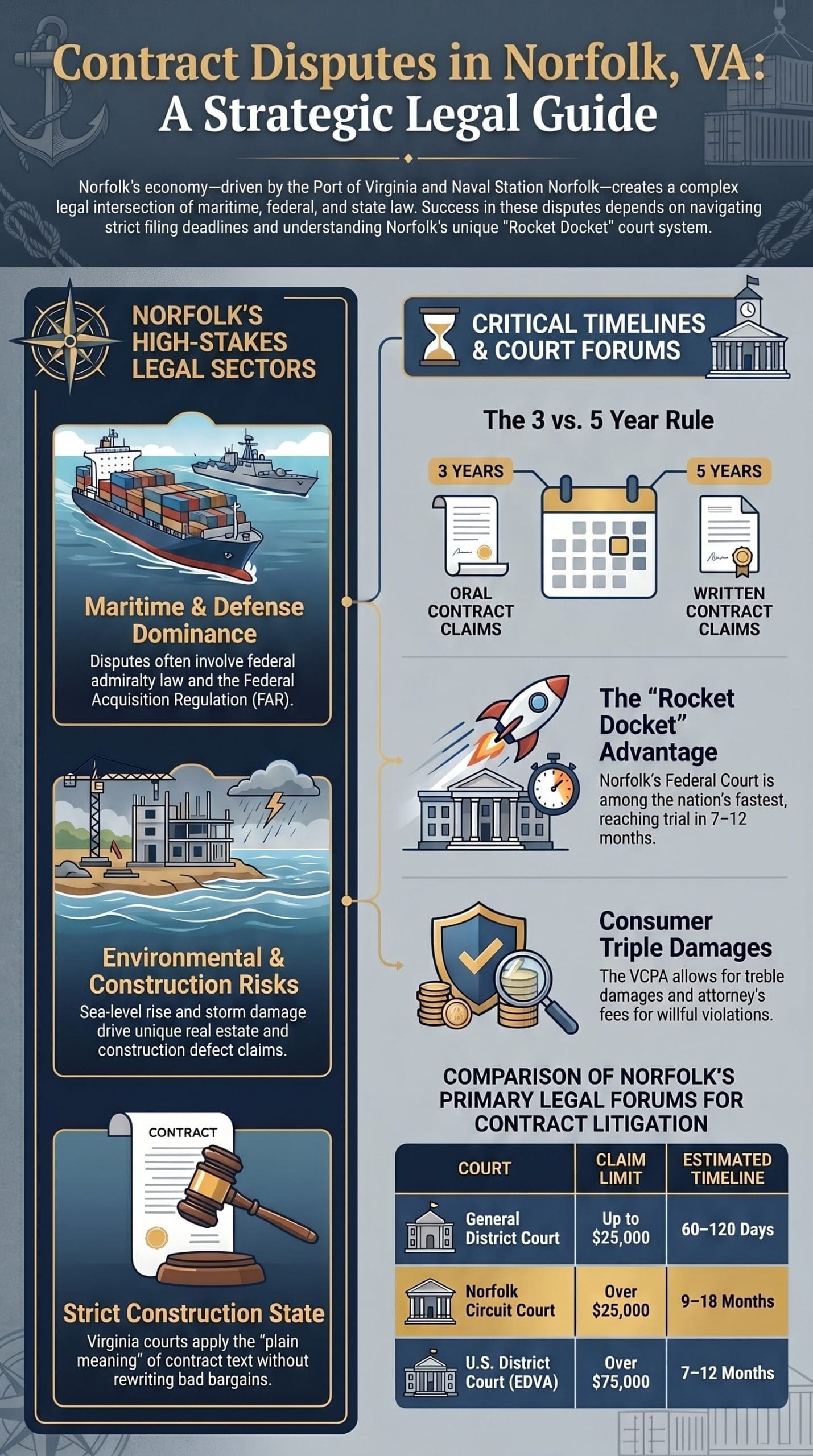
Table of Contents
- The Norfolk Contract Dispute Environment
- Maritime and Port-Related Contract Disputes
- Defense and Government Contracting Disputes
- Construction and Shipbuilding Contract Disputes
- Commercial Business-to-Business Contract Disputes
- Real Estate and Commercial Lease Disputes
- Consumer Contract Disputes for Norfolk Residents
- Virginia Law on Breach of Contract and Available Remedies
- Navigating Norfolk’s Court System for Contract Litigation
- How Shin Law Office Resolves Contract Disputes
- Summary
- Frequently Asked Questions
- References
Chapter 1: The Norfolk Contract Dispute Environment
Norfolk sits at the heart of one of the most contractually complex economies in the United States. The Port of Virginia moves nearly three million container units a year, Naval Station Norfolk anchors the largest concentration of naval power on earth, and the surrounding Hampton Roads region houses shipbuilders, defense contractors, healthcare systems, and universities that all generate written and oral agreements at a remarkable pace. When those agreements break down, the disputes that follow rarely look like a typical commercial breach.
I have practiced civil litigation in Virginia for years, and I can tell you that the contract problems my clients bring me from Norfolk often involve overlapping bodies of law. A single dispute might pull in Virginia’s Uniform Commercial Code at Title 8.2, federal admiralty principles, the Federal Acquisition Regulation, and local Norfolk court procedure all at once. That combination is unusual for the Commonwealth, and it changes the calculation for anyone deciding whether to sue, settle, or seek alternative resolution.
For businesses, the question is rarely whether a contract was breached. The harder questions are which forum will hear the case, which law governs, and how to preserve evidence in an industry where vessels move, shipments perish, and federal contracting officers make binding decisions on tight timelines. For residents, the issues are often more personal. A flooded home, a botched roof replacement, a car purchase that went sideways. Virginia law gives consumers real tools, but those tools must be used promptly and correctly.
This guide covers ten categories of contract disputes that arise in Norfolk and the broader Hampton Roads area. Each chapter explains the legal framework, the specific risks Norfolk presents, and what to expect if you bring the matter to court. For readers who do business north of the Rappahannock, see our companion Northern Virginia commercial contract litigation guide, which covers the parallel framework for that region.
Chapter 2: Maritime and Port-Related Contract Disputes
The Port of Virginia ranks as one of the busiest container ports on the East Coast and offers the deepest harbor on the U.S. Atlantic seaboard. That depth attracts ultra-large container ships that cannot dock anywhere else south of New York. Norfolk International Terminals, Virginia International Gateway, and the Portsmouth Marine Terminal handle billions of dollars in cargo annually, and every container moves under a written agreement.
When a maritime contract goes sideways, the dispute often falls under federal admiralty jurisdiction. The U.S. District Court for the Eastern District of Virginia, Norfolk Division, sitting at the Walter E. Hoffman United States Courthouse, hears more admiralty cases than most federal courts in the country. The cases I see most often include carriage of goods disputes governed by the Carriage of Goods by Sea Act (which limits a carrier’s liability to $500 per package unless the shipper declares a higher value), charter party disputes between vessel owners and charterers over demurrage and hire payments, stevedoring and terminal services contracts, marine insurance coverage disputes under hull and cargo policies, and salvage claims when a vessel is rescued from peril.
Why this matters for Norfolk:
Federal courts apply general maritime law to these disputes, but Virginia state courts can also hear them under the “saving to suitors” clause of 28 U.S.C. § 1333. Choosing the right forum is one of the most consequential decisions a maritime client makes.
The Eastern District of Virginia operates under what is informally called the “rocket docket,” meaning cases move to trial faster than nearly any other federal district. That speed cuts both ways. It limits discovery time and forces early settlement discussions, which can favor a well-prepared plaintiff and punish a defendant who is still gathering evidence.
For Norfolk-area shippers, terminal operators, and vessel owners, the practical takeaway is straightforward. Document everything, preserve records the moment a problem appears, and bring an attorney in before the carrier’s bill of lading defenses harden into final positions.
Chapter 3: Defense and Government Contracting Disputes
Naval Station Norfolk holds the title of largest naval base in the world by personnel and ship support capacity. Combined with Joint Expeditionary Base Little Creek, Norfolk Naval Shipyard, and the Naval Air Station Oceana complex, the federal defense footprint in Hampton Roads supports thousands of prime and subcontractor companies. When a defense contract dispute arises, the rules differ from those in private commercial litigation.
Federal contracts are governed by the Federal Acquisition Regulation (FAR), the Defense Federal Acquisition Regulation Supplement (DFARS), and the Contract Disputes Act of 1978. A contractor who disagrees with a contracting officer’s final decision must choose between the Armed Services Board of Contract Appeals (ASBCA) and the U.S. Court of Federal Claims. Both have strict deadlines. The ASBCA appeal must be filed within 90 days. The Court of Federal Claims has a 12-month window. Miss either deadline and the claim is gone.
The disputes I handle most often in this category include termination for convenience and termination for default disagreements (where the difference between the two can mean the difference between recovering costs and owing the government money), cost and pricing disputes under FAR Part 31 and the Truth in Negotiations Act, bid protests filed at the Government Accountability Office or the Court of Federal Claims, subcontractor pass-through claims when a sub’s losses must be presented through the prime, and False Claims Act exposure under 31 U.S.C. § 3729 (which carries treble damages and per-claim civil penalties). I have written separately about the top legal challenges defense, aerospace, and federal contracting companies face, and most of those issues apply equally to Hampton Roads contractors.
Subcontractor disputes between primes operating at Norfolk-area facilities and their lower-tier suppliers stay in state court, usually in Norfolk Circuit Court or the Eastern District of Virginia depending on diversity jurisdiction. These cases turn on flow-down clauses, which incorporate prime contract terms into the subcontract, and on disputed scope changes that the prime never formally approved.
Practical tip for Hampton Roads contractors:
Preserve your contract file and any communications with the contracting officer the moment a dispute appears. The government’s position often hardens around early documents, and reconstructing what happened after the fact is far harder than capturing it in real time.
Chapter 4: Construction and Shipbuilding Contract Disputes
Norfolk’s construction sector is shaped by two forces that most Virginia cities do not face: maritime industrial work and recurring storm damage. Newport News Shipbuilding, BAE Systems Norfolk Ship Repair, and the Norfolk Naval Shipyard pull in trade contractors, equipment suppliers, and specialty subs from across the region. Hurricanes and nor’easters then create a parallel demand for residential and commercial repair work that strains the local contractor pool every few years.
Virginia construction law sits at the intersection of contract, lien, and statutory rights. The mechanic’s lien statute at Va. Code §§ 43-1 through 43-23.2 gives unpaid contractors and suppliers a powerful tool, but the deadlines are unforgiving. A memorandum of mechanic’s lien must be filed within 90 days from the last day of the last month in which work was performed, and a suit to enforce the lien must follow within six months. Miss either deadline and the lien is invalid. I have walked through the precise steps for filing a Virginia mechanic’s lien before the clock runs out in a separate piece, and the same statutory windows apply to Norfolk projects.
Common construction contract disputes I see in Norfolk include delay and disruption claims when weather, design changes, or owner-caused interference push the schedule; pay-when-paid and pay-if-paid clauses that shift payment risk down the contracting chain (Virginia courts enforce both, with limits); change order disputes over scope, pricing, and authority to approve; construction defect claims under both contract theory and the Virginia Consumer Protection Act for residential work; performance and payment bond claims under Va. Code § 2.2-4337 for public projects and the Miller Act for federal projects; and hurricane-related force majeure disputes when storm damage interrupts performance.
For homeowners in flood-prone Norfolk neighborhoods like Larchmont, Ghent, and Ocean View, the post-storm contract problem is often a roofer or restoration company that took a deposit and disappeared, or that did substandard work and refuses to return. Virginia residential contractor licensing rules at Va. Code § 54.1-1100, and the Virginia Consumer Protection Act at Va. Code § 59.1-200, give homeowners several routes to recovery, including treble damages for willful violations. The legal protections available to homeowners dealing with builder delays, cost overruns, or construction defects apply across the Commonwealth. The clock is short, though, and evidence preservation matters from day one.
Chapter 5: Commercial Business-to-Business Contract Disputes
Outside the maritime and defense sectors, Norfolk hosts a substantial commercial economy in healthcare, higher education, professional services, and regional retail. When two businesses fight over a contract, Virginia’s Uniform Commercial Code (Title 8.2 for sale of goods) and common law contract principles both come into play.
The most common B2B disputes I handle for Norfolk-area businesses include supply contract breaches where a vendor fails to deliver, delivers nonconforming goods, or repudiates the contract; service agreement disputes over scope, performance standards, and termination rights; distribution and dealer agreements that involve exclusive territories and minimum purchase requirements; non-compete and non-solicitation enforcement under the standards set in Home Paramount Pest Control Cos. v. Shaffer, 282 Va. 412 (2011), and modified by Virginia’s 2020 statutory ban on non-competes for low-wage workers at Va. Code § 40.1-28.7:8; partnership and LLC operating agreement disputes under the Virginia Stock Corporation Act and Limited Liability Company Act; and indemnification and warranty disputes in M&A transactions.
Virginia is a strict construction state for contracts. Courts read the words on the page and apply the plain meaning unless the language is ambiguous. The Virginia Supreme Court reaffirmed this principle in TM Delmarva Power, L.L.C. v. NCP of Virginia, L.L.C., 263 Va. 116 (2002), holding that courts will not rewrite a contract to relieve a party of a bad bargain. Many disputes also turn on whether the contract was validly formed in the first place, and Virginia recognizes a long list of formation defenses ranging from lack of mutual assent to fraud in the inducement.
Watch the forum clause:
Many commercial contracts include forum selection clauses that designate a specific Virginia court, often Fairfax or Richmond rather than Norfolk. Those clauses are generally enforceable under Paul Bus. Sys. v. Canon U.S.A., 240 Va. 337 (1990), unless they are unreasonable or were procured by fraud. Reading and negotiating the forum clause matters as much as the substantive terms.
Chapter 6: Real Estate and Commercial Lease Disputes
Norfolk real estate carries a unique pressure that few other Virginia markets share: sea-level rise. The city has documented increasing tidal flooding for over a decade, and the National Oceanic and Atmospheric Administration projects continued rises through the century. That reality changes how real estate contracts get written, disputed, and enforced.
The real estate contract disputes I see in Norfolk include purchase agreement breaches where a buyer fails to close or a seller refuses to convey; earnest money disputes when the deal collapses and both sides claim the deposit; disclosure failures under the Virginia Residential Property Disclosure Act at Va. Code § 55.1-700, particularly for properties in Special Flood Hazard Areas; commercial lease defaults for nonpayment, holdover tenancy, and unauthorized assignments; construction defect and warranty claims on new home purchases; and title disputes and boundary issues that surface during or after closing.
For commercial landlords and tenants in downtown Norfolk, the lease itself controls almost every aspect of the relationship. Virginia treats commercial leases as arm’s-length contracts and gives the parties wide latitude to allocate risk. The Virginia Residential Landlord and Tenant Act at Va. Code § 55.1-1200 et seq. does not apply to commercial space, so a tenant’s protections are limited to those provided by the lease. The same principles play out in central Virginia, and I have written a parallel guide to Virginia real estate and construction disputes that walks through similar issues in Chesterfield County.
Sea-level rise has begun to surface in real estate litigation through three vehicles. First, disclosure obligations for flood history, which sellers and landlords increasingly have to address explicitly. Second, force majeure and casualty clauses in long-term commercial leases, which were rarely negotiated with recurring nuisance flooding in mind. Third, insurance coverage disputes when flood damage exceeds the National Flood Insurance Program limits and the loss falls into a coverage gap. I expect this category of dispute to grow significantly over the next decade as climate-related claims continue to mount.
Chapter 7: Consumer Contract Disputes for Norfolk Residents
Residents of Norfolk and the surrounding cities face a familiar set of consumer contract problems, but with a Virginia-specific framework that gives them more tools than many people realize.
The Virginia Consumer Protection Act (VCPA) at Va. Code § 59.1-196 et seq. is the primary statutory weapon for residents. It covers a broad range of fraudulent and deceptive practices in consumer transactions, allows recovery of actual damages, and authorizes treble damages when the violation is willful. Attorney’s fees are available to a prevailing consumer, which changes the economics of pursuing a smaller claim. I have written more about Virginia consumer protection claims and how the VCPA works in practice for residents who have been misled or sold a defective product.
The consumer disputes I see most often from Norfolk-area residents include home improvement contractor disputes following major storm events; auto purchase fraud at dealerships across South Hampton Roads; service contract disputes with HVAC, pest control, lawn care, and similar providers; wedding and event venue cancellations where deposits and refund clauses become flashpoints; health club and gym membership disputes under the specific rules at Va. Code § 59.1-294; and timeshare and vacation club disputes (which are common given the regional tourism economy).
Two procedural tools matter:
First, the Virginia General District Court hears civil claims up to $25,000 without a jury, with simpler procedure and faster resolution than Circuit Court. Most consumer cases belong there. Second, the demand letter is enormously valuable. A well-drafted demand letter that cites the VCPA and identifies the willfulness facts often produces a settlement before suit is filed. When it does not, that same letter becomes evidence at trial.
For residents who have been wronged by a contractor or seller, the worst approach is to wait. Memories fade, witnesses move, and documents disappear. Virginia’s three-year statute of limitations on oral contracts and five-year limit on written ones at Va. Code § 8.01-246 sounds long, but it goes faster than most people expect.
Chapter 8: Virginia Law on Breach of Contract and Available Remedies
Every contract dispute in Norfolk eventually comes down to two questions: was there a breach, and what is the remedy. Virginia law answers both with a body of doctrine that is relatively traditional and predictable, which is often an advantage for the side that prepares thoroughly. I have published a more detailed walkthrough of Virginia breach-of-contract claims that covers the elements, defenses, and damage calculations in greater depth.
Elements of a Breach of Contract Claim
The elements are set out in Filak v. George, 267 Va. 612 (2004): a legal obligation, a breach of that obligation, and resulting damages. The plaintiff must prove each element by a preponderance of the evidence. The contract itself, whether written or oral, establishes the obligation. The breach is the failure to perform as the contract requires. The damages must be proven with reasonable certainty, which is often the hardest element.
Statute of Limitations
Va. Code § 8.01-246 sets the deadline at five years for written contracts and three years for unwritten (oral) contracts. The clock generally starts on the date of breach, not the date of discovery. Some specific contract types have shorter periods, including UCC sales of goods at four years under Va. Code § 8.2-725.
Statute of Frauds
Va. Code § 11-2 requires certain contracts to be in writing to be enforceable, including promises to answer for the debt of another, agreements that cannot be performed within one year, sales of land or any interest in land, and contracts for the sale of goods of $500 or more under Va. Code § 8.2-201.
Available Remedies
Virginia recognizes compensatory damages that put the plaintiff in the position the contract promised; consequential damages for foreseeable losses flowing from the breach; liquidated damages when the contract specifies them and they are not a penalty; specific performance for unique items, including real estate; rescission to undo the contract when fraud or material breach justifies it; and reformation to correct mutual mistake in the written instrument.
Mitigation and Punitive Damages
Mitigation is required. A non-breaching party must take reasonable steps to reduce damages, and a court will deny recovery for losses that could have been avoided. This rule, articulated in Forbes v. Rapp, 269 Va. 374 (2005), surprises clients who believe the breach itself entitles them to sit back and let losses accumulate. Punitive damages are not available for breach of contract alone in Virginia. They require an independent tort, such as fraud in the inducement, that exists alongside the contract claim. The line between business fraud and breach of contract matters enormously when punitive exposure is on the table. The cap on punitive damages under Va. Code § 8.01-38.1 is $350,000.
Chapter 9: Navigating Norfolk’s Court System for Contract Litigation
Norfolk contract disputes can land in any of three courts, and the choice of forum often determines the speed, cost, and even the outcome of the case. The procedural mechanics are similar to what I have described elsewhere about how Virginia courts resolve contract and business disputes, but Norfolk has its own venue rules and docket dynamics.
Norfolk General District Court
Located at 811 East City Hall Avenue, this court hears civil cases with an amount in controversy up to $25,000 (exclusive of interest and attorney’s fees). Cases proceed without juries, follow simplified procedure, and typically resolve within 60 to 120 days. Discovery is limited. Appeals from the General District Court go to the Circuit Court for a trial de novo, meaning the case starts over with full procedural rights. For consumer disputes and small commercial matters, the General District Court is often the right venue.
Norfolk Circuit Court
Located at 100 St. Paul’s Boulevard, this court hears civil cases over $25,000 and any case requiring equitable relief such as specific performance or injunctions. Circuit Court allows full discovery under the Virginia Rules of the Supreme Court Part Four, jury trials, and the full range of pretrial motions. Cases typically take 9 to 18 months from filing to trial, depending on docket conditions. Norfolk Circuit Court is part of the Fourth Judicial Circuit.
U.S. District Court, Eastern District of Virginia, Norfolk Division
Located at the Walter E. Hoffman Courthouse at 600 Granby Street, this court hears federal question cases, diversity cases over $75,000, and admiralty cases. The Norfolk Division is known for the fastest civil docket in the federal system, often called the rocket docket. Cases routinely go to trial within 7 to 12 months of filing. The compressed schedule rewards early preparation and punishes parties who wait.
Removal, Mediation, and Arbitration
Removal to federal court is available in diversity cases under 28 U.S.C. § 1441 and must be filed within 30 days of service of the complaint. Out-of-state defendants frequently remove Virginia state court contract cases to federal court, which can dramatically change the litigation timeline and the discovery calendar. Many commercial contracts contain arbitration clauses governed by the Federal Arbitration Act, 9 U.S.C. § 1 et seq., or the Virginia Uniform Arbitration Act at Va. Code § 8.01-581.01 et seq. These clauses are generally enforceable, and a court will dismiss or stay litigation when a valid arbitration agreement covers the dispute.
Chapter 10: How Shin Law Office Resolves Contract Disputes
Shin Law Office serves clients throughout the Commonwealth of Virginia, including Norfolk and the broader Hampton Roads region. As a Virginia-licensed attorney, I can represent clients in any Virginia state court and in the U.S. District Court for the Eastern District of Virginia, including the Norfolk Division. The full range of our work is described on our civil litigation practice page.
Our process for a contract dispute follows a deliberate sequence. The work begins with an initial case assessment. When you call the firm, we collect the contract, relevant communications, and a chronology of events. The first review tells us three things: whether you have a viable claim, what the realistic damages look like, and what the procedural posture is. If the matter falls outside our practice areas or is better handled by a different attorney, I will tell you that directly.
From there, we move to a pre-litigation strategy. A surprising number of contract disputes resolve before suit is filed. A well-drafted demand letter that cites the controlling statutes, attaches key documents, and lays out a credible damages calculation often results in a settlement offer within 30 days. When the demand letter does not produce a result, we evaluate whether mediation, arbitration, or litigation is the right next step.
When litigation is necessary, we file in the court that gives our client the best procedural and substantive position. That choice depends on the amount in controversy, the desired speed, the availability of a jury, the discovery rules, and any forum selection or arbitration clauses in the contract. For Norfolk clients, the federal Norfolk Division and the state Circuit Court each have advantages depending on the case.
The discovery phase is where most contract cases are won or lost. We use depositions, document requests, interrogatories, and requests for admission strategically rather than reflexively. Summary judgment motions under Rule 3:20 of the Virginia Supreme Court Rules can resolve a case before trial when the contract language is clear and the material facts are undisputed.
Most contract disputes settle, often after discovery narrows the issues and clarifies the damages exposure. When a settlement is not possible, we try the case. I have represented clients in bench trials and jury trials across Virginia, and I prepare every case as if it will go to trial. When a trial result needs to be challenged, the appeal goes to the Court of Appeals of Virginia for civil cases under the 2022 jurisdictional expansion at Va. Code § 17.1-405. Federal appeals from EDVA go to the U.S. Court of Appeals for the Fourth Circuit in Richmond.
The work is detailed, technical, and demanding. That is what tough cases require, and that is what we do.
Summary
Contract disputes in Norfolk run through a complicated set of overlapping legal systems. Maritime law, federal contracting rules, Virginia’s UCC, common law contract principles, and consumer protection statutes can all come into play in a single case. The Port of Virginia, Naval Station Norfolk, the Hampton Roads shipbuilding economy, and the residential market in flood-exposed neighborhoods all create their own contract risks that other Virginia cities do not share.
Whatever the dispute, three principles apply across the board. First, time matters. Virginia’s statutes of limitations are not generous, and federal contracting deadlines are even shorter. Second, documentation matters. The party with the better contract file usually wins. Third, forum matters. The choice between Norfolk General District Court, Norfolk Circuit Court, and the EDVA Norfolk Division can change everything about how a case proceeds.
If you are facing a contract dispute, do not wait for the situation to clarify itself. Get a lawyer involved early, when the evidence is fresh and the options are still open.
Frequently Asked Questions
How long do I have to file a breach of contract lawsuit in Norfolk, Virginia?
Virginia gives you five years from the date of breach for a written contract and three years for an oral contract under Va. Code § 8.01-246. Sales of goods under the UCC are limited to four years under Va. Code § 8.2-725. The clock starts on the date of breach, not the date you discovered it, so the practical window is often shorter than it sounds.
Do I need an attorney to handle a contract dispute in Norfolk?
For matters under $5,000 in General District Court, many people represent themselves successfully. Once the amount in controversy exceeds $25,000 and the case moves to Circuit Court, the procedural rules become significantly more demanding, and self-representation usually costs more than it saves. For maritime, defense contracting, and complex commercial cases, an attorney is effectively required.
Can I sue someone for breaking an oral agreement in Virginia?
Yes, oral contracts are enforceable in Virginia, with a three-year statute of limitations under Va. Code § 8.01-246. The Statute of Frauds at Va. Code § 11-2 carves out exceptions that must be in writing, including land contracts, suretyship agreements, and contracts that cannot be performed within one year. Outside those exceptions, an oral agreement supported by adequate proof is fully enforceable.
What damages can I recover in a Virginia breach of contract case?
Compensatory damages, consequential damages within the rule of foreseeability, liquidated damages when the contract specifies them and they are not a penalty, specific performance for unique items, rescission, and reformation. Punitive damages are not available for breach of contract alone, but they may be available if an independent tort like fraud is also pleaded and proven. Attorney’s fees are recoverable only if the contract or a statute provides for them.
Should I send a demand letter before filing a lawsuit?
Almost always, yes. A demand letter signals seriousness, opens settlement discussions, and creates a written record of your position. For Virginia Consumer Protection Act claims, a pre-suit demand can also support a finding of willfulness if the defendant ignores it, which opens the door to treble damages.
What is the difference between Norfolk General District Court and Circuit Court for contract cases?
General District Court hears civil cases up to $25,000, decides them without a jury, allows limited discovery, and resolves cases in roughly 60 to 120 days. Circuit Court hears cases over $25,000 and equitable claims, allows full discovery and jury trials, and typically takes 9 to 18 months to reach trial. An appeal from General District goes to Circuit Court for a fresh trial.
How does Virginia’s Consumer Protection Act help with contractor disputes?
The VCPA at Va. Code § 59.1-196 et seq. covers fraudulent and deceptive practices in consumer transactions. A homeowner who proves a willful violation can recover treble damages and attorney’s fees, which dramatically improves the economics of pursuing a contractor who walked off the job or did substandard work.
Can a contract be enforced if it was not signed?
Often, yes. Virginia recognizes contracts formed by conduct, by exchange of emails, and by partial performance. The Statute of Frauds requires writings for certain categories, but even there, courts have enforced agreements based on email exchanges, signed memoranda, and other partial writings. The absence of a single signed document is not the end of the inquiry.
What is specific performance, and when can I get it?
Specific performance is a court order requiring a party to perform the contract rather than pay damages. Virginia courts grant it most commonly in real estate contracts, where every parcel of land is treated as unique, and occasionally in contracts for unique goods or business assets. Money damages have to be inadequate before a court will order specific performance.
How long does a contract lawsuit take in Norfolk?
In General District Court, expect 60 to 120 days from filing to trial. In Norfolk Circuit Court, expect 9 to 18 months. In the EDVA Norfolk Division (the rocket docket), expect 7 to 12 months. Settlement can shorten any of these timelines significantly, and most contract cases do settle before trial.
Ready to Resolve Your Contract Dispute?
Whether you are a business facing a maritime contract problem at the Port of Virginia, a defense contractor with a termination dispute, a commercial landlord chasing a defaulting tenant, or a Norfolk homeowner who paid a contractor who never finished the job, you deserve a Virginia attorney who understands the law and will fight for you.
Tough cases require tough attorneys. Shin Law Office handles contract disputes across the Commonwealth, including Norfolk and the Hampton Roads region.
Call 571-445-6565 or book your case review online.

References
Carriage of Goods by Sea Act, 46 U.S.C. § 30701 et seq. https://www.govinfo.gov/app/collection/uscode
Code of Virginia. (2024). Title 8.01, Chapter 4: Limitations of actions. Virginia General Assembly. https://law.lis.virginia.gov/vacode/title8.01/chapter4/
Code of Virginia. (2024). Title 8.2: Commercial Code, Sales. Virginia General Assembly. https://law.lis.virginia.gov/vacode/title8.2/
Code of Virginia. (2024). Title 11, Chapter 1: Statute of Frauds. Virginia General Assembly. https://law.lis.virginia.gov/vacode/title11/chapter1/
Code of Virginia. (2024). Title 43: Mechanics’ and Certain Other Liens. Virginia General Assembly. https://law.lis.virginia.gov/vacode/title43/
Code of Virginia. (2024). Title 55.1, Chapter 7: Virginia Residential Property Disclosure Act. Virginia General Assembly. https://law.lis.virginia.gov/vacode/title55.1/chapter7/
Code of Virginia. (2024). Title 59.1, Chapter 17: Virginia Consumer Protection Act. Virginia General Assembly. https://law.lis.virginia.gov/vacode/title59.1/chapter17/
Contract Disputes Act of 1978, 41 U.S.C. § 7101 et seq. https://www.govinfo.gov/app/collection/uscode
Federal Acquisition Regulation. (2024). FAR (Federal Acquisition Regulation). U.S. General Services Administration. https://www.acquisition.gov/far
Federal Arbitration Act, 9 U.S.C. § 1 et seq. https://www.govinfo.gov/app/collection/uscode
Filak v. George, 267 Va. 612 (2004).
Forbes v. Rapp, 269 Va. 374 (2005).
Home Paramount Pest Control Cos. v. Shaffer, 282 Va. 412 (2011).
National Oceanic and Atmospheric Administration. (2022). Sea level rise technical report. https://oceanservice.noaa.gov/hazards/sealevelrise/
Norfolk Circuit Court. (2024). Civil division information. City of Norfolk. https://www.norfolk.gov/4030/Circuit-Court
Paul Business Systems, Inc. v. Canon U.S.A., Inc., 240 Va. 337 (1990).
Port of Virginia. (2024). Annual report and statistics. The Virginia Port Authority. https://www.portofvirginia.com/
TM Delmarva Power, L.L.C. v. NCP of Virginia, L.L.C., 263 Va. 116 (2002).
U.S. District Court for the Eastern District of Virginia. (2024). Norfolk Division. https://www.vaed.uscourts.gov/