
Contract Disputes in Roanoke, Virginia: A Complete Guide for Businesses and Residents
By Anthony I. Shin, Esq. | Shin Law Office | Serving Clients Across Virginia
BOTTOM LINE UP FRONT
Roanoke is the commercial center of Southwest Virginia, anchored by Carilion Clinic, Norfolk Southern Railway, a substantial manufacturing base, and a tourism economy built around the Blue Ridge Mountains. Contract disputes here look different from the federal contractor heavy environment in Northern Virginia or the maritime focus of Hampton Roads. The local economy generates a distinct mix of healthcare, manufacturing supply chain, mountain construction, family business, and consumer disputes, all funneled through the 23rd and 23A Judicial Circuits.
This guide covers every major category of contract dispute affecting Roanoke businesses and residents, the Virginia statutes and courts that apply, and how a Virginia litigation attorney handles each type. Call Shin Law Office at 571-445-6565 or book your case review online at shinlawoffice.com/meet-our-team/contact.
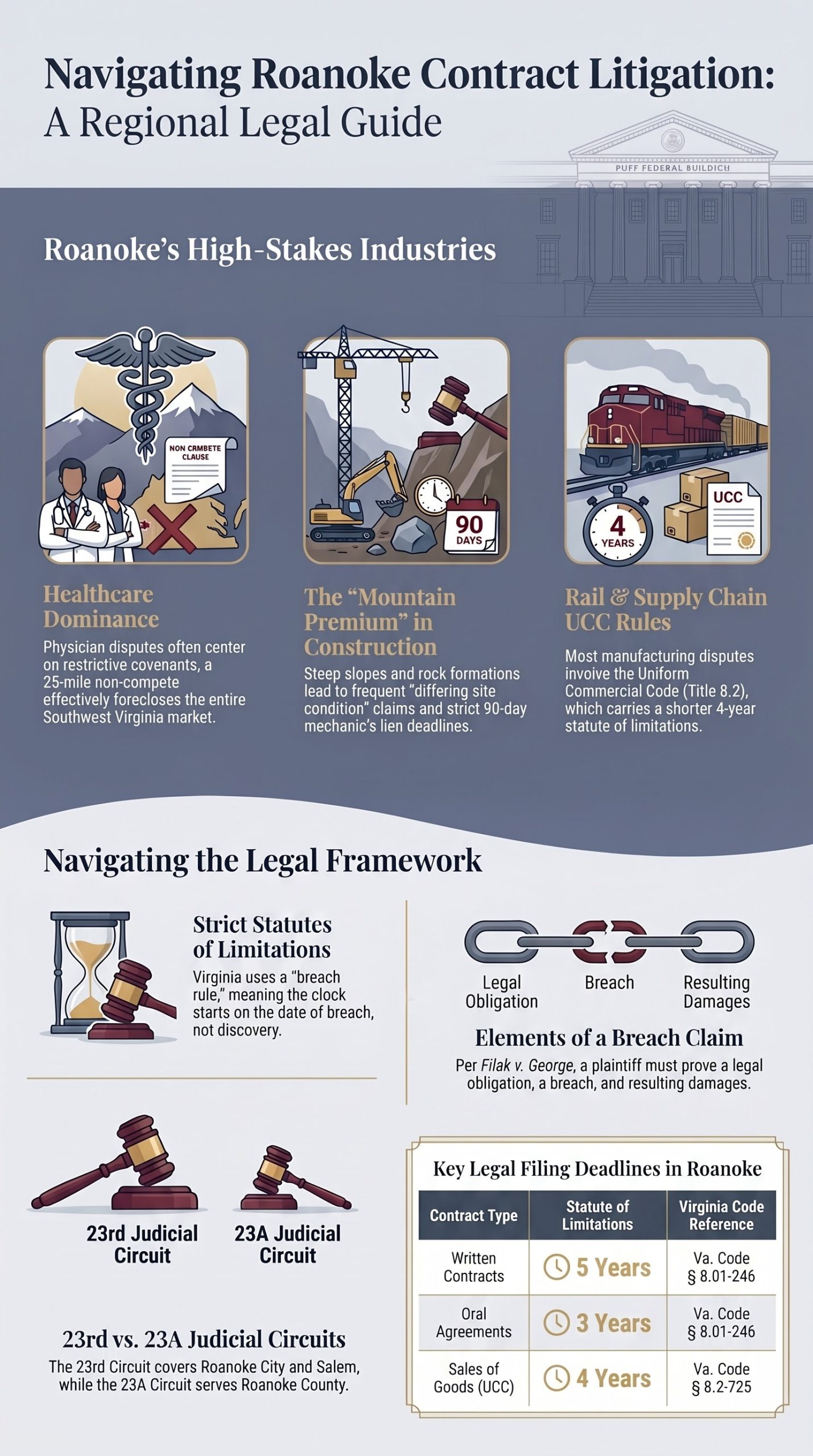
Table of Contents
- The Roanoke Contract Dispute Environment
- Healthcare and Medical Practice Contract Disputes
- Manufacturing, Distribution, and Rail-Adjacent Supply Chain Disputes
- Construction Contract Disputes in the Roanoke Valley
- Commercial Real Estate and Lease Disputes
- Small Business, Family Business, and Partnership Disputes
- Consumer Contract Disputes for Roanoke Residents
- Virginia Law on Breach of Contract and Available Remedies
- Navigating Roanoke’s Court System: 23rd and 23A Circuits and the WDVA
- How Shin Law Office Resolves Contract Disputes
- Summary
- Frequently Asked Questions
- References
Chapter 1: The Roanoke Contract Dispute Environment
Roanoke is the largest metropolitan area in Southwest Virginia and the regional commercial center for the western half of the Commonwealth. The city sits where the Roanoke River meets the eastern slope of the Blue Ridge Mountains, and that geography has shaped the local economy for more than a century. The Norfolk and Western Railway, now Norfolk Southern, built its headquarters here. Manufacturing followed. Healthcare grew up around the rail and manufacturing workforce. Tourism arrived with the Blue Ridge Parkway. Today, the Roanoke Valley supports a diversified regional economy that generates contract disputes in patterns I do not see anywhere else in Virginia.
The dominant economic forces are healthcare, manufacturing and distribution, professional services, education (Virginia Tech sits forty miles up I-81 in Blacksburg), tourism, and a smaller but persistent agricultural and food processing sector in the surrounding counties. Carilion Clinic alone employs more than 13,000 people across its facilities, and its contract footprint extends across nearly every category of healthcare agreement. The freight rail infrastructure built around Norfolk Southern continues to support manufacturers, distributors, and warehousing operations that sign supply contracts, leases, and service agreements at substantial volume.
Roanoke contract disputes also reflect a market reality that lawyers in Northern Virginia often miss. The commercial community is smaller, more interconnected, and more relationship-driven than the metropolitan markets to the east. Business owners in Roanoke often did business with each other for years before the dispute. Suppliers know each other’s families. Lawyers, accountants, bankers, and business owners attend the same Carilion fundraisers and the same Roanoke Regional Chamber events. The result is that disputes here are not always purely commercial. They carry social weight that affects how cases are negotiated, mediated, and tried.
The court system reflects the region’s structure. The 23rd Judicial Circuit covers the City of Roanoke and the City of Salem. The 23A Judicial Circuit covers Roanoke County. Both circuits sit in compact courthouses with judges who know the local bar and watch the same patterns of cases recur. The U.S. District Court for the Western District of Virginia, Roanoke Division, hears federal cases for the region. The procedural rules and substantive law are identical to what applies elsewhere in Virginia, but the practical experience of litigating in Roanoke differs from filing in Fairfax or Norfolk.
This guide covers ten categories of contract disputes that arise in Roanoke and the surrounding region. For readers who do business in other parts of the Commonwealth, see our companion guides on contract disputes in Norfolk and Hampton Roads and on Northern Virginia commercial contract litigation, both of which apply the same Virginia law to different regional economies. The firm also maintains a parallel civil litigation guide for Roanoke that addresses the broader litigation framework beyond contract disputes specifically.
Chapter 2: Healthcare and Medical Practice Contract Disputes
Healthcare dominates the Roanoke contract landscape more than any other industry. Carilion Clinic operates the dominant hospital system, with Carilion Roanoke Memorial Hospital, Carilion Children’s, and a network of clinics, urgent care centers, and physician practices stretching across Southwest Virginia. LewisGale Medical Center, a HCA Healthcare facility in Salem, provides a second major system. Around these institutions sits a substantial network of independent physicians, specialty groups, ancillary providers, and supply vendors, all working under written contracts.
The healthcare contract disputes I see most often in Roanoke include physician employment and shareholder disputes within medical groups, hospital-physician services agreements (medical directorships, call coverage, professional services), restrictive covenant enforcement when physicians leave one practice for another, equipment supply and maintenance contracts (imaging, surgical, lab), payor contracts and reimbursement disputes with commercial insurers, and information technology contracts for electronic health records and billing systems.
Physician restrictive covenant disputes deserve special attention. Virginia enforces non-compete clauses that are reasonable in scope, duration, geography, and that protect a legitimate business interest under Home Paramount Pest Control Cos. v. Shaffer, 282 Va. 412 (2011). For physicians, the geographic question matters more than the duration. A non-compete that prohibits practice within a twenty-five mile radius of Roanoke effectively forces a departing physician to leave Southwest Virginia entirely, because the alternative markets in Lynchburg, Christiansburg, and Lexington fall within that radius. Courts evaluate whether such a clause protects a legitimate interest or improperly restrains the physician’s livelihood. The 2020 amendments to Virginia non-compete law at Va. Code § 40.1-28.7:8 do not exempt physicians, but they have shifted the broader analysis. I have written separately about Virginia’s 2020 non-compete law changes, which apply across the Commonwealth.
Why this matters in Roanoke specifically:
When a Roanoke physician group dissolves or a physician leaves for a competing practice, the dispute typically pulls in the patient base, the practice goodwill, and often a Carilion or LewisGale relationship. The intersection of restrictive covenants, fiduciary duties among shareholders, and ongoing patient care creates litigation that requires both contract experience and an understanding of how Roanoke healthcare actually works.
Chapter 3: Manufacturing, Distribution, and Rail-Adjacent Supply Chain Disputes
Norfolk Southern Railway moved its operating headquarters to Atlanta in 2021, but the company’s heritage and substantial workforce footprint in Roanoke remain. The rail infrastructure that built the city continues to anchor a manufacturing and distribution sector that employs tens of thousands across the Roanoke Valley and the surrounding counties. Companies like Yokohama Tire, Mohawk Industries, Stantec, and dozens of smaller manufacturers and distributors maintain operations served by rail, truck, or both.
Supply chain contract disputes here typically involve Virginia’s Uniform Commercial Code at Title 8.2 for sales of goods. The most common patterns include nonconforming goods (delivery of products that fail to meet contract specifications), late delivery causing downstream production delay, repudiation when a supplier announces it cannot perform, requirements and output contract disputes when actual demand or production deviates significantly from forecasts, and warranty claims on industrial equipment, components, and raw materials.
Two issues recur in Roanoke manufacturing disputes that affect strategy. First, the four-year UCC statute of limitations under Va. Code § 8.2-725 is shorter than the five-year limit on common law written contracts. A purchase order dispute that appears to be a standard contract claim may actually be a UCC claim with a shorter deadline. Second, the parties often have a long-running commercial relationship that produces a course of dealing under Va. Code § 8.1A-303. A course of dealing can modify or supplement express terms, and a careful review of the parties’ historical exchanges often produces evidence that alters the analysis.
Distribution and dealer agreements are another recurring source of disputes. Manufacturers establish exclusive territories, set minimum purchase requirements, and impose marketing obligations on dealers. When the relationship breaks down (a manufacturer terminates a dealer, a dealer falls short of purchase commitments, a competing dealer encroaches on a protected territory), the resulting litigation often involves both contract and tort theories under Virginia law. The contract analysis under TM Delmarva Power, L.L.C. v. NCP of Virginia, L.L.C., 263 Va. 116 (2002), and related authority dominate the outcome.
Chapter 4: Construction Contract Disputes in the Roanoke Valley
Construction in the Roanoke Valley faces challenges that flat-terrain markets do not encounter. The Blue Ridge Mountains and the surrounding foothills produce sites with steep slopes, complex stormwater drainage, expansive clay soils in some pockets, and weathered rock formations that complicate foundation work. The mountain construction premium adds cost, time, and dispute exposure to projects that look straightforward on paper.
The construction contract disputes I see most often in Roanoke and the surrounding counties include delay claims tied to weather, site conditions, and supply chain issues; differing site condition claims when the actual subsurface differs from what the contract documents represented; mechanic’s lien filings under Va. Code §§ 43-1 through 43-23.2; pay-when-paid and pay-if-paid clause enforcement; change order disputes for scope, pricing, and authority issues; and warranty claims on commercial and residential work after completion.
Mechanic’s liens deserve attention because the deadlines are short and unforgiving. A memorandum of mechanic’s lien must be filed within 90 days of the last day of the last month in which work was performed or materials were furnished. Suit to enforce the lien must follow within six months of recordation, or 60 days from completion of the building, whichever is later. The 23rd Circuit Clerk’s office in Roanoke and the 23A Circuit Clerk’s office in Roanoke County both maintain busy lien dockets, and the procedural rules are enforced strictly. I have walked through the precise mechanics of filing a Virginia mechanic’s lien before the clock runs out in a separate piece, and the same statutory windows apply to Roanoke projects.
Residential construction disputes in the Roanoke Valley often involve mountain-home builds in upscale communities like Smith Mountain Lake, the foothills of the Blue Ridge, and the high-ground neighborhoods around Roanoke County. Defective work in these settings can be expensive to investigate and repair, and Virginia’s implied warranty of habitability and workmanlike construction provides homeowners a substantive remedy alongside the express warranty terms. The Virginia Consumer Protection Act at Va. Code § 59.1-200 also applies to fraudulent or deceptive contractor conduct, with treble damages available for willful violations. For homeowners dealing with builder delays, cost overruns, or construction defects, the protections are substantial when the right claims are filed within the right deadlines.
Chapter 5: Commercial Real Estate and Lease Disputes
Roanoke’s commercial real estate market is divided into several distinct submarkets. Downtown Roanoke has undergone substantial revitalization over the last twenty years, with historic warehouses and tobacco buildings converted to office, residential, and mixed-use space. Grandin Village, South Roanoke, and the West End offer different character and tenant mixes. The Valley View and Tanglewood corridors anchor the suburban retail and office market. Industrial and flex space spreads along Route 460, Route 220, and the rail corridors.
The commercial lease disputes I handle most often in Roanoke include tenant defaults for nonpayment, holdover tenancy, and unauthorized assignments; common area maintenance (CAM) and operating expense audit disagreements; build-out and tenant improvement disputes when the work goes sideways; exclusive use and competitor restrictions in retail leases; casualty and rebuild obligations after fire, water damage, or structural failure; and option and renewal disputes when the lease term comes due.
Floodplain issues affect a meaningful portion of Roanoke’s commercial real estate. The Roanoke River runs through downtown and parts of the surrounding area, and FEMA flood maps designate Special Flood Hazard Areas along the river corridor. Properties within those areas carry insurance obligations and disclosure considerations that affect both purchase contracts and leases. The Roanoke River flood of record (the 1985 flood from Hurricane Juan) remains the historical reference point for floodplain analysis. Tenants and owners along the river corridor should evaluate flood exposure as part of any lease or purchase decision.
Real estate purchase disputes involve earnest money allocation, disclosure obligations under the Virginia Residential Property Disclosure Act at Va. Code § 55.1-700 et seq., title issues that surface during or after closing, and specific performance actions when one party refuses to convey. Virginia courts grant specific performance in real estate cases because every parcel is treated as unique, making it a real option for buyers facing a seller’s breach on a property that meets specific Roanoke needs.
Chapter 6: Small Business, Family Business, and Partnership Disputes
Roanoke’s commercial community includes a substantial number of family-owned businesses that have operated for decades or generations. Restaurants, retail stores, professional services firms, manufacturing companies, automobile dealerships, and trades businesses often pass from one generation to the next under arrangements documented imperfectly or not at all. When the underlying relationships break down, the resulting disputes carry both legal and personal weight.
The small business and partnership disputes I see most often in Roanoke include LLC operating agreement disputes (especially when the agreement is silent on a question that matters); shareholder disputes in closely held corporations under the Virginia Stock Corporation Act; partnership dissolution disputes between long-time partners; family business succession disputes when a generation transition does not go as expected; buy-sell agreement disputes over valuation, triggering events, and payment terms; and employment disputes between owners who are also officers or employees.
Buy-sell agreements receive special attention in family businesses. A well-drafted buy-sell anticipates death, disability, divorce, retirement, voluntary withdrawal, and involuntary termination. It establishes valuation methodology (formula, appraisal, fixed price with adjustment), payment terms (lump sum, installment), and security for installment payments. Most family businesses I encounter have buy-sell language that addresses some of these but not all of them, and the gaps surface when the trigger event arrives. The Virginia Supreme Court’s approach to ambiguous business agreements in Berry v. Klinger, 225 Va. 201 (1983), and similar authority drives the resolution. For more on contract formation issues that surface in business disputes, see our piece on contract formation and enforceability under Virginia law.
Fiduciary duty claims often accompany contract claims in closely held business disputes. Officers, directors, and controlling members owe duties to the company and to minority owners that go beyond the contract terms. A majority owner who diverts opportunities, pays excessive compensation to family members, or refuses to make reasonable distributions may be liable for breach of fiduciary duty even when the operating agreement language allows the conduct. The line between business fraud and breach of contract matters here, and the choice of theory affects the available remedies and the punitive damages exposure.
Chapter 7: Consumer Contract Disputes for Roanoke Residents
Roanoke residents face the same consumer contract problems found anywhere in Virginia, with a few regional variations. The Virginia Consumer Protection Act (VCPA) at Va. Code § 59.1-196 et seq. provides the primary statutory framework, and its treble damages and attorney’s fee provisions for willful violations make smaller claims economically viable.
The consumer disputes I see most often from Roanoke clients include home improvement contractor disputes (especially for mountain home work where the contractor demanded a large deposit and never finished the job); auto purchase fraud at regional dealerships; service contract disputes with HVAC, pest control, lawn care, and similar providers; wedding and event venue disputes (Roanoke supports a substantial wedding industry around the Hotel Roanoke, the Patrick Henry, and various Blue Ridge venues); timeshare and vacation club disputes (Smith Mountain Lake and the surrounding tourism corridor produce these regularly); and gym, club, and subscription service disputes under Va. Code § 59.1-294 and similar provisions.
For residents pursuing a consumer claim, two procedural realities shape the strategy. Roanoke General District Court and the Roanoke County General District Court both hear civil claims up to $25,000 with simplified procedure, no jury, and resolution typically within 60 to 120 days. Most consumer cases belong there. A well-drafted demand letter that cites the VCPA and identifies the willfulness facts often results in a settlement before suit is filed. When it does not, that letter becomes evidence of willfulness that supports treble damages at trial. For more on Virginia consumer protection claims, see our consumer protection guide.
Time matters more than people realize:
Virginia’s three-year statute of limitations on oral contracts and five-year limit on written ones at Va. Code § 8.01-246 sounds long, but it goes faster than most people expect. The VCPA carries a two-year limitations period from discovery under Va. Code § 59.1-204.1. Document the dispute, send the demand letter, and consult counsel before deadlines begin to close.
Chapter 8: Virginia Law on Breach of Contract and Available Remedies
Every contract dispute in Roanoke comes back to two questions: was there a breach, and what is the remedy. Virginia law answers both with a body of doctrine that is traditional, predictable, and often advantageous for the side that prepares thoroughly. I have published a detailed walkthrough of Virginia breach of contract claims that covers the elements, defenses, and damages calculations in depth. The summary below highlights what matters most for Roanoke cases.
Elements of a Breach of Contract Claim
The Virginia Supreme Court set out the elements in Filak v. George, 267 Va. 612 (2004): a legal obligation, a breach of that obligation, and resulting damages. The plaintiff must prove each element by a preponderance of the evidence. The contract itself, whether written or oral, establishes the obligation. The breach is the failure to perform as the contract requires. The damages must be proven with reasonable certainty, which is often the hardest of the three elements.
Statute of Limitations
Va. Code § 8.01-246 sets the deadline at five years for written contracts and three years for unwritten (oral) contracts. UCC sales of goods are limited to four years under Va. Code § 8.2-725. The clock starts on the date of breach, not the date of discovery, with limited exceptions. Virginia uses the breach rule, not the discovery rule, for most contract claims.
Statute of Frauds
Va. Code § 11-2 requires certain contracts to be in writing to be enforceable, including promises to answer for the debt of another, agreements that cannot be performed within one year, sales of land or any interest in land, and contracts for the sale of goods of $500 or more under Va. Code § 8.2-201. Email exchanges and other electronic records can satisfy the writing requirement under the Uniform Electronic Transactions Act at Va. Code § 59.1-479 et seq.
Available Remedies
Virginia recognizes compensatory damages that put the plaintiff in the position the contract promised; consequential damages for foreseeable losses flowing from the breach under the rule of Hadley v. Baxendale; liquidated damages when the contract specifies them and they are not a penalty; specific performance for unique items, including real estate; rescission to undo the contract when fraud or material breach justifies it; and reformation to correct mutual mistake in the written instrument.
Mitigation and Punitive Damages
Mitigation is required. A non-breaching party must take reasonable steps to reduce damages, and a court will deny recovery for losses that could have been avoided. Punitive damages are not available for breach of contract alone in Virginia. They require an independent tort, such as fraud in the inducement, that exists alongside the contract claim. The cap on punitive damages under Va. Code § 8.01-38.1 is $350,000.
Chapter 9: Navigating Roanoke’s Court System
Roanoke contract disputes can land in any of several courts, and the choice of forum often determines the speed, cost, and outcome of the case. The procedural mechanics are similar to what I have described elsewhere about how Virginia courts resolve contract and business disputes, but Roanoke has its own venue rules and docket dynamics shaped by the 23rd and 23A Circuits.
Roanoke City General District Court
Located in the Roanoke City Courthouse at 315 Church Avenue SW, this court hears civil cases with an amount in controversy up to $25,000 (exclusive of interest and attorney’s fees). Cases proceed without juries, follow simplified procedure, and typically resolve within 60 to 120 days. Discovery is limited. Appeals from the General District Court go to the Circuit Court for a trial de novo, meaning the case starts over with full procedural rights. For consumer disputes and small commercial matters, the General District Court is often the right venue.
Roanoke City Circuit Court (23rd Judicial Circuit)
The 23rd Judicial Circuit Court sits at 315 Church Avenue SW and hears civil cases over $25,000 and any case requiring equitable relief such as specific performance or injunctions. The circuit covers the City of Roanoke and the City of Salem. Cases allow full discovery under the Virginia Rules of the Supreme Court Part Four, jury trials, and the full range of pretrial motions. Cases typically take 9 to 18 months from filing to trial.
Roanoke County Circuit Court (23A Judicial Circuit)
The 23A Circuit Court sits in the Roanoke County Courthouse at 305 East Main Street, Salem. The 23A circuit covers Roanoke County. The substantive law and procedural rules are identical to the 23rd Circuit, but the docket dynamics, judges, and local practice culture differ in ways that experienced litigators take into account. Venue between the 23rd and 23A Circuits often turns on where the contract was executed, where performance was to occur, and where the defendant resides under Va. Code § 8.01-262.
U.S. District Court, Western District of Virginia, Roanoke Division
Located at the Richard H. Poff Federal Building at 210 Franklin Road SW, this court hears federal question cases, diversity cases over $75,000, and other federal matters. The Western District of Virginia operates at a more measured pace than the EDVA Norfolk Division’s rocket docket, but it still moves cases efficiently and applies Federal Rules of Civil Procedure rigorously.
Removal, Mediation, and Arbitration
Removal to federal court is available in diversity cases under 28 U.S.C. § 1441 and must be filed within 30 days of service of the complaint. Out-of-state defendants frequently remove Virginia state court contract cases to federal court, which can change the litigation timeline and the discovery calendar. Many commercial contracts contain arbitration clauses governed by the Federal Arbitration Act, 9 U.S.C. § 1 et seq., or the Virginia Uniform Arbitration Act at Va. Code § 8.01-581.01 et seq. These clauses are generally enforceable, and a court will dismiss or stay litigation when a valid arbitration agreement covers the dispute.
Chapter 10: How Shin Law Office Resolves Contract Disputes
Shin Law Office serves clients throughout the Commonwealth of Virginia, including Roanoke, Salem, Roanoke County, and the surrounding Southwest Virginia region. As a Virginia-licensed attorney, I represent clients in any state court in Virginia and in the U.S. District Court for the Western District of Virginia, including the Roanoke Division. The full range of our work is described on our civil litigation practice page.
Our process for a Roanoke contract dispute follows a deliberate sequence. The work begins with an initial case assessment. When you call the firm, we collect the contract, the relevant communications, and a chronology of what happened. The first review tells us three things: whether you have a viable claim, what the realistic damages look like, and what the procedural posture is. If the matter falls outside our practice areas or is better handled by a different attorney, I will tell you that directly.
From there we move to pre-litigation strategy. A surprising number of contract disputes resolve before suit is filed. A well-drafted demand letter that cites the controlling Virginia statutes, attaches the key documents, and lays out a credible damages calculation often produces a settlement offer within 30 days. When the demand letter does not produce a result, we evaluate whether mediation, arbitration, or litigation is the right next step.
When litigation is necessary, we file in the court that gives our client the best procedural and substantive position. That choice depends on the amount in controversy, the desired speed, the availability of a jury, the discovery rules, and any forum selection or arbitration clauses in the contract. For Roanoke clients, the 23rd Circuit, the 23A Circuit, and the Western District of Virginia each have advantages depending on the case.
The discovery phase is where most contract cases are won or lost. We use depositions, document requests, interrogatories, and requests for admission strategically rather than reflexively. Summary judgment motions under Rule 3:20 of the Virginia Supreme Court Rules can resolve a case before trial when the contract language is clear and the material facts are undisputed.
Most contract disputes settle, often after discovery has narrowed the issues and clarified the damages exposure. When settlement is not possible, we try the case. I have represented clients in bench trials and jury trials across Virginia, and I prepare every case as if it will go to trial. When a trial result needs to be challenged, the appeal goes to the Court of Appeals of Virginia for civil cases under the 2022 jurisdictional expansion at Va. Code § 17.1-405. Federal appeals from the Western District go to the U.S. Court of Appeals for the Fourth Circuit in Richmond.
The work is detailed, technical, and demanding. That is what tough cases require, and that is what we do.
Summary
Contract disputes in Roanoke run through a regional economy unlike anywhere else in Virginia. Healthcare contracts dominated by Carilion Clinic and LewisGale, manufacturing supply chain disputes shaped by the rail heritage and active distribution sector, mountain construction with its terrain and soil challenges, and a smaller but tightly interconnected business community combine to produce patterns of disputes that are distinctly Roanoke.
Three principles apply across every category of dispute discussed in this guide. First, time matters. Virginia’s statutes of limitations are not generous, and several contract-adjacent claims (UCC sales, fraud, VCPA) run on shorter periods than the basic five-year written contract limit. Second, documentation matters. The party with the better contract file, the better contemporaneous record, and the better preserved communications usually wins. Third, forum matters. The choice between the 23rd Circuit, the 23A Circuit, the General District Courts, and the Western District of Virginia can change everything about how a case proceeds.
If you are facing a contract dispute in Roanoke, do not wait for the situation to clarify itself. Get a lawyer involved early, when the evidence is fresh and the options are still open.
Frequently Asked Questions
How long do I have to file a breach of contract lawsuit in Roanoke, Virginia?
Virginia gives you five years from the date of breach for a written contract and three years for an oral contract under Va. Code § 8.01-246. Sales of goods under the UCC are limited to four years under Va. Code § 8.2-725. The clock starts on the date of breach, not the date you discovered it, so the practical window is often shorter than it sounds.
Where do I file a contract lawsuit in Roanoke?
For amounts up to $25,000, the appropriate General District Court (Roanoke City or Roanoke County, depending on venue). For amounts over $25,000 or for equitable relief, the 23rd Circuit Court (Roanoke City and Salem) or the 23A Circuit Court (Roanoke County). For federal claims or diversity cases, the U.S. District Court for the Western District of Virginia, Roanoke Division.
Are physician non-compete agreements enforceable in Roanoke?
Yes, when reasonable in scope, duration, and geography, and when they protect a legitimate business interest under Home Paramount Pest Control Cos. v. Shaffer, 282 Va. 412 (2011). The geographic question matters most for Roanoke physicians, where a twenty-five mile radius effectively forecloses Southwest Virginia practice. Courts evaluate each clause on its specific terms.
What is the difference between the 23rd and 23A Judicial Circuits?
The 23rd Judicial Circuit covers the City of Roanoke and the City of Salem. The 23A Judicial Circuit covers Roanoke County. The substantive law is identical, but the courthouses, judges, and local practice differ. Venue between them turns on Va. Code § 8.01-262 factors including where the contract was executed, where performance was to occur, and where the defendant resides.
What damages can I recover in a Virginia breach of contract case?
Compensatory damages, consequential damages within the rule of foreseeability, liquidated damages when the contract specifies them and they are not a penalty, specific performance for unique items, rescission, and reformation. Punitive damages are not available for breach of contract alone, but may be available if an independent tort like fraud is also pleaded and proven. Attorney’s fees are recoverable only if the contract or a statute provides for them.
Should I send a demand letter before filing a lawsuit?
Almost always, yes. A demand letter signals seriousness, opens settlement discussions, and creates a written record of your position. For Virginia Consumer Protection Act claims, a pre-suit demand can also support a finding of willfulness if the defendant ignores it, which opens the door to treble damages and attorney’s fees.
How does the Virginia Consumer Protection Act help with Roanoke contractor disputes?
The VCPA at Va. Code § 59.1-196 et seq. covers fraudulent and deceptive practices in consumer transactions. A homeowner who proves a willful violation can recover treble damages and attorney’s fees, which dramatically improves the economics of pursuing a contractor who walked off the job, took a deposit and disappeared, or did substandard work and refused to return.
How long does a contract lawsuit take in Roanoke?
In General District Court, expect 60 to 120 days from filing to trial. In the 23rd or 23A Circuit Courts, expect 9 to 18 months. In the Western District of Virginia, expect 12 to 18 months. Settlement can shorten any of these timelines significantly, and most contract cases do settle before trial.
Can I sue someone for breaking an oral agreement in Virginia?
Yes, oral contracts are enforceable in Virginia, with a three-year statute of limitations under Va. Code § 8.01-246. The Statute of Frauds at Va. Code § 11-2 carves out exceptions that must be in writing, including land contracts, suretyship agreements, and contracts that cannot be performed within one year. Outside those exceptions, an oral agreement supported by adequate proof is fully enforceable.
Do I need an attorney to handle a contract dispute in Roanoke?
For matters under $5,000 in the General District Court, many people represent themselves successfully. Once the amount in controversy exceeds $25,000 and the case moves to Circuit Court, the procedural rules become significantly more demanding, and self-representation usually costs more than it saves. For healthcare, partnership, and complex commercial cases, an attorney is required.
Ready to Resolve Your Roanoke Contract Dispute?
Whether you are a Roanoke physician facing a non-compete enforcement action, a manufacturer with a supply chain dispute, a contractor chasing payment on a mountain home build, a family business owner working through a partnership dissolution, or a homeowner who paid a contractor that never finished the job, you deserve a Virginia attorney who understands the law and will fight for you.
Tough cases require tough attorneys. Shin Law Office handles contract disputes across the Commonwealth, including Roanoke, Salem, Roanoke County, and the broader Southwest Virginia region.
Call 571-445-6565 or book your case review online at shinlawoffice.com/meet-our-team/contact

References
Berry v. Klinger, 225 Va. 201 (1983).
Carilion Clinic. (2024). About Carilion Clinic and our facilities. https://www.carilionclinic.org/about-carilion-clinic
Code of Virginia. (2024). Title 8.01, Chapter 4: Limitations of actions. Virginia General Assembly. https://law.lis.virginia.gov/vacode/title8.01/chapter4/
Code of Virginia. (2024). Title 8.2: Commercial Code, Sales. Virginia General Assembly. https://law.lis.virginia.gov/vacode/title8.2/
Code of Virginia. (2024). Title 11, Chapter 1: Statute of Frauds. Virginia General Assembly. https://law.lis.virginia.gov/vacode/title11/chapter1/
Code of Virginia. (2024). Title 13.1: Stock Corporations. Virginia General Assembly. https://law.lis.virginia.gov/vacode/title13.1/
Code of Virginia. (2024). Title 40.1, Section 28.7:8: Covenants not to compete. Virginia General Assembly. https://law.lis.virginia.gov/vacode/title40.1/chapter3/section40.1-28.7:8/
Code of Virginia. (2024). Title 43: Mechanics’ and Certain Other Liens. Virginia General Assembly. https://law.lis.virginia.gov/vacode/title43/
Code of Virginia. (2024). Title 55.1, Chapter 7: Virginia Residential Property Disclosure Act. Virginia General Assembly. https://law.lis.virginia.gov/vacode/title55.1/chapter7/
Code of Virginia. (2024). Title 59.1, Chapter 17: Virginia Consumer Protection Act. Virginia General Assembly. https://law.lis.virginia.gov/vacode/title59.1/chapter17/
Federal Arbitration Act, 9 U.S.C. § 1 et seq. https://www.govinfo.gov/app/collection/uscode
Filak v. George, 267 Va. 612 (2004).
Home Paramount Pest Control Companies, Inc. v. Shaffer, 282 Va. 412 (2011).
LewisGale Medical Center. (2024). About LewisGale. HCA Healthcare. https://lewisgale.com/about/
Norfolk Southern Corporation. (2024). Heritage and history. https://www.norfolksouthern.com/en/about-ns/history
Roanoke City Circuit Court. (2024). Twenty-Third Judicial Circuit. City of Roanoke. https://www.roanokeva.gov/272/Circuit-Court
Roanoke County Circuit Court. (2024). Twenty-Third A Judicial Circuit. County of Roanoke. https://www.roanokecountyva.gov/255/Circuit-Court
TM Delmarva Power, L.L.C. v. NCP of Virginia, L.L.C., 263 Va. 116 (2002).
U.S. District Court for the Western District of Virginia. (2024). Roanoke Division. https://www.vawd.uscourts.gov/
Virginia Department of Professional and Occupational Regulation. (2024). Contractor licensing requirements. https://www.dpor.virginia.gov/Boards/Contractors/