

Sandbridge Beach Vacation Rental Disputes: A Legal Guide for Property Owners and Investors
By Anthony I. Shin, Esq. | Shin Law Office | Serving Sandbridge and Virginia Beach Property Owners
BOTTOM LINE UP FRONT
Sandbridge is Virginia Beach’s barrier-island vacation rental community, generating tens of millions of dollars in seasonal revenue across roughly 1,500 oceanfront and bay-side homes. Property owners here face a distinctive set of legal disputes that mainland Virginia Beach owners do not encounter. Property management commission and trust accounting fights. Sandbridge Special Service District assessments. HOA and Civic League enforcement issues. Short-term rental zoning compliance under the Virginia Beach city ordinance. Hurricane and nor’easter damage claims with stubborn insurers. Federal Coastal Barrier Resources System restrictions on flood insurance and federal lending. Guest damage and cancellation disputes during peak season. Each category has its own legal framework, and the right strategy depends on getting the framework right from the beginning.
This guide covers each category of Sandbridge dispute, the Virginia statutes and federal rules that apply, and how Shin Law Office handles them. Call Shin Law Office at 571-445-6565 or book your case review online at shinlawoffice.com/meet-our-team/contact.
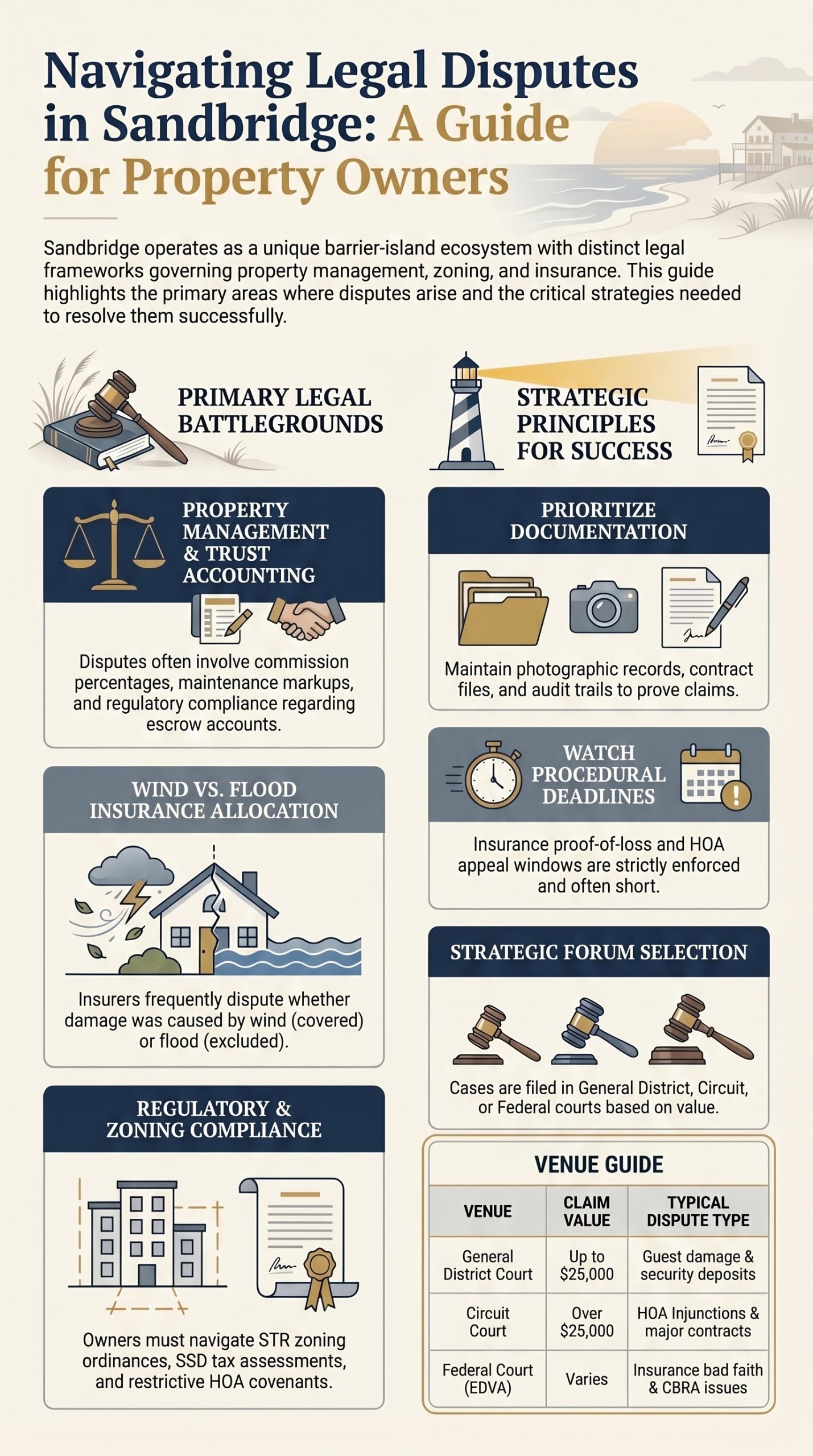
Table of Contents
- The Sandbridge Vacation Rental Environment
- Property Management Agreement Disputes
- Short-Term Rental Zoning and the Sandbridge Special Service District
- HOA, Civic League, and Architectural Review Disputes
- Hurricane, Nor’easter, and Insurance Disputes
- Guest Damage, Cancellation, and Booking Disputes
- Coastal Barrier Resources Act and Flood Insurance Issues
- How Shin Law Office Helps Sandbridge Property Owners
- Summary
- Frequently Asked Questions
- References
Chapter 1: The Sandbridge Vacation Rental Environment
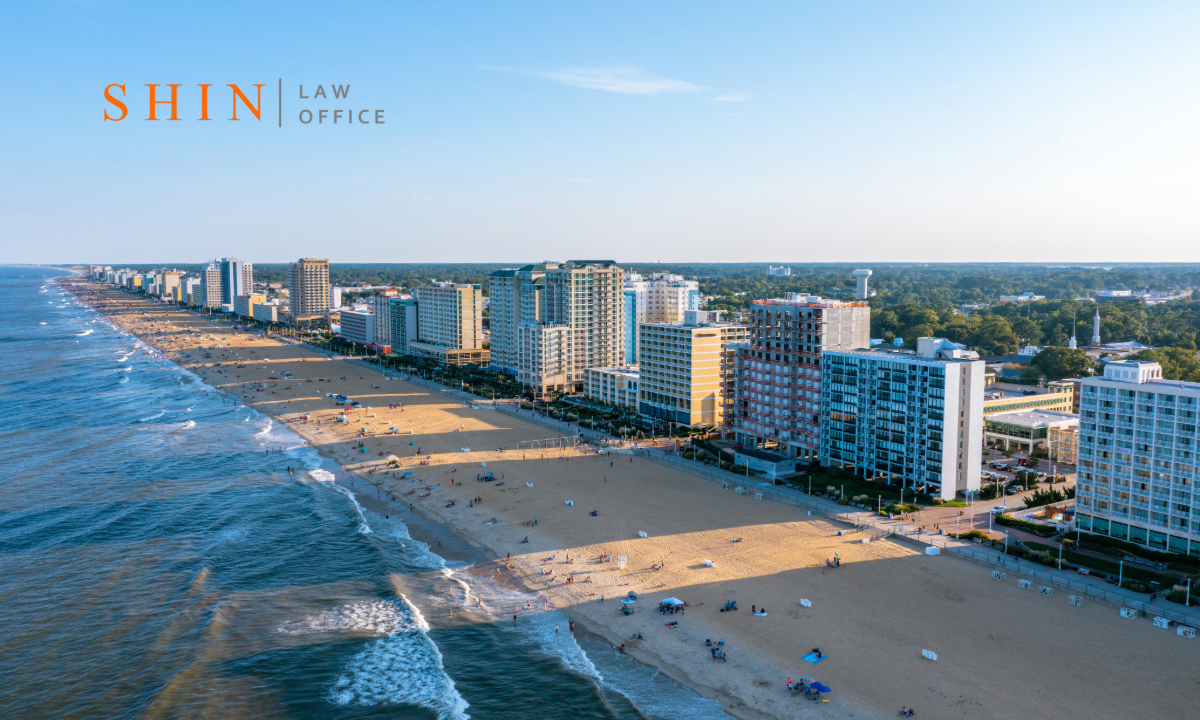
Sandbridge sits at the southern end of Virginia Beach, separated from the mainland by Back Bay and from the rest of the oceanfront by the Naval Auxiliary Landing Field at Dam Neck. Drive south on Sandbridge Road from General Booth Boulevard, cross the bridge over the marsh, and you enter a barrier island community that operates almost as a separate town within the city. Roughly five miles long and a few hundred yards wide at its narrowest point, Sandbridge contains around 1,500 single-family homes, the great majority of which are vacation rentals. The Sandbridge real estate ecosystem generates tens of millions of dollars in seasonal rental revenue and supports a network of property management firms, cleaning companies, repair contractors, and supply vendors that operate almost exclusively within the community.
The geography drives the economics. Oceanfront homes on Sandfiddler Road, Sandpiper Road, and the dune-side stretches command peak summer rental rates of $5,000 to $15,000 or more per week. Bay-side homes along Sandbridge Road and the canal communities rent for less but still produce strong returns. Owners come from across the Mid-Atlantic, with concentrations in Northern Virginia, Richmond, the Roanoke Valley, and the Washington, DC region. Many Sandbridge owners purchased the property as a combined vacation home and investment, and rental income often makes the difference between owning and selling.
Sandbridge’s distinctive legal disputes flow from this concentrated ownership structure and the seasonal nature of the rental market. Property management commission disputes intensify when peak-season bookings produce six-figure revenue, and the owner challenges the manager’s accounting. HOA and architectural review fights flare when owners want to build additions, replace roofs after storm damage, or modify exterior finishes that affect the community’s look. Insurance disputes follow every named storm that touches the Outer Banks or the Mid-Atlantic coast. Short-term rental zoning compliance has become a constant background issue as Virginia Beach has tightened its short-term rental ordinance over the past several years.
The court system that handles Sandbridge disputes is the same one that serves the rest of Virginia Beach. The Virginia Beach Circuit Court (2nd Judicial Circuit) and the Virginia Beach General District Court both sit at the Judicial Center on Nimmo Parkway. Federal cases go to the Eastern District of Virginia, Norfolk Division, which is widely known among litigators as the rocket docket for its compressed timelines. The substantive law is the same Virginia law that applies elsewhere in the Commonwealth, but the practical issues, the typical dispute patterns, and the witnesses who testify in Sandbridge cases differ from anything you find in mainland Virginia Beach. For a broader overview of how vacation property and short-term rental disputes fit into the Virginia Beach litigation framework, see our complete guide to contract disputes in Virginia Beach.
Chapter 2: Property Management Agreement Disputes
Most Sandbridge owners use a local property management firm to handle bookings, guest communication, cleaning, maintenance, and accounting. The major firms operating in the community include Sandbridge Realty, Siebert Realty, Beach Vacation Rentals, and Atkinson Realty, as well as several smaller operators. The standard property management agreement runs three to five pages, sets a commission rate of typically 15 to 25 percent on gross rental revenue, and gives the manager substantial discretion over pricing, marketing, maintenance, and dispute handling. When the relationship works, owners receive monthly statements, see their rental income deposited reliably, and never need to think about the operational details. When the relationship breaks down, the disputes that follow have predictable patterns.
Trust accounting issues are the most serious category. Virginia real estate brokers who hold rental income on behalf of owners must maintain that money in a designated escrow account, separate from the broker’s operating funds, with detailed records under the Virginia Real Estate Board regulations at 18 VAC 135-20-180 and Va. Code § 54.1-2108.1. Owners who suspect commingling, late deposits, or shortfalls in the trust account have remedies at multiple levels. The Virginia Real Estate Board accepts complaints and can suspend or revoke the broker’s license. Civil claims for breach of fiduciary duty and conversion proceed in state court, with potential punitive damages if the conduct meets the standard for actual malice or willful disregard of the owner’s rights.
Commission and accounting disputes are more common than trust account issues, but still require careful analysis. The standard agreement bases commission on “gross rental revenue,” which sounds simple until you examine what is included and excluded. Some agreements deduct credit card processing fees before calculating commission. Some net out cleaning fees or pet fees. Some apply a separate “booking fee” or “reservation fee” to the guest that the manager keeps in addition to commission. Owners should periodically audit the manager’s accounting against the booking platform records and the trust account statements. Discrepancies that surface in an audit often resolve through demand letters, but sometimes require litigation.
Maintenance markup disputes follow a similar pattern. Property managers often hire repair contractors, cleaning crews, and supply vendors and pass the cost through to the owner with a markup. The markup is permitted if the agreement discloses it, but managers who fail to disclose the markup or who inflate it beyond commercially reasonable levels create breach of contract and potentially Virginia Consumer Protection Act exposure under Va. Code § 59.1-200. Sandbridge owners who see maintenance charges that seem disproportionate to the actual work should request the underlying invoices and compare them to market rates.
Termination disputes arise when owners try to switch managers or self-manage, and the existing manager resists the transition. Most agreements include 30-day or 60-day termination provisions, but managers sometimes claim the owner owes commission on bookings that were made before termination but for stays after termination. The contract language controls. Owners who plan to switch managers should review the termination clause carefully, provide written notice in the form required by the agreement, and document the handoff of guest information and pending bookings.
Chapter 3: Short-Term Rental Zoning and the Sandbridge Special Service District
Virginia Beach regulates short-term rentals through its zoning ordinance, with detailed provisions on registration, occupancy limits, parking, signage, and overlay districts that establish where rentals are permitted by right and where conditional use permits are required. Sandbridge sits within an overlay area where short-term rentals are generally permitted, but the registration requirements and the operational rules still apply. Owners who fail to register, who exceed occupancy limits, or who violate parking and noise rules face enforcement action that can escalate from warning letters to citations to revocation of the rental privilege.
The Sandbridge Special Service District is the second layer of regulation that affects rental owners. Created by city ordinance, the SSD imposes an additional tax on Sandbridge properties, with the revenue dedicated to services that benefit the community, including beach replenishment, dune maintenance, and infrastructure improvements. The SSD tax is typically several thousand dollars per year on oceanfront properties and somewhat less on bay-side homes. Owners who dispute the SSD assessment, challenge the use of SSD funds, or face liens for unpaid SSD taxes have administrative and judicial remedies, but the deadlines are short and the procedures are technical.
Beach replenishment is the most visible use of SSD funds. The U.S. Army Corps of Engineers and the city periodically pump sand from offshore borrow areas to widen the beach and rebuild the dune system after storms erode it. The work is expensive, controversial in some respects, and essential to maintaining the property values that fund the SSD. Owners occasionally object to the timing or scope of replenishment projects, the temporary access restrictions during construction, or the SSD assessments that fund the work. Most of these disputes are resolved through the city’s public process, but some end up in litigation when the procedural requirements are not met.
Compliance with the Virginia Beach short-term rental ordinance has become a more active enforcement area in recent years. The city collects transient occupancy taxes from property managers and direct booking platforms like Airbnb and VRBO. Owners who book guests outside the property manager’s system or who use unregistered direct-rental arrangements may inadvertently fall behind on tax remittance, registration renewals, or occupancy reports. The city’s enforcement approach has tightened, and unintentional violations can produce real consequences. Owners who face notices of violation should respond promptly, with counsel if the matter is significant, rather than ignore the notice and hope the issue goes away.
A common Sandbridge compliance trap:
Owners who book guests directly through their own website or through informal channels (rather than through a registered property manager) sometimes assume the bookings fall outside the city’s reporting and tax framework. They do not. Virginia Beach treats direct-booking owners as responsible for their own registration, occupancy reporting, and remittance of transient occupancy tax. Falling behind on these obligations creates exposure that compounds over time and can affect the rental privilege.
Chapter 4: HOA, Civic League, and Architectural Review Disputes
Sandbridge contains several distinct subdivisions, some of which have formal homeowners’ associations with recorded covenants, conditions, and restrictions, and others that rely on the Sandbridge Beach Civic League for community-level coordination. The legal status of the rules differs between these arrangements, and owners who confuse the two sometimes underestimate or overestimate their exposure.
Formal HOAs in Sandbridge are governed by the Virginia Property Owners’ Association Act at Va. Code § 55.1-1800 et seq. The Act establishes board governance, assessment authority, dispute-resolution procedures, and rules for amending governing documents. HOAs in Sandbridge that have recorded declarations of covenants, conditions, and restrictions can enforce architectural standards, restrict short-term rentals in some cases, levy assessments to fund common services, and pursue judicial enforcement against owners who violate the rules. Owners facing HOA enforcement should carefully review the governing documents, identify the specific covenant or rule allegedly violated, and evaluate whether the HOA complied with the procedural requirements before initiating enforcement.
The Sandbridge Beach Civic League is not an HOA in the legal sense. It is a community organization that advocates for Sandbridge interests with city government, organizes community events, and coordinates on issues like beach replenishment and emergency response. The Civic League does not have the legal authority to levy mandatory assessments or enforce architectural rules against non-member owners, although it influences the broader regulatory environment in Sandbridge. Owners who receive Civic League correspondence about community standards should evaluate it for what it actually is: advocacy and information, not legal enforcement.
Architectural review disputes within formal HOAs follow a familiar pattern. An owner wants to add an outdoor shower, replace siding, expand a deck, or rebuild a portion of the home after storm damage. The architectural review committee approves, denies, or requests modifications. The owner disagrees and proceeds with the work or appeals the decision. The HOA pursues enforcement, sometimes with substantial penalties or even injunctive relief. The legal analysis turns on the specific covenants, the procedural fairness of the review process, and whether the committee acted reasonably and consistently with prior decisions. Disputes that reach litigation often turn on whether the HOA enforced the rules selectively, which can create estoppel and waiver defenses for the owner.
Short-term rental restrictions within HOA governing documents have become a more contested area. Virginia courts generally enforce reasonable HOA restrictions on short-term rentals when the governing documents authorize them, but the analysis turns on whether the restriction was in place when the owner purchased, whether it was added later through a valid amendment, and whether it is being enforced consistently. Owners who bought a Sandbridge property specifically for vacation rental income, only to face an HOA later trying to restrict that use, have potential defenses depending on the timing and the language of the documents.
Chapter 5: Hurricane, Nor’easter, and Insurance Disputes
Sandbridge’s barrier-island location means that every named storm that tracks up the Eastern Seaboard, every nor’easter that pushes water into the Mid-Atlantic, and every hurricane that approaches the Outer Banks creates risk of property damage. Recent decades have produced a steady drumbeat of damaging events, including Hurricane Isabel in 2003, Hurricane Sandy in 2012, the multiple nor’easters of 2018, and various smaller storms that have eroded dunes, damaged oceanfront homes, and disrupted rental seasons. Insurance claims after these events generate the most concentrated category of legal disputes that Sandbridge owners face.
Wind versus flood coverage allocation is the central issue in most coastal storm disputes. Standard homeowners’ policies typically cover wind damage but exclude flood damage. Flood damage is covered under separate policies, usually through the National Flood Insurance Program (NFIP) or, for higher-value properties, through private flood insurance. When a storm causes both wind and water damage, insurers and adjusters often dispute which peril caused which damage, with the goal of pushing as much of the loss as possible into coverage the owner does not have or has lower limits. Anti-concurrent causation clauses in many policies further complicate the analysis. Sandbridge owners with storm-damaged homes should document everything photographically, retain independent adjusters when the loss is significant, and resist pressure to accept early settlement offers that may not reflect the full claim.
Loss of rental income coverage is a separate claim that often gets overlooked. Many Sandbridge owners carry policies that include rental income coverage for periods when the property is uninhabitable due to a covered loss. After a storm renders a home unusable for several weeks during peak season, the lost rental income can substantially exceed the physical damage. Insurers sometimes resist these claims by disputing the period of restoration, the rental rates that would have been charged, or the extent to which the property would have been booked. Owners who can document confirmed bookings, historical rental patterns, and the period during which the property was actually unavailable have a stronger claim than owners who rely on general estimates.
Replacement cost versus actual cash value disputes affect the bottom-line recovery. Replacement cost coverage pays the cost to restore the property to pre-loss condition without depreciation. Actual cash value pays the depreciated value of the damaged property. Sandbridge homes are typically several decades old, and the difference between RCV and ACV for roofs, exterior cladding, or interior finishes can run into the tens of thousands of dollars. Owners should know which coverage they have and push for the correct calculation when the insurer applies depreciation that the policy does not authorize.
Bad faith and unfair claim settlement practices arise when an insurer’s conduct crosses from a legitimate dispute into deliberate underpayment, unreasonable delay, or misrepresentation of policy terms. Virginia recognizes statutory remedies for unfair claim settlement practices under Va. Code § 38.2-510, with penalties available when the violations are part of a pattern. The Virginia Consumer Protection Act may also apply when an insurer engages in deceptive practices toward a consumer. Owners who suspect bad-faith conduct should preserve all communications with the insurer, document the claim timeline, and consult counsel before signing any release.
Chapter 6: Guest Damage, Cancellation, and Booking Disputes
Vacation rental guests are a different category of counterparty than residential tenants, and the legal framework that applies to disputes with them differs from standard landlord-tenant law. Guests in a Sandbridge vacation rental are typically governed by the rental agreement, not the Virginia Residential Landlord and Tenant Act, because the stay is shorter than the Act’s threshold. The contract terms drive most disputes, with Virginia common law on contract interpretation supplying the background rules.
Guest damage that exceeds the security deposit is a recurring issue. A standard Sandbridge security deposit ranges from $500 to $2,000 and covers minor damage and excess cleaning, but not major issues like a flooded bathroom from a forgotten faucet, a broken hot tub liner, smoke damage from indoor smoking despite a no-smoking rule, or pet damage despite a no-pet policy. Owners who face damage beyond the deposit have remedies under the rental agreement, through guest damage insurance products offered by some property managers, and through direct claims against the guest if the manager will not absorb the loss. Pursuing guests directly is procedurally cumbersome because the guest is usually out of state, but small-claims-style litigation in the General District Court of the guest’s home jurisdiction is sometimes available, depending on the contract’s forum-selection clause.
Cancellation disputes most often flare up around weather events. A guest with a booking for the week of an approaching hurricane wants a full refund. The owner wants to enforce the contract’s cancellation policy, which typically allows partial refunds within a certain window and no refund within a shorter window. Force majeure language in the rental agreement controls the analysis. Most modern Sandbridge rental agreements specifically address tropical storm and mandatory evacuation scenarios, with refund obligations triggered when the city or the state issues specific evacuation orders. Disputes arise when the storm threatens but does not actually require evacuation, leaving the contractual trigger ambiguous. The owner who refuses a refund in this scenario may be acting consistent with the contract, but the guest may pursue a Virginia Consumer Protection Act claim if the cancellation policy was not clearly disclosed.
Booking platform disputes overlay the direct guest disputes. VRBO, Airbnb, and similar platforms have their own dispute-resolution processes that often resolve guest complaints by issuing refunds from the platform’s reserves and then reimbursing themselves from the host’s future earnings. Hosts who feel the platform’s resolution was unjust have limited recourse against the platform itself, as its terms of service usually require arbitration and limit liability. Virginia owners with significant disputes against booking platforms should review the terms, identify the arbitration procedure, and evaluate whether pursuing the dispute through that channel is worth it. Some platform disputes also have downstream dimensions under the Virginia Consumer Protection Act when the platform’s conduct involves deceptive practices toward the host.
Chapter 7: Coastal Barrier Resources Act and Flood Insurance Issues
The southern portion of Sandbridge sits within a unit designated under the federal Coastal Barrier Resources Act of 1982, codified at 16 U.S.C. § 3501 et seq. The CBRA designation has significant practical consequences for property ownership and financing in the affected area. Properties within a CBRA unit are not eligible for new federal flood insurance through the National Flood Insurance Program. Federally subsidized loans, including most VA, FHA, and USDA-backed mortgages, are unavailable for new purchases of structures in CBRA units. Federal disaster assistance for repairs after a storm is restricted.
Owners and prospective buyers in the CBRA-designated portion of Sandbridge face a different financial profile than owners in the non-CBRA portion. The lender pool is narrower, with private lenders willing to underwrite the property without federal backstop. Flood insurance must come from the private market, with rates that vary substantially and policies that require careful review. Disclosure obligations during purchase transactions are heightened, because a buyer who discovers CBRA status only after closing may have a fraud or nondisclosure claim against the seller and the seller’s agent if the status was not properly identified.
FEMA flood map updates are another moving target. The flood maps that govern flood insurance requirements and elevation standards are periodically updated, and properties that previously sat in lower-risk zones can be reclassified into higher-risk zones, with corresponding increases in insurance premiums and lender requirements. Owners who face premium increases tied to map changes have administrative remedies through FEMA’s appeal process, but the deadlines and procedural requirements are technical. Sandbridge owners facing significant premium increases should evaluate whether the new map designation is supported by the underlying data and whether an elevation certificate or other documentation could support a Letter of Map Amendment or Letter of Map Revision.
Lender disputes about flood insurance coverage and CBRA status occasionally arise during refinancing or sale transactions. A lender who claims the property requires flood insurance the owner does not believe is required, or a lender who refuses to lend because of misunderstood CBRA status, can derail a closing. Owners caught in these disputes should obtain documentation from FEMA confirming the property’s flood zone and CBRA status, present it to the lender, and escalate within the lender’s organization if the front-line response is wrong. Litigation over wrongful refusal to lend is rare but does occur when the lender’s conduct rises to bad faith or violates federal lending laws.
Chapter 8: How Shin Law Office Helps Sandbridge Property Owners
Shin Law Office represents property owners across Virginia, including Sandbridge, the Virginia Beach oceanfront, and the broader Hampton Roads region. As a Virginia-licensed attorney, I represent clients in Virginia state courts and in the U.S. District Court for the Eastern District of Virginia, including the Norfolk Division. The full range of our work in this area is described on our civil litigation practice page.
Sandbridge cases begin with a careful intake. When you call the firm, we collect the property management agreement, the HOA governing documents (if applicable), the insurance policy, and any communications with the counterparty. The first review tells us three things: what claims are available, what the realistic damages look like, and what the procedural posture requires. Some matters resolve through a well-drafted demand letter that cites the controlling statute or contract provision, attaches the supporting documents, and identifies the specific damages calculation. Others require formal litigation, particularly when the counterparty is an insurer with a settled position or an HOA with established enforcement practices.
The choice of forum matters in Sandbridge cases. The Virginia Beach General District Court hears claims up to $25,000 with simplified procedure and resolution typically within 60 to 120 days. Most guest damage and security deposit disputes belong there. The Virginia Beach Circuit Court (2nd Judicial Circuit) handles larger claims and equitable relief, including specific performance against an HOA and injunctions. The U.S. District Court for the Eastern District of Virginia, Norfolk Division, handles federal questions and diversity cases, with its rocket-docket pace producing trial-ready cases within months rather than years. Insurance bad faith claims, CBRA-related federal questions, and substantial multi-claim disputes often belong in federal court.
Discovery is where most Sandbridge cases are won or lost. In a property management dispute, the trust account records, the booking platform statements, and the maintenance invoices establish what actually happened during the period in question. In an insurance dispute, the claim file, the adjuster’s notes, and the engineering reports show whether the carrier handled the claim appropriately. In an HOA dispute, the meeting minutes, the prior enforcement decisions, and the architectural review records show whether the rules were applied consistently. We use depositions, document requests, interrogatories, and requests for admission strategically rather than reflexively, with the goal of producing a clear, contained record by the time a case is ready for resolution.
Most Sandbridge disputes settle once discovery has clarified the facts and the damages exposure. When a settlement is not possible, we try the case. I have represented clients in bench trials and jury trials across Virginia, and I prepare every case as if it will go to trial. The work is detailed, technical, and demanding. That is what tough cases require, and that is what we do.
Summary
Sandbridge vacation rental disputes run through a regional ecosystem unlike anywhere else in Virginia. Property management commission and trust accounting fights driven by concentrated peak-season revenue. Sandbridge Special Service District assessments tied to beach replenishment and dune maintenance. HOA and architectural review enforcement against owners trying to modify or rebuild. Hurricane and nor’easter insurance claims with disputed wind-versus-flood allocations and loss of rental income components. Guest damage and cancellation conflicts shaped by force majeure language and platform terms of service. Federal Coastal Barrier Resources Act restrictions that affect insurance, lending, and disaster assistance. Each category has its own legal framework, and the disputes that arise here are distinctly Sandbridge.
Three principles apply across every category of dispute discussed in this guide. First, documentation matters. The owner with the better contract file, the better trust account audit, the better photographic record after a storm, and the better communications log usually wins. Second, deadlines matter. Insurance proof-of-loss windows, HOA appeal periods, FEMA map appeal procedures, and Virginia statutes of limitations all run on schedules that are not generous. Third, forum matters. The choice between the General District Court, the Virginia Beach Circuit Court, and the EDVA Norfolk Division can change everything about how a case proceeds.
If you own a Sandbridge property and are facing a dispute that will not resolve through normal channels, do not wait for the situation to clarify itself. Get a lawyer involved early, when the evidence is fresh and the procedural options are still open.
Frequently Asked Questions
My Sandbridge property manager’s accounting does not match the booking platform records. What should I do?
Request the underlying records in writing, including the trust account statements, the booking platform reports, the maintenance invoices, and the guest payment records. Reconcile them yourself or with the help of an accountant. If the discrepancies are material, send a written demand identifying the specific issues. If the manager will not respond, the matter may need to escalate to a complaint with the Virginia Real Estate Board and a civil claim for breach of fiduciary duty.
Can my Sandbridge HOA stop me from short-term renting my property?
Possibly, depending on the HOA’s governing documents and the rules in effect when you bought the property. Virginia courts generally enforce reasonable HOA restrictions on short-term rentals when the governing documents authorize them. The analysis turns on whether the restriction was in place at purchase, whether it was added later through a valid amendment, and whether it is being enforced consistently. Owners who bought specifically for rental income have potential defenses depending on the timing.
My oceanfront Sandbridge home was damaged in a storm. The insurer says it was flood damage and not covered. Is that final?
No, not necessarily. Wind versus flood allocation is heavily contested in coastal storm claims. Insurers and adjusters often push damage into the flood category to avoid wind coverage payment. An independent adjuster, photographic documentation taken before any cleanup, and engineering analysis of the actual cause of damage can challenge the carrier’s allocation. Anti-concurrent causation clauses complicate the analysis but do not necessarily defeat the claim.
What is the Sandbridge Special Service District tax?
The SSD is an additional tax imposed on Sandbridge properties beyond the standard Virginia Beach property tax, with revenue dedicated to community-specific services including beach replenishment, dune maintenance, and infrastructure improvements. The amount varies by property type and assessed value. Disputes over SSD assessments have administrative and judicial remedies, but the deadlines are short.
A guest caused $8,000 of damage to my Sandbridge rental. The security deposit was $1,500. How do I recover the rest?
Several options. If your property manager offers guest damage insurance, file a claim under that coverage. Pursue the guest directly under the rental agreement, with the forum selection clause determining where suit can be filed. Some owners elect to absorb smaller losses rather than pursue out-of-state guests, but losses in the $8,000 range often justify pursuit, particularly when the rental agreement supports a Virginia forum.
Is my Sandbridge property in a Coastal Barrier Resources Act unit?
Some Sandbridge properties are in CBRA-designated units, primarily in the southern portion of the community closer to Back Bay National Wildlife Refuge. CBRA designation affects flood insurance availability through NFIP and federal lending eligibility. The U.S. Fish and Wildlife Service maintains official CBRA maps, and FEMA flood maps identify the boundaries. Owners can verify status through these federal resources or through a title professional familiar with the area.
My Sandbridge property manager wants to charge commission on bookings made before I terminated the agreement. Is that valid?
It depends on the specific contract language. Most property management agreements include termination provisions that address pending bookings, but the language varies significantly between firms. Some agreements credit commission to the manager who booked the stay, regardless of who manages it on the actual stay date. Others provide for proration. Review the termination clause carefully and consult counsel before terminating if the pending bookings represent significant revenue.
A storm forced me to close my Sandbridge rental for three weeks during peak season. Can I claim lost rental income?
Yes, if your insurance policy includes loss of rental income coverage and the closure resulted from a covered peril. Document the period of restoration, the rental rates that would have applied during that period, and the bookings that had to be canceled or could not be made. Insurers sometimes resist these claims, but well-documented loss of rental income claims often produce substantial recovery, particularly when peak-season weeks are involved.
How long do I have to file a lawsuit against my Sandbridge property manager?
Five years for breach of a written property management agreement under Va. Code § 8.01-246. Two years for fraud or Virginia Consumer Protection Act claims under Va. Code § 59.1-204.1. Three years for breach of fiduciary duty in some circumstances. The applicable period depends on the specific theory of recovery and when the breach occurred or was discovered. Earlier action generally produces stronger cases.
Where do I file a lawsuit involving my Sandbridge property?
For amounts up to $25,000, the Virginia Beach General District Court at the Judicial Center on Nimmo Parkway. For amounts over $25,000 or for equitable relief, the Virginia Beach Circuit Court (2nd Judicial Circuit) at the same Judicial Center. For federal questions or diversity cases over $75,000, the U.S. District Court for the Eastern District of Virginia, Norfolk Division. The choice of forum often determines the speed and cost of the case.
Facing a Sandbridge Vacation Rental Dispute?
Whether you are a Sandbridge owner with a property management commission dispute, an HOA enforcement action against your renovation plans, an insurance carrier resisting your storm claim, a guest damage situation that exceeded the security deposit, or a Coastal Barrier Resources Act issue affecting your insurance or financing, you deserve a Virginia attorney who understands the law and the Sandbridge market.
Tough cases require tough attorneys. Shin Law Office handles vacation rental and coastal property disputes across the Commonwealth, including Sandbridge, Virginia Beach, and the broader Hampton Roads region.
Call 571-445-6565 or book your case review online at shinlawoffice.com/meet-our-team/contact

References
Code of Virginia. (2024). Title 8.01, Chapter 4: Limitations of actions. Virginia General Assembly. https://law.lis.virginia.gov/vacode/title8.01/chapter4/
Code of Virginia. (2024). Title 38.2, Section 510: Unfair claim settlement practices. Virginia General Assembly. https://law.lis.virginia.gov/vacode/title38.2/chapter5/section38.2-510/
Code of Virginia. (2024). Title 54.1, Section 2108.1: Trust account requirements for real estate brokers. Virginia General Assembly. https://law.lis.virginia.gov/vacode/title54.1/chapter21/section54.1-2108.1/
Code of Virginia. (2024). Title 55.1, Chapter 18: Property Owners’ Association Act. Virginia General Assembly. https://law.lis.virginia.gov/vacode/title55.1/chapter18/
Code of Virginia. (2024). Title 59.1, Chapter 17: Virginia Consumer Protection Act. Virginia General Assembly. https://law.lis.virginia.gov/vacode/title59.1/chapter17/
Coastal Barrier Resources Act, 16 U.S.C. § 3501 et seq. https://www.govinfo.gov/app/collection/uscode
National Flood Insurance Act, 42 U.S.C. § 4001 et seq. https://www.govinfo.gov/app/collection/uscode
U.S. Fish and Wildlife Service. (2024). Coastal Barrier Resources System mapping. https://www.fws.gov/program/coastal-barrier-resources-act
Federal Emergency Management Agency. (2024). National Flood Insurance Program flood maps. https://www.fema.gov/flood-maps
U.S. Army Corps of Engineers, Norfolk District. (2024). Sandbridge Beach Erosion Control and Hurricane Protection Project. https://www.nao.usace.army.mil/
Virginia Real Estate Board. (2024). Regulations governing real estate brokers, 18 VAC 135-20-180 (Trust account requirements). https://law.lis.virginia.gov/admincode/title18/agency135/chapter20/
City of Virginia Beach. (2024). Short-term rental ordinance. https://www.vbgov.com/government/departments/planning/Pages/short-term-rental.aspx
City of Virginia Beach. (2024). Sandbridge Special Service District. https://www.vbgov.com/government/departments/finance/Pages/special-service-districts.aspx
Sandbridge Beach Civic League. (2024). Community information and resources. https://www.sandbridgebeachcl.com/
Virginia Beach City Circuit Court. (2024). Second Judicial Circuit of Virginia. City of Virginia Beach. https://www.vbgov.com/government/departments/courts/circuit-court/Pages/default.aspx
U.S. District Court for the Eastern District of Virginia. (2024). Norfolk Division. https://www.vaed.uscourts.gov/
