
Bottom Line Up Front
I see this issue hit defense, aerospace, and federal contracting companies across Virginia and Maryland all the time. In this region, growth often comes through small-business set-asides, mentor-protégé relationships, joint ventures, and layered prime-subcontractor structures. That creates legal exposure at every stage of the procurement cycle. A company can win on price and technical merit, then lose on size, affiliation, ostensible subcontractor status, NAICS code disputes, or a status protest tied to HUBZone, WOSB, VOSB, or SDVOSB eligibility. Bid protest pressure is real too. GAO reported 1,688 cases filed in fiscal year 2025, a 14 percent sustained rate on the merits, and a 52 percent effectiveness rate based on protesters obtaining some form of relief.
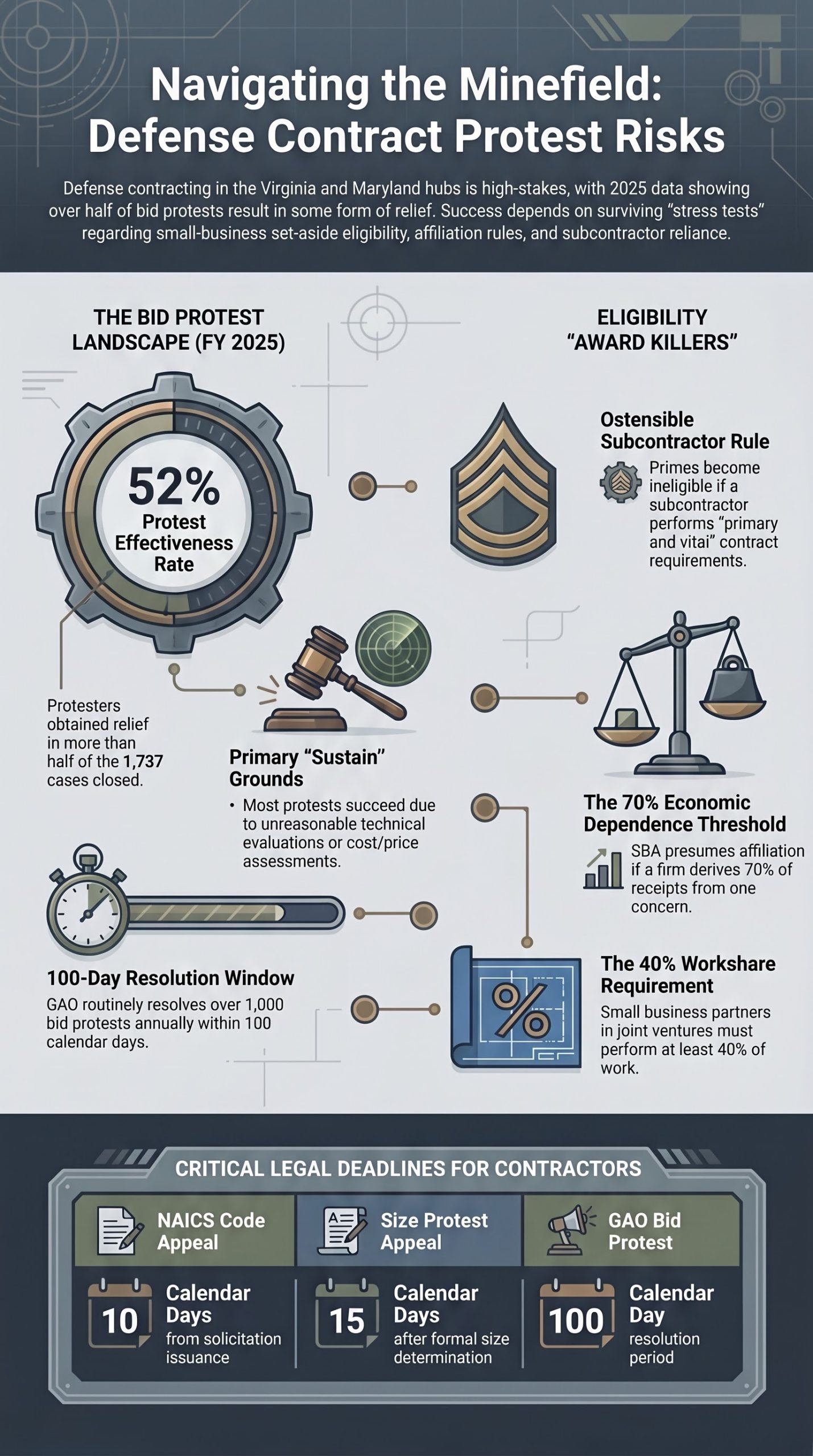
Table of Contents
- Why is this issue so intense across Virginia and Maryland
- What a bid protest really attacks
- How size protests work after apparent award
- Where affiliation fights usually begin
- Why mentor protégé and joint venture structures create pressure
- How ostensible subcontractor problems destroy set aside eligibility
- NAICS code appeals and OHA deadlines
- What I tell contractors to do before they bid
- Summary
- Authoritative sources in APA format
Chapter 1. Why is this issue so intense across Virginia and Maryland
I practice in a market where the density of defense work changes the legal risk profile. Virginia Economic Development Partnership describes Virginia as home to various regional aerospace and defense hubs. Maryland’s Department of Commerce likewise maintains a defense agency directory for agencies and military institutions with headquarters or major operations in the state and says its Office of Military and Federal Affairs works to help Maryland companies grow through government contracts and partnering vehicles. That means these disputes are not confined to a single county or courthouse. They show up across the major defense corridors of both states.
In Virginia, the pressure runs from the National Capital Region down through Hampton Roads. Fort Belvoir says it hosts more than 145 mission partners. Quantico describes itself as the Crossroads of the Marine Corps, where future concepts, training, and equipment are developed. In Hampton Roads, Joint Base Langley Eustis serves both Air Force and Army units, and Joint Expeditionary Base Little Creek Fort Story calls itself the country’s premier installation for housing and training the nation’s expeditionary forces.
Maryland Defense Concentration
Maryland carries the same kind of concentration, but with its own profile. Fort Meade says it supports the nation’s senior platform for intelligence, information, and cyber operations. Aberdeen Proving Ground hosts major tenant organizations, including DEVCOM, ATEC, PEO IEW&S, and Army Contracting Command Aberdeen Proving Ground. Joint Base Andrews houses the 89th Airlift Wing, which provides global Special Air Mission support for the President, Vice President, cabinet members, and senior leaders. When so much federal work sits inside dense defense ecosystems like these, the fights over who is really eligible for a set-aside become sharper and more frequent.
Chapter 2. What a bid protest really attacks
Many contractors talk about bid protests as if they are just a post-award annoyance. I do not see them that way. A protest is often the moment when the entire procurement record is stress-tested. GAO reported that in fiscal year 2025, it received 1,688 cases and closed 1,737. It also reported a 52 percent effectiveness rate, meaning protesters obtained some form of relief in more than half of closed cases. GAO separately states that it routinely resolves over 1,000 bid protests annually within the 100-day calendar period and that protesters achieve some form of relief in approximately 50 percent of cases filed with the Office.
The 2025 GAO annual report is especially useful because it shows what actually broke. GAO reported that the most prevalent grounds for sustaining protests in fiscal year 2025 were unreasonable technical evaluation, unreasonable cost or price evaluation, and unreasonable rejection of proposal. That matters across Virginia and Maryland defense hubs because many of these procurements are technical, evaluation-heavy, and structured around mission performance narratives, staffing plans, past performance, and specialized capabilities.
The Real Scope of Protest Risk
My practical takeaway is simple. In this market, a bid protest is rarely just about one sentence in the source selection decision. It is usually about whether the agency followed the solicitation and whether the offeror’s structure, representations, and proposal approach can withstand scrutiny when a competitor starts pulling on the loose threads.
Chapter 3. How size protests work after an apparent award
Size protests are more technical than many executives realize, and that is exactly why they are dangerous. FAR 19.302 points contractors back to SBA’s size protest rules in 13 C.F.R. part 121. Under SBA’s current rules, interested parties may file size protests in set-aside procurements, and the regulation expressly recognizes that other interested parties can include large businesses where only one concern submitted an offer for the procurement at issue.
Timing matters. SBA’s rules say a protest is premature if filed before bid opening or before notification of the apparent successful offer. A party with standing may file only against an apparent successful offeror or an offeror in line to receive an award. SBA also says it will generally dismiss a size protest tied to an initial apparent successful offeror where an agency takes corrective action in response to a FAR Subpart 33.1 bid protest, and the reevaluation could change who the apparent successful offeror is.
Strategic Timing of Size Protests
That is one reason these disputes are so strategic. A size protest is not just a substantive challenge. It is a sequencing challenge. If the award picture changes after corrective action, the original protest can become moot and the window may reset around a newly identified awardee. Contractors who treat this like background noise often miss the timing issue entirely.
If SBA issues a formal size determination, the appeal clock is short. OHA rules state that size appeals must be filed within 15 calendar days after receipt of the formal size determination. That deadline is unforgiving, and I tell clients not to wait until the internal debate is over before preserving the appeal path.
Chapter 4. Where affiliation fights usually begin
The size fight often turns into an affiliation fight. SBA’s general rule is that concerns are affiliates when one controls, or has the power to control, the other, or when a third party controls, or has the power to control, both. SBA says it looks at ownership, management, prior relationships, and contractual relationships. It also says control may be affirmative or negative, including situations where a minority shareholder can block board or shareholder action beyond a narrow set of extraordinary investor protections.
That matters because many defense companies in Virginia and Maryland are built around investors, spinouts, serial founders, former incumbents, and tightly networked operating teams. SBA’s affiliation rule does not stop at stock ownership. It expressly recognizes affiliation based on common management, identity of interest, and economic dependence. SBA may presume identity of interest based on economic dependence where a concern derived 70 percent or more of its receipts from another concern over the previous three fiscal years.
Newly Organized Concern Risk
I also pay close attention to the newly organized concern rule in this region. SBA says affiliation may arise where former or current officers, directors, principal stockholders, managing members, or key employees of one concern organize a new concern in the same or related field and the older concern furnishes contracts, financial or technical assistance, bond support, or other facilities. In a market with constant spinouts and incumbent-to-challenger migration, that rule is not academic.
Chapter 5. Why mentor protégé and joint venture structures create pressure
Many contractors assume that mentor-protégé structures solve the affiliation problem. They do not. They solve some things and create new ones. SBA’s joint venture rule for small business set-aside work requires that a mentor protégé joint venture designate the small business as the managing venturer and designate a responsible manager with ultimate responsibility for performance. The agreement must address profit distribution, the joint venture account, records, work performance reporting, and other required provisions.
Performance of work is where many teams get exposed. SBA’s rule states that for a contract performed by a mentor-protégé joint venture, the joint venture must meet the applicable subcontracting limitation, and the small business partner must perform at least 40 percent of the work performed by the joint venture. The small business partner’s work must be more than administrative or ministerial to gain substantive experience.
Mentor Protégé Structural Limits
The mentor protégé rule also imposes structural limits that many growing defense contractors overlook. SBA says a mentor cannot be a contract holder through joint ventures with two protégé firms on the same small business multiple award contract or reserve at the same time. In other words, growth through multiple protégés on the same vehicle has a boundary, and teams that ignore it can create downstream eligibility problems.
The broader limitations on subcontracting rule add another pressure layer. For services and supplies contracts, a qualifying prime generally cannot pay more than 50 percent of the amount the government pays to firms that are not similarly situated. For general construction, the cap is 85 percent. For special trade construction, it is 75 percent. SBA also makes clear that for mixed contracts, the NAICS code selected by the contracting officer determines which limitation applies.
Chapter 6. How ostensible subcontractor problems destroy set-aside eligibility
This is where many companies lose the award after thinking the corporate chart looked fine. SBA’s current rule states that an offeror is ineligible as a small business, 8(a), certified HUBZone, WOSB, or EDWOSB, or VOSB or SDVOSB concern where SBA determines there is an ostensible subcontractor. SBA defines an ostensible subcontractor as a subcontractor that is not a similarly situated entity and that performs the primary and vital requirements of the contract or is a subcontractor upon which the prime is unusually reliant.
SBA also gives an important limitation. A prime may use a subcontractor’s experience and past performance to strengthen its offer. The problem arises when that subcontractor will perform the primary and vital requirements or when the prime is unusually reliant on that subcontractor. In service, specialty trade construction, and supply procurements, SBA says it will find that the prime is performing the primary and vital requirements, and is not unduly reliant, where the prime, together with small subcontractors, meets the limitations on subcontracting. That is why the paper structure and the actual workshare have to match.
Status Protest Implications
The status protest rules for the major set-aside programs make this even more important. HUBZone protests expressly allow challenges based on whether the HUBZone prime is unduly reliant on a small, non-similarly situated subcontractor, or whether that subcontractor is performing the primary and vital requirements. WOSB and EDWOSB protest rules likewise allow protests based on unusual reliance or on primary and vital work by a non-similarly situated subcontractor. For VOSB and SDVOSB contracts, SBA says a concern found not to qualify in a status protest may not submit an offer on a future VOSB or SDVOSB procurement until it reapplies and is designated in SBA’s certification database.
There is one important nuance in the 8(a) world. SBA says a participant’s eligibility for a sole-source or competitive 8(a) requirement may not be challenged by another participant or any other party in a bid or other contract protest. But the size status of the apparent successful offeror for a competitive 8(a) procurement may still be protested under the size protest rules. So even where 8(a) eligibility itself is insulated, size is still live in the right setting.
Chapter 7. NAICS code appeals and OHA deadlines
Contractors often focus on size and forget the front end lever that can decide size before a protest ever starts. SBA says a contracting officer’s NAICS code designation may be appealed to OHA, and that administrative remedy must be exhausted before judicial review may be sought. SBA also states that a NAICS code appeal must be filed within 10 calendar days after issuance of the solicitation or an amendment affecting the NAICS code or size standard.
NAICS Code Strategic Impact
That is a major issue in the Virginia and Maryland defense market because procurements often blend engineering, logistics, cyber, manufacturing, intelligence support, and field services. A single NAICS choice can change the size standard and the pool of firms that qualify as small. It can also alter which limitation on subcontracting rule applies, because SBA says the contracting officer’s selected NAICS code is determinative for mixed contracts. That means NAICS, size, subcontracting compliance, and ostensible subcontractor risk often move together.
Chapter 8. What I tell contractors to do before they bid
I tell clients to stop treating eligibility as a box-checking issue handled the week before proposal submission. In this region, eligibility is part of the capture strategy. Before the bid goes out, I want to know who really controls the entity, who has veto rights, who will manage day-to-day performance, where the entity’s past performance comes from, how much revenue dependence exists between the parties, and whether the proposed workshare would survive a line-by-line SBA review.
I also tell contractors to pressure test the protest record before award, not after. That means reviewing the NAICS code, validating small-business status, mapping subcontracting limitations, confirming similarly situated assumptions, and ensuring the proposal does not quietly tell the government that the subcontractor is the real performer. If the capture story says one thing and the operating model says another, that contradiction is usually what kills the award.
Summary
Across Virginia and Maryland defense hubs, these disputes are not side fights. They are award killers. Bid protests attack whether the agency followed the solicitation. Size protests test whether the apparent winner is actually small. Affiliation fights examine control, management, dependence, and business structure. Mentor-protégé and joint venture arrangements create opportunities, but they also create specific compliance obligations. And the ostensible subcontractor rule remains one of the fastest ways for a set-aside prime to become ineligible.
My view is straightforward. In Virginia and Maryland’s defense economy, you do not win these disputes by sounding small, independent, or compliant. You win them by proving it under the actual SBA and protest rules that govern the procurement.
Schedule a Consultation
If your Virginia or Maryland defense contracting company faces bid protest challenges, size protests, affiliation disputes, ostensible subcontractor issues, or set-aside eligibility questions, Shin Law Office provides experienced representation protecting contractor interests in GAO protests, SBA proceedings, and OHA appeals.
Call 571-445-6565 or visit our contact page
Author: Anthony I. Shin, Esq.
Firm: Shin Law Office
Location: Leesburg, Virginia
Authoritative Sources in APA Format
Aberdeen Proving Ground. (2025, May 14). Units & tenant activities. U.S. Army. Retrieved April 19, 2026, from https://home.army.mil/apg/index.php/units-tenants
Acquisition.gov. (2026). FAR Part 19, Small business programs. Retrieved April 19, 2026, from https://www.acquisition.gov/far/part-19
Code of Federal Regulations. (2026). 13 C.F.R. § 121.103, How does SBA determine affiliation? Electronic Code of Federal Regulations. Retrieved April 19, 2026, from https://www.ecfr.gov/current/title-13/chapter-I/part-121/subpart-A/subject-group-ECFR2a69e97634dd7c1/section-121.103
Code of Federal Regulations. (2026). 13 C.F.R. § 121.1001, Who may initiate a size protest or request a formal size determination? Electronic Code of Federal Regulations. Retrieved April 19, 2026, from https://www.ecfr.gov/current/title-13/chapter-I/part-121/subpart-B/section-121.1001
Code of Federal Regulations. (2026). 13 C.F.R. § 121.1004, What time limits apply to size protests? Electronic Code of Federal Regulations. Retrieved April 19, 2026, from https://www.ecfr.gov/current/title-13/chapter-I/part-121/subpart-B/section-121.1004
Code of Federal Regulations. (2026). 13 C.F.R. § 121.1102, Are NAICS code designations subject to appeal? Electronic Code of Federal Regulations. Retrieved April 19, 2026, from https://www.ecfr.gov/current/title-13/chapter-I/part-121/subpart-B/section-121.1102
Code of Federal Regulations. (2026). 13 C.F.R. § 125.6, What are the prime contractor’s limitations on subcontracting? Electronic Code of Federal Regulations. Retrieved April 19, 2026, from https://www.ecfr.gov/current/title-13/chapter-I/part-125/section-125.6
Code of Federal Regulations. (2026). 13 C.F.R. § 125.8, What requirements must a joint venture satisfy to submit an offer for a procurement or sale set aside or reserved for small business? Electronic Code of Federal Regulations. Retrieved April 19, 2026, from https://www.ecfr.gov/current/title-13/chapter-I/part-125/section-125.8
Code of Federal Regulations. (2026). 13 C.F.R. § 125.9, What are the rules governing SBA’s small business mentor protégé program? Electronic Code of Federal Regulations. Retrieved April 19, 2026, from https://www.ecfr.gov/current/title-13/chapter-I/part-125/section-125.9
Code of Federal Regulations. (2026). 13 C.F.R. § 126.801, How does an interested party file a HUBZone status protest? Electronic Code of Federal Regulations. Retrieved April 19, 2026, from https://www.ecfr.gov/current/title-13/chapter-I/part-126/subpart-H/section-126.801
Code of Federal Regulations. (2026). 13 C.F.R. Part 127 Subpart F, Protests. Electronic Code of Federal Regulations. Retrieved April 19, 2026, from https://www.ecfr.gov/current/title-13/chapter-I/part-127/subpart-F
Code of Federal Regulations. (2026). 13 C.F.R. § 128.500, What are the requirements for filing a VOSB or SDVOSB status protest? Electronic Code of Federal Regulations. Retrieved April 19, 2026, from https://www.ecfr.gov/current/title-13/chapter-I/part-128/subpart-E/section-128.500
Code of Federal Regulations. (2026). 13 C.F.R. § 124.517, Can the eligibility or size of a Participant for award of an 8(a) contract be questioned? Electronic Code of Federal Regulations. Retrieved April 19, 2026, from https://www.ecfr.gov/current/title-13/chapter-I/part-124/subpart-E/section-124.517
Code of Federal Regulations. (2026). 13 C.F.R. § 134.304, Commencement of appeals from size determinations and NAICS code designations. Electronic Code of Federal Regulations. Retrieved April 19, 2026, from https://www.ecfr.gov/current/title-13/chapter-I/part-134/subpart-C/section-134.304
Fort Belvoir. (2026). Home. U.S. Army. Retrieved April 19, 2026, from https://home.army.mil/belvoir/
Fort George G. Meade. (2023, October 18). Mission and vision. U.S. Army. Retrieved April 19, 2026, from https://home.army.mil/meade/index.php/about/mission-vision
Government Accountability Office. (2025, December 12). GAO bid protest annual report to Congress for fiscal year 2025 (GAO-26-900695). Retrieved April 19, 2026, from https://www.gao.gov/products/gao-26-900695
Government Accountability Office. (2025, July 22). Bid protests: Key features and trends (GAO-25-108652). Retrieved April 19, 2026, from https://www.gao.gov/products/gao-25-108652
Joint Base Andrews. (2025, September 26). 89th Airlift Wing. U.S. Air Force. Retrieved April 19, 2026, from https://www.jba.af.mil/Units/89th-Airlift-Wing/
Joint Base Langley Eustis. (2026). 633d Air Base Wing. U.S. Air Force. Retrieved April 19, 2026, from https://www.jble.af.mil/
Joint Expeditionary Base Little Creek Fort Story. (2026). Home. U.S. Navy. Retrieved April 19, 2026, from https://www.cnic.navy.mil/regions/cnrma/installations/jeb_little_creek_fort_story.html
Marine Corps Base Quantico. (2026). About. U.S. Marine Corps. Retrieved April 19, 2026, from https://www.quantico.marines.mil/About/
Maryland Department of Commerce. (2026). Maryland defense agency directory. Retrieved April 19, 2026, from https://commerce.maryland.gov/Documents/OtherDocuments/Maryland-Defense-Agency-Directory.pdf
Maryland Department of Commerce. (2026). Office of Military & Federal Affairs. Retrieved April 19, 2026, from https://commerce.maryland.gov/about/office-of-military-and-federal-affairs
Virginia Economic Development Partnership. (2026). Aerospace. Retrieved April 19, 2026, from https://www.vedp.org/industries/aerospace