


Bottom Line Up Front
Chantilly serves as Fairfax County’s defense and aerospace contractor hub, where government contractors, aerospace companies, technology firms, and professional services create civil litigation volume involving government contract disputes, teaming agreement conflicts, intellectual property claims, and employment litigation. When Chantilly defense contractors face prime contractor payment disputes over work acceptance or change order pricing, when teaming partners disagree over subcontract performance obligations or profit sharing allocations, when businesses encounter bid protest challenges or contract claim disputes with government agencies, and when employers face wrongful termination allegations or non compete enforcement demands, experienced legal representation understanding government contracting regulations, teaming arrangements, and Fairfax County courts proves essential protecting contractor interests, enforcing subcontract obligations, and navigating complex federal procurement rules through strategic litigation requiring specialized government contract knowledge and aggressive advocacy.
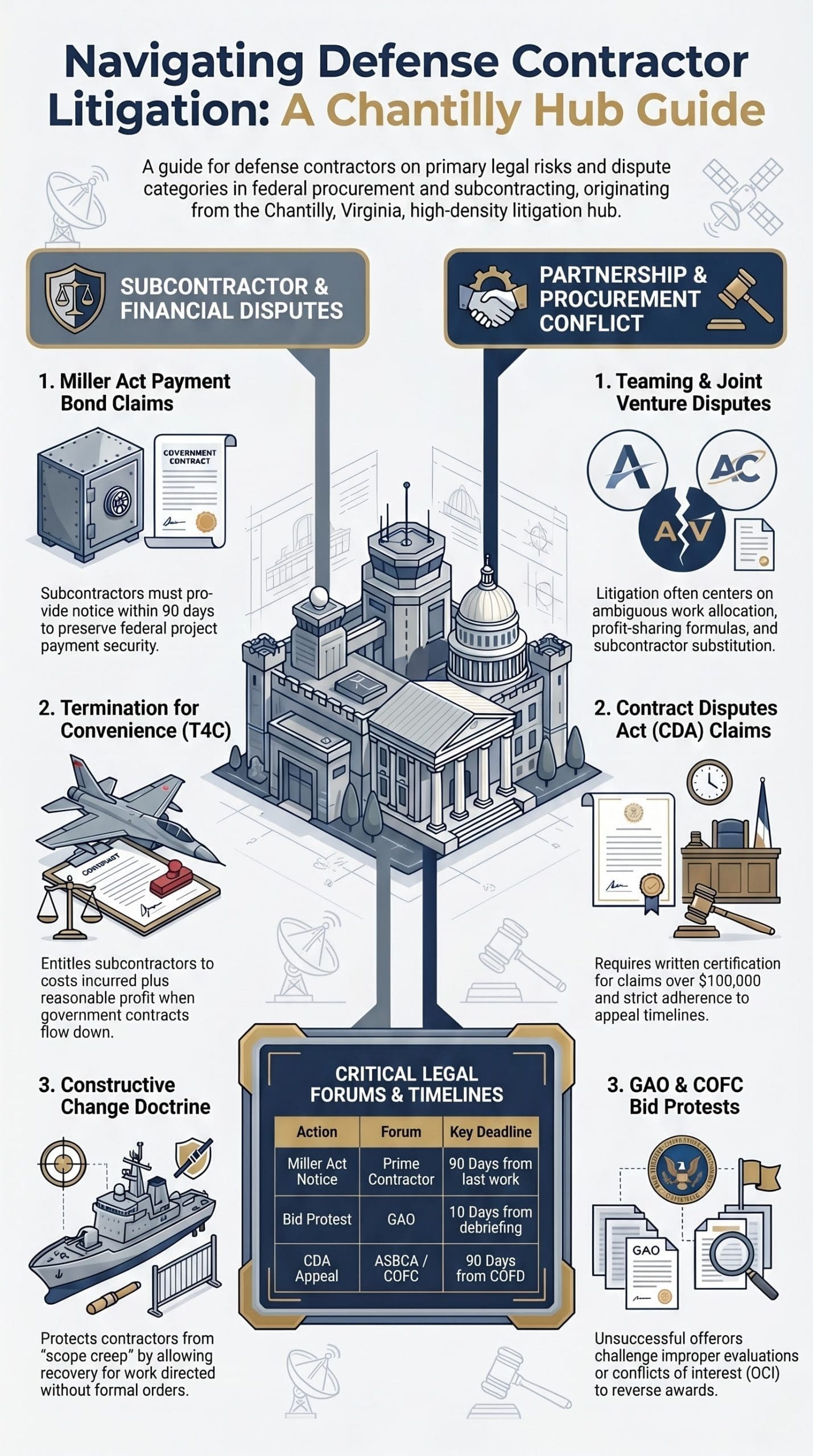
Chantilly’s commercial environment, concentrated near Dulles Airport, the Route 28 corridor, and surrounding aerospace facilities, creates a government contractor-focused business community in which prime contractors, subcontractors, and professional services encounter specialized commercial disputes that require experienced counsel. Northern Virginia commercial litigation encompasses business disputes, contract enforcement, and civil conflicts across Arlington, Fairfax, Prince William, and Loudoun counties. For comprehensive guidance on commercial contract disputes throughout the region, see our complete Northern Virginia Commercial Contract Disputes Guide, which provides strategic approaches to breach of contract litigation, partnership conflicts, and business tort claims across all Northern Virginia jurisdictions.
Prime Contractor and Subcontractor Payment Disputes
Subcontractor payment litigation dominates Chantilly government contractor disputes when prime contractors withhold payment, claiming deficient work performance, contract violations, or government nonpayment, creating subcontractor cash flow crises requiring immediate legal action. Miller Act payment bond claims on federal projects provide subcontractors and suppliers with payment security when the prime contractor defaults, creating nonpayment requiring bond claim filing within statutory periods. Miller Act notice requirements require subcontractors to provide 90 days’ notice to the prime contractor when strict compliance with the notice deadlines is essential to preserving bond claims.
Subcontract termination for convenience provisions permit prime contractors to terminate subcontracts without cause when the government prime contract termination flows down, creating subcontractor termination. Termination for convenience entitles subcontractors to costs incurred, plus a reasonable profit on work performed, when termination settlement procedures require careful cost documentation. Chantilly subcontractors should maintain detailed cost records, understand termination settlement procedures, and negotiate favorable termination provisions when termination for convenience creates a substantial economic impact.
Change order disputes arise when contract modifications, scope changes, or performance conditions result in disagreement over additional compensation, time extensions, or changes to the work scope. Constructive change doctrine provides recovery when government actions or prime contractor directions require additional work or different performance, creating compensable changes absent formal change orders. Chantilly subcontractors should document all scope changes, demand written change authorizations, and preserve changed condition claims when informal scope creep creates substantial uncompensated work.
Pass Through Claims and Sponsorship
Pass-through claims enable subcontractors to pursue claims against the government through prime contractor sponsorship when subcontractors lacking privity with the government require the prime contractor to present them. Severin doctrine requirements mandate that subcontractors prove prime contractor liability or cooperate in pursuing government claims when a pass-through mechanism requires prime contractor support. Chantilly subcontractors should negotiate pass-through claim provisions, maintain cooperation with the prime contractor, and document government-caused damages when pass-through claims are essential to recover government-caused losses.
Teaming Agreement and Joint Venture Disputes
Teaming agreement litigation arises when contractor partnerships formed to pursue government contracts encounter disagreement over work allocation, profit sharing, performance obligations, or contract award responses. Teaming agreements distinguish between prime subcontractor arrangements, in which the prime holds a contract with a subcontractor performing portions of the work, and joint ventures, in which partners share contract responsibility and liability equally. Teaming agreement interpretation requires examining partner roles, profit allocation formulas, performance obligations, and dispute resolution procedures when ambiguous provisions create disagreement.
Work allocation disputes involve partners disagreeing over the division of work scope, performance responsibilities, or subcontractor substitution when assignments affecting profit realization and performance risk create conflicts. Teaming agreements should specify detailed work packages, responsibility matrices, and change procedures when clear work allocation prevents disputes. Chantilly teaming partners should negotiate precise work definitions, understand performance obligations, and document scope changes when work allocation ambiguity creates substantial conflicts.
Profit-sharing disputes arise when teaming agreements specifying profit-allocation formulas lead to disagreement over calculation methodologies, allowable cost treatment, or overhead allocation. Cost-type contracts requiring cost segregation between partners can lead to allocation disputes when shared costs, joint facilities, or common resources require fair allocation. Teaming partners should adopt clear cost accounting procedures, maintain separate books, and regularly reconcile allocations when cost allocation disputes are common and contentious.
Government Contract Claim Disputes
Contract claim litigation under the Contract Disputes Act provides jurisdiction for contractor claims against government agencies when payment disputes, contract interpretation disagreements, or breach claims require formal resolution. CDA claim requirements mandate written claims submitted to the contracting officer, certification for claims exceeding $100,000, and a sum certain or estimated amount when strict CDA compliance proves essential to preserving claim rights. Chantilly contractors should understand CDA procedures, prepare proper claim submissions, and meet certification requirements when procedural defects render otherwise valid claims invalid.
Contracting officer’s final decision provides appeal rights to the Armed Services Board of Contract Appeals or the Court of Federal Claims when COFD proves essential triggering appeal jurisdiction. COFD appeal deadlines require filing within 90 days when strict compliance is mandatory. Contractors disagreeing with contracting officer decisions should preserve appeal rights, meet filing deadlines, and prepare comprehensive appeals when the COFD appeal provides an essential review mechanism.
Equitable adjustment claims seek contract price or schedule adjustments to compensate for contractor impacts from government-caused delays, defective specifications, or changed conditions. Equitable adjustment proof requires establishing government responsibility, demonstrating the contractor’s impact, and calculating a reasonable adjustment when a detailed cost analysis is required. Chantilly contractors should document government-caused impacts thoroughly, maintain contemporaneous records, and quantify damages carefully when equitable adjustment claims require substantial proof.
Defective Specification Claims
Defective specification claims arise when government-provided specifications prove impossible or impracticable, or result in defective performance when contractors, following the specifications, encounter problems and assert government specification liability. The distinction between design and performance specifications affects liability allocation: when the government specifies detailed design and assumes responsibility for adequacy, while performance specifications describe required results, placing design responsibility on contractors. Chantilly contractors should identify specification type, document specification defects, and notify the government promptly when defective specification claims require establishing government design responsibility and specification inadequacy.
Bid Protest and Competition Disputes
Bid protest litigation challenges government contract awards when unsuccessful offerors allege improper evaluation, specification defects, or violations of procurement regulations and seek reversal of the award or recompetition. Government Accountability Office protest jurisdiction provides expedited review when GAO protests are filed within 10 days of debriefing or award knowledge, and results in quick decisions. Chantilly contractors considering protests should evaluate protest grounds, meet filing deadlines, and prepare comprehensive protests when GAO procedures favor well-prepared challenges.
The Court of Federal Claims provides an alternative protest forum when post-award protests seeking monetary relief require COFC jurisdiction. Protest grounds include evaluation errors, specification defects, conflicts of interest, or procurement regulation violations, and may result in overturning awards, requiring re-evaluation, or awarding damages. Contractors should analyze solicitation requirements, evaluation criteria, and award decisions, identifying challengeable defects when bid protests prove expensive and require careful evaluation.
Organizational conflicts of interest create grounds for protest when contractors with unfair competitive advantages through prior government work, access to nonpublic information, or evaluation roles face disqualification. OCI mitigation plans addressing potential conflicts through firewalls, disclosure, or recusal may permit participation when inadequate mitigation creates protest vulnerability. Chantilly contractors should identify potential OCIs, implement mitigation measures, and disclose conflicts when OCI allegations prove common protest grounds.
Employment Litigation in Defense Contracting
Security clearance disputes arise when contractor employees who have lost clearances face termination or reassignment when clearance requirements make continued employment impossible. Terminated employees may challenge clearance denials or revocations through administrative appeals, as such denials or revocations are often due to financial problems, foreign contacts, or criminal conduct. Chantilly contractors should understand clearance requirements, assist employees with appeals, and, when possible, offer alternative positions to avoid wrongful termination claims.
Non-compete enforcement among defense contractors is particularly important when employees with classified information or sensitive technical knowledge face restrictions on competitive employment. Legitimate business interests, including classified information protection, proprietary technology, and customer relationships, justify restrictions when clearance requirements and classification prove non-compete enforcement. Chantilly employers should tailor restrictions that protect genuine interests without unreasonable employment restraints, given that courts carefully scrutinize them.
Wage hour compliance on government contracts requires Davis-Bacon prevailing wage payment, Service Contract Act wage determinations, or Fair Labor Standards Act compliance, depending on contract type. Prevailing wage violations create back wage liability, contract termination, and debarment when strict compliance proves mandatory. Chantilly contractors should understand applicable wage laws, pay required rates, and maintain proper records when wage violations create substantial exposure.
Intellectual Property and Data Rights Disputes
Data rights disputes under FAR data rights clauses arise when contractor-developed technical data, computer software, or inventions are developed under contractor-funded rather than government-funded arrangements, thereby affecting rights allocation. Limited rights in contractor-developed technology versus unlimited rights in government-funded development create substantial value differences. Chantilly contractors should protect proprietary technology through proper rights assertions, marking requirements, and license negotiations when data rights prove an essential competitive advantage.
Patent rights under the Bayh-Dole Act permit contractors to retain title to inventions made with government funding, subject to government licensing, provided the contractor’s obligations include disclosure, election, and filing requirements. The government’s march toward rights enables it to require licensing when contractors fail to achieve practical application. Contractors should comply with Bayh-Dole obligations, protect patent rights, and commercialize inventions when march-in rights require diligent commercialization.
Schedule a Consultation
If you face Chantilly civil litigation involving government contract disputes, subcontractor payment claims, teaming agreement conflicts, or bid protest challenges, Shin Law Office provides experienced representation protecting contractor interests through strategic advocacy.
Call 571-445-6565 or visit our contact page
