


Stepparent Adoption in Newport News, Virginia: A Peninsula Attorney’s Guide for the Stepparent Who Has Been Doing the Job and Wants the Law to Catch Up
By Anthony I. Shin, Esq. | Shin Law Office | Notes from a Virginia Attorney on the Adoption Cases That Make the Family on Paper Match the Family in Real Life
BOTTOM LINE UP FRONT
If you are reading this, you are probably the person who has been getting up in the middle of the night when the child has a fever. You are the one in the bleachers at the soccer field, the one signing the permission slips, the one helping with homework, the one teaching them how to ride a bike. The child calls you “Mom” or “Dad”. The biological parent left, or stopped showing up, or never really showed up to begin with. You have been doing the job. You want the law to recognize what the family already knows. That is what stepparent adoption does.
Virginia law makes this possible. Va. Code § 63.2-1241 and the surrounding sections govern stepparent adoption, with consent of the absent biological parent or, in many Newport News cases, without consent when the absent parent has not had meaningful contact or paid support for at least six months. The case is filed in Newport News Circuit Court at 2500 Washington Avenue. The path is real. The result is permanent. The relationship that already exists between you and the child becomes the relationship the law recognizes.
If you are ready to talk through what stepparent adoption looks like for your family, call Shin Law Office at 571-445-6565.
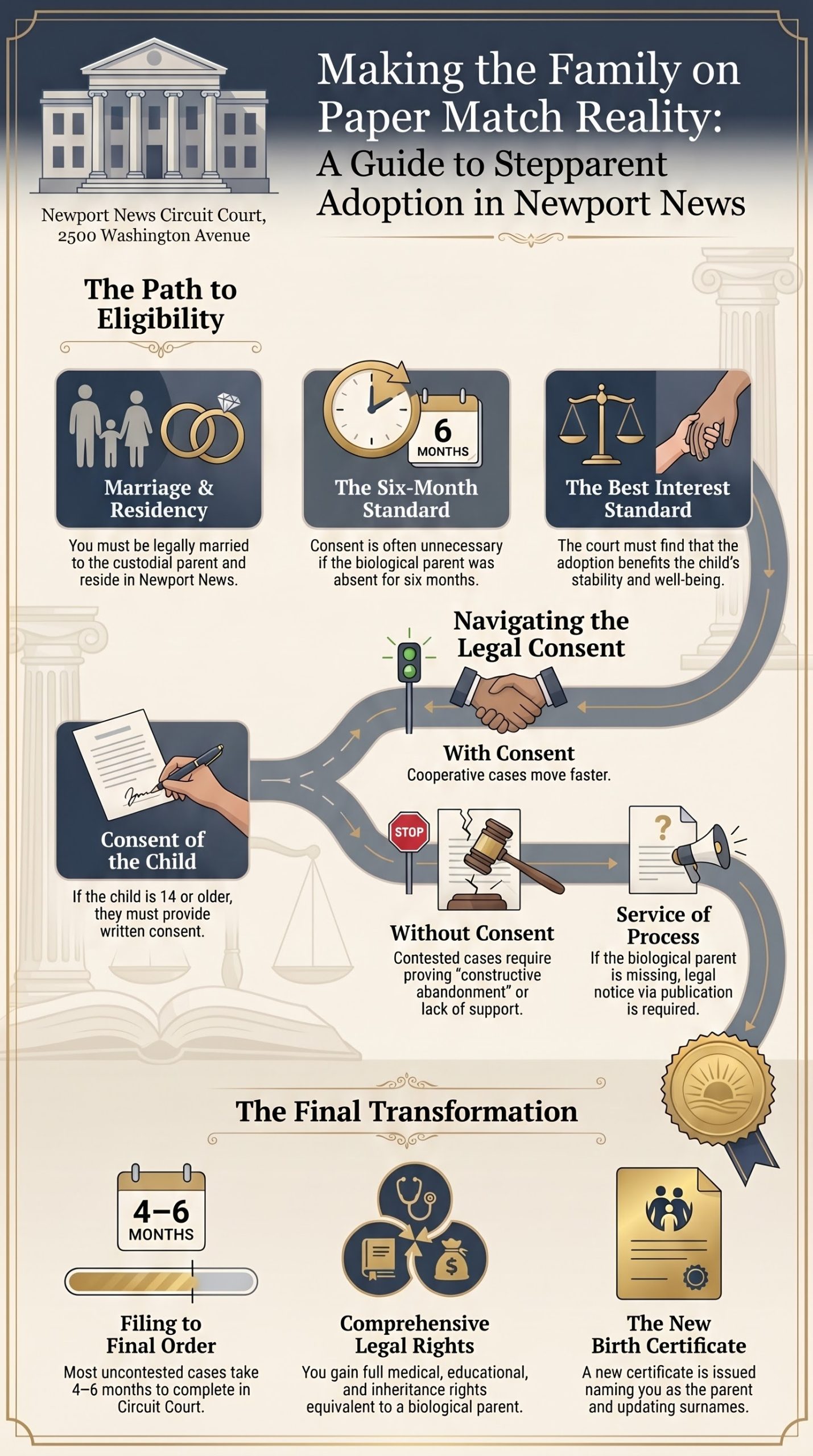
Table of Contents
- The Shipyard Welder Who Wanted His Daughter on Paper Too
- When Stepparent Adoption Is the Right Step
- What Virginia Law Requires
- The Consent Question: When the Other Parent Agrees
- Proceeding Without Consent: When the Absent Parent Will Not Sign
- The Newport News Procedure From Filing to Final Order
- What the Adoption Changes (and What It Cannot Change)
- What I Tell Peninsula Stepparents in the First Meeting
- Summary
- Frequently Asked Questions
- References
Chapter 1: The Shipyard Welder Who Wanted His Daughter on Paper Too
He came in on a Tuesday afternoon, after second shift had ended at the yard. He sat across from me with his wife, trying to find the words. They were not legal words. They were the words a man used when he wanted to talk about the girl who had been calling him Dad since she was three. She was nine now. The biological father had not seen her since she was four. Had not sent a birthday card. Had not paid a dollar of child support since the year before that. The wife and I had a friend in common, and that is how the welder ended up in my office.
What he wanted to know was simple. Could he be her father on paper, the way he was her father in every other way that mattered? If something happened to his wife, would the biological father be able to come back and take her? Could he sign her up for school sports without explaining the situation to the front office? Could he pick her up from the doctor’s office? Could she carry his last name when she started middle school in the fall?
I told him what I tell every Peninsula family that walks in with a similar story. Yes, this is possible. Virginia law has a path for it. The process is called stepparent adoption, and it culminates in a court order from Newport News Circuit Court that declares you the child’s legal father. The biological father’s parental rights end. Your name goes on a new birth certificate. The school, the doctor, the social security records, the insurance, the inheritance laws, the emergency contact forms, all of it changes to reflect what the family has known for years. The girl has one mother and one father, and you are the father.
We filed the petition that fall. We documented the years of absence. The biological father did not respond to the service. The court found that his consent was not required because of the constructive abandonment standard at Va. Code § 63.2-1202. The hearing was short, and the judge spoke directly to the girl, who, in the matter-of-fact way nine-year-olds use, explained that the man sitting next to her was her dad. The order was entered before Christmas. The new birth certificate came in January. He keeps a copy in his wallet. For a broader background on family law in our region, see our cornerstone guide on family law in Newport News, Virginia.
Chapter 2: When Stepparent Adoption Is the Right Step
Most of the Peninsula stepparent adoption cases I have handled fall into a few patterns. Reading them, you may recognize your own family.
The Long Absence
The most common pattern. The biological parent left when the child was very young, or sometime later, and has not been meaningfully present for years. There has been no support. There have been no birthdays, no holiday calls, no weekend visits. Sometimes the absent parent moved to another state. Sometimes, nobody knows where they went. The child has grown up with the stepparent in the role the absent parent vacated, and at some point, the family decides that the legal record should match the actual record.
The Cooperative Co-Parent Who Wants to Step Aside
Less common but real. The biological parent recognizes that the child has a stable, loving home with the other parent and a stepparent who is doing the parenting work, and decides that the right thing for the child is to formalize that arrangement. The biological parent consents to the adoption, signs the necessary paperwork, and the case proceeds with cooperation rather than dispute. These cases are often the easiest from a procedural standpoint, although they still involve a serious legal change that should not be entered into casually.
The Death of a Biological Parent
When a biological parent has died, the surviving parent’s new spouse can adopt the child without any consent issue from the deceased parent’s side, although other relatives may still have notice rights. These cases often arise after a period of grief, when the new family has stabilized and the stepparent’s role has become clear.
The Active Risk Case
Sometimes the issue is more pressing. The biological parent has substance abuse problems, mental health crises, or a history of involvement with the criminal justice system that makes their potential return to the child’s life concerning. Stepparent adoption ends the biological parent’s legal rights and forecloses any future attempt to assert custody or visitation. For families in this situation, the adoption provides protection, not just symbolic recognition.
The Estate and Inheritance Concern
A stepparent who has raised a child and considers them their own may want the child to have the same legal inheritance rights as a biological child. Virginia intestate succession does not give stepchildren automatic inheritance rights from a stepparent. Stepparent adoption fixes this by making the legal relationship complete. Even with a will, certain protections (such as the elective share, certain insurance defaults, and Social Security survivor benefits) flow from the legal parent-child relationship.
The Identity and Belonging Reason
Sometimes the reason is not legal at all. The child wants to share their stepparent’s last name. The family wants the school records to show one set of parents, not a complicated mix. The stepparent wants the legal recognition that they are not just a substitute but a parent. These reasons are valid, and Virginia courts respect them when the underlying circumstances support adoption.
Chapter 3: What Virginia Law Requires
Stepparent adoption in Virginia is governed by Va. Code Title 63.2, with the specific stepparent provisions at Va. Code § 63.2-1241 et seq. Several requirements have to be satisfied before the court can enter the order.
Marriage to the Biological Parent
The stepparent must be married to one of the child’s biological parents. The marriage must be valid under Virginia law. There is no minimum duration the marriage must have lasted before adoption can be sought, although longer marriages tend to produce stronger cases on the best interest analysis. For Peninsula couples who have been married for several years and have established a stable family unit, this requirement is rarely a problem.
Residency
The petition is filed in the Circuit Court of the city or county where the child resides. For Newport News families, that is the Newport News Circuit Court. For families in adjacent jurisdictions such as Hampton, York County, Williamsburg, James City County, or Poquoson, the petition is filed in the appropriate court. The residency requirement is straightforward in most cases.
The Best Interest Standard
Like every other major family law decision in Virginia, the court evaluates whether the adoption is in the child’s best interests. The court looks at the established relationship between the stepparent and the child, the stability of the home, the absent parent’s involvement (or lack of it), and the broader picture of what life will look like for the child after the adoption. For Peninsula families with strong, stable stepparent relationships, the best interest finding is usually straightforward.
Consent or Statutory Grounds for Proceeding Without It
The biological parent whose rights will be terminated must either consent to the adoption or fall within one of the statutory grounds for proceeding without consent under Va. Code § 63.2-1202. This is the most legally substantive requirement and often the most emotionally complicated, and Chapters 4 and 5 below address it in more detail.
Adoption Investigation
For most non-stepparent adoptions, Virginia requires a full investigation by the local Department of Social Services or a licensed agency. For stepparent adoptions, Va. Code § 63.2-1241 streamlines the process, and a full home study investigation is typically not required. The court can still order an investigation if specific concerns arise, but the default for stepparent cases is a more efficient procedural path.
Background Checks
The stepparent will be subject to criminal history and child protective services background checks. These are routine for adoption cases. A clean background is typically sufficient. A history of serious offenses can complicate the case, though it does not automatically disqualify the stepparent in every situation.
Chapter 4: The Consent Question: When the Other Parent Agrees
When the biological parent whose rights will be terminated agrees to the adoption, the case is much simpler. The path is shorter, the cost is lower, and the emotional weight is less.
What Consent Looks Like
Consent under Va. Code § 63.2-1233 has to be in writing, signed by the biological parent, and acknowledged before a notary or signed in the presence of certain authorized officials. The consent has to be informed, meaning the biological parent understands what they are giving up. They are not just permitting an adoption. They are terminating their parental rights, including any future custody or visitation rights and any future obligation to pay support.
Why a Biological Parent Might Consent
The reasons vary. Some biological parents recognize that they have not been a meaningful presence in the child’s life and that the child is better served by formalizing the arrangement that already exists. Some have started new families and want to release themselves from a prior obligation. Some are trying to do right by the child despite their own limitations. Whatever the reason, when the biological parent agrees, the case can move forward without the contested termination process.
When Consent Cannot Be Revoked
Once consent is properly executed and the adoption proceeds, revocation becomes very difficult. Virginia law sets specific rules about when consent becomes irrevocable. A biological parent who has second thoughts after signing typically cannot undo the consent simply by changing their mind. This finality is part of what protects the adopting family from later disputes, although it is also why the consent process should be approached carefully and with full understanding by everyone involved.
Consent of the Custodial Biological Parent
In a stepparent adoption, the custodial biological parent (the spouse of the adopting stepparent) also has to consent to the adoption. This is usually a formality because the adopting stepparent and the custodial parent are working together on the case, but the consent has to be properly documented in the petition.
Consent of the Child
If the child is fourteen years old or older, Virginia law requires the child’s written consent to the adoption. This is a meaningful protection. Older children have a voice in whether they want to be legally adopted, and the law respects that voice. For children under fourteen, consent is not required, but the court will often consider the child’s wishes informally as part of the best interest analysis.
Chapter 5: Proceeding Without Consent: When the Absent Parent Will Not Sign
In most of the Peninsula stepparent adoption cases I see, the biological parent will not sign a consent. They have been absent for years. Sometimes they are hostile to the idea. Sometimes they cannot be located at all. Virginia law provides a path forward in these situations. Va. Code § 63.2-1202 sets out the grounds for proceeding without consent, and Va. Code § 63.2-1203 governs cases where the court finds that withholding of consent is contrary to the best interest of the child.
The Six Month Constructive Abandonment Standard
The most commonly used path. When a biological parent has not visited or contacted the child for at least six months immediately preceding the petition, and has not provided meaningful financial support for the child, the court can find that consent is not required. The standard is sometimes called constructive abandonment. The six month period is the minimum, but in most Peninsula cases the actual absence has been substantially longer, which strengthens the petition.
What Counts as Contact
Courts look at meaningful contact, not technical contact. A single phone call after years of silence does not reset the six month clock. A birthday card without follow-through does not establish a relationship. The analysis looks at whether the biological parent has played any real parental role in the child’s life. For most cases where the absence has been long and substantial, this analysis is straightforward.
What Counts as Support
Similarly, the support analysis looks at whether the biological parent has actually contributed to the child’s care. A history of unpaid child support, with arrears growing year after year, weighs against the absent parent. Sporadic small payments do not necessarily meet the standard if the absent parent had the means to pay more. The court looks at the totality of the financial picture.
When the Absent Parent’s Whereabouts Are Unknown
Sometimes the biological parent has simply disappeared. Has not been heard from in years. Last known address is invalid. The Peninsula custodial parent has no idea where to find them. Virginia law allows for service by publication or other constructive service in these cases, after a documented diligent search. The court can proceed even if the absent parent never receives actual notice, provided the diligent search and the constructive service requirements are satisfied.
When the Absent Parent Contests the Adoption
The harder cases. The absent parent receives notice, hires a lawyer, and contests the adoption. Sometimes they claim recent contact that does not exist or exaggerate the importance of minor contacts. Sometimes they claim financial support that was not actually provided. Sometimes they make a sudden show of effort right before the hearing in an attempt to manufacture a record. These cases require more substantive court work, including evidentiary hearings, witness testimony, and detailed documentation. They are still winnable when the underlying facts support the petition, but they take more time and more cost.
Withholding of Consent Contrary to the Child’s Best Interest
Va. Code § 63.2-1203 provides an additional path. Even when the biological parent does not meet the constructive abandonment standard at § 63.2-1202, the court can find that the parent’s withholding of consent is contrary to the best interest of the child and can proceed with the adoption. This standard requires more substantial proof and a more thorough best interest analysis, but it provides a path forward in cases where the absent parent’s involvement has been minimal but does not quite meet the technical six month threshold.
Chapter 6: The Newport News Procedure From Filing to Final Order
For Newport News families, the case proceeds through Newport News Circuit Court at 2500 Washington Avenue. For Hampton families, it proceeds through Hampton Circuit Court. For York County, James City County, Williamsburg, and Poquoson, the case proceeds through the corresponding Circuit Court. The procedural rhythm is similar across the Peninsula.
Filing the Petition
The case begins with a petition for adoption filed in Circuit Court. The petition identifies the adopting stepparent, the custodial biological parent, the child, and the other biological parent whose rights will be terminated. The petition states the legal grounds for the adoption, including the basis for proceeding without consent if applicable, and describes the family relationship that already exists.
Service on the Biological Parent
The biological parent whose rights will be terminated must be served with the petition. If their address is known, personal service or substituted service is used. If their whereabouts are unknown, service by publication after a diligent search is used. The diligent search needs to be documented carefully because the court will examine whether reasonable efforts were made to locate the absent parent.
Background Investigation
The stepparent submits to criminal history background checks and child protective services record checks. These typically take a few weeks to complete. A clean record satisfies this requirement without difficulty.
The Hearing
The court schedules a hearing on the petition. For uncontested cases, the hearing is often relatively brief. The judge reviews the petition, confirms that the legal requirements are met, and listens to testimony from the adopting stepparent and the custodial biological parent. If the child is old enough to participate meaningfully, the judge may speak with the child, sometimes in chambers rather than in open court. Newport News Circuit Court conducts these hearings in a generally welcoming manner rather than in an adversarial manner.
For Contested Cases
When the absent biological parent contests the adoption, the hearing is more substantive. There may be testimony, exhibits documenting the absence, witnesses to the stepparent’s role in the child’s life, and cross-examination of the absent parent. These hearings can take longer and require more preparation, but they remain manageable when the underlying facts support the petition.
The Final Order
If the court grants the petition, it enters an Order of Adoption. The order terminates the absent biological parent’s parental rights, establishes the stepparent as the legal parent, often changes the child’s last name to match the adoptive family, and directs the issuance of a new birth certificate showing the adopting stepparent as the parent. The new birth certificate is issued by the Virginia Department of Health, Office of Vital Records, and typically arrives within a few weeks.
Realistic Timeline
For an uncontested case, the typical timeline from filing to final order is roughly four to six months. For contested cases or cases requiring extensive diligent search, the timeline can extend to a year or longer. The new birth certificate adds a few weeks after the final order. Most families plan their decisions around the practical timeline rather than expecting an instant result.
Chapter 7: What the Adoption Changes (and What It Cannot Change)
When the order enters, the legal change is comprehensive. Understanding what the adoption actually changes helps families plan for life after the order.
Legal Parental Rights
The stepparent becomes the legal parent of the child. They have the same rights and responsibilities as a biological parent. They make medical decisions. They make educational decisions. They can sign permission slips, pick the child up from school, consent to surgery, register the child for activities, and participate in any other parental decision the same way they would for a biological child. And it matters that if the custodial biological parent dies, the adopting stepparent continues as the child’s legal parent without any custody dispute.
End of the Other Biological Parent’s Rights
The biological parent whose rights are terminated loses all legal connection to the child. They cannot seek custody. They cannot seek visitation. They cannot make decisions about the child. They are also released from any future obligation to pay child support, although this does not erase past-due support that was already owed.
Inheritance and Succession
The child gains full inheritance rights from the adopting stepparent under Virginia intestate succession laws. The child is recognized as a legal child with the same priority as biological children. Conversely, the child loses inheritance rights from the biological parent whose rights were terminated, except in limited circumstances specified by statute.
Insurance and Benefits
The child becomes eligible for the stepparent’s employer-sponsored health insurance, life insurance benefits, retirement plan survivor benefits, and other benefits available to dependent children. For Peninsula families where the stepparent is at HII, Joint Base Langley-Eustis, NASA Langley, Jefferson Lab, or another employer with substantial benefits, this can be a meaningful practical change.
Name Change
The order can change the child’s last name to the adopting family’s name. This is often part of the petition, and the new birth certificate reflects the change. For older children whose names have been their identity for years, the choice about whether to change their names should involve them. For younger children, the change is usually less complicated.
What Adoption Cannot Change
Some things stay the same. The child’s biological history is what it is. Medical history from the biological parents’ family remains relevant for genetic and health purposes, even after the legal relationship ends. The child’s memories, relationships with extended biological family, and personal identity questions do not change because of a court order. Adoption is a legal act, not a memory eraser. Many adopting families talk openly with the child about their full history while building a new legal structure that supports them. For more on the broader Newport News family law context, see our cornerstone guide to Newport News family law and the firm’s family law practice page.
Chapter 8: What I Tell Peninsula Stepparents in the First Meeting
When a stepparent and their spouse come to my office for a stepparent adoption consultation, I tell them five things in the first meeting.
First, this is a real legal change with real consequences, and we are going to take it seriously. The relationship you have already been building for years is the foundation, but the legal step we are about to take is permanent. Once the order is entered, the absent biological parent’s rights are gone. Once the new birth certificate issues, the legal record is what it is. We do this carefully because we are doing it once.
Second, tell me everything about the absent parent. Where they last lived. When you last heard from them. Whether they have paid any support. Whether they have sent any cards or made any phone calls. Whether they have other children. Whether they have any criminal history. Whether anyone in their family stays in touch with the child. The details matter, and the more I know about the actual history, the better I can build the case.
Third, we need to think about timing. Stepparent adoption cases typically take four to six months from filing to final order, longer if contested or if the absent parent’s whereabouts are unknown. If you have a specific date in mind (a school year transition, a milestone birthday, a family event), we should plan around that. Rushing the process produces worse results. Beginning early is better.
Fourth, we are going to talk to the child appropriately for their age. For very young children, the conversation is simple. For older children, particularly those over fourteen who must consent, the conversation has to be honest and complete. The child is not a passive participant in this. They are the most important person in the case. How we frame the adoption to them matters, and most stepparent families benefit from thinking carefully about how to have the conversation.
Fifth, we are going to update everything else after the order enters. The Social Security record. The school records. The doctor’s office. The insurance carrier. The estate planning documents. The beneficiary designations on retirement accounts and life insurance. The adoption is the legal step, but the practical work of integrating the legal change into the rest of the family’s life takes attention afterward, and the parents who handle that promptly avoid the loose ends that can complicate things later.
Summary
Stepparent adoption in Newport News and across the Virginia Peninsula gives blended families a legal structure that matches the actual family structure. For families where the biological parent has been absent, has stopped paying support, has died, or has agreed to step aside, Va. Code § 63.2-1241 et seq. provides a path forward. The case is filed in Newport News Circuit Court for Newport News families and in the corresponding Circuit Court for families in Hampton, York County, Williamsburg, James City County, or Poquoson.
The legal requirements include marriage to the custodial biological parent, the best interest of the child standard, and either the absent biological parent’s consent or one of the statutory grounds at Va. Code § 63.2-1202 for proceeding without consent. The most common ground is the six month constructive abandonment standard, which applies when the biological parent has not had meaningful contact with or provided meaningful support to the child for at least six months immediately before filing. Va. Code § 63.2-1203 provides an additional path when withholding of consent is contrary to the child’s best interest.
When the order enters, the change is comprehensive. The stepparent becomes the legal parent. The absent biological parent’s rights and obligations end. The child gains full inheritance rights from the adopting family. The new birth certificate shows the adopting stepparent as the parent. For the family that has been doing the work of parenting all along, the legal recognition of that work brings clarity, protection, and the kind of permanence that supports the child for a lifetime.
Frequently Asked Questions
How long does a stepparent adoption take in Newport News?
For an uncontested case, typically four to six months from filing the petition to entry of the final order, plus a few additional weeks for the new birth certificate to issue. Contested cases or cases requiring diligent search for an absent parent can take a year or longer. Beginning early gives the family the most flexibility.
Do I need the biological father’s permission to adopt my stepchild?
Often, but not always. If the biological father consents, the case proceeds with cooperation. If he will not consent or cannot be located, Va. Code § 63.2-1202 provides grounds for proceeding without consent, most commonly the six month constructive abandonment standard. Many Peninsula stepparent adoptions proceed without consent under this provision.
What if I do not know where the biological parent is?
Virginia law allows for service by publication after a documented diligent search. The diligent search requires real effort to locate the absent parent: checking last known addresses, contacting known relatives, searching available public records. When the search is properly documented and the absent parent still cannot be located, the case can proceed with constructive service.
Can my stepchild keep their last name after adoption?
Yes, if that is what the family wants. The petition can request a name change as part of the adoption order, but the adoption itself does not require a name change. Some families change the name to match the adopting parent. Others keep the original name out of respect for the child’s history or preference. The choice is up to the family.
My stepchild is fifteen. Does she have to agree to be adopted?
Yes. Virginia law requires written consent from any child 14 years of age or older. This is a meaningful protection that gives older children a voice in whether they want to be legally adopted. Most teenagers who have a strong relationship with the adopting stepparent are eager to consent. Some have complicated feelings and need time to think about it. Either response is appropriate.
Will I be required to pay back the child support that the biological father owes?
No. The adoption ends the biological father’s future obligation to pay support, but his past-due arrears do not disappear unless the parties agree otherwise. The custodial parent who has been receiving (or trying to receive) unpaid support can still pursue collection of arrears, although, in practice, long-absent parents who have not paid for years often have limited collection prospects.
Does my stepchild lose their relationship with the biological father’s family after adoption?
Legally, the relationships with the biological father’s family (grandparents, aunts, uncles) end. In practice, the family decides which relationships to maintain. Some families continue contact with biological grandparents who have been involved in the child’s life. Others do not. The legal change does not require the family to break off existing extended family relationships if they want to keep them.
Can the biological father undo the adoption later?
In almost all cases, no. Adoption orders are intentionally final. Once entered and beyond the appeal period, the order is not subject to reopening based on the biological parent’s later regret. Limited exceptions apply to cases involving fraud or serious procedural defects, but in properly conducted Peninsula stepparent adoptions, the result is permanent.
How much does a stepparent adoption cost?
The cost depends on whether the case is contested, whether diligent search is required, the complexity of service, and other factors specific to the family’s situation. Uncontested cases with a cooperating biological parent are less expensive. Contested cases or cases requiring an extended diligent search cost more. Most families find the investment proportionate to the lifetime legal protection the order provides.
When should I contact a Newport News family law attorney about stepparent adoption?
Whenever you are ready to take the step. There is no perfect time. Some families wait until the absence has been long enough to support the constructive abandonment finding. Some families act sooner because the legal protection is needed. The consultation does not commit you to filing. It gives you the information to make a deliberate decision.
Ready to Make the Family on Paper Match the Family You Already Have?
Whether you have been parenting your stepchild for two years or fifteen, whether the biological parent has been gone for six months or a decade, whether your case is straightforward or complicated, you deserve counsel who treats your family with the respect it has earned.
Tough cases require tough attorneys. Shin Law Office handles stepparent adoption and the full range of family law matters for Newport News, the Virginia Peninsula, Hampton Roads, and the Commonwealth.
Call 571-445-6565

References
Code of Virginia. (2024). Title 63.2: Welfare (Social Services). Virginia General Assembly. https://law.lis.virginia.gov/vacode/title63.2/
Code of Virginia. (2024). Title 63.2, Section 63.2-1202: When parental consent not required for adoption. Virginia General Assembly. https://law.lis.virginia.gov/vacode/title63.2/chapter12/section63.2-1202/
Code of Virginia. (2024). Title 63.2, Section 63.2-1203: Withholding of consent contrary to child’s best interest. Virginia General Assembly. https://law.lis.virginia.gov/vacode/title63.2/chapter12/section63.2-1203/
Code of Virginia. (2024). Title 63.2, Section 63.2-1233: Form, content, and acknowledgment of consent. Virginia General Assembly. https://law.lis.virginia.gov/vacode/title63.2/chapter12/section63.2-1233/
Code of Virginia. (2024). Title 63.2, Section 63.2-1241: Adoption by stepparent. Virginia General Assembly. https://law.lis.virginia.gov/vacode/title63.2/chapter12/section63.2-1241/
Code of Virginia. (2024). Title 64.2: Wills, Trusts, and Fiduciaries (intestate succession provisions). Virginia General Assembly. https://law.lis.virginia.gov/vacode/title64.2/
Newport News Circuit Court. (2024). Court information and procedures. https://www.nnva.gov/186/Circuit-Court
Virginia Department of Social Services. (2024). Adoption resources. https://www.dss.virginia.gov/family/adoption.cgi
Virginia Department of Health, Office of Vital Records. (2024). Birth certificate amendments after adoption. https://www.vdh.virginia.gov/vital-records/
