


By Anthony I. Shin, Esq. | Shin Law Office | Notes from a Virginia Attorney on the Custody Cases That Decide What Shipyard Families Actually Look Like After Divorce
BOTTOM LINE UP FRONT
Roughly 25,000 people work at Newport News Shipbuilding. They build and refuel nuclear-powered aircraft carriers and submarines on the James River, and the work runs around the clock. First shift, second shift, third shift, weekend overtime, dry dock surge schedules, mandatory overtime during compressed timelines on the Ford-class carriers and Virginia-class submarines. The schedule that an HII pipefitter, welder, machinist, electrician, or sheet metal worker actually keeps is rarely a clean Monday through Friday daylight schedule. When that worker walks into a Newport News custody case, the standard parenting plan templates that Newport News Juvenile and Domestic Relations District Court judges see every day do not fit, and the worker who lets the templates dictate the schedule will lose meaningful time with the children for reasons that have nothing to do with parenting ability.
This is the article I would have wanted my own clients to read before they got their custody schedule wrong. Every-other-weekend visitation does not match a third shift schedule. Standard alternating holidays do not match the dry dock crunch periods. The default Wednesday evening dinner does not match a 3pm to 11pm shift. The work to build a parenting plan that actually fits a shipyard schedule starts with knowing how the yard runs, what flexibility the worker actually has, and what the J&DR court will accept under the best interest of the child standard at Va. Code § 20-124.3. That is the work that this article walks through.
If you are an HII shipyard worker facing a Newport News custody case, you deserve counsel who understands how the yard actually works. Call Shin Law Office at 571-445-6565.
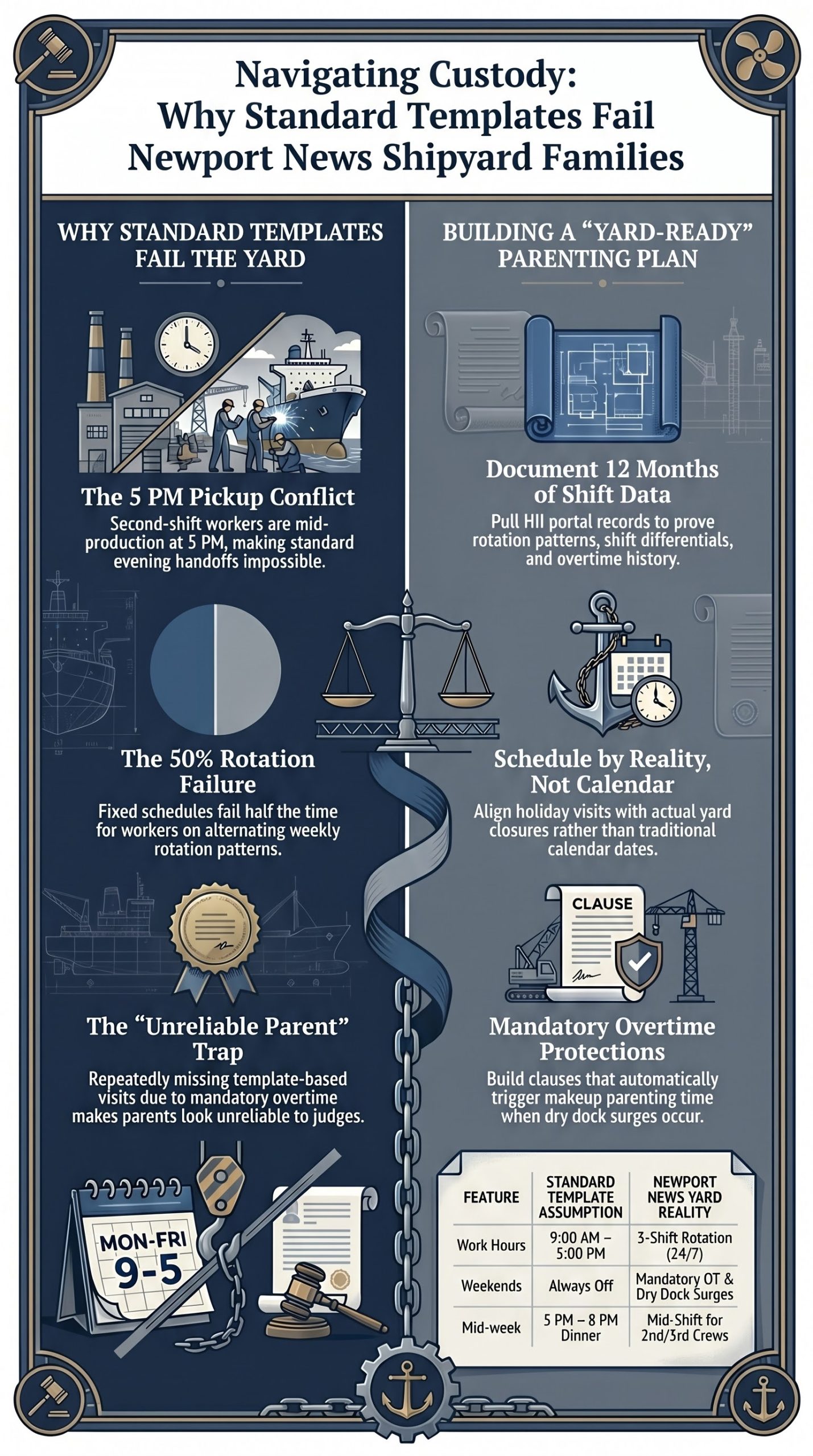
Table of Contents
- The Pipefitter Who Almost Lost His Kids to a Bad Template
- How Newport News Shipbuilding Shifts Actually Run
- Why Standard Custody Templates Fail Shipyard Families
- Building a Custody Schedule Around the Yard’s Reality
- Va. Code § 20-124.3 Factors as Applied to Shift Workers
- Co-Parent Coordination, Child Care, and the Practical Stuff
- What I Tell Shipyard Parents in the First Meeting
- Summary
- Frequently Asked Questions
- References
Chapter 1: The Pipefitter Who Almost Lost His Kids to a Bad Template
A pipefitter from Denbigh came to see me a few years ago. He had been at Newport News Shipbuilding for seventeen years, working a rotating shift pattern that put him on second shift one week and first shift the next, with occasional weekend overtime when the dry dock work demanded it. His marriage had ended badly. His wife had filed first, with a lawyer who had walked her through a standard custody package: she would have primary physical custody, he would have alternating weekends, Friday evening to Sunday evening, plus a Wednesday evening dinner from 5pm to 8pm.
When the pipefitter looked at that schedule against his actual work calendar, he realized something terrible. On second shift weeks, he would not be home at 5pm on Wednesday for the dinner. He would be standing in the submarine’s engine room. On weekend overtime days, which the yard scheduled with as little as 48 hours notice, he would not be available for the Friday evening pickup. He had been at the yard long enough to know that this schedule, presented to a J&DR judge as a reasonable parenting plan, would mean missing his children for stretches of weeks at a time. Not because he wanted to. Because the template did not match his life.
We rebuilt the case from the ground up. We pulled his actual shift records for the past two years to show the rotation pattern. We pulled the yard’s published shift differential rates and overtime authorization protocols to show the schedule was not optional. We documented the available unpaid leave for personal events. We built a parenting plan that respected his rotation: when he was on first-shift weeks, he had the children Tuesday through Thursday evenings and alternate weekends; when he was on second-shift weeks, he had the children all day Saturday and Sunday, and Monday morning before his shift started. The total parenting time worked out to roughly equal time with both parents, allocated around when each parent could actually be present.
The judge accepted it. Because it was specific, evidence-based, and obviously thought through with the child’s stability in mind. The pipefitter kept meaningful time with his kids. He kept his job. The schedule held up through the next two rotation cycles without modification. That outcome was not luck. It was the product of doing the work to understand the yard’s reality and present it to the court in a way the court could rely on. For broader background on Newport News family law, see our cornerstone guide on family law in Newport News, Virginia.
Chapter 2: How Newport News Shipbuilding Shifts Actually Run
To build a custody plan that fits a shipyard family, you have to understand how the yard actually runs. The schedule that shows up on a payroll printout looks deceptively simple. The reality on the production floor is more complicated.
Three Shift Structure
Newport News Shipbuilding operates production trades on a three-shift structure across most departments. The first shift typically runs from roughly 7am to 3:30pm. Second shift typically runs roughly 3pm to 11:30pm. Third shift typically runs roughly 11pm to 7:30am. Each shift overlaps the next by about 30 minutes for crew handoff. The trade work continues across shifts, meaning that a hull section being welded on first shift might be continued by a different welding crew on second shift and again on third. The yard runs ships through their construction or refueling cycle continuously because the work simply takes too long to complete in a single shift.
Rotating Patterns
Some workers permanently stay on a fixed shift. Others rotate. Rotation patterns vary by trade and by department. Common patterns include alternating between first and second shift week by week, three weeks on second followed by three weeks on first, or month-long rotations. The rotation matters in custody cases because it means the worker’s availability for parenting time is predictable but not constant. A parenting plan that assumes a fixed first shift will fail half the time for a worker on a two-week rotation.
Overtime and Mandatory Overtime
Overtime is a regular feature of shipyard work, and during certain phases of construction or refueling, it can be mandatory. When a Ford-class carrier hits a delivery milestone, when a Virginia-class submarine is approaching a sea trial date, or when a Refueling and Complex Overhaul (RCOH) is in a critical phase, the yard authorizes mandatory overtime to meet the schedule. Workers who refuse mandatory overtime face progressive discipline up to and including termination. For custody planning purposes, mandatory overtime is not optional, and the parenting plan has to anticipate that some weeks will include overtime that displaces normally scheduled parenting time.
Dry Dock Surges
When a ship is in dry dock for major work, the schedule intensifies. The yard runs additional crews, extends shifts, and compresses timelines because dry dock periods are limited and expensive. Workers assigned to dry dock projects often see meaningfully different schedules than workers on other projects. The pattern can include twelve-hour shifts during the most intense periods. Custody plans for workers who anticipate dry dock assignments need to address what happens during those compressed periods.
Trade Variation
Different trades have different scheduling realities. Welders, pipefitters, and machinists often work the production shifts described above. Salaried engineers, naval architects, and program managers typically work first shift but may put in substantial additional hours during program-critical periods. Skilled trades represented by United Steelworkers Local 8888 work under collective bargaining agreement provisions that govern overtime, scheduling, and seniority. Each of these populations needs a different approach to custody planning.
Security Clearance and Schedule Documentation
Workers in clearance-required roles, particularly those working on classified submarine and carrier systems, face additional scheduling considerations. They may be subject to closed-area access restrictions during certain shifts, may be required to participate in specific clearance-maintenance activities, and may have less flexibility to swap shifts with co-workers due to clearance-level matching requirements. These constraints affect what custody arrangements are realistic.
Chapter 3: Why Standard Custody Templates Fail Shipyard Families
Most family law practitioners default to a small number of standard parenting plan templates. The most common is alternating weekends, Friday to Sunday, with a midweek evening dinner, with the non-custodial parent receiving roughly four overnights every two weeks. There are reasons templates exist. They are easy to write, easy for the court to evaluate, and work fine for families where both parents work daylight office jobs Monday through Friday. They fail for shipyard families.
Failure Mode 1: The Friday Evening Pickup
The standard template assumes the non-custodial parent picks up the children on Friday evening and returns them on Sunday evening. For a worker on second shift, Friday evening at 5pm is the middle of the work day. He is not available for pickup. By the time his shift ends at 11:30pm, the children are asleep. The standard template effectively eliminates Friday from his parenting time, and because the second shift week starts the parenting weekend at midnight Saturday, the actual parenting time is closer to one full day rather than two.
Failure Mode 2: The Wednesday Dinner
The Wednesday dinner is the workhorse of the standard template. Every other Wednesday, 5pm to 8pm, the non-custodial parent has dinner with the children. This works perfectly for office workers. It does not work at all for second- or third-shift workers, both of whom are at work during those hours. A worker on rotating shifts will hit the Wednesday dinner about half the time and miss it the other half.
Failure Mode 3: Holiday Allocation
Standard holiday templates alternate major holidays year over year, assuming the non-custodial parent has flexible access during the holiday period. Shipyard work does not stop for holidays. The yard works through Thanksgiving, Christmas Eve, the day after Christmas, New Year’s Eve, and most other holidays except for Christmas Day and a small number of company holidays. A worker scheduled for second shift on Christmas Eve cannot take the children for the traditional Christmas Eve dinner. A worker on overtime through New Year’s cannot meaningfully participate in the holiday rotation.
Failure Mode 4: Modification Cost
When a standard template fails for a shipyard family, the worker has to return to court for a modification. Modification petitions in Newport News J&DR Court take time and money, and the standard for modification under Va. Code § 20-108 requires a showing of a material change in circumstances. The need to modify the schedule because the original was unworkable is a self-inflicted wound. Building the right schedule from the start avoids the cost of fixing it later.
Failure Mode 5: The Best Interest Argument
The most damaging failure mode is the one that affects the worker’s perception of themselves as a parent. When a standard template repeatedly fails to deliver the parenting time the order awards, the working parent looks unreliable. The custodial parent collects evidence of missed pickups, missed dinners, and last-minute schedule changes. By the time of any modification or review, the working parent is at a disadvantage that has nothing to do with parenting ability and everything to do with a schedule that never fit.
Chapter 4: Building a Custody Schedule Around the Yard’s Reality
The right approach is to build the parenting plan around the worker’s actual schedule, not the standard template. This requires more upfront drafting, but it produces orders that hold up over time and respect both the work obligation and the parenting relationship.
Document the Actual Schedule
The first step is documenting the actual schedule. Pull at least twelve months of pay records, shift assignments, and overtime history. Identify the rotation pattern. Identify the typical overtime frequency. Identify the dry dock or program critical periods that affect the schedule. The documentation does two things. It tells the lawyer what the realistic parenting plan looks like. It also creates the evidentiary record that the court will need to accept a non-standard plan.
Match Parenting Time to Available Time
For a worker on first-shift weeks, parenting time can include Tuesday through Thursday evenings and alternate weekends, since the worker is home from 4pm onward. For a worker on second-shift weeks, parenting time should be in the morning to early afternoon and on full weekend days, because evenings are work hours. For a worker on third shift, parenting time should be from afternoon to bedtime, because mornings are sleep hours. The plan can specify different schedules for different weeks of the rotation, and judges accept these arrangements when presented as a coherent whole rather than a tangle of exceptions.
Build in Overtime Provisions
The plan should anticipate overtime. The provision can specify that mandatory overtime, defined as overtime authorized by the employer with less than 72 hours’ notice, displaces parenting time, and the displaced time is made up at a specified later date. This protects the worker from being penalized for accepting overtime that he cannot refuse. It also protects the children from missed parenting time because the makeup time is built in. The custodial parent has a clear protocol rather than a series of disruptive last-minute requests.
Holiday Allocation by Reality
Holiday allocation should follow the worker’s actual schedule. If the worker is reliably on shift Christmas Eve, the holiday plan should give the children Christmas morning rather than Christmas Eve, and the alternation should be by the meaningful day rather than by the calendar date. If the worker has Thanksgiving Day off but is on shift the day before and the day after, the plan should give Thanksgiving Day rather than the typical day-before-Thanksgiving overnight.
Summer and School Break Coverage
Summer and school break periods give shipyard families an opportunity for extended parenting time that fits the work schedule. A two-week summer block when the worker has scheduled vacation produces meaningful parenting time without the daily friction of the school year schedule. Spring break and Christmas break can be allocated similarly. The plan should specify how the periods are chosen, with notice protocols and the right of first selection alternating year to year.
Communication Between Parents
Shipyard families need clearer communication protocols than office job families because their schedules have more variables. The plan should specify how schedule changes get communicated, how much notice is required for routine swaps, and what the default is when the parents cannot agree. Common provisions include written communication through co-parenting apps, 72 hour notice for non-emergency changes, and a tie-breaker procedure for genuine disputes.
Chapter 5: Va. Code § 20-124.3 Factors as Applied to Shift Workers
Newport News J&DR judges decide custody cases under the best interest of the child standard at Va. Code § 20-124.3. The statute lists ten factors that the court must consider, and the court must communicate the basis of its decision in light of those factors. Each factor applies to shipyard workers, and several of them require careful presentation to ensure the work schedule is not held against the parent.
The Role Each Parent Has Played
The statute directs the court to consider the role each parent has played and will play in the child’s upbringing and care. For a shipyard worker, this analysis has to capture the parenting that happens around the work schedule. A second shift worker may have done the morning routine for years, taking the children to school before reporting to the yard. A third shift worker may have done the evening routine, picking the children up from school and handling homework before sleeping during the day. The role analysis should not penalize the work schedule but should credit the parenting that happened around it.
The Ability to Maintain a Close Relationship
The statute considers each parent’s relative willingness and demonstrated ability to maintain a close and continuing relationship with the child. The shipyard worker who has shown up reliably for parenting time, attended school events when scheduled around the shift, and stayed connected through phone calls and texts during work weeks demonstrates ability. The documentation of this engagement during the marriage is relevant to the custody determination.
The Propensity to Support the Other Parent’s Contact
The statute considers each parent’s propensity to actively support the child’s contact with the other parent. For shipyard families, this factor often shapes how schedule disputes are handled. A parent who proposes a workable plan that respects the other parent’s work schedule demonstrates the right propensity. A parent who insists on a template that effectively eliminates the working parent demonstrates the wrong one. Courts notice this distinction.
The Reasonable Preference of the Child
For older children, the statute considers the reasonable preference of the child of suitable age and intelligence. Shipyard children often have a sophisticated understanding of their parents’ work because the schedule has been part of their lives for as long as they can remember. The child who articulates a preference based on actual experience with the parent during available hours can be a meaningful voice in the proceeding.
Other Factors the Court Considers Necessary
The statute concludes with a catchall for other factors the court considers necessary and proper. For shipyard workers, the catchall is where the practical realities of the schedule come in. The court can consider the worker’s union seniority, the difficulty of changing shifts, the financial impact of refusing overtime, and the broader context that shapes the work schedule. These are legitimate inputs to the best interest analysis when presented properly.
Chapter 6: Co-Parent Coordination, Child Care, and the Practical Stuff
A shipyard custody plan that works on paper still has to work in practice. The practical considerations around coordination, child care, and day-to-day logistics matter as much as the schedule itself.
Child Care During Shift Hours
When the shipyard parent has children during a shift, child care must be arranged. The yard offers some on-site or partner child care arrangements, although capacity is limited and the hours do not always align with shift coverage needs. Many shipyard families rely on extended family, particularly grandparents who live in Newport News, Hampton, Yorktown, or the surrounding Peninsula communities. The custody plan can specify approved child care arrangements and can address what happens if the worker’s preferred arrangement becomes unavailable.
School Pickup and Drop Off
Newport News Public Schools have specific start and dismissal times that may or may not align with shift schedules. A first shift parent who finishes at 3:30pm can typically handle afternoon pickup at most schools. A second shift parent who starts at 3pm cannot. The custody plan needs to address pickup and drop off realistically, including what happens when the parent’s shift conflicts with the school schedule.
Activities and Extracurriculars
Children’s activities matter in custody planning. Sports practices, music lessons, religious education, and other regular commitments need parental support. The shipyard parent who can attend Saturday morning soccer games but not Tuesday evening practices needs a plan that accounts for this. The same parent may be the right one for school music recitals if scheduled during a first shift week. Building activities into the schedule, with clear provisions for who handles what, prevents friction and supports the children’s continuity.
Sick Days and Emergencies
Children get sick. Schools call. Someone has to respond. For a shipyard parent on shift, leaving the floor mid-day is harder than for an office parent. The custody plan should address default emergency response, with clear provisions for which parent is the primary contact during the other parent’s parenting time and how the working parent’s schedule is accommodated when emergencies happen during their shift.
Travel and Visitation
Shipyard workers sometimes have family in other states or want to take the children on trips. The custody plan should address travel notice requirements, what consents are needed, and how out-of-state visitation interacts with the regular schedule. For workers who plan to attend out-of-state family events, the schedule can include flexible swap provisions to shift time to accommodate the trip.
Income Documentation for Support
Custody and child support are separate but related determinations. The income calculation for shipyard workers under Va. Code § 20-108.2 needs to capture base wages, shift differentials for second and third shift work, overtime, performance bonuses, and any other regular compensation. A child support order based on incomplete income data will produce wrong results. Pulling complete income records during the custody case correctly establishes both the support order and any future modifications. For a more comprehensive treatment, see the cornerstone guide on Newport News family law.
Chapter 7: What I Tell Shipyard Parents in the First Meeting
When a Newport News shipyard worker comes in for a custody consultation, I tell them five things in the first meeting.
First, the standard template will probably hurt you, and not because anyone is trying to hurt you. The default plan exists because most family law cases involve daylight Monday through Friday workers. Your case is different, and the work to build a different plan starts now. Do not agree to a standard template just because the other side proposed it.
Second, we need your actual schedule documented. Twelve months of shift records, overtime authorizations, and any rotation pattern. The earlier we have this, the better the case will be. Most workers can pull this from the HII employee portal in an afternoon. The documentation does not just inform our strategy. It provides the evidentiary foundation for the non-standard plan we will propose.
Third, we are going to think carefully about what parenting time you can actually deliver. Promising more parenting time than your schedule supports will lead to missed pickups, frustrated co-parents, and a record that harms you. Promising less than you can deliver is also a mistake, because it gives away time that should be yours. The right plan matches what is realistic, no more and no less.
Fourth, we anticipate overtime, dry-dock surges, and other schedule disruptions that come with shipyard work. The plan needs provisions for what happens when the schedule shifts. Built-in flexibility prevents the modification cycle that drains money and creates conflict.
Fifth, we will present this to the J&DR court as a coherent whole rather than as a complicated exception. Newport News J&DR judges regularly see shipyard families. They understand the work. A well-presented non-standard plan with documented support will get accepted. A poorly presented one will get rejected, and the judge will fall back on the template that does not fit.
Summary
For Newport News Shipbuilding workers in Newport News custody cases, the standard parenting plan templates that work for office-job families do not work. First shift, second shift, third shift, rotating shifts, mandatory overtime, dry dock surges, and other features of shipyard work require a different approach. The right approach starts with documenting the actual schedule, matching parenting time to available time, building in provisions for schedule disruption, and presenting the plan to Newport News Juvenile and Domestic Relations District Court as a coherent whole.
The legal framework is Va. Code § 20-124.3, which gives the J&DR court the authority and the obligation to consider what the best interest of the child actually requires. The statutory factors apply to shipyard workers as fully as to anyone else, but their application must take account of the work schedule rather than penalize it. The role each parent has played, the ability to maintain a close relationship, the propensity to support the other parent’s contact, and the reasonable preference of the child can all be presented in ways that credit the shipyard parent for their actual contribution to the children’s lives.
The practical considerations matter as much as the schedule itself. Child care during shift hours, school pickup and drop-off, activities, sick days, travel, and regular communication between co-parents all need to be addressed in ways that account for the work schedule. The plan that holds up over time is the one that respects the work, the parenting, and the child’s stability altogether.
Frequently Asked Questions
Will my shipyard shift schedule be held against me in a Newport News custody case?
It does not have to be, but it can be if you let the case proceed on a standard template that does not fit your actual schedule. Newport News J&DR judges understand shipyard work because they see shipyard families regularly. The schedule becomes a problem only when the parenting plan does not account for it. A well-built plan that respects your actual schedule will not penalize you.
What documentation do I need to pull from HII for my custody case?
At minimum, twelve months of shift assignments, pay records showing shift differentials, overtime history, and any rotation pattern documentation. If you have been on dry dock or program critical assignments, document those periods specifically. The HII employee portal contains most of this information. Pulling it early in the case gives your attorney time to build the right plan around the actual data.
Can I refuse mandatory overtime to keep parenting time?
In most cases, no. Mandatory overtime authorized by HII is a condition of employment, and refusal can result in progressive discipline up to and including termination. The right approach is a parenting plan that anticipates mandatory overtime and provides for makeup time when it occurs, rather than asking you to choose between work and time with your children.
My ex’s lawyer proposed a standard parenting plan. Should I just sign it?
Not without reviewing it carefully against your actual work schedule. Standard plans benefit the parent with the daylight schedule. If the proposed plan would have you missing parenting time because your shift conflicts with pickup, drop-off, or scheduled visitation, you should work with counsel to propose an alternative that works for you.
Can I get joint physical custody if I work rotating shifts?
Yes, in many cases. Joint physical custody requires that both parents have substantial parenting time, and that arrangement can be built around rotating shifts as long as the schedule is predictable and the plan accounts for it. Newport News J&DR Court has approved joint physical custody arrangements for shipyard families when the plan respects the work schedule and provides stability for the children.
What if my shift assignment changes after the order is entered?
A well-drafted parenting plan should anticipate shift changes through built-in flexibility. If your shift assignment changes substantially, you may need to seek a modification of the order. Modification under Va. Code § 20-108 requires a showing of material change in circumstances and that modification is in the child’s best interest. Significant shift changes generally satisfy that standard, but the modification process takes time and money, which is why the original plan should anticipate the possibility.
How does my union representation affect the custody case?
USW Local 8888 representation does not directly affect custody, but it does affect the schedule documentation. Your collective bargaining agreement governs overtime authorization, scheduling, and seniority rights. A counsel familiar with the agreement can use the contractual provisions to support the schedule documentation in your custody case.
What about holidays when the yard is open?
The holiday allocation should follow your actual schedule rather than the calendar template. If the yard is open on a holiday and you are scheduled, the plan should give you the day before or the day after, or shift the allocation to a meaningful day you actually have available. Cookie-cutter holiday schedules that ignore your work calendar will produce disappointing holidays for everyone.
My kids are old enough to have an opinion. Will the court hear them?
Va. Code § 20-124.3 directs the court to consider the reasonable preference of a child of suitable age and intelligence. The court has discretion about how to receive the child’s input, often through an in-camera interview rather than open testimony. For shipyard children who have lived with the schedule for years, their preferences can carry meaningful weight when articulated based on actual experience.
When should I contact a Newport News family law attorney?
As early as possible. Custody cases benefit from early counsel because the documentation, strategic positioning, and negotiation with the other side all improve over time. If you have been served with papers, you have deadlines that start running immediately. If you are anticipating a custody case but have not yet filed or been served, the consultation provides you with the information to make informed decisions.
Shipyard Custody Case Coming in Newport News?
Whether you are a pipefitter, welder, machinist, electrician, sheet metal worker, painter, rigger, naval architect, engineer, program manager, or any other Newport News Shipbuilding employee facing a custody case, you deserve counsel who understands how the yard actually works and how to build a parenting plan that fits your real schedule.
Tough cases require tough attorneys. Shin Law Office handles custody and family law matters for Newport News Shipbuilding families and the broader Peninsula community.
Call 571-445-6565

References
Code of Virginia. (2024). Title 20, Section 20-108: Revision and alteration of orders. Virginia General Assembly. https://law.lis.virginia.gov/vacode/title20/chapter6.1/section20-108/
Code of Virginia. (2024). Title 20, Section 20-108.2: Guideline for determination of child support. Virginia General Assembly. https://law.lis.virginia.gov/vacode/title20/chapter6.1/section20-108.2/
Code of Virginia. (2024). Title 20, Section 20-124.2: Court-ordered custody and visitation arrangements. Virginia General Assembly. https://law.lis.virginia.gov/vacode/title20/chapter6.1/section20-124.2/
Code of Virginia. (2024). Title 20, Section 20-124.3: Best interests of the child; visitation. Virginia General Assembly. https://law.lis.virginia.gov/vacode/title20/chapter6.1/section20-124.3/
Huntington Ingalls Industries. (2024). Newport News Shipbuilding overview. https://nns.huntingtoningalls.com/
United Steelworkers Local 8888. (2024). Local union information. https://www.usw.org/
Newport News Juvenile and Domestic Relations District Court. (2024). Court information. https://www.nnva.gov/188/Juvenile-Domestic-Relations-District-Cour
Newport News Public Schools. (2024). School schedules and calendars. https://nnschools.org/
U.S. Navy. (2024). Aircraft carrier construction and refueling overview. https://www.navy.mil/
U.S. Department of Labor, Bureau of Labor Statistics. (2024). Occupational data for shipbuilding workers. https://www.bls.gov/oes/current/oes_nat.htm
