


By Anthony I. Shin, Esq. | Shin Law Office | Notes from a Virginia Attorney on the Custody Cases That Move on Military Time
BOTTOM LINE UP FRONT
If you are a service member at NAS Oceana, Joint Expeditionary Base Little Creek-Fort Story, Dam Neck Annex, or Naval Station Norfolk, and you are facing a custody dispute, the deployment cycle of the United States military will shape your case in ways that purely civilian custody cases never encounter. Virginia law at Va. Code § 20-124.7 provides specific protections for deploying service members in custody matters. The Servicemembers Civil Relief Act at 50 U.S.C. § 3901 provides additional procedural rights, including the ability to obtain a stay of court proceedings. The deployment-specific custody framework, the Family Care Plan requirement, and the prohibition on permanent custody changes based solely on deployment all combine to give deploying parents tools that civilian parents do not have.
If you are the civilian parent on the other side of a deployment-affected custody case, those same statutes shape what you can and cannot ask the court to do. Understanding both sides of the deployment custody framework is what allows Virginia Beach families to build custody arrangements that actually work for the next deployment, the deployment after that, and the children whose lives have to fit around the schedule of military service.
Call Shin Law Office at 571-445-6565.
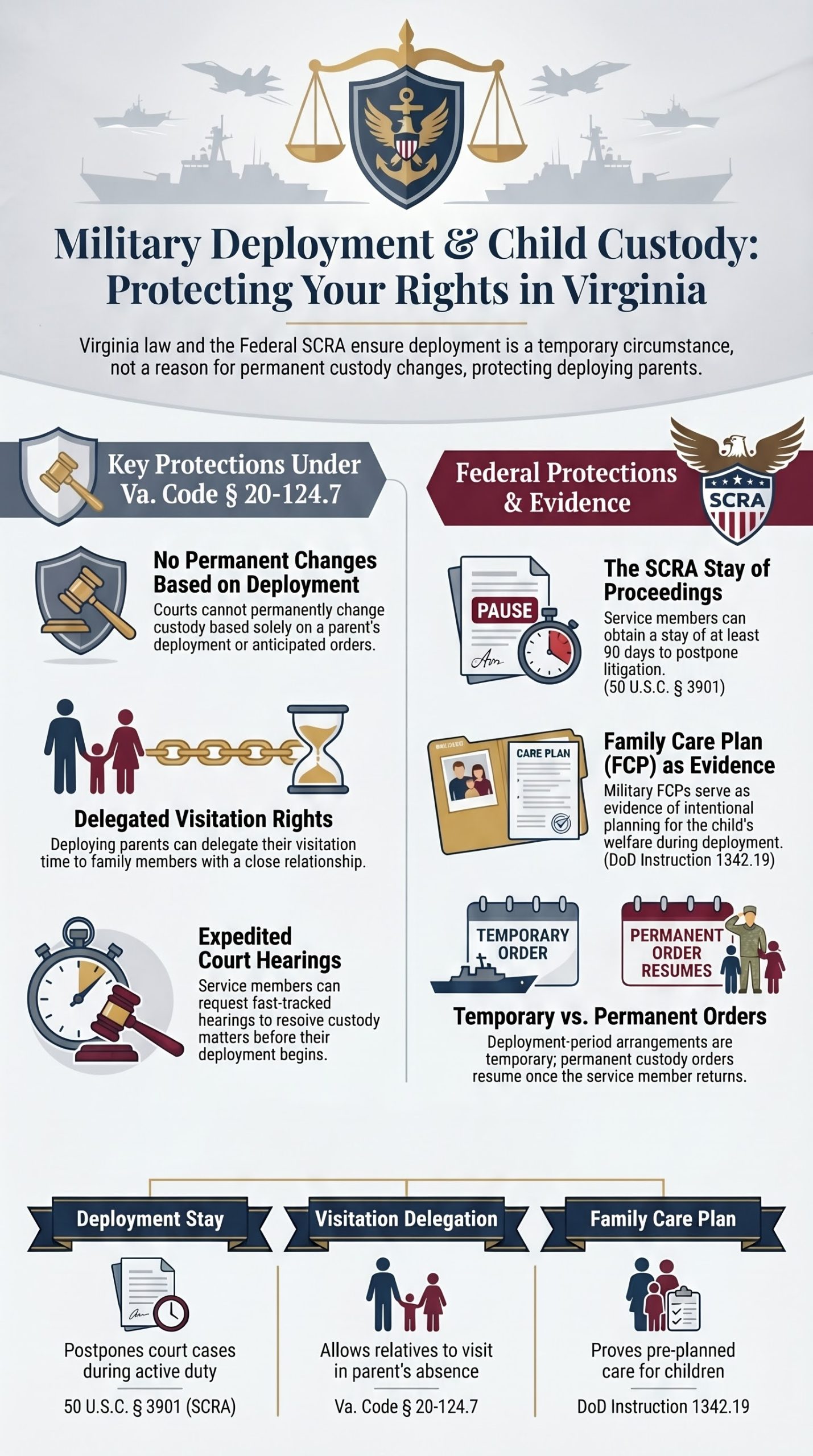
Table of Contents
- The Phone Call That Starts Every Deployment Custody Case
- Why Virginia Beach Custody Cases Are Different
- The Va. Code § 20-124.7 Framework
- SCRA Stays and Procedural Protections
- The Family Care Plan as Legal Evidence
- Drafting Deployment-Flexible Custody Orders
- What I Tell Deploying Parents in the First Meeting
- Summary
- Frequently Asked Questions
- References
Chapter 1: The Phone Call That Starts Every Deployment Custody Case
The phone call usually comes from a Navy spouse or service member, and it starts the same way. Deployment orders just dropped. The orders are for six months, or eight months, or a year. The custody case is already in progress or about to start. The other parent is talking about using the deployment to change everything. What can we do?
My answer is the same answer I have given for years to NAS Oceana aviators, Little Creek-Fort Story Marines, Dam Neck Annex special operators, and Naval Station Norfolk sailors. Quite a lot, actually. Virginia law and federal law together provide specific protections for deploying service members in custody disputes. Those protections are not absolute. They do not freeze the case in place. They do not guarantee a particular outcome. But they prevent the worst version of what civilian parents sometimes try to do when deployment orders drop, which is to use the deployment as a wedge to permanently shift custody in their favor.
This article is about how those protections work in Virginia Beach custody cases. The framework draws on Va. Code § 20-124.7 et seq. (the Virginia statute specifically addressing deployment and custody), the federal Servicemembers Civil Relief Act at 50 U.S.C. § 3901 et seq. (procedural protections for deploying service members), and the local practice of the Virginia Beach Juvenile and Domestic Relations District Court and the Virginia Beach Circuit Court. For the broader treatment of Virginia Beach family law, see the cornerstone guide on family law in Virginia Beach, Virginia.
Chapter 2: Why Virginia Beach Custody Cases Are Different
Virginia Beach is one of the most military-saturated cities in the United States. NAS Oceana is the East Coast master jet base, home to thousands of Navy and Marine Corps aviators and the families who support them. Joint Expeditionary Base Little Creek-Fort Story is home to expeditionary forces, naval special warfare elements, and joint operations capabilities. Dam Neck Annex hosts intelligence and special operations work, including units whose deployment cycles are far less predictable than the rest of the Navy. Naval Station Norfolk, the largest naval base in the world, is a twenty-minute drive away, and many of its sailors and their families live in Virginia Beach.
The result is that a substantial portion of every Virginia Beach J&DR Court custody docket involves at least one parent who is a current or former service member. The judges in Virginia Beach see these cases constantly. They understand the LES, the BAH structure, the deployment cycles, and the difference between an unaccompanied tour to Bahrain and a forward deployment with a carrier strike group. They are not surprised when a service member appears in court in uniform straight from a duty station. They are familiar with the special protections that apply.
This familiarity matters. A custody case in a jurisdiction that rarely sees military families requires substantial education of the court about the realities of military service. A custody case in Virginia Beach starts with a court that already understands. The strategic implications of that difference are significant. The case can move faster. The arguments can be more sophisticated. The schedule built into a custody order can be tailored to specific deployment patterns rather than approximated through generic visitation language.
Chapter 3: The Va. Code § 20-124.7 Framework
Virginia’s deployment-and-custody statutory framework is found at Va. Code § 20-124.7 through § 20-124.10. The framework was enacted to address the specific problem of military deployment in custody disputes and grants deploying service members several important rights.
No Permanent Custody Change Based Solely on Deployment
The statute prohibits a court from making a permanent custody determination based solely on a parent’s deployment or anticipated deployment. This is the headline protection. A civilian parent cannot, by itself, use deployment as the basis for permanently transferring custody from the deploying parent. The court can adjust the schedule during the deployment. The court cannot permanently change custody just because deployment is occurring.
Right to Delegate Visitation
The statute permits a deploying service member to delegate visitation rights during the deployment to a family member with a close and substantial relationship to the child. A grandparent, aunt, uncle, or other relative can be authorized to exercise the deploying parent’s visitation during the deployment period. This protection allows the child to maintain a connection with the deploying parent’s family during the deployment, rather than effectively losing all contact with that family for the duration.
Expedited Hearings
The statute provides for expedited hearings when deployment timing requires it. A deploying service member who needs a custody order entered before deployment begins can request an expedited hearing, and the court is supposed to accommodate the timing where possible. This protection prevents civilian parents from running out the clock on hearings, so that hearings are held after the service member has deployed and cannot attend.
Temporary Versus Permanent Orders
The framework distinguishes between temporary custody arrangements that apply during deployment and the permanent custody order that resumes upon deployment’s end. The deploying parent is entitled to have the permanent custody order resume upon return from deployment, subject to limited exceptions. This protection prevents the temporary deployment-period arrangement from becoming the new permanent baseline.
Chapter 4: SCRA Stays and Procedural Protections
The Servicemembers Civil Relief Act at 50 U.S.C. § 3901 et seq. is the federal statute that provides procedural protections for service members in civil litigation. In a custody case, the SCRA gives a deploying or actively serving parent the right to request a stay (a postponement) of court proceedings when military duty materially affects the parent’s ability to participate.
The Initial Stay
A service member can request an initial stay of at least 90 days by submitting an application that includes information about the current military assignment, the projected duration of the assignment that affects ability to appear, and a statement from a commanding officer about the impact on availability. The 90-day stay is generally granted where the application is procedurally sufficient.
Additional Stays
Additional stays beyond the initial 90 days can be granted at the court’s discretion based on the same materials. For service members on extended deployments, this means custody proceedings can sometimes be stayed for the duration of the deployment, allowing the case to be heard on the merits when the service member is actually able to participate.
When SCRA Stays Make Sense
SCRA stays are not automatic and are not always strategically advisable. A service member who is about to deploy and would prefer to have the custody question resolved before deployment may prefer not to seek a stay. A service member whose case is going badly may prefer to stay to slow the case down. The decision is strategic, and it depends on the specific facts. Counsel familiar with both military realities and Virginia custody practice can help make the right call.
Chapter 5: The Family Care Plan as Legal Evidence
Service members with family care responsibilities are required by military regulation to maintain a Family Care Plan (FCP) documenting how their dependents will be cared for during deployments, training exercises, or other unaccompanied duty. The FCP is a military document, prepared for command purposes, but it functions as important evidence in Virginia Beach custody disputes.
What the FCP Documents
The FCP names the short- and long-term caregivers responsible for the children during the service member’s absence. It addresses school enrollment, medical care authority, financial arrangements, and emergency contact procedures. For a Navy lieutenant at Oceana with children, the FCP might name the spouse as long-term caregiver and a grandparent as short-term backup. For a single Marine at Little Creek, the FCP might name a parent or sibling as the primary caregiver during deployments.
How Courts Use the FCP
In a custody dispute involving a deploying service member, the FCP can be presented to the court as evidence of an established care framework. The plan reflects considered judgments by the service member, often reviewed by command, about who should care for the children when the service member cannot. Virginia Beach J&DR Court judges generally give weight to FCPs as evidence of intentional planning and as a starting point for deployment-period custody arrangements.
When the FCP and the Custody Order Conflict
Sometimes the existing FCP and the custody arrangement the other parent is seeking conflict. The FCP names the service member’s mother as the deployment-period caregiver. The civilian parent argues that the children should be in the civilian parent’s primary care during deployment. The court has to reconcile these positions. The deploying service member’s right to delegate visitation under Va. Code § 20-124.7 is a meaningful tool here, but it is not absolute. The best interests of the child standard still governs the ultimate determination.
Chapter 6: Drafting Deployment-Flexible Custody Orders
A custody order that works for a Virginia Beach military family has to anticipate deployment. The standard custody order language used in non-military cases (alternating weekends, midweek dinners, holiday rotations) does not work cleanly when one parent disappears for six months at a time. Drafting a deployment-flexible custody order requires building in specific provisions for what happens before, during, and after deployment.
Pre-Deployment Provisions
Pre-deployment provisions should include procedures for notifying the other parent of upcoming deployment, accelerating visitation in the weeks before deployment to compensate for the upcoming separation, addressing any necessary documentation (passport applications, medical authorizations, school authorizations), and confirming the deployment-period schedule.
Deployment-Period Provisions
Deployment-period provisions should specify the deployment-period custody arrangement (often increased time for the non-deploying parent or designated family member), communication procedures between the deployed parent and the children (video calls, mail, scheduled phone calls), procedures for emergency decisions, and the limits on what the deployment-period arrangement does not change about the underlying custody order.
Post-Deployment Provisions
Post-deployment provisions should address the resumption of the underlying custody arrangement, the timing of reintegration with the children (sometimes a graduated return is appropriate, sometimes a clean snap-back is fine), and how the parties will handle the next anticipated deployment.
Special Provisions for Specific Roles
Service members in certain roles need additional special provisions. Naval aviators face periodic detachment cycles that are shorter than full deployments but still substantial. Submariners face periods of unreachable communication that affect how disputes are handled during patrols. Naval special warfare personnel may face operational tempos that include short-notice deployments. The custody order should be drafted to reflect the service member’s actual operational rhythm, not generic deployment language.
Chapter 7: What I Tell Deploying Parents in the First Meeting
When a deploying parent comes into my office for an initial meeting, I tell them five things.
First, the deployment is not going to lose your custody case. The civilian parent does not get to use deployment as a permanent custody-stripping mechanism. Va. Code § 20-124.7 forecloses that. We have time to build a strategy.
Second, we need to identify your operational tempo and your specific deployment schedule before we negotiate or litigate any custody order. A custody order built around the wrong schedule is going to fail at the first deployment, and we cannot rely on the other side to be reasonable about modifications.
Third, your Family Care Plan and your command’s documentation are evidence. We will gather them, organize them, and use them to demonstrate that you have planned carefully for your children’s welfare during deployment.
Fourth, the SCRA stay is a tool, not a default. We will use it when it helps, not when it does not. Sometimes the better answer is to push for a hearing before deployment. Sometimes the better answer is to stay the case until you return. The decision depends on the facts.
Fifth, the children matter more than the procedural fight. Whatever we do, we are doing for the relationship between you and your children. If something we are tempted to litigate over is going to cost you the relationship, we are going to think hard about whether to litigate it.
For broader information about how the firm handles Virginia Beach family law disputes, see our family law practice page and the cornerstone guide on Virginia Beach family law.
Summary
Deployment custody cases in Virginia Beach are a category of their own because of the military presence at NAS Oceana, Joint Expeditionary Base Little Creek-Fort Story, Dam Neck Annex, and Naval Station Norfolk. The combination of Virginia’s deployment-and-custody framework at Va. Code § 20-124.7 and the federal Servicemembers Civil Relief Act provides specific protections for deploying service members that are not available in purely civilian custody cases.
The protections include a prohibition on permanent custody changes based solely on deployment, the right to delegate visitation to a family member during deployment, expedited hearings before deployment, the ability to stay proceedings under SCRA, and the use of the Family Care Plan as evidence of careful planning. None of these protections is absolute, and the best interests of the child standard always governs the ultimate determination, but collectively they prevent civilian parents from using deployment as a wedge to permanently shift custody.
For Virginia Beach service member parents facing custody disputes, the strategy starts with understanding the specific operational tempo of the service member’s job, gathering the available evidence (FCP, command documentation, deployment orders), and building a custody order that anticipates deployment rather than ignoring it. For civilian parents on the other side of these cases, the strategy starts with understanding the protections that apply and building a position that respects those protections while still serving the children’s interests.
Frequently Asked Questions
Can the other parent take custody of my children just because I am deploying?
No, not on the basis of deployment alone. Va. Code § 20-124.7 prohibits a court from making a permanent custody change based solely on a service member’s deployment or anticipated deployment. The court can address deployment-period arrangements, but the underlying custody order remains in place subject to limited exceptions.
Can I delegate my visitation to a family member while I am deployed?
Yes. Virginia law specifically permits a deploying service member to delegate visitation rights during the deployment to a family member with a close and substantial relationship to the child. The delegation is subject to the best interests of the child standard, but the right to delegate is established in the statute.
What is an SCRA stay and how do I get one?
An SCRA stay is a postponement of court proceedings authorized by the Servicemembers Civil Relief Act for service members whose military duties materially affect the ability to participate in litigation. The initial stay is at least 90 days and is generally granted where the application includes appropriate command documentation. Additional stays may be granted at the court’s discretion.
Should I always seek an SCRA stay if I am deploying?
Not always. An SCRA stay can be helpful when proceeding with the case during deployment would cause prejudice. It can be unhelpful when the case is on a favorable track, and you want a resolution before deployment, or when the children’s interests are better served by getting clarity sooner. The decision is strategic and should be made with counsel.
Does my Family Care Plan matter in court?
Yes. The Family Care Plan documents the service member’s planning for the children’s care during deployment and is generally given weight by Virginia Beach J&DR Court judges as evidence of intentional, command-reviewed planning. It is not binding on the court, but it is meaningful evidence.
What happens to my custody arrangement when I return from deployment?
Generally, the underlying custody order resumes. Va. Code § 20-124.7 et seq. provides that deployment-period arrangements are temporary and that the permanent custody arrangement returns when the deployment ends, subject to limited exceptions. The transition back may benefit from a graduated reintegration period, particularly with younger children.
My custody case is in J&DR Court but my divorce is in Circuit Court. How does that work?
Virginia Beach divorce cases are heard in Circuit Court, while standalone custody and visitation cases between unmarried parents are heard in J&DR Court. When a divorce involves children, custody and visitation issues can sometimes be raised in either court, and the strategic decisions about which court to use require coordination.
Can a custody order require my children to relocate when I receive PCS orders?
Permanent change of station orders that move the service member parent out of the area trigger separate relocation analysis under Virginia law. The custody order may need to be modified, and the modification analysis will consider the best interests of the child including the realities of military service. PCS orders are different from deployment for these purposes.
What if I am the civilian parent and my service member spouse is using the deployment statute against me?
The deployment-and-custody statute provides protections for service members but does not allow service members to disregard the best interests of the child. A civilian parent on the other side of a deployment custody case has tools to advocate for what serves the children, including challenging delegation arrangements that may not actually serve the children’s interests.
When should I contact a Virginia Beach family law attorney about deployment custody?
As soon as you know deployment is on the horizon, or as soon as you know a custody dispute is on the horizon. The earlier you build the strategy, the more options you have. Waiting until orders drop and a hearing is scheduled in two weeks compresses what should be a careful planning process into a rushed reaction.
Facing a Deployment Custody Issue in Virginia Beach?
Whether you are a Navy aviator at Oceana with deployment orders that just dropped, a Marine at Little Creek planning a thirty-six month accompanied tour, a special operator at Dam Neck with an unpredictable operational tempo, or the civilian parent on the other side of any of these cases, you deserve counsel who understands both the Virginia custody framework and the federal protections that apply when one parent serves.
Tough cases require tough attorneys. Shin Law Office handles deployment custody matters throughout Virginia Beach, Hampton Roads, and the Commonwealth.
Call 571-445-6565

References
Code of Virginia. (2024). Title 20, Section 20-124.7: Definitions; deploying parents. Virginia General Assembly. https://law.lis.virginia.gov/vacode/title20/chapter6.1/section20-124.7/
Code of Virginia. (2024). Title 20, Section 20-124.8: Temporary order during deployment. Virginia General Assembly. https://law.lis.virginia.gov/vacode/title20/chapter6.1/section20-124.8/
Code of Virginia. (2024). Title 20, Section 20-124.3: Best interests of the child; visitation. Virginia General Assembly. https://law.lis.virginia.gov/vacode/title20/chapter6.1/section20-124.3/
Servicemembers Civil Relief Act, 50 U.S.C. § 3901 et seq. https://www.govinfo.gov/app/collection/uscode
Servicemembers Civil Relief Act, 50 U.S.C. § 3932 (stay of proceedings). https://www.govinfo.gov/app/collection/uscode
Department of Defense Instruction 1342.19. (2017). Family Care Plans. U.S. Department of Defense. https://www.esd.whs.mil/dd/
Naval Air Station Oceana. (2024). Installation overview. U.S. Navy. https://cnrma.cnic.navy.mil/Installations/NAS-Oceana/
Joint Expeditionary Base Little Creek-Fort Story. (2024). Installation overview. U.S. Navy. https://cnrma.cnic.navy.mil/Installations/JEB-Little-Creek-Fort-Story/
Virginia Beach Juvenile and Domestic Relations District Court. (2024). Custody and visitation procedures. https://www.vbgov.com/government/departments/courts/jdr-court
