


Bottom Line Up Front
Protective orders in Virginia are powerful legal tools available in every jurisdiction across the Commonwealth, from Fairfax County courthouses to rural Southwest Virginia circuits. Whether you face domestic violence in Richmond, stalking in Virginia Beach, harassment in Loudoun County, or threats in Roanoke, Virginia law provides emergency, preliminary, and permanent protective orders that work the same way statewide but require understanding county-specific court procedures, local law enforcement response protocols, and jurisdictional rules that determine where you file. The scenarios people face differ by region, urban density, military presence, and community characteristics, but the legal framework remains consistent: you must prove a credible threat, present admissible evidence, and navigate court procedures that move quickly and demand preparation.
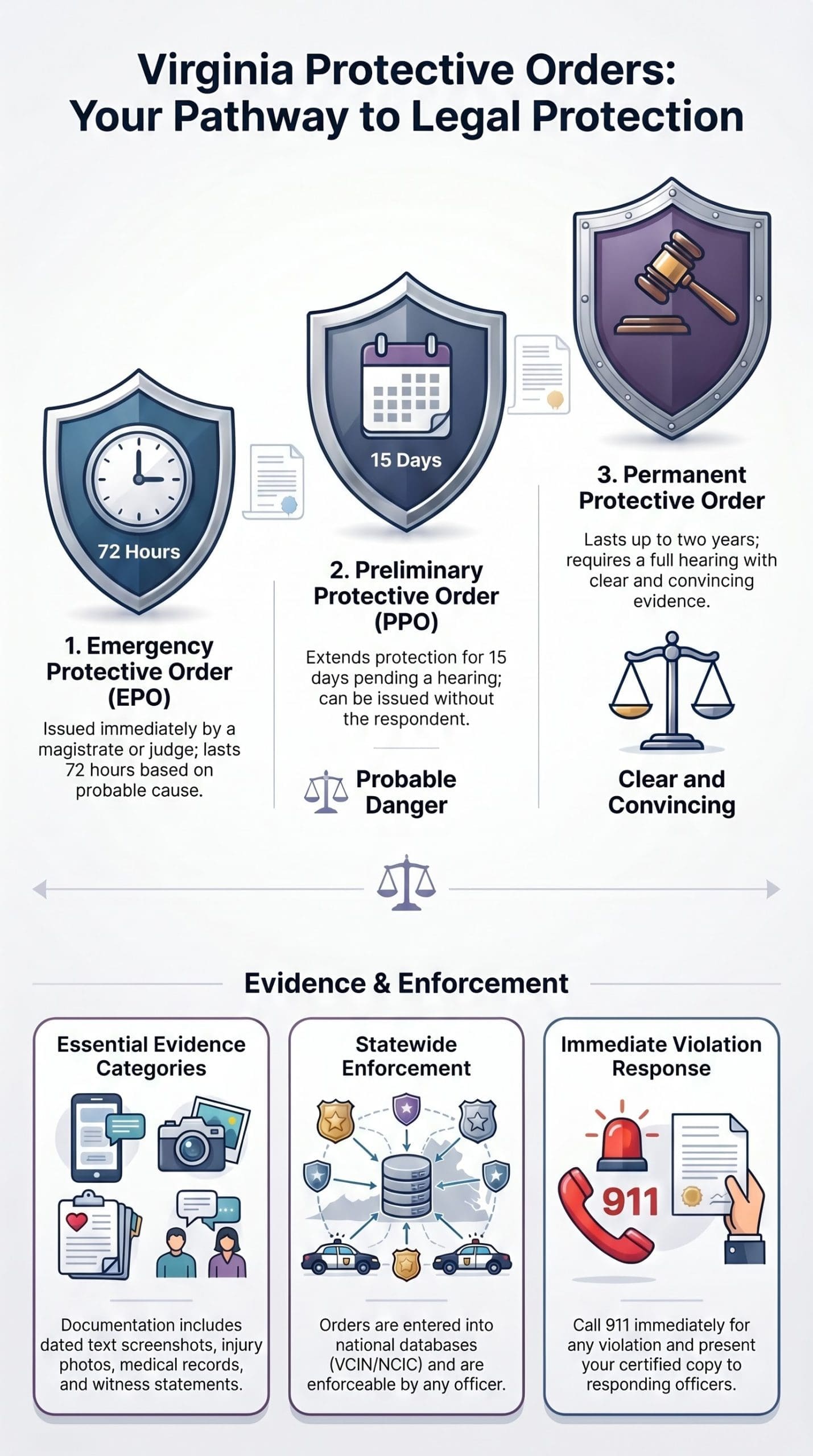
Table of Contents
- How protective orders work across Virginia’s judicial system
- Northern Virginia scenarios: Fairfax, Loudoun, Prince William, Arlington
- Hampton Roads scenarios: Virginia Beach, Norfolk, Chesapeake, Newport News
- Richmond region scenarios: Henrico, Chesterfield, Hanover
- Southwest Virginia scenarios: Roanoke, Montgomery, Washington counties
- Shenandoah Valley scenarios: Rockingham, Augusta, Shenandoah
- Evidence that works across all Virginia counties
- What happens after the order is granted
- Summary
Looking for the statewide framework? This page focuses on a specific area of Virginia family law. For the broader statewide guide that covers divorce grounds, equitable distribution, custody under Va. Code 20-124.3, child support, alimony, protective orders, and adoption, see Virginia Family Law Lawyer: A Working Attorney’s Guide.
Chapter 1. How protective orders work across Virginia’s judicial system
Virginia’s protective order system operates under the same statutes statewide, but local court procedures, judicial temperament, law enforcement practices, and community resources vary significantly by jurisdiction. Virginia Code § 19.2-152.8 through § 19.2-152.10 governs emergency protective orders. Virginia Code § 16.1-253.1 controls preliminary protective orders. Virginia Code § 16.1-279.1 establishes permanent protective orders. These statutes apply identically whether you file in Fairfax Circuit Court, Wise County General District Court, or Albemarle County Juvenile and Domestic Relations Court.
The three types of protective orders create a progression. An emergency protective order can be issued immediately, lasts 72 hours, and requires only that a magistrate or judge find probable cause that a person has been subjected to an act of violence, force, or threat. A preliminary protective order can extend protection for up to 15 days pending a full hearing, requires the court to find probable danger of further acts, and can be issued ex parte without the respondent present. A permanent protective order requires a full hearing with both parties present, lasts up to two years, and demands clear and convincing evidence that the petitioner has been subjected to an act of violence or credible threat.
Jurisdiction Matters More Than You Think
Where you file determines which judge hears your case, which law enforcement agency enforces violations, and which local resources are available for support. If you live in Loudoun County but work in Fairfax County and the threat occurs in Prince William County, you need to understand which court has proper jurisdiction. For detailed guidance on cross-county jurisdiction issues, see our article on how jurisdiction affects protective orders across county lines.
Chapter 2. Northern Virginia scenarios: Fairfax, Loudoun, Prince William, Arlington
Northern Virginia protective order cases often involve high income households, dual career couples, technology sector employment, government contractor positions requiring security clearances, complex custody arrangements, and sophisticated social media harassment. The density of legal resources means better access to representation, but also means respondents often retain aggressive counsel who challenge every element of the petition.
Fairfax County Scenario: McLean Professional Couple
Sarah works as a consultant in McLean and recently separated from her spouse who works for a defense contractor. After she filed for divorce, her spouse began showing up at her office building, sending hundreds of text messages daily, and telling her coworkers that she was mentally unstable. When she blocked his number, he created fake social media accounts to continue contact. Last week he waited in the parking garage and followed her car onto the Beltway while calling her continuously.
How to handle this: Sarah should immediately file for a preliminary protective order at Fairfax County Juvenile and Domestic Relations Court at 4110 Chain Bridge Road. She needs to document the text message volume with screenshots showing dates and times, obtain a witness statement from a coworker who observed the workplace appearances, save the fake social media profiles, and, if possible, get security footage from the parking garage. Fairfax County judges expect organized evidence and clear testimony about fear of future harm. For more on workplace harassment protective orders in Fairfax, see our McLean harassment guide.
Loudoun County Scenario: Ashburn Cyberstalking
Michael lives in Ashburn and ended a dating relationship three months ago. His ex-girlfriend has been posting his address, phone number, and employer information on public forums with false accusations about criminal behavior. She created a fake Tinder profile using his photos and sent messages to his family members claiming he was having affairs. She has never physically approached him, but the online campaign has cost him a job opportunity after a background check revealed the false posts.
How to handle this: Michael should file in Loudoun County General District Court or Juvenile and Domestic Relations Court. Cyberstalking qualifies under Virginia’s protective order statutes when it creates a reasonable fear of harm. He needs to preserve screenshots of every post with visible dates and URLs, document the fake profile with archived pages, obtain written statements from family members who received messages, and show the connection between the online activity and the lost job opportunity. Loudoun County has specific experience with technology-based harassment. For detailed guidance, see our article on protective orders in Loudoun County.
Prince William County Scenario: Woodbridge Teen Dating Violence
Jennifer is a 16-year-old student at a Woodbridge high school. Her ex-boyfriend has been waiting at her bus stop every morning, following her between classes, and threatening to share intimate photos if she does not get back together with him. He grabbed her arm hard enough to leave bruises during an argument in the school parking lot. The school suspended him but cannot prevent him from appearing in public areas near her home.
How to handle this: Jennifer’s parents can file on her behalf at Prince William County Juvenile and Domestic Relations Court. They need the school suspension documentation, photos of the bruises taken immediately after the incident, any text messages containing threats, and witness statements from other students. Prince William County takes teen dating violence seriously and the court can include provisions prohibiting contact at school, bus stops, and extracurricular activities. For more on teen protective orders, see our articles on teen dating violence in Fairfax and Lorton teen protective orders.
Arlington County Scenario: Military Spouse at Pentagon
Amanda is married to an active-duty service member stationed at the Pentagon. During arguments he has pushed her into walls, blocked her from leaving rooms, and threatened to use his military connections to take their children if she leaves. She fears reporting to military authorities will hurt his career and her family’s financial security, but the violence is escalating.
How to handle this: Amanda should file in Arlington County General District Court for a civilian protective order. Military spouses can obtain civilian protective orders that operate independently from military protective orders. She needs medical records if she sought treatment, photos of any injuries, text messages showing controlling behavior, and documentation of any police calls to the residence. Arlington County coordinates with military law enforcement but a civilian protective order provides independent protection. For military family considerations, see our Quantico military protective orders guide.
Northern Virginia Court Locations
Fairfax County: Juvenile and Domestic Relations Court, 4110 Chain Bridge Road, Fairfax, VA 22030
Loudoun County: Loudoun County Courts Complex, 18 East Market Street, Leesburg, VA 20176
Prince William County: Juvenile and Domestic Relations Court, 9311 Lee Avenue, Manassas, VA 20110
Arlington County: General District Court, 1425 North Courthouse Road, Arlington, VA 22201
Chapter 3. Hampton Roads scenarios: Virginia Beach, Norfolk, Chesapeake, Newport News
Hampton Roads protective order cases frequently involve military personnel, maritime workers, tourism industry employees, shared base housing situations, and coastal community dynamics. The concentration of Navy installations means many cases intersect military jurisdiction, and the transient nature of military families creates unique challenges when service members receive orders mid-proceeding.
Virginia Beach Scenario: Oceanfront Hospitality Worker
Rachel works at an oceanfront hotel and her supervisor has been making unwanted sexual advances, waiting for her after shifts, showing up at her apartment building, and threatening her continued employment if she does not respond to his advances. She reported the behavior to hotel management but they transferred him to night shifts without addressing the harassment. He continues texting her explicit messages and following her on the boardwalk.
How to handle this: Rachel should file for a protective order at Virginia Beach General District Court at 2501 James Madison Boulevard. Although this involves workplace conduct, Virginia protective orders can address stalking and harassment regardless of the relationship context when accompanied by threats. She needs the explicit text messages, documentation of her complaint to hotel management showing they knew about the behavior, any security footage of him waiting outside her workplace, and witness statements from coworkers. Virginia Beach courts are familiar with tourism industry cases where power imbalances create harassment situations.
Norfolk Scenario: Naval Station Domestic Violence
Lisa lives in base housing at Naval Station Norfolk with her husband who is an active duty sailor. After drinking at home he becomes verbally abusive, has punched holes in walls, thrown furniture, and last weekend grabbed her by the throat during an argument. Base security responded to a call but military police took a report without making an arrest. His command issued a military protective order but she wants civilian legal protection that extends off base.
How to handle this: Lisa should file in Norfolk Juvenile and Domestic Relations Court at 811 East City Hall Avenue. She can obtain a civilian protective order that provides broader protection than a military protective order and remains in effect even if he deploys or receives transfer orders. She needs the base security incident reports, photos of the damaged property and any injuries, the military protective order documentation, and medical records if she sought treatment. Norfolk courts handle numerous military-connected cases and understand the intersection between military and civilian protective orders.
Chesapeake Scenario: Shared Custody Escalation
David shares custody of two children with his ex-wife in Chesapeake. During exchanges she has become increasingly volatile, screaming at him in front of the children, making false accusations to their school that he is abusive, and last month followed him to his new girlfriend’s home and pounded on the door threatening violence. She sent him a text saying she would make sure he never sees the children again and that his new relationship would destroy his life.
How to handle this: David should file at Chesapeake General District Court or Juvenile and Domestic Relations Court. Men can obtain protective orders against female partners when threats and harassment create credible fear. He needs the threatening text messages, witness testimony from the new girlfriend about the incident at her home, documentation of the false reports to the school with the school’s response, and any video or audio recordings of volatile custody exchanges if Virginia’s single party consent recording law applies. For custody-related protective order issues, see our article on protective orders in custody disputes.
Newport News Scenario: Shipyard Worker Neighbor Dispute
Marcus works at Newport News Shipbuilding and lives in a townhouse community. His neighbor has been leaving threatening notes on his door, keying his car, filing false noise complaints, and last week confronted him in the parking lot with a baseball bat while yelling racial slurs. Police took a report but said it was a civil matter. The neighbor’s harassment has made Marcus afraid to leave his home.
How to handle this: Marcus should file for a protective order at Newport News General District Court at 2501 Huntington Avenue. Although neighbor disputes often start as civil matters, conduct involving weapons, racial intimidation, and property damage creating fear of bodily harm qualifies for protective order relief. He needs the threatening notes, photos of the car damage with police report numbers, documentation of the false complaints to show a pattern of harassment, and any security camera footage of confrontations. Newport News courts can issue protective orders that require the neighbor to stay away from common areas and prohibit further contact.
Chapter 4. Richmond region scenarios: Henrico, Chesterfield, Hanover
Richmond-area protective order cases often involve suburban families, professional couples, university community dynamics, and urban-suburban crossover situations in which threats occur in Richmond City but the parties live in surrounding counties. The concentration of employment in healthcare, education, and financial services creates cases involving professional reputation concerns and workplace harassment.
Henrico County Scenario: Short Pump Domestic Violence
Catherine lives in Short Pump and has been married for eight years. Her husband controls all finances, monitors her phone and email, forbids her from seeing family, and recently told her that if she tries to leave he will take their children and ensure she gets nothing in a divorce. Last night, during an argument, he held her against a wall by her neck and said next time he would not stop. She has no separate bank account and fears she cannot afford to leave.
How to handle this: Catherine should go to Henrico County Juvenile and Domestic Relations Court at 4301 East Parham Road and request an emergency protective order. She does not need money to file. Financial control combined with physical violence and threats qualifies for immediate protection. She should document the choking incident with photos of any marks, write down dates and descriptions of prior controlling incidents, and contact Henrico County domestic violence services for emergency shelter and financial assistance. Henrico County has victim advocates available at the courthouse who can help with the filing process.
Chesterfield County Scenario: VCU Student Stalking
Emily is a VCU student who lives with her parents in Chesterfield County. A classmate she went on two dates with has been showing up uninvited at her parents’ home, following her to classes, sending dozens of messages daily despite her requests to stop, and created a social media account posting photos of her with captions suggesting they are in a relationship. Campus police issued a no-contact order but he continues appearing at off-campus locations.
How to handle this: Emily should file at Chesterfield County General District Court at 9500 Courthouse Road. She needs the campus police no-contact order showing she already sought help, screenshots of all messages with dates showing the volume and her requests to stop, documentation of the fake social media account, and witness statements from family members or roommates who observed the unwanted appearances. Chesterfield County courts can issue orders that coordinate with university disciplinary proceedings while providing broader off-campus protection.
Hanover County Scenario: Rural Property Boundary Dispute
Robert owns rural property in Hanover County. His neighbor has been trespassing on his land, cutting down trees that cross the property line, and last month blocked Robert’s driveway with equipment while threatening to shoot him if he called the sheriff. The neighbor claims an easement that does not exist in the deed. Sheriff’s deputies advised it was a civil property dispute but the threats and intimidation have escalated.
How to handle this: Robert should file for a protective order at Hanover County General District Court at 7507 Library Drive in Hanover. Protective orders can address neighbor disputes when threats of violence accompany property conflicts. He needs the sheriff’s incident reports, property survey showing the correct boundary, photos or video of the trespassing and property damage, and written documentation of the threats. Hanover County cases often involve rural property disputes where isolation increases fear, and courts can issue orders prohibiting contact while civil property litigation proceeds separately.
Richmond Region Court Locations
Henrico County: Juvenile and Domestic Relations Court, 4301 East Parham Road, Henrico, VA 23228
Chesterfield County: General District Court, 9500 Courthouse Road, Chesterfield, VA 23832
Hanover County: General District Court, 7507 Library Drive, Hanover, VA 23069
Richmond City: John Marshall Courts Building, 400 North 9th Street, Richmond, VA 23219
Chapter 5. Southwest Virginia scenarios: Roanoke, Montgomery, Washington counties
Southwest Virginia protective order cases often involve smaller communities where privacy concerns are heightened, rural isolation increases danger, economic stress contributes to domestic violence, and victims may face limited access to services compared to urban areas. Court dockets move differently than Northern Virginia, and local relationships between law enforcement, courts, and social services create unique procedural considerations.
Roanoke Scenario: Downtown Apartment Domestic Violence
Jessica lives in downtown Roanoke and her boyfriend moved in six months ago. He does not work and has become increasingly controlling and violent when she discusses ending the relationship. Last week he smashed her laptop, threw kitchen knives at the wall near her, and prevented her from leaving the apartment for two days by blocking the door and taking her keys. She finally escaped when a neighbor heard her screaming and called police.
How to handle this: Jessica should file immediately at Roanoke City Juvenile and Domestic Relations Court at 315 Church Avenue SW. She needs the police report from the neighbor’s 911 call, photos of the damaged property showing the violence, medical records if she sought treatment, and the neighbor’s witness statement. Because he lives in her apartment, the protective order can require him to vacate the premises even though he has been residing there. Roanoke City has domestic violence services that can provide emergency housing assistance while the order is in effect.
Montgomery County Scenario: Virginia Tech Student Harassment
Brandon is a Virginia Tech student living off campus in Blacksburg. His ex-girlfriend who also attends Tech has been spreading false rumors about him, vandalizing his car parked at his apartment, appearing at his workplace, and sent him messages saying she would ruin his academic career and future employment. University officials issued a no-contact directive but she continues finding ways to appear where he will be.
How to handle this: Brandon should file at Montgomery County Juvenile and Domestic Relations Court at 1 East Main Street in Christiansburg. He needs the university no-contact directive, documentation of the car vandalism with police reports and repair estimates, the threatening messages, and written statements from witnesses who heard the false rumors or saw her appear at his workplace. Montgomery County courts coordinate with Virginia Tech student conduct proceedings but provide independent legal protection that extends beyond campus.
Washington County Scenario: Rural Isolation Domestic Violence
Mary lives in rural Washington County fifteen miles from the nearest town. Her husband controls access to their only vehicle, monitors her phone use, and has threatened to harm her family if she tells anyone about the abuse. Physical violence has occurred multiple times but she has not sought medical treatment because he prevents her from leaving the property. She finally accessed a neighbor’s phone to call the domestic violence hotline.
How to handle this: Mary should contact Washington County Sheriff’s Office who can transport her to the courthouse in Abingdon at 189 East Main Street to file for an emergency protective order. Rural isolation is a factor courts recognize as increasing danger. She should document dates and descriptions of abuse episodes, photograph any current injuries even if old, and provide detailed testimony about the isolation tactics and threats. Washington County victim services can arrange transportation and temporary shelter while the protective order process proceeds.
Chapter 6. Shenandoah Valley scenarios: Rockingham, Augusta, Shenandoah counties
Shenandoah Valley protective order cases often reflect agricultural community dynamics, small town interconnections where parties may have mutual friends and business relationships, Mennonite and conservative religious communities with unique cultural considerations, and cases where economic dependence on family businesses complicates leaving abusive situations.
Rockingham County Scenario: Harrisonburg Immigrant Victim
Maria lives in Harrisonburg and her husband threatens to report her to immigration authorities if she leaves or seeks help for the abuse. He controls all documents including her passport and work authorization, tells her she will be deported and lose her children if she contacts police, and has physically assaulted her multiple times. She fears both the abuse and the immigration consequences.
How to handle this: Maria can file for a protective order at Rockingham County Juvenile and Domestic Relations Court at 50 Court Square in Harrisonburg regardless of immigration status. Virginia protective order proceedings do not require proof of legal status and do not trigger immigration reporting. She should document the physical abuse with photos, seek medical records if available, and contact immigrant victim services through Rockingham County. Immigration threats as a control tactic are themselves a form of abuse that courts consider when evaluating danger.
Augusta County Scenario: Staunton Small Business Harassment
Thomas owns a small retail business in downtown Staunton. His ex-business partner who left the company acrimoniously has been showing up at the store daily, confronting customers with false claims about Thomas, posting fake negative reviews online, and threatening to physically harm Thomas. The harassment is damaging his business and he fears the escalating threats.
How to handle this: Thomas should file at Augusta County General District Court at 1 East Johnson Street in Staunton. Although business disputes typically proceed through civil litigation, threats of physical harm and intentional interference through harassment can support a protective order. He needs documentation of each store appearance with dates and times, witness statements from employees or customers who observed the confrontations, screenshots of the fake reviews with evidence they are false, and records of any threatening communications. The protective order can prohibit the ex-partner from approaching the business premises.
Shenandoah County Scenario: Woodstock Family Farm Dispute
Rebecca works on her family’s farm near Woodstock. Her brother who also works on the farm has become volatile and threatening during disputes about farm operations and inheritance expectations. Last month he threatened her with farm equipment, prevented her from entering the farm office where business records are kept, and told other family members he would make sure she got nothing when their parents die.
How to handle this: Rebecca should file at Shenandoah County Juvenile and Domestic Relations Court at 112 South Main Street in Woodstock. Family business disputes that include threats and intimidation can qualify for protective order relief when they create fear of harm. She needs witness testimony from other family members or farm employees who observed the threats, documentation of being blocked from business areas showing a pattern of control through intimidation, and written or recorded threats regarding inheritance. Shenandoah County courts can fashion orders that allow continued farm operations while prohibiting threatening contact.
Chapter 7. Evidence that works across all Virginia counties
Regardless of which Virginia county you file in, certain categories of evidence consistently prove effective in protective order proceedings. Judges across the Commonwealth look for concrete documentation, credible corroboration, and testimony that demonstrates reasonable fear of future harm.
Essential Evidence Categories
Text messages and electronic communications: Screenshot every threatening, harassing, or controlling message with visible date and time stamps. Include context showing you requested no contact. Print communications in chronological order.
Photos of injuries: Take photos immediately after any physical incident showing visible injuries from multiple angles. Include photos showing injury progression over days. Photograph property damage showing violence indicators.
Police and medical records: Obtain copies of all incident reports even if no arrest occurred. Collect medical records documenting injuries with provider statements about how injuries occurred. Request 911 call recordings if available.
Witness statements: Written statements from people who observed incidents, heard threats, or saw your emotional state afterward. Witnesses should include contact information and willingness to testify if needed.
Documentation of pattern: Timeline showing escalation of behavior. Records of prior protective orders or criminal charges. Documentation showing violations of previous court orders or conditions.
Virginia courts permit evidence that might be inadmissible in criminal proceedings because protective orders use a lower evidentiary standard. Hearsay statements may be considered if they bear sufficient indicia of reliability. Prior bad acts showing pattern of abuse are relevant even if they did not result in convictions. Your testimony about your fear is evidence, especially when corroborated by the circumstances.
Chapter 8. What happens after the order is granted
A protective order is only effective if properly enforced and you understand both your rights and responsibilities under the order. Virginia protective orders are enforceable statewide and violations carry serious consequences including criminal charges, but enforcement requires immediate reporting and cooperation with law enforcement.
After the court grants a protective order, the clerk enters it into the Virginia Criminal Information Network and the National Crime Information Center. This means any law enforcement officer anywhere in Virginia can access and enforce the order. You should carry a certified copy at all times and provide copies to your employer, children’s schools, and apartment management if applicable.
If Violations Occur
Call 911 immediately for any violation regardless of how minor it seems. Document the violation with photos, screenshots, saved voicemails, or witness information before calling police. Do not respond to the contact even to tell the person to stop, as this can complicate enforcement.
Provide responding officers with your certified copy of the protective order and clear description of the violation. Request that the officer file charges for violation of the protective order, which is a Class 1 misdemeanor carrying up to 12 months in jail.
Keep detailed records of every violation with dates, times, and circumstances. Multiple violations can result in enhanced penalties and may support extension of the protective order beyond the initial two year period.
You also have responsibilities under the order. Do not initiate contact with the respondent or you may jeopardize enforcement. Do not allow violations because you feel sorry for the person or think the situation has improved. The order remains in effect for its full duration unless modified or dissolved by the court, and only the court can make changes.
Summary
Virginia’s protective order system provides consistent legal protection across all counties, but effective use requires understanding local court procedures, collecting jurisdiction-appropriate evidence, and recognizing that scenarios vary significantly by region. Northern Virginia cases often involve technology sector professionals, cyberstalking, and sophisticated harassment. Hampton Roads cases frequently intersect military jurisdiction and base housing dynamics. Richmond area cases span urban and suburban contexts with professional reputation concerns. Southwest Virginia and Shenandoah Valley cases involve rural isolation, agricultural community dynamics, and economic dependence on family businesses.
Regardless of location, successful protective orders require concrete documentation, credible witness testimony, clear articulation of fear, and immediate enforcement when violations occur. The legal standard remains the same whether you file in Fairfax or Washington County, but local resources, court practices, and community support systems vary significantly.
For comprehensive guidance on Virginia protective orders generally, see our complete guide to Virginia protective orders. For assistance with protective order defense, see our article on fighting false protective order allegations.
Schedule a Consultation
If you need to obtain a protective order in any Virginia county or defend against a protective order petition, Shin Law Office provides experienced representation understanding the procedures, evidence requirements, and enforcement mechanisms across Northern Virginia, Hampton Roads, Richmond, and Southwest Virginia jurisdictions.
Call 571-445-6565 or visit our contact page

Authoritative Sources
Virginia Statutes:
Code of Virginia. (n.d.). § 16.1-253.1. Preliminary protective orders. Virginia Law. Retrieved April 20, 2026, from https://law.lis.virginia.gov/vacode/title16.1/chapter11/section16.1-253.1/
Code of Virginia. (n.d.). § 16.1-279.1. Protective orders; confidentiality of information. Virginia Law. Retrieved April 20, 2026, from https://law.lis.virginia.gov/vacode/title16.1/chapter11/section16.1-279.1/
Code of Virginia. (n.d.). § 19.2-152.8. Emergency protective orders authorized. Virginia Law. Retrieved April 20, 2026, from https://law.lis.virginia.gov/vacode/title19.2/chapter9/section19.2-152.8/
Code of Virginia. (n.d.). § 19.2-152.9. Emergency protective order; penalty for violation. Virginia Law. Retrieved April 20, 2026, from https://law.lis.virginia.gov/vacode/title19.2/chapter9/section19.2-152.9/
Code of Virginia. (n.d.). § 19.2-152.10. Emergency protective orders; procedures and hearing. Virginia Law. Retrieved April 20, 2026, from https://law.lis.virginia.gov/vacode/title19.2/chapter9/section19.2-152.10/
Northern Virginia Court Resources:
Arlington County General District Court. (2026). Court information. Virginia Judicial System. Retrieved April 20, 2026, from https://www.vacourts.gov/courts/gd/arlington/home.html
Fairfax County Juvenile and Domestic Relations District Court. (2026). Court information. Virginia Judicial System. Retrieved April 20, 2026, from https://www.vacourts.gov/courts/jdr/fairfax/home.html
Loudoun County Courts. (2026). Court locations and contact information. Virginia Judicial System. Retrieved April 20, 2026, from https://www.vacourts.gov/courts/circuit/loudoun/home.html
Prince William County Juvenile and Domestic Relations District Court. (2026). Court information. Virginia Judicial System. Retrieved April 20, 2026, from https://www.vacourts.gov/courts/jdr/prince_william/home.html
Hampton Roads Court Resources:
Chesapeake General District Court. (2026). Court information. Virginia Judicial System. Retrieved April 20, 2026, from https://www.vacourts.gov/courts/gd/chesapeake/home.html
Newport News General District Court. (2026). Court information. Virginia Judicial System. Retrieved April 20, 2026, from https://www.vacourts.gov/courts/gd/newport_news/home.html
Norfolk Juvenile and Domestic Relations District Court. (2026). Court information. Virginia Judicial System. Retrieved April 20, 2026, from https://www.vacourts.gov/courts/jdr/norfolk/home.html
Virginia Beach General District Court. (2026). Court information. Virginia Judicial System. Retrieved April 20, 2026, from https://www.vacourts.gov/courts/gd/virginia_beach/home.html
Richmond Region Court Resources:
Chesterfield County General District Court. (2026). Court information. Virginia Judicial System. Retrieved April 20, 2026, from https://www.vacourts.gov/courts/gd/chesterfield/home.html
Hanover County General District Court. (2026). Court information. Virginia Judicial System. Retrieved April 20, 2026, from https://www.vacourts.gov/courts/gd/hanover/home.html
Henrico County Juvenile and Domestic Relations District Court. (2026). Court information. Virginia Judicial System. Retrieved April 20, 2026, from https://www.vacourts.gov/courts/jdr/henrico/home.html
Richmond City John Marshall Courts Building. (2026). Court information. Virginia Judicial System. Retrieved April 20, 2026, from https://www.vacourts.gov/courts/circuit/richmond_city/home.html
Southwest Virginia Court Resources:
Montgomery County Juvenile and Domestic Relations District Court. (2026). Court information. Virginia Judicial System. Retrieved April 20, 2026, from https://www.vacourts.gov/courts/jdr/montgomery/home.html
Roanoke City Juvenile and Domestic Relations District Court. (2026). Court information. Virginia Judicial System. Retrieved April 20, 2026, from https://www.vacourts.gov/courts/jdr/roanoke_city/home.html
Washington County General District Court. (2026). Court information. Virginia Judicial System. Retrieved April 20, 2026, from https://www.vacourts.gov/courts/gd/washington/home.html
Shenandoah Valley Court Resources:
Augusta County General District Court. (2026). Court information. Virginia Judicial System. Retrieved April 20, 2026, from https://www.vacourts.gov/courts/gd/augusta/home.html
Rockingham County Juvenile and Domestic Relations District Court. (2026). Court information. Virginia Judicial System. Retrieved April 20, 2026, from https://www.vacourts.gov/courts/jdr/rockingham/home.html
Shenandoah County Juvenile and Domestic Relations District Court. (2026). Court information. Virginia Judicial System. Retrieved April 20, 2026, from https://www.vacourts.gov/courts/jdr/shenandoah/home.html
Virginia Judicial System Resources:
Supreme Court of Virginia. (2026). Protective orders. Virginia Judicial System. Retrieved April 20, 2026, from https://www.vacourts.gov/programs/dv/protective_orders.html
Virginia Judicial System. (2026). Domestic violence resources. Retrieved April 20, 2026, from https://www.vacourts.gov/programs/dv/home.html
Virginia State Police. (2026). Virginia Criminal Information Network (VCIN). Retrieved April 20, 2026, from https://vsp.virginia.gov/services/virginia-criminal-information-network-vcin/
Support Resources:
Virginia Department of Criminal Justice Services. (2026). Sexual and domestic violence victim services. Retrieved April 20, 2026, from https://www.dcjs.virginia.gov/victim-services
Virginia Department of Social Services. (2026). Domestic violence services. Retrieved April 20, 2026, from https://www.dss.virginia.gov/family/dv/
