Bottom Line Up Front (BLUF)
The Virginia Consumer Protection Act (VCPA) is a broad state law that protects consumers from deceptive or unfair business practices. For businesses in Northern Virginia – including Fairfax, Loudoun, Prince William, Arlington, Clarke, and Frederick counties – this means even unintentional misrepresentations or failures to disclose important information can lead to legal liability. The VCPA gives consumers powerful remedies (like attorney fees and treble damages) and is enforced both through private lawsuits and by state or local authorities.
Bottom line: Companies must make VCPA compliance a priority and be prepared with strong defenses if a claim arises. This article provides an overview of the VCPA, common compliance risks for Virginia businesses, practical defenses (with case law and code citations), a Northern Virginia perspective, and a handy defense checklist.
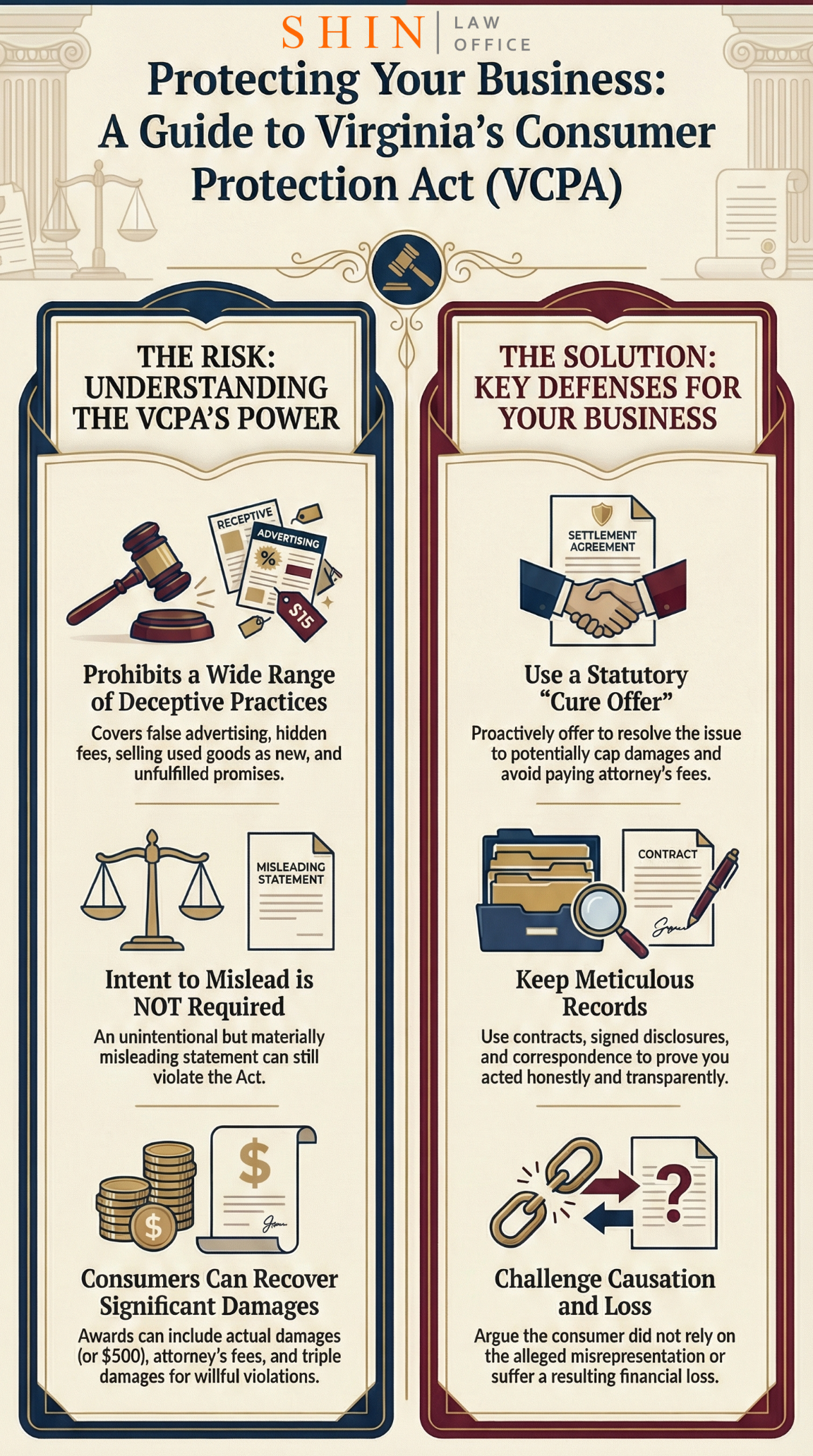
Table of Contents
1. Overview of the Virginia Consumer Protection Act (VCPA)
The Virginia Consumer Protection Act, codified at Va. Code § 59.1-196 et seq., is a remedial law intended to promote fair and ethical standards between businesses and consumers. The VCPA makes it unlawful for a business to engage in a wide range of fraudulent, deceptive, or misleading practices in connection with consumer transactions. A “consumer transaction” is broadly defined as the sale, lease, or advertisement of goods or services for personal, family, or household use.
The VCPA contains a comprehensive list of banned practices in Va. Code § 59.1-200, including misrepresenting the standard or grade of goods, bait-and-switch advertising, false statements about price reductions, using fake invoices, and failing to disclose material conditions up front. The Act also has a catch-all provision banning any other deception, fraud, false pretense, false promise, or misrepresentation in a consumer transaction.
Importantly, the VCPA expands consumer remedies beyond common-law fraud — a consumer does not have to prove fraudulent intent. Victims can recover actual damages (or $500 statutory damages per violation, whichever is greater), and if the violation was willful, up to triple actual damages. The statute also entitles the winner to attorney’s fees and court costs, giving consumers significant leverage.
Certain entities are exempt: banks, credit unions, insurance companies, public utilities, and real estate licensees acting in their regulated capacity. However, these exemptions are narrowly interpreted.
2. Common VCPA Compliance Risks for Businesses
Virginia businesses must be proactive in identifying and managing practices that could violate the VCPA. Common compliance risks include:
- False or Misleading Advertising: Making claims about your product or service that are not entirely true, including exaggerations about quality, fake sale prices, or misuse of terms like “free” or “guaranteed.”
- Failure to Disclose Key Terms or Fees: Hiding the fine print. The VCPA requires clear disclosure of material terms such as refund policies, warranty limitations, and any unusual conditions.
- Selling Used or Defective Goods as New: The VCPA specifically forbids selling used, secondhand, repossessed, defective, blemished, or reconditioned goods without clearly identifying them as such.
- Unfulfilled Promises and Guarantees: If your business offers guarantees or promises results, failing to honor them can violate the VCPA. A false promise is in the statutory list of illegal practices.
- Improper Use of Contracts and Legal Clauses: Including void or unenforceable clauses in consumer contracts and then attempting to enforce them can itself be a VCPA violation.
- Violations of Specific Consumer Statutes: The VCPA incorporates several other Virginia consumer laws, including the Virginia Home Solicitation Sales Act, the Automobile Repair Facilities Act, and the Health Club Act. Violating those laws automatically triggers VCPA liability as well.
- Poor Complaint Handling: Ignoring customer service issues, especially when a consumer feels misled, is risky. Virginia law provides a cure offer mechanism for businesses to resolve issues before litigation.
3. Defending Against VCPA Claims – Key Strategies
Facing a VCPA lawsuit can be daunting, but businesses do have several defenses available:
- Transaction or Entity Outside VCPA Scope: The Act covers only consumer transactions for personal or household use. Business-to-business transactions are not consumer transactions. If the defendant’s business falls under a statutory exemption under Va. Code § 59.1-199, that can be a complete defense.
- No Misrepresentation or Intent to Mislead: A business can defend by showing its actions were not actually false, deceptive, or unfair. Clear documentation — contracts, disclosures, marketing materials, email communications — can demonstrate the business acted honestly and in good faith.
- Lack of Causation (No Reliance/No Loss): Even if a technical violation occurred, a plaintiff must prove they actually suffered a loss as a result. Virginia courts require proof that the misrepresentation caused the consumer’s harm.
- Statutory Cure Offer Defense: Under Va. Code § 59.1-204(C), before a consumer files suit you can send a written cure offer to remedy the problem and compensate the consumer. If the consumer unreasonably rejects it, the court can cap damages at the amount of the cure offer and bar attorney’s fees or extra damages after the offer was made.
- Statute of Limitations: The statute of limitations for a VCPA private action is generally two years after the cause of action accrues. Claims filed after that window can be dismissed as time-barred.
- Good Faith Unintentional Violation Defense: Va. Code § 59.1-207 provides a safe harbor for unintentional violations where the business can prove the violation was caused by someone else’s act beyond its control, or was a bona fide error despite compliance procedures. Note the court can still order restitution and attorney’s fees even for unintentional violations.
4. VCPA Enforcement in Northern Virginia (Local Perspective)
Northern Virginia – especially Fairfax, Loudoun, Prince William, Arlington, Clarke, and Frederick Counties – is a bustling economic hub with a large consumer population. Consumers in this region frequently turn to the VCPA when they feel wronged in transactions like auto sales, home improvement projects, retail purchases, and service contracts.
The Virginia Attorney General’s Office has a Consumer Protection Section that actively enforces the VCPA across the Commonwealth. The AG can investigate businesses through Civil Investigative Demands and bring lawsuits seeking injunctions, restitution, and civil penalties. Local Commonwealth’s Attorneys also have authority to enforce the VCPA and seek civil penalties for willful violations up to $2,500 per violation (or $5,000 for repeated violations).
Northern Virginia localities also have consumer protection offices or hotlines, such as Fairfax County Consumer Affairs, which mediate complaints and can refer patterns of abuse to the Attorney General. An Assurance of Voluntary Compliance (settlement) is often available to resolve AG investigations before public litigation.
Culturally, Northern Virginia juries tend to favor honest business practices and can distinguish between a frivolous gripe and an actual scam. Judges in these counties have experience with VCPA cases and will allow them to proceed to trial if the consumer’s allegations meet the statute’s criteria.
5. Defensive Checklist for Virginia Businesses
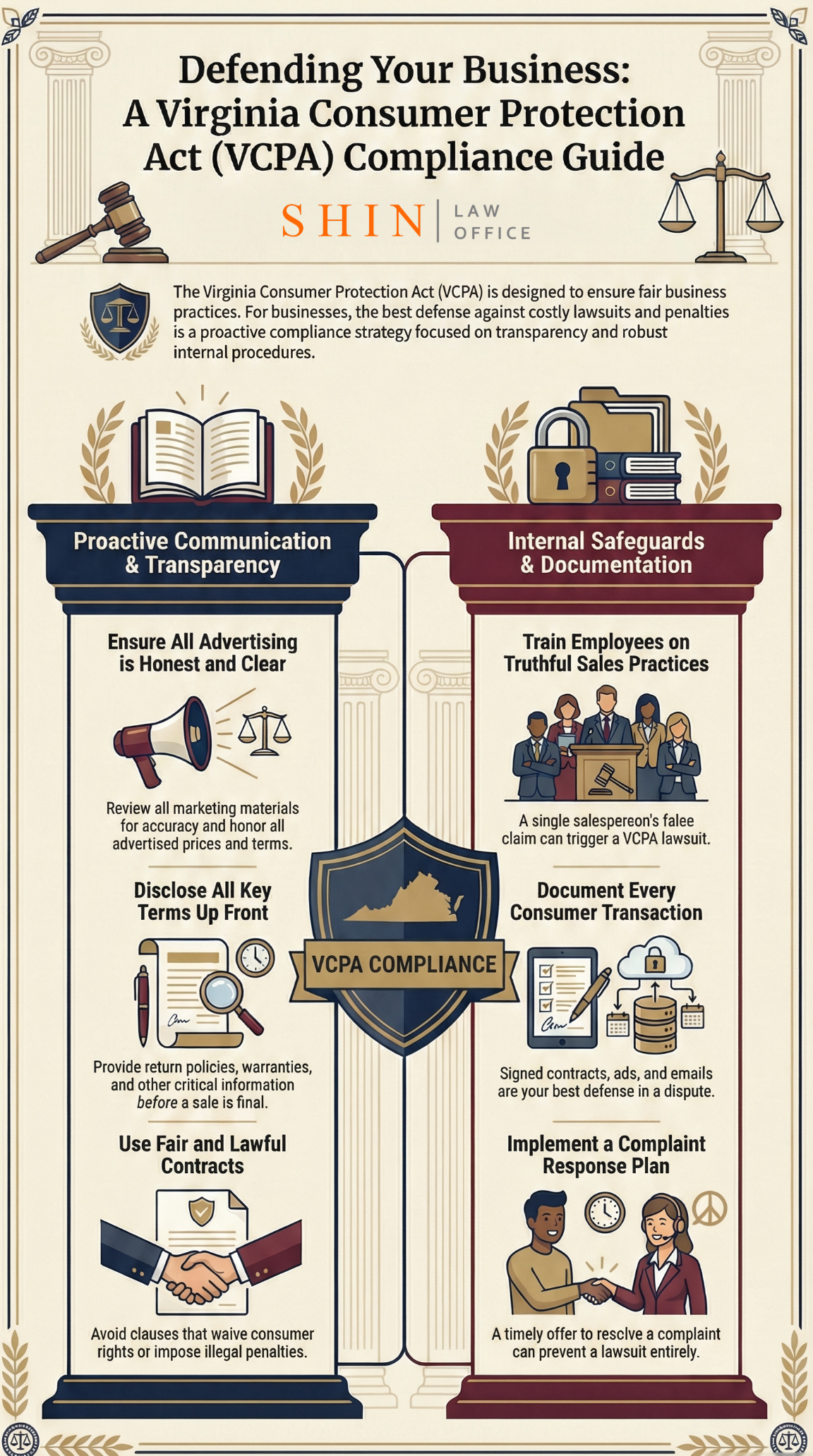
✅ Advertise Honestly and Clearly. Review all marketing for accuracy. Remove or clarify any statement that could be misconstrued. Honor advertised prices and promotions.
✅ Disclose Key Terms Up Front. Before a sale is final, make sure the customer has all crucial information: return/refund policies, warranty terms, delivery timelines, and installation requirements. Put these disclosures in writing.
✅ Avoid Unfair Contract Clauses. Do not include provisions in consumer contracts that violate the law or public policy. Use plain language contracts and include required Notice of Cancellation rights where applicable.
✅ Train Employees on Truthful Sales Practices. Train your staff to never make false claims or promises just to close a deal. Establish that all representations to customers must be truthful and authorized.
✅ Monitor and Update Marketing Content. Ensure outdated or incorrect claims are not lingering on your website, social media, or in-store signage. Designate someone to periodically audit your public content.
✅ Keep Documentation of All Consumer Transactions. Maintain copies of advertisements, signed contracts, receipts, warranties, and all correspondence with customers. Good record-keeping can make or break your ability to defend a VCPA claim.
✅ Implement a Complaint Response Plan. Have a clear process for handling customer complaints. Respond in writing to significant complaints. A timely cure offer or settlement can prevent a minor issue from becoming a lawsuit.
✅ Utilize Cure Offers When Appropriate. If you identify a potential VCPA violation or receive a demand letter, consider using the cure offer mechanism proactively with legal counsel.
✅ Check for Statutory Compliance. If your business type has extra consumer protection statutes (gym memberships, auto repair, credit services), double-check compliance. Violations of those acts trigger the VCPA automatically.
✅ Good Faith Error? Document It. If a mistake happens, fix it immediately and document what happened. Under Va. Code § 59.1-207, demonstrating an unintentional, bona fide error with proper compliance procedures can shield you from damages.
✅ Consult Legal Counsel Periodically. Laws and regulations evolve. Have a periodic legal check-up for your consumer practices, especially when launching new advertising campaigns or product lines.
FAQs – Virginia Consumer Protection Act
Q: What is the Virginia Consumer Protection Act (VCPA) and who does it protect?
A: The VCPA (Va. Code § 59.1-196 et seq.) protects consumers from fraudulent or deceptive acts by businesses in consumer transactions. It covers sales, leases, and services for personal or household use and gives consumers the right to sue for damages, attorney’s fees, and in willful cases, treble damages.
Q: What are some examples of VCPA violations?
A: Common examples include: misrepresenting a product’s qualities or origin; false advertising like bait-and-switch or fake sale prices; selling used or defective goods as new without disclosure; hidden fees; contracts with illegal provisions; and any deception or false promise made to a consumer in a transaction.
Q: My business didn’t intend to mislead anyone – can we still be liable?
A: Yes, intent is not required for many VCPA violations. Lack of intent might protect you from treble damages and might invoke the unintentional error defense, but the consumer can still claim actual damages.
Q: What can a consumer get if they win a VCPA lawsuit?
A: A successful consumer can recover actual damages (or $500, whichever is greater), reasonable attorney’s fees and court costs, and up to triple actual damages if the business’s violation was willful.
Q: How long does a consumer have to file a VCPA claim?
A: The statute of limitations is two years from when the cause of action accrues, generally the transaction date or when the consumer discovered the misrepresentation.
Q: Can a consumer sue for both fraud and under the VCPA for the same issue?
A: Yes, they can include both counts, but cannot recover twice for the same harm. If they win on both, they choose the higher award. VCPA provides attorney fees which fraud does not, and requires only a preponderance of evidence rather than clear and convincing proof.
Principal Attorney | Shin Law Office
Call 571-445-6565 or book a consultation online today.
(This article is provided for general informational purposes and does not constitute legal advice. For advice on your specific situation, consult with a licensed Virginia attorney.)
References
- Virginia Consumer Protection Act, Va. Code Ann. §§ 59.1-196–59.1-207 (2025). https://law.lis.virginia.gov/vacode/title59.1/chapter17/
- Virginia Code § 59.1-199. Exemptions. (2025).
- Virginia Code § 59.1-200. Prohibited practices. (2025).
- Virginia Code § 59.1-204. Private actions and damages. (2025).
- Virginia Code § 59.1-207. Unintentional violations. (2025).
- Ballagh v. Fauber, 290 Va. 120, 772 S.E.2d 315 (2015).
- Owens v. DRS Automotive FantomWorks, Inc., 288 Va. 489, 764 S.E.2d 256 (2014).
- Office of the Attorney General of Virginia. Consumer protection laws and enforcement authority. https://www.oag.state.va.us/consumer-protection/
Part of Shin Law Office’s Northern Virginia Commercial Litigation Guide
This article is part of a broader guide covering commercial contract disputes, federal contracting, construction litigation, mechanic’s liens, and toxic torts across Northern Virginia. See the complete resource: When the Contract Breaks: The Northern Virginia Commercial Litigation Guide — covering B2B disputes, federal contracting, teaming agreements, construction claims, mechanic’s liens, and toxic torts across Loudoun, Fairfax, Prince William, Arlington, Clarke, and Frederick Counties.