
BOTTOM LINE UP FRONT (BLUF)
Estate planning is not one-size-fits-all. Northern Virginia families have a range of will types and tools available to protect their legacy. As a Leesburg estate attorney, I’ve learned that the “right” will depends on your family situation and goals. Below, I explain the different types of wills in Virginia, from simple wills to more complex arrangements, and illustrate how each works under Virginia law (with Loudoun County’s local probate practices in mind). The key takeaway: ensure your will is properly executed under Virginia law and tailored to your family’s needs, and seek local counsel to avoid common pitfalls.
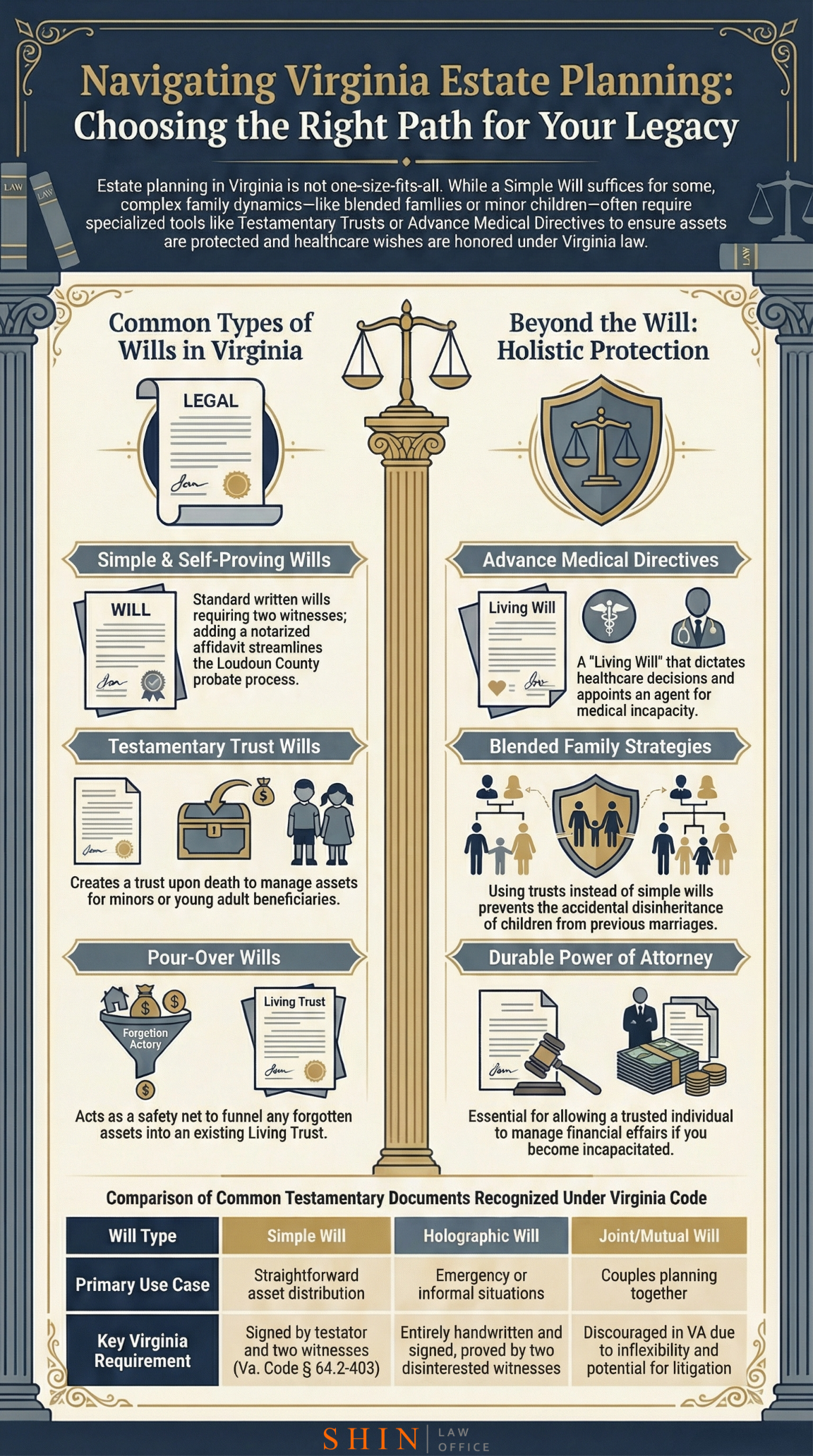
Table of Contents
- Introduction
- Basic Wills: Simple Wills, Testamentary Trust Wills, and Pour-Over Wills
- Wills for Couples: Joint Wills and Mutual Wills
- Handwritten and Self-Proving Wills: Execution Formalities
- Living Wills and Advance Medical Directives
- Special Family Situations: Blended Families and When a Will Is Not Enough
- Summary
- Works Cited: References
Hello, I’m Adam L. Engel, Esq, an estate planning attorney based in Leesburg, Virginia. In my practice, I often meet clients who are unsure what kind of will they need or if they need one at all. The truth is, Virginia law recognizes several types of wills and testamentary documents, each suited to different situations. Choosing the correct type (or combination of estate planning tools) can make a world of difference for your heirs and can avoid headaches in Loudoun County’s probate court.
In this guide, I’ll walk you through ten common will types and related estate planning instruments: from the basic Simple Will, to specialized versions like Testamentary Trust Wills, Pour-Over Wills, Joint and Mutual Wills for couples, Holographic Wills (handwritten wills), Self-Proving Wills, and even the so-called Living Will for healthcare decisions. I’ll also discuss wills for blended families and explain when a will alone might not be enough to meet your estate planning needs.
Along the way, I’ll provide Virginia legal citations and examples drawn from Virginia statutes and case law. I’ll highlight what makes each will type suitable or problematic for certain family scenarios, and point out common pitfalls we see in Loudoun County probate. My goal is to give you a clear, approachable understanding – as if we were sitting across the desk at my Leesburg office, talking through your plan in plain English.
Let’s start with the basics: what exactly is a will in Virginia, and what does it take to make one valid?
Basic Wills: Simple Wills, Testamentary Trust Wills, and Pour-Over Wills
Not every estate plan needs bells and whistles. For many people, a straightforward will suffices. In this chapter, we’ll cover “basic” wills – including the classic Simple Will and two common enhancements: the Testamentary Trust Will and the Pour-Over Will. Each of these is a variation on the last will and testament, and each must meet Virginia’s legal requirements to be valid.
Simple Wills
A Simple Will is the standard last will and testament most people think of. It’s a written document in which you (the testator) designate who should inherit your assets upon your death. You can also name an executor to manage your estate and guardians for minor children. Simple Wills work well for many nuclear families or modest estates where you intend a straightforward distribution of assets.
Virginia Legal Requirements: In Virginia, any valid will must be in writing and signed by the testator, and usually witnessed by two competent witnesses present at the same time. (An exception exists for holographic wills, discussed later.) The witnesses also sign the will in the testator’s presence. There’s no requirement that a will be notarized for validity, but adding a notarized affidavit can make the will “self-proving” (more on that shortly). Virginia’s statute Va. Code § 64.2-403 encapsulates these formalities: a will must be written and signed by the testator (or someone at his direction), and if the will isn’t entirely handwritten, it must have two witnesses signing in the testator’s presence. In my practice, I ensure that every will signing adheres strictly to these rules – it’s a simple step that prevents major problems later.
Hypothetical Example: John Doe, a Leesburg resident with a spouse and two adult children, drafts a simple will leaving all his assets to his wife, or if she predeceases him, to their children equally. He signs his will in front of two neighbors who also sign as witnesses. John’s will meets Virginia’s formal requirements, so when he passes, the Loudoun County Clerk can readily admit it to probate. Because John kept things simple and properly executed the will, his estate transfers smoothly to his family. A Simple Will, like John’s, is often suitable for first marriages with adult children or smaller estates where more complex trusts aren’t needed.
Why It May Be Insufficient: A Simple Will can fall short if your situation isn’t simple. For example, if John had minor children, a Simple Will might force a court-supervised guardianship for the kids’ inheritance. Or if John had a child with special needs, an outright distribution could jeopardize government benefits. Also, if John’s family were more complex (say a blended family or estranged relatives), a Simple Will might inadvertently disinherit someone or invite a will contest. We’ll discuss those scenarios later. The takeaway is that while a Simple Will is a powerful tool to direct your assets, you should periodically review it especially after major life events (marriage, divorce, births, deaths) – Virginia law changes some outcomes if you don’t (for instance, marriage or the birth of a child can partially revoke or override a pre-existing will by law).
Testamentary Trust Wills
A Testamentary Trust Will is essentially a will that creates a trust upon your death. In other words, the will contains language directing that some or all of your assets be placed into a trust for a beneficiary, rather than given to them outright. This is commonly used if you have minor children, young adult beneficiaries, or others who may need managed funds. The will names a trustee to manage the assets and outlines the trust terms (e.g., “Hold my assets in trust for my children until they reach age 25, and use the funds for their health, education, and support in the meantime”). In Virginia, these are sometimes called “family pot trusts” or minors’ trusts when for children.
How It Works: The key distinction is that the trust in a testamentary trust will does not exist until you die and the will is probated. At that point, the will effectively carves out a trust and transfers the designated assets into it. The Loudoun County Circuit Court (which handles probate) has continuing jurisdiction over testamentary trusts, meaning the trust might be subject to some court oversight. For example, the trustee may have to file inventories and accountings with the Commissioner of Accounts (the official supervising estate administration in Virginia) to show the trust funds are being managed properly for the beneficiaries. This oversight can protect beneficiaries but also adds complexity and cost.
Virginia Law: Virginia law fully permits testamentary trusts. In fact, the Uniform Trust Code (adopted in Virginia) applies to testamentary trusts just as it does to living trusts, with some nuances. The will must still meet all will formalities discussed above. A specific Virginia statute, Va. Code § 64.2-701 (Uniform Trust Code), provides that a trust created by a will (i.e., a testamentary trust) is valid so long as the will is valid and the trust terms are clearly stated. Additionally, Virginia law gives the circuit court authority to interpret and enforce testamentary trusts.
One important consideration: assets in a testamentary trust go through probate first (since they fund the trust after death via the will). This means probate fees and delays occur, unlike a trust created and funded during life. Some people prefer to avoid that by using a revocable living trust (discussed later). But in many cases – for instance, parents with young children – a Testamentary Trust Will is a sensible and cost-effective way to ensure your kids’ inheritance is managed responsibly if you’re gone.
Hypothetical Example: Jane Smith is a single mother in Loudoun County with two kids, ages 10 and 12. Her will leaves everything to a trust for the children’s benefit. The will says her sister will be trustee to manage the money, and that each child will receive half the remaining principal at age 25 (with the trustee empowered to use funds for the children’s needs in the meantime). When Jane tragically passes, her will is probated and her assets pour into the trust as directed. The Loudoun County Commissioner of Accounts oversees the trust’s initial funding. Jane’s sister (as trustee) now manages investments and expenses for the children, and each child will inherit outright at 25. In this scenario, the Testamentary Trust Will protected Jane’s young children – had she left a Simple Will giving them assets at age 18, they might have squandered an inheritance or needed a court-appointed guardian of property. Virginia courts favor honoring trust provisions in wills as long as they’re clearly drafted, and will enforce the trust according to Jane’s instructions.
Potential Pitfalls: A testamentary trust is only as good as its drafting and trustee. If the will’s trust language is ambiguous, courts may have to interpret it, which could lead to delays or even litigation. I always stress clarity – define the trustee’s powers and the beneficiaries’ rights precisely. Also, because the trust will be under court jurisdiction, the trustee will need to maintain accurate records and may be required to file periodic accountings. Some clients dislike this formality. If that’s a concern, a living trust (created outside a will) might be preferable to achieve the same goal without ongoing court supervision.
Pour-Over Wills
A Pour-Over Will is a special type of will often used in conjunction with a revocable living trust. If you have created a separate living trust during your lifetime, a Pour-Over Will is designed as a safety net to capture any assets you didn’t transfer into that trust while you were alive. The will essentially says: “I leave all my remaining assets to the trustee of my living trust, to be distributed according to that trust.” It “pours over” the probate assets into your trust at death.
Virginia Law on Pour-Over Wills: Pour-over wills are explicitly permitted by Virginia statute. Va. Code § 64.2-427 (the Uniform Testamentary Additions to Trusts Act as adopted in VA) provides that a will may devise property to an existing trust (or even a trust to be established by the will or another person’s will), and that such a pour-over provision is valid even if the trust is amendable or revocable, or was amended after the will was executed. In short, Virginia law makes it very easy to integrate a will with a living trust. The statute ensures that assets poured into the trust are administered under the trust’s terms, not as a separate testamentary trust of the decedent. One caveat: if the trust named in the will is revoked or terminated before the testator’s death, the pour-over gift lapses (so your will should have a backup plan for that).
How It Works: If you have a living trust, ideally you title most of your assets in the trust during life. But inevitably something might be left out (forgotten bank accounts, a car, etc.). The Pour-Over Will acts as a catch-all. When you die, any asset in your sole name with no beneficiary designation will go through probate under the will. The will’s terms then immediately funnel those assets into your trust. Once the assets are in the trust, the trustee (whom you chose) distributes them as the trust document directs. This way, you maintain the comprehensive plan outlined by your trust and avoid separate distributions under a will that could conflict with it.
Hypothetical Example: Sam and Maria Lee set up the “Lee Family Revocable Trust” during their lives, naming themselves as initial trustees and their adult daughter as successor trustee. They transfer their house and investment accounts to the trust, but Sam happens to own an old classic car just in his name. They each sign Pour-Over Wills saying any assets in their individual name at death shall pour into the Lee Family Trust. Sam dies first. His will is probated in Loudoun County for the sole purpose of transferring that classic car (and a small bank account he’d missed) into the trust. Pursuant to Va. Code § 64.2-427, this pour-over gift is valid and effective even though the trust was amendable and was created years before the will. The car becomes trust property and is then dealt with according to the trust (in their case, sold and divided among Maria and the kids per the trust terms). The pour-over will ensure none of Sam’s property is left outside the plan they carefully crafted.
Local Practice Tip: Loudoun County’s probate clerk will treat a pour-over will like any other will. The executor will still need to qualify and file an inventory listing assets (like Sam’s car) and then an accounting showing distribution to the trust. Practically, once the asset is in the trust, the court’s involvement ends. But remember, a pour-over will does not avoid probate for those particular assets – it just funnels them. The goal is to minimize what falls under the will in the first place. In Northern Virginia, many families use pour-over wills alongside living trusts to avoid probate and maintain privacy. It’s a best practice to keep your trust-funded, and use the pour-over will as a backup. (I often help clients align their assets with their trust and regularly remind them to update beneficiary designations and titles after major acquisitions, to reduce what might need to “pour over.”)
When to Use: Pour-over wills are ideal if you have a revocable living trust as the centerpiece of your plan. They are relatively short and simple documents since the heavy lifting is done by the trust. If you don’t have a living trust, you don’t need a pour-over will (your will would instead directly name beneficiaries). In the next sections, we’ll explore will strategies for married couples, and later we’ll circle back to discuss when you might choose a living trust over a will.
Wills for Couples: Joint Wills and Mutual Wills
Married couples (or sometimes other partners) often plan their estates together. Two concepts that frequently come up are Joint Wills and Mutual Wills. These are not the same thing, and each has significant legal implications in Virginia. In this chapter, I’ll explain what they are, why they are rarely used today, and how Virginia law (and Loudoun courts) treat them. I’ll also provide a hypothetical to illustrate potential pitfalls.
Joint Wills
A Joint Will is a single will document signed by two people – typically a married couple – as the will of both. For example, a husband and wife might make one will that says, “We leave everything to the survivor of us, and upon the survivor’s death, to our children.” Both spouses sign this one document. The distinguishing feature is one document, two testators.
Important: Joint wills are very uncommon now and generally discouraged by estate attorneys (including myself). In fact, joint wills can pose practical problems, and Virginia law has some unique wrinkles regarding them. One Virginia estate attorney’s blog put it plainly: “Joint wills are typically not recognized in Virginia” in the sense that if a couple moves to Virginia with a joint will from elsewhere, they’ll likely need to create separate wills here. That statement reflects the reality that Virginia has no statute or standard form governing joint wills, and probate courts here are not accustomed to seeing them.
How Virginia Treats a Joint Will: Technically, a joint will can be probated in Virginia for the first deceased spouse – it’s a valid will for that person if executed properly. When the first spouse dies, the joint will is submitted to probate just like any other will. But here’s the catch: after that, the surviving spouse is left in a bind. The joint will now also serves (at least on paper) as their will. Once one testator dies, the will usually becomes irrevocable for the survivor (because the other party to it can no longer agree to changes). The surviving spouse cannot change the will, even if circumstances change (remarriage, estrangement, new grandchildren, etc.), unless the joint will includes built-in flexibility (which is rare). This loss of control is a big downside.
Another practical problem: after the first death, the original joint will is typically filed with the court. When the second spouse passes away later, there may be confusion or difficulty in probating the will, since the original might have already been retained in the first probate file. (Courts prefer an original will for probate.) I’ve seen situations where families had to retrieve a certified copy or get a court order to use the filed will for the second death – an unnecessary complication.
Case Law Insight: Virginia courts have addressed whether joint wills imply a contract not to revoke the will. Simply making a joint will doesn’t automatically prevent the surviving spouse from making a new will (unless there was a separate contract or clear language indicating otherwise). The Virginia Supreme Court in Ayers v. Mosby (1998) encountered a scenario with a couple who had executed mutual wills (we’ll get to mutual wills next) leaving property to certain beneficiaries. After the husband died, the wife made a new will changing the plan, and litigation ensued. The Court noted that while the facts could give rise to enforcing the original plan via a constructive trust (if a contract were proven), ultimately in that case the evidence was insufficient and the wife’s later will was upheld. The takeaway for joint wills is: unless clearly agreed otherwise, any will is revocable by the survivor. So a joint will alone might not stop a surviving spouse from changing their estate plan, despite the old notion that joint wills become irrevocable. But even if legally changeable, a joint will’s existence can invite confusion and lawsuits from children or heirs who thought the original joint plan was set in stone.
Hypothetical Example: Bill and Susan, a retired Leesburg couple, naively sign a joint will in 2020 stating that upon the first death, everything goes to the survivor, and upon the second death, everything goes to their two children equally. Bill dies in 2025; the will is probated and Susan inherits everything. Now, Susan’s circumstances change – in 2026, she remarries and wants to provide for her new spouse, or perhaps one child needs more help than the other. Can she make a new will? If the joint will is interpreted strictly, Susan may feel (or be argued to be) contractually bound to its terms. To avoid a fight, she doesn’t make a new will. Upon Susan’s death, the estate passes to the two children as originally stated. But suppose Susan did sign a new will after Bill’s death leaving everything to her new husband instead. The children would almost certainly challenge it, claiming the joint will was a contract she couldn’t break. A Virginia court would then have to determine if a binding agreement existed. Without explicit language or a separate contract, the court might rule the new will valid (honoring Susan’s right to change her mind) – but the children could try to impose a constructive trust on the assets, citing the original joint plan. This exact kind of situation is why I (and most lawyers) advise couples against joint wills.
Loudoun County Practice: In my experience, the Loudoun County Clerk’s office rarely, if ever, sees joint wills these days. If a joint will from another state is presented, the clerks may treat it as the will of the decedent and would not automatically assume it’s binding on the survivor. They might even advise the survivor to draft a new will under Virginia law. The best practice for married folks in Virginia is to have separate wills, often coordinated to complement each other, rather than a single joint will. This leads us to “Mutual Wills,” which is related but distinct.
Mutual Wills
Mutual Wills (also called “reciprocal wills” or sometimes “mirror wills” depending on context) are separate wills executed by two people that have substantially similar or reciprocal provisions. For example, a husband and wife each write a will leaving everything to the other, and on the second death, to their shared children. Unlike a joint will, mutual wills are two distinct documents – but they often come with a promise or agreement that neither will change their will without the other’s consent, especially after one spouse dies.
In Virginia, mutual wills are recognized, but the critical factor is whether there is a contract between the spouses not to revoke or alter the wills. The wills themselves can be identical in terms and still not be binding if one spouse later wants to change things, unless a clear agreement exists. Courts will look for evidence (sometimes even a written contract) that the couple intended the wills as a permanent, irrevocable arrangement.
Virginia Case Law: Historically, Virginia’s Supreme Court has upheld contracts to make wills (or not revoke wills) if proven. In Williams v. Williams (1918), for example, and other cases, the Court acknowledged that properly drafted mutual wills are enforceable as a contract. In modern commentary, estate experts note that you need “magic words” (or at least very explicit terms) to truly bind the survivor. One Virginia Lawyers Weekly article put it succinctly: despite being enforceable in theory, there are “no magic words to keep the surviving spouse from writing a new will… All you’re doing is throwing it on the heirs to fight it out over what Mommy and Daddy intended”. In other words, mutual wills often rely more on trust between spouses than on law, because after one spouse dies, it can be difficult for the children to prove the surviving spouse had agreed not to change their will.
To illustrate, let’s revisit the earlier case: Ayers v. Mosby (Va. 1998). The Mosby couple executed mutual wills in 1990 leaving their home to specific relatives. After the husband died, the wife initially kept the plan, but then did a new deed and will benefiting someone else. The disinherited relatives sued. The Virginia Supreme Court noted that such facts might support enforcing the original mutual will via a constructive trust (citing Hanson v. Harding (1993) and Malbon v. Davis (1946) where mutual will agreements were at issue). However, in Ayers, the court couldn’t enforce the mutual will because the evidence of an actual binding agreement was lacking and a necessary party was missing. The original mutual wills alone didn’t stop the wife from changing her estate plan.
Hypothetical Example: Bob and Mary each execute wills saying that if one dies, everything goes to the other, and on the second death, everything goes to Bob’s two kids from a prior marriage. They also sign a separate document stating, “We each agree not to change these wills after the first death; this is a contract binding on us.” Bob dies first, leaving his estate to Mary per the will. After a few years, Mary feels differently — she wants to leave some money to her own sister. If Mary writes a new will that includes her sister, Bob’s children might object after Mary’s death, arguing that the contract and mutual wills should be enforced. In Loudoun County, Bob’s children could file a chancery suit to impose a constructive trust on Mary’s estate, alleging that Mary breached the contract. A court would examine the contract and circumstances. Given a clear written agreement, the court might enforce the original mutual will arrangement, thereby requiring Mary’s estate to be distributed to Bob’s children as promised. (This could mean undoing part of Mary’s new will or imposing a trust on those assets for the kids’ benefit.) If the agreement wasn’t clear or if no written contract existed, Bob’s kids might lose and Mary’s later will would stand.
Why Mutual Wills Are Rare: This example shows why mutual wills are tricky. They can protect children of the first-to-die spouse (common in blended families, discussed more below) by preventing the survivor from cutting them out. But enforcement is uncertain and can lead to expensive litigation, often long after everyone expected the estate to be settled. As one Virginia estate planner, Prof. Rodney Johnson, noted, even with a contract, pursuing the case may not be worthwhile unless substantial assets are at stake. He eventually refused to draft mutual wills because “so many surviving spouses did just that” – changed their wills – leaving the jilted heirs to fight it out.
Best Practice for Couples: In Virginia (and Loudoun County), the preferred approach for spouses is usually reciprocal wills (sometimes called “mirror wills”) without an irrevocable agreement. These are wills that mirror each other – e.g., each leaves everything to the other, then to the kids – but each spouse remains free to change their will if circumstances require. Another approach for blended families is to use trusts to lock in certain provisions (for instance, a trust that provides for the spouse for life but preserves the principal for the deceased’s children, which can be more straightforward to enforce than a mutual will contract). We’ll talk more about blended family strategies in Section 6.
From a Loudoun County perspective, I advise against joint or strict mutual wills. If a client insists on an irrevocable arrangement, I might suggest a contract to make a will combined with current transfers (like putting property in trust or LLC) to ensure the promise is kept without relying on a later court battle. It’s crucial to consult a knowledgeable attorney because Virginia law will enforce a clearly proven contract, but drafting and evidence must be spot on. One more point: if you have moved to Virginia from another state and have a joint or mutual will setup, definitely have a Virginia attorney review it. I’ve encountered folks who moved with joint wills that were perfectly valid in their old state, but totally inadvisable here. Often, we end up revoking the joint will and creating fresh separate wills that achieve the same goals in a cleaner way.
Handwritten and Self-Proving Wills: Execution Formalities
The execution (signing) of a will might seem like a dry technical detail, but it’s the foundation of whether a will is honored or rejected in probate. Virginia has specific execution requirements, and also offers some flexibility in special cases like handwritten wills. Additionally, there’s a useful option to make a will “self-proving” to streamline the probate process. In this chapter, I’ll cover Holographic Wills (handwritten wills) and Self-Proving Wills, explaining how Loudoun County courts handle them, and I’ll give hypotheticals to show when they arise.
Holographic (Handwritten) Wills
A Holographic Will is a will that is entirely in the testator’s handwriting and signed by the testator, with no witnesses present at the time of writing. Virginia, like many states, does recognize holographic wills under strict conditions. According to Virginia law, a wholly handwritten will is valid “without further requirements” if and only if two disinterested witnesses (after the fact) can prove that the handwriting and signature are indeed the testator’s. In other words, you don’t need witnesses at the moment you write and sign a holographic will, but after you’re gone someone must testify (or swear by affidavit) that the will was written and signed by you.
The relevant statute is again Va. Code § 64.2-403(B): it explicitly provides that a will wholly in the testator’s handwriting is valid provided the handwriting and signature are proved by two disinterested persons. “Disinterested” means these witnesses shouldn’t be beneficiaries of the will (to avoid bias). Typically they are friends, coworkers, or anyone familiar with your handwriting (and who don’t stand to gain from your estate).
Local Court Practice: Loudoun County’s probate office is quite familiar with holographic wills – usually because they crop up when someone passes unexpectedly and leaves a handwritten letter or note as their will. The Clerk (or deputy clerk) will require those two witnesses to give sworn statements (depositions or affidavits) attesting to the decedent’s handwriting. In fact, Loudoun’s official guidance states that a holographic will may be admitted to probate if it shows testamentary intent, is fully in the testator’s handwriting, is signed, and is proved by two disinterested witnesses. The probate clerk makes the final ruling to admit a holographic will, just as they do with formal wills.
Hypothetical Example: Alex, a resident of Sterling in Loudoun County, is about to undergo emergency surgery. Fearing he might not survive, he scribbles a note by hand: “If I don’t make it, I want all my assets to go to my sister, Jane. [signed] Alex.” He dates it and sticks it in his desk. Unfortunately, Alex passes away. This one-paragraph note is a holographic will. It wasn’t witnessed at signing. For Loudoun’s Clerk to accept it, Alex’s family needs to produce at least two people who are familiar with Alex’s handwriting – say, a longtime family friend and a coworker. Those two sign affidavits swearing the note is all in Alex’s writing and signature. The note clearly expresses Alex’s testamentary intent (i.e., it’s meant to be a will, disposing of property at death). The Clerk can admit it to probate as Alex’s valid will. Jane would then be appointed executrix and carry out the will.
Pros and Cons: The obvious advantage of a holographic will is that it allows for emergency or informal situations where getting witnesses isn’t feasible. They have a storied history (think soldiers in battle writing wills on whatever paper they have). However, there are serious downsides. First, a layperson might omit crucial details – the will might not name an executor, for instance, or might be ambiguous. Second, if the handwriting isn’t clearly all the decedent’s, it could be invalid. For example, if Alex used a pre-printed will form and just filled in blanks by hand, that is not entirely in his handwriting, so it wouldn’t qualify as holographic and it lacked witnesses, making it invalid. Third, finding two disinterested witnesses who recognize the decedent’s handwriting can sometimes be challenging, especially for older individuals who may not have many peers left. If no one can prove the handwriting, the will can’t be probated – that means the estate might be distributed under intestacy (no-will) laws even if the holographic will was genuine. (Intestacy could lead to a different result than the will intended.)
Virginia Example: In one case I recall, a decedent wrote a will entirely by hand but kept it hidden. After death, the family found it, but only one person alive could verify the handwriting. They had to locate an old family friend who had correspondences from the decedent to serve as the second verifier. It worked out, but one shudders to think – if they hadn’t found that second witness, the decedent’s wishes might have been defeated.
Practical Tip: I sometimes encounter clients who ask, “Can I just handwrite my will?” Legally, yes, Virginia will honor it if done as described. But I always caution: a holographic will should be a last resort, not a plan. It’s far safer to have a formally witnessed will (typed or handwritten) to avoid any doubt. If you do ever make a holographic will in an emergency, consider it a temporary measure and consult a lawyer to formalize things as soon as possible. Also, interestingly, Virginia does not require holographic wills to be dated by statute, but it’s wise to date them. If two conflicting wills are found, the court needs to know which came last. Undated holographic wills can trigger costly court proceedings.
Loudoun County’s probate officials will look at a holographic will with a bit more scrutiny. They’re checking: “Is this really a will? Did the person intend this document to serve as their will?” Sometimes people handwrite things that are more like notes or musings and not clearly a directive. The clerk might refuse probate if the writing doesn’t obviously appear to dispose of the estate. For instance, a notebook entry that says “I’ve been thinking about giving my truck to Joe” but isn’t clearly a final directive might be rejected for lack of testamentary intent. Thus, clarity in language matters even in a holographic will (e.g., use phrases like “this is my last will” or “I direct that…” to remove doubt).
Self-Proving Wills
A Self-Proving Will isn’t a different kind of will in terms of content – it’s a will that has an extra feature: a notarized statement (affidavit) signed by the testator and witnesses affirming the will was properly executed. The purpose of self-proving a will is to make probate easier. If a will is self-proved, the probate court does not require the witnesses to come in or provide testimony; the will is presumed to have been executed validly. This is extremely handy, because tracking down witnesses many years later can be difficult or impossible.
How to Self-Prove a Will: In Virginia, you can make a will self-proving at the time of execution (or even afterward) by having the testator and the witnesses swear an affidavit before a notary. Virginia’s statute Va. Code § 64.2-452 provides a sample form of the self-proving affidavit. It basically says the testator declared the document to be their will, signed it willingly, and that the witnesses signed in the testator’s presence, etc., and that everyone was adult and of sound mind at the time. The notary then certifies this under seal. The language is formal, but it mirrors what the witnesses would otherwise have to testify to in court.
Virginia also allows a slightly different method under § 64.2-453, but the idea is the same: it’s an acknowledgment by the testator and witnesses in front of an officer authorized to administer oaths. Most wills prepared by attorneys in Virginia include a self-proving affidavit as the final page for convenience.
Loudoun Probate Practice: The Loudoun County Clerk’s first step when a will is brought for probate is to determine if it’s self-proving. If yes, the probate can proceed without needing to contact the witnesses at all. If the will is not self-proving, the Clerk will require proof of the will, meaning the witnesses must be located to give a deposition or affidavit, or appear in person to attest that they saw the signing. If a witness is unavailable or deceased, Virginia law (and Loudoun practice) allow other methods, such as proof of their signature or, if absolutely no witness can be found, potentially proof of the handwriting of the testator (similar to holographic proof). But these scenarios complicate probate significantly.
By making your will self-proving, you spare your family this hassle. I’ve seen estates delayed for weeks or months because the witnesses lived out of state or couldn’t be found immediately – something entirely avoidable with a self-proving affidavit.
Hypothetical Example: Maria signs her will in 2010 with two friends as witnesses, but they did not do a self-proving affidavit at that time. In 2025, Maria passes away in Leesburg. Her executor finds the will is not self-proved. One witness has since moved to California, the other passed away. The executor must now obtain a deposition from the surviving witness (perhaps via written questions sent to California) and evidence that the deceased witness signed the will (e.g., an affidavit from someone who can verify the signature). This takes time and may require additional costs (court reporters, etc.). If Maria had signed a self-proving affidavit in 2010 with her will, the Loudoun Clerk could immediately accept the will without any witness testimony. Under Virginia law, the affidavit serves as live testimony, and the will is deemed proven.
Most wills I draft today include the self-proving section by default – it’s a standard best practice. Note that a will can be made self-proving even after it’s signed, as long as the testator is still alive and competent, by having the testator and witnesses swear to an affidavit later (this is less common, but sometimes done if we realize the will wasn’t self-proved initially).
Legal Detail: Once a will is self-proved, Virginia law states it “shall be accepted by the court without further proof”. That presumption of proper execution holds unless someone challenges the will for fraud, forgery, etc., which is rare. Also, interestingly, if a codicil (amendment to a will) is self-proved and explicitly republishes the will, it can retroactively self-prove the original will even if the original wasn’t notarized.
In Loudoun County, the probate staff will usually mark on their checklist whether the will is self-proving. If not, they’ll say “need proof – contact witnesses or get depositions.” It’s much smoother when it is self-proved. One more Loudoun insight: even if a will is self-proved, if there’s something irregular about the document (like apparent erasures, or it’s a copy, etc.), the Clerk might still ask for a witness to testify. But that’s an uncommon situation.
Bottom line: If you’re executing a will in Virginia, make it self-proving at the outset. Virtually every attorney does this, but if you’re using a do-it-yourself approach, be aware of the option. The statutory form in § 64.2-452 is a good model. It requires a notary, so you’d sign the will with your witnesses, then all of you swear and sign in front of the notary. It’s a bit of extra paperwork but can save a lot of trouble when your will is needed.
Living Wills and Advance Medical Directives
Shifting gears a bit, let’s discuss the so-called Living Will. Despite the name, a “living will” is not about distributing your property or handling your assets after death. Instead, it’s about your healthcare wishes while you’re alive but unable to communicate. In Virginia, a living will is typically part of an Advance Medical Directive – a legal document where you state what medical treatments you do or do not want if you are incapacitated (for example, life support preferences). You can also appoint a healthcare agent in this document.
Because the term “will” is in the name, people often include living wills in the conversation about estate planning documents. I ensure my estate planning clients in Leesburg address advance directives alongside their property wills. Here, I’ll explain Virginia’s take on living wills, and how they fit into a complete estate plan.
Living Wills (Advance Medical Directives)
A Living Will in Virginia is usually referred to as an Advance Medical Directive or Advance Directive. This document authorizes medical decisions on your behalf if you cannot speak for yourself. The classic example is stating whether you want “heroic measures” (CPR, ventilator, feeding tube, etc.) if you’re terminally ill or in a persistent vegetative state. The living will portion covers your end-of-life care wishes. Another portion of an advance directive can designate a person (healthcare power of attorney) to make decisions on your behalf.
Virginia Law: Virginia has a specific law, the Health Care Decisions Act (Code § 54.1-2981 et seq.), which authorizes advance directives. Virginia even provides a statutory suggested form at Va. Code § 54.1-2984 that people can use for their advance medical directive. The law defines an advance directive as a written instruction about health care to be followed if the maker is incapacitated – explicitly including “a living will or durable power of attorney for health care” as examples. In short, living wills are 100% recognized under Virginia law as binding expressions of your healthcare choices.
To be valid, an advance medical directive in Virginia must be signed by the person and witnessed by two adults (not notarized, just witnessed). Often these are done with a notary as well for good measure, but the statute doesn’t strictly require notarization – witnesses suffice.
What It Does: If you have a living will, doctors and hospitals in Virginia are required to follow it once you’re determined to be incapacitated and in the condition specified (e.g., terminal condition with no hope of recovery). For instance, you can declare that “if I am in a persistent vegetative state with no likelihood of regaining awareness, I do not want life-prolonging procedures, and I want to be allowed to die naturally.” This can include specifics like whether you want artificial nutrition or hydration. You can also state preferences about pain management, organ donation, etc.
Additionally, you can appoint an agent – for example, “I appoint my spouse (or adult child, or friend) to make healthcare decisions for me if I cannot.” This person, often called your healthcare proxy or agent, is empowered to speak with doctors and make any decision you could make if you were able. The living will portion guides that agent (and doctors) on big questions like life support.
Northern Virginia Application: Let’s say Robert, from Leesburg, signs an advance medical directive (living will) saying he declines any life-prolonging procedures if he has a non-reversible terminal illness and cannot communicate. He also names his daughter as his healthcare agent. Later, Robert is in a severe accident and suffers brain death with no hope of recovery. The doctors at Inova Loudoun Hospital examine Robert and, in consultation with another physician, certify that he is incapacitated and in a persistent vegetative state (fulfilling the conditions of his directive). Because Robert has a living will, the medical team and his daughter know his wishes: he did not want to be kept alive on machines. Under Virginia law, they can honor this directive and withdraw life support, even if some family members might emotionally disagree, because it’s Robert’s right to dictate his care through an advance directive. His daughter, as agent, has legal authority to ensure the doctors follow the plan. This spares the family potential anguish or conflict over “guessing” what Robert would have wanted.
Without a living will, Robert’s family might have faced a tough decision or even a court proceeding (guardianship) to determine who decides and what to do. One famous case illustrating the importance of these documents was the Terri Schiavo case (not in Virginia, but widely known), where a family fought in court for years over removing life support because there was no clear written directive.
Virginia’s Suggested Form: The statutory form in § 54.1-2984 is a good starting template. It’s long but covers, in brief, appointing an agent, providing specific instructions (the living will section), and organ donation. Many attorneys (including me) customize the form to the client’s preferences while ensuring it meets the code requirements. The Virginia Code even acknowledges that an advance directive doesn’t have to exactly follow the form – it can be in any format as long as it’s signed and witnessed with the necessary content.
Living Will vs. Last Will: It’s worth highlighting to avoid confusion: a Living Will is NOT a substitute for a Last Will and Testament. They serve entirely different purposes. Your Living Will deals with health care and ends when you die (at which point your last will and testament, or trust, takes over to handle assets). Both documents are crucial to a complete estate plan. In fact, in Northern Virginia, hospitals often ask on admission if you have an advance directive. It’s that important.
Loudoun County specifics: Advance directives are not filed with the court or probate office. They’re personal medical documents. However, the Loudoun County Area Agency on Aging and many local hospitals provide information on registering your advance directive with Virginia’s online registry or making sure your doctors and family have copies. I advise my clients to give copies of their advance directive to their primary doctor and the person they named as agent, and to discuss their wishes openly with family. The document can also be uploaded to Virginia’s Advance Directive Registry (a state-run electronic registry) for easy access by hospitals if needed.
Hypothetical Example 2: Elaine is an elderly woman in Ashburn with strong feelings about end-of-life care. She fills out an advance directive saying she wants all available treatments to prolong life, unless she’s actually brain-dead. She also says in any case she wants maximum pain relief, even if it might hasten death (a common clause people choose, legal in Virginia). Elaine’s religious beliefs influence her choices. Down the line, Elaine has a stroke and is unable to communicate. Because she has this directive, her family and doctors know to continue treatment aggressively and only withdraw care if certain stringent conditions are met. They also know to prioritize her comfort. By contrast, if Elaine had no such directive, some family members might argue over whether to stop treatment or not, and doctors might be unsure how far to go. The advance directive thus prevents conflict and guilt among her children, who might have differing opinions; it’s Elaine’s voice making the call.
Legal Protections: Virginia law protects healthcare providers and agents who follow a valid advance directive in good faith from liability. It also protects a patient’s right to refuse treatment. For instance, if a Loudoun County hospital for some reason didn’t want to follow a directive (perhaps due to an individual doctor’s conscience objection), the law requires them to arrange a transfer of the patient to a willing provider rather than just ignore the directive.
In summary, Living Wills/Advance Directives are a vital part of planning. They ensure your medical wishes are honored and relieve your loved ones of immense burden. When we talk about estate planning in Leesburg, I always raise this topic along with wills, because planning isn’t just about death and property – it’s also about quality of life and dignity in your final days. A comprehensive plan addresses both.
Now that we’ve covered property wills and living wills, let’s combine some concepts: what unique challenges arise in blended families, and in what scenarios is a will by itself not sufficient for your goals?
Special Family Situations: Blended Families and When a Will Is Not Enough
Estate planning can get complicated when family dynamics are complex. Blended families – where one or both spouses have children from previous relationships – are common in Northern Virginia, and they pose special challenges for wills. Additionally, there are times when a will, no matter the type, isn’t enough to fully achieve your estate planning goals. In this chapter, I’ll discuss considerations for blended families and then broaden out to when you might need more than just a will (bringing in tools like trusts, beneficiary designations, and powers of attorney).
Wills for Blended Families
Blended families often worry: “How do I provide for my current spouse without accidentally disinheriting my children from a prior marriage?” This can be a real dilemma. By default, if you leave everything to your spouse outright in a simple will, you’re trusting them to eventually pass anything unused to your children (their stepchildren). They might intend to, but circumstances (or human nature) could intervene. Virginia’s intestacy law actually acknowledges this risk – if you die without a will and have children from a prior relationship, your surviving spouse does not get 100% of your estate; instead, your children (from outside the marriage) get two-thirds and your spouse one-third. This is a rare instance of law “protecting” those stepchildren’s share in absence of a will. But if you have a will, you control the distribution, which means you must plan carefully to be fair (if fairness is your goal).
The Problem: Second marriages and “first families” raise the question of equitable treatment when the last parent dies. Often each spouse in a remarriage wants to care for the other, but also ensure their own kids ultimately receive an inheritance. Without careful planning, the surviving spouse controls everything and may favor only their biological children. As the Virginia Lawyers Weekly article put it, a big issue is “making sure the children of each spouse get treated equitably when the last parent dies.” Mutual wills (discussed earlier) were one proposed solution, but, as we saw, they rely on trust and can be difficult to enforce.
Virginia Reality Check: In Virginia, a surviving spouse has strong property rights – including potentially claiming an “elective share” of the estate (around 1/3 to 1/2 of the augmented estate, depending on length of marriage) if the will tried to leave them little or nothing. That means you usually can’t completely cut out a current spouse without their agreement (prenuptial or postnuptial waiver). So plan for the spouse, but also for the kids.
Tools and Strategies: There are a few approaches for blended families:
- 1. Specific Bequests to Children: In your will, you can leave certain assets or a percentage of your estate directly to your children, and the rest to your spouse. For example, “50% to my spouse, 50% split among my children.” This guarantees the children a share immediately. The downside is it could leave the spouse with less support, depending on circumstances.
- 2. Trusts for the Surviving Spouse and Children: This is often the best solution. For instance, your will (or revocable trust) could say, “I leave my estate in trust. My spouse has the right to income (and perhaps principal for needs) from the trust during their lifetime, and when the spouse dies, whatever is left goes to my children.” This is usually called a QTIP trust (Qualified Terminable Interest Property trust) if designed to qualify for marital deduction, or just a family trust. It ensures the spouse is taken care of but cannot redirect the principal away from your kids. The trustee can be an independent party or one of the children to ensure everyone’s interests are balanced. In Loudoun County, the courts uphold these trusts routinely – they’re very common in second marriage situations.
- 3. Mutual Will Contracts: As discussed, a mutual will agreement is another way – basically forcing the survivor to do what was agreed. But given the enforceability concerns and expense, I see trusts as a more practical alternative.
- 4. Life Insurance or Segregated Assets: Some people take out a life insurance policy naming their children as beneficiaries, while leaving the rest of the estate to the spouse. That way the kids get something upon the first death, and the spouse keeps the rest. Or each spouse may keep certain assets as “separate property” earmarked for their own children, and perhaps only commingle some joint assets for each other.
- 5. Beneficiary Designations & Joint Ownership: You might use beneficiary designations (for retirement accounts, etc.) to allocate assets directly to your kids or to a trust for them, bypassing the spouse (with their knowledge and consent ideally, to avoid surprises). Joint ownership with a child (like adding a child on a bank account) is not a substitute for a will in most cases and can cause other issues, so I caution against that except for maybe small accounts.
Case Illustration: Recall the Keith v. Lulofs case mentioned in the Lawyers Weekly article. Arvid and Faye Keith were a second marriage; each had a child from before. They made “mutual wills” intending to leave assets ultimately to both of their children. Arvid died, and Faye turned around and made a new will leaving everything to her own daughter (cutting out Arvid’s son). When Faye died, Arvid’s son challenged the will. The trial judge found no clear evidence the wills were intended to be mutual (no explicit contract), so Faye’s new will stood. The Supreme Court of VA granted an appeal, indicating it’s a close call. This example shows how a plan that wasn’t nailed down (no trust, no contract except “mirror” wills) can result in exactly what the first spouse feared: their child gets nothing, and all goes to the step-sibling.
In a hypothetical Loudoun County scenario: John has two children from a prior marriage; Lisa (his second wife) has one child from a prior marriage. John and Lisa each want to provide for the other and for all three kids (a Brady Bunch of sorts). If John leaves everything to Lisa outright in his will, trusting she’ll “do the right thing,” there’s a risk. Lisa could, even with good intentions, later be influenced by her own child’s needs or just circumstances (remarriage, falling out with stepkids, etc.) and the stepchildren might end up with nothing. A savvy plan would be: John’s will leaves assets to a trust for Lisa’s lifetime, then to all three kids (or perhaps in specific shares to his two and her one). Or John’s will could give something directly to his kids at his death (so they’re guaranteed) and the rest to Lisa. Meanwhile, Lisa’s will could mirror that approach for fairness. The trust method is often best because it smooths out life’s unpredictability – Lisa can’t accidentally disinherit John’s kids, but she’s still supported.
The Davis Law Group article on blended families emphasizes that trusts are often preferable to wills alone for these situations. In fact, it notes if you leave everything to your new spouse outright, “he or she is free to leave any remaining amounts to their children (and to leave nothing to your own children)” which could be against your wishes. That’s exactly the point – an outright bequest is a gamble. The article also points out that unless you’ve adopted a stepchild, they have no legal right to inherit from you. So if you want to include stepchildren (and some do, if very close), you must explicitly name them in your will or trust. Conversely, if you don’t want a stepchild to accidentally inherit, you might even state that clearly to avoid any confusion.
Virginia’s Intestacy quirk: I mentioned it earlier: if you die without a will in Virginia and have a surviving spouse and at least one child from outside that marriage, your spouse gets one-third, and those children split two-thirds. Some clients think, “Well, that protects my kids.” It does give them a share, but intestacy is a blunt instrument. It doesn’t allow customization or trusts. Plus, if you have minor children, that two-thirds share will be held under court supervision until they’re 18 (not ideal). So relying on intestacy is not a good plan – better to use a will/trust to tailor the outcome.
Pitfalls in Loudoun Probate for Blended Families: One common pitfall is will contests – e.g., children from a first marriage suspect the second spouse unduly influenced an elderly parent to change the will in their favor. These cases do happen. Clear estate planning can mitigate that risk. For instance, using an independent trustee or having a lawyer involved to document capacity can fend off later challenges. Loudoun’s Circuit Court has seen will disputes involving step-siblings. To avoid that: communicate your intentions during life if possible. It’s often wise to tell your kids, “I’ve provided for my spouse, but you will get XYZ eventually (or immediately) via [trust, policy, etc.].” Surprises breed litigation.
Another pitfall is failing to update wills after remarriage. Under Virginia law, marriage can partially revoke a prior will if that will was made before the marriage (because the new spouse is an “omitted spouse” who may inherit as if no will, unless the will or other agreement shows the omission was intentional). I’ve encountered cases where someone remarried and never updated their will, which left everything to their kids. By law, the new spouse still receives a substantial elective share or intestate share, leading to outcomes the decedent didn’t anticipate (and possibly shortchanging both spouse and children in different ways). So, updating your documents with each life change is crucial.
Best Practice: For blended families in Leesburg, I often implement a combination: a revocable living trust that becomes irrevocable upon the first spouse’s death, with trust provisions for the survivor and then the children. The trust approach can also avoid probate (keeping family financials more private and potentially reducing delays). If a trust isn’t used, a carefully drafted will with testamentary trust provisions and maybe a marital contract (prenup/postnup) is second best.
In summary, Wills for Blended Families should be drafted with clear eyes about human nature. As one Norfolk estate lawyer quoted in that Lawyers Weekly piece said, doing a simplistic mutual will is “just an invitation to litigation” for the kids. Instead, use mechanisms that actually lock in the plan or deliver an immediate inheritance to those who should have it.
When a Will Is Not Enough – Trusts and Other Tools
Finally, let’s broaden the lens. When is a will not enough? A will is a fundamental tool, but by itself it only takes effect at death and only controls assets that go through probate. There are several scenarios where a will, even a complex one, doesn’t cover all the bases:
- 1. Incapacity During Life: A will does nothing for you if you become disabled or incapacitated. If you suffer dementia or a serious injury and can’t manage your affairs, your family cannot use your will to pay bills, manage accounts, or make healthcare decisions. Without other planning, they’d have to seek a court-appointed guardian (for your person) and conservator (for your finances). That’s a public, potentially expensive proceeding. To avoid it, you need a Durable General Power of Attorney (for finances) and a Healthcare Power of Attorney (often combined in the Advance Medical Directive we discussed). These documents allow someone you trust to act on your behalf during your life. In Northern Virginia, I consider these just as important as the will. In fact, during the COVID-19 pandemic, we saw how urgent it was to have powers of attorney, as people fell ill suddenly and families needed to step in without time for court delays.
- 2. Non-Probate Assets: Many assets don’t pass under your will at all. Examples: life insurance policies, retirement accounts (401k, IRA), payable-on-death bank accounts, jointly titled property with survivorship – all of these typically go directly to named beneficiaries or co-owners. Your will cannot override those designations (except in limited cases like naming your estate as beneficiary). So, if your will says “I leave my brokerage account to my son,” but that account is actually a joint account with your daughter, guess what – the daughter as surviving joint owner gets it, not the son. Or if you forget to update a life insurance beneficiary after a divorce, the listed ex-spouse might get the money despite your will leaving everything to your new spouse. Thus, best practice is to regularly review beneficiary designations and align them with your overall plan. Sometimes, to truly control distribution, people name a trust as beneficiary (for instance, minor children can’t receive life insurance directly, so you might have the policy go to a trust that your will or living trust sets up for them).
- 3. Desire to Avoid Probate: Probate in Virginia is not as onerous as in some states (our process is relatively straightforward and not terribly expensive), but it does involve filing fees, paperwork, and it’s public record. Some clients prefer to avoid it, especially if they have property in multiple states (each state would require a probate for real estate located there, called ancillary probate). For privacy or simplicity, a Revocable Living Trust is a popular solution. If you transfer ownership of your assets to a trust during your life, then at death those assets aren’t in your estate – the trust (which doesn’t die) continues to own them, and the successor trustee can distribute them to your beneficiaries without court supervision. You still typically have a pour-over will for anything left out, but if done thoroughly, the will’s role is minor. In Loudoun County, we see more and more people using living trusts, particularly for larger estates or those with out-of-state real estate. Also, during life, if you become incapacitated, a co-trustee can step in to manage a trust’s assets immediately (whereas a power of attorney might be needed for non-trust assets). So living trusts can provide both lifetime management and after-death distribution – a will only handles after death and only through probate.
- 4. Complex or Long-Term Asset Management: If you have beneficiaries who shouldn’t or can’t receive assets outright (minors, spendthrifts, special needs individuals on government benefits, etc.), a will alone (without a trust) may not be enough to safeguard their interests. A will that simply says “I leave everything to my 10-year-old” will result in a court-supervised conservatorship until the child is 18, then a lump sum distribution at 18 – which is rarely ideal. Instead, incorporating a testamentary trust or using a trust outside the will is necessary. Similarly, if you want to stagger inheritances (say, 1/3 at 25, 1/3 at 30, 1/3 at 35), you need trust provisions; a will with outright gifts can’t do that by itself except via trust.
- 5. Estate Tax Planning: Currently (as of the mid-2020s), the federal estate tax exemption is very high (over $12 million). Most people won’t owe federal estate tax. Virginia has no state estate tax. However, those laws can change. If you have significant wealth or special assets (like a family business), advanced strategies beyond a basic will might be needed – such as credit shelter trusts, marital trusts, charitable trusts, etc. A simple will likely wouldn’t optimize tax outcomes for a large estate if laws shift in the future. Right now, with current exemptions, I mostly mention this for awareness; a decade from now, who knows.
- 6. Business or Property Succession: If you own a business, a will can transfer your shares or interest, but business succession is often better handled with buy-sell agreements or trusts to ensure continuity. If you become incapacitated, who runs the business? A power of attorney might allow someone to step in, but a robust plan might include naming a successor manager in an operating agreement or a management trust.
- 7. Situations Requiring Immediate Post-Death Access: When someone dies, assets in their sole name are frozen until an executor is appointed by the court, which can take weeks. For example, if a sole breadwinner died, the family might struggle to pay bills until the estate is opened. By contrast, if that person had a joint account with their spouse, the spouse still has access to funds. Or if assets were in a trust, the successor trustee could access them next day. So sometimes aligning assets to avoid a gap is important for practical reasons.
Hypothetical illustrating will vs. trust: Carol lives in Leesburg and has a sizeable estate, including a home, bank accounts, and a vacation condo in Florida. If Carol uses only a will, when she dies her executor will probate the will in Virginia (to handle the VA assets) and also do an ancillary probate in Florida for the condo. That’s two courts, two processes. If Carol had instead placed the condo and home in a living trust, her successor trustee could administer them without court involvement, potentially selling or transferring them to beneficiaries immediately. This could save months of time and significant paperwork (and potentially attorney fees in two states). Carol’s heirs also benefit from privacy – no public record of what assets she had or who got what, since trust settlements aren’t filed with the court. Carol would still have a pour-over will for any odds and ends, but maybe that’s a “no asset” probate (if everything was indeed in trust or had a beneficiary). In Northern Virginia, avoiding the D.C. area probate delays is one reason some choose trusts. (Though Loudoun’s probate office is pretty efficient; D.C. and Maryland probates are often slower or more cumbersome, prompting many NoVA folks with ties to those jurisdictions to lean towards trusts.)
Local Counsel Importance: This is a good place to emphasize the importance of consulting local Virginia counsel for your estate plan. Estate planning is state-specific. I often see wills drafted in another state that don’t quite fit Virginia law – maybe they have only one witness (valid in Maryland for example, but not valid in Virginia absent holographic status), or refer to executors as “personal representatives” which is fine, but sometimes miss Virginia-specific provisions. Also, local counsel is aware of Loudoun County’s procedures – for instance, the fact you need to schedule a probate appointment with the Clerk’s office, the bond and surety requirements for executors (sometimes a will can waive surety to save cost, a detail a local attorney ensures is in the will). We know the Commissioners of Accounts in our area and what format they like accountings in. These little things help your estate settle more smoothly.
Local counsel can also advise on unique Virginia laws like our Augmented Estate/Elective Share (to navigate spousal rights), our rules on ademption (what happens if property in the will was sold before death), lapse and anti-lapse statutes (if a beneficiary predeceases, Virginia might save the gift to their descendants unless the will says otherwise), and even things like Virginia’s small estate affidavit procedure for estates under a certain value. A well-crafted plan anticipates these and is tailored to our Commonwealth’s laws. As I often say: you wouldn’t use a one-size national form for something as crucial as your life’s work; you’d want someone who speaks the language of Loudoun’s courts to prepare these documents.
When “not enough” means more, not instead: To be clear, saying “a will is not enough” doesn’t mean you should skip a will entirely. It means you should supplement your will with other documents and possibly consider whether a will or a trust should be your primary vehicle. At minimum, almost everyone needs: a will, a durable power of attorney, and an advance medical directive. Many will also benefit from a trust (whether testamentary or living).
For example, parents of young children in Leesburg will want a will to name a guardian for their children in case something happens to them – a crucial provision you can only do in a will (courts give great weight to the parent’s nomination in the will when appointing a guardian). At the same time, those parents likely need a trust for the child’s property, because minors can’t inherit directly. The will can create that trust (testamentary trust) or they might set up a living trust that continues for the child’s benefit. Either way, the will alone isn’t enough by itself; it works in tandem with trusts or other planning.
To illustrate how a comprehensive estate plan might look in practice, let’s bring it all together:
Comprehensive Plan Hypothetical: The Nguyen family in Northern Virginia has a blended family with children from prior marriages, a house, life insurance, and they want to avoid drama and delays. Their plan might include: each spouse’s will establishing a trust for the other and then kids (to protect the first spouse’s kids), reciprocal powers of attorney so they can manage each other’s finances if incapacitated, advance medical directives expressing end-of-life wishes, all life insurance naming the trustee of the kids’ trust as beneficiary (so funds go into the trust rather than outright to the surviving spouse or directly to minors), and real estate titled in a way (perhaps a trust or a life estate deed) that aligns with their plan (maybe giving the surviving spouse use of the home for life, then it goes to the decedent’s children). They work with a local attorney to draft this, ensuring it’s compliant with Virginia law. When one spouse passes, the plan clicks into gear smoothly: the trust is funded without probate (because most assets were either jointly held or had beneficiary to the trust), the will is probated just for any miscellaneous assets with minimal fuss (it was self-proving, of course), and the surviving spouse is taken care of but cannot override the deceased’s wishes to benefit only their own child. And importantly, if either becomes incapacitated along the way, the powers of attorney and healthcare directives allow family to manage health and financial affairs without court intervention.
That kind of well-rounded approach is what I strive to implement for my clients. A will is a cornerstone, but not the entire house.
Having navigated all these topics – from simple wills to complex scenarios – let’s wrap up with a summary of key points and some final thoughts on best practices for estate planning in Leesburg, VA.
Summary
Estate planning in Leesburg, Virginia (and throughout the Commonwealth) offers a variety of will types and tools to fit different needs. The major will types we explored are:
- Simple Wills: Basic distribution documents, ideal for straightforward situations. Ensure they’re executed with proper formalities (writing, signed, two witnesses) to be valid.
- Testamentary Trust Wills: Wills that include trust provisions, often used to protect minor children or provide structured gifts. They require clear drafting but are recognized and enforced under Virginia law to carry out your posthumous instructions.
- Pour-Over Wills: Safety-net wills used with living trusts, directing any probate assets into your trust. Virginia explicitly permits these so your trust plan is honored.
- Joint Wills: One-document-for-two-spouses arrangements, now largely discouraged in Virginia due to inflexibility and legal complications.
- Mutual Wills: Separate but reciprocal wills, sometimes with a contract not to change them. Enforceable in VA if a clear agreement exists, but often an invitation to litigation among heirs. Trusts are usually a better way to achieve the same goals.
- Holographic Wills: Handwritten, unwitnessed wills. Valid in VA if entirely in the testator’s handwriting and proved by two disinterested witnesses. These can work in a pinch, but formal wills are safer.
- Self-Proving Wills: Wills with an attached notarized affidavit making them easier to probate (no witness testimony needed). This is a best practice – nearly every will I draft is self-proved to smooth the Loudoun probate process.
- Living Wills (Advance Medical Directives): Not a traditional “will” for property, but a crucial estate planning document stating your healthcare wishes. Virginia law honors living wills (advance directives) for medical decisions when you can’t decide for yourself. Everyone, not just elders, should consider one.
- Wills for Blended Families: Wills (or better, wills plus trusts) tailored for families with stepchildren. These aim to balance providing for a surviving spouse with protecting children from a prior relationship. Without special provisions, the last spouse to die can disinherit the other’s kids. Tools like trusts, life estates, or well-crafted mutual arrangements are key to fairness.
- When a Will Is Not Enough: Recognition that a will should be part of a larger plan. Situations like incapacity, avoidance of probate, special needs, or multi-state property call for additional instruments – powers of attorney, living trusts, etc. – beyond just a will.
Throughout this discussion, a few common themes emerged:
- Proper execution is paramount. Whether simple or complex, a will that isn’t signed correctly or witnessed properly is just paper. Virginia’s requirements are strict, but clear. We saw how a self-proving affidavit can greatly help in probate – a small step now saves big headaches later.
- Family situation drives the strategy. A young couple with kids might use a testamentary trust will to name guardians and manage inheritances. A blended family might use trusts or mutual agreements to secure each side’s children. A single person with charitable goals might use specific bequests or a pour-over to a charitable trust. The “best” will is the one tailored to your life and loved ones.
- Local probate practices matter. In Loudoun County, probate is by appointment and the Clerk will check if the will is self-proving or needs witness proof. Holographic wills require those extra affidavits. Being prepared for these requirements (with a well-drafted will) makes the process quicker and cheaper. Local counsel can foresee issues unique to our jurisdiction – for example, ensuring the will waives the executor’s surety bond (Virginia allows this in the will; otherwise, the executor might have to pay for a bond), or knowing how the Loudoun Commissioner of Accounts will want the estate handled.
- Trusts are powerful complements. Many perceived shortcomings of wills (such as loss of control after death or during incapacity) can be addressed with trusts. A living trust can avoid probate and provide continuity. Testamentary trusts can protect minors or give a surviving spouse income for life but preserve principal for children. Especially for blended families, trusts often achieve what mutual wills attempted to do, with more certainty.
- Communication and updates are key. A will is not “set it and forget it.” Laws change (for instance, tax laws or elective share rules) and so do lives (marriages, divorces, births, deaths). In Virginia, marriage or having a child after making a will can change how that will operates if not updated. Regularly review your estate plan with a local attorney – I generally suggest at least every 5 years, or sooner if a major event occurs. And talk to your family about your plan if you’re comfortable; surprises after death often lead to hurt feelings or disputes.
- Consider the whole estate plan. I counsel clients that estate planning is a package: at minimum, Will + Durable Power of Attorney + Advance Medical Directive. The will handles assets at death; the power of attorney handles finances if you’re alive but incapacitated; the medical directive handles healthcare decisions and end-of-life wishes. If any of these are missing, the plan (and your loved ones) may face turbulence. For example, without a power of attorney, your family might have to seek a court conservatorship just to pay your bills if you’re in a coma – an avoidable scenario. So, a will is foundational, but not sufficient by itself for holistic peace of mind.
Best Practices for Estate Planning in Leesburg, VA: To close, here are some practical tips drawn from experience:
- Work with an experienced Virginia estate attorney. Laws vary by state; an internet form or out-of-state will can misfire under Virginia law. A local attorney (like myself) will ensure your documents meet all requirements and reflect current law. They can also advise on strategies (like trusts or beneficiary designations) suited to Loudoun County norms and your personal goals.
- Keep your will and documents updated. Life is fluid. Update beneficiary designations on retirement accounts and insurance when life changes. Revisit your will if you move to Virginia or every few years. I’ve seen too many near-misses where an outdated will named a now-deceased executor or left out a later-born child – issues that require court interpretation that could have been prevented with a simple update.
- Make your will self-proving. We can’t stress this enough – include the notarized affidavit. It’s a standard practice that ensures a smooth probate in Loudoun or anywhere in Virginia.
- Store documents safely and communicate. Tell your executor where your original will is kept (Loudoun’s probate needs the original if available). Many people use a fireproof home safe or a safe deposit box (if the latter, make sure someone can access it after death). You can also file your advance medical directive with Virginia’s registry and carry a wallet card about it. And discuss your healthcare wishes with family so they’re not taken by surprise by what your living will says.
- Plan for taxes and special assets. While most won’t owe estate tax now, be mindful of things like capital gains step-up rules (sometimes a trust or how you title assets can affect that). If you own real estate jointly, understand survivorship implications. If you have a family business or property out of state, coordinate your plan to handle those. Estate planning is not just about documents, but also how assets are titled and beneficiaries named. It all should work in concert.
- Utilize Virginia’s estate planning tools. We have some unique tools like the augmented estate for elective share, transferable on death deeds for real estate (a possible probate shortcut in some cases), and of course trusts, including special needs trusts if you have a disabled beneficiary. A thoughtful plan will make use of these where appropriate.
In the end, a well-crafted estate plan gives you peace of mind and spares your loved ones from unnecessary legal hurdles. As an estate attorney, my role is to anticipate the “what ifs” and ensure your wishes are carried out to the letter of Virginia law.
I hope this comprehensive overview has demystified the types of wills and related estate planning considerations for you. Every family’s situation is unique, so there’s no one-size-fits-all will – but with the right guidance, there is a fitting solution for everyone. Whether you’re a young parent, a blended family, or planning for retirement, taking the time now to set up the proper will (and supporting documents) is a true gift to your family. It means that when the time comes, the question of “what happens next” is already answered, and your legacy transitions smoothly according to your plan.
Thank you for reading, and feel free to contact Shin Law Office if you have questions or would like personalized advice on preparing your Virginia estate plan. It’s never too early to plan – only too late. “Plan for the worst, hope for the best.” In estate planning, that translates to planning with diligence now so your loved ones can achieve the best outcome later.
Call Shin Law Office at 571-445-6565 or use our online contact form to schedule a consultation.

Partner, Estate Planning and Probate
Shin Law Office, PLC
Leesburg, Virginia
References
- Code of Virginia § 64.2-403 (2012). Execution of wills; requirements. Retrieved from Virginia Legislative Information System website.
- Code of Virginia § 64.2-427 (1999). Testamentary additions to trusts (pour-over wills). Retrieved from Virginia Legislative Information System website.
- Code of Virginia § 64.2-452 (1979). How will may be made self-proved; affidavits of witnesses. Retrieved from Virginia Legislative Information System website.
- Virginia State Bar, Trusts and Estates Section. (2021). Wills in Virginia (Frequently Asked Questions). Virginia State Bar Publications. Retrieved from vsb.org.
- Loudoun County, VA – Clerk of the Circuit Court. (n.d.). Testate Estates (person died with a will) – Probate Procedures. Retrieved from loudoun.gov.
- Ayers v. Mosby, 256 Va. 228, 504 S.E.2d 845 (Va. 1998). (Discussion of mutual wills and enforcement).
- Von Keller Thelin Williams, PC. (2022, Dec 7). What married couples should know about joint and reciprocal wills. Estate Planning Blog. Retrieved from vktwlaw.com.
- Cooper, A. (2011, July 19). ‘Mutual wills’ depend more on trust than law. Virginia Lawyers Weekly. Retrieved from valawyersweekly.com.
- 12 Va. Admin. Code § 30-10-130 (1991). Requirements for advance directives (defining living will). Retrieved from Cornell Law LII.
- Code of Virginia § 54.1-2984 (2018). Suggested form of written advance directives. Retrieved from Virginia Legislative Information System.
- Davis Law Group, PLLC. (2021). Estate Planning Considerations for Blended Families. Retrieved from dlgva.com.
- Virginia State Bar, Trusts and Estates Section. (2021). Wills in Virginia – Joint Ownership and Will Substitutes. Retrieved from vsb.org.
- Code of Virginia § 64.2-308.2 (2016). Augmented estate and elective share of surviving spouse (Virginia’s spousal elective share provisions). Retrieved from Virginia Code. (Addresses spousal rights regardless of will; see discussion in text).
- Smith, J. (2020). Probate in Virginia. Virginia CLE Publications. (Note: General reference on VA probate process and importance of self-proving wills).